INSIGHT INTO
AVIATION TURBINE
FUEL
WILL BE COVERED IN FOLLOWING HEADS
• INTRODUCTION
• AVIATION TURBINE FUEL (ATF)
• FUEL CONTAMINATION
• PRESENT QUALITY CHECKS ON ATF CAN BE CARRIED IN FEILD
AVIATION TURBINE FUEL (ATF)
• ATF is specialized type of petroleum based fuel
• ATF source of energy and powers most of modern
generation aero engine/ jet engine aircrafts
IMPORTANCE OF ATF
• Aero engine has to function within pre determined
parameters within specified altitude and flight
speed range. Hence Fuel Has To Be Of Consistent
Quality and airworthy
• ATF acts hydraulic and lubricating medium for fuel
equipments
WHAT IS AVIATION TURBINE FUEL ?
AVIATION TURBINE FUEL PROPERTIES
• IMPORTANT PERFORMANCE PROPERTIES OF ATF
• Energy content :- predicted by fuel density
• Combustion Characteristics:- combustion is
continuous in a jet engine
• Stability :- Whose properties remain unchanged
Storage Stability
Thermal stability
• Lubricity :- Lubricity is the ability to reduce friction
between solid surface
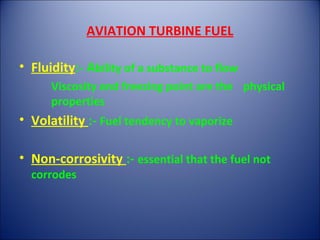
AVIATION TURBINE FUEL
• Fluidity:- Ability of a substance to flow
Viscosity and freezing point are the physical
properties
• Volatility :- Fuel tendency to vaporize
• Non-corrosivity :- essential that the fuel not
corrodes
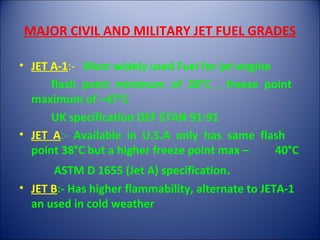
MAJOR CIVIL AND MILITARY JET FUEL GRADES
• JET A-1:- Most widely used Fuel for jet engine
flash point minimum of 38°C , freeze point
maximum of –47°C
UK specification DEF STAN 91-91
• JET A:- Available in U.S.A only has same flash
point 38°C but a higher freeze point max – 40°C
ASTM D 1655 (Jet A) specification.
• JET B:- Has higher flammability, alternate to JETA-1
an used in cold weather
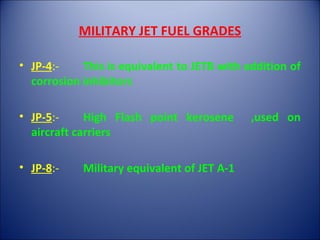
MILITARY JET FUEL GRADES
• JP-4:- This is equivalent to JETB with addition of
corrosion inhibitors
• JP-5:- High Flash point kerosene ,used on
aircraft carriers
• JP-8:- Military equivalent of JET A-1
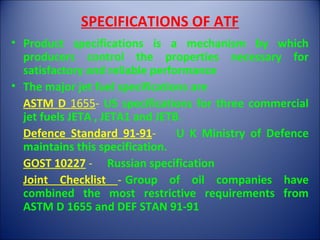
SPECIFICATIONS OF ATF
• Product specifications is a mechanism by which
producers control the properties necessary for
satisfactory and reliable performance
• The major jet fuel specifications are
ASTM D 1655- US specifications for three commercial
jet fuels JETA , JETA1 and JETB.
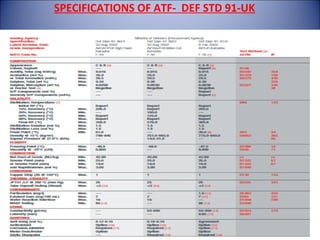
Defence Standard 91-91- U K Ministry of Defence
maintains this specification.
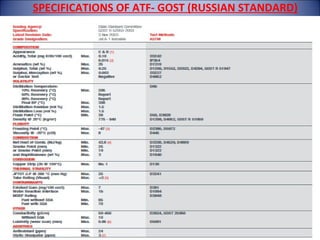
GOST 10227 - Russian specification
Joint Checklist - Group of oil companies have
combined the most restrictive requirements from
ASTM D 1655 and DEF STAN 91-91
SPECIFICATIONS OF ATF
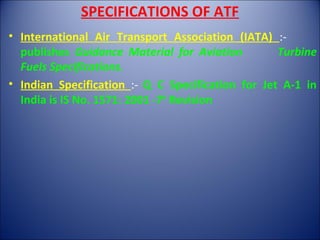
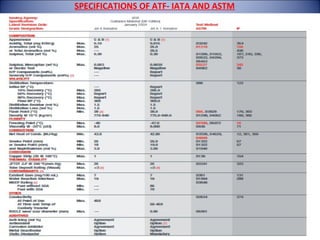
• International Air Transport Association (IATA) :-
publishes Guidance Material for Aviation Turbine
Fuels Specifications.
• Indian Specification :- Q C Specification for Jet A-1 in
India is IS No. 1571: 2001 -7th
Revision
SPECIFICATIONS OF ATF- IATA AND ASTM
SPECIFICATIONS OF ATF- GOST (RUSSIAN STANDARD)
SPECIFICATIONS OF ATF- DEF STD 91-UK
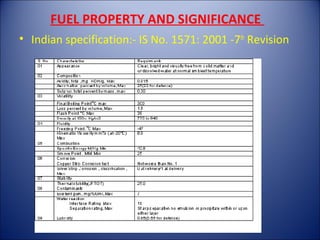
FUEL PROPERTY AND SIGNIFICANCE
• Indian specification:- IS No. 1571: 2001 -7th
Revision
FUEL CONTAMINATION
• Every transfer of ATF from refinery to aircraft occurs,
there is potential for contamination of the fuel
• Particulate matter and water are the most common
fuel contaminants
• WHY FUEL CONTAMINATION CRITICAL
Aero Engine fuel system has very precision
calibrated orifice/ fuel atomizer as components fuel
burners. The contamination in ATF will affect stable
engine operation
ATF FUEL CONTAMINATION
• Fuel Contamination occurs due to fuel transfers from
refinery to Bulk Petroleum Installation.
• Each time fuel transfer potential chance of fuel
contamination.
• Particulate matter and water are the most common
fuel contaminants.
• Particulate Matter
- Dominant source is solid corrosion
- Airborne suspended particles
- Solids from microbial infestation
- Refinery processing materials ( Catalyst fine)
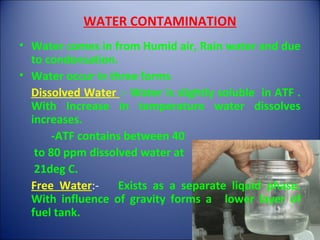
WATER CONTAMINATION
• Water comes in from Humid air, Rain water and due
to condensation.
• Water occur in three forms
Dissolved Water :- Water is slightly soluble in ATF .
With Increase in temperature water dissolves
increases.
-ATF contains between 40
to 80 ppm dissolved water at
21deg C.
Free Water:- Exists as a separate liquid phase.
With influence of gravity forms a lower layer of
fuel tank.
PARTICULATE CONTAMINATION
• Surfactants:- polar organic compounds can stabilize a
fuel water emulsion by reducing the interfacial
tension.
• Microbes:- Micro organism found in fuels includes
bacteria and fungi. Solids formed by bio growth are
very effective at plugging fuel filters.
PRESENT QUALITY CHECKS ON ATF IN FEILDS
• Visual Checks:- To check visually ATF sample is “clear
and Bright” and also for any trace of sediments .
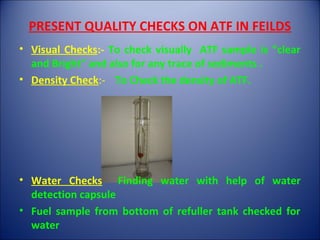
• Density Check:- To Check the density of ATF.
• Water Checks Finding water with help of water
detection capsule
• Fuel sample from bottom of refuller tank checked for
water
THANK YOU

Aviation turbine fuel

  • 1.
  • 2.
    WILL BE COVEREDIN FOLLOWING HEADS • INTRODUCTION • AVIATION TURBINE FUEL (ATF) • FUEL CONTAMINATION • PRESENT QUALITY CHECKS ON ATF CAN BE CARRIED IN FEILD AVIATION TURBINE FUEL (ATF)
  • 3.
    • ATF isspecialized type of petroleum based fuel • ATF source of energy and powers most of modern generation aero engine/ jet engine aircrafts IMPORTANCE OF ATF • Aero engine has to function within pre determined parameters within specified altitude and flight speed range. Hence Fuel Has To Be Of Consistent Quality and airworthy • ATF acts hydraulic and lubricating medium for fuel equipments WHAT IS AVIATION TURBINE FUEL ?
  • 4.
    AVIATION TURBINE FUELPROPERTIES • IMPORTANT PERFORMANCE PROPERTIES OF ATF • Energy content :- predicted by fuel density • Combustion Characteristics:- combustion is continuous in a jet engine • Stability :- Whose properties remain unchanged Storage Stability Thermal stability • Lubricity :- Lubricity is the ability to reduce friction between solid surface
  • 5.
    AVIATION TURBINE FUEL •Fluidity:- Ability of a substance to flow Viscosity and freezing point are the physical properties • Volatility :- Fuel tendency to vaporize • Non-corrosivity :- essential that the fuel not corrodes
  • 6.
    MAJOR CIVIL ANDMILITARY JET FUEL GRADES • JET A-1:- Most widely used Fuel for jet engine flash point minimum of 38°C , freeze point maximum of –47°C UK specification DEF STAN 91-91 • JET A:- Available in U.S.A only has same flash point 38°C but a higher freeze point max – 40°C ASTM D 1655 (Jet A) specification. • JET B:- Has higher flammability, alternate to JETA-1 an used in cold weather
  • 7.
    MILITARY JET FUELGRADES • JP-4:- This is equivalent to JETB with addition of corrosion inhibitors • JP-5:- High Flash point kerosene ,used on aircraft carriers • JP-8:- Military equivalent of JET A-1
  • 8.
    SPECIFICATIONS OF ATF •Product specifications is a mechanism by which producers control the properties necessary for satisfactory and reliable performance • The major jet fuel specifications are ASTM D 1655- US specifications for three commercial jet fuels JETA , JETA1 and JETB. Defence Standard 91-91- U K Ministry of Defence maintains this specification. GOST 10227 - Russian specification Joint Checklist - Group of oil companies have combined the most restrictive requirements from ASTM D 1655 and DEF STAN 91-91
  • 9.
    SPECIFICATIONS OF ATF •International Air Transport Association (IATA) :- publishes Guidance Material for Aviation Turbine Fuels Specifications. • Indian Specification :- Q C Specification for Jet A-1 in India is IS No. 1571: 2001 -7th Revision
  • 10.
  • 11.
    SPECIFICATIONS OF ATF-GOST (RUSSIAN STANDARD)
  • 12.
  • 13.
    FUEL PROPERTY ANDSIGNIFICANCE • Indian specification:- IS No. 1571: 2001 -7th Revision
  • 14.
    FUEL CONTAMINATION • Everytransfer of ATF from refinery to aircraft occurs, there is potential for contamination of the fuel • Particulate matter and water are the most common fuel contaminants • WHY FUEL CONTAMINATION CRITICAL Aero Engine fuel system has very precision calibrated orifice/ fuel atomizer as components fuel burners. The contamination in ATF will affect stable engine operation
  • 15.
    ATF FUEL CONTAMINATION •Fuel Contamination occurs due to fuel transfers from refinery to Bulk Petroleum Installation. • Each time fuel transfer potential chance of fuel contamination. • Particulate matter and water are the most common fuel contaminants. • Particulate Matter - Dominant source is solid corrosion - Airborne suspended particles - Solids from microbial infestation - Refinery processing materials ( Catalyst fine)
  • 16.
    WATER CONTAMINATION • Watercomes in from Humid air, Rain water and due to condensation. • Water occur in three forms Dissolved Water :- Water is slightly soluble in ATF . With Increase in temperature water dissolves increases. -ATF contains between 40 to 80 ppm dissolved water at 21deg C. Free Water:- Exists as a separate liquid phase. With influence of gravity forms a lower layer of fuel tank.
  • 17.
    PARTICULATE CONTAMINATION • Surfactants:-polar organic compounds can stabilize a fuel water emulsion by reducing the interfacial tension. • Microbes:- Micro organism found in fuels includes bacteria and fungi. Solids formed by bio growth are very effective at plugging fuel filters.
  • 18.
    PRESENT QUALITY CHECKSON ATF IN FEILDS • Visual Checks:- To check visually ATF sample is “clear and Bright” and also for any trace of sediments . • Density Check:- To Check the density of ATF. • Water Checks Finding water with help of water detection capsule • Fuel sample from bottom of refuller tank checked for water
  • 19.