V I S V E S AVA R AYA T E C H N O LO G I C A L U N I V E R S I T Y, B E L A G AV I
Te c h n i c a l S e m i n a r O n
G R E E N E N G I N E
S u b m i t t e d B y : -
S h a n u C h o u d h a r y
( 1 j s 1 4 m e 0 8 7 )
G u i d e d B y
P r o f . J . S . S r i k a n t a M u r t h y
J S S A C A D E M Y O F T E C H N I C A L E D U C AT I O N , B E N G A L U R U – 5 6 0 0 6 0
D E PA R T M E N T O F M E C H A N I C A L E N G I N E E R I N G
CONTENTS
Introduction
Need To Invent
Principle and construction of green engine
Working of green engine
Technical features
Advantages & Disadvantages
Comparison of Green Engine with conventional engines
Application
Conclusion
References
INTRODUCTION
The green engine is one of the most interesting discoveries of the new millennium.
The efficiency of the engine is high when compared to the contemporary engine
and also the exhaust emissions are zero.
Compared to conventional piston engine operated on four phases, the Green
Engine is an actual six-phase internal combustion engine with much higher
expansion ratio.
 In green engine the priority is given to the complete mixing of fuel with the air
thereby causing its complete burning.
NEED TO INVENT
 Today, the world is facing serious pollution crisis due to the exhaust gases from vehicles
using petroleum-based fuel.
 The pollutants like HC, NOx occurs due to the incomplete combustion of fuel. These
pollutants are very harmful to human being causing various diseases.
 The “IEA Oil Market Report” forecasts worldwide average demand of nearly 96 million
barrels of oil and liquid fuels per day – that works out to more than 35 billion barrels a year,
of which about 50 per cent is used in communications and transportation.
 The world has 53.3 years left to find an alternative to oil before current proved reserves run
dry, according to “British Petroleum”.
 To counter this problem, the concept of green engine is introduced.
 Pollution is minimized by green engine.
 It is a multifuel engine; therefore the fuel crisis can also be overcome.
PRINCIPLE AND CONSTRUCTION OF
GREEN ENGINE
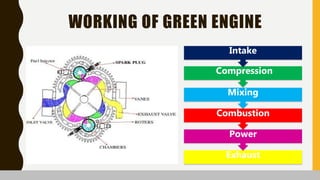
Due to six phase of working principle the priority is given to the complete mixing of fuel
with the air thereby causing its complete burning.
The six phases are INTAKE, COMPRESSION, MIXING, COMBUSTION, POWER AND
EXAUST.
It consist of :-
– A pair of rotors
– A set of vanes
– Two air intake ports
– Two spark plugs
– Two fuel injectors
Exhaust
Power
Combustion
Mixing
Compression
Intake
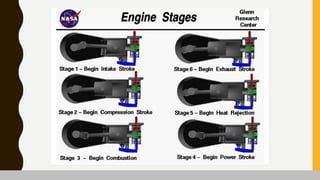
WORKING OF GREEN ENGINE
1. INTAKE
• The air is admitted directly inside the compression chamber.
• The air does not undergo any treatment before entry.
• The air filter is directly connected to the entry of the intake pipe.
• The amount of the air intake can be varied as per the fuel used.
• A duct is provided on the side walls of the vanes and rotors. When air moves through
duct strong swirls generates.
• Air pushes the vane blade ,imparts rotation in the small rotors.
• The inlet duct ends with very narrow opening to the chamber.
2. COMPRESSION
• The air admitted in, then enters into the compression chamber.
• The compression chamber has variable area.
• The central disc having arms pushes the air in the compression chamber.
• The compression chamber is connected to the combustion chamber by a small
diameter duct which is tangent to the combustion chamber.
• So as arm pushes the air in the compression chamber the pressurized air is forced to
flow through this duct.
• As the air flow through it, the air is swirled very fast. The air thus enters the
combustion chamber.
3. MIXING
• As the chamber comes in front of the fuel injector, the injector sprays fuel into
compressed air .
• The fuel mixes well with compressed air.
• Proper mixing leads to cut CO emissions.
• The Mixing phase has enough time to produce an ideal air-fuel mixture as the spark
plug is positioned towards the other end of the rotor.
• The mixing assures the complete burning of the fuel.
• The super mixed charge is forced by the arm towards the spark plug.
4. COMBUSTION
• The charge is ignited by the spark plug.
• The combustion time can be varied to burn different grade of fuels.
• The controlled combustion time gives the complete burning of the charge.
• The emissions are greatly reduced.
5. POWER
• The burned products of the combustion are expelled out of the combustion chamber.
• The high pressure gases push the arm of the compression chamber causing work
output.
• The Sudden increase in volume ensure that more power is released or in other words,
the thermal energy is fully utilized.
• The power is obtained in the form of the power pulses.
• These pulses reduce the area of the engine.
• The power pulses also reduce the explosion noise.
6. EXHAUST
• The burned gases are expelled out.
• The gases are first expanded in the expansion zone.
• The expansion ratio is more which ensures the maximum work output. Also the
maximum energy is gained from the gases.
• The temperature also reduces and hence an optimum utilization of the burned gases is
achieved.
• The burned gases after expansion are pushed into the exhaust pipe and released into
the atmosphere. Thus the six-phase cycle is completed.
TECHNICAL FEATURES
Direct Air Intake
Strong Swirling
Direct Fuel Injection
Lowest Surface to Volume Ratio
Controllable Combustion Time
High Working Temperature
High Expansion Ratio
Self-adapting Sealing System
Multi-power Pulses
Super Air-Fuel Mixing
ADVANTAGES
As Green Engine is very compact with multi-power pulses, the Size and Weight
could be only 1/5 to 1/10 of the conventional piston engines on same output.
The Thermal Efficiency of the Green Engine could be potentially as high as 65%,
even more if water add-in technology is to be considered.
Due to Six Phases of Working Principle, Super Air-fuel Mixing Process and Constant
Volume Combustion with Controllable Time the Green Engine becomes the only real
Multi-Fuels Engine on our planet; any liquid or gas fuels can be burned well.
With perfectly air-fuel mixture, complete combustion under lower peak temperature
and free of quenching effect, the Emissions of CO, HC and NOx could be near zero.
Due to inherence of good dynamic and static balance the performance of the Green
Engine is as smooth.
Limited parts, small in size, light in weight it means that it would be on the much
lower cost.
DISADVANTAGES
Not readily available
Still in experimental stages
Variation in smoke capacity
COMPARISON OF GREEN ENGINE
WITH CONVENTIONAL ENGINES
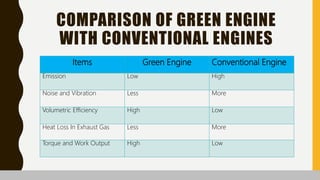
Items Green Engine Conventional Engine
Emission Low High
Noise and Vibration Less More
Volumetric Efficiency High Low
Heat Loss In Exhaust Gas Less More
Torque and Work Output High Low
APPLICATIONS
The Green Engines could be used as the ideal power plants on a very wide range of
applications in:-
 Transportation & Communication
 Farm
 Mine
 Engineering
 Military uses
 Aircrafts
 Submarines
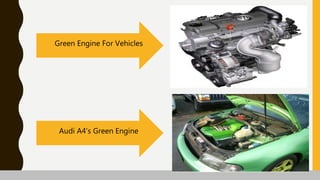
Green Engine For Vehicles
Audi A4’s Green Engine
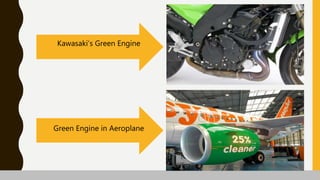
Kawasaki’s Green Engine
Green Engine in Aeroplane
CONCLUSION
The environmental problems can be effectively overcome by the use of Green
engine.
It can use almost any type of fuel available.
It is superior to the conventional I.C. engine in terms of smooth operation, efficiency
and cost.
 Compared to conventional piston engine operated on four phases, the Green
Engine is an actual six-phase internal combustion engine with much higher
expansion ratio.
Already it is being used in some of the application like aircrafts, ships and
locomotives. Research is going on for its effective use in wider range of transport
vehicles
REFERENCES
• International Research Journal of Engineering and Technology (IRJET) e-ISSN: 2395 -
0056 Volume: 03 Issue: 09 | Sep-2016 www.irjet.net p-ISSN: 2395-0072.
• M. Mofijur, M.G. Rasul, J. Hyde “Recent Developments on Internal Combustion Engine
Performance and Emissions Fuelled With Biodiesel-Diesel-Ethanol Blends”6th BSME
International Conference on Thermal Engineering (ICTE 2014).
• 3rd International Conference On Science, Technology and Management. Indian
International Centre, New Delhi. January-2016, www.conferenceworld.in
• T. Bohl & G. Tian “Optical investigation on diesel engine fuelled by vegetable oils” The
6th International Conference on Applied Energy – ICAE2014.
• Internal combustion engine- Mathur & Sharma. pp.1213 to1250.
• IEA - Oil Market Report.
• British Petroleum Statistical Review 2017
Green engine ppt

Green engine ppt

  • 1.
    V I SV E S AVA R AYA T E C H N O LO G I C A L U N I V E R S I T Y, B E L A G AV I Te c h n i c a l S e m i n a r O n G R E E N E N G I N E S u b m i t t e d B y : - S h a n u C h o u d h a r y ( 1 j s 1 4 m e 0 8 7 ) G u i d e d B y P r o f . J . S . S r i k a n t a M u r t h y J S S A C A D E M Y O F T E C H N I C A L E D U C AT I O N , B E N G A L U R U – 5 6 0 0 6 0 D E PA R T M E N T O F M E C H A N I C A L E N G I N E E R I N G
  • 2.
    CONTENTS Introduction Need To Invent Principleand construction of green engine Working of green engine Technical features Advantages & Disadvantages Comparison of Green Engine with conventional engines Application Conclusion References
  • 3.
    INTRODUCTION The green engineis one of the most interesting discoveries of the new millennium. The efficiency of the engine is high when compared to the contemporary engine and also the exhaust emissions are zero. Compared to conventional piston engine operated on four phases, the Green Engine is an actual six-phase internal combustion engine with much higher expansion ratio.  In green engine the priority is given to the complete mixing of fuel with the air thereby causing its complete burning.
  • 4.
    NEED TO INVENT Today, the world is facing serious pollution crisis due to the exhaust gases from vehicles using petroleum-based fuel.  The pollutants like HC, NOx occurs due to the incomplete combustion of fuel. These pollutants are very harmful to human being causing various diseases.  The “IEA Oil Market Report” forecasts worldwide average demand of nearly 96 million barrels of oil and liquid fuels per day – that works out to more than 35 billion barrels a year, of which about 50 per cent is used in communications and transportation.  The world has 53.3 years left to find an alternative to oil before current proved reserves run dry, according to “British Petroleum”.  To counter this problem, the concept of green engine is introduced.  Pollution is minimized by green engine.  It is a multifuel engine; therefore the fuel crisis can also be overcome.
  • 5.
    PRINCIPLE AND CONSTRUCTIONOF GREEN ENGINE Due to six phase of working principle the priority is given to the complete mixing of fuel with the air thereby causing its complete burning. The six phases are INTAKE, COMPRESSION, MIXING, COMBUSTION, POWER AND EXAUST. It consist of :- – A pair of rotors – A set of vanes – Two air intake ports – Two spark plugs – Two fuel injectors
  • 6.
  • 8.
    1. INTAKE • Theair is admitted directly inside the compression chamber. • The air does not undergo any treatment before entry. • The air filter is directly connected to the entry of the intake pipe. • The amount of the air intake can be varied as per the fuel used. • A duct is provided on the side walls of the vanes and rotors. When air moves through duct strong swirls generates. • Air pushes the vane blade ,imparts rotation in the small rotors. • The inlet duct ends with very narrow opening to the chamber.
  • 9.
    2. COMPRESSION • Theair admitted in, then enters into the compression chamber. • The compression chamber has variable area. • The central disc having arms pushes the air in the compression chamber. • The compression chamber is connected to the combustion chamber by a small diameter duct which is tangent to the combustion chamber. • So as arm pushes the air in the compression chamber the pressurized air is forced to flow through this duct. • As the air flow through it, the air is swirled very fast. The air thus enters the combustion chamber.
  • 10.
    3. MIXING • Asthe chamber comes in front of the fuel injector, the injector sprays fuel into compressed air . • The fuel mixes well with compressed air. • Proper mixing leads to cut CO emissions. • The Mixing phase has enough time to produce an ideal air-fuel mixture as the spark plug is positioned towards the other end of the rotor. • The mixing assures the complete burning of the fuel. • The super mixed charge is forced by the arm towards the spark plug.
  • 11.
    4. COMBUSTION • Thecharge is ignited by the spark plug. • The combustion time can be varied to burn different grade of fuels. • The controlled combustion time gives the complete burning of the charge. • The emissions are greatly reduced.
  • 12.
    5. POWER • Theburned products of the combustion are expelled out of the combustion chamber. • The high pressure gases push the arm of the compression chamber causing work output. • The Sudden increase in volume ensure that more power is released or in other words, the thermal energy is fully utilized. • The power is obtained in the form of the power pulses. • These pulses reduce the area of the engine. • The power pulses also reduce the explosion noise.
  • 13.
    6. EXHAUST • Theburned gases are expelled out. • The gases are first expanded in the expansion zone. • The expansion ratio is more which ensures the maximum work output. Also the maximum energy is gained from the gases. • The temperature also reduces and hence an optimum utilization of the burned gases is achieved. • The burned gases after expansion are pushed into the exhaust pipe and released into the atmosphere. Thus the six-phase cycle is completed.
  • 14.
    TECHNICAL FEATURES Direct AirIntake Strong Swirling Direct Fuel Injection Lowest Surface to Volume Ratio Controllable Combustion Time High Working Temperature High Expansion Ratio Self-adapting Sealing System Multi-power Pulses Super Air-Fuel Mixing
  • 15.
    ADVANTAGES As Green Engineis very compact with multi-power pulses, the Size and Weight could be only 1/5 to 1/10 of the conventional piston engines on same output. The Thermal Efficiency of the Green Engine could be potentially as high as 65%, even more if water add-in technology is to be considered. Due to Six Phases of Working Principle, Super Air-fuel Mixing Process and Constant Volume Combustion with Controllable Time the Green Engine becomes the only real Multi-Fuels Engine on our planet; any liquid or gas fuels can be burned well. With perfectly air-fuel mixture, complete combustion under lower peak temperature and free of quenching effect, the Emissions of CO, HC and NOx could be near zero. Due to inherence of good dynamic and static balance the performance of the Green Engine is as smooth. Limited parts, small in size, light in weight it means that it would be on the much lower cost.
  • 16.
    DISADVANTAGES Not readily available Stillin experimental stages Variation in smoke capacity
  • 17.
    COMPARISON OF GREENENGINE WITH CONVENTIONAL ENGINES Items Green Engine Conventional Engine Emission Low High Noise and Vibration Less More Volumetric Efficiency High Low Heat Loss In Exhaust Gas Less More Torque and Work Output High Low
  • 18.
    APPLICATIONS The Green Enginescould be used as the ideal power plants on a very wide range of applications in:-  Transportation & Communication  Farm  Mine  Engineering  Military uses  Aircrafts  Submarines
  • 19.
    Green Engine ForVehicles Audi A4’s Green Engine
  • 20.
  • 21.
    CONCLUSION The environmental problemscan be effectively overcome by the use of Green engine. It can use almost any type of fuel available. It is superior to the conventional I.C. engine in terms of smooth operation, efficiency and cost.  Compared to conventional piston engine operated on four phases, the Green Engine is an actual six-phase internal combustion engine with much higher expansion ratio. Already it is being used in some of the application like aircrafts, ships and locomotives. Research is going on for its effective use in wider range of transport vehicles
  • 22.
    REFERENCES • International ResearchJournal of Engineering and Technology (IRJET) e-ISSN: 2395 - 0056 Volume: 03 Issue: 09 | Sep-2016 www.irjet.net p-ISSN: 2395-0072. • M. Mofijur, M.G. Rasul, J. Hyde “Recent Developments on Internal Combustion Engine Performance and Emissions Fuelled With Biodiesel-Diesel-Ethanol Blends”6th BSME International Conference on Thermal Engineering (ICTE 2014). • 3rd International Conference On Science, Technology and Management. Indian International Centre, New Delhi. January-2016, www.conferenceworld.in • T. Bohl & G. Tian “Optical investigation on diesel engine fuelled by vegetable oils” The 6th International Conference on Applied Energy – ICAE2014. • Internal combustion engine- Mathur & Sharma. pp.1213 to1250. • IEA - Oil Market Report. • British Petroleum Statistical Review 2017