The International Journal of Engineering And Science (IJES)
||Volume|| 1 ||Issue|| 2 ||Pages|| 318-323 ||2012||
ISSN: 2319 – 1813 ISBN: 2319 – 1805
   Content Based Retrieval in Unstructured P2P Overlay Networks
                                     1
                                         Yoha Lakshmi.M, 2Priya Ponnusamy.P
  1
  Department of Computer Science, Sri Shakthi Institute of Engineering and Technology, Coimbatore, India
 2
  Assistant professor, Department of Computer Science, Sri Shakthi Institute of Engineering and Technology,
                                             Coimbatore, India


------------------------------------------------------------ABSTRACT---------------------------------------------------------------------
The emergence of peer to peer (P2P) file sharing has led millions of users to search their desired data’s easily.
Napster and Gnutella are the two major applications in the P2P network. P2P network stands among one of
the best and popular network tool. Sharing of contents by the user through internet has become easier through
this. Bloom Cast is an efficient technique used for full-text retrieval scheme in unstructured P2P networks. By
using the fullest of a hybrid P2P protocol, Bloom Cast makes copies of the contents in the network uniformly at
a random across the P2P networks in order to achieve a guaranteed recall at a communication cost of the
network. Bloom Cast model works only when the two constraints are met: 1) the query replicas and document
replicas are randomly and uniformly distributed across the P2P network; and 2) every peer knows N, the size
of the network. To support random node sampling and network size estimation, Bloom Cast mixes a
lightweight DHT into an unstructured P2P network. Further to reduce the replication cost, Bloom Cast utilizes
Bloom Filters to encode the entire document. Bloom Cast hybridizes a lightweight DHT with an unstructured
P2P overlay to support random node sampling and network size estimation. Since P2P networks are self-
configuring networks with minimal or no central control, P2P networks are more vulnerable to malwares,
malicious code, viruses, etc., than the traditional client -server networks, due to their lack of structure and
unmanaged nature. All peers in a P2P network is identified by its identity certi ficates (aka identity). The
identity here is attached to the repudiation of a given peer. Self-certification helps us to generate the identity
certificate, thus here all the peers maintain their own and hence trusted certificate authority which issues the
identity certificate to the peer.

Keywords - aka identity, Bloom Cast, Bloom Filters, Self-Certification, Self-Configuring Networks,
Unstructured P2P network
------------------------------------------------------------------------------------------------------------------------------------------------------
Date of Submission: 15, December, 2012                                                  Date of Publication: 30, December 2012
------------------------------------------------------------------------------------------------------------------------------------------------------
                    I. INTRODUCTION                                           capability issues Cohen studies how replication
         hen compared to the structured networks,                             techniques can be used to improve search in

W        searching process in unstructured networks are
         considered to be more challenging because of unstructured P2P networks. Objects are replicated
the lack of global routing guarantees provided by the                         based on their access frequencies.
overlay. More importantly, they are simple to
implement and it provide virtually no overhead in                                         Current P2P search mechanisms can be
topology maintenance. Even though, many real-world                            classified into three major types. First, at the server
large-scale peer-to-peer networks are constructed as                          side a centralized index is maintained, and all queries
unstructured.                                                                 are directed to the server.
            There are some typical unstructured P2P
networks such as Gnutella, in which the peer                                              Second, the query will be flooded across the
searching is done by flooding a (hop) limited                                 network to other peers then the query node will
neighborhood. But this simple method does not                                 broadcast the query to its neighboring nodes who will
provide any guarantee that an object that is exists in                        then broadcast to their neighbors, and so on. Such an
the peers in the network which is required. Flooding                          approach will lead to poor network utilization.
does not scale well in terms of message overhead,
since each query may generate a significant amount of                                     Third approach is the Distributed Hash Table
traffic. To solve this completeness and to test the                           (DHT) based scheme where the Peers and data are
                                                                              structurally organized so that the location of a data


www.theijes.com                                                       The IJES                                                          Page 31 8
Content Based Retrieval in Unstructured P2P Overlay Networks
can be determined by a hash function. Chord is an                    A pure P2P network does not have the notion
example that uses a DHT-based scheme.                      of clients or servers but only equal peer nodes that
                                                           simultaneously function as both "clients" and
                                                           "servers" to the other nodes on the network. The
                                                           network arrangement of this model differs from the
                                                           client–server model. Here the communication is from
                                                           and to the central server. File Transfer Protocol (FTP)
                                                           is a typical example of a file transfer that does not use
                                                           the P2P model. Here the client and server programs are
                                                           distinct: the clients initiate the transfer, and the
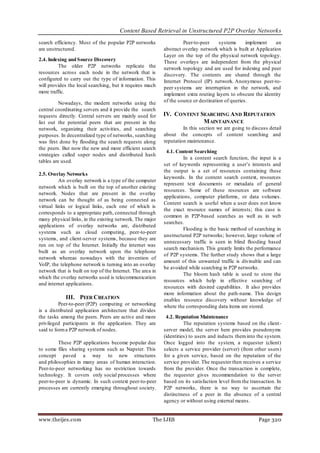
         Fig.1 DHT (Distributed hash Table)                servers fulfill these requests.
                                                                     The P2P overlay network consists of all the
          A distributed hash table (DHT) is a class of a   participating peers as network nodes. If there exists a
decentralized distributed system that provides a           link between any two nodes that know each other: i.e.
lookup service similar to a hash table; (key, value)       if a peer knows the location of another peer in a P2P
pairs are stored in a DHT, and any participating node      network, then there forms a directed edge between the
can efficiently retrieve the value associated with a       former node and the latter in the overlay network.
given key. Responsibility for maintaining the mapping      Based on the linking between the various nodes in the
from keys to values is distributed among the nodes, in     overlay network, we can classify the P2P networks as
such a way that a change in the set of participants        structured or unstructured.
causes a minimal amount of disruption. This allows a
DHT to scale to extremely large numbers of nodes and       2.2. Searching In Structured Networks
to handle continual node arrivals, departures, and                   Structured P2P networks employ a globally
failures.                                                  consistent protocol to ensure that any node can
                                                           efficiently route a search to some peer that has the
         DHT based P2P systems have several                desired resource or data, even if it a rare one. But this
advantages such as it is scalable, robust and efficient.   process needs more structured pattern overlay links.
As a result, DHT has become a general infrastructure       The most commonly seen structured P2P network is to
for building many P2P distributed applications.            implement a distributed hash table (DHT), in which
Applications such as content delivery, exchange of         deviating of hashing is used to assign ownership of
physical goods, services or spaces, networking,            files to that particular peer. It is not similar to the
science and searches adds more advantage to DHT.           traditional hash table assignment in which in a for a
                                                           particular array slots a separate key is assigned. The
          Here we use bloom filters, which is a hash       term DHT is generally used to refer the structured
based data structure used to reduce the amount of          overlay, but DHT is a data structure that is
communication required. It has more benefit that it        implemented on top of a structured overlay.
compares the keyword with the entire match list and        2.3. Searching In Unstructured Networks
found the exact match of the keyword. Here we can                     Unstructured P2P networks are formed when
easily find the locality of the document where it is       the overlay links are established randomly. The
actually present. We can search the content with less      networks here can be easily constructed by copying
amount of time.                                            existing links of another node and then form its own
                                                           links over a time. In an unstructured P2P network, if a
         This allows to achieve higher lookup              peer wants to find out a desired data in the network,
performance for a given memory bandwidth, without          the query is flooded through the network which finds
requiring large amounts of buffering in front of the       many peers that share their data. The major
lookup engine.                                             disadvantage here is that the queries may not be
                                                           resolved frequently. If there exists popular content
             II. RELATED WORKS                             then the available peers and any peer searching for it
         The content retrieval scheme is an important      is likely to find the same thing. In cases where a peer is
issue in the distributed P2P information sharing           looking for rare data shared by only a few peers, then
systems. There are two content searching schemes in        it is highly improbable that search will be successful.
the existing P2P systems. For a structured P2P             Since the peer and the content management are
networks it is DHT-based distributed global inverted       independent of each other, there is no assurance that
index, for unstructured P2P networks we use federated      flooding will find a peer that has the desired data.
search engines.                                            Flooding causes a high amount of signaling traffic in
2.1. Pure P2p Systems                                      the network. These networks typically have very poor


www.theijes.com                                       The IJES                                            Page 31 9
Content Based Retrieval in Unstructured P2P Overlay Networks
search efficiency. Most of the popular P2P networks                  Peer-to-peer     systems      implement    an
are unstructured.                                           abstract overlay network which is built at Application
                                                            Layer on the top of the physical network topology.
2.4. Indexing and Source Discovery                          These overlays are independent from the physical
         The older P2P networks replicate the               network topology and are used for indexing and peer
resources across each node in the network that is           discovery. The contents are shared through the
configured to carry out the type of information. This       Internet Protocol (IP) network. Anonymous peer-to-
will provides the local searching, but it requires much     peer systems are interruption in the network, and
more traffic.                                               implement extra routing layers to obscure the identity
          Nowadays, the modern networks using the           of the source or destination of queries.
central coordinating servers and it provide the search
requests directly. Central servers are mainly used for      IV. CONTENT SEARCHING AND REPUTATION
list out the potential peers that are present in the                     M AINTAINANCE
network, organizing their activities, and searching                  In this section we are going to discuss detail
purposes. In decentralized type of networks, searching      about the concepts of content searching and
was first done by flooding the search requests along        reputation maintenance.
the peers. But now the new and more efficient search
                                                             4.1. Content Searching
strategies called super nodes and distributed hash
                                                                     In a content search function, the input is a
tables are used.
                                                            set of keywords representing a user‟s interests and
                                                            the output is a set of resources containing these
2.5. Overlay Networks
                                                            keywords. In the content search context, resources
          An overlay network is a type of the computer
                                                            represent text documents or metadata of general
network which is built on the top of another existing
                                                            resources. Some of these resources are software
network. Nodes that are present in the overlay
                                                            applications, computer platforms, or data volumes.
network can be thought of as being connected as
                                                            Content search is useful when a user does not know
virtual links or logical links, each one of which is
                                                            the exact resource names of interests; this case is
corresponds to a appropriate path, connected through
                                                            common in P2P-based searches as well as in web
many physical links, in the existing network. The major
                                                            searches.
applications of overlay networks are, distributed
                                                                     Flooding is the basic method of searching in
systems such as cloud computing, peer-to-peer
                                                            unstructured P2P networks; however, large volume of
systems, and client-server systems, because they are
                                                            unnecessary traffic is seen in blind flooding based
run on top of the Internet. Initially the internet was
                                                            search mechanism. This greatly limits the performance
built as an overlay network upon the telephone
                                                            of P2P systems. The further study shows that a large
network whereas nowadays with the invention of
                                                            amount of this unwanted traffic is divinable and can
VoIP, the telephone network is turning into an overlay
                                                            be avoided while searching in P2P networks.
network that is built on top of the Internet. The area in
                                                                     The bloom hash table is used to store the
which the overlay networks used is telecommunication
                                                            resources which help in effective searching of
and internet applications.
                                                            resources with desired capabilities. It also provides
                                                            more information about the path-name. This design
             III. PEER CREATION                             enables resource discovery without knowledge of
          Peer-to-peer (P2P) computing or networking        where the corresponding data items are stored.
is a distributed application architecture that divides
the tasks among the peers. Peers are active and more         4.2. Reputation Maintenance
privileged participants in the application. They are                  The reputation systems based on the client-
said to form a P2P network of nodes.                        server model, the server here provides pseudonyms
                                                            (identities) to users and inducts them into the system.
         These P2P applications become popular due          Once logged into the system, a requester (client)
to some files sharing systems such as Napster. This         selects a service provider (server) (from other users)
concept paved a way to new structures                       for a given service, based on the reputation of the
and philosophies in many areas of human interaction.        service provider. The requester then receives a service
Peer-to-peer networking has no restriction towards          from the provider. Once the transaction is complete,
technology. It covers only social processes where           the requester gives recommendation to the server
peer-to-peer is dynamic. In such context peer-to-peer       based on its satisfaction level from the transaction. In
processes are currently emerging throughout society.        P2P networks, there is no way to ascertain the
                                                            distinctness of a peer in the absence of a central
                                                            agency or without using external means.


www.theijes.com                                        The IJES                                          Page 320
Content Based Retrieval in Unstructured P2P Overlay Networks

                V. B LOOM CAS T                                packet by inserting the corresponding link mask into a
          Bloom Cast is a novel replication strategy to        collector. After this, it performs a bit permutation on
support efficient and effective full-text retrieval.           the collector.
Different from the WP scheme, random node sampling
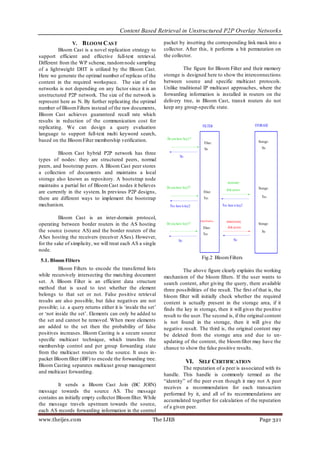
of a lightweight DHT is utilized by the Bloom Cast.                     The figure for Bloom Filter and their memory
Here we generate the optimal number of replicas of the         storage is designed here to show the interconnections
content in the required workspace. The size of the             between source and specific multicast protocols.
networks is not depending on any factor since it is an         Unlike traditional IP multicast approaches, where the
unstructured P2P network. The size of the network is           forwarding information is installed in routers on the
represent here as N. By further replicating the optimal        delivery tree, in Bloom Cast, transit routers do not
number of Bloom Filters instead of the raw documents,          keep any group-specific state.
Bloom Cast achieves guaranteed recall rate which
results in reduction of the communication cost for
replicating. We can design a query evaluation
language to support full-text multi keyword search,
based on the Bloom Filter membership verification.

         Bloom Cast hybrid P2P network has three
types of nodes: they are structured peers, normal
peers, and bootstrap peers. A Bloom Cast peer stores
a collection of documents and maintains a local
storage also known as repository. A bootstrap node
maintains a partial list of Bloom Cast nodes it believes
are currently in the system. In previous P2P designs,
there are different ways to implement the bootstrap
mechanism.

          Bloom Cast is an inter-domain protocol,
operating between border routers in the AS hosting
the source (source AS) and the border routers of the
ASes hosting the receivers (receiver ASes). However,
for the sake of simplicity, we will treat each AS a single
node.
                                                                                  Fig.2 Bloom Filters
 5.1. Bloom Filters
          Bloom Filters to encode the transferred lists                  The above figure clearly explains the working
while recursively intersecting the matching document           mechanism of the bloom filters. If the user wants to
set. A Bloom Filter is an efficient data structure             search content, after giving the query, there available
method that is used to test whether the element                three possibilities of the result. The first of that is, the
belongs to that set or not. False positive retrieval           bloom filter will initially check whether the required
results are also possible, but false negatives are not         content is actually present in the storage area, if it
possible; i.e. a query returns either it is „inside the set‟   finds the key in storage, then it will gives the positive
or „not inside the set‟. Elements can only be added to         result to the user. The second is, if the original content
the set and cannot be removed. When more elements              is not found in the storage, then it will give the
are added to the set then the probability of false             negative result. The third is, the original content may
positives increases. Bloom Casting is a secure source          be deleted from the storage area and due to un-
specific multicast technique, which transfers the              updating of the content, the bloom filter may have the
membership control and per group forwarding state              chance to show the false positive results.
from the multicast routers to the source. It uses in-
packet Bloom filter (iBF) to encode the forwarding tree.
                                                                          VI. SELF CERTIFICATION
Bloom Casting separates multicast group management
                                                                        The reputation of a peer is associated with its
and multicast forwarding.
                                                               handle. This handle is commonly termed as the
                                                               “identity” of the peer even though it may not A peer
         It sends a Bloom Cast Join (BC JOIN)
                                                               receives a recommendation for each transaction
message towards the source AS. The message
                                                               performed by it, and all of its recommendations are
contains an initially empty collector Bloom filter. While
                                                               accumulated together for calculation of the reputation
the message travels upstream towards the source,
                                                               of a given peer.
each AS records forwarding information in the control
www.theijes.com                                           The IJES                                             Page 321
Content Based Retrieval in Unstructured P2P Overlay Networks
                                                             documents across the network. We demonstrate the
            Self-certification obviates the centralized      power of Bloom Cast design through both
 trusted entity needed for issuing identities in a           mathematical proof and comprehensive simulations
 centralized system. Peers using self-certified identities   based on the TREC WT10G data collection and query
 remain pseudononymous in the system as there is no          logs from a real world search engine.
 way to map the identity of a peer in the system to its
 real-life identity.                                                   Peer-to-peer (P2P) networks are self-
                                                             configuring networks with minimal control. P2P
          A malicious peer can use self-certification to     networks are more vulnerable to dissemination of
 generate a large number of identities and thereby           malicious code, viruses, worms, and Trojans than the
 raising the reputation of one of its identities by          traditional client-server networks, due to their
 performing false transactions with other identities.        unregulated and unmanaged nature.
 There is no need for the malicious peer to collude with
 other distinct peers to raise its reputation. It only                  All peers in the P2P network are identified by
 needs to generate a set of identities for itself.           their identity certificates i.e. aka identity. The
                                                             reputation of a given peer is attached to its identity.
           VII. Content Auditing                             The identity certificates are generated using self-
           Peer to peer (P2P) network systems are not        certification, and all peers maintain their own (and
 preferred by content providers due to the occurrence        hence trusted) certificate authority which issues the
 of free-of-charge content sharing in such a model.          identity certificate(s) to the peer.
 This is sometimes referred to as the ""free rider""
 problem. Therefore companies that sell digital content                          REFERENCES
 such as music, video or movies typically rely on            Journal Papers:
 ""direct download"" methods. In direct download,            [1]   D. Li, J. Cao, X. Lu, and K. Chen, “Efficient Range
 users download content either from the vendor's                   Query Processing in Peer-to-Peer Systems,” IEEE
 website directly or via a contracted CDN (content                 Trans. Knowledge and Data Eng., vol. 21, no. 1, pp.
 delivery network). This approach of content                       78-91, Jan. 2008.
 distribution is less efficient and powerful than P2P.       [2]   H. Shen, Y. Shu, and B. Yu, “Efficient Semantic-
 Some P2P systems do require payment before a user                 Based Content Search in P2P Network,” IEEE
 can enter the network. However, once a user has                   Trans. Knowledge and Data Eng.,vol. 16, no. 7, pp.
 access to the content on the network, she may directly            813-826, July 2004.
 share the purchased content with other users on other       [3]   A. Broder and M . M itzenmacher, “Network
 networks, without authorization from the content                  Applications of Bloom Filters: A Survey,” Internet
 provider. Once these users learn of one another and               M ath., vol. 1, no. 4, pp. 485-509, 2004.
 know that they have similar interests, they can easily      [4]   M . Li, W.-C. Lee, A. Sivasubramaniam, and J. Zhao,
 form a private community for free future sharing of               “SSW: A Small-World-Based Overlay for Peer-to-
 similar content. Therefore, regular monitoring and                Peer Search,” IEEE Trans. Parallel and Distributed
 auditing of P2P network is required in maintaining a              Systems, vol. 19, no. 6, pp. 735-749, June 2008.
 paid and secure content distribution.                       [5]   B.H. Bloom, “Space/Time Trade-Offs in Hash
                                                                   Coding with Allowable Errors,” Comm. the ACM ,
          By analysing the results of the bloom hash               vol. 13, no. 7, pp. 422-426, 1971.
 table, we found that this is significantly faster than a    [6]   X. Tang, J. Xu, and W. Lee, “Analysis of TTL-
 normal hash table using the same amount of memory,                Based Consistency in Unstructured Peer-to-Peer
 hence it can support better throughput for router                 Networks,” IEEE Trans. Parallel and Distributed
 applications that use hash tables.                                Systems, vol. 19, no. 12, pp. 1683-1694, Dec. 2008.


VIII. CONCLUS ION AND FUTURE NHANCEMENT
 We here propose an efficient and effective full-text        Proceedings Papers:
 retrieval scheme in an unstructured P2P networks            [1]     R.A. Ferreira, M .K. Ramanathan, A. Awan, A.
 using Bloom Cast method. Bloom Cast is effective here             Grama, and S. Jagannathan, “Search with
 because it guarantees the recall with high probability.           Probabilistic Guarantees in Unstructured Peer-to-
 The overall communication cost of a full-text search is           Peer Networks,” Proc. IEEE Fifth Int‟l Conf. Peer to
 reduced below a formal bound.        Thus it is efficient         Peer Computing (P2P ‟05), pp. 165-172, 2005.
 and effective among other schemes. Furthermore the          [2]    E. Cohen and S. Shenker, “Replication Strategies in
 communication cost for replication is also reduced                Unstructured Peer-to-Peer Networks,” Proc. ACM
 since we replicate Bloom Filters instead of the raw               SIGCOM M ‟02. pp. 177-190, 2002.


 www.theijes.com                                        The IJES                                           Page 322
Content Based Retrieval in Unstructured P2P Overlay Networks
[3]      P. Reynolds and A. Vahdat, “Efficient Peer-to-
       Peer         Keyword         Searching,”      Proc.
       ACM /IFIP/USENIX 2003 Int‟l Conf. M iddleware
       (M iddleware ‟03), pp. 21-40, 2003.
[4]      H. Song, S. Dharmapurikar, J. Turner, and J.
       Lockwood, “Fast Hash Table Lookup Using
       Extended Bloom Filter: An Aid to Network
       Processing,” Proc. ACM SIGCOM M , 2005.
[5]     C. Tang and S. Dwarkadas, “Hybrid Global-Local
       Indexing for Efficient Peer-to-Peer Information
       Retrieval,” Proc. First Conf. Symp. Networked
       Systems Design and Implementation (NSDI ‟04),p.
       16, 2004.
[6]     G.S. M anku, “Routing Networks for Distributed
       Hash Tables,” Proc. ACM 22nd Ann. Symp.
       Principles of Distributed Computing (PODC ‟03),
       pp. 133-142, 2003.
[7]     V. King and J. Saia, “Choosing a Random Peer,”
       Proc. ACM 23rd Ann. Symp. Principles of
       Distributed Computing (PODC ‟04), pp. 125-130,
       2004.
[8]      I. Stoica, R. M orris, D. Karger, M .F. Kaashoek,
       and H.Balakrishnan, “Chord: A Scalable Peer-to-Peer
       Lookup Service for Internet Applications,” Proc.
       ACM SIGCOM M ‟01, pp. 149-160, 2001.
[9]     C. Tang and S. Dwarkadas, “Hybrid Global-Local
       Indexing for Effcient Peer-to-Peer Information
       Retrieval,” Proc. First Conf. Symp. Networked
       Systems Design and Implementation (NSDI ‟04), p.
       16, 2004.
[10]    F.M . Cuenca-Acuna, C. Peery, R.P. M artin, and
       T.D. Nguyen, “Planetp: Using Gossiping to Build
       Content Addressable Peer-to-Peer Information
       Sharing Communities,” Proc. 12th IEEE Int‟l Symp.
       High Performance Distributed Computing (HPDC
       ‟03), pp. 236-246, 2003.
[11]     K. Sripanidkulchai, B. M aggs, and H. Zhang,
       “Efficient Content Location Using Interest-Based
       Locality in Peer-to-Peer Systems,”Proc. IEEE
       INFOCOM ‟03, 2003.
[12]   Y. Chawathe, S. Ratnasamy, L. Breslau, N. Lanham,
       and S. Shenker, “M aking Gnutella-Like P2P Systems
       Scalable,” Proc. ACM SIGCOM M ‟03, pp. 407-
       418, 2003.
[13]   S. Saroiu, P.K. Gummadi, and S.D. Gribble, “A
       M easurement Study of Peer-to-Peer File Sharing
       Systems,” Proc. M ultimedia Computing and
       Networking (M M CN ‟02), pp. 156-170, 2002.
[14]   J.P.C. Jie Lu, “Content-Based Retrieval in Hybrid
       Peer-to-Peer Networks,” Proc. 12th Int‟l Conf.
       Information and Knowledge M anagement (CIKM ),
       pp. 199-206, 2003.


www.theijes.com                                         The IJES                          Page 323

The International Journal of Engineering and Science (IJES)

  • 1.
    The International Journalof Engineering And Science (IJES) ||Volume|| 1 ||Issue|| 2 ||Pages|| 318-323 ||2012|| ISSN: 2319 – 1813 ISBN: 2319 – 1805  Content Based Retrieval in Unstructured P2P Overlay Networks 1 Yoha Lakshmi.M, 2Priya Ponnusamy.P 1 Department of Computer Science, Sri Shakthi Institute of Engineering and Technology, Coimbatore, India 2 Assistant professor, Department of Computer Science, Sri Shakthi Institute of Engineering and Technology, Coimbatore, India ------------------------------------------------------------ABSTRACT--------------------------------------------------------------------- The emergence of peer to peer (P2P) file sharing has led millions of users to search their desired data’s easily. Napster and Gnutella are the two major applications in the P2P network. P2P network stands among one of the best and popular network tool. Sharing of contents by the user through internet has become easier through this. Bloom Cast is an efficient technique used for full-text retrieval scheme in unstructured P2P networks. By using the fullest of a hybrid P2P protocol, Bloom Cast makes copies of the contents in the network uniformly at a random across the P2P networks in order to achieve a guaranteed recall at a communication cost of the network. Bloom Cast model works only when the two constraints are met: 1) the query replicas and document replicas are randomly and uniformly distributed across the P2P network; and 2) every peer knows N, the size of the network. To support random node sampling and network size estimation, Bloom Cast mixes a lightweight DHT into an unstructured P2P network. Further to reduce the replication cost, Bloom Cast utilizes Bloom Filters to encode the entire document. Bloom Cast hybridizes a lightweight DHT with an unstructured P2P overlay to support random node sampling and network size estimation. Since P2P networks are self- configuring networks with minimal or no central control, P2P networks are more vulnerable to malwares, malicious code, viruses, etc., than the traditional client -server networks, due to their lack of structure and unmanaged nature. All peers in a P2P network is identified by its identity certi ficates (aka identity). The identity here is attached to the repudiation of a given peer. Self-certification helps us to generate the identity certificate, thus here all the peers maintain their own and hence trusted certificate authority which issues the identity certificate to the peer. Keywords - aka identity, Bloom Cast, Bloom Filters, Self-Certification, Self-Configuring Networks, Unstructured P2P network ------------------------------------------------------------------------------------------------------------------------------------------------------ Date of Submission: 15, December, 2012 Date of Publication: 30, December 2012 ------------------------------------------------------------------------------------------------------------------------------------------------------ I. INTRODUCTION capability issues Cohen studies how replication hen compared to the structured networks, techniques can be used to improve search in W searching process in unstructured networks are considered to be more challenging because of unstructured P2P networks. Objects are replicated the lack of global routing guarantees provided by the based on their access frequencies. overlay. More importantly, they are simple to implement and it provide virtually no overhead in Current P2P search mechanisms can be topology maintenance. Even though, many real-world classified into three major types. First, at the server large-scale peer-to-peer networks are constructed as side a centralized index is maintained, and all queries unstructured. are directed to the server. There are some typical unstructured P2P networks such as Gnutella, in which the peer Second, the query will be flooded across the searching is done by flooding a (hop) limited network to other peers then the query node will neighborhood. But this simple method does not broadcast the query to its neighboring nodes who will provide any guarantee that an object that is exists in then broadcast to their neighbors, and so on. Such an the peers in the network which is required. Flooding approach will lead to poor network utilization. does not scale well in terms of message overhead, since each query may generate a significant amount of Third approach is the Distributed Hash Table traffic. To solve this completeness and to test the (DHT) based scheme where the Peers and data are structurally organized so that the location of a data www.theijes.com The IJES Page 31 8
  • 2.
    Content Based Retrievalin Unstructured P2P Overlay Networks can be determined by a hash function. Chord is an A pure P2P network does not have the notion example that uses a DHT-based scheme. of clients or servers but only equal peer nodes that simultaneously function as both "clients" and "servers" to the other nodes on the network. The network arrangement of this model differs from the client–server model. Here the communication is from and to the central server. File Transfer Protocol (FTP) is a typical example of a file transfer that does not use the P2P model. Here the client and server programs are distinct: the clients initiate the transfer, and the Fig.1 DHT (Distributed hash Table) servers fulfill these requests. The P2P overlay network consists of all the A distributed hash table (DHT) is a class of a participating peers as network nodes. If there exists a decentralized distributed system that provides a link between any two nodes that know each other: i.e. lookup service similar to a hash table; (key, value) if a peer knows the location of another peer in a P2P pairs are stored in a DHT, and any participating node network, then there forms a directed edge between the can efficiently retrieve the value associated with a former node and the latter in the overlay network. given key. Responsibility for maintaining the mapping Based on the linking between the various nodes in the from keys to values is distributed among the nodes, in overlay network, we can classify the P2P networks as such a way that a change in the set of participants structured or unstructured. causes a minimal amount of disruption. This allows a DHT to scale to extremely large numbers of nodes and 2.2. Searching In Structured Networks to handle continual node arrivals, departures, and Structured P2P networks employ a globally failures. consistent protocol to ensure that any node can efficiently route a search to some peer that has the DHT based P2P systems have several desired resource or data, even if it a rare one. But this advantages such as it is scalable, robust and efficient. process needs more structured pattern overlay links. As a result, DHT has become a general infrastructure The most commonly seen structured P2P network is to for building many P2P distributed applications. implement a distributed hash table (DHT), in which Applications such as content delivery, exchange of deviating of hashing is used to assign ownership of physical goods, services or spaces, networking, files to that particular peer. It is not similar to the science and searches adds more advantage to DHT. traditional hash table assignment in which in a for a particular array slots a separate key is assigned. The Here we use bloom filters, which is a hash term DHT is generally used to refer the structured based data structure used to reduce the amount of overlay, but DHT is a data structure that is communication required. It has more benefit that it implemented on top of a structured overlay. compares the keyword with the entire match list and 2.3. Searching In Unstructured Networks found the exact match of the keyword. Here we can Unstructured P2P networks are formed when easily find the locality of the document where it is the overlay links are established randomly. The actually present. We can search the content with less networks here can be easily constructed by copying amount of time. existing links of another node and then form its own links over a time. In an unstructured P2P network, if a This allows to achieve higher lookup peer wants to find out a desired data in the network, performance for a given memory bandwidth, without the query is flooded through the network which finds requiring large amounts of buffering in front of the many peers that share their data. The major lookup engine. disadvantage here is that the queries may not be resolved frequently. If there exists popular content II. RELATED WORKS then the available peers and any peer searching for it The content retrieval scheme is an important is likely to find the same thing. In cases where a peer is issue in the distributed P2P information sharing looking for rare data shared by only a few peers, then systems. There are two content searching schemes in it is highly improbable that search will be successful. the existing P2P systems. For a structured P2P Since the peer and the content management are networks it is DHT-based distributed global inverted independent of each other, there is no assurance that index, for unstructured P2P networks we use federated flooding will find a peer that has the desired data. search engines. Flooding causes a high amount of signaling traffic in 2.1. Pure P2p Systems the network. These networks typically have very poor www.theijes.com The IJES Page 31 9
  • 3.
    Content Based Retrievalin Unstructured P2P Overlay Networks search efficiency. Most of the popular P2P networks Peer-to-peer systems implement an are unstructured. abstract overlay network which is built at Application Layer on the top of the physical network topology. 2.4. Indexing and Source Discovery These overlays are independent from the physical The older P2P networks replicate the network topology and are used for indexing and peer resources across each node in the network that is discovery. The contents are shared through the configured to carry out the type of information. This Internet Protocol (IP) network. Anonymous peer-to- will provides the local searching, but it requires much peer systems are interruption in the network, and more traffic. implement extra routing layers to obscure the identity Nowadays, the modern networks using the of the source or destination of queries. central coordinating servers and it provide the search requests directly. Central servers are mainly used for IV. CONTENT SEARCHING AND REPUTATION list out the potential peers that are present in the M AINTAINANCE network, organizing their activities, and searching In this section we are going to discuss detail purposes. In decentralized type of networks, searching about the concepts of content searching and was first done by flooding the search requests along reputation maintenance. the peers. But now the new and more efficient search 4.1. Content Searching strategies called super nodes and distributed hash In a content search function, the input is a tables are used. set of keywords representing a user‟s interests and the output is a set of resources containing these 2.5. Overlay Networks keywords. In the content search context, resources An overlay network is a type of the computer represent text documents or metadata of general network which is built on the top of another existing resources. Some of these resources are software network. Nodes that are present in the overlay applications, computer platforms, or data volumes. network can be thought of as being connected as Content search is useful when a user does not know virtual links or logical links, each one of which is the exact resource names of interests; this case is corresponds to a appropriate path, connected through common in P2P-based searches as well as in web many physical links, in the existing network. The major searches. applications of overlay networks are, distributed Flooding is the basic method of searching in systems such as cloud computing, peer-to-peer unstructured P2P networks; however, large volume of systems, and client-server systems, because they are unnecessary traffic is seen in blind flooding based run on top of the Internet. Initially the internet was search mechanism. This greatly limits the performance built as an overlay network upon the telephone of P2P systems. The further study shows that a large network whereas nowadays with the invention of amount of this unwanted traffic is divinable and can VoIP, the telephone network is turning into an overlay be avoided while searching in P2P networks. network that is built on top of the Internet. The area in The bloom hash table is used to store the which the overlay networks used is telecommunication resources which help in effective searching of and internet applications. resources with desired capabilities. It also provides more information about the path-name. This design III. PEER CREATION enables resource discovery without knowledge of Peer-to-peer (P2P) computing or networking where the corresponding data items are stored. is a distributed application architecture that divides the tasks among the peers. Peers are active and more 4.2. Reputation Maintenance privileged participants in the application. They are The reputation systems based on the client- said to form a P2P network of nodes. server model, the server here provides pseudonyms (identities) to users and inducts them into the system. These P2P applications become popular due Once logged into the system, a requester (client) to some files sharing systems such as Napster. This selects a service provider (server) (from other users) concept paved a way to new structures for a given service, based on the reputation of the and philosophies in many areas of human interaction. service provider. The requester then receives a service Peer-to-peer networking has no restriction towards from the provider. Once the transaction is complete, technology. It covers only social processes where the requester gives recommendation to the server peer-to-peer is dynamic. In such context peer-to-peer based on its satisfaction level from the transaction. In processes are currently emerging throughout society. P2P networks, there is no way to ascertain the distinctness of a peer in the absence of a central agency or without using external means. www.theijes.com The IJES Page 320
  • 4.
    Content Based Retrievalin Unstructured P2P Overlay Networks V. B LOOM CAS T packet by inserting the corresponding link mask into a Bloom Cast is a novel replication strategy to collector. After this, it performs a bit permutation on support efficient and effective full-text retrieval. the collector. Different from the WP scheme, random node sampling of a lightweight DHT is utilized by the Bloom Cast. The figure for Bloom Filter and their memory Here we generate the optimal number of replicas of the storage is designed here to show the interconnections content in the required workspace. The size of the between source and specific multicast protocols. networks is not depending on any factor since it is an Unlike traditional IP multicast approaches, where the unstructured P2P network. The size of the network is forwarding information is installed in routers on the represent here as N. By further replicating the optimal delivery tree, in Bloom Cast, transit routers do not number of Bloom Filters instead of the raw documents, keep any group-specific state. Bloom Cast achieves guaranteed recall rate which results in reduction of the communication cost for replicating. We can design a query evaluation language to support full-text multi keyword search, based on the Bloom Filter membership verification. Bloom Cast hybrid P2P network has three types of nodes: they are structured peers, normal peers, and bootstrap peers. A Bloom Cast peer stores a collection of documents and maintains a local storage also known as repository. A bootstrap node maintains a partial list of Bloom Cast nodes it believes are currently in the system. In previous P2P designs, there are different ways to implement the bootstrap mechanism. Bloom Cast is an inter-domain protocol, operating between border routers in the AS hosting the source (source AS) and the border routers of the ASes hosting the receivers (receiver ASes). However, for the sake of simplicity, we will treat each AS a single node. Fig.2 Bloom Filters 5.1. Bloom Filters Bloom Filters to encode the transferred lists The above figure clearly explains the working while recursively intersecting the matching document mechanism of the bloom filters. If the user wants to set. A Bloom Filter is an efficient data structure search content, after giving the query, there available method that is used to test whether the element three possibilities of the result. The first of that is, the belongs to that set or not. False positive retrieval bloom filter will initially check whether the required results are also possible, but false negatives are not content is actually present in the storage area, if it possible; i.e. a query returns either it is „inside the set‟ finds the key in storage, then it will gives the positive or „not inside the set‟. Elements can only be added to result to the user. The second is, if the original content the set and cannot be removed. When more elements is not found in the storage, then it will give the are added to the set then the probability of false negative result. The third is, the original content may positives increases. Bloom Casting is a secure source be deleted from the storage area and due to un- specific multicast technique, which transfers the updating of the content, the bloom filter may have the membership control and per group forwarding state chance to show the false positive results. from the multicast routers to the source. It uses in- packet Bloom filter (iBF) to encode the forwarding tree. VI. SELF CERTIFICATION Bloom Casting separates multicast group management The reputation of a peer is associated with its and multicast forwarding. handle. This handle is commonly termed as the “identity” of the peer even though it may not A peer It sends a Bloom Cast Join (BC JOIN) receives a recommendation for each transaction message towards the source AS. The message performed by it, and all of its recommendations are contains an initially empty collector Bloom filter. While accumulated together for calculation of the reputation the message travels upstream towards the source, of a given peer. each AS records forwarding information in the control www.theijes.com The IJES Page 321
  • 5.
    Content Based Retrievalin Unstructured P2P Overlay Networks documents across the network. We demonstrate the Self-certification obviates the centralized power of Bloom Cast design through both trusted entity needed for issuing identities in a mathematical proof and comprehensive simulations centralized system. Peers using self-certified identities based on the TREC WT10G data collection and query remain pseudononymous in the system as there is no logs from a real world search engine. way to map the identity of a peer in the system to its real-life identity. Peer-to-peer (P2P) networks are self- configuring networks with minimal control. P2P A malicious peer can use self-certification to networks are more vulnerable to dissemination of generate a large number of identities and thereby malicious code, viruses, worms, and Trojans than the raising the reputation of one of its identities by traditional client-server networks, due to their performing false transactions with other identities. unregulated and unmanaged nature. There is no need for the malicious peer to collude with other distinct peers to raise its reputation. It only All peers in the P2P network are identified by needs to generate a set of identities for itself. their identity certificates i.e. aka identity. The reputation of a given peer is attached to its identity. VII. Content Auditing The identity certificates are generated using self- Peer to peer (P2P) network systems are not certification, and all peers maintain their own (and preferred by content providers due to the occurrence hence trusted) certificate authority which issues the of free-of-charge content sharing in such a model. identity certificate(s) to the peer. This is sometimes referred to as the ""free rider"" problem. Therefore companies that sell digital content REFERENCES such as music, video or movies typically rely on Journal Papers: ""direct download"" methods. In direct download, [1] D. Li, J. Cao, X. Lu, and K. Chen, “Efficient Range users download content either from the vendor's Query Processing in Peer-to-Peer Systems,” IEEE website directly or via a contracted CDN (content Trans. Knowledge and Data Eng., vol. 21, no. 1, pp. delivery network). This approach of content 78-91, Jan. 2008. distribution is less efficient and powerful than P2P. [2] H. Shen, Y. Shu, and B. Yu, “Efficient Semantic- Some P2P systems do require payment before a user Based Content Search in P2P Network,” IEEE can enter the network. However, once a user has Trans. Knowledge and Data Eng.,vol. 16, no. 7, pp. access to the content on the network, she may directly 813-826, July 2004. share the purchased content with other users on other [3] A. Broder and M . M itzenmacher, “Network networks, without authorization from the content Applications of Bloom Filters: A Survey,” Internet provider. Once these users learn of one another and M ath., vol. 1, no. 4, pp. 485-509, 2004. know that they have similar interests, they can easily [4] M . Li, W.-C. Lee, A. Sivasubramaniam, and J. Zhao, form a private community for free future sharing of “SSW: A Small-World-Based Overlay for Peer-to- similar content. Therefore, regular monitoring and Peer Search,” IEEE Trans. Parallel and Distributed auditing of P2P network is required in maintaining a Systems, vol. 19, no. 6, pp. 735-749, June 2008. paid and secure content distribution. [5] B.H. Bloom, “Space/Time Trade-Offs in Hash Coding with Allowable Errors,” Comm. the ACM , By analysing the results of the bloom hash vol. 13, no. 7, pp. 422-426, 1971. table, we found that this is significantly faster than a [6] X. Tang, J. Xu, and W. Lee, “Analysis of TTL- normal hash table using the same amount of memory, Based Consistency in Unstructured Peer-to-Peer hence it can support better throughput for router Networks,” IEEE Trans. Parallel and Distributed applications that use hash tables. Systems, vol. 19, no. 12, pp. 1683-1694, Dec. 2008. VIII. CONCLUS ION AND FUTURE NHANCEMENT We here propose an efficient and effective full-text Proceedings Papers: retrieval scheme in an unstructured P2P networks [1] R.A. Ferreira, M .K. Ramanathan, A. Awan, A. using Bloom Cast method. Bloom Cast is effective here Grama, and S. Jagannathan, “Search with because it guarantees the recall with high probability. Probabilistic Guarantees in Unstructured Peer-to- The overall communication cost of a full-text search is Peer Networks,” Proc. IEEE Fifth Int‟l Conf. Peer to reduced below a formal bound. Thus it is efficient Peer Computing (P2P ‟05), pp. 165-172, 2005. and effective among other schemes. Furthermore the [2] E. Cohen and S. Shenker, “Replication Strategies in communication cost for replication is also reduced Unstructured Peer-to-Peer Networks,” Proc. ACM since we replicate Bloom Filters instead of the raw SIGCOM M ‟02. pp. 177-190, 2002. www.theijes.com The IJES Page 322
  • 6.
    Content Based Retrievalin Unstructured P2P Overlay Networks [3] P. Reynolds and A. Vahdat, “Efficient Peer-to- Peer Keyword Searching,” Proc. ACM /IFIP/USENIX 2003 Int‟l Conf. M iddleware (M iddleware ‟03), pp. 21-40, 2003. [4] H. Song, S. Dharmapurikar, J. Turner, and J. Lockwood, “Fast Hash Table Lookup Using Extended Bloom Filter: An Aid to Network Processing,” Proc. ACM SIGCOM M , 2005. [5] C. Tang and S. Dwarkadas, “Hybrid Global-Local Indexing for Efficient Peer-to-Peer Information Retrieval,” Proc. First Conf. Symp. Networked Systems Design and Implementation (NSDI ‟04),p. 16, 2004. [6] G.S. M anku, “Routing Networks for Distributed Hash Tables,” Proc. ACM 22nd Ann. Symp. Principles of Distributed Computing (PODC ‟03), pp. 133-142, 2003. [7] V. King and J. Saia, “Choosing a Random Peer,” Proc. ACM 23rd Ann. Symp. Principles of Distributed Computing (PODC ‟04), pp. 125-130, 2004. [8] I. Stoica, R. M orris, D. Karger, M .F. Kaashoek, and H.Balakrishnan, “Chord: A Scalable Peer-to-Peer Lookup Service for Internet Applications,” Proc. ACM SIGCOM M ‟01, pp. 149-160, 2001. [9] C. Tang and S. Dwarkadas, “Hybrid Global-Local Indexing for Effcient Peer-to-Peer Information Retrieval,” Proc. First Conf. Symp. Networked Systems Design and Implementation (NSDI ‟04), p. 16, 2004. [10] F.M . Cuenca-Acuna, C. Peery, R.P. M artin, and T.D. Nguyen, “Planetp: Using Gossiping to Build Content Addressable Peer-to-Peer Information Sharing Communities,” Proc. 12th IEEE Int‟l Symp. High Performance Distributed Computing (HPDC ‟03), pp. 236-246, 2003. [11] K. Sripanidkulchai, B. M aggs, and H. Zhang, “Efficient Content Location Using Interest-Based Locality in Peer-to-Peer Systems,”Proc. IEEE INFOCOM ‟03, 2003. [12] Y. Chawathe, S. Ratnasamy, L. Breslau, N. Lanham, and S. Shenker, “M aking Gnutella-Like P2P Systems Scalable,” Proc. ACM SIGCOM M ‟03, pp. 407- 418, 2003. [13] S. Saroiu, P.K. Gummadi, and S.D. Gribble, “A M easurement Study of Peer-to-Peer File Sharing Systems,” Proc. M ultimedia Computing and Networking (M M CN ‟02), pp. 156-170, 2002. [14] J.P.C. Jie Lu, “Content-Based Retrieval in Hybrid Peer-to-Peer Networks,” Proc. 12th Int‟l Conf. Information and Knowledge M anagement (CIKM ), pp. 199-206, 2003. www.theijes.com The IJES Page 323