International Journal of Engineering and Advanced Technology (IJEAT)
ISSN: 2249 – 8958, Volume-2, Issue-4, April 2013
383
Effective Data Retrieval System with Bloom in a
Unstructured p2p Network
Thumil Vannan, S. Uvaraj
Abstract- Bloomcast, an efficient and effective full-text
retrieval scheme, in unstructured P2P networks. Bloomcast is
effective because it guarantees perfect recall rate with high
probability. It is efficient because the overall communication cost
of full-text search is reduced below a formal bound. Furthermore
casting bloom filters instead of raw data across the network.
Bloomcast reduces the communication cost and storage cost for
replication. Bloomcast replicates the items uniformly at random
across the P2P networks, achieving a guaranteed recall at a
communication cost of O(√N), where N is the size of the network.
The main contribution of this proposal of Bloomcast design
through both mathematical proof and comprehensive
simulations.
Keywords- P2P O(√N),
I. INTRODUCTION
A P2Pnetwork has also shown great potential to become a
popular network tool for sharing information on the Internet.
Existing P2P full-text search schemes can be divided into
two types: DHT based global index and federated search
engine over unstructured protocols. DHT-based searching
engines are based on distributed indexes that partition a
logically global inverted index in a physically distributed
manner. Due to the exact match problem of DHTs, such
schemes provide poor full-text search capacity. In federated
search engines over unstructured P2Ps, queries are
processed based on flooding. The best candidate for
supporting full-text retrieval because the query evaluation
operations can be handled at the nodes that store the relevant
documents. recall is not guaranteed with acceptable
communication cost using a flooding-based scheme.
II. OUR CONTRIBUTIONS
In this paper, to propose BloomCast, an efficient and
effective full-text retrieval scheme, in unstructured P2P
networks. BloomCast is effective because it guarantees the
recall with high probability. It is efficient because the
overall communication cost of full-text search is reduced
below a formal bound. By replicating Bloom Filters instead
of the raw documents across the network,
BloomCast significantly reduces the communication cost for
replication.
III. SYSTEM APPROACH
Types of Nodes is an interactive system which provides
detect text file from copyright infringement in P2P file
sharing by using bloomcast scheme.
Manuscript received April 2013.
P.S. Thumilvannan, M.E., A.P/CSE Dept., Arulmigu Meenakshi
Amman College of Engineering, Thiruvannamalai Dt, Near Kanchipuram,
India.
S.Uvaraj, M.E, Arulmigu Meenakshi Amman College of Engineering,
Thiruvannamalai Dt, Near Kanchipuram, India.
1. Normal peers
2. Structured peers and
3. Bootstrap peers
Bootstrap node maintains a local repository and maintains
the partial list of bloom cast nodes.
Normal peers to provide services of random node sampling
and network size estimation.
Good connectivity and long uptimes are promoted to
structured peers by bootstrap peers to forms a global DHT.
Stemming Algorithm
Fundamental concepts
Stemming is the process for reducing inflected words to
their stem, base or root form generally a written words form.
Many search engines treat words with the same stem as
synonyms as a kind of query broadening a process called
conflation.
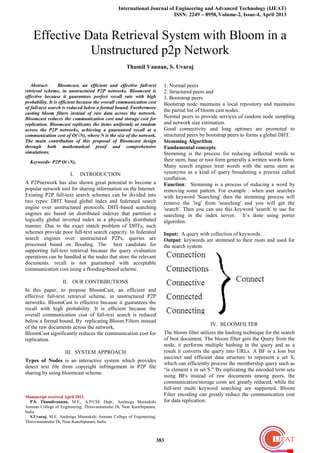
Function: Stemming is a process of reducing a word by
removing some pattern. For example : when user searches
with keyword 'Searching' then the stemming process will
remove the 'ing' from 'searching' and you will get the
'search'. Then you can use this keyword 'search' to use for
searching in the index server. It’s done using porter
algorithm.
Input: A query with collection of keywords.
Output: keywords are stemmed to their roots and used for
the search system.
IV. BLOOMFILTER
The bloom filter utilizes the hashing technique for the search
of best document. The bloom filter gets the Query from the
node, it performs multiple hashing in the query and as a
result it converts the query into URLs. A BF is a loss but
succinct and efficient data structure to represent a set S,
which can efficiently process the membership query such as
“is element x in set S.” By replicating the encoded term sets
using BFs instead of raw documents among peers, the
communication/storage costs are greatly reduced, while the
full-text multi keyword searching are supported. Bloom
Filter encoding can greatly reduce the communication cost
for data replication.
Effective Data Retrieval System with Bloom in a Unstructured p2p Network
384
Fig. 1. Bloom Filter
Efficient probabilistic data structure that is used to test
whether an element is a member of a set.
 False positive retrieval results are possible.
 False negative are not.
V. CAST BLOOM FILTER
VI. BLOOMCAST
In Unstructured P2P networks, BloomCast is an effective
and efficient full text retrieval scheme. By leveraging a
hybrid P2P protocol, Bloom Cast replicates the items
uniformly at random across the P2P networks. BloomCast
hybridizes a lightweight DHT with an unstructured P2P
overlay to support random node sampling and network size
estimation.
VII. QUERY EVALUATION OF BLOOMCAST
Distribute Bf among the Nodes
Once the data are converted into the URL’s, the url’s are
distributed to all other nodes. Once the node the request for
the particular data in the network, the nodes will check the
for the data or Urls related to the requested data. Once
search has been finished, the best results will display to the
user.
VIII. DATAFLOW DIAGRAM
Fig. 2. Dataflow Diagram
IX. RANKING PROCESS
The Ranking of data, so that the new users may able to find
the exact data when they search/surfing. Using the chord
algorithm, the peer node will do forward and backward
search and as a result each document is provided with the
rank and hence according to the rank given, the best
document is identified by the server and it is given to the
user efficiently.
Retrieval of Data
After ranking the documents, the user can choose the
required data that they wanted. By using the Bloom Filter
Concept, an effective and efficient data retrieval process is
achieved in the Unstructured P2P Networks.
X. CONCLUSION
A Bloomcast, an efficient and effective full-text retrieval
scheme, in unstructured P2P networks. Bloomcast is
effective because it guarantees the recall with high
probability. It is efficient because the overall
communication cost of full text search is reduced below a
formal bound. Bloomcast reduces the communication cost
for replication. All such limitations can be overcome by
using this application. This provides enhanced security.
Aim:
The main sources of this project efficient and effective full
text retrieval over unstructured p2p networks. Our goal is
reduces the network size, communication cost and storage
cost.
International Journal of Engineering and Advanced Technology (IJEAT)
ISSN: 2249 – 8958, Volume-2, Issue-4, April 2013
385
XI. FUTURE ENHANCEMENT
The future work should be focused towards increasing the
efficiency to downloading the documentation with secret
bloom filter value; each peer can store bloom filter values.
This bloom values are unique identifiers for peers and any
other device on a network. Therefore, if the bloom filter
values are detected occurring at wrongly, user peer will be
automatically barred from downloading the text file. When
this method works together with the current algorithm it can
provide an acceptable amount of security and privacy during
data transmission.
XII. RESULTS
To evaluate the performance of Bloom Cast, in the
simulation implement three baseline schemes.
Fig. 3. Recall.
Fig. 4. Latency.
Fig. 5. Query traffic..
Fig. 6. Efficiency
The result in Fig. 5 shows that the average query traffic of
BloomCast is 6:5 _ 105, very similar with that of the WP
algorithm. The average traffic of BloomCast is much less
than that of flooding.
REFERENCES
[1] E. Cohen and S. Shenker, “Replication Strategies in Unstructured
Peer-to-Peer Networks,” Proc. ACM SIGCOMM ’02. pp. 177-190,
2002.
[2] H. Shen, Y. Shu, and B. Yu, “Efficient Semantic-Based Content
Search in P2P Network,” IEEE Trans. Knowledge and Data Eng.,
vol. 16, no. 7, pp. 813-826, July 2004
[3] R.A. Ferreira, M.K. Ramanathan, A. Awan, A. Grama, and
S.Jagannathan, “Search with Probabilistic Guarantees in
Unstructured Peer-to-Peer Networks,” Proc. IEEE Fifth Int’l Conf.
Peer to Peer Computing (P2P ’05), pp. 165-172, 2005.
[4] S. Robertson, “Understanding Inverse Document Frequency: On
Theoretical Arguments for IDF,” J. Documentation, vol. 60, pp. 503-
520, 2004.
[5] P. Reynolds and A. Vahdat, “Efficient Peer-to-Peer Keyword
Searching,” Proc. ACM/IFIP/USENIX 2003 Int’l Conf. Middleware
(Middleware ’03), pp. 21-40, 2003.
[6] D. Li, J. Cao, X. Lu, and K. Chen, “Efficient Range Query
Processing in Peer-to-Peer Systems,” IEEE Trans. Knowledge and
Data Eng., vol. 21, no. 1, pp. 78-91, Jan. 2008.
[7] I. Stoica, R. Morris, D. Karger, M.F. Kaashoek, and H.Balakrishnan,
“Chord: A Scalable Peer-to-Peer Lookup Service for Internet
Applications,” Proc. ACM SIGCOMM ’01, pp. 149-160, 2001.
[8] J.P.C. Jie Lu, “Content-Based Retrieval in Hybrid Peer-to-Peer
Networks,” Proc. 12th Int’l Conf. Information and Knowledge
Management (CIKM), pp. 199-206, 2003.
[9] E.M. Voorhees, “Overview of Trec-2009,” Proc. 16th Text Retrieval
Conf. (TREC-11), 2009.
[10] A. Broder and M. Mitzenmacher, “Network Applications of Bloom
Filters: A Survey,” Internet Math., vol. 1, no. 4, pp. 485-509, 2004.

Effective Data Retrieval System with Bloom in a Unstructured p2p Network

  • 1.
    International Journal ofEngineering and Advanced Technology (IJEAT) ISSN: 2249 – 8958, Volume-2, Issue-4, April 2013 383 Effective Data Retrieval System with Bloom in a Unstructured p2p Network Thumil Vannan, S. Uvaraj Abstract- Bloomcast, an efficient and effective full-text retrieval scheme, in unstructured P2P networks. Bloomcast is effective because it guarantees perfect recall rate with high probability. It is efficient because the overall communication cost of full-text search is reduced below a formal bound. Furthermore casting bloom filters instead of raw data across the network. Bloomcast reduces the communication cost and storage cost for replication. Bloomcast replicates the items uniformly at random across the P2P networks, achieving a guaranteed recall at a communication cost of O(√N), where N is the size of the network. The main contribution of this proposal of Bloomcast design through both mathematical proof and comprehensive simulations. Keywords- P2P O(√N), I. INTRODUCTION A P2Pnetwork has also shown great potential to become a popular network tool for sharing information on the Internet. Existing P2P full-text search schemes can be divided into two types: DHT based global index and federated search engine over unstructured protocols. DHT-based searching engines are based on distributed indexes that partition a logically global inverted index in a physically distributed manner. Due to the exact match problem of DHTs, such schemes provide poor full-text search capacity. In federated search engines over unstructured P2Ps, queries are processed based on flooding. The best candidate for supporting full-text retrieval because the query evaluation operations can be handled at the nodes that store the relevant documents. recall is not guaranteed with acceptable communication cost using a flooding-based scheme. II. OUR CONTRIBUTIONS In this paper, to propose BloomCast, an efficient and effective full-text retrieval scheme, in unstructured P2P networks. BloomCast is effective because it guarantees the recall with high probability. It is efficient because the overall communication cost of full-text search is reduced below a formal bound. By replicating Bloom Filters instead of the raw documents across the network, BloomCast significantly reduces the communication cost for replication. III. SYSTEM APPROACH Types of Nodes is an interactive system which provides detect text file from copyright infringement in P2P file sharing by using bloomcast scheme. Manuscript received April 2013. P.S. Thumilvannan, M.E., A.P/CSE Dept., Arulmigu Meenakshi Amman College of Engineering, Thiruvannamalai Dt, Near Kanchipuram, India. S.Uvaraj, M.E, Arulmigu Meenakshi Amman College of Engineering, Thiruvannamalai Dt, Near Kanchipuram, India. 1. Normal peers 2. Structured peers and 3. Bootstrap peers Bootstrap node maintains a local repository and maintains the partial list of bloom cast nodes. Normal peers to provide services of random node sampling and network size estimation. Good connectivity and long uptimes are promoted to structured peers by bootstrap peers to forms a global DHT. Stemming Algorithm Fundamental concepts Stemming is the process for reducing inflected words to their stem, base or root form generally a written words form. Many search engines treat words with the same stem as synonyms as a kind of query broadening a process called conflation. Function: Stemming is a process of reducing a word by removing some pattern. For example : when user searches with keyword 'Searching' then the stemming process will remove the 'ing' from 'searching' and you will get the 'search'. Then you can use this keyword 'search' to use for searching in the index server. It’s done using porter algorithm. Input: A query with collection of keywords. Output: keywords are stemmed to their roots and used for the search system. IV. BLOOMFILTER The bloom filter utilizes the hashing technique for the search of best document. The bloom filter gets the Query from the node, it performs multiple hashing in the query and as a result it converts the query into URLs. A BF is a loss but succinct and efficient data structure to represent a set S, which can efficiently process the membership query such as “is element x in set S.” By replicating the encoded term sets using BFs instead of raw documents among peers, the communication/storage costs are greatly reduced, while the full-text multi keyword searching are supported. Bloom Filter encoding can greatly reduce the communication cost for data replication.
  • 2.
    Effective Data RetrievalSystem with Bloom in a Unstructured p2p Network 384 Fig. 1. Bloom Filter Efficient probabilistic data structure that is used to test whether an element is a member of a set.  False positive retrieval results are possible.  False negative are not. V. CAST BLOOM FILTER VI. BLOOMCAST In Unstructured P2P networks, BloomCast is an effective and efficient full text retrieval scheme. By leveraging a hybrid P2P protocol, Bloom Cast replicates the items uniformly at random across the P2P networks. BloomCast hybridizes a lightweight DHT with an unstructured P2P overlay to support random node sampling and network size estimation. VII. QUERY EVALUATION OF BLOOMCAST Distribute Bf among the Nodes Once the data are converted into the URL’s, the url’s are distributed to all other nodes. Once the node the request for the particular data in the network, the nodes will check the for the data or Urls related to the requested data. Once search has been finished, the best results will display to the user. VIII. DATAFLOW DIAGRAM Fig. 2. Dataflow Diagram IX. RANKING PROCESS The Ranking of data, so that the new users may able to find the exact data when they search/surfing. Using the chord algorithm, the peer node will do forward and backward search and as a result each document is provided with the rank and hence according to the rank given, the best document is identified by the server and it is given to the user efficiently. Retrieval of Data After ranking the documents, the user can choose the required data that they wanted. By using the Bloom Filter Concept, an effective and efficient data retrieval process is achieved in the Unstructured P2P Networks. X. CONCLUSION A Bloomcast, an efficient and effective full-text retrieval scheme, in unstructured P2P networks. Bloomcast is effective because it guarantees the recall with high probability. It is efficient because the overall communication cost of full text search is reduced below a formal bound. Bloomcast reduces the communication cost for replication. All such limitations can be overcome by using this application. This provides enhanced security. Aim: The main sources of this project efficient and effective full text retrieval over unstructured p2p networks. Our goal is reduces the network size, communication cost and storage cost.
  • 3.
    International Journal ofEngineering and Advanced Technology (IJEAT) ISSN: 2249 – 8958, Volume-2, Issue-4, April 2013 385 XI. FUTURE ENHANCEMENT The future work should be focused towards increasing the efficiency to downloading the documentation with secret bloom filter value; each peer can store bloom filter values. This bloom values are unique identifiers for peers and any other device on a network. Therefore, if the bloom filter values are detected occurring at wrongly, user peer will be automatically barred from downloading the text file. When this method works together with the current algorithm it can provide an acceptable amount of security and privacy during data transmission. XII. RESULTS To evaluate the performance of Bloom Cast, in the simulation implement three baseline schemes. Fig. 3. Recall. Fig. 4. Latency. Fig. 5. Query traffic.. Fig. 6. Efficiency The result in Fig. 5 shows that the average query traffic of BloomCast is 6:5 _ 105, very similar with that of the WP algorithm. The average traffic of BloomCast is much less than that of flooding. REFERENCES [1] E. Cohen and S. Shenker, “Replication Strategies in Unstructured Peer-to-Peer Networks,” Proc. ACM SIGCOMM ’02. pp. 177-190, 2002. [2] H. Shen, Y. Shu, and B. Yu, “Efficient Semantic-Based Content Search in P2P Network,” IEEE Trans. Knowledge and Data Eng., vol. 16, no. 7, pp. 813-826, July 2004 [3] R.A. Ferreira, M.K. Ramanathan, A. Awan, A. Grama, and S.Jagannathan, “Search with Probabilistic Guarantees in Unstructured Peer-to-Peer Networks,” Proc. IEEE Fifth Int’l Conf. Peer to Peer Computing (P2P ’05), pp. 165-172, 2005. [4] S. Robertson, “Understanding Inverse Document Frequency: On Theoretical Arguments for IDF,” J. Documentation, vol. 60, pp. 503- 520, 2004. [5] P. Reynolds and A. Vahdat, “Efficient Peer-to-Peer Keyword Searching,” Proc. ACM/IFIP/USENIX 2003 Int’l Conf. Middleware (Middleware ’03), pp. 21-40, 2003. [6] D. Li, J. Cao, X. Lu, and K. Chen, “Efficient Range Query Processing in Peer-to-Peer Systems,” IEEE Trans. Knowledge and Data Eng., vol. 21, no. 1, pp. 78-91, Jan. 2008. [7] I. Stoica, R. Morris, D. Karger, M.F. Kaashoek, and H.Balakrishnan, “Chord: A Scalable Peer-to-Peer Lookup Service for Internet Applications,” Proc. ACM SIGCOMM ’01, pp. 149-160, 2001. [8] J.P.C. Jie Lu, “Content-Based Retrieval in Hybrid Peer-to-Peer Networks,” Proc. 12th Int’l Conf. Information and Knowledge Management (CIKM), pp. 199-206, 2003. [9] E.M. Voorhees, “Overview of Trec-2009,” Proc. 16th Text Retrieval Conf. (TREC-11), 2009. [10] A. Broder and M. Mitzenmacher, “Network Applications of Bloom Filters: A Survey,” Internet Math., vol. 1, no. 4, pp. 485-509, 2004.