AUTONOMIC NERVOUS
SYSTEM
Dr Onaadepo O
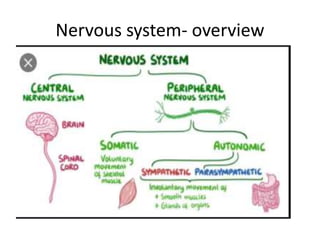
Nervous system- overview
Autonomic nervous system(ANS).
introduction
• Autonomic nervous system(ANS) is a motor or
efferent system which connects the central
nervous system(CNS) with the smooth muscle,
cardiac muscle and glands cells of the body
• It helps to control visceral functions such as blood
pressure, GI motility and secretion, urinary
bladder emptying, sweating, body temperature,
heart rate and several other activities
• Some of these functions are controlled almost
entirely by ANS and some only partially
Autonomic nervous system(ANS).
introduction
• Note that,
• when there’s a group of neuron cell bodies
located next to each other in the central
nervous system, the whole thing is called a
nucleus,
• while a group of neuron cell bodies located
outside the central nervous system is called a
ganglion.
Autonomic nervous system(ANS).
introduction
• It is a two neuron pathway, there is a ganglion
between the CNS and the effector
• Ratio of preganglionic to post ganglionic
neuron is not one to one
• There are more postganglionic than
preganglionic neurones
• Preganglionic neurones are myelinated
whereas post ganglionic are unmyelinated
Autonomic nervous system(ANS).
introduction
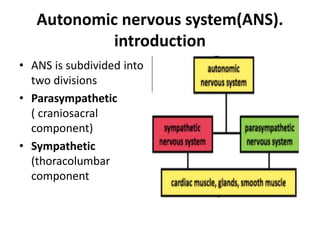
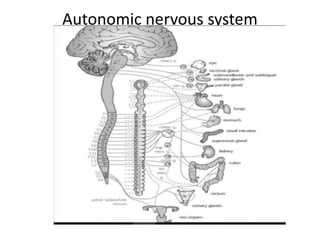
• ANS is subdivided into
two divisions
• Parasympathetic
( craniosacral
component)
• Sympathetic
(thoracolumbar
component
Functional anatomy of the PSN
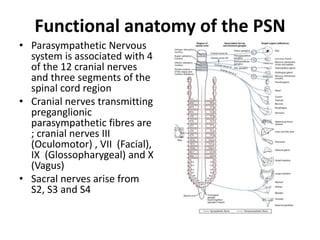
• Parasympathetic Nervous
system is associated with 4
of the 12 cranial nerves
and three segments of the
spinal cord region
• Cranial nerves transmitting
preganglionic
parasympathetic fibres are
; cranial nerves III
(Oculomotor) , VII (Facial),
IX (Glossopharygeal) and X
(Vagus)
• Sacral nerves arise from
S2, S3 and S4
Functional anatomy of the PSN
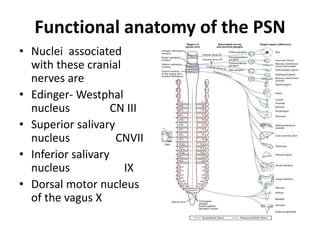
• Nuclei associated
with these cranial
nerves are
• Edinger- Westphal
nucleus CN III
• Superior salivary
nucleus CNVII
• Inferior salivary
nucleus IX
• Dorsal motor nucleus
of the vagus X
Functional anatomy of the PSN
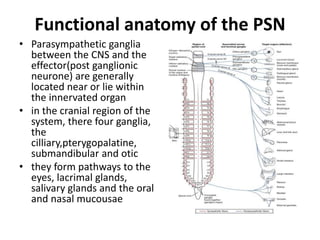
• Parasympathetic ganglia
between the CNS and the
effector(post ganglionic
neurone) are generally
located near or lie within
the innervated organ
• in the cranial region of the
system, there four ganglia,
the
cilliary,pterygopalatine,
submandibular and otic
• they form pathways to the
eyes, lacrimal glands,
salivary glands and the oral
and nasal mucousae
Functional anatomy of PSN
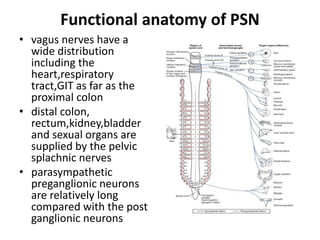
• vagus nerves have a
wide distribution
including the
heart,respiratory
tract,GIT as far as the
proximal colon
• distal colon,
rectum,kidney,bladder
and sexual organs are
supplied by the pelvic
splachnic nerves
• parasympathetic
preganglionic neurons
are relatively long
compared with the post
ganglionic neurons
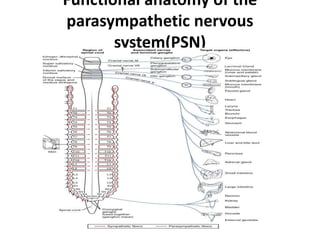
Functional anatomy of the
parasympathetic nervous
system(PSN)
Functional anatomy of the
Sympathetic nervous system(SNS)
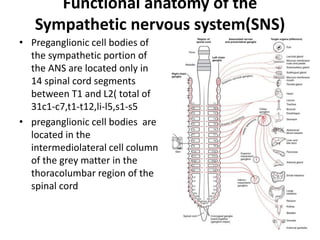
• Preganglionic cell bodies of
the sympathetic portion of
the ANS are located only in
14 spinal cord segments
between T1 and L2( total of
31c1-c7,t1-t12,li-l5,s1-s5
• preganglionic cell bodies are
located in the
intermediolateral cell column
of the grey matter in the
thoracolumbar region of the
spinal cord
Functional anatomy of the
Sympathetic nervous system(SNS)
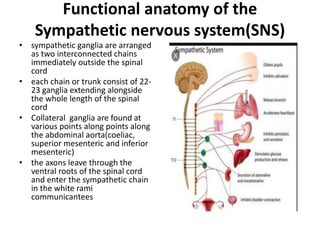
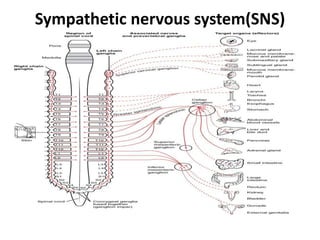
• sympathetic ganglia are arranged
as two interconnected chains
immediately outside the spinal
cord
• each chain or trunk consist of 22-
23 ganglia extending alongside
the whole length of the spinal
cord
• Collateral ganglia are found at
various points along points along
the abdominal aorta(coeliac,
superior mesenteric and inferior
mesenteric)
• the axons leave through the
ventral roots of the spinal cord
and enter the sympathetic chain
in the white rami
communicantees
Functional anatomy of the
Sympathetic nervous system(SNS)
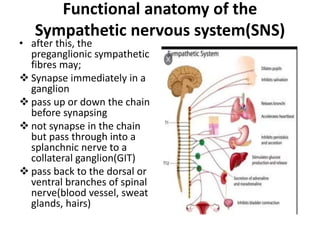
• after this, the
preganglionic sympathetic
fibres may;
 Synapse immediately in a
ganglion
 pass up or down the chain
before synapsing
 not synapse in the chain
but pass through into a
splanchnic nerve to a
collateral ganglion(GIT)
 pass back to the dorsal or
ventral branches of spinal
nerve(blood vessel, sweat
glands, hairs)
Functional anatomy of the
Sympathetic nervous system(SNS)
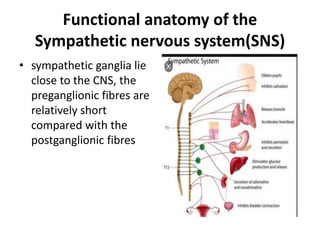
• sympathetic ganglia lie
close to the CNS, the
preganglionic fibres are
relatively short
compared with the
postganglionic fibres
Sympathetic nervous system(SNS)
Autonomic nervous system
Neurotransmitters of the ANS
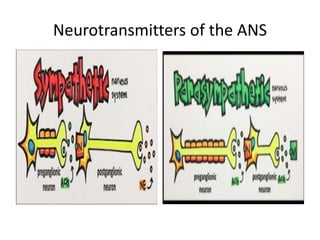
• Most neurotransmitters released by the
preganglionic fibres in both PSN and SNS is
acetylcholine, transmitter interaction is excitatory
• neurotransmiter at the neuro effector junction in
the parasympathetic is acetylcholine
• neurotransmiter at the neuro effector junction in
the parasympathetic is noradrenaline
• neurotransmiter at the neuro effector junction to
the sweat glands, piloerector muscle and skeletal
muscle arterioles is acetylcholine
Neurotransmitters of the ANS
some neurotransmission in the ANS involves
neither adrenergic nor cholinergic pathways
some synapses use more than a single
neurotranmitter(co transmission)
acetylcholine and norepnephrine play important
but not exclusive roles in the ANS
Non classic transmitters can be released at any
level (dopamine, glutamine,glycine, GABA,
Neuropeptides
Neurotransmitters of the ANS
Receptors of the ANS( Ach receptors)
• Acetylecholine activates two different types of
receptors muscarinic and nicotinic receptors
• It is important to understand the two types of
receptors because knowlege of location and
action is important in clinical medicine where
specific drugs can be used to stimulate or
block one or the other two types of receptors
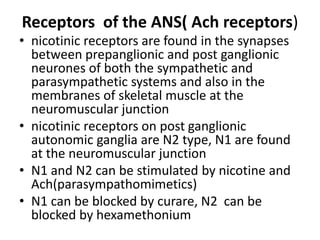
Receptors of the ANS( Ach receptors)
• nicotinic receptors are found in the synapses
between prepanglionic and post ganglionic
neurones of both the sympathetic and
parasympathetic systems and also in the
membranes of skeletal muscle at the
neuromuscular junction
• nicotinic receptors on post ganglionic
autonomic ganglia are N2 type, N1 are found
at the neuromuscular junction
• N1 and N2 can be stimulated by nicotine and
Ach(parasympathomimetics)
• N1 can be blocked by curare, N2 can be
blocked by hexamethonium
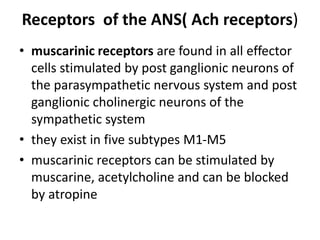
Receptors of the ANS( Ach receptors)
• muscarinic receptors are found in all effector
cells stimulated by post ganglionic neurons of
the parasympathetic nervous system and post
ganglionic cholinergic neurons of the
sympathetic system
• they exist in five subtypes M1-M5
• muscarinic receptors can be stimulated by
muscarine, acetylcholine and can be blocked
by atropine
Receptors of the ANS (
Adrenergic receptors)
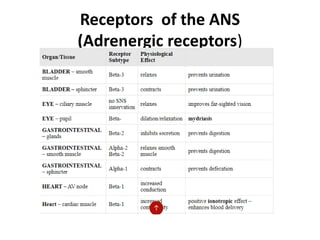
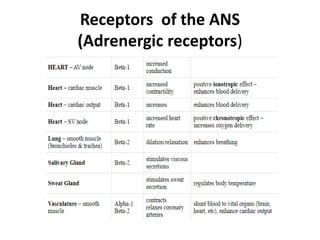
• Noradrenaline [NA] interacts with two types of
receptors:
• Alpha-adrenergic receptors [alpha adrenoceptors]
• Alpha-1 – blood vessels
• Alpha-2 – CNS (presynaptic)
• Beta-adrenergic receptors [beta adrenoceptors]
• Beta-1 – heart
• Beta-2 – lungs
• Beta-3 – bladder
Receptors of the ANS
(Adrenergic receptors)
Receptors of the ANS
(Adrenergic receptors)
Receptors of the ANS
( Adrenergic receptors)
• type of receptor present and action of drugs that
mimick the action of noradrenalin on sympathetic
effector organs(sympathomimetic drugs)
determine their effects in variuos tisssues
• adrenalin excites mainly alpha receptors but excites
beta receptors slightly
• adrenaline excite both receptors
• isoproterenol has an extremely strong action on
beta but not on alpha
• adrenergic receptors subtypes have a tissue
specific distribution
Functions of the Autonomic Nervous
System
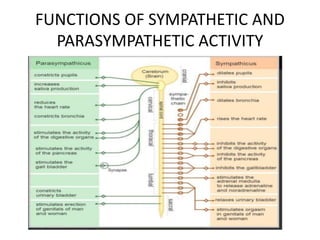
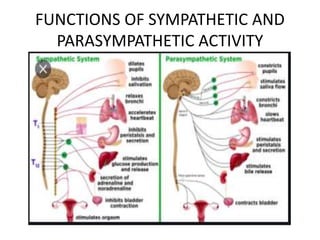
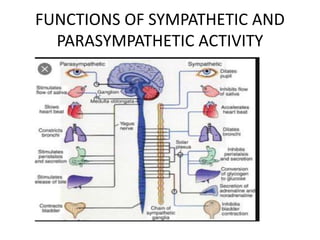
• stimulation of sympathetic and
parasympathetic nerves innervating the same
organ elicit opposite responses
• ANS functions spontaneosly, usually at the
subconscious level
• Stimulation of the PNS is responsible for the
rest and digest actions of the body
Functions of the Autonomic Nervous
System
• Genaral stimulation of the SNS is responsible
for the fight or flight responses of the body
and originates from thoracolumbar segments
of the spinal cord.
• These actions are most apparent when the
body is faced with stressful situations. It is
designed to mobilise energy stores, allowing
us to cope with the stress and increase our
chances of survival.
FUNCTIONS OF SYMPATHETIC AND
PARASYMPATHETIC ACTIVITY
FUNCTIONS OF SYMPATHETIC AND
PARASYMPATHETIC ACTIVITY
FUNCTIONS OF SYMPATHETIC AND
PARASYMPATHETIC ACTIVITY
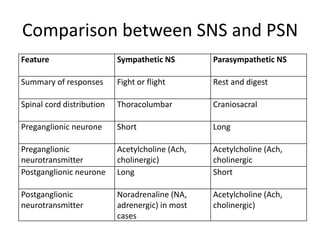
Comparison between SNS and PSN
Feature Sympathetic NS Parasympathetic NS
Summary of responses Fight or flight Rest and digest
Spinal cord distribution Thoracolumbar Craniosacral
Preganglionic neurone Short Long
Preganglionic
neurotransmitter
Acetylcholine (Ach,
cholinergic)
Acetylcholine (Ach,
cholinergic
Postganglionic neurone Long Short
Postganglionic
neurotransmitter
Noradrenaline (NA,
adrenergic) in most
cases
Acetylcholine (Ach,
cholinergic)
Control of ANS functions
• Although the ANS, can function independently, it can
be influenced by brainstem nuclei ,Spinal cord and
sometimes the forebrain(hypothalamus,amygdala
prefrontal cortex, insula,others)
• Nuclei within the lower brainstem mediate
autonomic reflexes(CVS, RS GIT, UGS) or modulate
the general level of autonomic tone
• Hypothalamus in the forebrain cordinates autonomic
function with feeding, thermoregulation,
waterbalance,emotions,sexual drive, reproduction
motivativation
ANY QUESTION?

AUTONOMIC NERVOUS SYSTEM.pptx

  • 1.
  • 2.
  • 3.
    Autonomic nervous system(ANS). introduction •Autonomic nervous system(ANS) is a motor or efferent system which connects the central nervous system(CNS) with the smooth muscle, cardiac muscle and glands cells of the body • It helps to control visceral functions such as blood pressure, GI motility and secretion, urinary bladder emptying, sweating, body temperature, heart rate and several other activities • Some of these functions are controlled almost entirely by ANS and some only partially
  • 4.
    Autonomic nervous system(ANS). introduction •Note that, • when there’s a group of neuron cell bodies located next to each other in the central nervous system, the whole thing is called a nucleus, • while a group of neuron cell bodies located outside the central nervous system is called a ganglion.
  • 5.
    Autonomic nervous system(ANS). introduction •It is a two neuron pathway, there is a ganglion between the CNS and the effector • Ratio of preganglionic to post ganglionic neuron is not one to one • There are more postganglionic than preganglionic neurones • Preganglionic neurones are myelinated whereas post ganglionic are unmyelinated
  • 6.
    Autonomic nervous system(ANS). introduction •ANS is subdivided into two divisions • Parasympathetic ( craniosacral component) • Sympathetic (thoracolumbar component
  • 7.
    Functional anatomy ofthe PSN • Parasympathetic Nervous system is associated with 4 of the 12 cranial nerves and three segments of the spinal cord region • Cranial nerves transmitting preganglionic parasympathetic fibres are ; cranial nerves III (Oculomotor) , VII (Facial), IX (Glossopharygeal) and X (Vagus) • Sacral nerves arise from S2, S3 and S4
  • 8.
    Functional anatomy ofthe PSN • Nuclei associated with these cranial nerves are • Edinger- Westphal nucleus CN III • Superior salivary nucleus CNVII • Inferior salivary nucleus IX • Dorsal motor nucleus of the vagus X
  • 9.
    Functional anatomy ofthe PSN • Parasympathetic ganglia between the CNS and the effector(post ganglionic neurone) are generally located near or lie within the innervated organ • in the cranial region of the system, there four ganglia, the cilliary,pterygopalatine, submandibular and otic • they form pathways to the eyes, lacrimal glands, salivary glands and the oral and nasal mucousae
  • 10.
    Functional anatomy ofPSN • vagus nerves have a wide distribution including the heart,respiratory tract,GIT as far as the proximal colon • distal colon, rectum,kidney,bladder and sexual organs are supplied by the pelvic splachnic nerves • parasympathetic preganglionic neurons are relatively long compared with the post ganglionic neurons
  • 11.
    Functional anatomy ofthe parasympathetic nervous system(PSN)
  • 12.
    Functional anatomy ofthe Sympathetic nervous system(SNS) • Preganglionic cell bodies of the sympathetic portion of the ANS are located only in 14 spinal cord segments between T1 and L2( total of 31c1-c7,t1-t12,li-l5,s1-s5 • preganglionic cell bodies are located in the intermediolateral cell column of the grey matter in the thoracolumbar region of the spinal cord
  • 13.
    Functional anatomy ofthe Sympathetic nervous system(SNS) • sympathetic ganglia are arranged as two interconnected chains immediately outside the spinal cord • each chain or trunk consist of 22- 23 ganglia extending alongside the whole length of the spinal cord • Collateral ganglia are found at various points along points along the abdominal aorta(coeliac, superior mesenteric and inferior mesenteric) • the axons leave through the ventral roots of the spinal cord and enter the sympathetic chain in the white rami communicantees
  • 14.
    Functional anatomy ofthe Sympathetic nervous system(SNS) • after this, the preganglionic sympathetic fibres may;  Synapse immediately in a ganglion  pass up or down the chain before synapsing  not synapse in the chain but pass through into a splanchnic nerve to a collateral ganglion(GIT)  pass back to the dorsal or ventral branches of spinal nerve(blood vessel, sweat glands, hairs)
  • 15.
    Functional anatomy ofthe Sympathetic nervous system(SNS) • sympathetic ganglia lie close to the CNS, the preganglionic fibres are relatively short compared with the postganglionic fibres
  • 16.
  • 17.
  • 18.
    Neurotransmitters of theANS • Most neurotransmitters released by the preganglionic fibres in both PSN and SNS is acetylcholine, transmitter interaction is excitatory • neurotransmiter at the neuro effector junction in the parasympathetic is acetylcholine • neurotransmiter at the neuro effector junction in the parasympathetic is noradrenaline • neurotransmiter at the neuro effector junction to the sweat glands, piloerector muscle and skeletal muscle arterioles is acetylcholine
  • 19.
    Neurotransmitters of theANS some neurotransmission in the ANS involves neither adrenergic nor cholinergic pathways some synapses use more than a single neurotranmitter(co transmission) acetylcholine and norepnephrine play important but not exclusive roles in the ANS Non classic transmitters can be released at any level (dopamine, glutamine,glycine, GABA, Neuropeptides
  • 20.
  • 21.
    Receptors of theANS( Ach receptors) • Acetylecholine activates two different types of receptors muscarinic and nicotinic receptors • It is important to understand the two types of receptors because knowlege of location and action is important in clinical medicine where specific drugs can be used to stimulate or block one or the other two types of receptors
  • 22.
    Receptors of theANS( Ach receptors) • nicotinic receptors are found in the synapses between prepanglionic and post ganglionic neurones of both the sympathetic and parasympathetic systems and also in the membranes of skeletal muscle at the neuromuscular junction • nicotinic receptors on post ganglionic autonomic ganglia are N2 type, N1 are found at the neuromuscular junction • N1 and N2 can be stimulated by nicotine and Ach(parasympathomimetics) • N1 can be blocked by curare, N2 can be blocked by hexamethonium
  • 23.
    Receptors of theANS( Ach receptors) • muscarinic receptors are found in all effector cells stimulated by post ganglionic neurons of the parasympathetic nervous system and post ganglionic cholinergic neurons of the sympathetic system • they exist in five subtypes M1-M5 • muscarinic receptors can be stimulated by muscarine, acetylcholine and can be blocked by atropine
  • 24.
    Receptors of theANS ( Adrenergic receptors) • Noradrenaline [NA] interacts with two types of receptors: • Alpha-adrenergic receptors [alpha adrenoceptors] • Alpha-1 – blood vessels • Alpha-2 – CNS (presynaptic) • Beta-adrenergic receptors [beta adrenoceptors] • Beta-1 – heart • Beta-2 – lungs • Beta-3 – bladder
  • 25.
    Receptors of theANS (Adrenergic receptors)
  • 26.
    Receptors of theANS (Adrenergic receptors)
  • 27.
    Receptors of theANS ( Adrenergic receptors) • type of receptor present and action of drugs that mimick the action of noradrenalin on sympathetic effector organs(sympathomimetic drugs) determine their effects in variuos tisssues • adrenalin excites mainly alpha receptors but excites beta receptors slightly • adrenaline excite both receptors • isoproterenol has an extremely strong action on beta but not on alpha • adrenergic receptors subtypes have a tissue specific distribution
  • 28.
    Functions of theAutonomic Nervous System • stimulation of sympathetic and parasympathetic nerves innervating the same organ elicit opposite responses • ANS functions spontaneosly, usually at the subconscious level • Stimulation of the PNS is responsible for the rest and digest actions of the body
  • 29.
    Functions of theAutonomic Nervous System • Genaral stimulation of the SNS is responsible for the fight or flight responses of the body and originates from thoracolumbar segments of the spinal cord. • These actions are most apparent when the body is faced with stressful situations. It is designed to mobilise energy stores, allowing us to cope with the stress and increase our chances of survival.
  • 30.
    FUNCTIONS OF SYMPATHETICAND PARASYMPATHETIC ACTIVITY
  • 31.
    FUNCTIONS OF SYMPATHETICAND PARASYMPATHETIC ACTIVITY
  • 32.
    FUNCTIONS OF SYMPATHETICAND PARASYMPATHETIC ACTIVITY
  • 33.
    Comparison between SNSand PSN Feature Sympathetic NS Parasympathetic NS Summary of responses Fight or flight Rest and digest Spinal cord distribution Thoracolumbar Craniosacral Preganglionic neurone Short Long Preganglionic neurotransmitter Acetylcholine (Ach, cholinergic) Acetylcholine (Ach, cholinergic Postganglionic neurone Long Short Postganglionic neurotransmitter Noradrenaline (NA, adrenergic) in most cases Acetylcholine (Ach, cholinergic)
  • 34.
    Control of ANSfunctions • Although the ANS, can function independently, it can be influenced by brainstem nuclei ,Spinal cord and sometimes the forebrain(hypothalamus,amygdala prefrontal cortex, insula,others) • Nuclei within the lower brainstem mediate autonomic reflexes(CVS, RS GIT, UGS) or modulate the general level of autonomic tone • Hypothalamus in the forebrain cordinates autonomic function with feeding, thermoregulation, waterbalance,emotions,sexual drive, reproduction motivativation
  • 35.