AUTOMATION
PRESENTED BY :- MOHD SAQIB
EC – 3rd Year
R. B. S. E. T. C. , Bichpuri
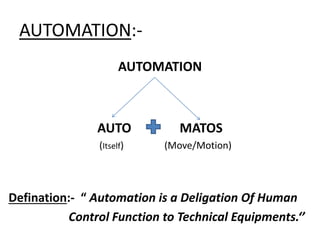
AUTOMATION:-
AUTOMATION
AUTO MATOS
(Itself) (Move/Motion)
Defination:- “ Automation is a Deligation Of Human
Control Function to Technical Equipments.‘’
Where Automation is Used :-
• Home Automation
For Example :- Air Conditioner , Fridge , etc.
• Building / Mall Automation
For Example:- Escalators , Main Gate , etc.
• Industrial Automation
For Example :- Conveyor Belts , etc.
Advantages & Disadvantages of
Automation :-
• ADVANTAGES:-
• DISADVANTAGES:-
1.Time Reduce
2.Production Increase
3.Productivity Increase
4.Labour Cost Decrease
1.Installation Cost High
2.Increase Unemployment
TYPES OF AUTOMATION :-
1. Fixed Automation
2. Programmable Automation
3. Flexible Automation
4. Integrated Automation
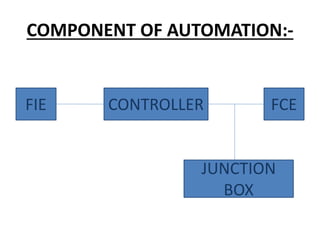
COMPONENT OF AUTOMATION:-
FIE CONTROLLER FCE
JUNCTION
BOX
FIE (FIELD INPUT ELEMENT) :-
i. Toggle Switch
ii. Push Button
iii. Sensors
1.Toggle Switch :- A Simple On/OFF switch is
Toggle switch.
Toggle switch
2. PUSH BUTTON :- It is of Two Type
1) NO ( NORMALLY OPEN )
2) NC ( NORMALLY CLOSE )
3. SENSORS:- A Device that detects or senses
Heat , Sound , Motion , etc., And then Reacts
to it in a particular way.
It is Classified into two types :-
a) Digital Sensors
b) Analog Sensors
ANALOG SENSORS:-
A. Temperature Sensors:- Sensors which sense the heat
are known as Temperature
sensors.
There are three types of Temperature sensors are:-
I. RTD ( Resistance Temperature Detector )
II. Thermistor
III. Thermocouple
B. Flow Sensors :- Sensors which sense the movement
of Fluid.
C. Level Sensors :- Sensors which detects the level of
liquid or other fluid and fluidised solid.
D. Pressure Sensors :- Sensors which detects the
Pressure of Gasses/Fluids.
DIGITAL SENSORS :-
A. Proximity Sensors :- Sensors able to
detect the presence of nearby objects
without any physical contact.
It is of two types :-
(a.) Inductive Type
(b.) Capacitive Type
(a.) Inductive Type Proximity Sensors :-
An inductive proximity sensor is a type of non-
contact electronic proximity sensor that is used to
detect the position. For ex :- Metal Detector , etc.
COIL Oscillator
Switching
Device
Triggering
circuit
+24v
Signal
Ground
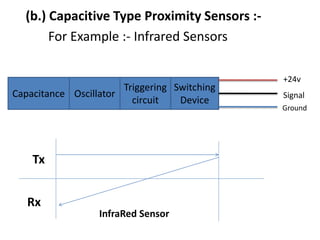
(b.) Capacitive Type Proximity Sensors :-
For Example :- Infrared Sensors
Capacitance Oscillator
Triggering
circuit
Switching
Device
+24v
Signal
Ground
Tx
Rx
InfraRed Sensor
CONTROLLER:-
• PLC ( Programmable Logic Controll )
• SCADA (Supervisory control and data acquisition)
• DRIVE
• DCS (DISTRIBUTED CONTROLL SYSTEM)
• HMI ( HUMAN MACHINE INTERFACE )
JUNCTION BOX:-
1. SMPS ( Switch Mode Power Supply )
2. ADC ( Analog to Digital Converter )
3. DAC ( Digital to Analog Converter )
4. Relay
5. Contactor
FCE (FINAL CONTROLL ELEMENT):-
1. LED ( LIGHT EMITTING DIODE )
2. MOTOR
3. LCD ( LIQUID CRYSTAL DISPLAY )
4. BULB
ANY QUESTIONS
?

Automation

  • 1.
    AUTOMATION PRESENTED BY :-MOHD SAQIB EC – 3rd Year R. B. S. E. T. C. , Bichpuri
  • 2.
    AUTOMATION:- AUTOMATION AUTO MATOS (Itself) (Move/Motion) Defination:-“ Automation is a Deligation Of Human Control Function to Technical Equipments.‘’
  • 3.
    Where Automation isUsed :- • Home Automation For Example :- Air Conditioner , Fridge , etc. • Building / Mall Automation For Example:- Escalators , Main Gate , etc. • Industrial Automation For Example :- Conveyor Belts , etc.
  • 4.
    Advantages & Disadvantagesof Automation :- • ADVANTAGES:- • DISADVANTAGES:- 1.Time Reduce 2.Production Increase 3.Productivity Increase 4.Labour Cost Decrease 1.Installation Cost High 2.Increase Unemployment
  • 5.
    TYPES OF AUTOMATION:- 1. Fixed Automation 2. Programmable Automation 3. Flexible Automation 4. Integrated Automation
  • 6.
    COMPONENT OF AUTOMATION:- FIECONTROLLER FCE JUNCTION BOX
  • 7.
    FIE (FIELD INPUTELEMENT) :- i. Toggle Switch ii. Push Button iii. Sensors 1.Toggle Switch :- A Simple On/OFF switch is Toggle switch. Toggle switch
  • 8.
    2. PUSH BUTTON:- It is of Two Type 1) NO ( NORMALLY OPEN ) 2) NC ( NORMALLY CLOSE )
  • 9.
    3. SENSORS:- ADevice that detects or senses Heat , Sound , Motion , etc., And then Reacts to it in a particular way. It is Classified into two types :- a) Digital Sensors b) Analog Sensors ANALOG SENSORS:- A. Temperature Sensors:- Sensors which sense the heat are known as Temperature sensors.
  • 10.
    There are threetypes of Temperature sensors are:- I. RTD ( Resistance Temperature Detector ) II. Thermistor III. Thermocouple B. Flow Sensors :- Sensors which sense the movement of Fluid. C. Level Sensors :- Sensors which detects the level of liquid or other fluid and fluidised solid. D. Pressure Sensors :- Sensors which detects the Pressure of Gasses/Fluids.
  • 11.
    DIGITAL SENSORS :- A.Proximity Sensors :- Sensors able to detect the presence of nearby objects without any physical contact. It is of two types :- (a.) Inductive Type (b.) Capacitive Type (a.) Inductive Type Proximity Sensors :- An inductive proximity sensor is a type of non- contact electronic proximity sensor that is used to detect the position. For ex :- Metal Detector , etc. COIL Oscillator Switching Device Triggering circuit +24v Signal Ground
  • 12.
    (b.) Capacitive TypeProximity Sensors :- For Example :- Infrared Sensors Capacitance Oscillator Triggering circuit Switching Device +24v Signal Ground Tx Rx InfraRed Sensor
  • 13.
    CONTROLLER:- • PLC (Programmable Logic Controll ) • SCADA (Supervisory control and data acquisition) • DRIVE • DCS (DISTRIBUTED CONTROLL SYSTEM) • HMI ( HUMAN MACHINE INTERFACE )
  • 14.
    JUNCTION BOX:- 1. SMPS( Switch Mode Power Supply ) 2. ADC ( Analog to Digital Converter ) 3. DAC ( Digital to Analog Converter ) 4. Relay 5. Contactor
  • 15.
    FCE (FINAL CONTROLLELEMENT):- 1. LED ( LIGHT EMITTING DIODE ) 2. MOTOR 3. LCD ( LIQUID CRYSTAL DISPLAY ) 4. BULB
  • 17.

Editor's Notes

  • #2 PRESENTED BY : MOHD SAQIB