MECHANICAL ENGINEERING
AND AUTOMATION
Syllabus
Outline of Presentation
 Elements of Automation Technology
 Sensors
 Actuators
 Robotics
Elements of Automation Technology
What is Mechatronics ?
 Mechatronics is an interdisciplinary field that combines
mechanical, electrical, and computer engineering to
create intelligent and automated systems. It focuses on
designing and developing integrated systems that can
sense, analyze, and control their environment.
 Mechatronics is used in many industries, including
manufacturing, healthcare, transportation, robotics, and
more.
Continued…
 Mechatronics is the control of mechanical motion with
the help of electrical, electronics and computer system
according to the required conditions.
Continued…
• Mechatronic systems use sensors, microprocessors, and
control algorithms to monitor and regulate their own
performance.
• Mechatronics requires the collaboration of engineers
from various disciplines to design and implement
successful integrated systems.
 Mechatronics creates advanced, flexible, and effective
solutions by utilizing the mutually beneficial advantages
of mechanical, electrical, and computer systems.
Mechatronics Systems in our daily life
Automation
 Automation is the application of
technology, programs, robotics or
processes to achieve outcomes
with minimal human input.
 Automation is transforming
mechatronics by integrating
modern technologies in order to
improve industrial processes,
productivity, accuracy, and
efficiency.
Automation Pros and Cons
The Role of Automation in Mechatronics
Systems
 Increased Efficiency - Automated
systems can perform tasks with
greater speed, precision, and
consistency compared to manual
labor.
 Enhanced Safety - Automation
removes human operators from
hazardous environments, reducing
the risk of injuries and accidents.
 Cost Savings - Automated processes
can lower labor costs, minimize
waste, and increase overall
productivity and profitability.
What is Automated Manufacturing
System ?
 Automated manufacturing system integrates software
and machinery so that manufacturing processes are run
autonomously through computer programming.
 They are called automated because they perform their
operations with a reduced level of human
participation compared with the corresponding manual
process. In some highly automated systems, there is
virtually no human participation.
• Automated manufacturing systems have
computerised controls built into the manufacturing
equipment.
Continued…
 Every part of the production is scheduled and performed
automatically.
 Automated manufacturing system requires:
 Automatic movement of material,
 Precise scheduling,
 Execution of all work steps,
 Automatic monitoring of quality and safety
 An automated manufacturing system has the ability to
perform the following tasks:
1. Collecting data
2. Processing data
3. Performing work
Continued…
 Collecting data: Collects data from the environment through
a wide range of sensors. A sensor is an input device that
measures data from the environment, such as Temperature,
Pressure, Motion, Flow and Light.
 Processing data: Data is processed into information using a
microcontrollers. A controller receives data from a sensor and
changes it into information that can be used by the system.
For example, sensors often collect data in analogue form,
and this needs to be converted (organised) to digital form for
use in the system. These data readings are then interpreted
and processes to output an appropriate response in the
automated system.
Continued…
 Performing work: In most cases, the product must be
moved from one location to another during the series of
processing steps. At each processing location, the
accurate positioning of the product is generally required.
 Actuators perform the actual work of the system,
such as stopping a pump, moving a switch or turning on
a light beam.
Automation &Types of automation
Automation is generally defined as the process of having
Machines follow a predetermined sequence of operations With
little or no human involvement, using specialized equipment
And devices that perform and control manufacturing processes
 Areas to implement the automation are :
 Manufacturing process and operations
 Material Handling
 Inspection
 Assembly
 Packaging
Continued…
Three types of automation in production can be distinguished:
 Fixed Automation,
 Programmable Automation
 Flexible Automation
Types of Automation
 Fixed automation, also referred to as hard automation, is a system in which the
automated production processes and assembly are preset to produce a single
product. The sequence of production and operation is fixed by the configuration
of tooling, equipment and machines allocated for high-production needs.
 Flexible automation is a type of manufacturing automation which exhibits some
form of “flexibility”. Most commonly this flexibility is the capability of making
different products in a short time frame. This “process flexibility” allows the
production of different part types with overlapping life-cycles. Flexible
automation allows the production of a variety of part types in small or unit batch
sizes. Flexible Automation is the ability for a robot or system to be quickly and
easily re-tasked to change product design for both low and high mix
manufacturing
 Programmable automation: A numerical-control machine tool is a
good example of programmable automation. The program is coded in computer
memory for each different product style, and the machine tool is controlled by the
computer program. Industrial robots are another example. Flexible automation is
an extension of programmable automation.
Sensors
 Sensors are devices that detect and respond to physical
stimuli, converting them into electrical signals for processing.
 Sensors are used extensively in industrial automation,
robotics, smart home systems, and a wide range of other
applications.
 Sensors provide real-time data, allowing for constant
monitoring and adjustment of processes and systems.
CONTROLLER
SENSORS
SENSORS
ACTUATORS
ACTUATORS
ACTUATORS
HUMAN BODY (BEST EXAMPLE)
Basic Classifications of Sensors
 In the first classification of the sensors(based on working
principle), they are divided in to Active and Passive.
 Active Sensors are those which require an external excitation
signal or a power signal.
 Passive Sensors, on the other hand, do not require any
external power signal and directly generates output response.
 The other type of classification is based on the means of
detection used in the sensor. Some of the means of detection
are Electric, Biological, Chemical, Radioactive etc.
 The next classification is based on conversion phenomenon
i.e., the input and the output. Some of the common
conversion phenomena are Photoelectric, Thermoelectric,
Electrochemical, Electromagnetic, Thermooptic, etc.
Continued…
 The final classification of the sensors are Analog and
Digital Sensors. Analog Sensors produce an analog output i.e., a
continuous output signal (usually voltage but sometimes other
quantities like Resistance etc.) with respect to the quantity being
measured.
 Digital Sensors, in contrast to Analog Sensors, work with discrete
or digital data. The data in digital sensors, which is used for
conversion and transmission, is digital in nature.
Advantages of Sensors
 Sensors can automate responsibilities and methods, growing
performance and accuracy.
 Sensors may be used to screen situations and collect records in real-time,
taking into account brief and knowledgeable choice-making.
 Sensors may be used to screen and manipulate structures remotely,
permitting faraway operation and maintenance.
 Sensors may be used to enhance protection by detecting fuel line leaks or
the presence of human beings or items in dangerous regions.
 Sensors may be used to preserve resources, adjust the construction
temperature based totally on occupancy or turn off lighting while a room
isn't in use.
 Sensors can be used to track the outstanding quality of the air or water,
identify flaws in production processes, and improve the exceptional
quality of goods and services.
 By enabling self-riding cars or adding contact or gesture controls to
smartphones, sensors can enhance the functionality of products and
devices.
Disadvantages of Sensors
 Sensors may be expensive, in particular, if they're
excessive-precision or specialized.
 Sensors may be tormented by interference from different
sources, electromagnetic fields, or sensors.
 Sensors might also have restrained resolution, which
means they'll no longer be capable of locating small
adjustments within the bodily belongings they're
measuring.
 Sensors may not be appropriate for all environments, as a
few sensors may not be capable of facing up to excessive
ranges of moisture or dust.
 Sensors also enhance privacy issues if they're used to
collect non-public records, together with area or biometric
information.
Types of Sensors based on the application
 Temperature sensors: These sensors degree temperature and
are utilized in various programs, such as thermostats, ovens,
and climate stations.
 Pressure sensors: These sensors degree stress ever realized in
several programs, such as tire stress monitors, altimeters, and
air stress gauges.
 Motion sensors: These sensors locate motion and are utilized
in protection structures, computerized light structures, and
online game controllers.
 Chemical sensors: These sensors locate the presence or
awareness of precise chemical substances and are utilized in air
exceptional monitors, breath analyzers, and meal protection
monitors.
 Light sensors: These sensors locate mild and are utilized in
cameras, automated door openers, and streetlights.
 Sound sensors: These sensors locate sound and are utilized in
noise-canceling headphones.
 Proximity sensors: These sensors locate the presence of close
by items and are utilized in smartphones, laptops, and robotics.
 Magnetic sensors: These sensors locate a magnetic area and
are utilized in compass apps and door sensors.
Applications
 Automotive and Motorsport – in this industry, displacement sensors
can be used for steering systems on agricultural machinery, electric cart
throttle control, the suspension on bikes and many other applications.
 Factory Automation – displacement sensors can be used for conveyor
speed measurement, labelling machines and control, printing processes
and packaging.
 Medical Applications – displacement sensors are used on medical
pieces of machinery such as MRI or oncology machines.
 Security Applications - displacement sensors can be used in security
applications, for example, monitoring the angle of a CCTV camera.
 Barriers and bridges – displacement sensors are used to position
various types of barriers; these could be for pedestrians or vehicles.
Moving bridges and ramps also use displacement sensors to control the
positions they are fixated in.
 Patient monitoring in medical applications – Temperature sensors
are used to monitor the patients temperature in medical facilities.
Continued
 Manufacturing and industrial equipment – Temperature
sensors are used within machines to ensure they do not overheat
and become unsafe.
 Agriculture Applications – Steering systems in agricultural
machinery use both rotary and linear position sensors.
 Aerospace Applications – Position sensors are used for wing
flap position measurement as well as other applications integral
to the safety of passengers.
 HVAC Applications – Pressure transducers are used for
monitoring heater pumps, cooling liquids and to monitor liquid
levels within HVAC
 Medical Applications – Pressure switches are used to monitor
levels in oxygen tanks, they are also used on DNA sampling
machinery and other medical devices. Pressure transducers are
also used within medical devices.
Actuators
 Actuators are devices that convert
energy into motion or force to interact
with and control physical systems.
 Actuators are essential components in
automated systems, responsible for
executing the desired actions based on
sensor data and control algorithms.
 Actuators are used in a wide range of
applications, including industrial
machinery, robotics, valves, and more.
Types of Actuators
 Electric Actuators: Use electric
motors to generate motion and force.
 Hydraulic Actuators: Utilize
pressurized fluid to produce linear or
rotary motion.
 Pneumatic Actuators: Employ
compressed air to create mechanical
movement.
 Servo Actuators: Provide precise
position and speed control for
industrial applications.
Pros & Cons of Hydraulic, Pneumatic, and Electric
Linear Actuators
Advantages of Hydraulic Linear Actuators
 Hydraulic actuators can hold a constant force without the pump
supplying more fluid due to the use of an incompressible fluid.
 They can produce very high forces and speeds.
 It can produce high speeds.
Disadvantages of Hydraulic Linear Actuators
 Hydraulic fluid can leak, which leads to a loss in efficiency.
This can also lead to cleanliness issues.
 Require many accompanying components including a fluid
reservoir, pumps, motors, release valves, heat exchangers, and
noise reduction equipment.
 High maintenance systems with numerous components to
monitor constantly.
Continued…
Advantages of Pneumatic Linear Actuators
 A pneumatic linear actuator is very simple. Most aluminium cylinders have
optimal maximum pressure ratings which allows for a range of forces.
 A pneumatic linear actuator is often used in areas of extreme temperatures
due to the safety of using air rather than hazardous chemicals or electricity.
 It is a low-cost option.
Disadvantages of Pneumatic Linear Actuators
 Pressure losses and the compressibility of air make pneumatic devices less
capable than other linear motion methods. A compressor must run
continuously to maintain the operating pressure even if there is no
movement needed.
 Pneumatic actuators must be sized for a specific job in order to be efficient.
This requires proportional sized valves, regulators, and compressors which
raises the cost and complexity.
 The air can be contaminated by oil or lubrication, leading to downtime and
maintenance.

Continued…
Advantages of Electric Linear Actuators
 Electric actuators offer the highest precision.
 Scalable for any purpose or force requirement.
 They can be easily networked and programmed quickly.
Immediate feedback for diagnostics and maintenance is available.
 They provide complete control of motion, offering custom
speeds, stroke lengths, and applied forces.
 They are quieter than pneumatic and hydraulic actuators.
Disadvantages of Electric Linear Actuators
 The initial cost is greater than that of pneumatic and hydraulic
actuators.
 They are not suitable for all conditions, whereas a pneumatic
actuator is safe in hazardous and flammable areas.
 The electric motors can be large.
Application of Pneumatic Actuators
 Automobile Engine
Pneumatic actuators are used in a variety of automotive applications, including engine
control, transmission control, and braking systems. Pneumatic actuators offer many
advantages over hydraulic and electric actuators, including higher power density, lower
weight, and more precise control.
 Material Handling
Pneumatic actuators are widely used in material handling applications. They are well suited
for these applications because they can provide high force output with a relatively small
footprint. Additionally, pneumatic actuators are often used in applications where precise
control is required, such as in pick-and-place operations.
 Pneumatic cylinders are the most common type of pneumatic actuator and are well-suited
for use in material handling applications.
 Food And Beverage Production
Pneumatic actuators are used extensively in the food and beverage production industry due
to their versatility, reliability, and cost-effectiveness. They are commonly used in conveyor
systems to move products from one stage of production to the next, as well as in packaging
and labelling machines.
 Pneumatic actuators can also be used in process control applications such as regulating the
flow of liquids and gases or controlling the temperature of ovens and other cooking
equipment. In addition, these actuators are often used in sanitation applications due to their
ability to withstand harsh cleaning chemicals.
Pneumatic Braking System Pick and Place
Food And Beverage Pneumatic Flow Control Valve
Applications of Hydraulic Actuators
 These are used in high force-based applications.
 These are used for various applications like crane drives, winches,
self-driven cranes, excavators, wheel motors in military vehicles,
feeder drives, agitator drives & mixer, roll mills, trammels & kilns,
drum drives for digesters, shredders for cars, tires, drilling rigs,
high-powered lawn trimmers & trench cutters.
 Hydraulic jack
 Highly precise positioning for heavy loads
 Hydraulic brake
Applications
of Hydraulic
Actuators
Cranes Shredders for cars
Trench cutters Hydraulic jack
What Is Robotics?
 It is the interdisciplinary study and
practice of the design, construction,
operation, and use of robots. It is
the intersection of science,
engineering and technology that
produces machines, called robots,
that replicate or substitute for
human actions.
 Robots perform basic and repetitive
tasks with greater efficiency and
accuracy than humans, making
them ideal for industries like
manufacturing.
What is a Robot?
 A robot is a programmable
machine that can complete a
task, while the term robotics
describes the field of study
focused on developing robots
and automation.
 Each robot has a different level
of autonomy. These levels
range from human-controlled
bots that carry out tasks to
fully-autonomous bots that
perform tasks without any
external influences.
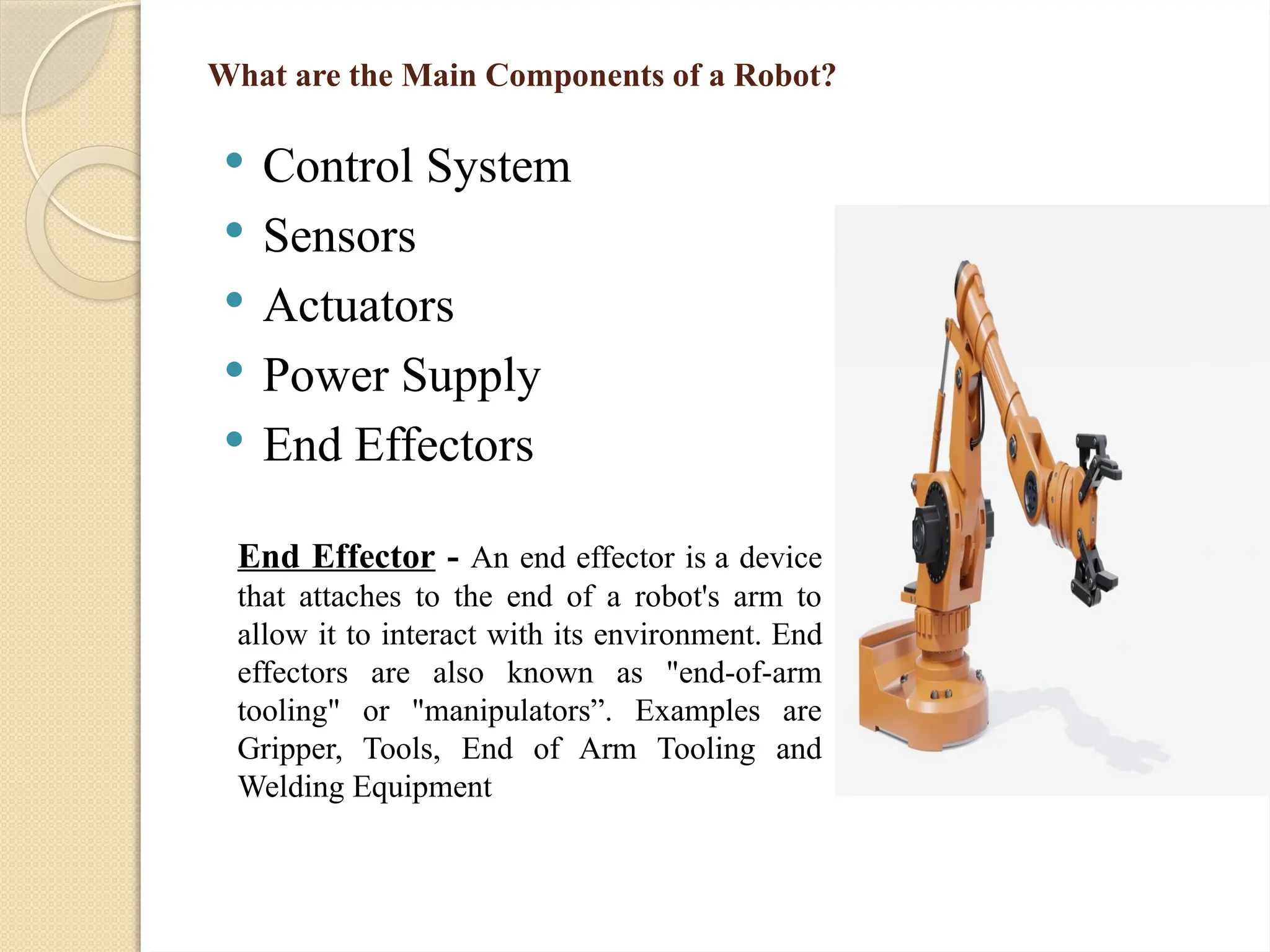
What are the Main Components of a Robot?
 Control System
 Sensors
 Actuators
 Power Supply
 End Effectors
End Effector - An end effector is a device
that attaches to the end of a robot's arm to
allow it to interact with its environment. End
effectors are also known as "end-of-arm
tooling" or "manipulators”. Examples are
Gripper, Tools, End of Arm Tooling and
Welding Equipment
Types of Robots
 Humanoid Robots - Humanoid robots are robots that look like or mimic
human behavior. These robots usually perform human-like activities (like
running, jumping and carrying objects), and are sometimes designed to
look like us, even having human faces and expressions.
 Cobots - Cobots or collaborative robots, are robots designed to work
alongside humans. These robots prioritize safety by using sensors to remain
aware of their surroundings, executing slow movements and ceasing
actions when their movements are obstructed.
 Industrial Robots - Industrial robots automate processes in manufacturing
environments like factories and warehouses. Possessing at least one robotic
arm, these robots are made to handle heavy objects while moving with
speed and precision. As a result, industrial robots often work in assembly
lines to boost productivity.
 Augmenting Robots - Augmenting robots, also known as VR robots,
either enhance current human capabilities or replace the capabilities a
human may have lost. The field of robotics for human augmentation is a
field where science fiction could become reality very soon, with bots that
have the ability to redefine the definition of humanity by making humans
faster and stronger.
Humonoid Robots
Cobots Industrial Robots Augmenting Robots
Continued…
 Medical Robots - Medical robots assist healthcare professionals in various
scenarios and support the physical and mental health of humans. These robots
rely on AI and sensors to navigate healthcare facilities, interact with humans
and execute precise movements.
 Agricultural Robots - Agricultural robots handle repetitive and labor-
intensive tasks, allowing farmers to use their time and energy more efficiently.
These robots also operate in greenhouses, where they monitor crops and help
with harvests. Agricultural robots come in many forms, ranging from
autonomous tractors to drones that collect data for farmers to analyze.
 Microrobotics - Microrobotics is the study and development of robots on a
miniature scale. Often no bigger than a millimeter, microrobots can vary in
size, depending on the situation. Biotech researchers typically use
microrobotics to monitor and treat diseases, with the goal of improving
diagnostic tools and creating more targeted solutions.
 Software Bots - Software bots, or simply ‘bots,’ are computer programs which
carry out tasks autonomously. They are not technically considered robots. One
common use case of software robots is a chatbot, which is a computer program
that simulates conversation both online and over the phone and is often used in
customer service scenarios.
Medical Robots
Agricultural Robots Microrobotics
Degree of Freedom
In robotics, degrees of freedom (DoF) is a term that refers
to the number of independent joints or axes of motion a
robot has. Each joint that can rotate around or extend along
a geometric axis is counted as a single DoF.
Here are some examples of how DoF can be applied to
different parts of a robot:
 Shoulder: A shoulder joint that can rotate in any
direction provides three DoF
 Elbow: An elbow joint that can bend in only one
direction provides one DoF
 Wrist: A wrist that can rotate in any direction provides
three DoF
Different Type of Joints and Degree of
Freedom
Robot Configurations
 Robots are mostly divided into four major configurations based on
their appearances, sizes, etc., including cylindrical configuration,
polar configuration, jointed arm configuration, and cartesian
coordinate configuration.
 Cartesian co-ordinate configuration (3P) –Three perpendicular
slides create a cartesian or rectangular coordinate system, which
only allows for linear motions along the three principal axes. There
are three prismatic joints in all. The arm's extremities have the
ability to function in a cuboidal space. The cartesian arm is simple
to program and provides excellent precision.
Continued…
 These robots are also called XYZ robots because they are equipped with
three rotary joints to assemble XYZ axes. The robots will process in a
rectangular workspace using these three joints movement. It can carry
high payloads with the help of its rigid structure. It is mainly integrated
with pick and place, material handling, loading, unloading, etc.
Advantages
• Highly accurate & speed,
• Fewer costs,
• Simple operating procedures, and
• High payloads.
Disadvantages
• Less work envelope, Reduced flexibility.
• Low dexterity (not able to move quickly and easily)
• Limited manipulability
Continued…
 Cylindrical configuration (R2P) - There is a revolute joint and
two perpendicular prismatic joints in the cylindrical shape. This
design makes use of a vertical column and a slide that slides up
and down the column. The robot arm may rotate radially around
the column and is attached to the slide. The robot may achieve a
workspace that resembles a cylinder by rotating the column. There
is good mechanical stiffness provided by the cylindrical form.
Advantages
• Increased rigidity, and
• Capacity to carry high payloads.
Disadvantages
• Floor space required is more, and
• Less work volume.
• Accuracy decreases as the horizontal stroke increases.
Continued…
 Polar configuration (2RP) - Polar robots, also known as
spherical robots, are a robot configuration with a combined linear
joint and two rotary joints, with an arm connected to a robotic base
and a twisting joint allowing the axes to create a spherical work
envelope and a polar coordinate system.
Advantages
• Long reach capability in the horizontal position.
Disadvantages
• Vertical reach is low
• Low mechanical stiffness
• Complex construction
• Accuracy decreases with the increasing radial stroke
Continued…
 Jointed arm (Articulate) configuration (3R) - Widely-used jointed
arm configuration all revolute similar to that of a human arm. It
comprises two straight links representing the human forearm and upper
arm and two rotary joints representing the elbow and shoulder joints,
which are mounted on a vertical rotary table corresponding to the
human waist joint. As a result, it can be controlled at any adjustments
in the workspace. These types of robots perform several operations like
spray painting, spot welding, arc welding, and more.
Advantages
• Increased flexibility,
• Huge work volume, and
• Quick operation.
Disadvantages
• Very expensive,
• Difficult operating procedures, and
• Plenty of components.
Continued…
 Selective Compliance Assembly Robot Arm (SCARA)(2R1P):
They have two revolute joints that are parallel and allow the robot to
move in a horizontal plane, plus an additional prismatic joint that
moves vertically. A SCARA robot is a special kind of robot that’s
used in factories and other places to do tasks that need a lot of
precision. SCARA robots are used in many industries, like making
electronics, cars, metal products, plastic items, and more.
Advantages
 Speed & Precision
 Compact Size & Cost-Efficiency
 SCARA robots can easily fit into existing system
Disadvantages
 Can’t Lift Heavy Things
 Not for Big Spaces
THANKYOU

MECHANICAL ENGINEERING AND AUTOMATION.pptx

  • 1.
  • 2.
  • 3.
    Outline of Presentation Elements of Automation Technology  Sensors  Actuators  Robotics
  • 4.
    Elements of AutomationTechnology What is Mechatronics ?  Mechatronics is an interdisciplinary field that combines mechanical, electrical, and computer engineering to create intelligent and automated systems. It focuses on designing and developing integrated systems that can sense, analyze, and control their environment.  Mechatronics is used in many industries, including manufacturing, healthcare, transportation, robotics, and more.
  • 5.
    Continued…  Mechatronics isthe control of mechanical motion with the help of electrical, electronics and computer system according to the required conditions.
  • 6.
    Continued… • Mechatronic systemsuse sensors, microprocessors, and control algorithms to monitor and regulate their own performance. • Mechatronics requires the collaboration of engineers from various disciplines to design and implement successful integrated systems.  Mechatronics creates advanced, flexible, and effective solutions by utilizing the mutually beneficial advantages of mechanical, electrical, and computer systems.
  • 7.
  • 8.
    Automation  Automation isthe application of technology, programs, robotics or processes to achieve outcomes with minimal human input.  Automation is transforming mechatronics by integrating modern technologies in order to improve industrial processes, productivity, accuracy, and efficiency.
  • 9.
  • 10.
    The Role ofAutomation in Mechatronics Systems  Increased Efficiency - Automated systems can perform tasks with greater speed, precision, and consistency compared to manual labor.  Enhanced Safety - Automation removes human operators from hazardous environments, reducing the risk of injuries and accidents.  Cost Savings - Automated processes can lower labor costs, minimize waste, and increase overall productivity and profitability.
  • 11.
    What is AutomatedManufacturing System ?  Automated manufacturing system integrates software and machinery so that manufacturing processes are run autonomously through computer programming.  They are called automated because they perform their operations with a reduced level of human participation compared with the corresponding manual process. In some highly automated systems, there is virtually no human participation. • Automated manufacturing systems have computerised controls built into the manufacturing equipment.
  • 12.
    Continued…  Every partof the production is scheduled and performed automatically.  Automated manufacturing system requires:  Automatic movement of material,  Precise scheduling,  Execution of all work steps,  Automatic monitoring of quality and safety  An automated manufacturing system has the ability to perform the following tasks: 1. Collecting data 2. Processing data 3. Performing work
  • 13.
    Continued…  Collecting data:Collects data from the environment through a wide range of sensors. A sensor is an input device that measures data from the environment, such as Temperature, Pressure, Motion, Flow and Light.  Processing data: Data is processed into information using a microcontrollers. A controller receives data from a sensor and changes it into information that can be used by the system. For example, sensors often collect data in analogue form, and this needs to be converted (organised) to digital form for use in the system. These data readings are then interpreted and processes to output an appropriate response in the automated system.
  • 14.
    Continued…  Performing work:In most cases, the product must be moved from one location to another during the series of processing steps. At each processing location, the accurate positioning of the product is generally required.  Actuators perform the actual work of the system, such as stopping a pump, moving a switch or turning on a light beam.
  • 15.
    Automation &Types ofautomation Automation is generally defined as the process of having Machines follow a predetermined sequence of operations With little or no human involvement, using specialized equipment And devices that perform and control manufacturing processes  Areas to implement the automation are :  Manufacturing process and operations  Material Handling  Inspection  Assembly  Packaging
  • 16.
    Continued… Three types ofautomation in production can be distinguished:  Fixed Automation,  Programmable Automation  Flexible Automation
  • 17.
    Types of Automation Fixed automation, also referred to as hard automation, is a system in which the automated production processes and assembly are preset to produce a single product. The sequence of production and operation is fixed by the configuration of tooling, equipment and machines allocated for high-production needs.  Flexible automation is a type of manufacturing automation which exhibits some form of “flexibility”. Most commonly this flexibility is the capability of making different products in a short time frame. This “process flexibility” allows the production of different part types with overlapping life-cycles. Flexible automation allows the production of a variety of part types in small or unit batch sizes. Flexible Automation is the ability for a robot or system to be quickly and easily re-tasked to change product design for both low and high mix manufacturing  Programmable automation: A numerical-control machine tool is a good example of programmable automation. The program is coded in computer memory for each different product style, and the machine tool is controlled by the computer program. Industrial robots are another example. Flexible automation is an extension of programmable automation.
  • 18.
    Sensors  Sensors aredevices that detect and respond to physical stimuli, converting them into electrical signals for processing.  Sensors are used extensively in industrial automation, robotics, smart home systems, and a wide range of other applications.  Sensors provide real-time data, allowing for constant monitoring and adjustment of processes and systems.
  • 19.
  • 20.
    Basic Classifications ofSensors  In the first classification of the sensors(based on working principle), they are divided in to Active and Passive.  Active Sensors are those which require an external excitation signal or a power signal.  Passive Sensors, on the other hand, do not require any external power signal and directly generates output response.  The other type of classification is based on the means of detection used in the sensor. Some of the means of detection are Electric, Biological, Chemical, Radioactive etc.  The next classification is based on conversion phenomenon i.e., the input and the output. Some of the common conversion phenomena are Photoelectric, Thermoelectric, Electrochemical, Electromagnetic, Thermooptic, etc.
  • 21.
    Continued…  The finalclassification of the sensors are Analog and Digital Sensors. Analog Sensors produce an analog output i.e., a continuous output signal (usually voltage but sometimes other quantities like Resistance etc.) with respect to the quantity being measured.  Digital Sensors, in contrast to Analog Sensors, work with discrete or digital data. The data in digital sensors, which is used for conversion and transmission, is digital in nature.
  • 22.
    Advantages of Sensors Sensors can automate responsibilities and methods, growing performance and accuracy.  Sensors may be used to screen situations and collect records in real-time, taking into account brief and knowledgeable choice-making.  Sensors may be used to screen and manipulate structures remotely, permitting faraway operation and maintenance.  Sensors may be used to enhance protection by detecting fuel line leaks or the presence of human beings or items in dangerous regions.  Sensors may be used to preserve resources, adjust the construction temperature based totally on occupancy or turn off lighting while a room isn't in use.  Sensors can be used to track the outstanding quality of the air or water, identify flaws in production processes, and improve the exceptional quality of goods and services.  By enabling self-riding cars or adding contact or gesture controls to smartphones, sensors can enhance the functionality of products and devices.
  • 23.
    Disadvantages of Sensors Sensors may be expensive, in particular, if they're excessive-precision or specialized.  Sensors may be tormented by interference from different sources, electromagnetic fields, or sensors.  Sensors might also have restrained resolution, which means they'll no longer be capable of locating small adjustments within the bodily belongings they're measuring.  Sensors may not be appropriate for all environments, as a few sensors may not be capable of facing up to excessive ranges of moisture or dust.  Sensors also enhance privacy issues if they're used to collect non-public records, together with area or biometric information.
  • 24.
    Types of Sensorsbased on the application  Temperature sensors: These sensors degree temperature and are utilized in various programs, such as thermostats, ovens, and climate stations.  Pressure sensors: These sensors degree stress ever realized in several programs, such as tire stress monitors, altimeters, and air stress gauges.  Motion sensors: These sensors locate motion and are utilized in protection structures, computerized light structures, and online game controllers.  Chemical sensors: These sensors locate the presence or awareness of precise chemical substances and are utilized in air exceptional monitors, breath analyzers, and meal protection monitors.  Light sensors: These sensors locate mild and are utilized in cameras, automated door openers, and streetlights.  Sound sensors: These sensors locate sound and are utilized in noise-canceling headphones.  Proximity sensors: These sensors locate the presence of close by items and are utilized in smartphones, laptops, and robotics.  Magnetic sensors: These sensors locate a magnetic area and are utilized in compass apps and door sensors.
  • 25.
    Applications  Automotive andMotorsport – in this industry, displacement sensors can be used for steering systems on agricultural machinery, electric cart throttle control, the suspension on bikes and many other applications.  Factory Automation – displacement sensors can be used for conveyor speed measurement, labelling machines and control, printing processes and packaging.  Medical Applications – displacement sensors are used on medical pieces of machinery such as MRI or oncology machines.  Security Applications - displacement sensors can be used in security applications, for example, monitoring the angle of a CCTV camera.  Barriers and bridges – displacement sensors are used to position various types of barriers; these could be for pedestrians or vehicles. Moving bridges and ramps also use displacement sensors to control the positions they are fixated in.  Patient monitoring in medical applications – Temperature sensors are used to monitor the patients temperature in medical facilities.
  • 26.
    Continued  Manufacturing andindustrial equipment – Temperature sensors are used within machines to ensure they do not overheat and become unsafe.  Agriculture Applications – Steering systems in agricultural machinery use both rotary and linear position sensors.  Aerospace Applications – Position sensors are used for wing flap position measurement as well as other applications integral to the safety of passengers.  HVAC Applications – Pressure transducers are used for monitoring heater pumps, cooling liquids and to monitor liquid levels within HVAC  Medical Applications – Pressure switches are used to monitor levels in oxygen tanks, they are also used on DNA sampling machinery and other medical devices. Pressure transducers are also used within medical devices.
  • 28.
    Actuators  Actuators aredevices that convert energy into motion or force to interact with and control physical systems.  Actuators are essential components in automated systems, responsible for executing the desired actions based on sensor data and control algorithms.  Actuators are used in a wide range of applications, including industrial machinery, robotics, valves, and more.
  • 29.
    Types of Actuators Electric Actuators: Use electric motors to generate motion and force.  Hydraulic Actuators: Utilize pressurized fluid to produce linear or rotary motion.  Pneumatic Actuators: Employ compressed air to create mechanical movement.  Servo Actuators: Provide precise position and speed control for industrial applications.
  • 30.
    Pros & Consof Hydraulic, Pneumatic, and Electric Linear Actuators Advantages of Hydraulic Linear Actuators  Hydraulic actuators can hold a constant force without the pump supplying more fluid due to the use of an incompressible fluid.  They can produce very high forces and speeds.  It can produce high speeds. Disadvantages of Hydraulic Linear Actuators  Hydraulic fluid can leak, which leads to a loss in efficiency. This can also lead to cleanliness issues.  Require many accompanying components including a fluid reservoir, pumps, motors, release valves, heat exchangers, and noise reduction equipment.  High maintenance systems with numerous components to monitor constantly.
  • 31.
    Continued… Advantages of PneumaticLinear Actuators  A pneumatic linear actuator is very simple. Most aluminium cylinders have optimal maximum pressure ratings which allows for a range of forces.  A pneumatic linear actuator is often used in areas of extreme temperatures due to the safety of using air rather than hazardous chemicals or electricity.  It is a low-cost option. Disadvantages of Pneumatic Linear Actuators  Pressure losses and the compressibility of air make pneumatic devices less capable than other linear motion methods. A compressor must run continuously to maintain the operating pressure even if there is no movement needed.  Pneumatic actuators must be sized for a specific job in order to be efficient. This requires proportional sized valves, regulators, and compressors which raises the cost and complexity.  The air can be contaminated by oil or lubrication, leading to downtime and maintenance. 
  • 32.
    Continued… Advantages of ElectricLinear Actuators  Electric actuators offer the highest precision.  Scalable for any purpose or force requirement.  They can be easily networked and programmed quickly. Immediate feedback for diagnostics and maintenance is available.  They provide complete control of motion, offering custom speeds, stroke lengths, and applied forces.  They are quieter than pneumatic and hydraulic actuators. Disadvantages of Electric Linear Actuators  The initial cost is greater than that of pneumatic and hydraulic actuators.  They are not suitable for all conditions, whereas a pneumatic actuator is safe in hazardous and flammable areas.  The electric motors can be large.
  • 33.
    Application of PneumaticActuators  Automobile Engine Pneumatic actuators are used in a variety of automotive applications, including engine control, transmission control, and braking systems. Pneumatic actuators offer many advantages over hydraulic and electric actuators, including higher power density, lower weight, and more precise control.  Material Handling Pneumatic actuators are widely used in material handling applications. They are well suited for these applications because they can provide high force output with a relatively small footprint. Additionally, pneumatic actuators are often used in applications where precise control is required, such as in pick-and-place operations.  Pneumatic cylinders are the most common type of pneumatic actuator and are well-suited for use in material handling applications.  Food And Beverage Production Pneumatic actuators are used extensively in the food and beverage production industry due to their versatility, reliability, and cost-effectiveness. They are commonly used in conveyor systems to move products from one stage of production to the next, as well as in packaging and labelling machines.  Pneumatic actuators can also be used in process control applications such as regulating the flow of liquids and gases or controlling the temperature of ovens and other cooking equipment. In addition, these actuators are often used in sanitation applications due to their ability to withstand harsh cleaning chemicals.
  • 34.
    Pneumatic Braking SystemPick and Place Food And Beverage Pneumatic Flow Control Valve
  • 35.
    Applications of HydraulicActuators  These are used in high force-based applications.  These are used for various applications like crane drives, winches, self-driven cranes, excavators, wheel motors in military vehicles, feeder drives, agitator drives & mixer, roll mills, trammels & kilns, drum drives for digesters, shredders for cars, tires, drilling rigs, high-powered lawn trimmers & trench cutters.  Hydraulic jack  Highly precise positioning for heavy loads  Hydraulic brake
  • 36.
    Applications of Hydraulic Actuators Cranes Shreddersfor cars Trench cutters Hydraulic jack
  • 37.
    What Is Robotics? It is the interdisciplinary study and practice of the design, construction, operation, and use of robots. It is the intersection of science, engineering and technology that produces machines, called robots, that replicate or substitute for human actions.  Robots perform basic and repetitive tasks with greater efficiency and accuracy than humans, making them ideal for industries like manufacturing.
  • 38.
    What is aRobot?  A robot is a programmable machine that can complete a task, while the term robotics describes the field of study focused on developing robots and automation.  Each robot has a different level of autonomy. These levels range from human-controlled bots that carry out tasks to fully-autonomous bots that perform tasks without any external influences.
  • 39.
    What are theMain Components of a Robot?  Control System  Sensors  Actuators  Power Supply  End Effectors End Effector - An end effector is a device that attaches to the end of a robot's arm to allow it to interact with its environment. End effectors are also known as "end-of-arm tooling" or "manipulators”. Examples are Gripper, Tools, End of Arm Tooling and Welding Equipment
  • 40.
    Types of Robots Humanoid Robots - Humanoid robots are robots that look like or mimic human behavior. These robots usually perform human-like activities (like running, jumping and carrying objects), and are sometimes designed to look like us, even having human faces and expressions.  Cobots - Cobots or collaborative robots, are robots designed to work alongside humans. These robots prioritize safety by using sensors to remain aware of their surroundings, executing slow movements and ceasing actions when their movements are obstructed.  Industrial Robots - Industrial robots automate processes in manufacturing environments like factories and warehouses. Possessing at least one robotic arm, these robots are made to handle heavy objects while moving with speed and precision. As a result, industrial robots often work in assembly lines to boost productivity.  Augmenting Robots - Augmenting robots, also known as VR robots, either enhance current human capabilities or replace the capabilities a human may have lost. The field of robotics for human augmentation is a field where science fiction could become reality very soon, with bots that have the ability to redefine the definition of humanity by making humans faster and stronger.
  • 41.
    Humonoid Robots Cobots IndustrialRobots Augmenting Robots
  • 42.
    Continued…  Medical Robots- Medical robots assist healthcare professionals in various scenarios and support the physical and mental health of humans. These robots rely on AI and sensors to navigate healthcare facilities, interact with humans and execute precise movements.  Agricultural Robots - Agricultural robots handle repetitive and labor- intensive tasks, allowing farmers to use their time and energy more efficiently. These robots also operate in greenhouses, where they monitor crops and help with harvests. Agricultural robots come in many forms, ranging from autonomous tractors to drones that collect data for farmers to analyze.  Microrobotics - Microrobotics is the study and development of robots on a miniature scale. Often no bigger than a millimeter, microrobots can vary in size, depending on the situation. Biotech researchers typically use microrobotics to monitor and treat diseases, with the goal of improving diagnostic tools and creating more targeted solutions.  Software Bots - Software bots, or simply ‘bots,’ are computer programs which carry out tasks autonomously. They are not technically considered robots. One common use case of software robots is a chatbot, which is a computer program that simulates conversation both online and over the phone and is often used in customer service scenarios.
  • 43.
  • 44.
    Degree of Freedom Inrobotics, degrees of freedom (DoF) is a term that refers to the number of independent joints or axes of motion a robot has. Each joint that can rotate around or extend along a geometric axis is counted as a single DoF. Here are some examples of how DoF can be applied to different parts of a robot:  Shoulder: A shoulder joint that can rotate in any direction provides three DoF  Elbow: An elbow joint that can bend in only one direction provides one DoF  Wrist: A wrist that can rotate in any direction provides three DoF
  • 45.
    Different Type ofJoints and Degree of Freedom
  • 46.
    Robot Configurations  Robotsare mostly divided into four major configurations based on their appearances, sizes, etc., including cylindrical configuration, polar configuration, jointed arm configuration, and cartesian coordinate configuration.  Cartesian co-ordinate configuration (3P) –Three perpendicular slides create a cartesian or rectangular coordinate system, which only allows for linear motions along the three principal axes. There are three prismatic joints in all. The arm's extremities have the ability to function in a cuboidal space. The cartesian arm is simple to program and provides excellent precision.
  • 47.
    Continued…  These robotsare also called XYZ robots because they are equipped with three rotary joints to assemble XYZ axes. The robots will process in a rectangular workspace using these three joints movement. It can carry high payloads with the help of its rigid structure. It is mainly integrated with pick and place, material handling, loading, unloading, etc. Advantages • Highly accurate & speed, • Fewer costs, • Simple operating procedures, and • High payloads. Disadvantages • Less work envelope, Reduced flexibility. • Low dexterity (not able to move quickly and easily) • Limited manipulability
  • 48.
    Continued…  Cylindrical configuration(R2P) - There is a revolute joint and two perpendicular prismatic joints in the cylindrical shape. This design makes use of a vertical column and a slide that slides up and down the column. The robot arm may rotate radially around the column and is attached to the slide. The robot may achieve a workspace that resembles a cylinder by rotating the column. There is good mechanical stiffness provided by the cylindrical form. Advantages • Increased rigidity, and • Capacity to carry high payloads. Disadvantages • Floor space required is more, and • Less work volume. • Accuracy decreases as the horizontal stroke increases.
  • 49.
    Continued…  Polar configuration(2RP) - Polar robots, also known as spherical robots, are a robot configuration with a combined linear joint and two rotary joints, with an arm connected to a robotic base and a twisting joint allowing the axes to create a spherical work envelope and a polar coordinate system. Advantages • Long reach capability in the horizontal position. Disadvantages • Vertical reach is low • Low mechanical stiffness • Complex construction • Accuracy decreases with the increasing radial stroke
  • 50.
    Continued…  Jointed arm(Articulate) configuration (3R) - Widely-used jointed arm configuration all revolute similar to that of a human arm. It comprises two straight links representing the human forearm and upper arm and two rotary joints representing the elbow and shoulder joints, which are mounted on a vertical rotary table corresponding to the human waist joint. As a result, it can be controlled at any adjustments in the workspace. These types of robots perform several operations like spray painting, spot welding, arc welding, and more. Advantages • Increased flexibility, • Huge work volume, and • Quick operation. Disadvantages • Very expensive, • Difficult operating procedures, and • Plenty of components.
  • 51.
    Continued…  Selective ComplianceAssembly Robot Arm (SCARA)(2R1P): They have two revolute joints that are parallel and allow the robot to move in a horizontal plane, plus an additional prismatic joint that moves vertically. A SCARA robot is a special kind of robot that’s used in factories and other places to do tasks that need a lot of precision. SCARA robots are used in many industries, like making electronics, cars, metal products, plastic items, and more. Advantages  Speed & Precision  Compact Size & Cost-Efficiency  SCARA robots can easily fit into existing system Disadvantages  Can’t Lift Heavy Things  Not for Big Spaces
  • 52.

Editor's Notes

  • #16 Three types of automation in production can be distinguished: (1) fixed automation, (2) programmable automation (3) flexible automation