5th Practical Exercise
Optometry
Second Faculty of Medicine, Charles University
General Medicine, 1st year
Biophysics
Practical Exercises
Measurement of eye refraction
This slides show you how we get a record from Autorefractor.
Principle
For an objective examination of visual acuity different instruments are in use.
In the present task we shall use an autorefractor (automatic refractometer)
Canon R-F10. Autorefractors contain a system relaxing accommodation and
preventing the formation of instrumental myopia. A slide observed by the
patient hazes before and during the measurement. Using the infrared light
and four photoelements, the refractometer evaluates and determines –
measuring speed, quality and reflection direction – eye refraction. After
locating and focusing the eye, the device emits light ray which is reflected
from the retina and detected by a CCD camera.
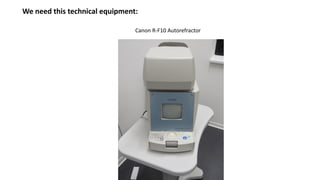
We need this technical equipment:
Canon R-F10 Autorefractor
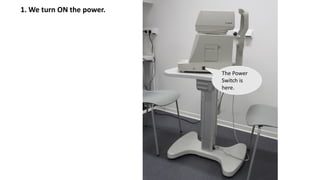
1. We turn ON the power.
The Power
Switch is
here.
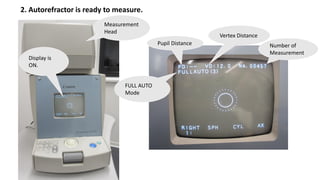
2. Autorefractor is ready to measure.
Display is
ON.
Pupil Distance
FULL AUTO
Mode
Vertex Distance
Number of
Measurement
Measurement
Head
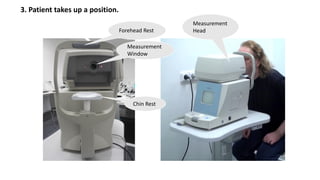
3. Patient takes up a position.
Chin Rest
Forehead Rest
Measurement
Window
Measurement
Head
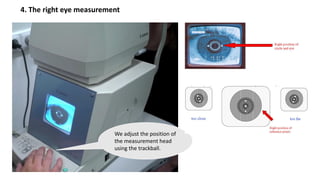
4. The right eye measurement
We adjust the position of
the measurement head
using the trackball.
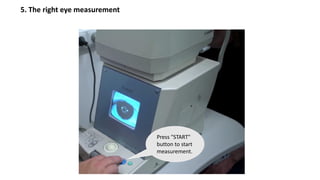
5. The right eye measurement
Press "START"
button to start
measurement.
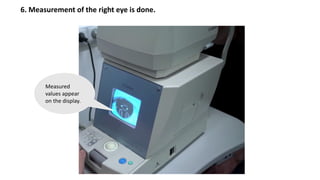
6. Measurement of the right eye is done.
Measured
values appear
on the display.
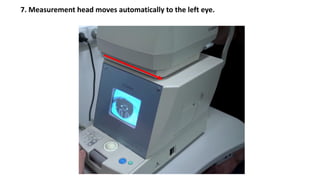
7. Measurement head moves automatically to the left eye.
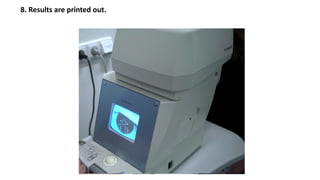
8. Results are printed out.
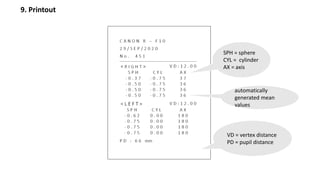
9. Printout
SPH = sphere
CYL = cylinder
AX = axis
VD = vertex distance
PD = pupil distance
automatically
generated mean
values
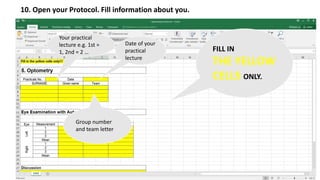
10. Open your Protocol. Fill information about you.
Your practical
lecture e.g. 1st =
1, 2nd = 2 …
Date of your
practical
lecture
Group number
and team letter
FILL IN
THE YELLOW
CELLS ONLY.
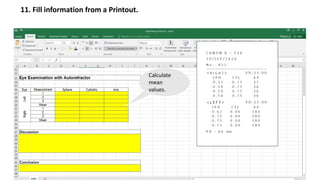
11. Fill information from a Printout.
Calculate
mean
values.
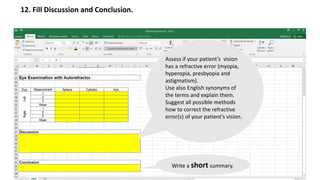
12. Fill Discussion and Conclusion.
Assess if your patient’s vision
has a refractive error (myopia,
hyperopia, presbyopia and
astigmatism).
Use also English synonyms of
the terms and explain them.
Suggest all possible methods
how to correct the refractive
error(s) of your patient’s vision.
Write a short summary.

Optometry

  • 1.
    5th Practical Exercise Optometry SecondFaculty of Medicine, Charles University General Medicine, 1st year Biophysics Practical Exercises Measurement of eye refraction
  • 2.
    This slides showyou how we get a record from Autorefractor. Principle For an objective examination of visual acuity different instruments are in use. In the present task we shall use an autorefractor (automatic refractometer) Canon R-F10. Autorefractors contain a system relaxing accommodation and preventing the formation of instrumental myopia. A slide observed by the patient hazes before and during the measurement. Using the infrared light and four photoelements, the refractometer evaluates and determines – measuring speed, quality and reflection direction – eye refraction. After locating and focusing the eye, the device emits light ray which is reflected from the retina and detected by a CCD camera.
  • 3.
    We need thistechnical equipment: Canon R-F10 Autorefractor
  • 4.
    1. We turnON the power. The Power Switch is here.
  • 5.
    2. Autorefractor isready to measure. Display is ON. Pupil Distance FULL AUTO Mode Vertex Distance Number of Measurement Measurement Head
  • 6.
    3. Patient takesup a position. Chin Rest Forehead Rest Measurement Window Measurement Head
  • 7.
    4. The righteye measurement We adjust the position of the measurement head using the trackball.
  • 8.
    5. The righteye measurement Press "START" button to start measurement.
  • 9.
    6. Measurement ofthe right eye is done. Measured values appear on the display.
  • 10.
    7. Measurement headmoves automatically to the left eye.
  • 11.
    8. Results areprinted out.
  • 12.
    9. Printout SPH =sphere CYL = cylinder AX = axis VD = vertex distance PD = pupil distance automatically generated mean values
  • 13.
    10. Open yourProtocol. Fill information about you. Your practical lecture e.g. 1st = 1, 2nd = 2 … Date of your practical lecture Group number and team letter FILL IN THE YELLOW CELLS ONLY.
  • 14.
    11. Fill informationfrom a Printout. Calculate mean values.
  • 15.
    12. Fill Discussionand Conclusion. Assess if your patient’s vision has a refractive error (myopia, hyperopia, presbyopia and astigmatism). Use also English synonyms of the terms and explain them. Suggest all possible methods how to correct the refractive error(s) of your patient’s vision. Write a short summary.