Updated management of Autoimmune
hemolytic anemia
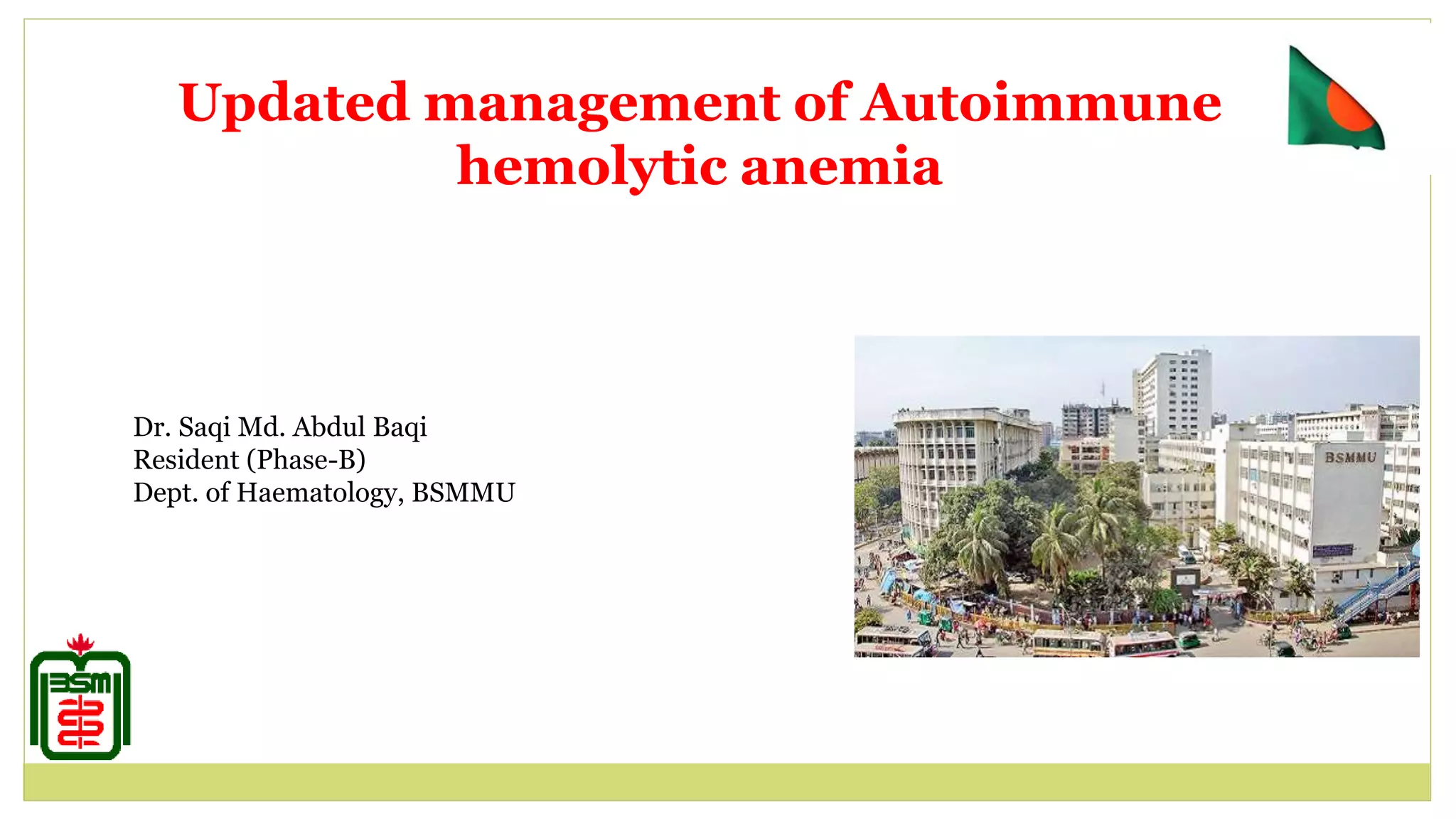
Dr. Saqi Md. Abdul Baqi
Resident (Phase-B)
Dept. of Haematology, BSMMU
 Autoimmune hemolytic anemia (AIHA) is an uncommon disorder
characterized by shortened red blood cell (RBC) survival and the
presence of autoantibodies directed against autologous RBCs
 Incidence : 1–3 cases per 100,000 subjects per year
 Prevalence : 17:100,000
 Mortality rate : 11%
 Presentation
 Clinical : anemia, jaundice, and splenomegaly
 Laboratory : reticulocytosis, unconjugated hyperbilirubinemia,
and direct antiglobulin test (DAT) positivity
Introduction
 On the basis of thermal range of autoantibodies involved in
the pathogenesis:
 Warm AIHA (75% of all AIHA cases)
 Cold AIHA (about 15%)
 Mixed type AIHA (less than 5%)
 According to etiology
 Idiopathic (50%)
 Secondary to lymphoproliferative syndromes (20%),
autoimmune diseases (20%), infections, tumors and drugs
Classification
Laboratory diagnosis
Direct antiglobulin test (DAT) which shows positivity with
anti-IgG (usually in warm AIHA) and/or anti-C3d (usually in
cold AIHA) antisera
Laboratory findings supporting hemolysis such as
 Unconjugated hyperbilirubinemia
 Increase of serum lactate dehydrogenase (LDH)
 Reticulocytosis and spherocytosis in peripheral blood
smears
Treatment of warm AIHA
The first-line therapy is corticosteroids
Starting dose of prednisolone : 1.0 to 1.5 mg/kg per day or a
flat dose of 60 to 100 mg daily
The starting dose is maintained for at least 2 weeks and
until achievement of hemoglobin >12 g/dL. Thereafter,
taper the prednisone by 20mg every week until a dose of
20mg daily is reached, followed by a slower taper over 4 to
8 weeks
Response occurs mainly during the second week, and if
none or minimal improvement is observed in the third
week, this therapy is assumed to be ineffective
Corticosteroids provide a response in 70-85% of patients
Only 1 in 3 cases remain in long term remission once the drug
is discontinued
50% cases require maintenance doses
20-30% cases need additional second-line therapies
For refractory/relapsed cases, the current sequence of second-
line therapy is
 Splenectomy (effective approx. in 2 out of 3 cases but with a
presumed cure rate of up to 20%)
 Rituximab (effective in approx. 80-90% of cases)
 Thereafter any of the immunosuppressive drugs (azathioprine,
cyclophosphamide, cyclosporin, mycophenolate mofetil)
Additional therapies are intravenous immunoglobulins,
danazol, plasma-exchange, and alemtuzumab and high-dose
cyclophosphamide
Most of the immunosuppressive drugs have many deleterious
side-effects and the onset of action is slow
Splenectomy carries the risk of an overwhelming post
splenectomy sepsis
Rituximab (so called “medical splenectomy”) is an effective
second-line therapy, can work quickly with lasting effects,
providing high initial response rates up to 87% and
prolonged disease free survivals of 56% up to 2 years with
reduced adverse reactions
For warm AIHA, rituximab therapy is considered as a second
line option as monotherapy or combined therapy
It can also be used as a first line therapy in combination with
steroids for newly diagnosed patients
Another option is the use of therapeutic plasma exchange
(TPE) to quickly reduce the pathologic antibody titer in
patients with an overwhelming hemolysis
TPE can be performed in severely affected warm AIHA
patients in whom the anemia could not be stabilized with
steroids and transfusion therapy alone, as a temporizing
measure which seemed to stabilize the disease and increase
the efficiency of blood transfusion
Current indication categories endorsed by the American
Association of Blood Banks (AABB) and the American
Society for Apheresis, TPE for AIHA is considered as a
category III indication, i.e. an application representing
“heroic or last-ditch efforts on behalf of a patient’’
Decision to transfuse RBC in AIHA should be based on the
clinical condition of the patient. No critical patient should be
denied blood transfusion due to serological incompatibility
and “the least incompatible” RBC should be transfused in
this situation
Treatment of CAD
Supportive measures aimed at avoiding cold exposures
 Adequate clothing for cold weather
 Keeping indoor thermostat at higher set points
 Avoidance of icy drinks and cold showers
 Application of body warming blankets and pre warming of
IV fluids and blood products may minimize the
exacerbation of the hemolysis
 CAD associated with infections is usually self-limited and
generally does not require treatment
 It is necessary to treat the underlying lymphoproliferative
disorder if this is present.
 Consider systemic treatment when there are substantial or
disabling signs or symptoms despite supportive measures. These
include
 Cold-induced manifestations such as acrocyanosis or
Raynaud phenomenon
 Clinical sequelae of anemia and hemolysis
 Response to steroids has never been supported by systematic
studies
 Effective in a small fraction of cases (14-35%)
 Usually requiring unacceptably high doses in order to maintain
the remission
 Therefore, this treatment, although still widely used in the
clinical practice, is now discouraged
Single-agent rituximab is currently considered the first-line
systemic therapy (effective in approximately 60% of cases,
with a response duration of one year, the median time to
response was 1-2 months)
Combination of rituximab and prednisolone achieved a
relatively shorter median time to response, more CRs, and
fewer relapses, suggesting a potential additive effect
Plasmapheresis may be useful in acute hemolytic crisis and
before surgery requiring hypothermia, although its effect is
transient
 Splenectomy is usually ineffective due to the fact that clearance of
C3b opsonized erythrocytes primarily occurs in the liver
 Treatment of relapse or refractory disease
 Treatments reported to have nearly no response are azathioprine
and cladribine
 Treatments reported to be effective are
 Bortezomib
 Eculizumab,
 Rituximab/bendamustine
 Rituximab/cyclophosphamide
 Rituximab/fludarabine/cyclophosphamide
Case report
A 67-year-old diabetic man presented with new-onset fatigue
and dizziness. On physical examination, patient was severely
anemic, mildly icteric and had just palpable splenomegaly
Laboratory test results were significant for hemoglobin (5.7
g/dL), ESR (140 mm in 1st hour), PBF (RBC showed
spherocytosis, clumping & frequent nRBC), lactate
dehydrogenase (LDH; 2749 U/L), total bilirubin (5.8 mg/dL)
and DAT (showed strong positivity)
Case report
Treatment was started with high dose corticosteroid
(Dexamethasone 5mg i/v 8hourly). Out of 10 donors only 1
was found least incompatible and thus only 1 unit of RCC can
be transfused to the patient. A further decrease in
hemoglobin was observed on day 3 of corticosteroid therapy
and blood glucose level was rising despite of insulin therapy.
Further RCC transfusion was not possible because of donor
incompatibility. The patient’s clinical condition was
gradually becoming worsened significantly
Case report
TPE was therefore started under intensive care monitoring
on day 5. TPE was performed on every alternate day for 5
times. The patient was in better clinical condition after the
procedures. There after 2 units of RCC was transfused. After
that he was hemodynamically stable and has not shown any
further hemolytic phenomena. Then Azathioprine (50mg
b.d) was added and tapering of dexamethasone had to be
started because of uncontrolled DM. But few days later,
hemoglobin was again gradually decreasing & ESR was rising
Case report
Then inj. Rituximab (375mg/m2 weekly for 4 weeks) was
started along with Azathioprine. After the 1st dose of
Rituximab, he was gradually improving and successfully
completed remaining 3 doses without any major adverse
reactions with further improvement of clinical conditions.
Since then no further transfusion support was required and
the patient is now on Azathioprine only
Case report
 Plasma exchange has been used in the therapy of a widevariety of
disorders, particularly those associated with awell-documented or
suspected immunologic pathogenesis. It sounded rationale to use
plasma exchange to remove antibodiesas a supportive treatment to
sustain the vital functionsof the patient, until immunosuppressive
therapybecame effective. The American Society for Apheresis
suggeststhe usage of TPE in AIHA as an emergency measure. TPE can
be used to maintain acceptable hemoglobin levels, remove free
hemoglobin, reduce the title of auto-antibodies and sustain
cardiopulmonary functions. Therapy with rituximab is well tolerated,
effective and has a shorter time of onset compared to the other
immunosuppressive agents and provides a prolonged remission with a
relatively short course of steroid therapy.
 Our patient had severe disease, manifested by the rapid development of
anemia in less than 96h, minimal reticulocytosis, hemoglobinuria and a
poor response to conventional therapy.
Case report
In summary, our patient presented with a severe, life-
threatening AIHA not responsive to conventional therapy.
TPE was initiated on emergency basis to quickly and
temporarily reduce the over whelming titer of pathologic
antibody. This was demonstrated by an improved
reticulocytosis and a reduction in the net change in
hemoglobin following TPE. Rituximab was added as an
immunosuppressant that provided prolonged remission from
the overwhelming hemolysis. The combination of all the
modalities resulted in the successful management of this
severe case of AIHA.

Autoimmune hemolytic anemia

  • 1.
    Updated management ofAutoimmune hemolytic anemia Dr. Saqi Md. Abdul Baqi Resident (Phase-B) Dept. of Haematology, BSMMU
  • 2.
     Autoimmune hemolyticanemia (AIHA) is an uncommon disorder characterized by shortened red blood cell (RBC) survival and the presence of autoantibodies directed against autologous RBCs  Incidence : 1–3 cases per 100,000 subjects per year  Prevalence : 17:100,000  Mortality rate : 11%  Presentation  Clinical : anemia, jaundice, and splenomegaly  Laboratory : reticulocytosis, unconjugated hyperbilirubinemia, and direct antiglobulin test (DAT) positivity Introduction
  • 3.
     On thebasis of thermal range of autoantibodies involved in the pathogenesis:  Warm AIHA (75% of all AIHA cases)  Cold AIHA (about 15%)  Mixed type AIHA (less than 5%)  According to etiology  Idiopathic (50%)  Secondary to lymphoproliferative syndromes (20%), autoimmune diseases (20%), infections, tumors and drugs Classification
  • 4.
    Laboratory diagnosis Direct antiglobulintest (DAT) which shows positivity with anti-IgG (usually in warm AIHA) and/or anti-C3d (usually in cold AIHA) antisera Laboratory findings supporting hemolysis such as  Unconjugated hyperbilirubinemia  Increase of serum lactate dehydrogenase (LDH)  Reticulocytosis and spherocytosis in peripheral blood smears
  • 5.
    Treatment of warmAIHA The first-line therapy is corticosteroids Starting dose of prednisolone : 1.0 to 1.5 mg/kg per day or a flat dose of 60 to 100 mg daily The starting dose is maintained for at least 2 weeks and until achievement of hemoglobin >12 g/dL. Thereafter, taper the prednisone by 20mg every week until a dose of 20mg daily is reached, followed by a slower taper over 4 to 8 weeks Response occurs mainly during the second week, and if none or minimal improvement is observed in the third week, this therapy is assumed to be ineffective
  • 6.
    Corticosteroids provide aresponse in 70-85% of patients Only 1 in 3 cases remain in long term remission once the drug is discontinued 50% cases require maintenance doses 20-30% cases need additional second-line therapies For refractory/relapsed cases, the current sequence of second- line therapy is  Splenectomy (effective approx. in 2 out of 3 cases but with a presumed cure rate of up to 20%)  Rituximab (effective in approx. 80-90% of cases)  Thereafter any of the immunosuppressive drugs (azathioprine, cyclophosphamide, cyclosporin, mycophenolate mofetil)
  • 8.
    Additional therapies areintravenous immunoglobulins, danazol, plasma-exchange, and alemtuzumab and high-dose cyclophosphamide Most of the immunosuppressive drugs have many deleterious side-effects and the onset of action is slow Splenectomy carries the risk of an overwhelming post splenectomy sepsis
  • 9.
    Rituximab (so called“medical splenectomy”) is an effective second-line therapy, can work quickly with lasting effects, providing high initial response rates up to 87% and prolonged disease free survivals of 56% up to 2 years with reduced adverse reactions For warm AIHA, rituximab therapy is considered as a second line option as monotherapy or combined therapy It can also be used as a first line therapy in combination with steroids for newly diagnosed patients
  • 10.
    Another option isthe use of therapeutic plasma exchange (TPE) to quickly reduce the pathologic antibody titer in patients with an overwhelming hemolysis TPE can be performed in severely affected warm AIHA patients in whom the anemia could not be stabilized with steroids and transfusion therapy alone, as a temporizing measure which seemed to stabilize the disease and increase the efficiency of blood transfusion
  • 11.
    Current indication categoriesendorsed by the American Association of Blood Banks (AABB) and the American Society for Apheresis, TPE for AIHA is considered as a category III indication, i.e. an application representing “heroic or last-ditch efforts on behalf of a patient’’ Decision to transfuse RBC in AIHA should be based on the clinical condition of the patient. No critical patient should be denied blood transfusion due to serological incompatibility and “the least incompatible” RBC should be transfused in this situation
  • 12.
    Treatment of CAD Supportivemeasures aimed at avoiding cold exposures  Adequate clothing for cold weather  Keeping indoor thermostat at higher set points  Avoidance of icy drinks and cold showers  Application of body warming blankets and pre warming of IV fluids and blood products may minimize the exacerbation of the hemolysis  CAD associated with infections is usually self-limited and generally does not require treatment  It is necessary to treat the underlying lymphoproliferative disorder if this is present.
  • 13.
     Consider systemictreatment when there are substantial or disabling signs or symptoms despite supportive measures. These include  Cold-induced manifestations such as acrocyanosis or Raynaud phenomenon  Clinical sequelae of anemia and hemolysis  Response to steroids has never been supported by systematic studies  Effective in a small fraction of cases (14-35%)  Usually requiring unacceptably high doses in order to maintain the remission  Therefore, this treatment, although still widely used in the clinical practice, is now discouraged
  • 14.
    Single-agent rituximab iscurrently considered the first-line systemic therapy (effective in approximately 60% of cases, with a response duration of one year, the median time to response was 1-2 months) Combination of rituximab and prednisolone achieved a relatively shorter median time to response, more CRs, and fewer relapses, suggesting a potential additive effect Plasmapheresis may be useful in acute hemolytic crisis and before surgery requiring hypothermia, although its effect is transient
  • 15.
     Splenectomy isusually ineffective due to the fact that clearance of C3b opsonized erythrocytes primarily occurs in the liver  Treatment of relapse or refractory disease  Treatments reported to have nearly no response are azathioprine and cladribine  Treatments reported to be effective are  Bortezomib  Eculizumab,  Rituximab/bendamustine  Rituximab/cyclophosphamide  Rituximab/fludarabine/cyclophosphamide
  • 17.
    Case report A 67-year-olddiabetic man presented with new-onset fatigue and dizziness. On physical examination, patient was severely anemic, mildly icteric and had just palpable splenomegaly Laboratory test results were significant for hemoglobin (5.7 g/dL), ESR (140 mm in 1st hour), PBF (RBC showed spherocytosis, clumping & frequent nRBC), lactate dehydrogenase (LDH; 2749 U/L), total bilirubin (5.8 mg/dL) and DAT (showed strong positivity)
  • 18.
    Case report Treatment wasstarted with high dose corticosteroid (Dexamethasone 5mg i/v 8hourly). Out of 10 donors only 1 was found least incompatible and thus only 1 unit of RCC can be transfused to the patient. A further decrease in hemoglobin was observed on day 3 of corticosteroid therapy and blood glucose level was rising despite of insulin therapy. Further RCC transfusion was not possible because of donor incompatibility. The patient’s clinical condition was gradually becoming worsened significantly
  • 19.
    Case report TPE wastherefore started under intensive care monitoring on day 5. TPE was performed on every alternate day for 5 times. The patient was in better clinical condition after the procedures. There after 2 units of RCC was transfused. After that he was hemodynamically stable and has not shown any further hemolytic phenomena. Then Azathioprine (50mg b.d) was added and tapering of dexamethasone had to be started because of uncontrolled DM. But few days later, hemoglobin was again gradually decreasing & ESR was rising
  • 20.
    Case report Then inj.Rituximab (375mg/m2 weekly for 4 weeks) was started along with Azathioprine. After the 1st dose of Rituximab, he was gradually improving and successfully completed remaining 3 doses without any major adverse reactions with further improvement of clinical conditions. Since then no further transfusion support was required and the patient is now on Azathioprine only
  • 21.
    Case report  Plasmaexchange has been used in the therapy of a widevariety of disorders, particularly those associated with awell-documented or suspected immunologic pathogenesis. It sounded rationale to use plasma exchange to remove antibodiesas a supportive treatment to sustain the vital functionsof the patient, until immunosuppressive therapybecame effective. The American Society for Apheresis suggeststhe usage of TPE in AIHA as an emergency measure. TPE can be used to maintain acceptable hemoglobin levels, remove free hemoglobin, reduce the title of auto-antibodies and sustain cardiopulmonary functions. Therapy with rituximab is well tolerated, effective and has a shorter time of onset compared to the other immunosuppressive agents and provides a prolonged remission with a relatively short course of steroid therapy.  Our patient had severe disease, manifested by the rapid development of anemia in less than 96h, minimal reticulocytosis, hemoglobinuria and a poor response to conventional therapy.
  • 22.
    Case report In summary,our patient presented with a severe, life- threatening AIHA not responsive to conventional therapy. TPE was initiated on emergency basis to quickly and temporarily reduce the over whelming titer of pathologic antibody. This was demonstrated by an improved reticulocytosis and a reduction in the net change in hemoglobin following TPE. Rituximab was added as an immunosuppressant that provided prolonged remission from the overwhelming hemolysis. The combination of all the modalities resulted in the successful management of this severe case of AIHA.