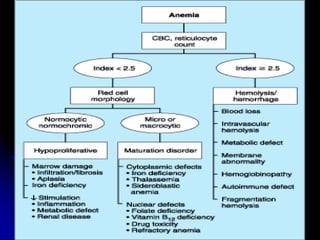
Hemolytic
anemia
Rakesh Biswas
MD, Professor, Department of Medicine,
People's College of Medical Sciences,
Bhanpur, Bhopal, India
Young man of 19
Complains of giddiness
weakness, pallor
Examination reveals a spleen
mild lemon yellow sclera
How shall you investigate to find
out the cause of the problem?
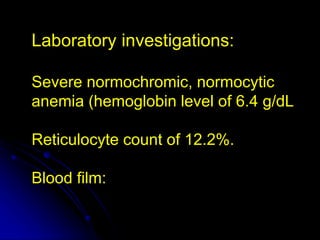
Laboratory investigations:
Severe normochromic, normocytic
anemia (hemoglobin level of 6.4 g/dL
Reticulocyte count of 12.2%.
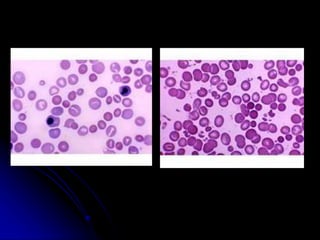
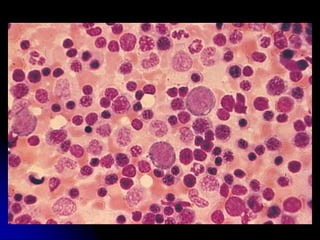
Blood film:
Bilirubin level of 2.5 mg/dL,
Lactate dehydrogenase (LDH) of
2140 IU/L,
Haptoglobin below 7 mg/dL
Introduction
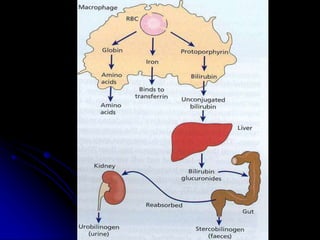
 Mean life span of a RBC-120days
 Removed Extravascularly by- Macrophages
of RE system
Hemolytic Anemia
 Definition:
 Those anemias which result from an increase
in RBC destruction
 Classification:
 Congenital / Hereditary
 Acquired
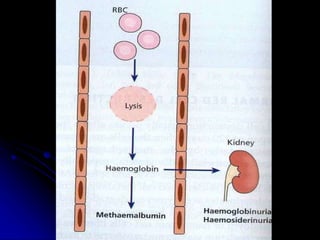
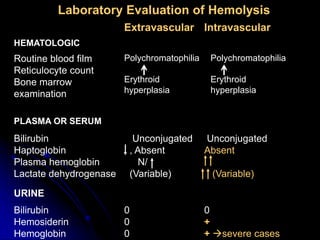
Laboratory Evaluation of Hemolysis
Extravascular Intravascular
HEMATOLOGIC
Routine blood film
Reticulocyte count
Bone marrow
examination
Polychromatophilia
Erythroid
hyperplasia
Polychromatophilia
Erythroid
hyperplasia
PLASMA OR SERUM
Bilirubin
Haptoglobin
Plasma hemoglobin
Lactate dehydrogenase
Unconjugated
, Absent
N/
(Variable)
Unconjugated
Absent
(Variable)
URINE
Bilirubin
Hemosiderin
Hemoglobin
0
0
0
0
+
+ severe cases
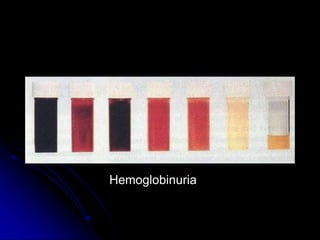
Hemoglobinuria
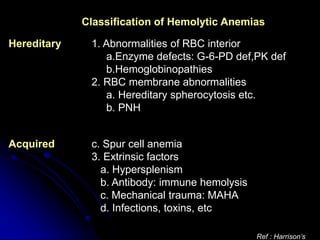
Classification of Hemolytic Anemias
Hereditary 1. Abnormalities of RBC interior
a.Enzyme defects: G-6-PD def,PK def
b.Hemoglobinopathies
2. RBC membrane abnormalities
a. Hereditary spherocytosis etc.
b. PNH
Acquired c. Spur cell anemia
3. Extrinsic factors
a. Hypersplenism
b. Antibody: immune hemolysis
c. Mechanical trauma: MAHA
d. Infections, toxins, etc
Ref : Harrison’s
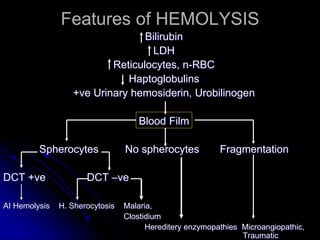
Features of HEMOLYSIS
Bilirubin
LDH
Reticulocytes, n-RBC
Haptoglobulins
+ve Urinary hemosiderin, Urobilinogen
Blood Film
Spherocytes No spherocytes Fragmentation
DCT +ve DCT –ve
AI Hemolysis H. Sherocytosis Malaria,
Clostidium
Hereditery enzymopathies Microangiopathic,
Traumatic
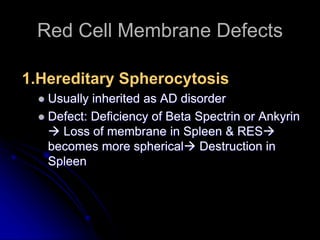
Red Cell Membrane Defects
1.Hereditary Spherocytosis
 Usually inherited as AD disorder
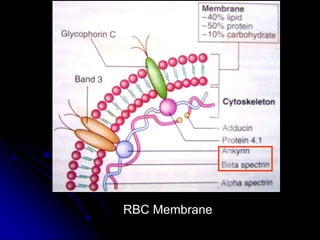
 Defect: Deficiency of Beta Spectrin or Ankyrin
 Loss of membrane in Spleen & RES
becomes more spherical Destruction in
Spleen
RBC Membrane
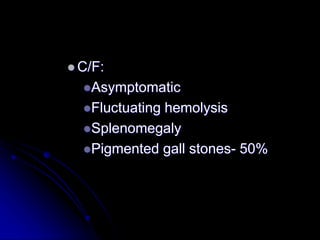
 C/F:
Asymptomatic
Fluctuating hemolysis
Splenomegaly
Pigmented gall stones- 50%
Complications
 Clinical course may be complicated with
Crisis:
 Hemolytic Crisis: associated with infection
 Aplastic crisis: associated with Parvovirus
infection
 Inv:
 Test will confirm Hemolysis
 P Smear: Spherocytes
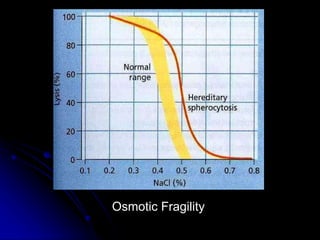
 Osmotic Fragility: Increased
Screen Family members
Osmotic Fragility
 Management:
 Folic Acid 5mg weekly, prophylaxis life long
 Spleenectomy
 Blood transfusion in Ac, severe hemolytic crisis
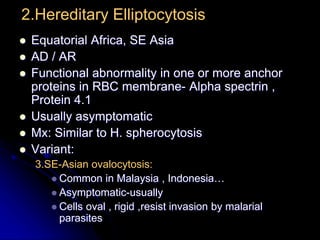
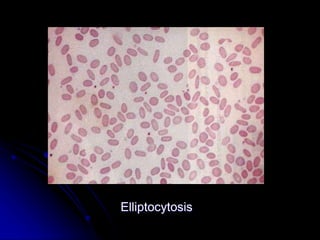
2.Hereditary Elliptocytosis
 Equatorial Africa, SE Asia
 AD / AR
 Functional abnormality in one or more anchor
proteins in RBC membrane- Alpha spectrin ,
Protein 4.1
 Usually asymptomatic
 Mx: Similar to H. spherocytosis
 Variant:
3.SE-Asian ovalocytosis:
 Common in Malaysia , Indonesia…
 Asymptomatic-usually
 Cells oval , rigid ,resist invasion by malarial
parasites
Elliptocytosis
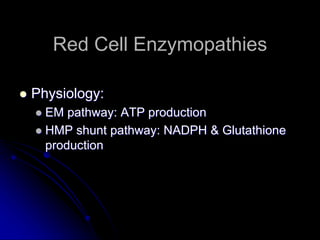
Red Cell Enzymopathies
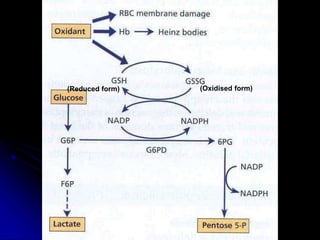
 Physiology:
 EM pathway: ATP production
 HMP shunt pathway: NADPH & Glutathione
production
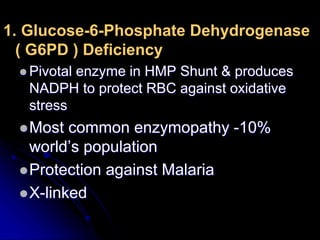
1. Glucose-6-Phosphate Dehydrogenase
( G6PD ) Deficiency
 Pivotal enzyme in HMP Shunt & produces
NADPH to protect RBC against oxidative
stress
Most common enzymopathy -10%
world’s population
Protection against Malaria
X-linked
(Oxidised form)
(Reduced form)
 Clinical Features:
 Acute drug induced hemolysis:
 Aspirin, primaquine, quinine, chloroquine,
dapsone….
 Chronic compensated hemolysis
 Infection/acute illness
 Neonatal jaundice
 Favism
 Inv:
 e/o non-spherocytic intravascular
hemolyis
 P. Smear: Bite cells, blister cells,
irregular small cells, Heinz bodies,
polychromasia
 G-6-PD level
 Treatment:
 Stop the precipitating drug or treat the
infection
 Acute transfusions if required
2. Pyruvate Kinase Deficiency
 AR
 Deficient ATP production, Chronic
hemolytic anemia
 Inv;
P. Smear: Prickle cells
Decreased enzyme activity
 Treatment:
Transfusion may be required
Hemolobinopathies…
Autoimmune Hemolytic Anemia
 Result from RBC destruction due to RBC
autoantibodies: Ig G, M, E, A
 Most commonly-idiopathic
 Classification
 Warm AI hemolysis:Ab binds at 37degree
Celsius
 Cold AI Hemolysis: Ab binds at 4 degree
Celsius
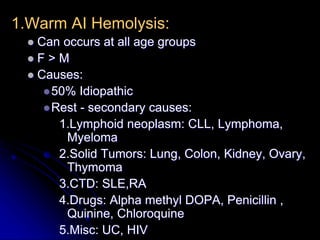
1.Warm AI Hemolysis:
 Can occurs at all age groups
 F > M
 Causes:
50% Idiopathic
Rest - secondary causes:
1.Lymphoid neoplasm: CLL, Lymphoma,
Myeloma
2.Solid Tumors: Lung, Colon, Kidney, Ovary,
Thymoma
3.CTD: SLE,RA
4.Drugs: Alpha methyl DOPA, Penicillin ,
Quinine, Chloroquine
5.Misc: UC, HIV
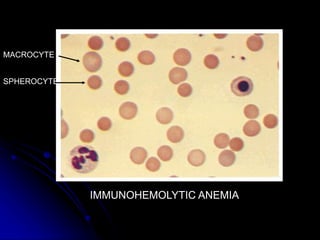
IMMUNOHEMOLYTIC ANEMIA
MACROCYTE
SPHEROCYTE
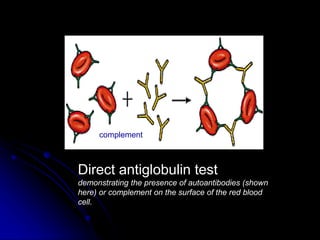
Direct antiglobulin test
demonstrating the presence of autoantibodies (shown
here) or complement on the surface of the red blood
cell.
complement
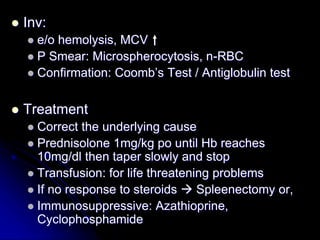
 Inv:
 e/o hemolysis, MCV
 P Smear: Microspherocytosis, n-RBC
 Confirmation: Coomb’s Test / Antiglobulin test
 Treatment
 Correct the underlying cause
 Prednisolone 1mg/kg po until Hb reaches
10mg/dl then taper slowly and stop
 Transfusion: for life threatening problems
 If no response to steroids  Spleenectomy or,
 Immunosuppressive: Azathioprine,
Cyclophosphamide
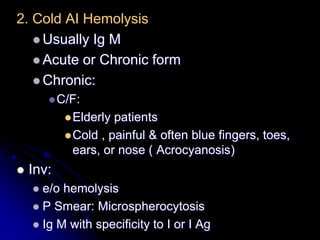
2. Cold AI Hemolysis
 Usually Ig M
 Acute or Chronic form
 Chronic:
C/F:
Elderly patients
Cold , painful & often blue fingers, toes,
ears, or nose ( Acrocyanosis)
 Inv:
 e/o hemolysis
 P Smear: Microspherocytosis
 Ig M with specificity to I or I Ag
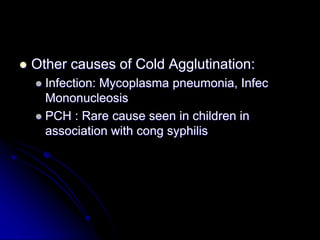
 Other causes of Cold Agglutination:
 Infection: Mycoplasma pneumonia, Infec
Mononucleosis
 PCH : Rare cause seen in children in
association with cong syphilis
 Treatment:
 Treatment of the underlying cause
 Keep extremities warm
 Steroids treatment
 Blood transfusion
Non-Immune Acquired Hemolytic
Anemia
1. Mechanical Trauma
A). Mechanical heart valves, Arterial grafts:
cause shear stress damage
B).March hemoglobinuria: Red cell damage in
capillaries of feet
C). Thermal injury: burns
D). Microangiopathic hemolytic anemia (MAHA):
by passage of RBC through fibrin strands
deposited in small vessels  disruption of
RBC eg: DIC,PIH, Malignant HTN,TTP,HUS
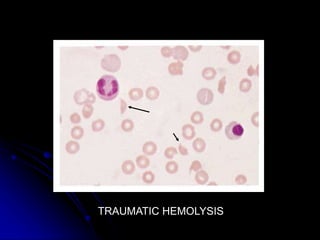
TRAUMATIC HEMOLYSIS
Acquired hemolysis
2.Infection
F. malaria: intravascular hemolysis: severe
called ‘Blackwater fever’
Cl. perfringens septicemia
3.Chemical/Drugs: oxidant denaturation of
hemoglobin
Eg: Dapsone, sulphasalazine, Arsenic
gas, Cu, Nitrates & Nitrobenzene
The direct antiglobulin test was
positive for complement (C3d) (++),
and IgG (++-).
Also was positive for agglutinins of
IgM type and had a titer of 1:1024.
Serologies for human
immunodeficiency virus, hepatitis B
and C viruses, and Mycoplasma
pneumoniae were negative.
Rheumatoid factor and antinuclear
antibodies were undetectable.
Prednisone therapy was started at
a dose of 1 mg/kg intravenously,
daily. Hemoglobin level rose to
11 g/dL, concomitantly with the
improvement of hemolytic signs.
A reduction of positivity of both
direct and indirect antiglobulin tests
(polyvalent serum + ; C3d + ;
IgG+ ), as well as a reduction of
cold agglutinin titers (1:128), was
observed 8 weeks after
corticosteroid therapy.
Three months later, corticosteroids
were tapered to a maintenance
dose of 25 mg daily.
Hemolysis recurred again with the
fall of hemoglobin to 7 g/dL.
The direct antiglobulin test recurred
positive for polyvalent serum (+++),
complement (+++), and IgG (+++),
while cold agglutinin titers again
became strongly positive (1:256).
Immunophenotyping of bone
marrow cells showed that 10% of
all the cells were CD20 and CD19
positive.
CD20 is widely expressed on B-
cells.
CD20 could play a role in Ca2+
influx across plasma membranes,
maintaining intracellular Ca2+
concentration and allowing
activation of B cells.
Rituximab is a monoclonal
antibody that binds to CD 20
Rituximab was started at the dose
of 375 mg/mq once weekly, for a
total of 4 doses
Hemoglobin value reached
13.5 g/dL just before the third dose,
although biochemical signs of
hemolysis remained substantially
unaltered.
At the end of therapy, the hemolytic
signs disappeared, the direct and
indirect antiglobulin tests became
negative, and cold agglutinin titers
fell to 1:32
Immunophenotyping of bone
marrow cells showed the absence
of CD20 and CD19 B cells.
Summary of lecture
Learning points
ANEMIA HEMOLITICA-INDIA.ppt

ANEMIA HEMOLITICA-INDIA.ppt

  • 1.
    Hemolytic anemia Rakesh Biswas MD, Professor,Department of Medicine, People's College of Medical Sciences, Bhanpur, Bhopal, India
  • 2.
    Young man of19 Complains of giddiness weakness, pallor Examination reveals a spleen mild lemon yellow sclera
  • 3.
    How shall youinvestigate to find out the cause of the problem?
  • 5.
    Laboratory investigations: Severe normochromic,normocytic anemia (hemoglobin level of 6.4 g/dL Reticulocyte count of 12.2%. Blood film:
  • 7.
    Bilirubin level of2.5 mg/dL, Lactate dehydrogenase (LDH) of 2140 IU/L, Haptoglobin below 7 mg/dL
  • 9.
    Introduction  Mean lifespan of a RBC-120days  Removed Extravascularly by- Macrophages of RE system
  • 12.
    Hemolytic Anemia  Definition: Those anemias which result from an increase in RBC destruction  Classification:  Congenital / Hereditary  Acquired
  • 13.
    Laboratory Evaluation ofHemolysis Extravascular Intravascular HEMATOLOGIC Routine blood film Reticulocyte count Bone marrow examination Polychromatophilia Erythroid hyperplasia Polychromatophilia Erythroid hyperplasia PLASMA OR SERUM Bilirubin Haptoglobin Plasma hemoglobin Lactate dehydrogenase Unconjugated , Absent N/ (Variable) Unconjugated Absent (Variable) URINE Bilirubin Hemosiderin Hemoglobin 0 0 0 0 + + severe cases
  • 14.
  • 15.
    Classification of HemolyticAnemias Hereditary 1. Abnormalities of RBC interior a.Enzyme defects: G-6-PD def,PK def b.Hemoglobinopathies 2. RBC membrane abnormalities a. Hereditary spherocytosis etc. b. PNH Acquired c. Spur cell anemia 3. Extrinsic factors a. Hypersplenism b. Antibody: immune hemolysis c. Mechanical trauma: MAHA d. Infections, toxins, etc Ref : Harrison’s
  • 16.
    Features of HEMOLYSIS Bilirubin LDH Reticulocytes,n-RBC Haptoglobulins +ve Urinary hemosiderin, Urobilinogen Blood Film Spherocytes No spherocytes Fragmentation DCT +ve DCT –ve AI Hemolysis H. Sherocytosis Malaria, Clostidium Hereditery enzymopathies Microangiopathic, Traumatic
  • 17.
    Red Cell MembraneDefects 1.Hereditary Spherocytosis  Usually inherited as AD disorder  Defect: Deficiency of Beta Spectrin or Ankyrin  Loss of membrane in Spleen & RES becomes more spherical Destruction in Spleen
  • 18.
  • 19.
  • 20.
    Complications  Clinical coursemay be complicated with Crisis:  Hemolytic Crisis: associated with infection  Aplastic crisis: associated with Parvovirus infection
  • 21.
     Inv:  Testwill confirm Hemolysis  P Smear: Spherocytes  Osmotic Fragility: Increased Screen Family members
  • 22.
  • 23.
     Management:  FolicAcid 5mg weekly, prophylaxis life long  Spleenectomy  Blood transfusion in Ac, severe hemolytic crisis
  • 24.
    2.Hereditary Elliptocytosis  EquatorialAfrica, SE Asia  AD / AR  Functional abnormality in one or more anchor proteins in RBC membrane- Alpha spectrin , Protein 4.1  Usually asymptomatic  Mx: Similar to H. spherocytosis  Variant: 3.SE-Asian ovalocytosis:  Common in Malaysia , Indonesia…  Asymptomatic-usually  Cells oval , rigid ,resist invasion by malarial parasites
  • 25.
  • 26.
    Red Cell Enzymopathies Physiology:  EM pathway: ATP production  HMP shunt pathway: NADPH & Glutathione production
  • 27.
    1. Glucose-6-Phosphate Dehydrogenase (G6PD ) Deficiency  Pivotal enzyme in HMP Shunt & produces NADPH to protect RBC against oxidative stress Most common enzymopathy -10% world’s population Protection against Malaria X-linked
  • 28.
  • 29.
     Clinical Features: Acute drug induced hemolysis:  Aspirin, primaquine, quinine, chloroquine, dapsone….  Chronic compensated hemolysis  Infection/acute illness  Neonatal jaundice  Favism
  • 30.
     Inv:  e/onon-spherocytic intravascular hemolyis  P. Smear: Bite cells, blister cells, irregular small cells, Heinz bodies, polychromasia  G-6-PD level  Treatment:  Stop the precipitating drug or treat the infection  Acute transfusions if required
  • 31.
    2. Pyruvate KinaseDeficiency  AR  Deficient ATP production, Chronic hemolytic anemia  Inv; P. Smear: Prickle cells Decreased enzyme activity  Treatment: Transfusion may be required
  • 32.
  • 33.
    Autoimmune Hemolytic Anemia Result from RBC destruction due to RBC autoantibodies: Ig G, M, E, A  Most commonly-idiopathic  Classification  Warm AI hemolysis:Ab binds at 37degree Celsius  Cold AI Hemolysis: Ab binds at 4 degree Celsius
  • 34.
    1.Warm AI Hemolysis: Can occurs at all age groups  F > M  Causes: 50% Idiopathic Rest - secondary causes: 1.Lymphoid neoplasm: CLL, Lymphoma, Myeloma 2.Solid Tumors: Lung, Colon, Kidney, Ovary, Thymoma 3.CTD: SLE,RA 4.Drugs: Alpha methyl DOPA, Penicillin , Quinine, Chloroquine 5.Misc: UC, HIV
  • 35.
  • 36.
    Direct antiglobulin test demonstratingthe presence of autoantibodies (shown here) or complement on the surface of the red blood cell. complement
  • 37.
     Inv:  e/ohemolysis, MCV  P Smear: Microspherocytosis, n-RBC  Confirmation: Coomb’s Test / Antiglobulin test  Treatment  Correct the underlying cause  Prednisolone 1mg/kg po until Hb reaches 10mg/dl then taper slowly and stop  Transfusion: for life threatening problems  If no response to steroids  Spleenectomy or,  Immunosuppressive: Azathioprine, Cyclophosphamide
  • 38.
    2. Cold AIHemolysis  Usually Ig M  Acute or Chronic form  Chronic: C/F: Elderly patients Cold , painful & often blue fingers, toes, ears, or nose ( Acrocyanosis)  Inv:  e/o hemolysis  P Smear: Microspherocytosis  Ig M with specificity to I or I Ag
  • 39.
     Other causesof Cold Agglutination:  Infection: Mycoplasma pneumonia, Infec Mononucleosis  PCH : Rare cause seen in children in association with cong syphilis
  • 40.
     Treatment:  Treatmentof the underlying cause  Keep extremities warm  Steroids treatment  Blood transfusion
  • 41.
    Non-Immune Acquired Hemolytic Anemia 1.Mechanical Trauma A). Mechanical heart valves, Arterial grafts: cause shear stress damage B).March hemoglobinuria: Red cell damage in capillaries of feet C). Thermal injury: burns D). Microangiopathic hemolytic anemia (MAHA): by passage of RBC through fibrin strands deposited in small vessels  disruption of RBC eg: DIC,PIH, Malignant HTN,TTP,HUS
  • 42.
  • 43.
    Acquired hemolysis 2.Infection F. malaria:intravascular hemolysis: severe called ‘Blackwater fever’ Cl. perfringens septicemia 3.Chemical/Drugs: oxidant denaturation of hemoglobin Eg: Dapsone, sulphasalazine, Arsenic gas, Cu, Nitrates & Nitrobenzene
  • 44.
    The direct antiglobulintest was positive for complement (C3d) (++), and IgG (++-). Also was positive for agglutinins of IgM type and had a titer of 1:1024.
  • 45.
    Serologies for human immunodeficiencyvirus, hepatitis B and C viruses, and Mycoplasma pneumoniae were negative. Rheumatoid factor and antinuclear antibodies were undetectable.
  • 46.
    Prednisone therapy wasstarted at a dose of 1 mg/kg intravenously, daily. Hemoglobin level rose to 11 g/dL, concomitantly with the improvement of hemolytic signs.
  • 47.
    A reduction ofpositivity of both direct and indirect antiglobulin tests (polyvalent serum + ; C3d + ; IgG+ ), as well as a reduction of cold agglutinin titers (1:128), was observed 8 weeks after corticosteroid therapy.
  • 48.
    Three months later,corticosteroids were tapered to a maintenance dose of 25 mg daily. Hemolysis recurred again with the fall of hemoglobin to 7 g/dL.
  • 49.
    The direct antiglobulintest recurred positive for polyvalent serum (+++), complement (+++), and IgG (+++), while cold agglutinin titers again became strongly positive (1:256).
  • 50.
    Immunophenotyping of bone marrowcells showed that 10% of all the cells were CD20 and CD19 positive.
  • 51.
    CD20 is widelyexpressed on B- cells. CD20 could play a role in Ca2+ influx across plasma membranes, maintaining intracellular Ca2+ concentration and allowing activation of B cells.
  • 52.
    Rituximab is amonoclonal antibody that binds to CD 20 Rituximab was started at the dose of 375 mg/mq once weekly, for a total of 4 doses
  • 53.
    Hemoglobin value reached 13.5g/dL just before the third dose, although biochemical signs of hemolysis remained substantially unaltered.
  • 54.
    At the endof therapy, the hemolytic signs disappeared, the direct and indirect antiglobulin tests became negative, and cold agglutinin titers fell to 1:32 Immunophenotyping of bone marrow cells showed the absence of CD20 and CD19 B cells.
  • 55.