Autoimmune
diseases
Introduction
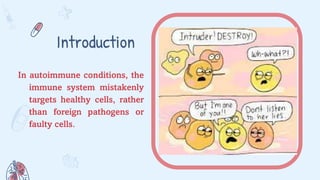
In autoimmune conditions, the
immune system mistakenly
targets healthy cells, rather
than foreign pathogens or
faulty cells.
We have the enemy,
and he is us
Auto immunity
Immune cells defends the body
In this scenario, they cannot distinguish self from non-self.
Attack’s own tissues - Autoimmunity
Horror Autotoxicus
Paul Ehrlich
Cold Hemoglobinuria.
1960 - Concept Accepted
Types of Autoimmunity
1
Organ Specific
2
Systemic
Organ Specific
Systemic Autoimmunity
 Non-organ specific autoimmune diseases
 Immune complexes accumulate in many tissues and cause
inflammation and damage.
 Affects many organs or the whole body
For example:
 Systemic Lupus Erythematosus
 Rheumatoid Arthritis
 Rheumatic fever
Graves diseases
Hyperthyroidism
About the Disease
01
Anxiety
Goiter
Symptoms
02
autoantibodies
Causes
03
Sex
age
Risk factor
04
Chronic
Radioiodine therapy
Treatment
05
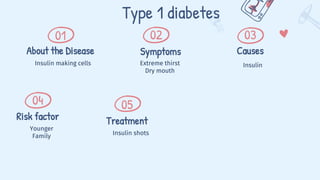
Type 1 diabetes
Insulin making cells
About the Disease
01
Extreme thirst
Dry mouth
Symptoms
02
Insulin
Causes
03
Younger
Family
Risk factor
04
Insulin shots
Treatment
05
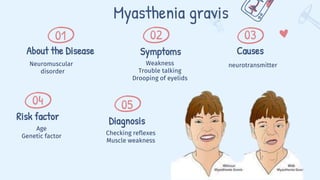
Myasthenia gravis
Neuromuscular
disorder
About the Disease
01
Weakness
Trouble talking
Drooping of eyelids
Symptoms
02
neurotransmitter
Causes
03
Age
Genetic factor
Risk factor
04
Checking reflexes
Muscle weakness
Diagnosis
05
Good Pasture’s Syndrome
Collagen
About the Disease
01
Blood in urine
Difficulty in urine
Symptoms
02
collagen
Causes
03
Genetic factor
20 -30
Smoking
Risk factor
04
Dialysis
Kidney transplant
Treatment
05
Megan Starshak
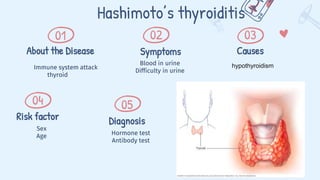
Hashimoto’s thyroiditis
Immune system attack
thyroid
About the Disease
01
Blood in urine
Difficulty in urine
Symptoms
02
hypothyroidism
Causes
03
Sex
Age
Risk factor
04
Hormone test
Antibody test
Diagnosis
05
Multiple sclerosis
Brain
Spinal cord
Optic nerve
About the Disease
01
Blurred vision
Numbness
Lhermitte’s sign
Symptoms
02
Insulin
Causes
03
Age
Genetic factor
Risk factor
04
MRI Scan
No cure
Treatment
05
Systemic Lupus erythematous
Brain
Spinal cord
Optic nerve
About the Disease
01
Chest pain
fatigue
Symptoms
02
Insulin
Causes
03
Age
Gender
Risk factor
04
Antinuclear antibody
CBE
Diagnosis
05
Rheumatoid arthritis
Inflammatory diseases
About the Disease
01
Stiffness
Swelling
deformity
Symptoms
02
Immune response
Causes
03
Age
sex
Genetic factor
Risk factor
04
X ray
DMARDS
Diagnosis
05
Conclusions
¤ More than 80 different autoimmune diseases exist. Often their symptoms
overlap, making them hard to diagnose.
¤ Autoimmune diseases are more common in women, and they often run
in families.
¤ Blood tests that look for autoantibodies can help doctors diagnose these
conditions.
¤ Treatments include medications to calm the overactive immune
response and bring down inflammation in the body.
I was just a teenager when a friend and I went for a fateful run
down to the beach in Florida.
Suddenly, I had to find a bathroom; I actually sprinted three times
looking for bathrooms on that run because of diarrhea.
I just figured it was from traveling from cold to hot weather, or
perhaps I'd caught a bug.
Even when I wasn’t active, diarrhea and abdominal pains became
more frequent and intense.
That summer, I went for a colonoscopy, and was diagnosed
with ulcerative colitis, a disease that causes inflammation and
sores on the lining of the large intestine.
I thought: Let’s just treat this, and I’ll be fine.
I began taking the maximum dose of an anti-inflammatory—12 pills
a day, which was a lot—but my symptoms still controlled my life.
Occasionally, my doctor added steroids, which caused huge
emotional swings. I didn’t sleep well.
And I’d wake up super-early to rush to the bathroom; sometimes I
wouldn’t make it.
Over the years, I read about other drug options.
Finally, six years after my initial diagnosis, I switched to a
gastroenterologist who was open to new treatments.
I felt hope when he said, ‘You’re 24, and you deserve to live your life.’
We tried a different class of drugs that decreased my immune system’s
response.
They helped, but not enough. Then he suggested an intravenous
biologic, which I knew worked for people with inflammatory bowel
disease (IBD).
In 2008, I had my first infusion.
I began to notice that I didn’t have to run to the bathroom as often. I
wasn’t 100%, but the urgency was gone.
It took a few years, but eventually I was able to get back into running,
thanks to the improvement in my symptoms.
I joined a running group in 2012. And in 2015, I ran my first race.
At one point, I was really starting to slow down when I heard my name
being chanted—my friends were gathered at a water stop and had
everyone there cheering for me.
I know that not everyone with my condition is able to do something as
physical as run a race. So, in that moment, I just kept thinking how
fortunate I was to have the strength to run, and good health.”
Back

Autoimmune diseases

  • 1.
  • 2.
    Introduction In autoimmune conditions,the immune system mistakenly targets healthy cells, rather than foreign pathogens or faulty cells.
  • 3.
    We have theenemy, and he is us
  • 4.
    Auto immunity Immune cellsdefends the body In this scenario, they cannot distinguish self from non-self. Attack’s own tissues - Autoimmunity
  • 5.
    Horror Autotoxicus Paul Ehrlich ColdHemoglobinuria. 1960 - Concept Accepted
  • 6.
    Types of Autoimmunity 1 OrganSpecific 2 Systemic
  • 7.
  • 8.
    Systemic Autoimmunity  Non-organspecific autoimmune diseases  Immune complexes accumulate in many tissues and cause inflammation and damage.  Affects many organs or the whole body For example:  Systemic Lupus Erythematosus  Rheumatoid Arthritis  Rheumatic fever
  • 9.
    Graves diseases Hyperthyroidism About theDisease 01 Anxiety Goiter Symptoms 02 autoantibodies Causes 03 Sex age Risk factor 04 Chronic Radioiodine therapy Treatment 05
  • 10.
    Type 1 diabetes Insulinmaking cells About the Disease 01 Extreme thirst Dry mouth Symptoms 02 Insulin Causes 03 Younger Family Risk factor 04 Insulin shots Treatment 05
  • 11.
    Myasthenia gravis Neuromuscular disorder About theDisease 01 Weakness Trouble talking Drooping of eyelids Symptoms 02 neurotransmitter Causes 03 Age Genetic factor Risk factor 04 Checking reflexes Muscle weakness Diagnosis 05
  • 12.
    Good Pasture’s Syndrome Collagen Aboutthe Disease 01 Blood in urine Difficulty in urine Symptoms 02 collagen Causes 03 Genetic factor 20 -30 Smoking Risk factor 04 Dialysis Kidney transplant Treatment 05
  • 13.
  • 14.
    Hashimoto’s thyroiditis Immune systemattack thyroid About the Disease 01 Blood in urine Difficulty in urine Symptoms 02 hypothyroidism Causes 03 Sex Age Risk factor 04 Hormone test Antibody test Diagnosis 05
  • 15.
    Multiple sclerosis Brain Spinal cord Opticnerve About the Disease 01 Blurred vision Numbness Lhermitte’s sign Symptoms 02 Insulin Causes 03 Age Genetic factor Risk factor 04 MRI Scan No cure Treatment 05
  • 16.
    Systemic Lupus erythematous Brain Spinalcord Optic nerve About the Disease 01 Chest pain fatigue Symptoms 02 Insulin Causes 03 Age Gender Risk factor 04 Antinuclear antibody CBE Diagnosis 05
  • 17.
    Rheumatoid arthritis Inflammatory diseases Aboutthe Disease 01 Stiffness Swelling deformity Symptoms 02 Immune response Causes 03 Age sex Genetic factor Risk factor 04 X ray DMARDS Diagnosis 05
  • 18.
    Conclusions ¤ More than80 different autoimmune diseases exist. Often their symptoms overlap, making them hard to diagnose. ¤ Autoimmune diseases are more common in women, and they often run in families. ¤ Blood tests that look for autoantibodies can help doctors diagnose these conditions. ¤ Treatments include medications to calm the overactive immune response and bring down inflammation in the body.
  • 19.
    I was justa teenager when a friend and I went for a fateful run down to the beach in Florida. Suddenly, I had to find a bathroom; I actually sprinted three times looking for bathrooms on that run because of diarrhea. I just figured it was from traveling from cold to hot weather, or perhaps I'd caught a bug.
  • 20.
    Even when Iwasn’t active, diarrhea and abdominal pains became more frequent and intense. That summer, I went for a colonoscopy, and was diagnosed with ulcerative colitis, a disease that causes inflammation and sores on the lining of the large intestine. I thought: Let’s just treat this, and I’ll be fine. I began taking the maximum dose of an anti-inflammatory—12 pills a day, which was a lot—but my symptoms still controlled my life.
  • 21.
    Occasionally, my doctoradded steroids, which caused huge emotional swings. I didn’t sleep well. And I’d wake up super-early to rush to the bathroom; sometimes I wouldn’t make it. Over the years, I read about other drug options. Finally, six years after my initial diagnosis, I switched to a gastroenterologist who was open to new treatments.
  • 22.
    I felt hopewhen he said, ‘You’re 24, and you deserve to live your life.’ We tried a different class of drugs that decreased my immune system’s response. They helped, but not enough. Then he suggested an intravenous biologic, which I knew worked for people with inflammatory bowel disease (IBD). In 2008, I had my first infusion. I began to notice that I didn’t have to run to the bathroom as often. I wasn’t 100%, but the urgency was gone.
  • 23.
    It took afew years, but eventually I was able to get back into running, thanks to the improvement in my symptoms. I joined a running group in 2012. And in 2015, I ran my first race. At one point, I was really starting to slow down when I heard my name being chanted—my friends were gathered at a water stop and had everyone there cheering for me. I know that not everyone with my condition is able to do something as physical as run a race. So, in that moment, I just kept thinking how fortunate I was to have the strength to run, and good health.” Back

Editor's Notes

  • #3 Because the immune system is so complex, there are many potential ways in which it can go wrong. Immune system disorder  cause abnormally low activity or over activity of the immune system. In cases of immune system overactivity, the body attacks and damages its own tissues (autoimmune diseases).
  • #4 n 1970, artist Walt Kelly developed a poster promoting Earth Day, featuring a character from Pogo, his daily newspaper comic strip. In the poster, Pogo looks out across a litter-strewn forest and says wryly, “We have met the enemy and he is us.” Pogo was not talking about the human immune system, but he very well could have been. Although the immune system protects the body by attacking invading “enemies” (pathogens), in some cases, the immune system can mistakenly identify the body’s own cells as the enemy, resulting in autoimmune disease.
  • #5 Thus the immune system defends the body against infections and certain other diseases by identifying, attacking, and destroying germs and other foreign substances. Sometimes the immune system makes a mistake and starts attacking the body’s own tissues or organs. This is called autoimmunity.
  • #6 A very famous, Nobel laureate Paul Ehrlich (1854-1915) coined the term “Horror autotoxicus” to emphasize that body has innate aversion to immunological self-destruction. “Horror autotoxicus” literally means the horror of self-toxicity.  Donath-Landsteiner syndrome) is an uncommon type of autoimmune hemolytic anemia (AIHA) cold hemoglobinuria was described, and soon confirmed. However, the concept that autoimmunization caused cold hemoglobinuria was not yet clear and was not accepted concept of autoimmunization was accepted. The failure of immune tolerance is termed as Autoimmunity.
  • #7 This autoimmune disease is directed against a component of one particular type of organ. These diseases are associated with auto antibodies to antigens which are not tissue specific. The causes of autoimmune disease are a combination of the individual’s genetic makeup and the effect of environmental influences, such as sunlight, infections, medications, and environmental chemicals. However, the vagueness of this list reflects our poor understanding of the etiology of these diseases. Except in a very few specific diseases, the initiation event(s) of most autoimmune states has not been fully characterized.
  • #8 Organ specific autoimmune disease: This autoimmune disease is directed against a component of one particular type of organ. The organ specific autoimmune disease can further be divided into two groups: i. Autoimmune disease  mediated by direct cellular damage: This type of damage occur when lymphocytes or antibodies bind to cell membrane antigens, causing cellular lysis or inflammatory response in affected organ. The damaged cellular structure is then replaced by connective tissue (fibrous) & it losses its function. Examples: Hasimoto’s thyroiditis, autoimmune anaemia, Good pasteur’s syndrome, Insulin dependent diabetes mellitus. ii. Autoimmune disease mediated by stimulating or blocking auto antibodies: In some cases, antibodies act as antagonist & bind to hormone receptor stimulating inappropriate activity. This usually leads to overproduction of mediators or increase cell growth. They also bind to hormone receptor function and thereby block receptor function. This causes impaired secretion of mediators and gradual atrophy of the affected organ. Examples: Grave’s disease, Myasthenia gravis.
  • #10 Graves' disease is an immune system disorder that results in the overproduction of thyroid hormones (hyperthyroidism). Heat sensitivity and an increase in perspiration or warm, moist skin Weight loss, despite normal eating habits Enlargement of the thyroid gland (goiter) Bulging eyes (Graves' ophthalmopathy) Fatigue Thick, red skin usually on the shins or tops of the feet (Graves' dermopathy) Radioactive iodine uptake test. & Thyroid scan   the immune system produces an antibody to one part of the cells in the hormone-producing gland in the neck (thyroid gland). Family history.  Sex. Women are much more likely to develop Graves' disease than are men. Age. Graves' disease usually develops in people before age 40. Other autoimmune disorders.
  • #11 Type 1 diabetes is a condition in which your immune system destroys insulin-making cells in your pancreas. These are called beta cells. The condition is usually diagnosed in children and young people, so it used to be called juvenile diabetes. Extreme thirst Increased hunger (especially after eating) Dry mouth Upset stomach and vomiting Frequent urination Unexplained weight loss, even though you’re eating and feel hungry Blurry vision Heavy, labored breathing (your doctor may call this Kussmaul respiration) Crankiness or mood changes Insulin is a hormone that helps move sugar, or glucose, into your body's tissues. Your cells use it as fuel. Damage to beta cells from type 1 diabetes throws the process off. Glucose doesn’t move into your cells because insulin isn’t there to do the job. Instead, it builds up in your blood, and your cells starve.  "Onset" is how long it takes to reach your bloodstream and begin lowering your blood sugar. "Peak time" is when insulin is doing the most work in terms of lowering your blood sugar. "Duration" is how long it keeps working after onset. Type 1 diabetes can lead to other problems, especially if it isn’t well-controlled. Complications include: Cardiovascular disease. Diabetes can put you at higher risk of blood clots, as well as high blood pressure and cholesterol. These can lead to chest pain, heart attack, stroke, or heart failure. Skin problems.  Gum disease.  Retinopathy.  80% of adults who have had type 1 diabetes for more than 15 years. Kidney damage. About 20% to 30% of people with type 1 diabetes get a condition called nephropathy. Poor blood flow and nerve damage. 
  • #12 Myasthenia gravis (MG) is a neuromuscular disorder that causes weakness in the skeletal muscles, which are the muscles your body uses for movement. It occurs when communication between nerve cells and muscles becomes impaired.  trouble talking problems walking up stairs or lifting objects facial paralysis difficulty breathing due to muscle weakness difficulty swallowing or chewing antibodies, which are proteins that normally attack foreign, harmful substances in the body, attack the neuromuscular junction. Damage to the neuromuscular membrane reduces the effect of the neurotransmitter substance acetylcholine, which is a crucial substance for communication between nerve cells and muscles. This results in muscle weakness. checking your reflexes looking for muscle weakness checking for muscle tone making certain your eyes move properly testing sensation in different areas of your body testing motor functions, like touching your finger to your nose Other tests that can help your doctor diagnose the condition include: repetitive nerve stimulation test blood testing for antibodies associated with MG edrophonium (Tensilon) test: a drug called Tensilon (or a placebo) is administered intravenously, and you’re asked to perform muscle movements under doctor observation
  • #13 Goodpasture's Syndrome is an uncommon autoimmune disease that affects both the kidneys and the lungs.  antibodies that attack and damage the lining of your lungs and kidney disease may quickly progress and you may bleed from the lungs and cough up blood. It may also lead to inflamed kidneys (glomerulonephritis). It is not exactly known why your antibodies begin to attack your own lungs and kidneys. Goodpasture syndrome can run in families. So some researchers believe it may have a genetic component. Goodpasture syndrome usually affects young men. It more often occurs among whites, and it most commonly affects people who are: Between ages 20 and 30 Older than age 60 The first signs of Goodpasture syndrome may include: Fatigue Nausea and vomiting Difficulty breathing Pale skin When Goodpasture syndrome affects the kidneys, symptoms may include: Blood in the urine Foamy urine Swelling in the legs High blood pressure Burning or difficulty when urinating Back pain below the ribs When Goodpasture syndrome affects the kidneys, symptoms may include: Blood in the urine Foamy urine Swelling in the legs High blood pressure Burning or difficulty when urinating Back pain below the ribs
  • #15  The thyroid gland is part of your endocrine system, which produces hormones that coordinate many of your body's functions. Signs and symptoms of hypothyroidism include: Fatigue and sluggishness Increased sensitivity to cold Constipation Pale, dry skin A puffy face Brittle nails Hair loss Enlargement of the tongue Unexplained weight gain Muscle aches, tenderness and stiffness These factors may contribute to your risk of developing Hashimoto's disease: Sex. Women are much more likely to get Hashimoto's disease. Age. Hashimoto's disease can occur at any age but more commonly occurs during middle age. Heredity. You're at higher risk for Hashimoto's disease if others in your family have thyroid or other autoimmune diseases. A hormone test. Blood tests can determine the amount of hormones produced by your thyroid and pituitary glands. If your thyroid is underactive, the level of thyroid hormone is low. At the same time, the level of TSH is elevated because your pituitary gland tries to stimulate your thyroid gland to produce more thyroid hormone. An antibody test. Because Hashimoto's disease is an autoimmune disorder, the cause involves production of abnormal antibodies. A blood test may confirm the presence of antibodies against thyroid peroxidase (TPO antibodies), an enzyme normally found in the thyroid gland that plays an important role in the production of thyroid hormones. But the TPO antibody test isn't positive in everyone with Hashimoto's thyroiditis. Many people have TPO antibodies present, but don't have a goiter, hypothyroidism or other problems. if Hashimoto's disease causes thyroid hormone deficiency, you may need replacement therapy with thyroid hormone. This usually involves daily use of the synthetic thyroid hormone levothyroxine (Levoxyl, Synthroid, others).
  • #16 Multiple sclerosis is a chronic disease that affects the central nervous system, which is the brain, spinal cord, and optic nerves. This can lead to a wide range of symptoms throughout the body. Some people have mild symptoms, such as blurred vision and numbness and tingling in the limbs. In severe cases, a person may experience paralysis, vision loss, and mobility problems.  Age: Most people receive a diagnosis between the ages of 20 and 40 years. Sex: Most forms of MS are twice as likely to affect women than men. Genetic factors: Susceptibility may pass down in the genes, but scientists believe an environmental trigger is also necessary for MS to develop, even in people with specific genetic features.
  • #17 Systemic lupus erythematosus (SLE) is an autoimmune disease. In this disease, the immune system of the body mistakenly attacks healthy tissue. It can affect the skin, joints, kidneys, brain, and other organs. Causes The cause of SLE is not clearly known. It may be linked to the following factors: Genetic Environmental Hormonal Certain medicines SLE is more common in women than men by nearly 10 to 1. It may occur at any age. However, it appears most often in young women between the ages of 15 and 44. Chest pain when taking a deep breath. Fatigue. Fever with no other cause. Hair loss. Weight loss. Mouth sores. Sensitivity to sunlight. Skin rash -- A "butterfly" rash develops in about half the people with SLE. The rash is mostly seen over the cheeks and bridge of the nose. It can be widespread. It gets worse in sunlight. A complete blood count (CBC) test The Coombs test looks for antibodies that may stick to your red blood cells and cause red blood cells to die too early.
  • #18 heumatoid arthritis, or RA, is an autoimmune and inflammatory disease, which means that your immune system attacks healthy cells in your body by mistake, causing inflammation (painful swelling) in the affected parts of the body. A mainly attacks the joints, usually many joints at once. RA commonly affects joints in the hands, wrists, and knees. In a joint with RA, the lining of the joint becomes inflamed, causing damage to joint tissue. This tissue damage can cause long-lasting or chronic pain, unsteadiness (lack of balance), and deformity (misshapenness). Age. RA can begin at any age, but the likelihood increases with age. The onset of RA is highest among adults in their sixties. Sex. New cases of RA are typically two-to-three times higher in women than men. Genetics/inherited traits. People born with specific genes are more likely to develop RA. These genes, called HLA (human leukocyte antigen) class II genotypes, can also make your arthritis worse. The risk of RA may be highest when people with these genes are exposed to environmental factors like smoking or when a person is obese. isease-modifying antirheumatic drugs (DMARDs);