Steam Sterilization Monitoring
(Sterilization Assurance)
Dr. Mohamed Eleraky
MBBCh
Infection Control Board
Hospital Management Diploma
Project Management Diploma
ESIC / APIC member
 Sterilization / Sterility
 Process used to transform product free from viable
microorganisms (Bacteria, Viruses, Fungi) through
inactivation of microorganisms
Introduction
The absence of microorganisms cannot be proven
A sterility assurance level (SAL) is used to define the sterility
Dr. Mohamed Eleraky 28/2/2019
Cont. Introduction
 Sterility Assurance Level (SAL)
 Probability of a
viable organism
being present
on a product unit
after sterilization
 SAL of 10-6 is required
by the FDA for
invasive medical
device
Dr. Mohamed Eleraky 28/2/2019
Cont. Introduction
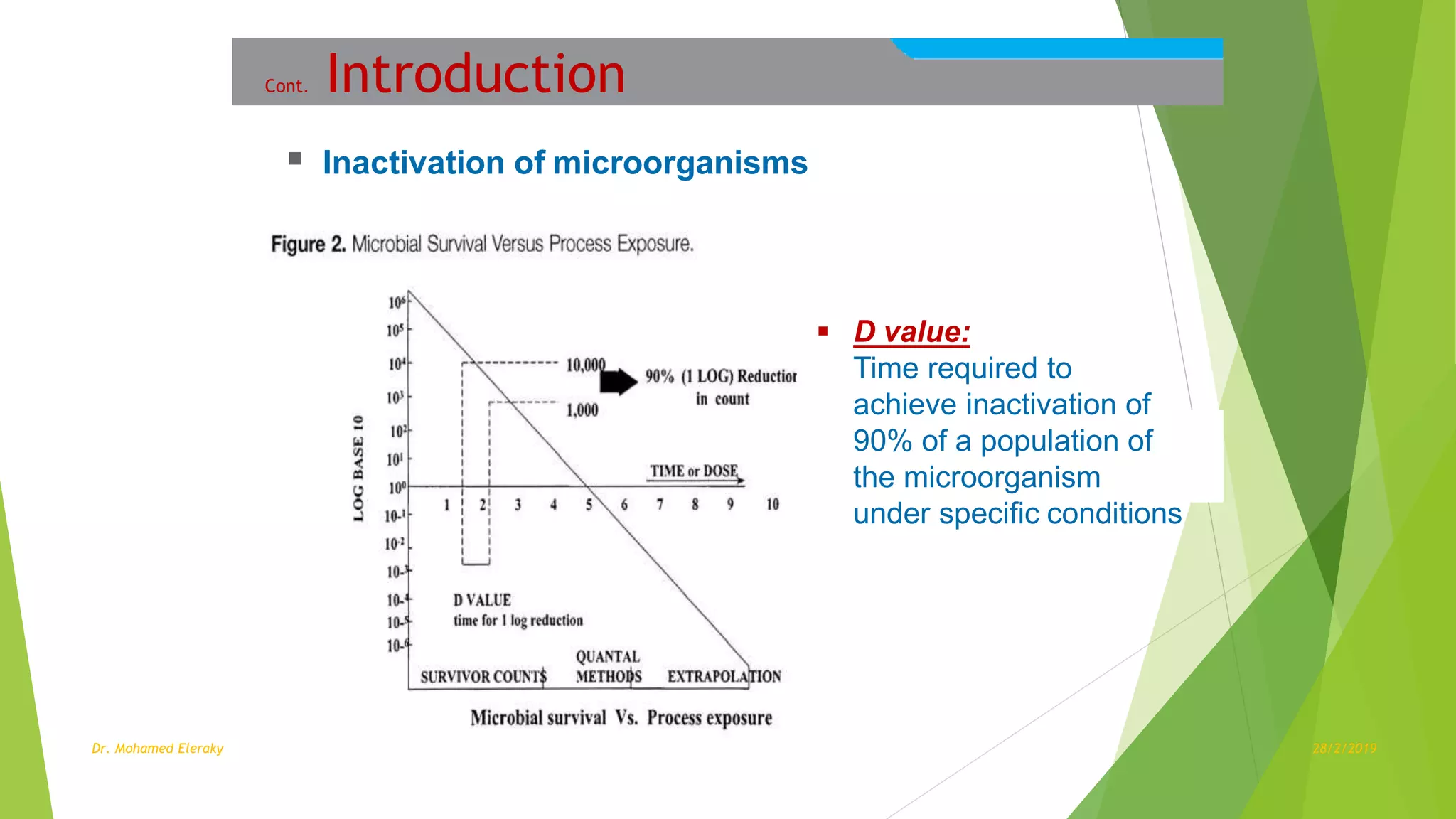
 Inactivation of microorganisms
 D value:
Time required to
achieve inactivation of
90% of a population of
the microorganism
under specific conditions
Dr. Mohamed Eleraky 28/2/2019
 12:00 1
 12:20 2
 12:40 4
 13:00 8
 14:00 64
 15:00 512
 16:00 4,096
 17:00 32,768
 18:00 262,144
 19:00 2,097,152
Cont. Introduction
Dr. Mohamed Eleraky 28/2/2019
 How fast do microorganisms reproduce??
Cont. Introduction
 Moist heat
 Gamma radiation
 Hydrogen peroxide gas plasma
 Ethylene oxide (ETO)
Common Sterilization methods used in health services:
For moist heat sterilization, There are four parameters of steam sterilization:
steam, pressure, temperature, and time.
Dr. Mohamed Eleraky 28/2/2019
Sterilization Quality Control
How do I know my item is safe for the patient???
I. Methods used for Sterilization monitoring
II. Levels of Sterilization Assurance
Dr. Mohamed Eleraky 28/2/2019
 Mechanical monitoring
 Chemical indicators
 Biological indicators
 Equipment Control
 Exposure control
 Pack Control
 Load Control
 Record Keeping
I. Methods used for monitoring
II. Levels of Sterilization Assurance
Dr. Mohamed Eleraky 28/2/2019
 Cycle time.
 Temperature.
 Pressure
 Sterilizers have recording devices that print out these parameters.
 Correct readings do not ensure sterilization, but incorrect readings can be the first
indicator for a problem with the sterilization cycle.
I. Methods used for monitoring
A.Mechanical monitoring : through assessing
Dr. Mohamed Eleraky 28/2/2019
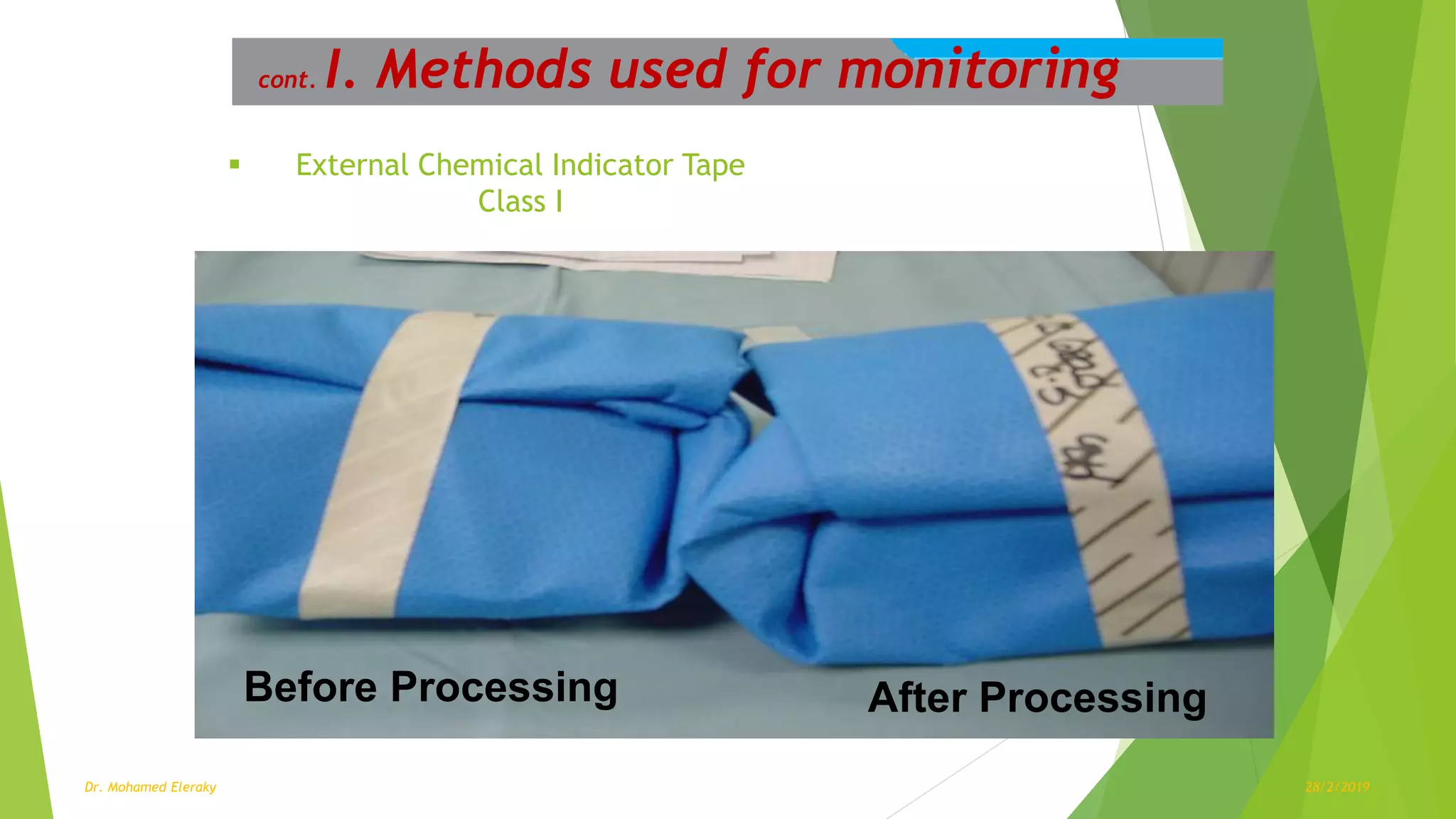
 External chemical indicators (class 1):
 They are applied to the outside of a package (e.g., chemical indicator tape and labels).
 They change color rapidly when a specific parameter is reached, and they verify that the
package has been exposed to the sterilization process.
 Internal chemical indicators and integrators (Class 3-6 ):
 They are used inside package to ensure the sterilizing agent has penetrated the packaging
material and actually reached the instruments inside.
 Bowie-Dick Sheets inside test packs (class 2) :
 Sheets printed with a chemical indicator in the form of diagonal strips which change color to
dark brown or black.
 A satisfactory test is indicated by the development of uniform color change indicating rapid
steam penetration, adequate air removal and freedom from significant air.
 Chemical strip (Class 2) :
 Used inside a hollow load process challenge device (helix test) for testing the efficiency of
rapid steam penetration in pre vacuum sterilizers.
cont. I. Methods used for monitoring
B. Chemical indicators :
Dr. Mohamed Eleraky 28/2/2019
Class Description Use
Class 1 Process indicators
Used to indicate that the pack or container has been exposed to the sterilization process and to
differentiate between processed and unprocessed items (tape and labels)
Class 2
Indicators for use in
special tests
e.g. BD sheets and strips used inside process challenge device (PCD) to test for air removal in
vacuum assisted sterilizers
Class 3
Single variable
indicators
React to one of the critical parameter of sterilization and indicate exposure to a sterilization
cycle at stated values (SV) of the chosen parameter.
Critical parameters typically chosen for steam sterilization processes are time or temperature.
Class 4
Multi-variable
indicators
React to two or more of the critical variables (time, temperature and saturated steam) to
indicate exposure to a sterilization cycle as SVs of the chosen variables. They provide
additional monitoring of the sterilization cycle
Class 5 Integrators
React to all critical parameters over a specified range of sterilization cycles. Their
performance has been correlated to the performance of a biological indicator (BI) under its
labeled conditions for use. This class of indicator can be used in place of the BI in many
applications, thereby reducing the overall cost of sterile processing.
Class 6 Emulating indicators
They are cycle verification indicators that are designed to react to all critical variables of
specified sterilization cycles. They emulate the cycle. They have the most stringent tolerance
levels of all chemical indicators.
 Different chemical indicators
cont. I. Methods used for monitoring
Dr. Mohamed Eleraky 28/2/2019
Before Processing After Processing
 External Chemical Indicator Tape
Class I
cont. I. Methods used for monitoring
Dr. Mohamed Eleraky 28/2/2019
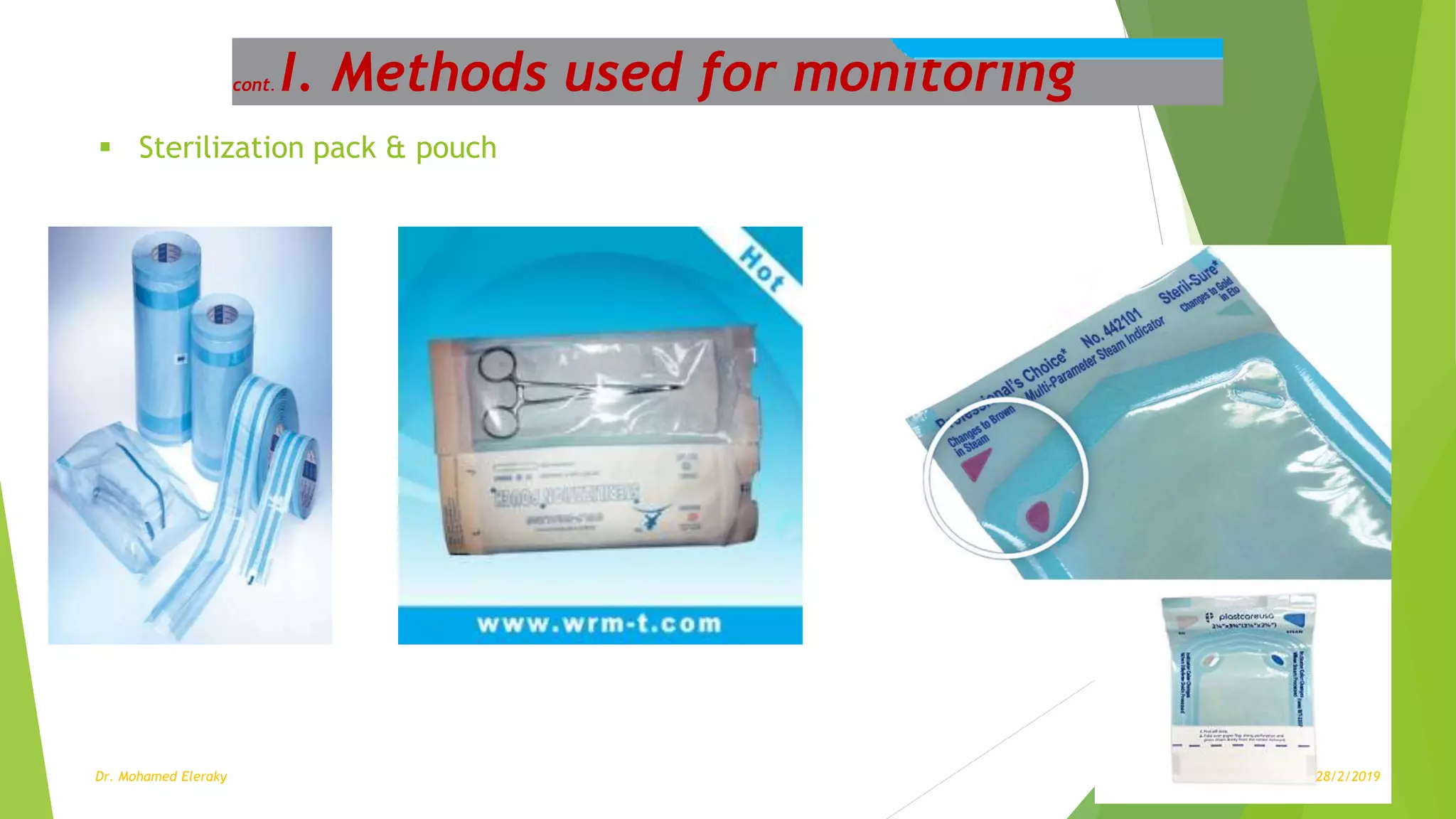
 Sterilization pack & pouch
cont. I. Methods used for monitoring
Dr. Mohamed Eleraky 28/2/2019
 Tamper evident device—container locks, tape, arrows
 Internal Pack Control—chemical indicators placed inside the tray, let us know
that several parameters for sterilization have been met
 Tamper evident device—container
cont. I. Methods used for monitoring
Dr. Mohamed Eleraky 28/2/2019
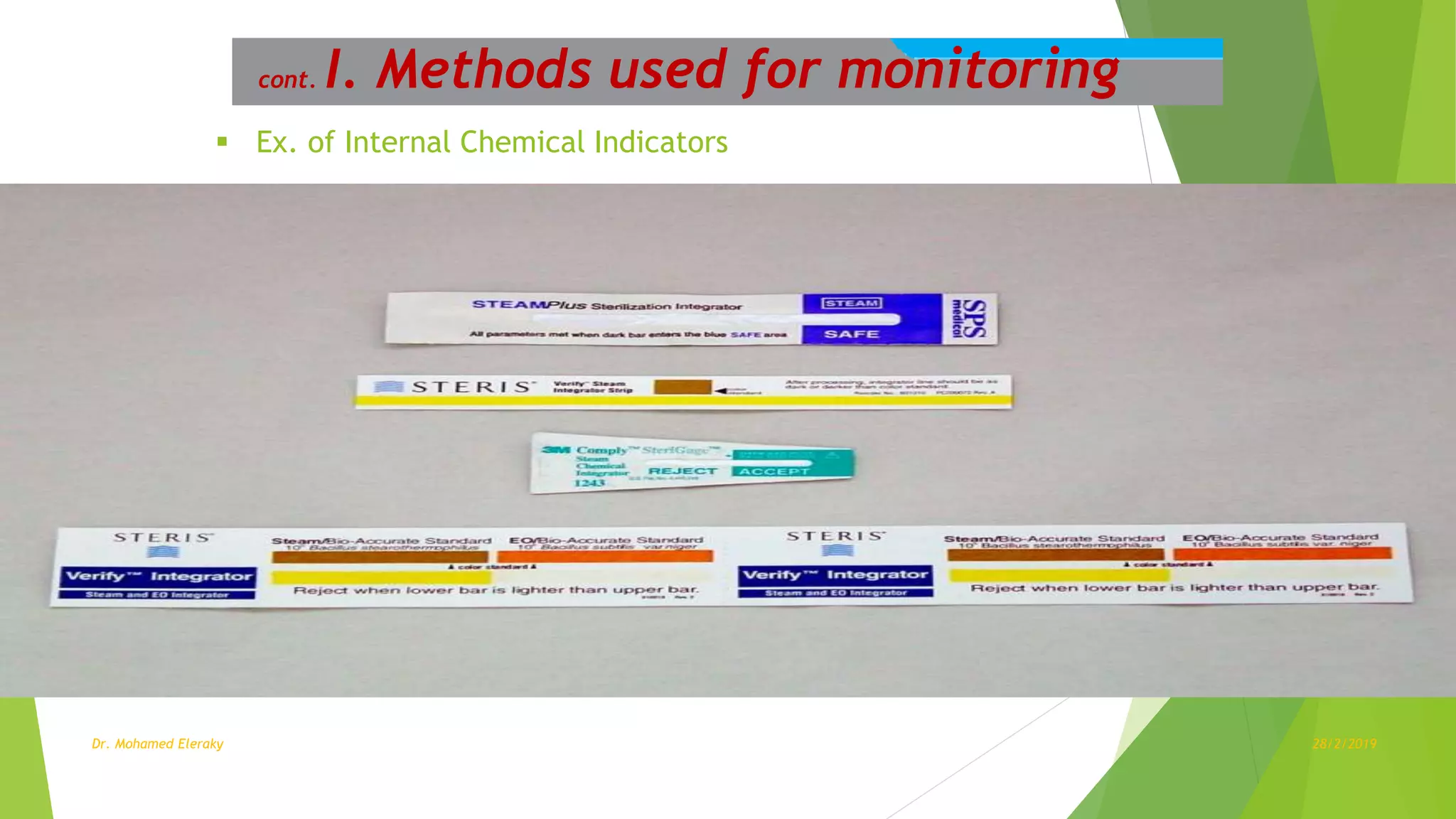
 Ex. of Internal Chemical Indicators
cont. I. Methods used for monitoring
Dr. Mohamed Eleraky 28/2/2019
 Bowie Dick Test—used to assure the air removal system is working properly in
a prevacuum sterilizer Daily
 Bowie Dick Test
cont. I. Methods used for monitoring
Dr. Mohamed Eleraky 28/2/2019
 Helix test
cont. I. Methods used for monitoring
Dr. Mohamed Eleraky 28/2/2019
 They assess the sterilization process directly by killing known highly resistant
microorganisms.
 Contain Geobacillus stearothermophillus- Highly heat resistant, spore-forming
bacteria does not produce toxins and is non-pathogenic.
C. Biological indicators : (Spore Tests)
cont. I. Methods used for monitoring
Dr. Mohamed Eleraky 28/2/2019
A. Equipment Control
B. Exposure control
C. Pack Control
D. Load Control
E. Record Keeping
II. Levels of Sterilization Assurance
Dr. Mohamed Eleraky 28/2/2019
A. Equipment Control
 Testing of new autoclaves
 Testing after repair or maintenance
 Periodic testing
 Mechanical parameters
 Tests for air removal in pre vacuum sterilizers
 Spore test can be used for equipment control
cont. II. Levels of Sterilization Assurance
Dr. Mohamed Eleraky 28/2/2019
It includes:
It is done through:
B. Exposure control
 They are placed on the external surface of (class 1 external chemical
indicator, e.g. tape and labels) or inside (class 3 internal single parameter
chemical indicator) each sterilized pack.
 If the indicator is only inside the pack, it should be visible to the user
examining the package. They are used to identify packs and sets that have
been processed in the sterilization process.
cont. II. Levels of Sterilization Assurance
Dr. Mohamed Eleraky 28/2/2019
C. Pack Control
 Chemical indicators and integrators are used to verify the penetration of the sterilization process
inside the pack or set.
 Usually, two or more parameters are monitored (multiple parameter internal chemical indicators
and integrators).
 The indicator or integrator should be placed in the most difficult to penetrate location within the
pack or tray.
 Integrators are helpful in identifying packs or trays with too high a density or mass, incorrect
configuration of the load, or beginning failures of sterilization equipment.
 They can help the user to differentiate problems between packs or trays and the sterilizer itself.
cont. II. Levels of Sterilization Assurance
Dr. Mohamed Eleraky 28/2/2019
D. Load Control
1. Biological release
The process by which a load is monitored and released based on the result of a biological
indicator in a test pack.
 Test the load with appropriate spore test
 Incubate test and control vials for the recommended time
 Read the result
 Use the result for releasing the load as sterile load
 2. Parametric Release
 Parametric Release is “declaring the product as sterile based on physical or chemical (or
both) process data rather than on the basis of biological indicators results”.
 Sterilize a PCD, double wrapped, with every sterilization cycle and use the test result for
batch release (BMS).
 Batch Monitoring System (BMS): Class 2 chemical indicators inside process challenge devices
cont. II. Levels of Sterilization Assurance
Dr. Mohamed Eleraky 28/2/2019
E. Record Keeping
 The staff should document each sterilizer:
• load number, date and time,
• contents of load,
• outcomes of chemical indicators, integrators, BIs & mechanical indicators ,
• operator’s name or initials.
 Any equipment maintenance, repairs, and calibration must be documented on each sterilizer.
 Autoclave User Log:
 Complete User Log with Every Use
 Maintain User Logs for 1-2 Years
 Autoclave Maintenance Log:
 Complete Maintenance Log for Every Repair
 Maintain records of Yearly Calibration
 Maintain Maintenance Logs for 3 – 5 Years
 Monitoring Results Log:
 Complete Results Log with Every Test
 Maintain Results Logs for 3 – 5 Years
cont. II. Levels of Sterilization Assurance
28/2/2019
 Take the sterilizer out of work
 Notify the infection prevention and control department
 All implantable objects of suspect load (s) should be recalled .
 Check that the spore test was done properly.
 Check with the hospital maintenance to ensure that the autoclave was used correctly and check for any changes in steam supply
 A single positive BI does not indicate a sterilizer malfunction if mechanical and chemical indicators are acceptable and appear to be functioning
properly.
 Objects, other than implantable ones do not need to be permanent recalled because of a single positive spore test unless the sterilizer or the
sterilization procedure is defective
 A second BI should be immediately processed while holding the suspect items in quarantine.
 Repeat the spore test in 3 consecutive sterilizer cycles and if the 3 spore test results were negative put the sterilizer back in service
 If the repeated tests showed positive results, the items should be considered non sterile and all objects processed since the last negative test should
be recalled and processed again and the sterilizer should be closed till the manufacturer solve the problem and ensure that it works properly and retest
before use in three consecutive cycles.
The followings are suggested to manage
a positive biological indicator in a steam sterilizer:
Dr. Mohamed Eleraky 28/2/2019
Any questions?
Steam sterilization monitoring

Steam sterilization monitoring

  • 1.
    Steam Sterilization Monitoring (SterilizationAssurance) Dr. Mohamed Eleraky MBBCh Infection Control Board Hospital Management Diploma Project Management Diploma ESIC / APIC member
  • 2.
     Sterilization /Sterility  Process used to transform product free from viable microorganisms (Bacteria, Viruses, Fungi) through inactivation of microorganisms Introduction The absence of microorganisms cannot be proven A sterility assurance level (SAL) is used to define the sterility Dr. Mohamed Eleraky 28/2/2019
  • 3.
    Cont. Introduction  SterilityAssurance Level (SAL)  Probability of a viable organism being present on a product unit after sterilization  SAL of 10-6 is required by the FDA for invasive medical device Dr. Mohamed Eleraky 28/2/2019
  • 4.
    Cont. Introduction  Inactivationof microorganisms  D value: Time required to achieve inactivation of 90% of a population of the microorganism under specific conditions Dr. Mohamed Eleraky 28/2/2019
  • 5.
     12:00 1 12:20 2  12:40 4  13:00 8  14:00 64  15:00 512  16:00 4,096  17:00 32,768  18:00 262,144  19:00 2,097,152 Cont. Introduction Dr. Mohamed Eleraky 28/2/2019  How fast do microorganisms reproduce??
  • 6.
    Cont. Introduction  Moistheat  Gamma radiation  Hydrogen peroxide gas plasma  Ethylene oxide (ETO) Common Sterilization methods used in health services: For moist heat sterilization, There are four parameters of steam sterilization: steam, pressure, temperature, and time. Dr. Mohamed Eleraky 28/2/2019
  • 7.
    Sterilization Quality Control Howdo I know my item is safe for the patient??? I. Methods used for Sterilization monitoring II. Levels of Sterilization Assurance Dr. Mohamed Eleraky 28/2/2019
  • 8.
     Mechanical monitoring Chemical indicators  Biological indicators  Equipment Control  Exposure control  Pack Control  Load Control  Record Keeping I. Methods used for monitoring II. Levels of Sterilization Assurance Dr. Mohamed Eleraky 28/2/2019
  • 9.
     Cycle time. Temperature.  Pressure  Sterilizers have recording devices that print out these parameters.  Correct readings do not ensure sterilization, but incorrect readings can be the first indicator for a problem with the sterilization cycle. I. Methods used for monitoring A.Mechanical monitoring : through assessing Dr. Mohamed Eleraky 28/2/2019
  • 10.
     External chemicalindicators (class 1):  They are applied to the outside of a package (e.g., chemical indicator tape and labels).  They change color rapidly when a specific parameter is reached, and they verify that the package has been exposed to the sterilization process.  Internal chemical indicators and integrators (Class 3-6 ):  They are used inside package to ensure the sterilizing agent has penetrated the packaging material and actually reached the instruments inside.  Bowie-Dick Sheets inside test packs (class 2) :  Sheets printed with a chemical indicator in the form of diagonal strips which change color to dark brown or black.  A satisfactory test is indicated by the development of uniform color change indicating rapid steam penetration, adequate air removal and freedom from significant air.  Chemical strip (Class 2) :  Used inside a hollow load process challenge device (helix test) for testing the efficiency of rapid steam penetration in pre vacuum sterilizers. cont. I. Methods used for monitoring B. Chemical indicators : Dr. Mohamed Eleraky 28/2/2019
  • 11.
    Class Description Use Class1 Process indicators Used to indicate that the pack or container has been exposed to the sterilization process and to differentiate between processed and unprocessed items (tape and labels) Class 2 Indicators for use in special tests e.g. BD sheets and strips used inside process challenge device (PCD) to test for air removal in vacuum assisted sterilizers Class 3 Single variable indicators React to one of the critical parameter of sterilization and indicate exposure to a sterilization cycle at stated values (SV) of the chosen parameter. Critical parameters typically chosen for steam sterilization processes are time or temperature. Class 4 Multi-variable indicators React to two or more of the critical variables (time, temperature and saturated steam) to indicate exposure to a sterilization cycle as SVs of the chosen variables. They provide additional monitoring of the sterilization cycle Class 5 Integrators React to all critical parameters over a specified range of sterilization cycles. Their performance has been correlated to the performance of a biological indicator (BI) under its labeled conditions for use. This class of indicator can be used in place of the BI in many applications, thereby reducing the overall cost of sterile processing. Class 6 Emulating indicators They are cycle verification indicators that are designed to react to all critical variables of specified sterilization cycles. They emulate the cycle. They have the most stringent tolerance levels of all chemical indicators.  Different chemical indicators cont. I. Methods used for monitoring Dr. Mohamed Eleraky 28/2/2019
  • 12.
    Before Processing AfterProcessing  External Chemical Indicator Tape Class I cont. I. Methods used for monitoring Dr. Mohamed Eleraky 28/2/2019
  • 13.
     Sterilization pack& pouch cont. I. Methods used for monitoring Dr. Mohamed Eleraky 28/2/2019
  • 14.
     Tamper evidentdevice—container locks, tape, arrows  Internal Pack Control—chemical indicators placed inside the tray, let us know that several parameters for sterilization have been met  Tamper evident device—container cont. I. Methods used for monitoring Dr. Mohamed Eleraky 28/2/2019
  • 15.
     Ex. ofInternal Chemical Indicators cont. I. Methods used for monitoring Dr. Mohamed Eleraky 28/2/2019
  • 16.
     Bowie DickTest—used to assure the air removal system is working properly in a prevacuum sterilizer Daily  Bowie Dick Test cont. I. Methods used for monitoring Dr. Mohamed Eleraky 28/2/2019
  • 17.
     Helix test cont.I. Methods used for monitoring Dr. Mohamed Eleraky 28/2/2019
  • 18.
     They assessthe sterilization process directly by killing known highly resistant microorganisms.  Contain Geobacillus stearothermophillus- Highly heat resistant, spore-forming bacteria does not produce toxins and is non-pathogenic. C. Biological indicators : (Spore Tests) cont. I. Methods used for monitoring Dr. Mohamed Eleraky 28/2/2019
  • 19.
    A. Equipment Control B.Exposure control C. Pack Control D. Load Control E. Record Keeping II. Levels of Sterilization Assurance Dr. Mohamed Eleraky 28/2/2019
  • 20.
    A. Equipment Control Testing of new autoclaves  Testing after repair or maintenance  Periodic testing  Mechanical parameters  Tests for air removal in pre vacuum sterilizers  Spore test can be used for equipment control cont. II. Levels of Sterilization Assurance Dr. Mohamed Eleraky 28/2/2019 It includes: It is done through:
  • 21.
    B. Exposure control They are placed on the external surface of (class 1 external chemical indicator, e.g. tape and labels) or inside (class 3 internal single parameter chemical indicator) each sterilized pack.  If the indicator is only inside the pack, it should be visible to the user examining the package. They are used to identify packs and sets that have been processed in the sterilization process. cont. II. Levels of Sterilization Assurance Dr. Mohamed Eleraky 28/2/2019
  • 22.
    C. Pack Control Chemical indicators and integrators are used to verify the penetration of the sterilization process inside the pack or set.  Usually, two or more parameters are monitored (multiple parameter internal chemical indicators and integrators).  The indicator or integrator should be placed in the most difficult to penetrate location within the pack or tray.  Integrators are helpful in identifying packs or trays with too high a density or mass, incorrect configuration of the load, or beginning failures of sterilization equipment.  They can help the user to differentiate problems between packs or trays and the sterilizer itself. cont. II. Levels of Sterilization Assurance Dr. Mohamed Eleraky 28/2/2019
  • 23.
    D. Load Control 1.Biological release The process by which a load is monitored and released based on the result of a biological indicator in a test pack.  Test the load with appropriate spore test  Incubate test and control vials for the recommended time  Read the result  Use the result for releasing the load as sterile load  2. Parametric Release  Parametric Release is “declaring the product as sterile based on physical or chemical (or both) process data rather than on the basis of biological indicators results”.  Sterilize a PCD, double wrapped, with every sterilization cycle and use the test result for batch release (BMS).  Batch Monitoring System (BMS): Class 2 chemical indicators inside process challenge devices cont. II. Levels of Sterilization Assurance Dr. Mohamed Eleraky 28/2/2019
  • 24.
    E. Record Keeping The staff should document each sterilizer: • load number, date and time, • contents of load, • outcomes of chemical indicators, integrators, BIs & mechanical indicators , • operator’s name or initials.  Any equipment maintenance, repairs, and calibration must be documented on each sterilizer.  Autoclave User Log:  Complete User Log with Every Use  Maintain User Logs for 1-2 Years  Autoclave Maintenance Log:  Complete Maintenance Log for Every Repair  Maintain records of Yearly Calibration  Maintain Maintenance Logs for 3 – 5 Years  Monitoring Results Log:  Complete Results Log with Every Test  Maintain Results Logs for 3 – 5 Years cont. II. Levels of Sterilization Assurance 28/2/2019
  • 25.
     Take thesterilizer out of work  Notify the infection prevention and control department  All implantable objects of suspect load (s) should be recalled .  Check that the spore test was done properly.  Check with the hospital maintenance to ensure that the autoclave was used correctly and check for any changes in steam supply  A single positive BI does not indicate a sterilizer malfunction if mechanical and chemical indicators are acceptable and appear to be functioning properly.  Objects, other than implantable ones do not need to be permanent recalled because of a single positive spore test unless the sterilizer or the sterilization procedure is defective  A second BI should be immediately processed while holding the suspect items in quarantine.  Repeat the spore test in 3 consecutive sterilizer cycles and if the 3 spore test results were negative put the sterilizer back in service  If the repeated tests showed positive results, the items should be considered non sterile and all objects processed since the last negative test should be recalled and processed again and the sterilizer should be closed till the manufacturer solve the problem and ensure that it works properly and retest before use in three consecutive cycles. The followings are suggested to manage a positive biological indicator in a steam sterilizer: Dr. Mohamed Eleraky 28/2/2019
  • 26.
    Dr. Mohamed Eleraky28/2/2019 Any questions?

Editor's Notes

  • #16 You may see several. Indicators tell you what the indicator was exposed to
  • #17 Makes sure steam is displacing the air but not assure sterilization.