

Are the principles of authentic e-learning and
activity theory compatible?
Rita Kizito (PhD),
University of the Western
Cape, Republic of South Africa,
The abstract
This theoretical paper compares the principles of
authentic e-learning with those of a social science
theory- cultural historical activity theory or CHAT. I point
out areas of compatibility and explore contradictions
resulting from an overlap of the two sets of principles.
Future directions for research are then recommended.
The problem
 The abstraction and de-contextualisation of the type of
knowledge taught in schools and universities from real
world contexts is problematic (Herrington &
Oliver, 2000, Resnick, 1987).
 Authentic learning offers an approach to designing
instruction that is engaging, allowing students to
understand fundamental ideas , while providing
opportunities for them to practice reasoning as experts
(Herrington, 2009).
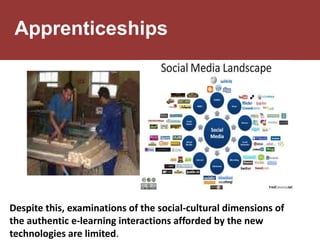
Apprenticeships
Despite this, examinations of the social-cultural dimensions of
the authentic e-learning interactions afforded by the new
technologies are limited.
Comparing authentic e
learning principles and CHAT
The purpose of the present paper is to address this issue by comparing
principles of authentic e-learning with a social science theory- cultural-
historical activity theory (CHAT). CHAT is chosen as a frame of
reference because of its focus on social and cultural dimensions of
human behaviour embedded in analyses of the human activity. CHAT
espouses the Vygotskian idea that human development is based on
sequences of mediated interactions within one‟s social and cultural
context (Vgotsky, 1978; Daniels et al., 2009).
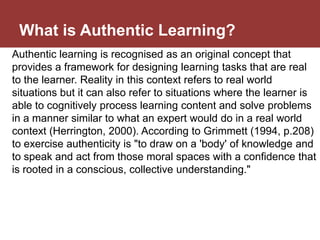
What is Authentic Learning?
Authentic learning is recognised as an original concept that
provides a framework for designing learning tasks that are real
to the learner. Reality in this context refers to real world
situations but it can also refer to situations where the learner is
able to cognitively process learning content and solve problems
in a manner similar to what an expert would do in a real world
context (Herrington, 2000). According to Grimmett (1994, p.208)
to exercise authenticity is "to draw on a 'body' of knowledge and
to speak and act from those moral spaces with a confidence that
is rooted in a conscious, collective understanding."
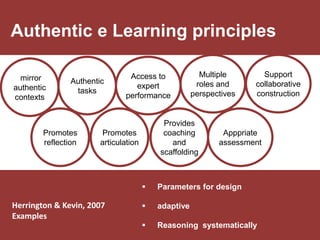
Authentic e Learning principles
 Parameters for design
 adaptive
 Reasoning systematically
Authentic
tasks
mirror
authentic
contexts
Support
collaborative
construction
Promotes
reflection
Provides
coaching
and
scaffolding
Promotes
articulation
Multiple
roles and
perspectives
Access to
expert
performance
Apppriate
assessment
Herrington & Kevin, 2007
Examples
Authentic Learning
• whose reality is given prominence in the “authentic context”
or “authentic activity”? Is it that of the experts or the learner
(s)?
• Typically, the expert contexts take prominence as the
refined and collective understanding of any practice resides
with this group. Then the question becomes that of
determining the extent to which the learner contexts are
accommodated in the learner-teacher interactions mediated
by technology.
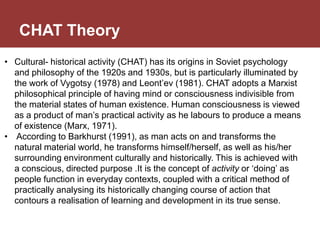
CHAT Theory
• Cultural- historical activity (CHAT) has its origins in Soviet psychology
and philosophy of the 1920s and 1930s, but is particularly illuminated by
the work of Vygotsy (1978) and Leont‟ev (1981). CHAT adopts a Marxist
philosophical principle of having mind or consciousness indivisible from
the material states of human existence. Human consciousness is viewed
as a product of man‟s practical activity as he labours to produce a means
of existence (Marx, 1971).
• According to Barkhurst (1991), as man acts on and transforms the
natural material world, he transforms himself/herself, as well as his/her
surrounding environment culturally and historically. This is achieved with
a conscious, directed purpose .It is the concept of activity or „doing‟ as
people function in everyday contexts, coupled with a critical method of
practically analysing its historically changing course of action that
contours a realisation of learning and development in its true sense.
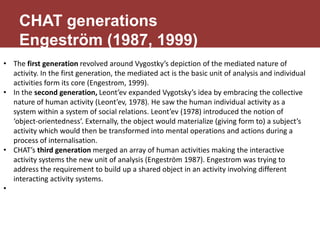
CHAT generations
Engeström (1987, 1999)
• The first generation revolved around Vygostky’s depiction of the mediated nature of
activity. In the first generation, the mediated act is the basic unit of analysis and individual
activities form its core (Engestrom, 1999).
• In the second generation, Leont’ev expanded Vygotsky’s idea by embracing the collective
nature of human activity (Leont’ev, 1978). He saw the human individual activity as a
system within a system of social relations. Leont’ev (1978) introduced the notion of
‘object-orientedness’. Externally, the object would materialize (giving form to) a subject’s
activity which would then be transformed into mental operations and actions during a
process of internalisation.
• CHAT’s third generation merged an array of human activities making the interactive
activity systems the new unit of analysis (Engeström 1987). Engestrom was trying to
address the requirement to build up a shared object in an activity involving different
interacting activity systems.
•
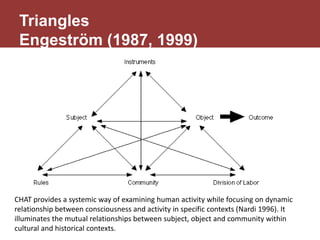
Triangles
Engeström (1987, 1999)
CHAT provides a systemic way of examining human activity while focusing on dynamic
relationship between consciousness and activity in specific contexts (Nardi 1996). It
illuminates the mutual relationships between subject, object and community within
cultural and historical contexts.
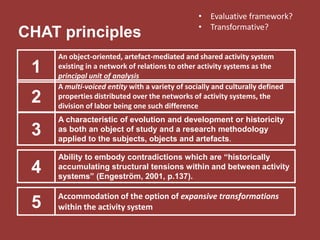
CHAT principles
1
An object-oriented, artefact-mediated and shared activity system
existing in a network of relations to other activity systems as the
principal unit of analysis
2
A multi-voiced entity with a variety of socially and culturally defined
properties distributed over the networks of activity systems, the
division of labor being one such difference
3
A characteristic of evolution and development or historicity
as both an object of study and a research methodology
applied to the subjects, objects and artefacts.
4
Ability to embody contradictions which are “historically
accumulating structural tensions within and between activity
systems” (Engeström, 2001, p.137).
5
Accommodation of the option of expansive transformations
within the activity system
• Evaluative framework?
• Transformative?
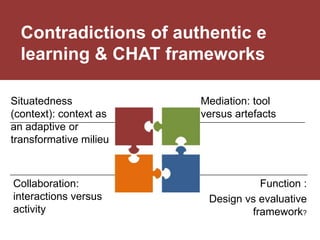
Contradictions of authentic e
learning & CHAT frameworks
Situatedness
(context): context as
an adaptive or
transformative milieu
Collaboration:
interactions versus
activity
Mediation: tool
versus artefacts
Function :
Design vs evaluative
framework?
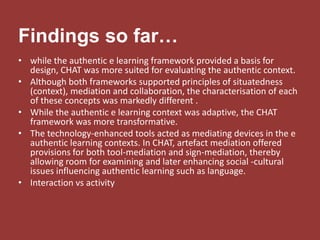
Findings so far…
• while the authentic e learning framework provided a basis for
design, CHAT was more suited for evaluating the authentic context.
• Although both frameworks supported principles of situatedness
(context), mediation and collaboration, the characterisation of each
of these concepts was markedly different .
• While the authentic e learning context was adaptive, the CHAT
framework was more transformative.
• The technology-enhanced tools acted as mediating devices in the e
authentic learning contexts. In CHAT, artefact mediation offered
provisions for both tool-mediation and sign-mediation, thereby
allowing room for examining and later enhancing social -cultural
issues influencing authentic learning such as language.
• Interaction vs activity
Going forward…
•
To make more conclusive judgements, empirical design
based research is required to explore contradictions
resulting from an overlap of the two sets of principles
and correctly frame the intersection of authentic e
learning and CHAT.
Questions?
Thank-you

Authentic learning vs chat

  • 1.
    Are the principlesof authentic e-learning and activity theory compatible? Rita Kizito (PhD), University of the Western Cape, Republic of South Africa,
  • 2.
    The abstract This theoreticalpaper compares the principles of authentic e-learning with those of a social science theory- cultural historical activity theory or CHAT. I point out areas of compatibility and explore contradictions resulting from an overlap of the two sets of principles. Future directions for research are then recommended.
  • 3.
    The problem  Theabstraction and de-contextualisation of the type of knowledge taught in schools and universities from real world contexts is problematic (Herrington & Oliver, 2000, Resnick, 1987).  Authentic learning offers an approach to designing instruction that is engaging, allowing students to understand fundamental ideas , while providing opportunities for them to practice reasoning as experts (Herrington, 2009).
  • 4.
    Apprenticeships Despite this, examinationsof the social-cultural dimensions of the authentic e-learning interactions afforded by the new technologies are limited.
  • 5.
    Comparing authentic e learningprinciples and CHAT The purpose of the present paper is to address this issue by comparing principles of authentic e-learning with a social science theory- cultural- historical activity theory (CHAT). CHAT is chosen as a frame of reference because of its focus on social and cultural dimensions of human behaviour embedded in analyses of the human activity. CHAT espouses the Vygotskian idea that human development is based on sequences of mediated interactions within one‟s social and cultural context (Vgotsky, 1978; Daniels et al., 2009).
  • 6.
    What is AuthenticLearning? Authentic learning is recognised as an original concept that provides a framework for designing learning tasks that are real to the learner. Reality in this context refers to real world situations but it can also refer to situations where the learner is able to cognitively process learning content and solve problems in a manner similar to what an expert would do in a real world context (Herrington, 2000). According to Grimmett (1994, p.208) to exercise authenticity is "to draw on a 'body' of knowledge and to speak and act from those moral spaces with a confidence that is rooted in a conscious, collective understanding."
  • 7.
    Authentic e Learningprinciples  Parameters for design  adaptive  Reasoning systematically Authentic tasks mirror authentic contexts Support collaborative construction Promotes reflection Provides coaching and scaffolding Promotes articulation Multiple roles and perspectives Access to expert performance Apppriate assessment Herrington & Kevin, 2007 Examples
  • 8.
    Authentic Learning • whosereality is given prominence in the “authentic context” or “authentic activity”? Is it that of the experts or the learner (s)? • Typically, the expert contexts take prominence as the refined and collective understanding of any practice resides with this group. Then the question becomes that of determining the extent to which the learner contexts are accommodated in the learner-teacher interactions mediated by technology.
  • 9.
    CHAT Theory • Cultural-historical activity (CHAT) has its origins in Soviet psychology and philosophy of the 1920s and 1930s, but is particularly illuminated by the work of Vygotsy (1978) and Leont‟ev (1981). CHAT adopts a Marxist philosophical principle of having mind or consciousness indivisible from the material states of human existence. Human consciousness is viewed as a product of man‟s practical activity as he labours to produce a means of existence (Marx, 1971). • According to Barkhurst (1991), as man acts on and transforms the natural material world, he transforms himself/herself, as well as his/her surrounding environment culturally and historically. This is achieved with a conscious, directed purpose .It is the concept of activity or „doing‟ as people function in everyday contexts, coupled with a critical method of practically analysing its historically changing course of action that contours a realisation of learning and development in its true sense.
  • 10.
    CHAT generations Engeström (1987,1999) • The first generation revolved around Vygostky’s depiction of the mediated nature of activity. In the first generation, the mediated act is the basic unit of analysis and individual activities form its core (Engestrom, 1999). • In the second generation, Leont’ev expanded Vygotsky’s idea by embracing the collective nature of human activity (Leont’ev, 1978). He saw the human individual activity as a system within a system of social relations. Leont’ev (1978) introduced the notion of ‘object-orientedness’. Externally, the object would materialize (giving form to) a subject’s activity which would then be transformed into mental operations and actions during a process of internalisation. • CHAT’s third generation merged an array of human activities making the interactive activity systems the new unit of analysis (Engeström 1987). Engestrom was trying to address the requirement to build up a shared object in an activity involving different interacting activity systems. •
  • 11.
    Triangles Engeström (1987, 1999) CHATprovides a systemic way of examining human activity while focusing on dynamic relationship between consciousness and activity in specific contexts (Nardi 1996). It illuminates the mutual relationships between subject, object and community within cultural and historical contexts.
  • 12.
    CHAT principles 1 An object-oriented,artefact-mediated and shared activity system existing in a network of relations to other activity systems as the principal unit of analysis 2 A multi-voiced entity with a variety of socially and culturally defined properties distributed over the networks of activity systems, the division of labor being one such difference 3 A characteristic of evolution and development or historicity as both an object of study and a research methodology applied to the subjects, objects and artefacts. 4 Ability to embody contradictions which are “historically accumulating structural tensions within and between activity systems” (Engeström, 2001, p.137). 5 Accommodation of the option of expansive transformations within the activity system • Evaluative framework? • Transformative?
  • 13.
    Contradictions of authentice learning & CHAT frameworks Situatedness (context): context as an adaptive or transformative milieu Collaboration: interactions versus activity Mediation: tool versus artefacts Function : Design vs evaluative framework?
  • 14.
    Findings so far… •while the authentic e learning framework provided a basis for design, CHAT was more suited for evaluating the authentic context. • Although both frameworks supported principles of situatedness (context), mediation and collaboration, the characterisation of each of these concepts was markedly different . • While the authentic e learning context was adaptive, the CHAT framework was more transformative. • The technology-enhanced tools acted as mediating devices in the e authentic learning contexts. In CHAT, artefact mediation offered provisions for both tool-mediation and sign-mediation, thereby allowing room for examining and later enhancing social -cultural issues influencing authentic learning such as language. • Interaction vs activity
  • 15.
    Going forward… • To makemore conclusive judgements, empirical design based research is required to explore contradictions resulting from an overlap of the two sets of principles and correctly frame the intersection of authentic e learning and CHAT. Questions?
  • 16.

Editor's Notes

  • #3 The onset of online technologies has made the design and creation of innovative authentic learning environments possible. Using design - based research it is now possible to apply and review principles of authentic e-learning design when developing learning activities in higher education. Despite this, examinations of the social-cultural dimensions of the authentic e-learning interactions afforded by the new technologies are limited. To address this concern,