Dr Susan Myburgh
           University of South Australia
Visiting Professor, University of Parma
   How does the information society affect the
    information professions?
    ◦ What do we do?
    ◦ Are there commonalities between the
      information professions?
    ◦ Why do we do what we do?
   The sea change/ paradigm shift.
    ◦ Foucault‟s „Bibliotheque fantastique‟
    ◦ Information interventionists (Myburgh,
      2007)
    ◦ Participatory librarianship
    ◦ Transliteracies
   What are we (as information workers) and
    what will we become?
    ◦ Digital libraries
    ◦ User involvement
    ◦ Context
    ◦ Particular learning role
    ◦ Metaprofession
    ◦ Metatheory
 the expression “information
 society” has become the
 hegemonic term to describe
 contemporary times: not because
 it expresses a theoretical
 clarity, but rather due to its
 “baptism” by the official policies
 of the more developed countries
 It
   seems as if the information
 society is built from the
 incorporation of technologies
 and not from the existing
 structural realities and
 contradictions
What is fundamental is to
 contest and delegitimize any
 term or definition that
 reinforces this technocentric
 conception of society
 Inorder to historically review the
 concept, it should be remembered
 that, in general, the relationship
 between technology and
 development has frequently been
 perceived as a lineal relationship
   In the first approach, to talk about
    the information society refers to a
    new development paradigm that
    assigns technology to a causal
    role in the social order,
    designating it as the drive of
    economic development.
   The second approach maintains that the
    new phase of human development that we
    are entering into is characterised by the
    predominance of information,
    communication, and knowledge in the
    economy as well as human activities.
    According to this standpoint, technology is
    the support that has unleashed the
    acceleration of this process; but it is not a
    neutral factor, nor is its course inexorable,
    since technological development is guided
    by games of interest.
   The discourse of information is a discourse of
    power ... Information ... looks chaotic, i.e.
    individual oriented, but it is based on power
    as much as on its outward sign, money. The
    discourse of the information economy
    displaces and discourages the idea of
    information as a social good by giving the
    impression of a non-hierarchical and
    powerless structure, where everybody has a
    chance to find the message one is looking
    for. But indeed this means that finally the
    messengers are the main point, the medium
    is indeed the message
    (Capurro, 1996, online).
 How  can one characterise the
 deep transformations that come
 with the accelerated insertion of
 artificial intelligence and new
 Information and Communication
 Technologies (ICTs) in our present
 society?
 Thatinformation
possesses transformative
abilities is an article of
faith for librarians
On one hand the international dominant
 position holds that only deregulation of
 markets can guarantee the existence of the
 infrastructure necessary for universal access
 to the Information Society.

On the other hand, movements are fighting to
 ensure that information remains above all a
 public good and calling for regulation and
 public governance at a level appropriate for
 the important issues of the Information Age.
But now collaborative everything
is possible: even consumerism…
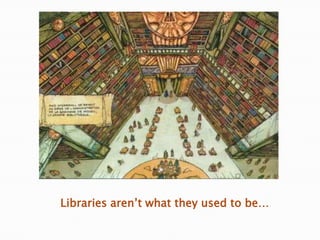
Libraries aren‟t what they used to be…
Perhaps they‟re even more so.
   Elucidating the professional contribution
    of librarianship to the information
    society. Four issues can be identified:
   Information work must be explained as a
    discipline/profession.
   Thus, there is a necessity for a
    theoretical framework which describes
    the knowledge domain.
   Possibility of a metacommunity of
    information professionals but we need
    conceptual clarity.
   Every discipline/profession must have
    asocial purpose or responsibility.
   . A profession can be defined by the role it
    plays in society, but it nonetheless needs a
    disciplinary or theoretical base to inform its
    praxis: it requires a supporting discipline
    which exhibits epistemological commitments
    and develops theory which supports practice.
   Parsons suggests that there are several core
    criteria which distinguish professional work
    from the work of other occupations, namely a
    “requirement of formal technical training...
    giving prominence to an intellectual
    component”; the development of “skills in
    some form of its use”; and the “socially
    responsible uses” of the profession
    (Parsons, 1968, his italics).
   Among the various distinguishing criteria of a
    profession are: a core body of knowledge
    outlining and governing its practices, a social
    problem or need which the profession uses
    its knowledge base to deal with, and a degree
    of autonomy.
   Abbott (1988, p. 8) defines professions as
    “exclusive occupational groups applying
    somewhat abstract knowledge to particular
    cases”, and he believes that a profession‟s
    strongest claim of jurisdiction over a problem
    is that its knowledge system is effective in
    the task domain.
   Blackler (1995) compares command of the
    abstractions which constitute a knowledge
    domain to a „black box‟ of professional
    knowledge (c.f. Latour and Woolgar, 1986).
    This professional knowledge is not shared by
    other professions: separation and isolation
    give authority to such knowledge
    (Blackler, 1995). This suggests that both a
    theoretical foundation and a clear social
    purpose are necessary .
   A discipline can be
    characterised,
    according to Klein,
    as “[T]he tools,
    methods,
    procedures,
    exempla, concepts
    and theories that
    account coherently
    for a set of objects
    or subjects” (Klein,
    1990, p.12).
   Disciplines comprise an object of
    study, theories, and epistemological
    commitments, as disciplines are a
    means for, in Foucauldian terms,
    constructing and controlling
    knowledge production.

   A discipline therefore includes a
    disciplinary culture, which provides an
    identity, credentials and values for its
    practitioners.
   A discipline imparts, in addition, a particular
    view of the object of its study and this is
    what commonly differentiates disciplines:
    the objects, and the way in which they are
    studied, which Kuhn (1962/1970) called a
    paradigm or world view. The knowledge
    domain depends, in turn, on identified
    objects of study, and established methods
    and procedures for examination of these
    objects within the discipline.
Action guided by habitus has
the appearance of rationality
but is based not so much on
    reason as on socially-
  constituted dispositions.
Van House and Sutton, 1996
 Theory is the core of an
 academic discipline (as
 opposed to its practical
 expression as a profession),
 and concepts are the core of a
 theory.
Praxis (practice) is the
 execution of the
 theoretical principles
 embodied in the
 knowledge domain of a
 discipline/profession.
   The branches of philosophy (or knowledge
    seeking) include epistemology (the nature
    and grounds for knowing); ontology (the
    nature of being and the existence of entities);
    methodology (systematic understandings of
    method); ideology (the role of power and
    forces in human life, institutions, and
    cultures); teleology (designs and purposes as
    explanation); and axiology (the nature and
    operation of values and ethics).
 Epistemology is the branch of
  philosophy that deals with the
  definition, nature, structure, origin
  and theory of knowledge: how
  knowledge is created.
 Many disciplines identify an
  epistemological base which guides
  what knowledge in the discipline is
  created, structured, organised and
  understood: an epistemological
  commitment is considered the
  philosophical base of the discipline.
   Borko‟s1968 definition of “Information
    Science”:
   Information science is that discipline
    that investigates the properties and
    behaviour of information, the forces
    governing the flow of information, and
    the means of processing information
    for optimum accessibility and usability
    (Borko, 1968, pp. 3-5).
   Soergel (2005), amongst others, believes that
    Information Science already “brings together and
    advances basic thinking about the structure of
    knowledge, the structure of
    problems, approaches to problem solving and
    decision making, human information
    processing, and the functioning of social groups
    and organizations”, and thus it includes, or draws
    upon, many diverse areas, including computer
    science, mathematics, journalism, graphic
    design, education, economics and so on.
   … we emphasise that the argument for
    jurisdiction must be based on
    demonstrated ability to solve
    information problems. Many
    professions are at work building new
    information tools in the form of
    computer-based systems. Many are
    concerned with methods of managing
    and delivering information, and not
    just traditional information containers
    (Van House and Sutton, 1998, online).
Reductionism
„The mother of all models’


Transmission model. Shown to cultural and communication studies as
a poor, oversimplified and irrelevant example.
This hierarchy is first suggested in a poem by T. S.
 Eliot, published in 1934, called The chorus of the
 rock:

Where is the Life we have lost in living?
Where is the wisdom we have lost in knowledge?
Where is the knowledge we have lost in information?
   A good way to think about information is that it's
    the professional object of librarianship. Every
    profession has its object: for law everything is a
    case, for medicine everything is a disease, and
    for librarianship everything is information. In
    each case, someone walks in the door with a
    problem, and the professional's job is to find
    their object in that problem, and to talk about
    the problem in a way that makes it sound like a
    case, a disease, or information that can be
    compared with other cases, other diseases, or
    other information (Agre, 1997, online).
   “IPs collect, organise, describe, manage, preserve
    and make accessible… ”.
     •the pattern of organisation of matter and energy that has been given
     meaning by a living being.
•the lifeblood of the knowledge-based organisation.
      •anything that makes sense.
•something that is intended to make sense.
     •an objective phenomenon, something that is generated
     by, transmitted in, received and stored in physical media, but the
     existence of which is independent of an interpreting agent.
•the presence of a 1 or 0 in a bit.
      •a stimulus which expands or amends the World View of the
      informed.
 •what people or systems need to be able to carry out work
 practices.
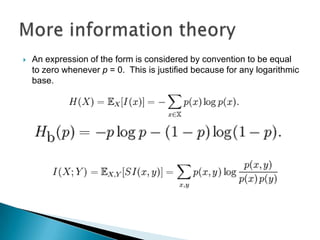
   An expression of the form is considered by convention to be equal
    to zero whenever p = 0. This is justified because for any logarithmic
    base.
 Developing  a theoretical
 framework which provides a kind
 of „lingua franca‟ for the
 disciplines/professions involved
 in information work would be a
 high priority if further
 collaboration and integration is
 desired.
   A theoretical framework provides a
    basic, hypothetical, logical, conceptual
    structure or description of a complex
    entity or process, which can be used
    to develop theory, by classifying and
    organising complex information and
    providing a unified and coherent view.
    It enables the organisation and
    classification of concepts, entities, and
    phenomena, and the relationships
    between them, providing a unified and
    coherent view.
   A theoretical framework comprises a set of
    concepts (ontology), the relationships
    between the concepts or phenomena which
    are called propositions or principles, and
    these relations are captured in a taxonomy.
    The ontology and taxonomy are accompanied
    by a statement of teleology, or purpose,
    which is qualified by axiological beliefs or
    obligations. „Nomos‟, or the present
    situation and customs, can be contrasted
    with „telos‟, which refers to a purpose or
    goal. Epistemologically speaking, an axiom is
    a self-evident truth.
   Information is that part of knowledge that is
    selected to be communicated
   It is communicated by being represented in
    symbols (sound and image) – language
   Knowledge of language (sound and image)
    must exist before communication can take
    place (i.e. mutual understanding of cultural
    symbols) (Myburgh, 2007)
Learning is a process of active engagement
  with experience.
It is what people do when they want to
  make sense of the world. It may involve
  the development or deepening of
  skills, knowledge, understanding, awarene
  ss, values, ideas and feelings, or an
  increase in the capacity to reflect.
  Effective learning leads to
  change, development and the desire to
  learn more.
 Libraries are political sites;
  information professionals have a
  political role: this is clear because of
  the relationship between
  information (ideas) and power.
 All knowledge
  structures, epistemologies and
  communication of information
  are, as Foucault tells us, highly
  political and hegemonic.
Information is a key component of what
 Giddens calls ‘structuration’, an emergent
 process in which neither structure nor
 individual action predominates but it must
 be related to what is already known and
 understood; but it must also have an
 element of novelty and so inspire
 creativity.
 In other words, information must be made
 meaningful to human beings.
   ...information professionals are not neutral,
    impartial custodians of truth; that
    information centre documents are not
    disinterested or innocent by-products of
    actions and administrations; that
    documents are rooted in the process and
    discourse of creation; and the order and
    language imposed on documents through
    arrangement and description are not value-
    free recreations of reality (Cook, 1997,
    online).
 Information professionals can be
  viewed as “organic intellectuals”
  (Gramsci)
 they play an ideological and
  organizational role in maintaining an
  historic bloc’s hegemony over the
  relations of economic production and
  civil society. From this perspective, the
  apparently neutral discourse of LIS
  regarding access to information can be
  examined as a discourse that privileges
  particular rather than universal
  interests (Raber, 2003, p. 35).
They are the organizers of capitalist
 hegemony and its culture, and they play
 central strategic and ideological roles in the
 superstructure that reproduces capitalist
 relations of production.
These intellectuals “are the dominant group‟s
 “deputies” exercising the subaltern
 functions of social hegemony and political
 government”(Gramsci, 1971, p. 12, cited by
 Raber, 2003, p. 45)
   For Castells, it is the interaction between
    knowledge creation, making meaning,
    learning and application that is a key aspect
    of the Information Society.

   Power then is central to information – for
    information, as Castells in particular has so
    forcefully argued, is an element which must
    flow. Where it flows from, and to whom, is
    the province of power.
   They control mastery of and access to those
    discursive resources which could provide
    essential competencies in an information-
    based economy and society, and which
    directly affect social and economic power.
Habermas (1962) argues, in his book, The structural transformation of the
  bourgeois public sphere, that art criticism, social criticism and literary
  criticism developed in public spaces like coffee houses. They became
  organised in the sense that criticism developed particular forms of
  communication in order to talk and write about social, political and cultural
  issues in society.
The success of the public sphere, according to Habermas, depends upon:
 the extent of access (as close to universal as possible),

 the degree of autonomy (the citizens must be free of coercion),

 the rejection of hierarchy (so that each might participate on an equal
  footing),
 the rule of law (particularly the subordination of the state),

 the quality of participation (the common commitment to the ways of logic).

 rational-critical discourse (Rutherford, 2000, p. 18).
   understand how information is
    created, the differences between
    information sources, the distinctions in
    how people acquire information and
    turn it into something meaningful to
    them and their organizations, and the
    changing nature of information
    systems as reflections of
    social, economic, political, cultural and
    other factors…(Cox, 1998, online).
   information work has been described as a
    „metadiscipline‟ which is concerned with the
    content of conventional disciplines‟, and it is
    orthogonally situated in relation to other
    disciplines. (Bates, 1999, p. 1044). Herold
    quotes an earlier writer who suggested that
    there are similarities between philosophy and
    librarianship in this regard (as does Floridi):

   1. Material field – agreement on the set of
    objects with which the discipline is concerned;
   2. Subject matter – the point of view or
    epistemology from which the metadiscipline
    looks upon the set of objects that it studies
   3. Level of theoretical integration –
    reconstruction of the reality of its subject matter.
    Most disciplines have many different
    theories, some unrelated, some contradictory.
   4. Methods - the methods used to
    observe, describe and interpret the entities and
    phenomena that comprise the objects of study in
    the discipline..
   5. Analytical tools – the tools a discipline uses,
    although Heckhausen indicates that these are not
    specific to disciplines.
   6. Applications of a discipline in fields of practice
    – the degree of applicability of the theory to
    established practical applications. Heckhausen
    notes that disciplines with obligations to
    professional practice tend to be multi-
    disciplinary and lag behind in research.
   7. Historical contingencies – a discipline is always
    in a transitional state and is a product of
    historical developments.
   8. Social purpose of the profession/discipline .
    The purpose of the profession/discipline must be
    articulated and incorporated in its theoretical
    structures.
   How and why is knowledge created
   How and why is knowledge selected for
    communication; how is it represented
   Who are the intended recipients of the coded
    message?
   How do they decode it and extract meaning
    and make sense?
   What happens when they have received and
    understood the information?
   How does this „transform‟ them (change their
    decisions and actions)?
If they can
  get it
  together,
  so can
  we.

Why a profession needs a discipline

  • 1.
    Dr Susan Myburgh University of South Australia Visiting Professor, University of Parma
  • 2.
    How does the information society affect the information professions? ◦ What do we do? ◦ Are there commonalities between the information professions? ◦ Why do we do what we do?
  • 3.
    The sea change/ paradigm shift. ◦ Foucault‟s „Bibliotheque fantastique‟ ◦ Information interventionists (Myburgh, 2007) ◦ Participatory librarianship ◦ Transliteracies
  • 4.
    What are we (as information workers) and what will we become? ◦ Digital libraries ◦ User involvement ◦ Context ◦ Particular learning role ◦ Metaprofession ◦ Metatheory
  • 5.
     the expression“information society” has become the hegemonic term to describe contemporary times: not because it expresses a theoretical clarity, but rather due to its “baptism” by the official policies of the more developed countries
  • 6.
     It seems as if the information society is built from the incorporation of technologies and not from the existing structural realities and contradictions
  • 7.
    What is fundamentalis to contest and delegitimize any term or definition that reinforces this technocentric conception of society
  • 8.
     Inorder tohistorically review the concept, it should be remembered that, in general, the relationship between technology and development has frequently been perceived as a lineal relationship
  • 9.
    In the first approach, to talk about the information society refers to a new development paradigm that assigns technology to a causal role in the social order, designating it as the drive of economic development.
  • 10.
    The second approach maintains that the new phase of human development that we are entering into is characterised by the predominance of information, communication, and knowledge in the economy as well as human activities. According to this standpoint, technology is the support that has unleashed the acceleration of this process; but it is not a neutral factor, nor is its course inexorable, since technological development is guided by games of interest.
  • 11.
    The discourse of information is a discourse of power ... Information ... looks chaotic, i.e. individual oriented, but it is based on power as much as on its outward sign, money. The discourse of the information economy displaces and discourages the idea of information as a social good by giving the impression of a non-hierarchical and powerless structure, where everybody has a chance to find the message one is looking for. But indeed this means that finally the messengers are the main point, the medium is indeed the message (Capurro, 1996, online).
  • 12.
     How can one characterise the deep transformations that come with the accelerated insertion of artificial intelligence and new Information and Communication Technologies (ICTs) in our present society?
  • 13.
     Thatinformation possesses transformative abilitiesis an article of faith for librarians
  • 14.
    On one handthe international dominant position holds that only deregulation of markets can guarantee the existence of the infrastructure necessary for universal access to the Information Society. On the other hand, movements are fighting to ensure that information remains above all a public good and calling for regulation and public governance at a level appropriate for the important issues of the Information Age.
  • 15.
    But now collaborativeeverything is possible: even consumerism…
  • 16.
    Libraries aren‟t whatthey used to be…
  • 17.
  • 20.
    Elucidating the professional contribution of librarianship to the information society. Four issues can be identified:  Information work must be explained as a discipline/profession.  Thus, there is a necessity for a theoretical framework which describes the knowledge domain.  Possibility of a metacommunity of information professionals but we need conceptual clarity.  Every discipline/profession must have asocial purpose or responsibility.
  • 22.
    . A profession can be defined by the role it plays in society, but it nonetheless needs a disciplinary or theoretical base to inform its praxis: it requires a supporting discipline which exhibits epistemological commitments and develops theory which supports practice.
  • 23.
    Parsons suggests that there are several core criteria which distinguish professional work from the work of other occupations, namely a “requirement of formal technical training... giving prominence to an intellectual component”; the development of “skills in some form of its use”; and the “socially responsible uses” of the profession (Parsons, 1968, his italics).
  • 24.
    Among the various distinguishing criteria of a profession are: a core body of knowledge outlining and governing its practices, a social problem or need which the profession uses its knowledge base to deal with, and a degree of autonomy.
  • 25.
    Abbott (1988, p. 8) defines professions as “exclusive occupational groups applying somewhat abstract knowledge to particular cases”, and he believes that a profession‟s strongest claim of jurisdiction over a problem is that its knowledge system is effective in the task domain.
  • 26.
    Blackler (1995) compares command of the abstractions which constitute a knowledge domain to a „black box‟ of professional knowledge (c.f. Latour and Woolgar, 1986). This professional knowledge is not shared by other professions: separation and isolation give authority to such knowledge (Blackler, 1995). This suggests that both a theoretical foundation and a clear social purpose are necessary .
  • 27.
    A discipline can be characterised, according to Klein, as “[T]he tools, methods, procedures, exempla, concepts and theories that account coherently for a set of objects or subjects” (Klein, 1990, p.12).
  • 28.
    Disciplines comprise an object of study, theories, and epistemological commitments, as disciplines are a means for, in Foucauldian terms, constructing and controlling knowledge production.  A discipline therefore includes a disciplinary culture, which provides an identity, credentials and values for its practitioners.
  • 29.
    A discipline imparts, in addition, a particular view of the object of its study and this is what commonly differentiates disciplines: the objects, and the way in which they are studied, which Kuhn (1962/1970) called a paradigm or world view. The knowledge domain depends, in turn, on identified objects of study, and established methods and procedures for examination of these objects within the discipline.
  • 31.
    Action guided byhabitus has the appearance of rationality but is based not so much on reason as on socially- constituted dispositions. Van House and Sutton, 1996
  • 38.
     Theory isthe core of an academic discipline (as opposed to its practical expression as a profession), and concepts are the core of a theory.
  • 39.
    Praxis (practice) isthe execution of the theoretical principles embodied in the knowledge domain of a discipline/profession.
  • 40.
    The branches of philosophy (or knowledge seeking) include epistemology (the nature and grounds for knowing); ontology (the nature of being and the existence of entities); methodology (systematic understandings of method); ideology (the role of power and forces in human life, institutions, and cultures); teleology (designs and purposes as explanation); and axiology (the nature and operation of values and ethics).
  • 41.
     Epistemology isthe branch of philosophy that deals with the definition, nature, structure, origin and theory of knowledge: how knowledge is created.  Many disciplines identify an epistemological base which guides what knowledge in the discipline is created, structured, organised and understood: an epistemological commitment is considered the philosophical base of the discipline.
  • 42.
    Borko‟s1968 definition of “Information Science”:  Information science is that discipline that investigates the properties and behaviour of information, the forces governing the flow of information, and the means of processing information for optimum accessibility and usability (Borko, 1968, pp. 3-5).
  • 43.
    Soergel (2005), amongst others, believes that Information Science already “brings together and advances basic thinking about the structure of knowledge, the structure of problems, approaches to problem solving and decision making, human information processing, and the functioning of social groups and organizations”, and thus it includes, or draws upon, many diverse areas, including computer science, mathematics, journalism, graphic design, education, economics and so on.
  • 44.
    … we emphasise that the argument for jurisdiction must be based on demonstrated ability to solve information problems. Many professions are at work building new information tools in the form of computer-based systems. Many are concerned with methods of managing and delivering information, and not just traditional information containers (Van House and Sutton, 1998, online).
  • 45.
  • 46.
    „The mother ofall models’ Transmission model. Shown to cultural and communication studies as a poor, oversimplified and irrelevant example.
  • 47.
    This hierarchy isfirst suggested in a poem by T. S. Eliot, published in 1934, called The chorus of the rock: Where is the Life we have lost in living? Where is the wisdom we have lost in knowledge? Where is the knowledge we have lost in information?
  • 48.
    A good way to think about information is that it's the professional object of librarianship. Every profession has its object: for law everything is a case, for medicine everything is a disease, and for librarianship everything is information. In each case, someone walks in the door with a problem, and the professional's job is to find their object in that problem, and to talk about the problem in a way that makes it sound like a case, a disease, or information that can be compared with other cases, other diseases, or other information (Agre, 1997, online).
  • 49.
    “IPs collect, organise, describe, manage, preserve and make accessible… ”. •the pattern of organisation of matter and energy that has been given meaning by a living being. •the lifeblood of the knowledge-based organisation. •anything that makes sense. •something that is intended to make sense. •an objective phenomenon, something that is generated by, transmitted in, received and stored in physical media, but the existence of which is independent of an interpreting agent. •the presence of a 1 or 0 in a bit. •a stimulus which expands or amends the World View of the informed. •what people or systems need to be able to carry out work practices.
  • 50.
    An expression of the form is considered by convention to be equal to zero whenever p = 0. This is justified because for any logarithmic base.
  • 51.
     Developing a theoretical framework which provides a kind of „lingua franca‟ for the disciplines/professions involved in information work would be a high priority if further collaboration and integration is desired.
  • 52.
    A theoretical framework provides a basic, hypothetical, logical, conceptual structure or description of a complex entity or process, which can be used to develop theory, by classifying and organising complex information and providing a unified and coherent view. It enables the organisation and classification of concepts, entities, and phenomena, and the relationships between them, providing a unified and coherent view.
  • 53.
    A theoretical framework comprises a set of concepts (ontology), the relationships between the concepts or phenomena which are called propositions or principles, and these relations are captured in a taxonomy. The ontology and taxonomy are accompanied by a statement of teleology, or purpose, which is qualified by axiological beliefs or obligations. „Nomos‟, or the present situation and customs, can be contrasted with „telos‟, which refers to a purpose or goal. Epistemologically speaking, an axiom is a self-evident truth.
  • 54.
    Information is that part of knowledge that is selected to be communicated  It is communicated by being represented in symbols (sound and image) – language  Knowledge of language (sound and image) must exist before communication can take place (i.e. mutual understanding of cultural symbols) (Myburgh, 2007)
  • 55.
    Learning is aprocess of active engagement with experience. It is what people do when they want to make sense of the world. It may involve the development or deepening of skills, knowledge, understanding, awarene ss, values, ideas and feelings, or an increase in the capacity to reflect. Effective learning leads to change, development and the desire to learn more.
  • 57.
     Libraries arepolitical sites; information professionals have a political role: this is clear because of the relationship between information (ideas) and power.  All knowledge structures, epistemologies and communication of information are, as Foucault tells us, highly political and hegemonic.
  • 58.
    Information is akey component of what Giddens calls ‘structuration’, an emergent process in which neither structure nor individual action predominates but it must be related to what is already known and understood; but it must also have an element of novelty and so inspire creativity.  In other words, information must be made meaningful to human beings.
  • 59.
    ...information professionals are not neutral, impartial custodians of truth; that information centre documents are not disinterested or innocent by-products of actions and administrations; that documents are rooted in the process and discourse of creation; and the order and language imposed on documents through arrangement and description are not value- free recreations of reality (Cook, 1997, online).
  • 60.
     Information professionalscan be viewed as “organic intellectuals” (Gramsci)  they play an ideological and organizational role in maintaining an historic bloc’s hegemony over the relations of economic production and civil society. From this perspective, the apparently neutral discourse of LIS regarding access to information can be examined as a discourse that privileges particular rather than universal interests (Raber, 2003, p. 35).
  • 61.
    They are theorganizers of capitalist hegemony and its culture, and they play central strategic and ideological roles in the superstructure that reproduces capitalist relations of production. These intellectuals “are the dominant group‟s “deputies” exercising the subaltern functions of social hegemony and political government”(Gramsci, 1971, p. 12, cited by Raber, 2003, p. 45)
  • 62.
    For Castells, it is the interaction between knowledge creation, making meaning, learning and application that is a key aspect of the Information Society.  Power then is central to information – for information, as Castells in particular has so forcefully argued, is an element which must flow. Where it flows from, and to whom, is the province of power.
  • 63.
    They control mastery of and access to those discursive resources which could provide essential competencies in an information- based economy and society, and which directly affect social and economic power.
  • 64.
    Habermas (1962) argues,in his book, The structural transformation of the bourgeois public sphere, that art criticism, social criticism and literary criticism developed in public spaces like coffee houses. They became organised in the sense that criticism developed particular forms of communication in order to talk and write about social, political and cultural issues in society. The success of the public sphere, according to Habermas, depends upon:  the extent of access (as close to universal as possible),  the degree of autonomy (the citizens must be free of coercion),  the rejection of hierarchy (so that each might participate on an equal footing),  the rule of law (particularly the subordination of the state),  the quality of participation (the common commitment to the ways of logic).  rational-critical discourse (Rutherford, 2000, p. 18).
  • 65.
    understand how information is created, the differences between information sources, the distinctions in how people acquire information and turn it into something meaningful to them and their organizations, and the changing nature of information systems as reflections of social, economic, political, cultural and other factors…(Cox, 1998, online).
  • 66.
    information work has been described as a „metadiscipline‟ which is concerned with the content of conventional disciplines‟, and it is orthogonally situated in relation to other disciplines. (Bates, 1999, p. 1044). Herold quotes an earlier writer who suggested that there are similarities between philosophy and librarianship in this regard (as does Floridi):
  • 67.
      1. Material field – agreement on the set of objects with which the discipline is concerned;  2. Subject matter – the point of view or epistemology from which the metadiscipline looks upon the set of objects that it studies  3. Level of theoretical integration – reconstruction of the reality of its subject matter. Most disciplines have many different theories, some unrelated, some contradictory.  4. Methods - the methods used to observe, describe and interpret the entities and phenomena that comprise the objects of study in the discipline..
  • 68.
    5. Analytical tools – the tools a discipline uses, although Heckhausen indicates that these are not specific to disciplines.  6. Applications of a discipline in fields of practice – the degree of applicability of the theory to established practical applications. Heckhausen notes that disciplines with obligations to professional practice tend to be multi- disciplinary and lag behind in research.  7. Historical contingencies – a discipline is always in a transitional state and is a product of historical developments.  8. Social purpose of the profession/discipline . The purpose of the profession/discipline must be articulated and incorporated in its theoretical structures.
  • 69.
    How and why is knowledge created  How and why is knowledge selected for communication; how is it represented  Who are the intended recipients of the coded message?  How do they decode it and extract meaning and make sense?  What happens when they have received and understood the information?  How does this „transform‟ them (change their decisions and actions)?
  • 72.
    If they can get it together, so can we.

Editor's Notes

  • #46 Data, information and knowledge are thus collocated at the heart of a collection of complex interrelationships which are ideologically instituted, through selectivity within discourse. This study has shown from within the core of IP literature that they are articulated within ideologies which already pose a challenge to their putative role in society. Within the literature, these concepts have been reduced to such an extent that they do not appear to be complex or robust enough undertake the tasks with which they have been charged: can simple data be processed sufficiently to bring economic prosperity and freedom from disease? This reductionism and simplification is evident in the research done in the field, as well as in the definitions. Furthermore, there appears to be no recognition of the bias that this simplification implies, particularly when it is uncritically attached to technologies, which are then seen as the transforming agents, rather than the information itself.A computer cannot create knowledge
  • #64 Frohmann comments: If, as Andrew Ross claims, ‘a code of intellectual activism which is not grounded in the vernacular of information technology and the discourses and images of popular, commercial culture, will have as much leverage over the new nomination of modern social movements as the spells of medieval witches or consultations of the I Ching’ (Ross, 1989, pp. 212-213), then the question of what intellectual activism in information science would look like cannot avoid confronting postmodernist debates about the relationship between the new communication and information technologies and human subjectivity (Frohmann, 2000, online).i.e. Information professionals need to engage in the current debates, in their terms. Information professionals are notorious for talking only to each other.