SUBJECT CENTERED
CURRICULUM
It is also known as Discipline centered
curriculum.
In 1950-1960 s curriculum was designed
according to the discipline .
• All subjects matter of the curriculum based on
the structure of discipline and nondiscipline
knowledge is unsuitable for teaching learning.
• According to this curriculum the sequence of
learning starting from basic concepts and
building up to more advance knowledge.
• All the student should study same material , in
the same setting within the same time frame.
ADVANTAGE
• Learning is well defined by the subject area.
• Easy for student and teacher to know the
extent and depth of knowledge in that
particular subject is to be achieved.
• Easy to design the evaluation.
DISADVANTAGES
• Does not help in easy transfer of learning.
• Reward the students who memorize well
and often ignores the students who likes to
learn by reasoning.
Lack relevency.
INTEGRATED CURRICULUM
• Integration means putting different parts into
meaningful whole.
• Curriculum units are arranged not in terms of
traditional disciplines but some logical
sequence which help in interdisciplinary
collaboration.
• The integration may be between same
discipline at different level or horizontal
integration of subjects at same level.
CRITERIA
• Collaboration between teachers from different
departments.
• Teachers from different discipline must agree
upon common institutional goals.
• Building teachers capability to teach the
integrated subject is mandatory.
• Time for implementation the curriculum
should be adequate.
ADVANTAGES
• Help in relevancy of subjects.
• Student motivated what they are learning is
meaningful or purposeful.
• Relevancy help for long term retention.
• Teacher helps develop an attitude for mutual
respect as teacher aware of what each other is
teaching.
• Apply the knowledge in real situation.
DISADVANTAGES
• Time consuming for faculty both in planning
and implementing of curriculum.
PROBLEM BASED CURRICULUM
• Human beings are exposed to a variety of
problematic situations in their lives that
become the learning experiences which
provide them with the information and
knowledge that can be applied to solve future
problems.
CHARACTERISTIC
• Students can be treated as adults responsible for
their own learning.
• Learning is on the relevant to the student’s need
student get motivated and actively involve them
in learning.
• Information from many disciplines is integrated in
the mind of the learner.
• Dealing with the problems of real life situation
helps in integration of theory and practice.
• Problem solving skills can be learned and
evaluated.
• Information is reinforced through its reuse
and is therefore retained better.
• Self learning and self evaluation skills are
learned and evaluated.
• All knowledge , skill and attitudes are to be
given equal emphasis.
• Role of teacher is of a facilitator.
ADVANTAGES
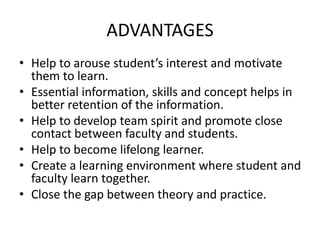
• Help to arouse student’s interest and motivate
them to learn.
• Essential information, skills and concept helps in
better retention of the information.
• Help to develop team spirit and promote close
contact between faculty and students.
• Help to become lifelong learner.
• Create a learning environment where student and
faculty learn together.
• Close the gap between theory and practice.
DISADVANTAGES
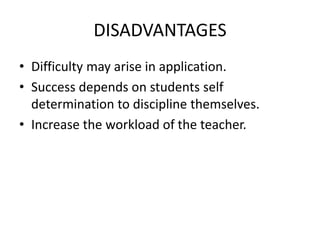
• Difficulty may arise in application.
• Success depends on students self
determination to discipline themselves.
• Increase the workload of the teacher.

SUBJECT CENTERED CURRICULUM.pptx

  • 1.
    SUBJECT CENTERED CURRICULUM It isalso known as Discipline centered curriculum. In 1950-1960 s curriculum was designed according to the discipline .
  • 2.
    • All subjectsmatter of the curriculum based on the structure of discipline and nondiscipline knowledge is unsuitable for teaching learning. • According to this curriculum the sequence of learning starting from basic concepts and building up to more advance knowledge. • All the student should study same material , in the same setting within the same time frame.
  • 3.
    ADVANTAGE • Learning iswell defined by the subject area. • Easy for student and teacher to know the extent and depth of knowledge in that particular subject is to be achieved. • Easy to design the evaluation.
  • 4.
    DISADVANTAGES • Does nothelp in easy transfer of learning. • Reward the students who memorize well and often ignores the students who likes to learn by reasoning. Lack relevency.
  • 5.
    INTEGRATED CURRICULUM • Integrationmeans putting different parts into meaningful whole. • Curriculum units are arranged not in terms of traditional disciplines but some logical sequence which help in interdisciplinary collaboration. • The integration may be between same discipline at different level or horizontal integration of subjects at same level.
  • 6.
    CRITERIA • Collaboration betweenteachers from different departments. • Teachers from different discipline must agree upon common institutional goals. • Building teachers capability to teach the integrated subject is mandatory. • Time for implementation the curriculum should be adequate.
  • 7.
    ADVANTAGES • Help inrelevancy of subjects. • Student motivated what they are learning is meaningful or purposeful. • Relevancy help for long term retention. • Teacher helps develop an attitude for mutual respect as teacher aware of what each other is teaching. • Apply the knowledge in real situation.
  • 8.
    DISADVANTAGES • Time consumingfor faculty both in planning and implementing of curriculum.
  • 9.
    PROBLEM BASED CURRICULUM •Human beings are exposed to a variety of problematic situations in their lives that become the learning experiences which provide them with the information and knowledge that can be applied to solve future problems.
  • 10.
    CHARACTERISTIC • Students canbe treated as adults responsible for their own learning. • Learning is on the relevant to the student’s need student get motivated and actively involve them in learning. • Information from many disciplines is integrated in the mind of the learner. • Dealing with the problems of real life situation helps in integration of theory and practice.
  • 11.
    • Problem solvingskills can be learned and evaluated. • Information is reinforced through its reuse and is therefore retained better. • Self learning and self evaluation skills are learned and evaluated. • All knowledge , skill and attitudes are to be given equal emphasis. • Role of teacher is of a facilitator.
  • 12.
    ADVANTAGES • Help toarouse student’s interest and motivate them to learn. • Essential information, skills and concept helps in better retention of the information. • Help to develop team spirit and promote close contact between faculty and students. • Help to become lifelong learner. • Create a learning environment where student and faculty learn together. • Close the gap between theory and practice.
  • 13.
    DISADVANTAGES • Difficulty mayarise in application. • Success depends on students self determination to discipline themselves. • Increase the workload of the teacher.