Group Members:
Shanae Wilmot
Terri-Ann Tucker
Shemonon Stone
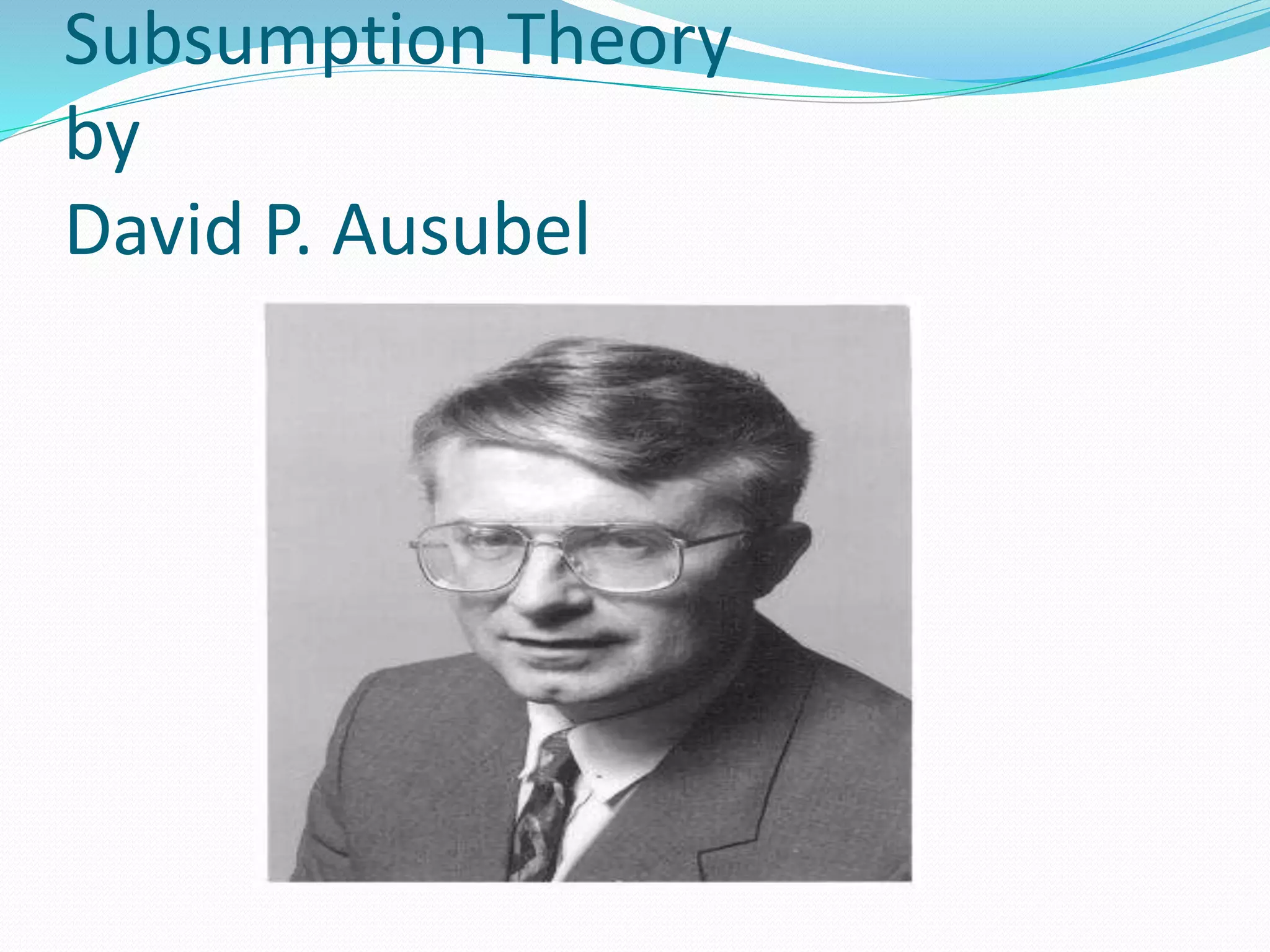
Subsumption Theory
by
David P. Ausubel
About Ausubel
 David P. Ausubel was an American psychologist who did
his undergraduate work at the University of Pennsylvania
(pre-med and psychology). He graduated from medical
school at Middlesex University.
 Later he earned a PhD in Developmental Psychology at
Columbia University. He was influenced by the work
of Piaget. He served on the faculty at several universities
and retired from academic life in 1973 and began his
practice in psychiatry.
Ausubel
 Dr. Ausubel published several textbooks in developmental
and educational psychology, and more than 150 journal
articles. He was awarded the Thorndike Award for
"Distinguished Psychological Contributions to Education"
by the American Psychological Association (1976).
Subsumpmtion Theory
 Ausubel’s theory is concerned with how individuals learn
large amounts of meaningful information from verbal or
textual presentations in a school setting. According to
Ausubel, learning is based upon the kinds of super-
ordinate, representational and combination processes that
occur during the reception of information.
Theory
 A primary process in learning is subsumption in which
new materials is related to relevant ideas in the existing
cognitive structure on a substantive, non-verbatim basis.
Cognitive structures represent the residue of all learning
experiences; forgetting occurs because certain details get
integrated and lose their individual identity.
Main Tenets
 Subordinate Learing
 Superordinate Learning
 Combinatorial Learning
Subordinate Learning
 Two Types of Subordinate Learning.
 In derivative subsumption, new information is linked to
superordinate idea A and represents another case or
extension of A. The critical attributes of the concept A are
not changed, but new examples are recognized as
relevant.
Subordinate Learning
 In correlative subsumption, new information y is linked to
idea X, but is an extension, modification, or qualification
of X. The critical attributes of the subsuming concept may
be extended or modified with the new correlative
subsumption.
Combinatorial Learning
 In combinatorial learning new idea A is seen as related to
existing ideas B, C, and D but is neither more inclusive
nor more specific than ideas B, C, and D. In this case, new
idea A is seen to have some criteria attributes are common
with pre-existing ideas.
Superordinate Learning
 In superordinate learning, established ideas a1, a2,
and a3 are recognized as more specific examples of new
idea A and become linked to A. Superordinate idea A is
defined by a new set of critical attributes that encompass
the subordinate ideas.
Subsumtion Learning in the
Classroom
 This method is explored by the theorist where it states
that explaining or introducing new knowledge can be
thought by making comparisons or helping students
to recognize similarities with the aim to help the
student to clearly understand what is being taught.
Subsumtion Learning in the
Classroom
 Example; The study of plant reproduction and the
human reproductive system, while the human
reproductive system can be related to and easily
understood, depending on the grade and age, a child
may have difficulties grasping the process of the
flower.
 Therefore to explain this, discuss the similarities and
differences between the two so that subsuming new
information may be easier or do a quick recap of the
lesson to familiarise the students with the vocabulary.
Subsumtion Learning in the
Classroom
 Another way this theory can be used in the classroom
is by allowing students to answer questions and make
their own observation after the lesson is thought. This
tenet of the theory is super ordinate learning.
 Super ordinate theory is explained as, a child being
able to give examples but does not know the on point
answer to the question asked. Yet still they give
examples or explanation about the content which is
somewhat correct.
Influence of the theory on student
centered approach
 This theory gives students the chance to express his or
her opinion as it relates to the topic that is being
covered.
 The theory speaks about advances organizers, this is
where students are given time to adequately prepare so
that the cognitive structure can be made to subsume
new information.
Reference
 http://www.lifecircles-
inc.com/Learningtheories/constructivism/ausubel.ht
ml
 https://principlesoflearning.wordpress.com/dissertati
on/chapter-3-literature-review-2/the-cognitive-
perspective/subsumption-theory-david-p-ausubel-
1962/

S.t.l powerpoint

  • 1.
  • 2.
  • 3.
    About Ausubel  DavidP. Ausubel was an American psychologist who did his undergraduate work at the University of Pennsylvania (pre-med and psychology). He graduated from medical school at Middlesex University.  Later he earned a PhD in Developmental Psychology at Columbia University. He was influenced by the work of Piaget. He served on the faculty at several universities and retired from academic life in 1973 and began his practice in psychiatry.
  • 4.
    Ausubel  Dr. Ausubelpublished several textbooks in developmental and educational psychology, and more than 150 journal articles. He was awarded the Thorndike Award for "Distinguished Psychological Contributions to Education" by the American Psychological Association (1976).
  • 5.
    Subsumpmtion Theory  Ausubel’stheory is concerned with how individuals learn large amounts of meaningful information from verbal or textual presentations in a school setting. According to Ausubel, learning is based upon the kinds of super- ordinate, representational and combination processes that occur during the reception of information.
  • 6.
    Theory  A primaryprocess in learning is subsumption in which new materials is related to relevant ideas in the existing cognitive structure on a substantive, non-verbatim basis. Cognitive structures represent the residue of all learning experiences; forgetting occurs because certain details get integrated and lose their individual identity.
  • 7.
    Main Tenets  SubordinateLearing  Superordinate Learning  Combinatorial Learning
  • 8.
    Subordinate Learning  TwoTypes of Subordinate Learning.  In derivative subsumption, new information is linked to superordinate idea A and represents another case or extension of A. The critical attributes of the concept A are not changed, but new examples are recognized as relevant.
  • 9.
    Subordinate Learning  Incorrelative subsumption, new information y is linked to idea X, but is an extension, modification, or qualification of X. The critical attributes of the subsuming concept may be extended or modified with the new correlative subsumption.
  • 10.
    Combinatorial Learning  Incombinatorial learning new idea A is seen as related to existing ideas B, C, and D but is neither more inclusive nor more specific than ideas B, C, and D. In this case, new idea A is seen to have some criteria attributes are common with pre-existing ideas.
  • 11.
    Superordinate Learning  Insuperordinate learning, established ideas a1, a2, and a3 are recognized as more specific examples of new idea A and become linked to A. Superordinate idea A is defined by a new set of critical attributes that encompass the subordinate ideas.
  • 12.
    Subsumtion Learning inthe Classroom  This method is explored by the theorist where it states that explaining or introducing new knowledge can be thought by making comparisons or helping students to recognize similarities with the aim to help the student to clearly understand what is being taught.
  • 13.
    Subsumtion Learning inthe Classroom  Example; The study of plant reproduction and the human reproductive system, while the human reproductive system can be related to and easily understood, depending on the grade and age, a child may have difficulties grasping the process of the flower.  Therefore to explain this, discuss the similarities and differences between the two so that subsuming new information may be easier or do a quick recap of the lesson to familiarise the students with the vocabulary.
  • 14.
    Subsumtion Learning inthe Classroom  Another way this theory can be used in the classroom is by allowing students to answer questions and make their own observation after the lesson is thought. This tenet of the theory is super ordinate learning.  Super ordinate theory is explained as, a child being able to give examples but does not know the on point answer to the question asked. Yet still they give examples or explanation about the content which is somewhat correct.
  • 15.
    Influence of thetheory on student centered approach  This theory gives students the chance to express his or her opinion as it relates to the topic that is being covered.  The theory speaks about advances organizers, this is where students are given time to adequately prepare so that the cognitive structure can be made to subsume new information.
  • 16.