Ausubel’s
Contribution.
David P. Ausubel ~
Mathematician,American
Psychologist,Cognitive Learning
Theorist in 1950's propounded
Meaningful Receptional Learning
Theory.
In his time Mathematician was arguing about
problem solving and discovery learning in
against of lecture method of learning( cause of
rote learning ).
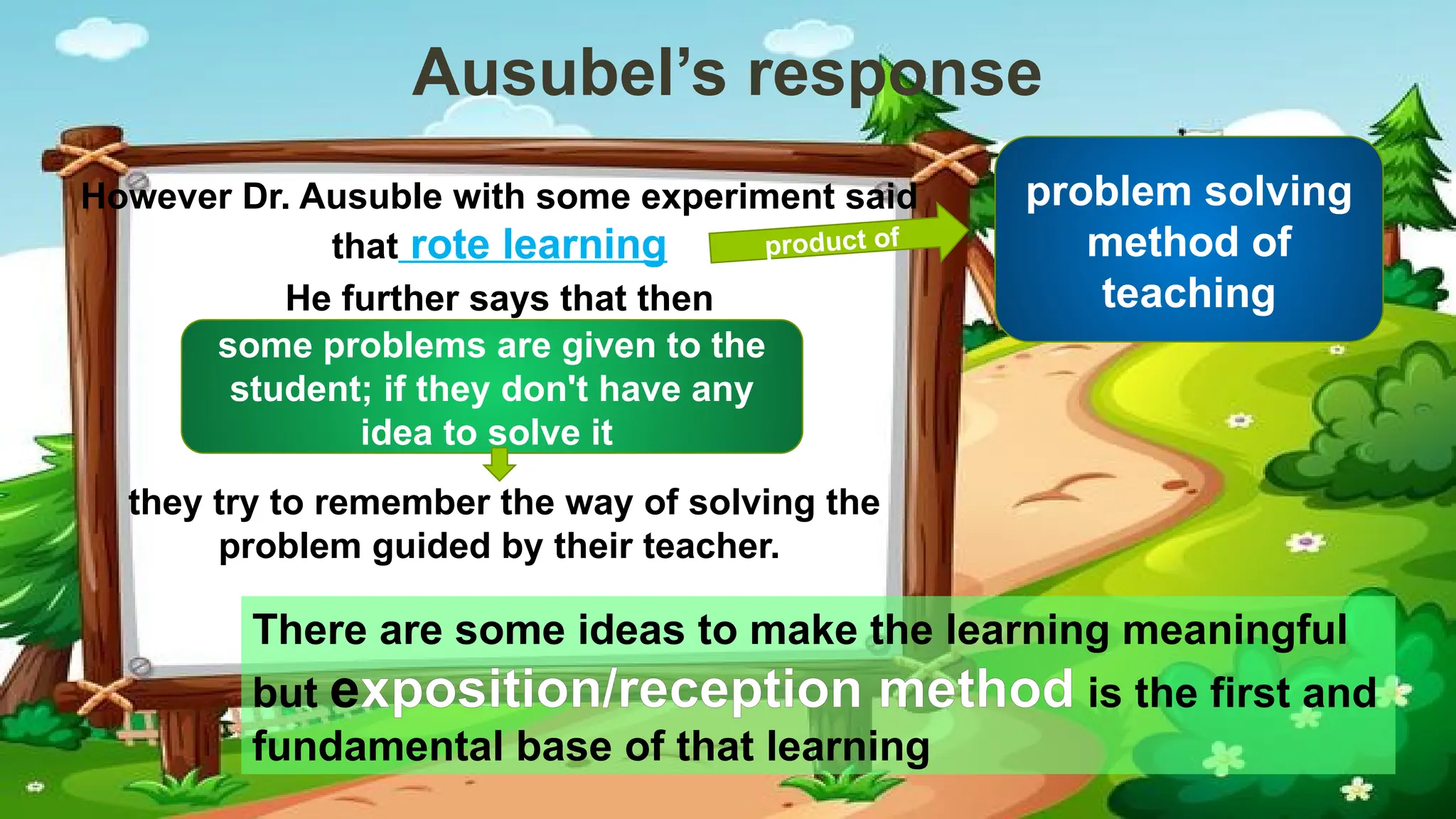
Ausubel’s response
However Dr. Ausuble with some experiment said
that rote learning
He further says that then
they try to remember the way of solving the
problem guided by their teacher.
problem solving
method of
teaching
product of
some problems are given to the
student; if they don't have any
idea to solve it
There are some ideas to make the learning meaningful
but exposition/reception method is the first and
fundamental base of that learning
Bruner and Ausubel
Theories of Piaget, Bruner, and Ausubel: Explications and implications. The Journal of Genetic
Psychology: Research and Theory on Human Development, 136(1), 121–136.
https://doi.org/10.1080/00221325.1980.10534102
Bruner’s work focuses on learning
through discovery whereas
Ausubel believes that learning
should be reception
FIGHTS
• 1. ROTE LEARNING
• 2. DISCOVERY LEARNING
MEANINGFUL LEARNING
RECEPTION LEARNING
• 1. ROTE LEARNING
• 2. DISCOVERY LEARNING
ROTE LEARNING Meaningful learning
Rote learning is the memorization of
information based on repetition
 Remembering a particular phone number, dates
and names are examples of rote learning.
Repeating material, again and again, helps a
learner recall it exactly as it was presentedBut
 you are not sure of utilizing that
information for some practical use.
 Multiplication tables in mathematics, that
most of the students learn by rote methodology
 No connection between new and previous
knowledge
Meaningful learning involves
understanding how all the pieces of an
entire concept fit together.
 it allows students to be fully engaged in the
learning process.
 Relating new information to prior knowledge
 Focusing on the outcome of the learning
process.
 Students who learn with meaningful learning
are able to problem solve better than those
who learn by rote.
Example
Simple memorizing the names and
places of pieces.
here with names and positions ,
we learn how they move all the
board
ROTE LEARNING Meaningful learning
• In Reception Learning the principle
content of what is to be learned is
presented to the learner in more or
less final form.
• The learning doesn't contain any
discovery in his part.
• He is required only to internalized
the material or incorporate it in to
his cognitive structure so that it is
available for reproduction or other
use at some future date
• The essential future of
discovery learning on the
other hand is that the principle
content of what is to be
learned isn't given but must be
discover by the learner before
he can internalize it. Main
principle of that learning is to
discover something. But this
may not be possible in all
situations.
DISCOVERY LEARNING
RECEPTION LEARNING
Ausubel's theory suggests how teachers or instructional
designers can best arrange the conditions that
facilitate learning for students.
The overarching idea in Ausubel's theory is that
knowledge is hierarchically organized: new information
is meaningful to the extent that it can be related to
what is already known.
Ausubel's theory
HANUMAN
According to
Ausubel, is created
through some forms
of representational
equivalence
between
language
and
mental
context.
Uniqueness of Ausubel theory
 it stresses Meaningful learning and opposes to rote
learning or memorization;
 stresses on reception or received knowledge, rather than
discovery learning .
TO be clear, Ausubel did not contend that discovery learning
doesn't work; but rather that it was not efficient
Subsumption
Theory
Derivative
Subsumption
Correlative
Subsumption
Superordinat
e Learning
Combinatorial
Learning
Strategy used
Advanced Organizers
Expository Teaching
( Old + New )
Comparative Teaching
( Old + New )
Receptive Learning / Meaningful Learning
O + N = L
O = Old information
N = New information
L = Learning ( meaningful )
to absorbing one thing into
another
Derivative Subsumption
Describe the situation in which the new information you learn is an example of a concept
that you have learned.
Example: Let’s you
have acquired a
basic concept such
as “bird” . You know
that a bird has
feathers, beak and
lays egg. Now you
learn about a kind of
bird that you have
never seen before
Correlative Subsumption
Higher level concept of thinking
You see a new kind of bird that has a
really big body and long strong legs. It
doesn’t fly but it can run fast. You may
now include your concept of an ostrich
to your previous concept of what a bird
is.
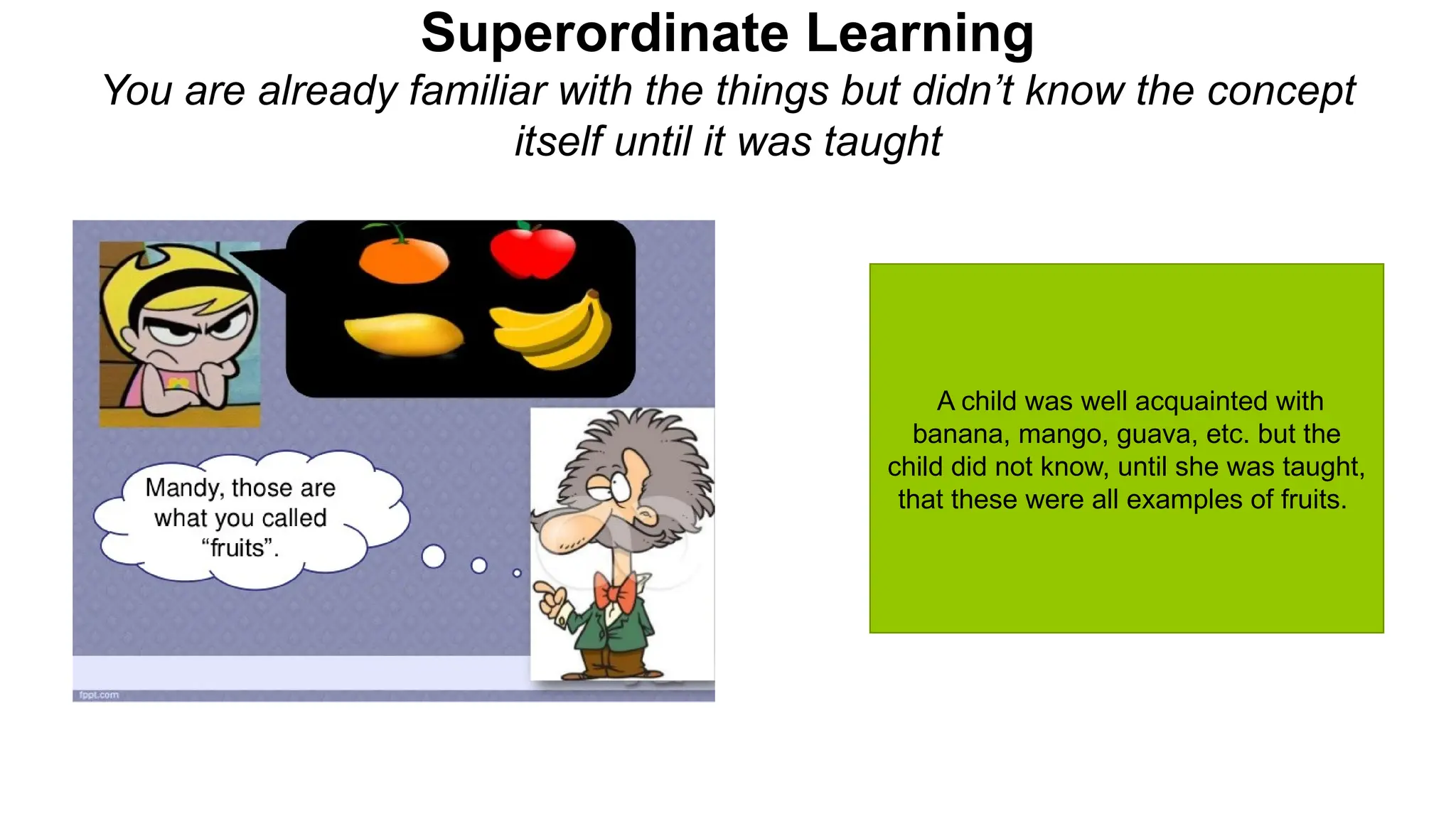
Superordinate Learning
You are already familiar with the things but didn’t know the concept
itself until it was taught
A child was well acquainted with
banana, mango, guava, etc. but the
child did not know, until she was taught,
that these were all examples of fruits.
Combinatorial Learning
When the newly acquired knowledge combine with prior knowledge to enrich the
understanding of both concepts.
Example: To teach someone about how
plants “breathe” you might relate it to
previously acquired knowledge of human
respiration where man inhales oxygen and
exhales carbon
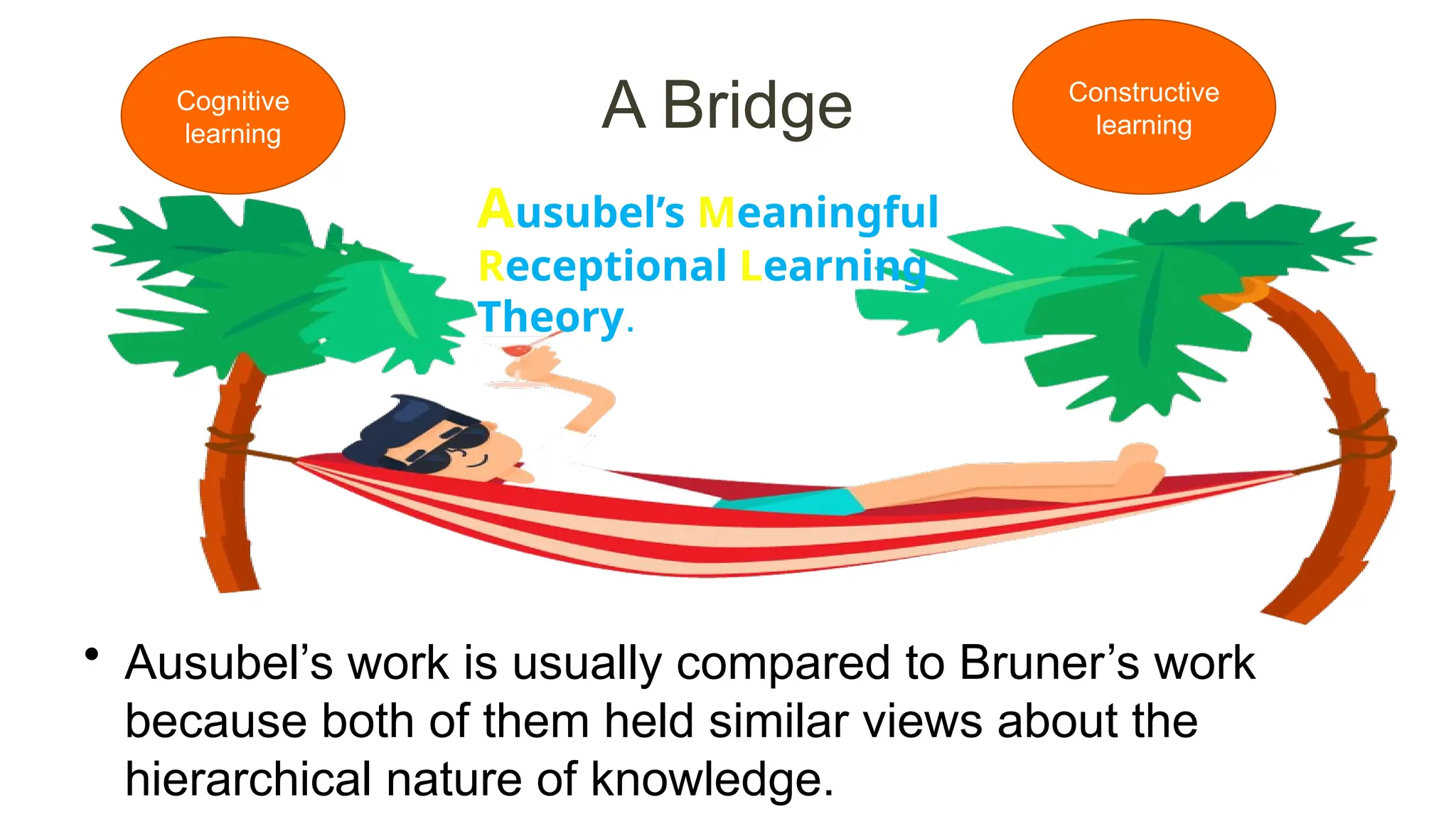
A Bridge
• Ausubel’s work is usually compared to Bruner’s work
because both of them held similar views about the
hierarchical nature of knowledge.
Cognitive
learning
Constructive
learning
Ausubel’s Meaningful
Receptional Learning
Theory.
REFERENCES
An official journal of
the National
Council of Teachers
of Mathematics
(NCTM):
https://www.jstor.or
g/stable/748536?
seq=1
https://
www.itma.vt.edu/
courses/tel/
 (2006). Student models
of instructional design.
Educational Technology
Research and
Development
 Educational
Psychology,Dr.
Lawrence Tomei
 The processes of
meaningful learning , D.
Ausubel
THANK YOU ALL
ausubelstheory-210725170452.pptxhhhhhhhh

ausubelstheory-210725170452.pptxhhhhhhhh

  • 1.
  • 2.
    David P. Ausubel~ Mathematician,American Psychologist,Cognitive Learning Theorist in 1950's propounded Meaningful Receptional Learning Theory. In his time Mathematician was arguing about problem solving and discovery learning in against of lecture method of learning( cause of rote learning ).
  • 3.
    Ausubel’s response However Dr.Ausuble with some experiment said that rote learning He further says that then they try to remember the way of solving the problem guided by their teacher. problem solving method of teaching product of some problems are given to the student; if they don't have any idea to solve it There are some ideas to make the learning meaningful but exposition/reception method is the first and fundamental base of that learning
  • 4.
    Bruner and Ausubel Theoriesof Piaget, Bruner, and Ausubel: Explications and implications. The Journal of Genetic Psychology: Research and Theory on Human Development, 136(1), 121–136. https://doi.org/10.1080/00221325.1980.10534102 Bruner’s work focuses on learning through discovery whereas Ausubel believes that learning should be reception
  • 5.
    FIGHTS • 1. ROTELEARNING • 2. DISCOVERY LEARNING MEANINGFUL LEARNING RECEPTION LEARNING • 1. ROTE LEARNING • 2. DISCOVERY LEARNING
  • 6.
    ROTE LEARNING Meaningfullearning Rote learning is the memorization of information based on repetition  Remembering a particular phone number, dates and names are examples of rote learning. Repeating material, again and again, helps a learner recall it exactly as it was presentedBut  you are not sure of utilizing that information for some practical use.  Multiplication tables in mathematics, that most of the students learn by rote methodology  No connection between new and previous knowledge Meaningful learning involves understanding how all the pieces of an entire concept fit together.  it allows students to be fully engaged in the learning process.  Relating new information to prior knowledge  Focusing on the outcome of the learning process.  Students who learn with meaningful learning are able to problem solve better than those who learn by rote.
  • 7.
    Example Simple memorizing thenames and places of pieces. here with names and positions , we learn how they move all the board ROTE LEARNING Meaningful learning
  • 8.
    • In ReceptionLearning the principle content of what is to be learned is presented to the learner in more or less final form. • The learning doesn't contain any discovery in his part. • He is required only to internalized the material or incorporate it in to his cognitive structure so that it is available for reproduction or other use at some future date • The essential future of discovery learning on the other hand is that the principle content of what is to be learned isn't given but must be discover by the learner before he can internalize it. Main principle of that learning is to discover something. But this may not be possible in all situations. DISCOVERY LEARNING RECEPTION LEARNING
  • 9.
    Ausubel's theory suggestshow teachers or instructional designers can best arrange the conditions that facilitate learning for students. The overarching idea in Ausubel's theory is that knowledge is hierarchically organized: new information is meaningful to the extent that it can be related to what is already known. Ausubel's theory
  • 11.
    HANUMAN According to Ausubel, iscreated through some forms of representational equivalence between language and mental context.
  • 12.
    Uniqueness of Ausubeltheory  it stresses Meaningful learning and opposes to rote learning or memorization;  stresses on reception or received knowledge, rather than discovery learning . TO be clear, Ausubel did not contend that discovery learning doesn't work; but rather that it was not efficient
  • 13.
    Subsumption Theory Derivative Subsumption Correlative Subsumption Superordinat e Learning Combinatorial Learning Strategy used AdvancedOrganizers Expository Teaching ( Old + New ) Comparative Teaching ( Old + New ) Receptive Learning / Meaningful Learning O + N = L O = Old information N = New information L = Learning ( meaningful ) to absorbing one thing into another
  • 14.
    Derivative Subsumption Describe thesituation in which the new information you learn is an example of a concept that you have learned. Example: Let’s you have acquired a basic concept such as “bird” . You know that a bird has feathers, beak and lays egg. Now you learn about a kind of bird that you have never seen before
  • 15.
    Correlative Subsumption Higher levelconcept of thinking You see a new kind of bird that has a really big body and long strong legs. It doesn’t fly but it can run fast. You may now include your concept of an ostrich to your previous concept of what a bird is.
  • 16.
    Superordinate Learning You arealready familiar with the things but didn’t know the concept itself until it was taught A child was well acquainted with banana, mango, guava, etc. but the child did not know, until she was taught, that these were all examples of fruits.
  • 17.
    Combinatorial Learning When thenewly acquired knowledge combine with prior knowledge to enrich the understanding of both concepts. Example: To teach someone about how plants “breathe” you might relate it to previously acquired knowledge of human respiration where man inhales oxygen and exhales carbon
  • 18.
    A Bridge • Ausubel’swork is usually compared to Bruner’s work because both of them held similar views about the hierarchical nature of knowledge. Cognitive learning Constructive learning Ausubel’s Meaningful Receptional Learning Theory.
  • 19.
    REFERENCES An official journalof the National Council of Teachers of Mathematics (NCTM): https://www.jstor.or g/stable/748536? seq=1 https:// www.itma.vt.edu/ courses/tel/  (2006). Student models of instructional design. Educational Technology Research and Development  Educational Psychology,Dr. Lawrence Tomei  The processes of meaningful learning , D. Ausubel THANK YOU ALL