Siddharth Mishra
15103008
PEC University of Technology
24/04/17
What is Virtual Reality?
Virtual reality (VR) is a technology which immerses a
user in a computer-generated environment. The
environment could be a simulation of the real world or an
imaginary world.
Miniaturization of circuits, sensors, peripherals
along with the rise and simplicity of Computer
Aided Design software have given a massive
boost to the development of VR.
Why a “step into the land of imagination”?
Virtual reality gives the ability to see, hear and feel a
world, which is entirely computer generated. Since the
computer generated world is also made/programmed
by a human, the only thing limiting its awesomeness is
creativity and imagination.
Using today’s software, one can easily design virtual
environments and directly create assets that he/she is
imagining
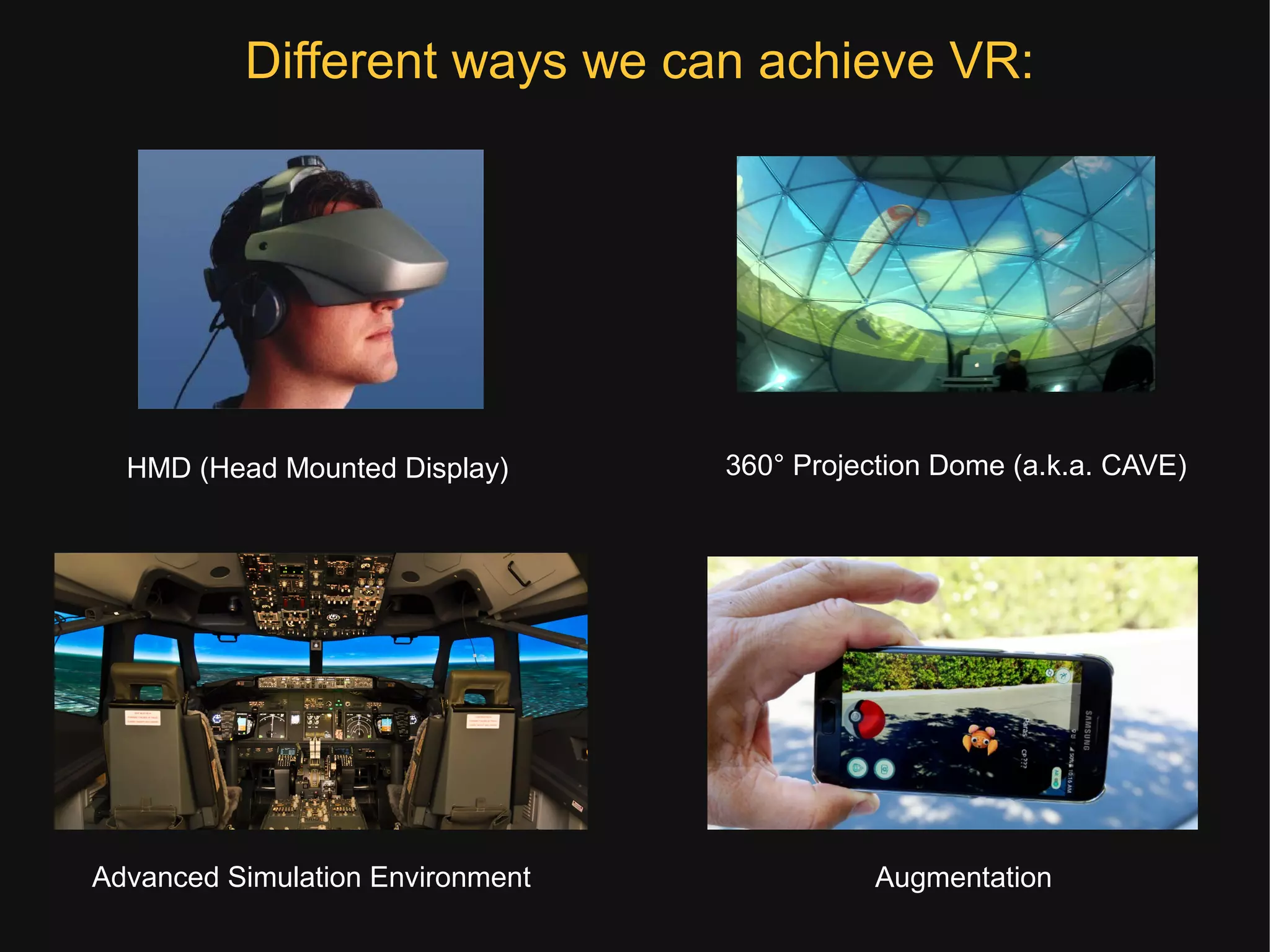
Different ways we can achieve VR:
HMD (Head Mounted Display) 360° Projection Dome (a.k.a. CAVE)
Advanced Simulation Environment Augmentation
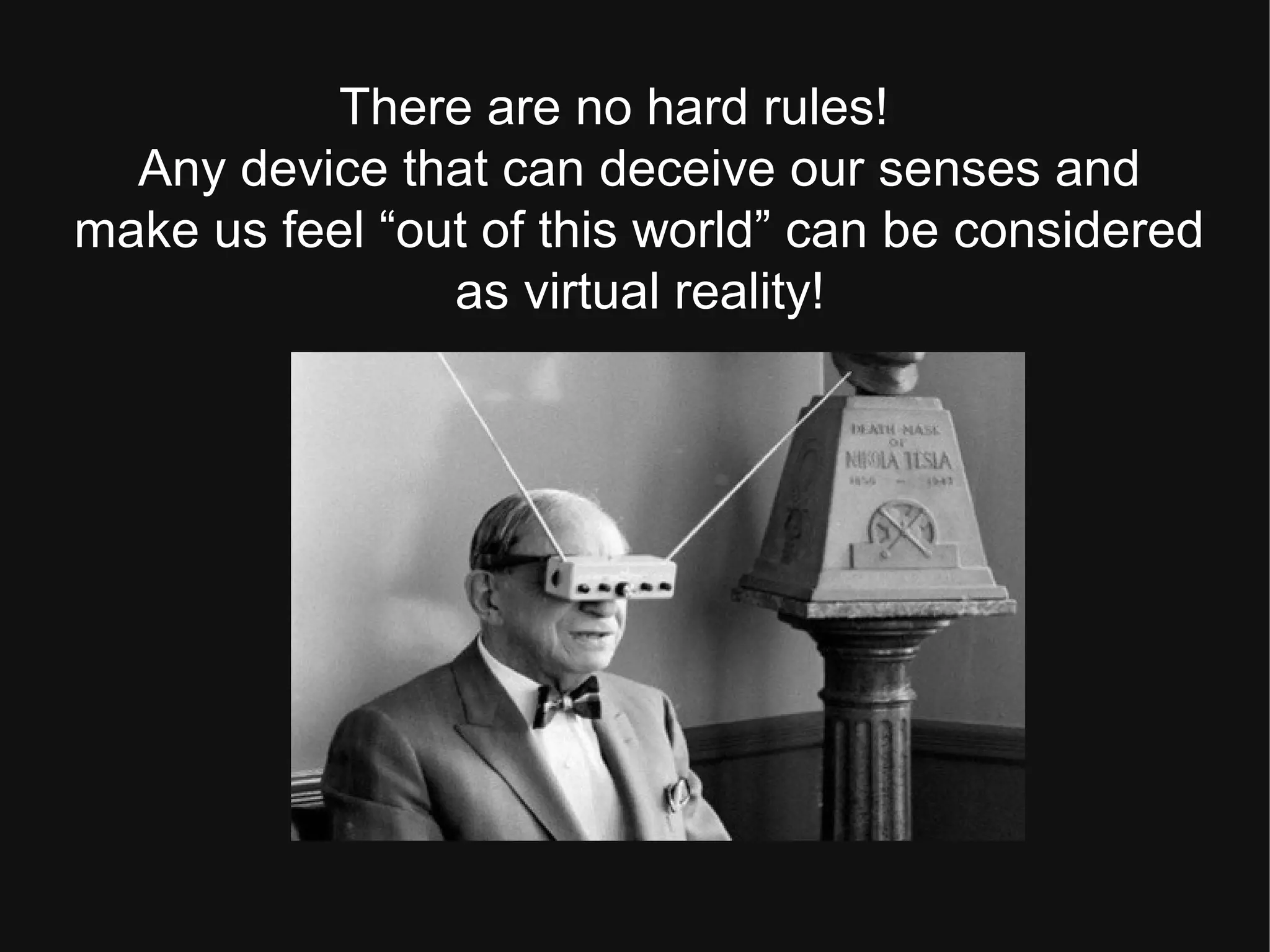
There are no hard rules!
Any device that can deceive our senses and
make us feel “out of this world” can be considered
as virtual reality!
Fun Fact!
Virtual reality industry is expected to be a
$120 Billion industry by 2020.

sight 70%
• hearing 20%
• smell 5%

touch 4%

taste 1%
Senses which need to be deceived:
We can infer that human vision is the most
important factor when we consider stimulation and
hence contributes to capturing the users attention
the most. Therefore the stimulation of the visual
senses and plays a principal role in making the
user feel immersed.
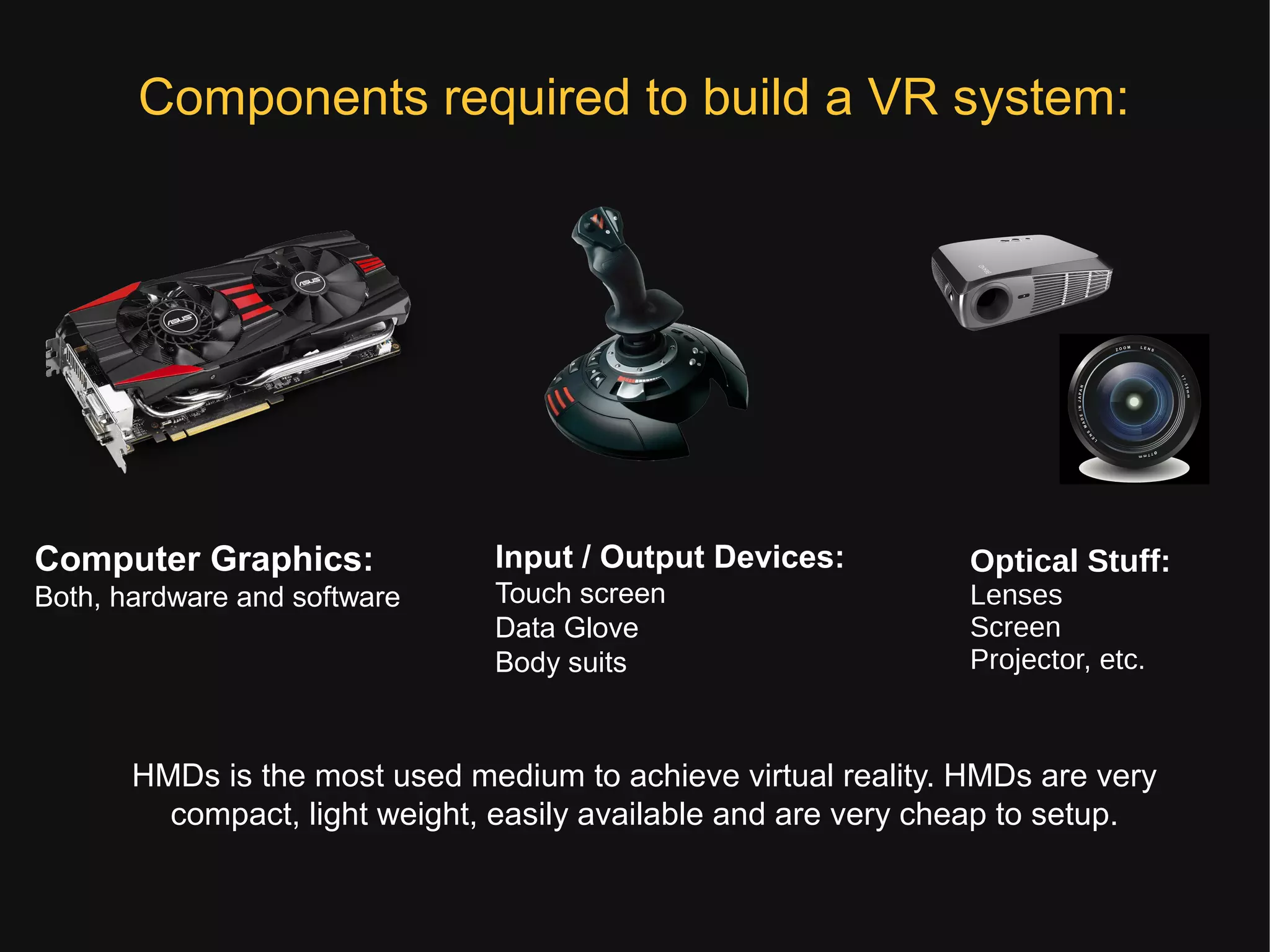
Components required to build a VR system:
Computer Graphics:
Both, hardware and software
Input / Output Devices:
Touch screen
Data Glove
Body suits
HMDs is the most used medium to achieve virtual reality. HMDs are very
compact, light weight, easily available and are very cheap to setup.
Optical Stuff:
Lenses
Screen
Projector, etc.
Types of HMDs:
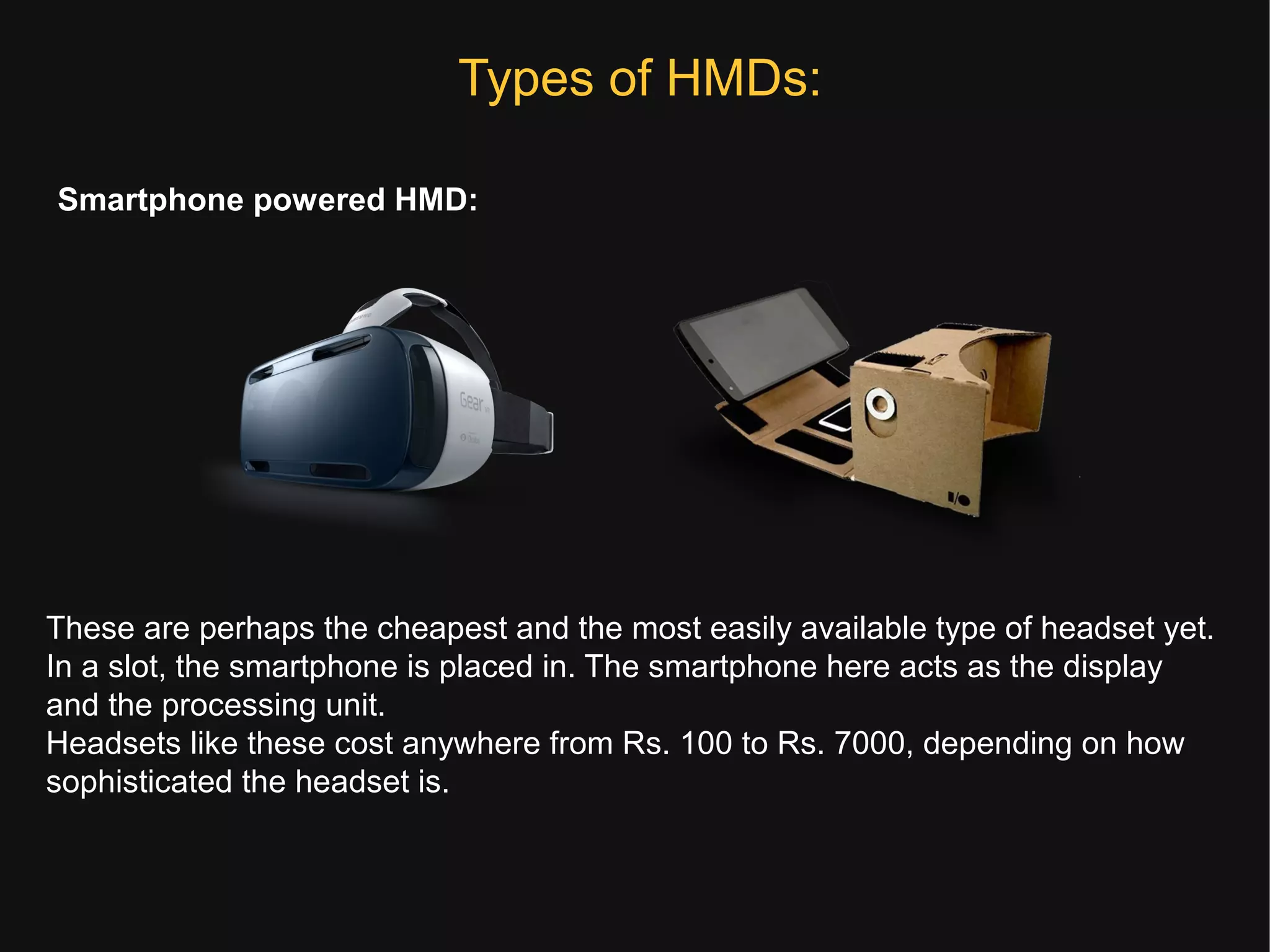
Smartphone powered HMD:
These are perhaps the cheapest and the most easily available type of headset yet.
In a slot, the smartphone is placed in. The smartphone here acts as the display
and the processing unit.
Headsets like these cost anywhere from Rs. 100 to Rs. 7000, depending on how
sophisticated the headset is.
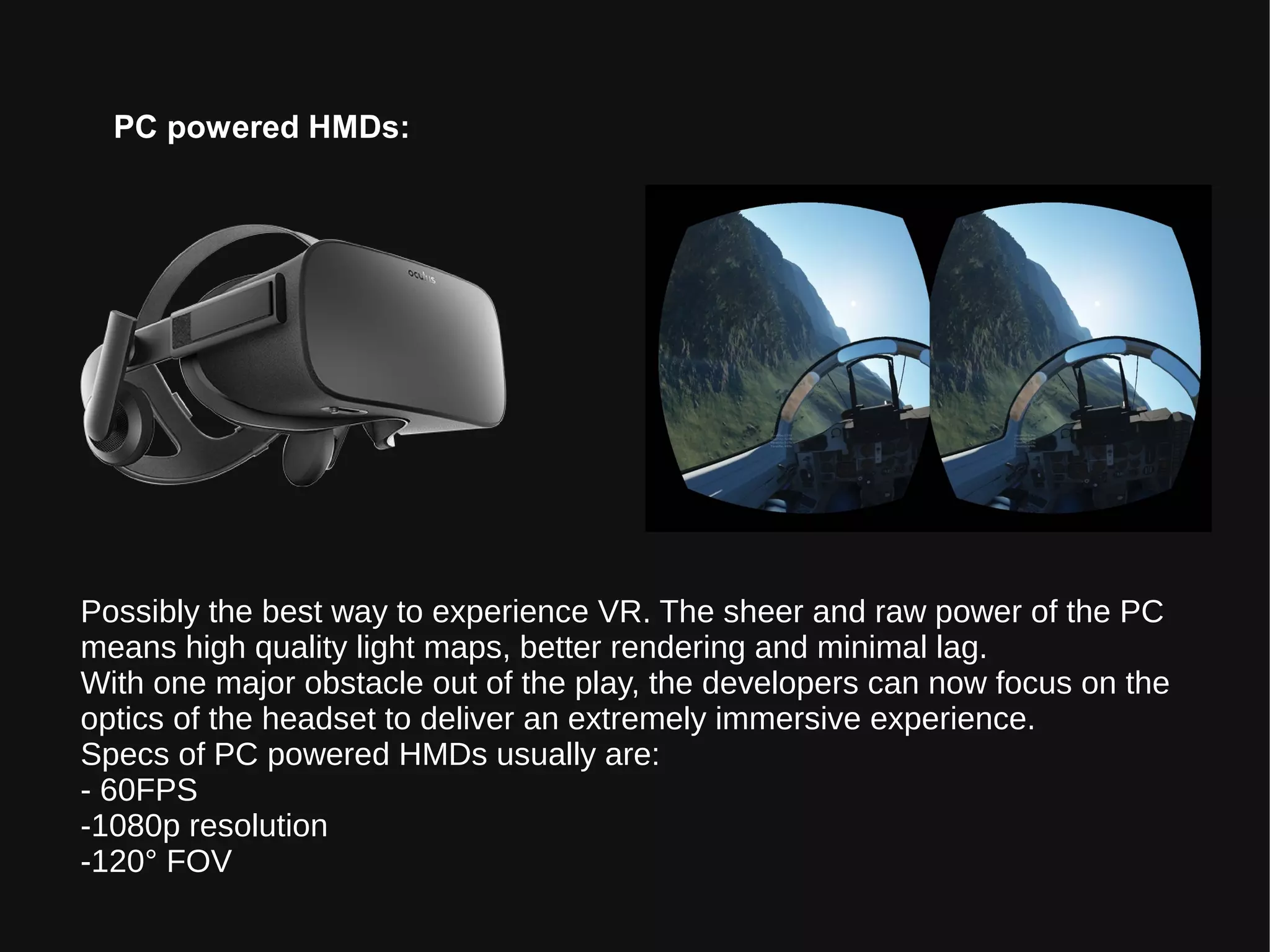
PC powered HMDs:
Possibly the best way to experience VR. The sheer and raw power of the PC
means high quality light maps, better rendering and minimal lag.
With one major obstacle out of the play, the developers can now focus on the
optics of the headset to deliver an extremely immersive experience.
Specs of PC powered HMDs usually are:
- 60FPS
-1080p resolution
-120° FOV
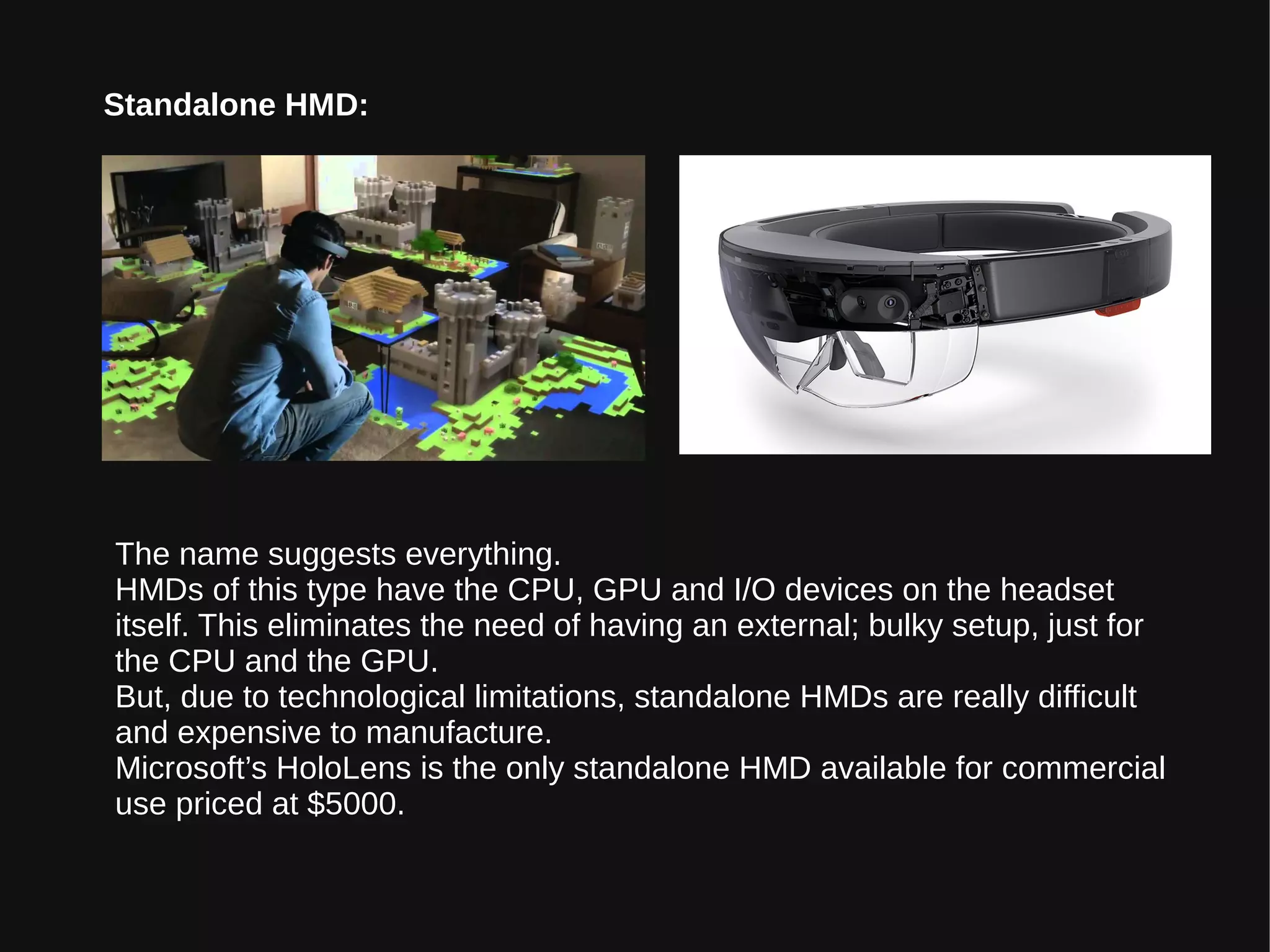
Standalone HMD:
The name suggests everything.
HMDs of this type have the CPU, GPU and I/O devices on the headset
itself. This eliminates the need of having an external; bulky setup, just for
the CPU and the GPU.
But, due to technological limitations, standalone HMDs are really difficult
and expensive to manufacture.
Microsoft’s HoloLens is the only standalone HMD available for commercial
use priced at $5000.
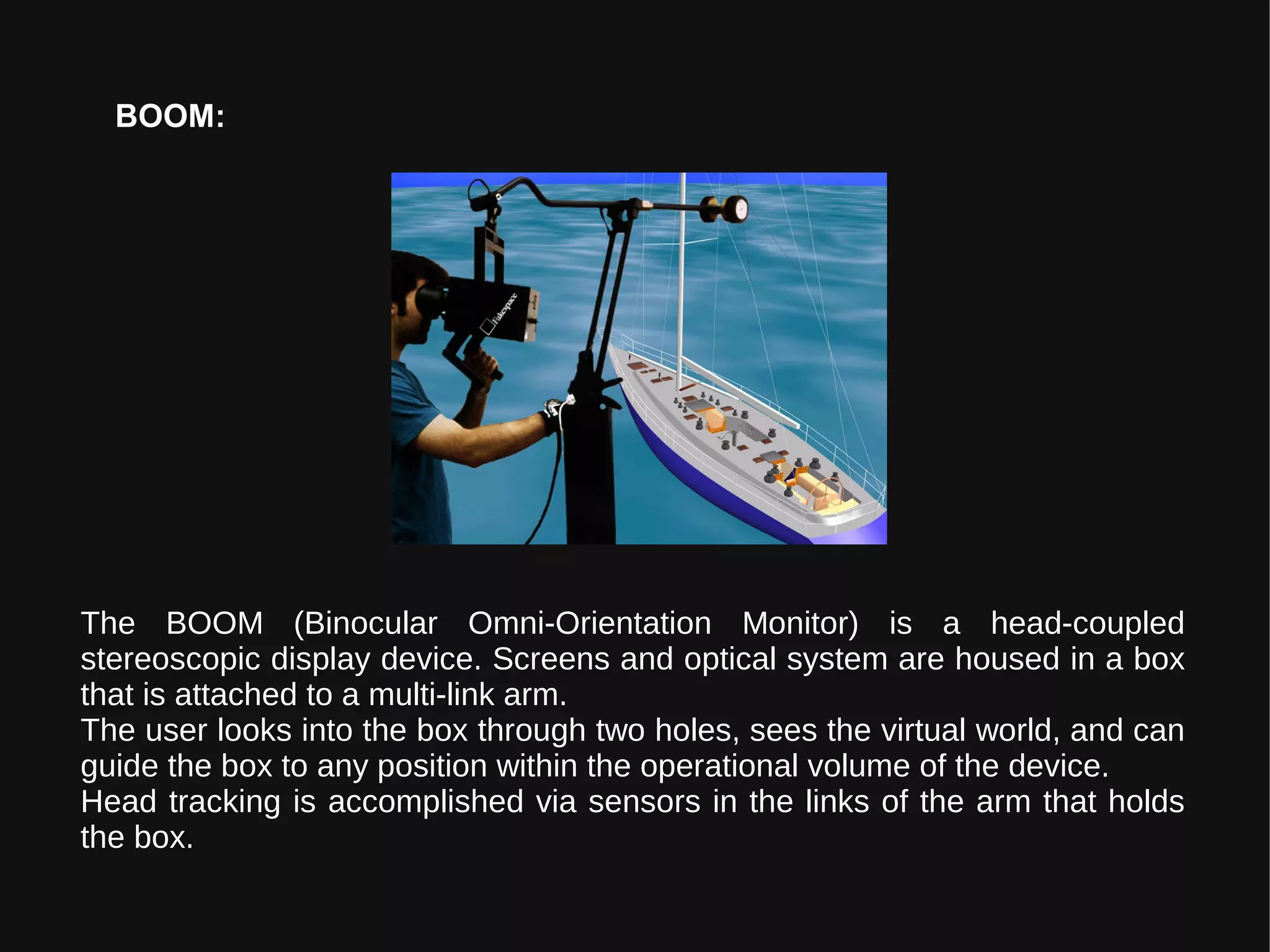
BOOM:
The BOOM (Binocular Omni-Orientation Monitor) is a head-coupled
stereoscopic display device. Screens and optical system are housed in a box
that is attached to a multi-link arm.
The user looks into the box through two holes, sees the virtual world, and can
guide the box to any position within the operational volume of the device.
Head tracking is accomplished via sensors in the links of the arm that holds
the box.
Types of Input devices:
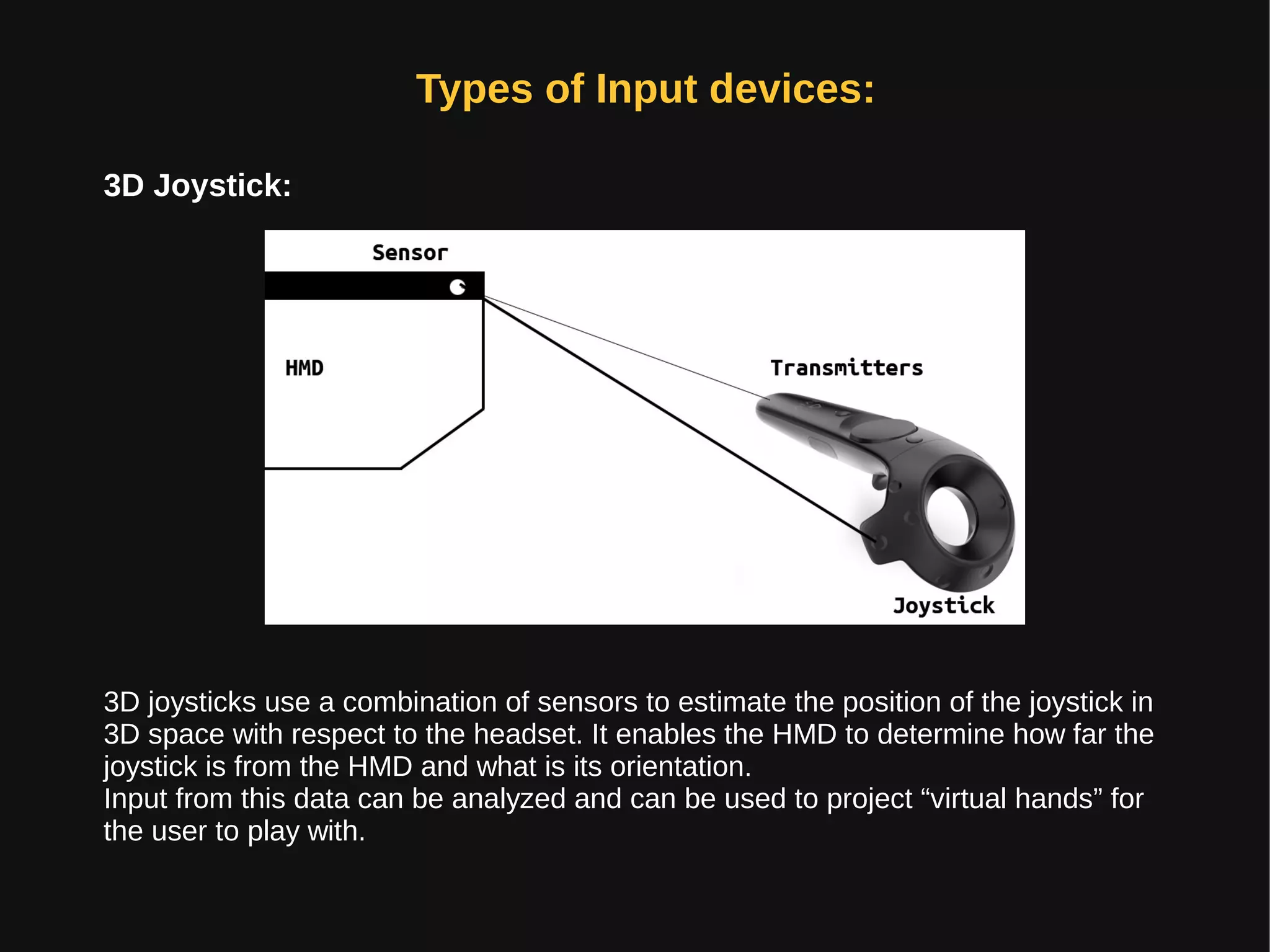
3D Joystick:
3D joysticks use a combination of sensors to estimate the position of the joystick in
3D space with respect to the headset. It enables the HMD to determine how far the
joystick is from the HMD and what is its orientation.
Input from this data can be analyzed and can be used to project “virtual hands” for
the user to play with.
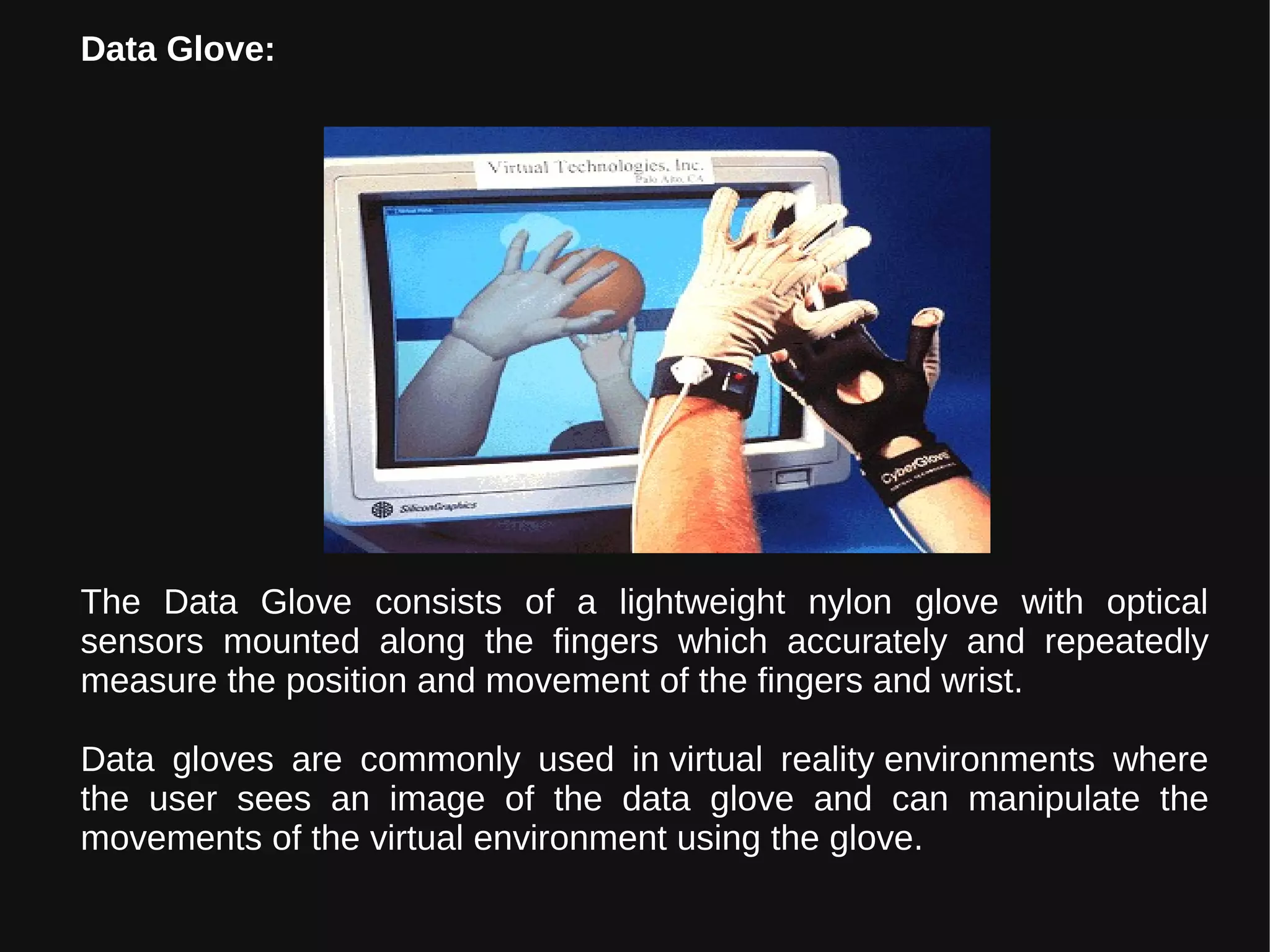
The Data Glove consists of a lightweight nylon glove with optical
sensors mounted along the fingers which accurately and repeatedly
measure the position and movement of the fingers and wrist.
Data gloves are commonly used in virtual reality environments where
the user sees an image of the data glove and can manipulate the
movements of the virtual environment using the glove.
Data Glove:
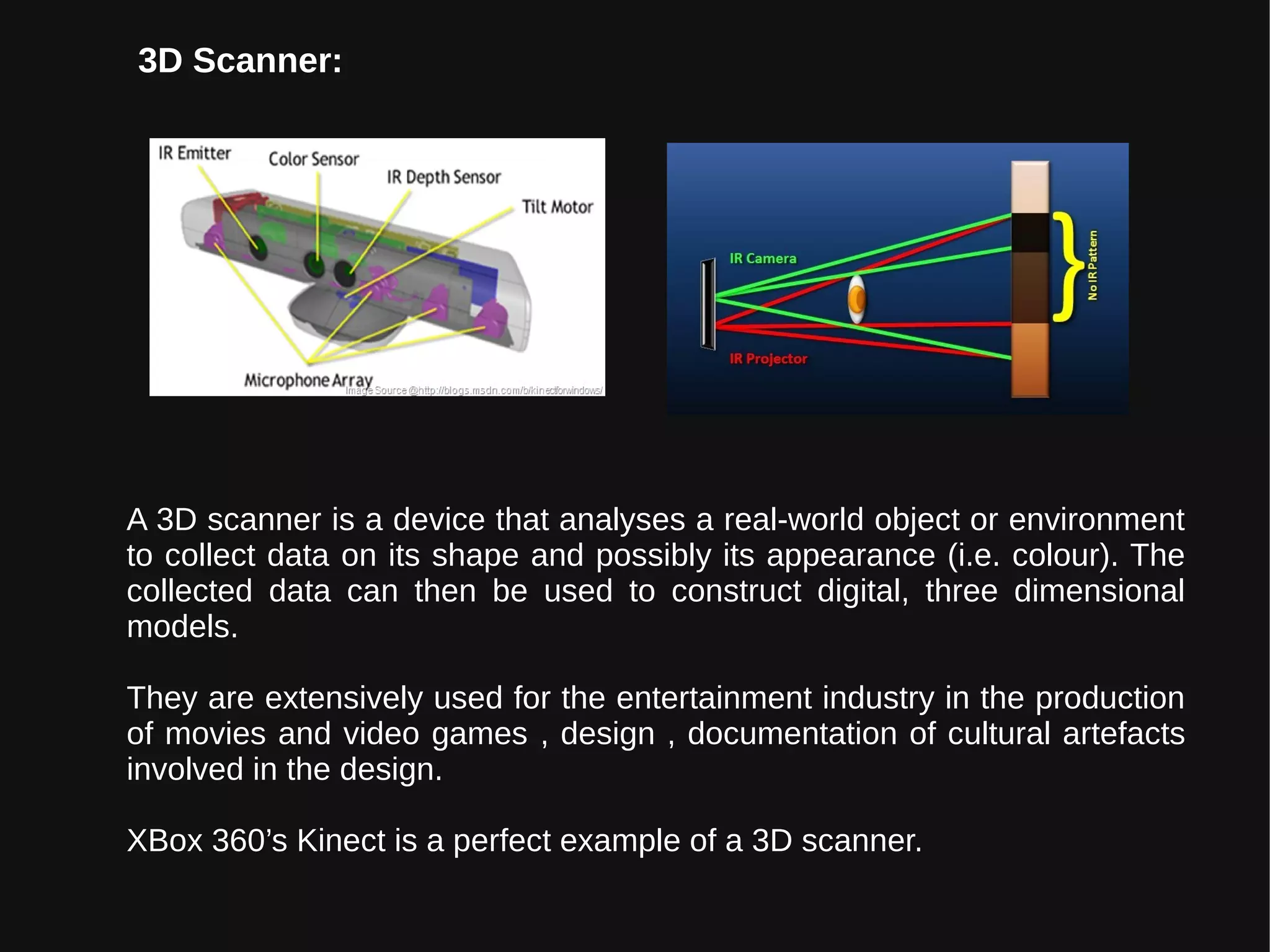
A 3D scanner is a device that analyses a real-world object or environment
to collect data on its shape and possibly its appearance (i.e. colour). The
collected data can then be used to construct digital, three dimensional
models.
They are extensively used for the entertainment industry in the production
of movies and video games , design , documentation of cultural artefacts
involved in the design.
XBox 360’s Kinect is a perfect example of a 3D scanner.
3D Scanner:
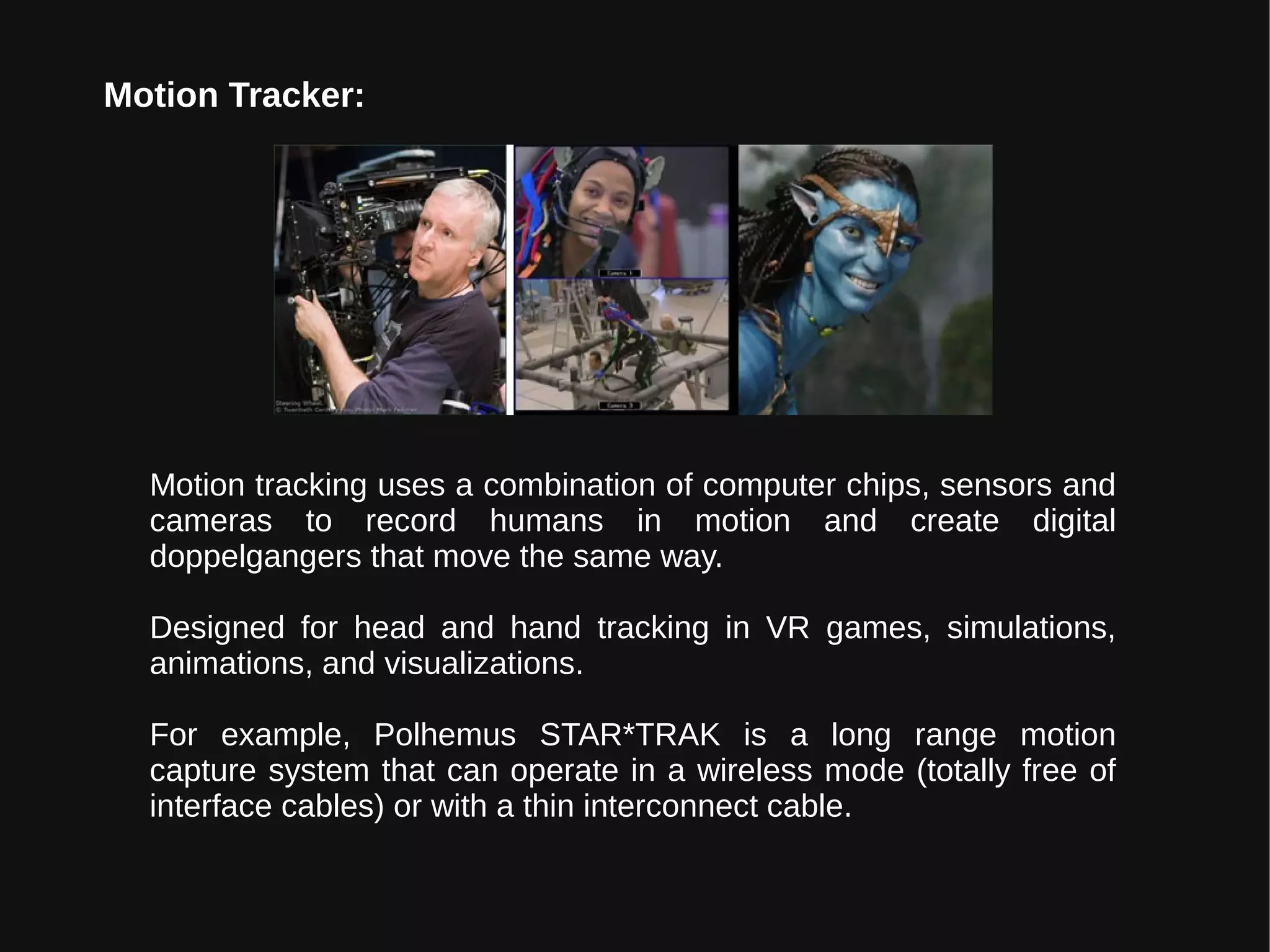
Motion Tracker:
Motion tracking uses a combination of computer chips, sensors and
cameras to record humans in motion and create digital
doppelgangers that move the same way.
Designed for head and hand tracking in VR games, simulations,
animations, and visualizations.
For example, Polhemus STAR*TRAK is a long range motion
capture system that can operate in a wireless mode (totally free of
interface cables) or with a thin interconnect cable.
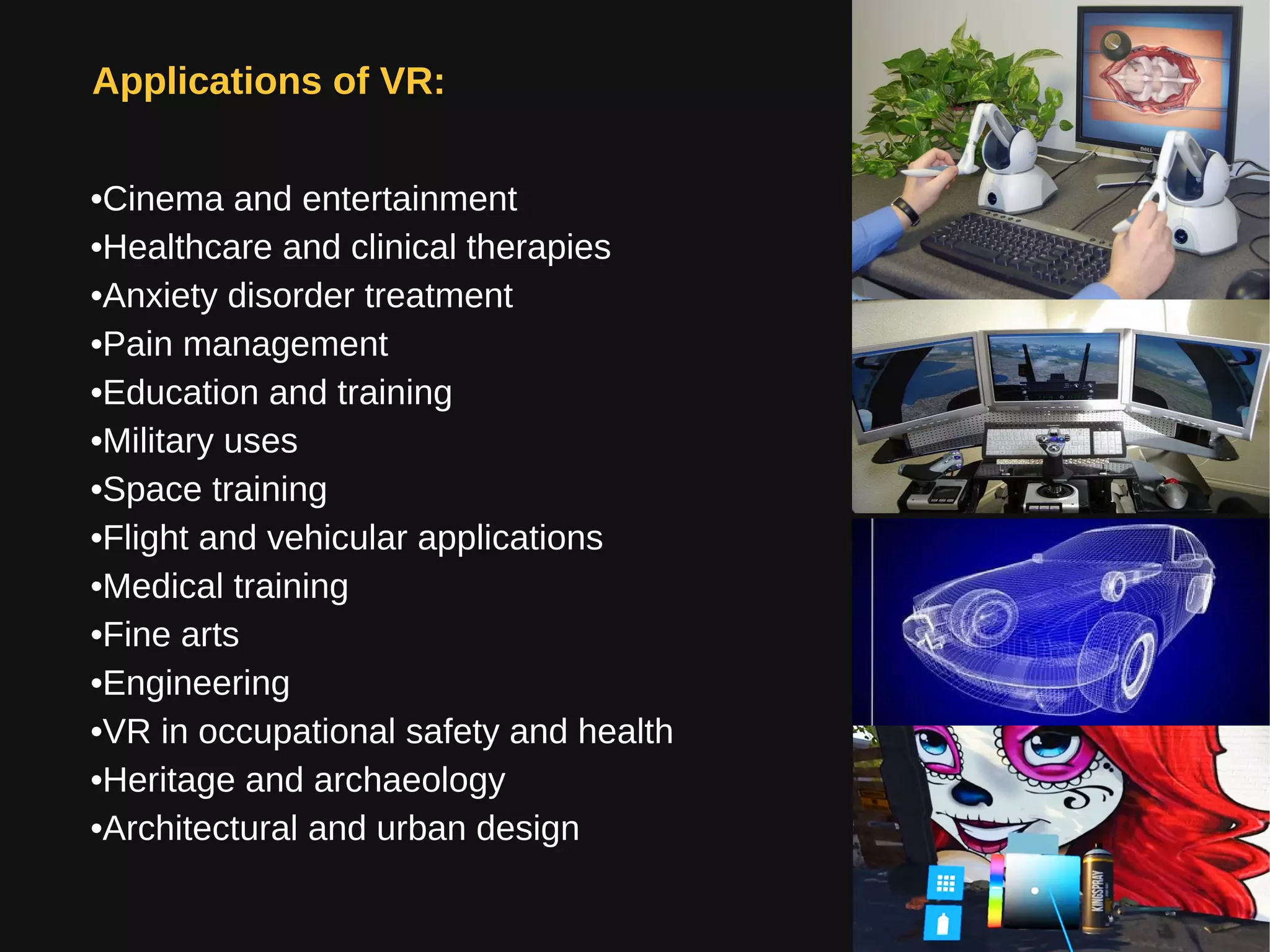
Applications of VR:
•Cinema and entertainment
•Healthcare and clinical therapies
•Anxiety disorder treatment
•Pain management
•Education and training
•Military uses
•Space training
•Flight and vehicular applications
•Medical training
•Fine arts
•Engineering
•VR in occupational safety and health
•Heritage and archaeology
•Architectural and urban design
Heath hazards associated with VR:
• Simulator Sickness
• Motion sickness
• Stress on the eye
• Surrounding awareness
• Skin rashes
• Nausea, vomiting and headaches
• Lowered brain development in children
Virtual reality is still relatively a new technology, hence, research
regarding its health hazards is very limited. Injuries reported to be
caused by tripping over surrounding objects is a leading factor in
health hazards associated with VR. Keeping a screen just an inch
or two away from our eyes is also a very serious health risk.
We will have to use this sophisticated technology with caution till
safer HMDs roll out and more research is done on the topic.
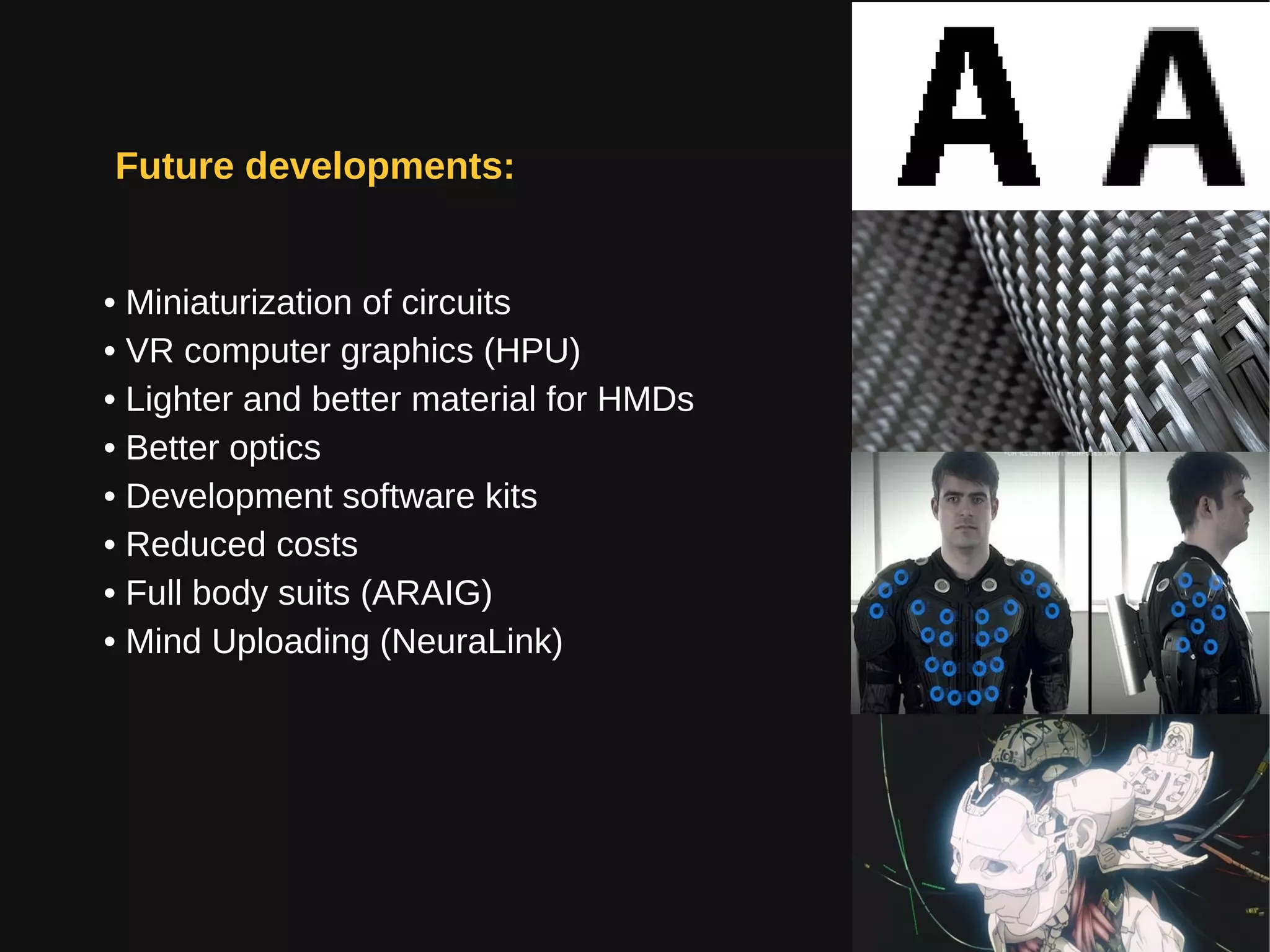
Future developments:
• Miniaturization of circuits
• VR computer graphics (HPU)
• Lighter and better material for HMDs
• Better optics
• Development software kits
• Reduced costs
• Full body suits (ARAIG)
• Mind Uploading (NeuraLink)
Virtual Reality is undoubtedly the next footstep towards a
modern/post-modern era of development. The potential ground
breaking effects that loom behind these machines is uncanny.
Virtual Reality is still at a critical design phase. It is merely a baby
step. The theories behind its design and operation are still being
written. There are 61,400+ international commercial companies
producing VR. There are approximately 3,600 educational
institutions which use VR.
• Visualization of complicated, large data is helpful for
understanding and analysis.
• VR offers us a new way to interact with computer.
• VR enables us to experience the virtual world that is impossible in
real world.
• VR is changing our life, eventually VR will increasingly become a
part of our life.
CONCLUSIONS
THANK YOU!
“The best reality is what seems like a fantasy…
The best fantasy is what feels like reality...”

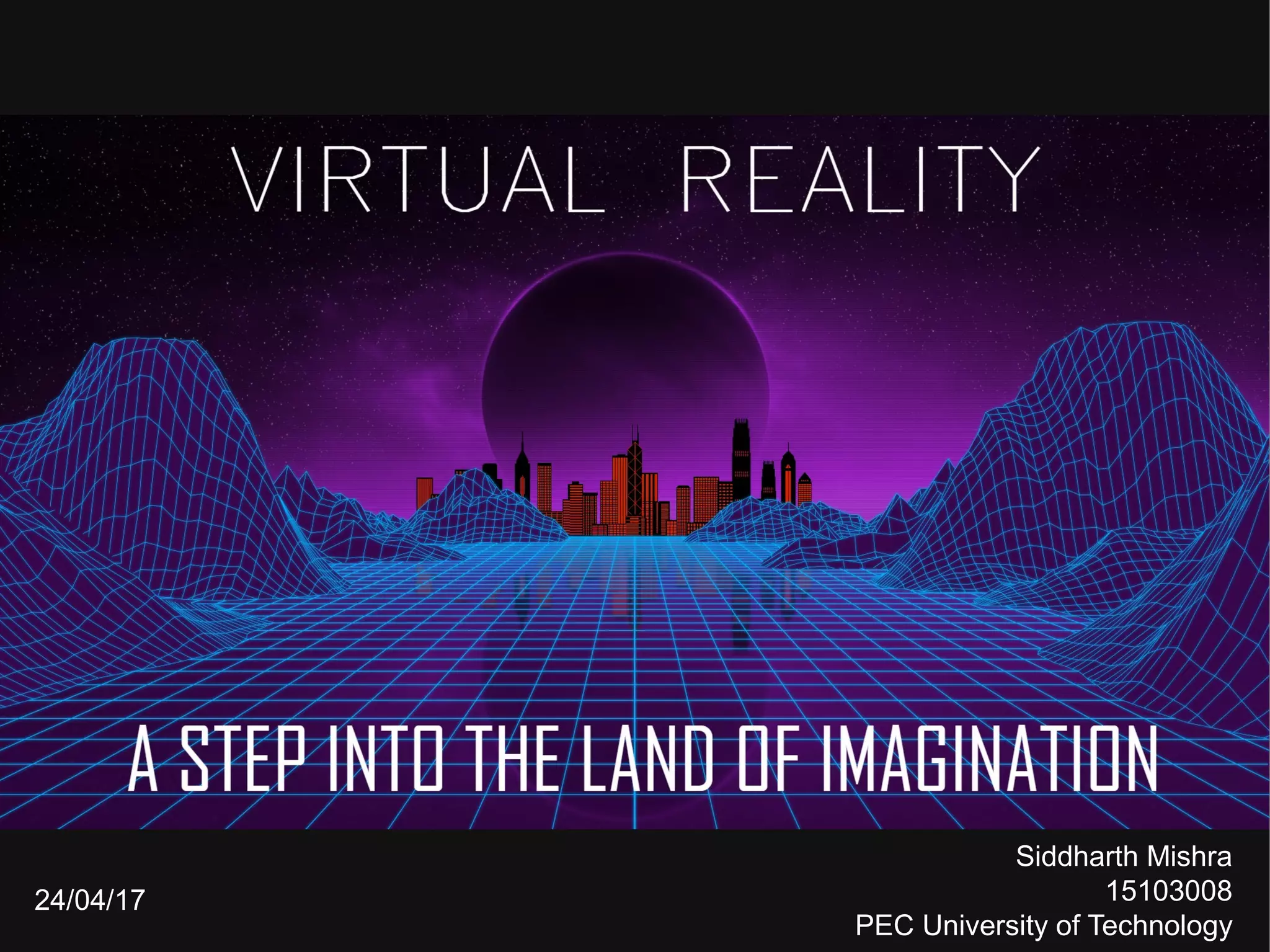
Virtual Reality: A Step into Land of Imagination

  • 1.
  • 2.
  • 3.
    Virtual reality (VR)is a technology which immerses a user in a computer-generated environment. The environment could be a simulation of the real world or an imaginary world. Miniaturization of circuits, sensors, peripherals along with the rise and simplicity of Computer Aided Design software have given a massive boost to the development of VR.
  • 4.
    Why a “stepinto the land of imagination”? Virtual reality gives the ability to see, hear and feel a world, which is entirely computer generated. Since the computer generated world is also made/programmed by a human, the only thing limiting its awesomeness is creativity and imagination. Using today’s software, one can easily design virtual environments and directly create assets that he/she is imagining
  • 5.
    Different ways wecan achieve VR: HMD (Head Mounted Display) 360° Projection Dome (a.k.a. CAVE) Advanced Simulation Environment Augmentation
  • 6.
    There are nohard rules! Any device that can deceive our senses and make us feel “out of this world” can be considered as virtual reality!
  • 7.
    Fun Fact! Virtual realityindustry is expected to be a $120 Billion industry by 2020.
  • 8.
     sight 70% • hearing20% • smell 5%  touch 4%  taste 1% Senses which need to be deceived: We can infer that human vision is the most important factor when we consider stimulation and hence contributes to capturing the users attention the most. Therefore the stimulation of the visual senses and plays a principal role in making the user feel immersed.
  • 9.
    Components required tobuild a VR system: Computer Graphics: Both, hardware and software Input / Output Devices: Touch screen Data Glove Body suits HMDs is the most used medium to achieve virtual reality. HMDs are very compact, light weight, easily available and are very cheap to setup. Optical Stuff: Lenses Screen Projector, etc.
  • 10.
    Types of HMDs: Smartphonepowered HMD: These are perhaps the cheapest and the most easily available type of headset yet. In a slot, the smartphone is placed in. The smartphone here acts as the display and the processing unit. Headsets like these cost anywhere from Rs. 100 to Rs. 7000, depending on how sophisticated the headset is.
  • 11.
    PC powered HMDs: Possiblythe best way to experience VR. The sheer and raw power of the PC means high quality light maps, better rendering and minimal lag. With one major obstacle out of the play, the developers can now focus on the optics of the headset to deliver an extremely immersive experience. Specs of PC powered HMDs usually are: - 60FPS -1080p resolution -120° FOV
  • 12.
    Standalone HMD: The namesuggests everything. HMDs of this type have the CPU, GPU and I/O devices on the headset itself. This eliminates the need of having an external; bulky setup, just for the CPU and the GPU. But, due to technological limitations, standalone HMDs are really difficult and expensive to manufacture. Microsoft’s HoloLens is the only standalone HMD available for commercial use priced at $5000.
  • 13.
    BOOM: The BOOM (BinocularOmni-Orientation Monitor) is a head-coupled stereoscopic display device. Screens and optical system are housed in a box that is attached to a multi-link arm. The user looks into the box through two holes, sees the virtual world, and can guide the box to any position within the operational volume of the device. Head tracking is accomplished via sensors in the links of the arm that holds the box.
  • 14.
    Types of Inputdevices: 3D Joystick: 3D joysticks use a combination of sensors to estimate the position of the joystick in 3D space with respect to the headset. It enables the HMD to determine how far the joystick is from the HMD and what is its orientation. Input from this data can be analyzed and can be used to project “virtual hands” for the user to play with.
  • 15.
    The Data Gloveconsists of a lightweight nylon glove with optical sensors mounted along the fingers which accurately and repeatedly measure the position and movement of the fingers and wrist. Data gloves are commonly used in virtual reality environments where the user sees an image of the data glove and can manipulate the movements of the virtual environment using the glove. Data Glove:
  • 16.
    A 3D scanneris a device that analyses a real-world object or environment to collect data on its shape and possibly its appearance (i.e. colour). The collected data can then be used to construct digital, three dimensional models. They are extensively used for the entertainment industry in the production of movies and video games , design , documentation of cultural artefacts involved in the design. XBox 360’s Kinect is a perfect example of a 3D scanner. 3D Scanner:
  • 17.
    Motion Tracker: Motion trackinguses a combination of computer chips, sensors and cameras to record humans in motion and create digital doppelgangers that move the same way. Designed for head and hand tracking in VR games, simulations, animations, and visualizations. For example, Polhemus STAR*TRAK is a long range motion capture system that can operate in a wireless mode (totally free of interface cables) or with a thin interconnect cable.
  • 18.
    Applications of VR: •Cinemaand entertainment •Healthcare and clinical therapies •Anxiety disorder treatment •Pain management •Education and training •Military uses •Space training •Flight and vehicular applications •Medical training •Fine arts •Engineering •VR in occupational safety and health •Heritage and archaeology •Architectural and urban design
  • 19.
    Heath hazards associatedwith VR: • Simulator Sickness • Motion sickness • Stress on the eye • Surrounding awareness • Skin rashes • Nausea, vomiting and headaches • Lowered brain development in children Virtual reality is still relatively a new technology, hence, research regarding its health hazards is very limited. Injuries reported to be caused by tripping over surrounding objects is a leading factor in health hazards associated with VR. Keeping a screen just an inch or two away from our eyes is also a very serious health risk. We will have to use this sophisticated technology with caution till safer HMDs roll out and more research is done on the topic.
  • 20.
    Future developments: • Miniaturizationof circuits • VR computer graphics (HPU) • Lighter and better material for HMDs • Better optics • Development software kits • Reduced costs • Full body suits (ARAIG) • Mind Uploading (NeuraLink)
  • 21.
    Virtual Reality isundoubtedly the next footstep towards a modern/post-modern era of development. The potential ground breaking effects that loom behind these machines is uncanny. Virtual Reality is still at a critical design phase. It is merely a baby step. The theories behind its design and operation are still being written. There are 61,400+ international commercial companies producing VR. There are approximately 3,600 educational institutions which use VR. • Visualization of complicated, large data is helpful for understanding and analysis. • VR offers us a new way to interact with computer. • VR enables us to experience the virtual world that is impossible in real world. • VR is changing our life, eventually VR will increasingly become a part of our life. CONCLUSIONS
  • 22.
    THANK YOU! “The bestreality is what seems like a fantasy… The best fantasy is what feels like reality...”