1
By :
L. KIRAN KUMAR
M PHARMACY
A U College of Pharmaceutical Sciences
GOOD LABORATORY PRACTICES
AUDIT
Contents :
• Audit
• Introduction
• Objectives
• Goals of an audit
• Types of audits
• Components of audit
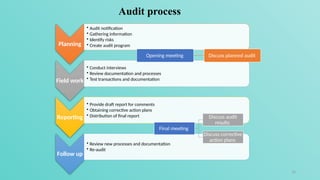
• Audit process
• References
2
3
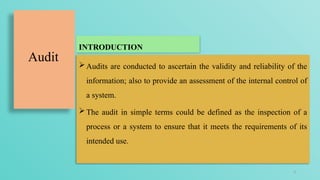
Audits are conducted to ascertain the validity and reliability of the
information; also to provide an assessment of the internal control of
a system.
The audit in simple terms could be defined as the inspection of a
process or a system to ensure that it meets the requirements of its
intended use.
Audit
INTRODUCTION
4
• Evaluating conformity of requirements to ISO 9001
• Evaluating conformity of documentation to ISO 9001
• Determining effectiveness in meeting requirements and objectives
• Providing an opportunity to improve the quality management system
Objectives
• The simple goal of this complex process is to evaluate existing activities
and documentation and determine if they meet the established standards.
• An audit will evaluate the strengths and weaknesses of quality control
and quality assurance processes, the results of which will help us to
improve processes and build a better system for the benefit of the
company.
Goals of an audit
5
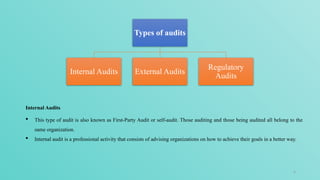
Internal Audits
 This type of audit is also known as First-Party Audit or self-audit. Those auditing and those being audited all belong to the
same organization.
 Internal audit is a professional activity that consists of advising organizations on how to achieve their goals in a better way.
Types of audits
Internal Audits External Audits
Regulatory
Audits
6
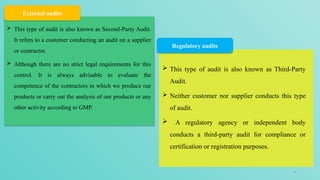
 This type of audit is also known as Second-Party Audit.
It refers to a customer conducting an audit on a supplier
or contractor.
 Although there are no strict legal requirements for this
control. It is always advisable to evaluate the
competence of the contractors in which we produce our
products or carry out the analysis of our products or any
other activity according to GMP.
External audits
Regulatory audits
 This type of audit is also known as Third-Party
Audit.
 Neither customer nor supplier conducts this type
of audit.
 A regulatory agency or independent body
conducts a third-party audit for compliance or
certification or registration purposes.
7
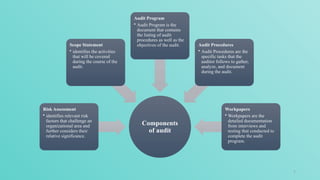
Components
of audit
Risk Assessment
• identifies relevant risk
factors that challenge an
organizational area and
further considers their
relative significance.
Scope Statement
• identifies the activities
that will be covered
during the course of the
audit.
Audit Program
• Audit Program is the
document that contains
the listing of audit
procedures as well as the
objectives of the audit. Audit Procedures
• Audit Procedures are the
specific tasks that the
auditor follows to gather,
analyze, and document
during the audit.
Workpapers
• Workpapers are the
detailed documentation
from interviews and
testing that conducted to
complete the audit
program.
8
Methods of gathering audit
information
• Interviews
• Inspections
• Reviewing documents
• Observations
• Exercises
• Vertical tracking
9
Composition of the auditing team
with clarity on their authority and
responsibility
Information regarding the
company policy pertaining to
auditing.
Standard
Operating
Procedures
for Auditing
A pharmaceutical company has to
prepare a standard operating
procedure for auditing which
includes the following points:
1
2
Statement of purpose scope
of audits 3 Chosen areas subjected
to auditing 4
Frequency of auditing
7
5
6
Written reports on audits
including their distribution
Corrective action
10
Planning
• Audit notification
• Gathering information
• Identify risks
• Create audit program
Field work
• Conduct interviews
• Review documentation and processes
• Test transactions and documentation
Reporting
• Provide draft report for comments
• Obtaining corrective action plans
• Distribution of final report
Follow up
• Review new processes and documentation
• Re-audit
Opening meeting Discuss planned audit
Final meeting
Discuss audit
results
Discuss corrective
action plans
Audit process
11
References:
1. https://www.researchgate.net/publication/330261216_Pharmaceutical_quality_audits_A_review
2. https://www.alghad.edu.ly/control_panel/books/the%20role%20of%20regulatory%20GMP%20audit%20in
%20pharma%20companies.pdf
3. https://www.researchgate.net/publication/263657405_A_review_on_audits_and_compliance_management
4. Establishing a cGMP Laboratory Andit System, A Practical Guide - David M Bleisner Wiley
12
THANK YOU

GOOD LABORATORY PRACTICES AUDIT PRESENTATION

  • 1.
    1 By : L. KIRANKUMAR M PHARMACY A U College of Pharmaceutical Sciences GOOD LABORATORY PRACTICES AUDIT
  • 2.
    Contents : • Audit •Introduction • Objectives • Goals of an audit • Types of audits • Components of audit • Audit process • References 2
  • 3.
    3 Audits are conductedto ascertain the validity and reliability of the information; also to provide an assessment of the internal control of a system. The audit in simple terms could be defined as the inspection of a process or a system to ensure that it meets the requirements of its intended use. Audit INTRODUCTION
  • 4.
    4 • Evaluating conformityof requirements to ISO 9001 • Evaluating conformity of documentation to ISO 9001 • Determining effectiveness in meeting requirements and objectives • Providing an opportunity to improve the quality management system Objectives • The simple goal of this complex process is to evaluate existing activities and documentation and determine if they meet the established standards. • An audit will evaluate the strengths and weaknesses of quality control and quality assurance processes, the results of which will help us to improve processes and build a better system for the benefit of the company. Goals of an audit
  • 5.
    5 Internal Audits  Thistype of audit is also known as First-Party Audit or self-audit. Those auditing and those being audited all belong to the same organization.  Internal audit is a professional activity that consists of advising organizations on how to achieve their goals in a better way. Types of audits Internal Audits External Audits Regulatory Audits
  • 6.
    6  This typeof audit is also known as Second-Party Audit. It refers to a customer conducting an audit on a supplier or contractor.  Although there are no strict legal requirements for this control. It is always advisable to evaluate the competence of the contractors in which we produce our products or carry out the analysis of our products or any other activity according to GMP. External audits Regulatory audits  This type of audit is also known as Third-Party Audit.  Neither customer nor supplier conducts this type of audit.  A regulatory agency or independent body conducts a third-party audit for compliance or certification or registration purposes.
  • 7.
    7 Components of audit Risk Assessment •identifies relevant risk factors that challenge an organizational area and further considers their relative significance. Scope Statement • identifies the activities that will be covered during the course of the audit. Audit Program • Audit Program is the document that contains the listing of audit procedures as well as the objectives of the audit. Audit Procedures • Audit Procedures are the specific tasks that the auditor follows to gather, analyze, and document during the audit. Workpapers • Workpapers are the detailed documentation from interviews and testing that conducted to complete the audit program.
  • 8.
    8 Methods of gatheringaudit information • Interviews • Inspections • Reviewing documents • Observations • Exercises • Vertical tracking
  • 9.
    9 Composition of theauditing team with clarity on their authority and responsibility Information regarding the company policy pertaining to auditing. Standard Operating Procedures for Auditing A pharmaceutical company has to prepare a standard operating procedure for auditing which includes the following points: 1 2 Statement of purpose scope of audits 3 Chosen areas subjected to auditing 4 Frequency of auditing 7 5 6 Written reports on audits including their distribution Corrective action
  • 10.
    10 Planning • Audit notification •Gathering information • Identify risks • Create audit program Field work • Conduct interviews • Review documentation and processes • Test transactions and documentation Reporting • Provide draft report for comments • Obtaining corrective action plans • Distribution of final report Follow up • Review new processes and documentation • Re-audit Opening meeting Discuss planned audit Final meeting Discuss audit results Discuss corrective action plans Audit process
  • 11.
    11 References: 1. https://www.researchgate.net/publication/330261216_Pharmaceutical_quality_audits_A_review 2. https://www.alghad.edu.ly/control_panel/books/the%20role%20of%20regulatory%20GMP%20audit%20in %20pharma%20companies.pdf 3.https://www.researchgate.net/publication/263657405_A_review_on_audits_and_compliance_management 4. Establishing a cGMP Laboratory Andit System, A Practical Guide - David M Bleisner Wiley
  • 12.