Understanding the Audit Opinion
Based on the powers vested by the 1987 Philippine Constitution, the COA conducts financial, compliance and performance audits. In
the conduct of such audits, the COA uses the International Standards of Supreme Audit Institutions (ISSAIs), which are the standards
being used by almost all the supreme audit institutions worldwide. The table below summarizes the key differences of these audits:
Type of Audit Audit Objective Audit Criteria Output
Financial Audit To determine whether the financial
statements are prepared, in all material
respects, in accordance with an
applicable financial reporting
framework.
Philippine Financial Reporting
Standards (PFRS); International
Public Sector Accounting
Standards (IPSAS)
Independent Auditor’s Report
containing the audit opinion
(published as part of the
Annual Audit Report)
Performance Audit To determine whether government
undertakings, systems, operations,
programmes, activities or
organizations are operating in
accordance with the principles of
economy, efficiency and/or
effectiveness and whether there is
room for improvement.
Audit criteria are not always
readily available to the auditor in
performance auditing; they are
typically based on knowledge of
best practice on how activities are
carried out to be most economical
and efficient (or what conditions
are the most favourable for good
performance and effectiveness)
Performance Audit Report
containing the audit
conclusion
Compliance Audit To determine whether activities,
financial transactions and information
comply, in all material respects, with
the authorities that govern the audited
entity.
Laws, rules and regulations Management Letter containing
the audit conclusion (for
direct reporting engagements)
As the basis for the auditor’s opinion in the financial audit, ISSAIs/ISAs require the auditor to obtain reasonable assurance whether
the financial statements as a whole are free from material misstatement, whether due to fraud or error. Reasonable assurance is a high
level of assurance. It is obtained when the auditor has acquired sufficient appropriate audit evidence to reduce audit risk (that is, the
risk that the auditor expresses an inappropriate opinion when the financial statements are materially misstated) to an acceptably low
level. However, reasonable assurance is not an absolute level of assurance, because there are inherent limitations of an audit which
result in most of the audit evidence on which the auditor draws conclusions and bases the auditor’s opinion being persuasive rather
than conclusive.
As such an audit opinion only covers the financial audit and thus, does not reflect the agency’s level of compliance with laws,
rules and regulations reported under a compliance audit (unless these have financial impact), nor the application of the
principles of economy, efficiency, and effectiveness in the agency’s operations reported under a performance audit.
To provide additional information, the following are the different types of opinion issued in connection with financial audit based on
ISSAI 2700 and ISSAI 2705 which were crafted from International Standards on Auditing (ISA) 700 and ISA 705:
A. Unmodified opinion (also referred to as unqualified opinion) – this opinion is issued when the auditor concludes that the
financial statements are prepared, in all material respects, in accordance with the applicable financial reporting framework (i.e.,
PFRS, IPSAS). For this purpose, the auditor’s evaluation includes due consideration on quantitative and qualitative materiality
established based on the prescribed COA’s audit guidelines. As such, an unmodified/unqualified opinion does not necessarily
mean that there were no misstatements found during the audit nor there were no uncorrected misstatements as at year-end. It is
possible that the misstatements found during the audit were already corrected by the audited agency or that the uncorrected
misstatements are not material, quantitatively and qualitatively. This does not also entail that the audited agency fully complies
with all the laws, rules and regulations, or that the uses of funds on the agency’s programs, projects and activities are
economical, effective or efficient.
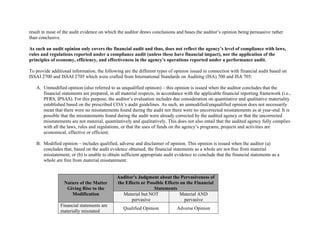
B. Modified opinion – includes qualified, adverse and disclaimer of opinion. This opinion is issued when the auditor (a)
concludes that, based on the audit evidence obtained, the financial statements as a whole are not free from material
misstatement; or (b) is unable to obtain sufficient appropriate audit evidence to conclude that the financial statements as a
whole are free from material misstatement:
Nature of the Matter
Giving Rise to the
Modification
Auditor’s Judgment about the Pervasiveness of
the Effects or Possible Effects on the Financial
Statements
Material but NOT
pervasive
Material AND
pervasive
Financial statements are
materially misstated
Qualified Opinion Adverse Opinion
Inability to obtain
sufficient appropriate
audit evidence
Qualified Opinion Disclaimer of Opinion
Considering the foregoing definition, purpose and context, an audit opinion should not be viewed as a rating, score or grade,
with ranking of lowest to highest. Time and again, an audit opinion is a statement that expresses whether the financial
statements are prepared, in all material respects, in accordance with the applicable financial reporting framework (i.e., PFRS,
IPSAS).

Audit Opinion

  • 1.
    Understanding the AuditOpinion Based on the powers vested by the 1987 Philippine Constitution, the COA conducts financial, compliance and performance audits. In the conduct of such audits, the COA uses the International Standards of Supreme Audit Institutions (ISSAIs), which are the standards being used by almost all the supreme audit institutions worldwide. The table below summarizes the key differences of these audits: Type of Audit Audit Objective Audit Criteria Output Financial Audit To determine whether the financial statements are prepared, in all material respects, in accordance with an applicable financial reporting framework. Philippine Financial Reporting Standards (PFRS); International Public Sector Accounting Standards (IPSAS) Independent Auditor’s Report containing the audit opinion (published as part of the Annual Audit Report) Performance Audit To determine whether government undertakings, systems, operations, programmes, activities or organizations are operating in accordance with the principles of economy, efficiency and/or effectiveness and whether there is room for improvement. Audit criteria are not always readily available to the auditor in performance auditing; they are typically based on knowledge of best practice on how activities are carried out to be most economical and efficient (or what conditions are the most favourable for good performance and effectiveness) Performance Audit Report containing the audit conclusion Compliance Audit To determine whether activities, financial transactions and information comply, in all material respects, with the authorities that govern the audited entity. Laws, rules and regulations Management Letter containing the audit conclusion (for direct reporting engagements) As the basis for the auditor’s opinion in the financial audit, ISSAIs/ISAs require the auditor to obtain reasonable assurance whether the financial statements as a whole are free from material misstatement, whether due to fraud or error. Reasonable assurance is a high level of assurance. It is obtained when the auditor has acquired sufficient appropriate audit evidence to reduce audit risk (that is, the risk that the auditor expresses an inappropriate opinion when the financial statements are materially misstated) to an acceptably low level. However, reasonable assurance is not an absolute level of assurance, because there are inherent limitations of an audit which
  • 2.
    result in mostof the audit evidence on which the auditor draws conclusions and bases the auditor’s opinion being persuasive rather than conclusive. As such an audit opinion only covers the financial audit and thus, does not reflect the agency’s level of compliance with laws, rules and regulations reported under a compliance audit (unless these have financial impact), nor the application of the principles of economy, efficiency, and effectiveness in the agency’s operations reported under a performance audit. To provide additional information, the following are the different types of opinion issued in connection with financial audit based on ISSAI 2700 and ISSAI 2705 which were crafted from International Standards on Auditing (ISA) 700 and ISA 705: A. Unmodified opinion (also referred to as unqualified opinion) – this opinion is issued when the auditor concludes that the financial statements are prepared, in all material respects, in accordance with the applicable financial reporting framework (i.e., PFRS, IPSAS). For this purpose, the auditor’s evaluation includes due consideration on quantitative and qualitative materiality established based on the prescribed COA’s audit guidelines. As such, an unmodified/unqualified opinion does not necessarily mean that there were no misstatements found during the audit nor there were no uncorrected misstatements as at year-end. It is possible that the misstatements found during the audit were already corrected by the audited agency or that the uncorrected misstatements are not material, quantitatively and qualitatively. This does not also entail that the audited agency fully complies with all the laws, rules and regulations, or that the uses of funds on the agency’s programs, projects and activities are economical, effective or efficient. B. Modified opinion – includes qualified, adverse and disclaimer of opinion. This opinion is issued when the auditor (a) concludes that, based on the audit evidence obtained, the financial statements as a whole are not free from material misstatement; or (b) is unable to obtain sufficient appropriate audit evidence to conclude that the financial statements as a whole are free from material misstatement: Nature of the Matter Giving Rise to the Modification Auditor’s Judgment about the Pervasiveness of the Effects or Possible Effects on the Financial Statements Material but NOT pervasive Material AND pervasive Financial statements are materially misstated Qualified Opinion Adverse Opinion
  • 3.
    Inability to obtain sufficientappropriate audit evidence Qualified Opinion Disclaimer of Opinion Considering the foregoing definition, purpose and context, an audit opinion should not be viewed as a rating, score or grade, with ranking of lowest to highest. Time and again, an audit opinion is a statement that expresses whether the financial statements are prepared, in all material respects, in accordance with the applicable financial reporting framework (i.e., PFRS, IPSAS).