Accounting &
Auditing II
AUDITING
Complete Course
Syllabus
I. Fundamental Auditing Principles and Concepts: Audit and Auditing, True and Fair
View, Audit Assertions, Reasonable Assurance, Documentation and Audit Evidence,
Audit Program, Audit Risks, Computer Information Systems (EDP Systems) and
Computer-assisted Audit Techniques (CAAT), Inspection, Fraud, Going Concern, Audit
Materiality, Misstatement, Governance and Premise, Tests of Control and Substantive
Procedures.
II. Audit Considerations, Dimensions and Conduct: Internal Control System and
Internal Audit, Internal VS External Audit, Responsibility for Financial Statements, Audit
Planning, Scope of an Audit, Objectives of an Audit, Inherent Limitations of an Audit,
Risk Assessment and Management, Internal Audit and Corporate
Governance,Classification of Audit, Qualities of an Auditor, Auditing in Computer
Information Systems (EDP Systems) and Computer-assisted Audit Techniques, General
Auditing Principles and Techniques commonly applicable to various Types of
Undertakings including Merchandizing, Manufacturing, Banking, Insurance, Investment
Entities etc., Audit Performance and Audit Completion.
III. Role and Responsibilities of an Auditor: Auditor’s professional and legal Rights,
Responsibilities & Duties, and Liabilities; Auditor’s Opinion and Report, and their
classification (Types); - as specified under the Companies Ordinance 1984, and in the
handbook of IFAC.
Introduction
An audit is an official examination of the accounts (or
accounting systems) of an entity (by an auditor).
The main objective of an audit is to enable an auditor to
convey an opinion as to whether or not the financial
statements of an entity are prepared according to an
applicable financial reporting framework.
An audit of a company‘s accounts is needed because in
companies, the owners of the business are often not the same
persons as the individuals who manage and control that
business.
 The shareholders own the company.
 The company is managed and controlled by its directors.
Introduction
The audit report: independence,
materiality and true and fair
An auditor reports to the shareholders on the financial
statements produced by a company‘s management.
The key features of the audit report are as follows:
a) The auditors producing the report are independent from
the directors producing the financial statements.
b) The report gives an opinion on whether the financial
statements ―give a true and fair view, or ―present
fairly the position and results of the entity.
c) The report considers whether the financial statements give
a true and fair view in all material respects. The concept
of materiality is applied in reaching an audit opinion.
The audit report: independence,
materiality and true and fair
Independence of the auditor
The external auditor must be independent from the
directors; otherwise his report will have little value. If
he is not independent, his opinion is likely to be
influenced by the directors.
True and fair view (fair presentation)
The auditor reports on whether (or not) the financial
statements give a true and fair view, or present
fairly, the position of the entity as at the end of the
financial period and the performance of the entity
during the period
The audit report: independence,
materiality and true and fair
Materiality concept
The auditor reports in accordance with the concept of
materiality. He gives an opinion on whether the
financial statements present fairly in all material
respects the financial position and performance of
the entity. Information is material if, on the basis of
the financial statements, it could influence the
economic decisions of users should it be omitted or
misstated.
Objectives of auditor
The objectives of the auditor are:
to obtain reasonable assurance about whether the
financial statements as a whole are free from material
misstatement, whether due to fraud or error, thereby
enabling the auditor to express an opinion on whether
the financial statements are prepared, in all material
respects, in accordance with the applicable financial
reporting framework.
to report on the financial statements, and
communicate as required by the ISAs, in accordance with
the auditor‘s findings.
Assurance
Assurance‘ means confidence. In an assurance engagement, an assurance
firm‘ is engaged by one party to give an opinion on a piece of information that
has been prepared by another party.
Levels of assurance:
The degree of assurance that can be provided about the reliability of the
financial statements of a company will depend on:
 the amount of work performed in carrying out the assurance process
 the results of that work.
The resulting assurance falls into one of two categories:
 Reasonable Assurance – A high (but not absolute) level of assurance
provided by the practitioner‘s conclusion expressed in a positive form.
E.g. ―In our opinion, the accounts are true and fair .
 Limited Assurance – A moderate level of assurance provided by the
practitioner‘s conclusion expressed in a negative form. E.g. ―Based on our
review, nothing has come to our attention that causes us to believe that the
accompanying financial statements do not give a true and fair view
What is required of the auditor?
 comply with all ISAs relevant to the audit
 comply with relevant ethical requirements
 plan and perform an audit with *professional scepticism
 exercise professional judgement in planning and
performing an audit
 obtain sufficient appropriate audit evidence to allow
him to obtain reasonable assurance
Important terms
Professional skepticism –An attitude that includes a questioning
mind, being alert to conditions which may indicate possible
misstatement due to error or fraud, and a critical assessment of audit
evidence.
Professional judgment – The application of relevant training,
knowledge and experience, within the context provided by auditing,
accounting and ethical standards, in making informed decisions
about the courses of action that are appropriate in the circumstances of
the audit engagement.
Sufficient appropriate audit evidence- Sufficiency is the measure of
the quantity of audit evidence. Appropriateness is the measure
of the quality of audit evidence in terms of its relevance and
reliability. The sufficiency and appropriateness of audit evidence are
interrelated, obtaining more audit evidence may not compensate for its
poor quality.
Scope of an audit
A. An audit involves performing procedures to obtain sufficient
appropriate audit evidence about the amounts and disclosures in the
financial statements.
B. The procedures selected depend on the auditor‘s professional
judgment, including the assessment of the risks of material
misstatement of the financial statements, whether due to fraud or
error.
C. In making those risk assessments, the auditor considers internal
control relevant to the entity‘s preparation of the financial statements
in order to design audit procedures that are appropriate in the
circumstances.
D. An audit also includes evaluating the appropriateness of accounting
policies used and the reasonableness of accounting estimates made
by management, as well as evaluating the overall presentation of
the financial statements.
An auditor of a company has a right:
• of access at all times to the company’s books, accounts and
vouchers
• of access to such copies of, an extracts from, the books and accounts
of the branch as have been transmitted to the principal office of the
company;
to require any of the following persons to provide him with such
information or explanations as he thinks necessary for the performance
of his duties as auditor:
(i) any director, officer or employee of the company;
(ii) any person holding or accountable for any of the company’s books
(iii) any subsidiary undertaking of the company; and
(iv) any officer, employee or auditor of any such subsidiary undertaking
of the company
Rights of auditors
Rights and duties of auditors
A company’s auditor must carry out such
examination to enable him to form an opinion as to:
(a)whether adequate accounting records have been
kept by the company and returns adequate for
their audit have been received from branches not
visited by him
(a)whether the company’s financial statements are
in agreement with the accounting records and
returns.
Contd…….
Duties of auditors
Rights and duties of auditors
The auditor will make out a report to the members of the company on the
accounts and books of accounts of the company and on every financial
statements and on every other document forming part of such statements
(a) whether or not they have obtained all the information and explanations
which to the best of their knowledge and belief were necessary for the
purposes of the audit and if not, the details thereof and the effect of such
information on the financial statements;
(b) whether or not in their opinion proper books of accounts as required by this
Act have been kept by the company;
(c) whether or not in their opinion the statement of financial position and profit
and loss account and other comprehensive income or the income and
expenditure account and the cash flows have been drawn up in conformity
with the requirements of accounting and reporting standards as notified
under this Act and are in agreement with the books of accounts and returns;
Contd…….
Duties of auditors (Audit Report)
Rights and duties of auditors
(d) whether or not in their opinion and to the best of their information and
according to the explanations given to them, the said accounts give the
information required by this Act in the manner so required and give a
true and fair view:
(i) in the case of the statement of financial position, of the state of
affairs of the company as at the end of the financial year;
(ii) in the case of the profit and loss account and other
comprehensive income or the income and expenditure account,
of the profit or loss and other comprehensive income or
surplus or deficit, as the case may be, for its financial year;
and
(iii) in the case of statement of cash flows, of the generation and
utilisation of the cash and cash equivalents of the company
for its financial year;
Contd…….
Duties of auditors
Rights and duties of auditors
(e) whether or not in their opinion:
(i) investments made, expenditure incurred and
guarantees extended, during the year, were for the
purpose of company’ s business; and
(ii) zakat deductible at source under the Zakat and
Usher Ordinance, 1980 (XVIII of 1980), was
deducted by the company and deposited in
the Central Zakat Fund
Duties of auditors
Rights and duties of auditors
(e) whether or not in their opinion:
(i) investments made, expenditure incurred and
guarantees extended, during the year, were for the
purpose of company’ s business; and
(ii) zakat deductible at source under the Zakat and
Usher Ordinance, 1980 (XVIII of 1980), was
deducted by the company and deposited in
the Central Zakat Fund
Duties of auditors
Rights and duties of auditors
 Its cost. The cost of an audit can be very high.
 Some items in the subject matter might be estimates whose truth
and fairness will not be known with certainty until some point in the
future.
 Most fraud will include an attempt to deliberately conceal the truth
or misrepresent information.
 In order to balance cost and efficiency the auditor routinely uses
sampling rather than tests every item.
 Irrespective of how robust a client‘s systems are they will always
incorporate some degree of inherent limitation.
 Audit evidence is persuasive rather than conclusive.
Limitations of statutory audits
Planning an audit
The auditor shall establish an overall audit strategy that sets
the scope, timing and direction of the audit, and that guides
the development of the audit plan.
The audit plan will set out:
• the procedures to be used in order to assess the risk of
misstatement in the entity’ s accounting records/financial
statements
• plan further audit procedures for each material audit
area. These audit procedures might be in response to the
risks assessed
Planning an audit
The audit procedures to be performed by audit
team members will be those needed in order to:
 obtain sufficient appropriate audit
evidence
reduce audit risk to an acceptably low level
Auditor’s Risk Assessment Process
Auditor’s risk assessment procedures to include the following:
 Inquiries (i.e. asking questions and getting answers) of:
 management;
 appropriate individuals within the internal audit function if such a function
exists
 others who may have information that is likely to assist in identifying risks
of material
misstatement due to fraud or error.
 Analytical procedures, which involves the study of ratios and trends to
identify the
existence of unusual transactions or events or amounts, ratios or trends that
might have
implications for the audit
 Observation and inspection (for example, inspecting internal control
manuals
The auditor is required to identify and assess the risks of misstatement,
whether due to fraud or error, through understanding the entity and its
environment, including its internal controls
Understanding the entity and its
environment
Internal control may be defined as the process
designed and put in place to provide assurance of a
reasonable level regarding the achievement of the
objectives of an entity.
These objectives relate to:
• the reliability of the financial reports,
• the efficiency and effectiveness of operations and
• adherence to relevant and applicable laws and
regulations
Internal Control
How the auditor uses internal controls
The auditor relies on the accounting systems and the
related controls to ensure that
transactions are properly recorded.
His assumption is that if the systems and the internal
controls are adequate, the transactions should be
processed correctly.
Before the auditor can rely on the systems and
controls that are in place, he must establish what
those systems and controls are, and carry out an
evaluation of the effectiveness of the controls.
Internal Control
The degree of effectiveness of an internal
control system will depend on the
following two factors:
The design of the internal control
system
The proper implementation of the
control
Internal Control
The auditor must therefore:
 test the underlying internal control systems
themselves, using tests of controls, and
 perform some tests on the transactions
and balances in the financial statements.
These tests on transactions and balances are
referred to as substantive procedures:
Internal Control
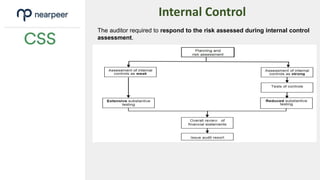
Internal Control
The auditor required to respond to the risk assessed during internal control
assessment.
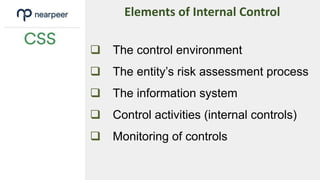
 The control environment
 The entity’s risk assessment process
 The information system
 Control activities (internal controls)
 Monitoring of controls
Elements of Internal Control
 Communication & enforcement of integrity & ethical values
 Commitment to competence
 Participation of management
 Management‟s philosophy and operating style
 Organisational structure
 Assignment of authority and responsibility
 Human resource policies and practices
Control Environment
Within a strong system of internal control,
management should identify, assess and
manage business risks, on a continual basis.
Significant business risks are any events or
omissions that may prevent the entity from
achieving its objectives.
Entity’s Risk Assessment Process
An information system consists of:
infrastructure (physical and hardware components)
software
people
procedures, and
data.
Information System
Control activities are the policies and procedures, other than
the control environment, used to ensure that the entity‟s
objectives are achieved
Control activities are the specific procedures designed:
 to prevent errors that may arise in processing information
 to detect and correct errors that may arise in processing
information
Control Activities
It is important within an internal control system that
management should review and monitor the operation
of the controls, on a systematic basis, to satisfy
themselves that the controls remain adequate and
that they are being applied properly
Monitoring of Controls
Infectiveness of Controls
Reasons why internal controls may be ineffective
Internal control systems are never fool proof. All systems, no matter how
effective they may appear to be, have several limitations:
 Human error may result in incomplete or inaccurate processing which
may not be detected by control systems.
 It may not be cost-effective to establish certain types of controls within
an organisation.
 Controls may be in place, but they may be ignored or overridden by
employees or management.
 Collusion may mean that segregation of duties is ineffective. Collusion
means that two or more people work together to avoid a control, possibly
for the purpose of committing fraud
The evaluation of accounting and control
systems is a two-stage process. The auditor
will need to establish:
Whether controls are effective on paper.
Whether the controls are applied properly
Evaluation of Controls
Difference between Internal Controls,
Internal Audit & Internal Check
Internal Check
•Definition: Internal Check is an arrangement of staff duties
of a business in such a way that work is automatically
checked by the next staff while performing their duties.
•Relationship: Internal check is a part of internal control.
•Objective: Internal Check is a system or method
introduced with defined instructions given to staff as to their
sphere of work with a view to controlling and verification of
their work and also maintenance of accurate records as the
ultimate aim.
Difference between Internal Controls,
Internal Audit & Internal Check
Internal Audit
•Definition: An internal audit is conducted by the permanent
staff of the office to detect weakness in system, procedures
and for the improvement
•Relationship: Internal audit is an independent audit
performance.
•Objective: It helps an organization accomplish its
objectives by bringing a systematic, disciplined approach to
evaluate and improve the effectiveness of risk management,
control, and governance processes.
Difference between Internal Controls,
Internal Audit & Internal Check
Internal Control
•Definition: A sufficient understanding of the internal control
structure is to be obtained to plan the audit and to determine
the nature, timing, and extent of tests to be performed.
•Relationship: Internal control is a part of the internal audit.
•Objective: It as a process affected by an organization’s
structure, work and authority flow, people and management
information systems, designed to help the organization
accomplish specific goals or objective
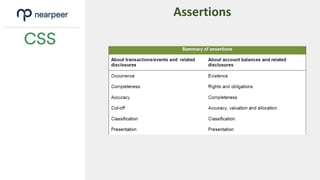
Assertions
Representations by management, explicit or otherwise, that
are embodied in the financial statements, as used by the
auditor to consider the different types of potential
misstatements that may occur.
These assertions fall into the following categories:
Assertions about classes of transactions and events
and related disclosures for the period under audit (i.e.
income statement assertions)
Assertions about account balances and related
disclosures at the period end (i.e. statement of financial
position assertions)
Assertions
Assertions about classes of transactions and events and related
disclosures are as follows:
 Occurrence: Transactions and events that have been recorded or disclosed
have occurred and relate to the entity.
 Completeness: There are no unrecorded transactions, events and
disclosures.
 Accuracy: Amounts and other data relating to recorded transactions and
events have been recorded appropriately
 Cut-off: Transactions and events have been recorded in the correct
accounting period.
 Classification: Transactions and events have been recorded in the proper
accounts.
 Presentation: Transactions and events are appropriately aggregated or
disaggregated and clearly described and related disclosures are relevant and
understandable..
Assertions
Assertions about account balances and related disclosures are as follows:
 Existence: Assets, liabilities and equity interests exist.
 Rights and obligations: The entity holds or controls the rights to assets,
and liabilities are those of the entity.
 Completeness: There are no unrecorded assets, liabilities or equity
interests and all related disclosures have been included.
 Accuracy, valuation and allocation: Assets, liabilities and equity interests
are included in the financial statements at appropriate amounts and any
resulting valuation or allocation adjustments are appropriately recorded and
related disclosures have been appropriately measured and described.
Classification: Assets, liabilities and equity interests are appropriately
aggregated or disaggregated and clearly described, and related disclosures are
relevant and understandable.
Assertions
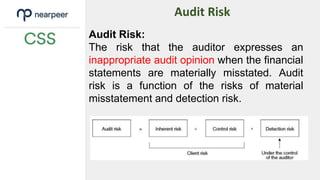
Audit Risk:
The risk that the auditor expresses an
inappropriate audit opinion when the financial
statements are materially misstated. Audit
risk is a function of the risks of material
misstatement and detection risk.
Audit Risk:
The risk that the auditor expresses an
inappropriate audit opinion when the financial
statements are materially misstated. Audit
risk is a function of the risks of material
misstatement and detection risk.
Audit Risk
Audit Risk
Inherent risk is the risk that items may be misstated as a
result of their inherent characteristics due to:
• the nature of the items themselves
• the nature of the entity and the industry in which it
operates
Control Risk:
The risk that a misstatement that could occur and will not be
prevented, or detected and corrected, on a timely basis by
the entity’s internal control.
Detection Risk:
The risk that the procedures performed by the auditor to
reduce audit risk to an acceptably low level will not detect a
misstatement that exists
Audit Report
The audit report is the end-product of the external audit process
Forming the audit opinion
In reaching his audit opinion, the auditor is required to
evaluate whether:
he has obtained sufficient appropriate audit evidence as to
whether the financial statements are free from material
misstatement
uncorrected misstatements are material, individually or in
aggregate
the financial statements have been prepared in
accordance with the requirements of the applicable
financial reporting framework
Audit Report (Types)
1. Unqualified Opinion
An unqualified opinion indicates that the information presented in a company’s
financial report is clean. An unqualified opinion shows that the audited financial
statements can be presumed to be free from misstatements.
2. Qualified Opinion
The auditor, having obtained sufficient appropriate audit evidence, concludes that
misstatements, individually or in the aggregate, are material, but not pervasive, to
the financial statements
3. Disclaimer Opinion
Auditors give a disclaimer when they are unable to express a definite opinion. This
can be due to the lack of properly maintained financial records or the absence or
insufficient support from the management
4. Adverse Opinion
When auditors issue an adverse opinion, it indicates that there has been a gross
misstatement and, possibly, fraud, in the preparation of the company’s financial
records.
Audit Report
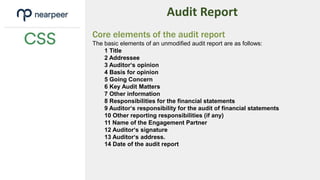
Core elements of the audit report
The basic elements of an unmodified audit report are as follows:
1 Title
2 Addressee
3 Auditor‘s opinion
4 Basis for opinion
5 Going Concern
6 Key Audit Matters
7 Other information
8 Responsibilities for the financial statements
9 Auditor‘s responsibility for the audit of financial statements
10 Other reporting responsibilities (if any)
11 Name of the Engagement Partner
12 Auditor‘s signature
13 Auditor‘s address.
14 Date of the audit report
Computer Assisted Audit Techniques
Computer assisted audit techniques
(CAATs) refer to the use of technology to
help you evaluate controls by extracting
and examining relevant data.
There are two broad categories of CAAT:
1. Audit software
2. Test data.
Computer Assisted Audit Techniques
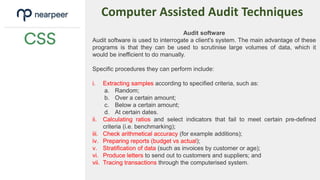
Audit software
Audit software is used to interrogate a client's system. The main advantage of these
programs is that they can be used to scrutinise large volumes of data, which it
would be inefficient to do manually.
Specific procedures they can perform include:
i. Extracting samples according to specified criteria, such as:
a. Random;
b. Over a certain amount;
c. Below a certain amount;
d. At certain dates.
ii. Calculating ratios and select indicators that fail to meet certain pre-defined
criteria (i.e. benchmarking);
iii. Check arithmetical accuracy (for example additions);
iv. Preparing reports (budget vs actual);
v. Stratification of data (such as invoices by customer or age);
vi. Produce letters to send out to customers and suppliers; and
vii. Tracing transactions through the computerised system.
Computer Assisted Audit Techniques
Test data
Test data involves the auditor submitting
'dummy' data into the client's system to
ensure that the system correctly
processes it and that it prevents or
detects and corrects misstatements. The
objective of this is to test the operation of
application controls within the system.
Computer Assisted Audit Techniques
Advantages of CAATs
CAATs allow the auditor to:
i. Independently access the data stored on a
computer system without dependence on the
client;
ii. Test the reliability of client software, i.e. the IT
application controls (the results of which can then
be used to assess control risk and design further
audit procedures);
iii. Increase the accuracy of audit tests; and
iv.Perform audit tests more efficiently, which in the
long-term will result in a more cost effective audit.
Computer Assisted Audit Techniques
Disadvantages of CAATs
i. CAATs can be expensive and time consuming
ii. Client permission and cooperation may be
difficult to obtain;
iii. Potential incompatibility with the client's computer
system;
iv. The audit team may not have sufficient IT skills
v. The audit team may not have the knowledge or
training needed to understand the results of the
CAATs;
vi. Data may be corrupted or lost during the
application of CAATs.
Past Papers
2018
Q. No. 2. How an internal control system helps the
management in conduct of their business affairs? Explain the
difference among internal check, internal audit and internal
control.
Q. No. 3. ABC Company is an audit and assurance firm,
which has recently accepted the audit of XYZ. Explain the
purpose of auditing financial statement of XYZ and the three
elements of audit risk faced by the company.
Q. No. 4. Due to the inherent limitations of audit, auditors are
only able to offer 'reasonable assurance' over the truth and fairness
of the financial statements rather than absolute assurance. Keeping
in view the above statement, explain the limitation of audit of
financial statement.
Past Papers
2019
Q. 2. Explain shortly all audit assertions related to class
of transactions (revenue and expenses), account balances
(assets/liabilities/equities), and presentation &
disclosure.
Q. 3. Define and explain different types of audit risks.
How these risks are used to manage the audit
assignment.
Q. 4. What are Computer Assisted Audit Techniques
(CAATs) that can be used in e-commerce environment.
Past Papers
2020
Q. 2. Why computerized audit is required in the presence of
manual audit? Elaborate the computerized auditing by application
of Computer Assisted Audit Techniques (CAAT).
Q. 3. Define audit and auditing. Comment on the auditor’s
(dependence) consideration of “reasonable assurance” and “True
& Fair view” for the financial audit of a corporate entity.
Q. 4. Write notes on any TWO of the followings:
(a) Audit materiality
(b) Misstatement and Fraud
(c) Test of Control and Substantive Procedures
24/7 Accessible Lectures Q/A from instructors Notes & Books
Thank You!

Auditing-DESKTOP-ITUD1J8.pptx

  • 1.
  • 2.
    Syllabus I. Fundamental AuditingPrinciples and Concepts: Audit and Auditing, True and Fair View, Audit Assertions, Reasonable Assurance, Documentation and Audit Evidence, Audit Program, Audit Risks, Computer Information Systems (EDP Systems) and Computer-assisted Audit Techniques (CAAT), Inspection, Fraud, Going Concern, Audit Materiality, Misstatement, Governance and Premise, Tests of Control and Substantive Procedures. II. Audit Considerations, Dimensions and Conduct: Internal Control System and Internal Audit, Internal VS External Audit, Responsibility for Financial Statements, Audit Planning, Scope of an Audit, Objectives of an Audit, Inherent Limitations of an Audit, Risk Assessment and Management, Internal Audit and Corporate Governance,Classification of Audit, Qualities of an Auditor, Auditing in Computer Information Systems (EDP Systems) and Computer-assisted Audit Techniques, General Auditing Principles and Techniques commonly applicable to various Types of Undertakings including Merchandizing, Manufacturing, Banking, Insurance, Investment Entities etc., Audit Performance and Audit Completion. III. Role and Responsibilities of an Auditor: Auditor’s professional and legal Rights, Responsibilities & Duties, and Liabilities; Auditor’s Opinion and Report, and their classification (Types); - as specified under the Companies Ordinance 1984, and in the handbook of IFAC.
  • 3.
    Introduction An audit isan official examination of the accounts (or accounting systems) of an entity (by an auditor). The main objective of an audit is to enable an auditor to convey an opinion as to whether or not the financial statements of an entity are prepared according to an applicable financial reporting framework. An audit of a company‘s accounts is needed because in companies, the owners of the business are often not the same persons as the individuals who manage and control that business.  The shareholders own the company.  The company is managed and controlled by its directors.
  • 4.
  • 5.
    The audit report:independence, materiality and true and fair An auditor reports to the shareholders on the financial statements produced by a company‘s management. The key features of the audit report are as follows: a) The auditors producing the report are independent from the directors producing the financial statements. b) The report gives an opinion on whether the financial statements ―give a true and fair view, or ―present fairly the position and results of the entity. c) The report considers whether the financial statements give a true and fair view in all material respects. The concept of materiality is applied in reaching an audit opinion.
  • 6.
    The audit report:independence, materiality and true and fair Independence of the auditor The external auditor must be independent from the directors; otherwise his report will have little value. If he is not independent, his opinion is likely to be influenced by the directors. True and fair view (fair presentation) The auditor reports on whether (or not) the financial statements give a true and fair view, or present fairly, the position of the entity as at the end of the financial period and the performance of the entity during the period
  • 7.
    The audit report:independence, materiality and true and fair Materiality concept The auditor reports in accordance with the concept of materiality. He gives an opinion on whether the financial statements present fairly in all material respects the financial position and performance of the entity. Information is material if, on the basis of the financial statements, it could influence the economic decisions of users should it be omitted or misstated.
  • 8.
    Objectives of auditor Theobjectives of the auditor are: to obtain reasonable assurance about whether the financial statements as a whole are free from material misstatement, whether due to fraud or error, thereby enabling the auditor to express an opinion on whether the financial statements are prepared, in all material respects, in accordance with the applicable financial reporting framework. to report on the financial statements, and communicate as required by the ISAs, in accordance with the auditor‘s findings.
  • 9.
    Assurance Assurance‘ means confidence.In an assurance engagement, an assurance firm‘ is engaged by one party to give an opinion on a piece of information that has been prepared by another party. Levels of assurance: The degree of assurance that can be provided about the reliability of the financial statements of a company will depend on:  the amount of work performed in carrying out the assurance process  the results of that work. The resulting assurance falls into one of two categories:  Reasonable Assurance – A high (but not absolute) level of assurance provided by the practitioner‘s conclusion expressed in a positive form. E.g. ―In our opinion, the accounts are true and fair .  Limited Assurance – A moderate level of assurance provided by the practitioner‘s conclusion expressed in a negative form. E.g. ―Based on our review, nothing has come to our attention that causes us to believe that the accompanying financial statements do not give a true and fair view
  • 10.
    What is requiredof the auditor?  comply with all ISAs relevant to the audit  comply with relevant ethical requirements  plan and perform an audit with *professional scepticism  exercise professional judgement in planning and performing an audit  obtain sufficient appropriate audit evidence to allow him to obtain reasonable assurance
  • 11.
    Important terms Professional skepticism–An attitude that includes a questioning mind, being alert to conditions which may indicate possible misstatement due to error or fraud, and a critical assessment of audit evidence. Professional judgment – The application of relevant training, knowledge and experience, within the context provided by auditing, accounting and ethical standards, in making informed decisions about the courses of action that are appropriate in the circumstances of the audit engagement. Sufficient appropriate audit evidence- Sufficiency is the measure of the quantity of audit evidence. Appropriateness is the measure of the quality of audit evidence in terms of its relevance and reliability. The sufficiency and appropriateness of audit evidence are interrelated, obtaining more audit evidence may not compensate for its poor quality.
  • 12.
    Scope of anaudit A. An audit involves performing procedures to obtain sufficient appropriate audit evidence about the amounts and disclosures in the financial statements. B. The procedures selected depend on the auditor‘s professional judgment, including the assessment of the risks of material misstatement of the financial statements, whether due to fraud or error. C. In making those risk assessments, the auditor considers internal control relevant to the entity‘s preparation of the financial statements in order to design audit procedures that are appropriate in the circumstances. D. An audit also includes evaluating the appropriateness of accounting policies used and the reasonableness of accounting estimates made by management, as well as evaluating the overall presentation of the financial statements.
  • 13.
    An auditor ofa company has a right: • of access at all times to the company’s books, accounts and vouchers • of access to such copies of, an extracts from, the books and accounts of the branch as have been transmitted to the principal office of the company; to require any of the following persons to provide him with such information or explanations as he thinks necessary for the performance of his duties as auditor: (i) any director, officer or employee of the company; (ii) any person holding or accountable for any of the company’s books (iii) any subsidiary undertaking of the company; and (iv) any officer, employee or auditor of any such subsidiary undertaking of the company Rights of auditors Rights and duties of auditors
  • 14.
    A company’s auditormust carry out such examination to enable him to form an opinion as to: (a)whether adequate accounting records have been kept by the company and returns adequate for their audit have been received from branches not visited by him (a)whether the company’s financial statements are in agreement with the accounting records and returns. Contd……. Duties of auditors Rights and duties of auditors
  • 15.
    The auditor willmake out a report to the members of the company on the accounts and books of accounts of the company and on every financial statements and on every other document forming part of such statements (a) whether or not they have obtained all the information and explanations which to the best of their knowledge and belief were necessary for the purposes of the audit and if not, the details thereof and the effect of such information on the financial statements; (b) whether or not in their opinion proper books of accounts as required by this Act have been kept by the company; (c) whether or not in their opinion the statement of financial position and profit and loss account and other comprehensive income or the income and expenditure account and the cash flows have been drawn up in conformity with the requirements of accounting and reporting standards as notified under this Act and are in agreement with the books of accounts and returns; Contd……. Duties of auditors (Audit Report) Rights and duties of auditors
  • 16.
    (d) whether ornot in their opinion and to the best of their information and according to the explanations given to them, the said accounts give the information required by this Act in the manner so required and give a true and fair view: (i) in the case of the statement of financial position, of the state of affairs of the company as at the end of the financial year; (ii) in the case of the profit and loss account and other comprehensive income or the income and expenditure account, of the profit or loss and other comprehensive income or surplus or deficit, as the case may be, for its financial year; and (iii) in the case of statement of cash flows, of the generation and utilisation of the cash and cash equivalents of the company for its financial year; Contd……. Duties of auditors Rights and duties of auditors
  • 17.
    (e) whether ornot in their opinion: (i) investments made, expenditure incurred and guarantees extended, during the year, were for the purpose of company’ s business; and (ii) zakat deductible at source under the Zakat and Usher Ordinance, 1980 (XVIII of 1980), was deducted by the company and deposited in the Central Zakat Fund Duties of auditors Rights and duties of auditors
  • 18.
    (e) whether ornot in their opinion: (i) investments made, expenditure incurred and guarantees extended, during the year, were for the purpose of company’ s business; and (ii) zakat deductible at source under the Zakat and Usher Ordinance, 1980 (XVIII of 1980), was deducted by the company and deposited in the Central Zakat Fund Duties of auditors Rights and duties of auditors
  • 19.
     Its cost.The cost of an audit can be very high.  Some items in the subject matter might be estimates whose truth and fairness will not be known with certainty until some point in the future.  Most fraud will include an attempt to deliberately conceal the truth or misrepresent information.  In order to balance cost and efficiency the auditor routinely uses sampling rather than tests every item.  Irrespective of how robust a client‘s systems are they will always incorporate some degree of inherent limitation.  Audit evidence is persuasive rather than conclusive. Limitations of statutory audits
  • 20.
    Planning an audit Theauditor shall establish an overall audit strategy that sets the scope, timing and direction of the audit, and that guides the development of the audit plan. The audit plan will set out: • the procedures to be used in order to assess the risk of misstatement in the entity’ s accounting records/financial statements • plan further audit procedures for each material audit area. These audit procedures might be in response to the risks assessed
  • 21.
    Planning an audit Theaudit procedures to be performed by audit team members will be those needed in order to:  obtain sufficient appropriate audit evidence reduce audit risk to an acceptably low level
  • 22.
    Auditor’s Risk AssessmentProcess Auditor’s risk assessment procedures to include the following:  Inquiries (i.e. asking questions and getting answers) of:  management;  appropriate individuals within the internal audit function if such a function exists  others who may have information that is likely to assist in identifying risks of material misstatement due to fraud or error.  Analytical procedures, which involves the study of ratios and trends to identify the existence of unusual transactions or events or amounts, ratios or trends that might have implications for the audit  Observation and inspection (for example, inspecting internal control manuals
  • 23.
    The auditor isrequired to identify and assess the risks of misstatement, whether due to fraud or error, through understanding the entity and its environment, including its internal controls Understanding the entity and its environment
  • 24.
    Internal control maybe defined as the process designed and put in place to provide assurance of a reasonable level regarding the achievement of the objectives of an entity. These objectives relate to: • the reliability of the financial reports, • the efficiency and effectiveness of operations and • adherence to relevant and applicable laws and regulations Internal Control
  • 25.
    How the auditoruses internal controls The auditor relies on the accounting systems and the related controls to ensure that transactions are properly recorded. His assumption is that if the systems and the internal controls are adequate, the transactions should be processed correctly. Before the auditor can rely on the systems and controls that are in place, he must establish what those systems and controls are, and carry out an evaluation of the effectiveness of the controls. Internal Control
  • 26.
    The degree ofeffectiveness of an internal control system will depend on the following two factors: The design of the internal control system The proper implementation of the control Internal Control
  • 27.
    The auditor musttherefore:  test the underlying internal control systems themselves, using tests of controls, and  perform some tests on the transactions and balances in the financial statements. These tests on transactions and balances are referred to as substantive procedures: Internal Control
  • 28.
    Internal Control The auditorrequired to respond to the risk assessed during internal control assessment.
  • 29.
     The controlenvironment  The entity’s risk assessment process  The information system  Control activities (internal controls)  Monitoring of controls Elements of Internal Control
  • 30.
     Communication &enforcement of integrity & ethical values  Commitment to competence  Participation of management  Management‟s philosophy and operating style  Organisational structure  Assignment of authority and responsibility  Human resource policies and practices Control Environment
  • 31.
    Within a strongsystem of internal control, management should identify, assess and manage business risks, on a continual basis. Significant business risks are any events or omissions that may prevent the entity from achieving its objectives. Entity’s Risk Assessment Process
  • 32.
    An information systemconsists of: infrastructure (physical and hardware components) software people procedures, and data. Information System
  • 33.
    Control activities arethe policies and procedures, other than the control environment, used to ensure that the entity‟s objectives are achieved Control activities are the specific procedures designed:  to prevent errors that may arise in processing information  to detect and correct errors that may arise in processing information Control Activities
  • 34.
    It is importantwithin an internal control system that management should review and monitor the operation of the controls, on a systematic basis, to satisfy themselves that the controls remain adequate and that they are being applied properly Monitoring of Controls
  • 35.
    Infectiveness of Controls Reasonswhy internal controls may be ineffective Internal control systems are never fool proof. All systems, no matter how effective they may appear to be, have several limitations:  Human error may result in incomplete or inaccurate processing which may not be detected by control systems.  It may not be cost-effective to establish certain types of controls within an organisation.  Controls may be in place, but they may be ignored or overridden by employees or management.  Collusion may mean that segregation of duties is ineffective. Collusion means that two or more people work together to avoid a control, possibly for the purpose of committing fraud
  • 36.
    The evaluation ofaccounting and control systems is a two-stage process. The auditor will need to establish: Whether controls are effective on paper. Whether the controls are applied properly Evaluation of Controls
  • 37.
  • 38.
    Difference between InternalControls, Internal Audit & Internal Check Internal Check •Definition: Internal Check is an arrangement of staff duties of a business in such a way that work is automatically checked by the next staff while performing their duties. •Relationship: Internal check is a part of internal control. •Objective: Internal Check is a system or method introduced with defined instructions given to staff as to their sphere of work with a view to controlling and verification of their work and also maintenance of accurate records as the ultimate aim.
  • 39.
    Difference between InternalControls, Internal Audit & Internal Check Internal Audit •Definition: An internal audit is conducted by the permanent staff of the office to detect weakness in system, procedures and for the improvement •Relationship: Internal audit is an independent audit performance. •Objective: It helps an organization accomplish its objectives by bringing a systematic, disciplined approach to evaluate and improve the effectiveness of risk management, control, and governance processes.
  • 40.
    Difference between InternalControls, Internal Audit & Internal Check Internal Control •Definition: A sufficient understanding of the internal control structure is to be obtained to plan the audit and to determine the nature, timing, and extent of tests to be performed. •Relationship: Internal control is a part of the internal audit. •Objective: It as a process affected by an organization’s structure, work and authority flow, people and management information systems, designed to help the organization accomplish specific goals or objective
  • 41.
    Assertions Representations by management,explicit or otherwise, that are embodied in the financial statements, as used by the auditor to consider the different types of potential misstatements that may occur. These assertions fall into the following categories: Assertions about classes of transactions and events and related disclosures for the period under audit (i.e. income statement assertions) Assertions about account balances and related disclosures at the period end (i.e. statement of financial position assertions)
  • 42.
    Assertions Assertions about classesof transactions and events and related disclosures are as follows:  Occurrence: Transactions and events that have been recorded or disclosed have occurred and relate to the entity.  Completeness: There are no unrecorded transactions, events and disclosures.  Accuracy: Amounts and other data relating to recorded transactions and events have been recorded appropriately  Cut-off: Transactions and events have been recorded in the correct accounting period.  Classification: Transactions and events have been recorded in the proper accounts.  Presentation: Transactions and events are appropriately aggregated or disaggregated and clearly described and related disclosures are relevant and understandable..
  • 43.
    Assertions Assertions about accountbalances and related disclosures are as follows:  Existence: Assets, liabilities and equity interests exist.  Rights and obligations: The entity holds or controls the rights to assets, and liabilities are those of the entity.  Completeness: There are no unrecorded assets, liabilities or equity interests and all related disclosures have been included.  Accuracy, valuation and allocation: Assets, liabilities and equity interests are included in the financial statements at appropriate amounts and any resulting valuation or allocation adjustments are appropriately recorded and related disclosures have been appropriately measured and described. Classification: Assets, liabilities and equity interests are appropriately aggregated or disaggregated and clearly described, and related disclosures are relevant and understandable.
  • 44.
  • 45.
    Audit Risk: The riskthat the auditor expresses an inappropriate audit opinion when the financial statements are materially misstated. Audit risk is a function of the risks of material misstatement and detection risk.
  • 46.
    Audit Risk: The riskthat the auditor expresses an inappropriate audit opinion when the financial statements are materially misstated. Audit risk is a function of the risks of material misstatement and detection risk. Audit Risk
  • 47.
    Audit Risk Inherent riskis the risk that items may be misstated as a result of their inherent characteristics due to: • the nature of the items themselves • the nature of the entity and the industry in which it operates Control Risk: The risk that a misstatement that could occur and will not be prevented, or detected and corrected, on a timely basis by the entity’s internal control. Detection Risk: The risk that the procedures performed by the auditor to reduce audit risk to an acceptably low level will not detect a misstatement that exists
  • 48.
    Audit Report The auditreport is the end-product of the external audit process Forming the audit opinion In reaching his audit opinion, the auditor is required to evaluate whether: he has obtained sufficient appropriate audit evidence as to whether the financial statements are free from material misstatement uncorrected misstatements are material, individually or in aggregate the financial statements have been prepared in accordance with the requirements of the applicable financial reporting framework
  • 49.
    Audit Report (Types) 1.Unqualified Opinion An unqualified opinion indicates that the information presented in a company’s financial report is clean. An unqualified opinion shows that the audited financial statements can be presumed to be free from misstatements. 2. Qualified Opinion The auditor, having obtained sufficient appropriate audit evidence, concludes that misstatements, individually or in the aggregate, are material, but not pervasive, to the financial statements 3. Disclaimer Opinion Auditors give a disclaimer when they are unable to express a definite opinion. This can be due to the lack of properly maintained financial records or the absence or insufficient support from the management 4. Adverse Opinion When auditors issue an adverse opinion, it indicates that there has been a gross misstatement and, possibly, fraud, in the preparation of the company’s financial records.
  • 50.
    Audit Report Core elementsof the audit report The basic elements of an unmodified audit report are as follows: 1 Title 2 Addressee 3 Auditor‘s opinion 4 Basis for opinion 5 Going Concern 6 Key Audit Matters 7 Other information 8 Responsibilities for the financial statements 9 Auditor‘s responsibility for the audit of financial statements 10 Other reporting responsibilities (if any) 11 Name of the Engagement Partner 12 Auditor‘s signature 13 Auditor‘s address. 14 Date of the audit report
  • 51.
    Computer Assisted AuditTechniques Computer assisted audit techniques (CAATs) refer to the use of technology to help you evaluate controls by extracting and examining relevant data. There are two broad categories of CAAT: 1. Audit software 2. Test data.
  • 52.
    Computer Assisted AuditTechniques Audit software Audit software is used to interrogate a client's system. The main advantage of these programs is that they can be used to scrutinise large volumes of data, which it would be inefficient to do manually. Specific procedures they can perform include: i. Extracting samples according to specified criteria, such as: a. Random; b. Over a certain amount; c. Below a certain amount; d. At certain dates. ii. Calculating ratios and select indicators that fail to meet certain pre-defined criteria (i.e. benchmarking); iii. Check arithmetical accuracy (for example additions); iv. Preparing reports (budget vs actual); v. Stratification of data (such as invoices by customer or age); vi. Produce letters to send out to customers and suppliers; and vii. Tracing transactions through the computerised system.
  • 53.
    Computer Assisted AuditTechniques Test data Test data involves the auditor submitting 'dummy' data into the client's system to ensure that the system correctly processes it and that it prevents or detects and corrects misstatements. The objective of this is to test the operation of application controls within the system.
  • 54.
    Computer Assisted AuditTechniques Advantages of CAATs CAATs allow the auditor to: i. Independently access the data stored on a computer system without dependence on the client; ii. Test the reliability of client software, i.e. the IT application controls (the results of which can then be used to assess control risk and design further audit procedures); iii. Increase the accuracy of audit tests; and iv.Perform audit tests more efficiently, which in the long-term will result in a more cost effective audit.
  • 55.
    Computer Assisted AuditTechniques Disadvantages of CAATs i. CAATs can be expensive and time consuming ii. Client permission and cooperation may be difficult to obtain; iii. Potential incompatibility with the client's computer system; iv. The audit team may not have sufficient IT skills v. The audit team may not have the knowledge or training needed to understand the results of the CAATs; vi. Data may be corrupted or lost during the application of CAATs.
  • 56.
    Past Papers 2018 Q. No.2. How an internal control system helps the management in conduct of their business affairs? Explain the difference among internal check, internal audit and internal control. Q. No. 3. ABC Company is an audit and assurance firm, which has recently accepted the audit of XYZ. Explain the purpose of auditing financial statement of XYZ and the three elements of audit risk faced by the company. Q. No. 4. Due to the inherent limitations of audit, auditors are only able to offer 'reasonable assurance' over the truth and fairness of the financial statements rather than absolute assurance. Keeping in view the above statement, explain the limitation of audit of financial statement.
  • 57.
    Past Papers 2019 Q. 2.Explain shortly all audit assertions related to class of transactions (revenue and expenses), account balances (assets/liabilities/equities), and presentation & disclosure. Q. 3. Define and explain different types of audit risks. How these risks are used to manage the audit assignment. Q. 4. What are Computer Assisted Audit Techniques (CAATs) that can be used in e-commerce environment.
  • 58.
    Past Papers 2020 Q. 2.Why computerized audit is required in the presence of manual audit? Elaborate the computerized auditing by application of Computer Assisted Audit Techniques (CAAT). Q. 3. Define audit and auditing. Comment on the auditor’s (dependence) consideration of “reasonable assurance” and “True & Fair view” for the financial audit of a corporate entity. Q. 4. Write notes on any TWO of the followings: (a) Audit materiality (b) Misstatement and Fraud (c) Test of Control and Substantive Procedures
  • 59.
    24/7 Accessible LecturesQ/A from instructors Notes & Books Thank You!