Audience Response
Theories
Rachel Heyes
The Manchester College
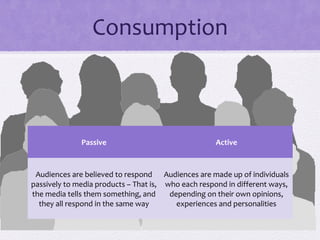
Consumption
Passive Active
Audiences are believed to respond
passively to media products – That is,
the media tells them something, and
they all respond in the same way
Audiences are made up of individuals
who each respond in different ways,
depending on their own opinions,
experiences and personalities
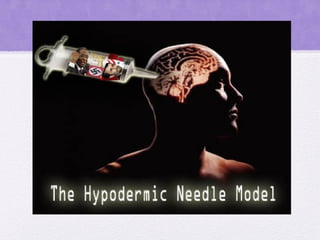
Hypodermic Needle
Model
The hypodermic syringe theory is that the media is like a
syringe which injects ideas, attitudes and beliefs into the
audience
• In some cases this may work, but the problem is that
people are affected in different ways by the media - films,
advertising, newspapers, television etc.
• The ‘audience’ are also now much more critically aware of
the media and having ideas ‘injected’ into them.
• However, this theory still has uses - i.e. watching violent
crimes can make you violent, for example the Jamie Bulger
killers, copycat crimes, the ‘Power Rangers’ fighting in play
grounds.
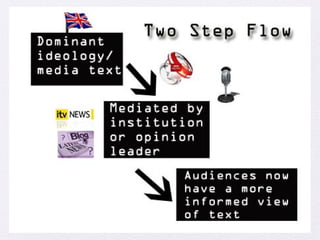
Two Step Flow
The two-step flow theory suggests:
• We are much more likely to be affected by the media if we
discuss it with others.
• Our opinions are affected by the way our friends etc have viewed
the media, i.e. discussions on Eastenders - Cat and Zoe, views on
documentaries etc.
• The people we discuss our ideas with are called ‘opinion
leaders’.
• This is another theory where the James Bulger case has been
cited - apparently one boy talked to his friend about a film he had
watched and apparently influenced the other’s behaviour.
Uses and Gratifications
Theory
According to uses and gratification theory we all have different uses for
the media and we make choices over what we want to watch. We are
expecting something from our use of the media.
1. Information - we may want to find out about society and the world. We
want to satisfy our curiosity.
2. Personal Identity - we may watch television for models for our
behaviour. For instance - we may identify with soap characters or
their situations.
3. Integration and Social Interaction - we use the media to find out more
about the circumstances of other people perhaps through empathy
or sympathy.
4. Entertainment - enjoyment, relaxation, fill the time.
CRITICISMS: You don’t always choose what media you use - you may be a
secondary or tertiary user. Your mum has the remote control! You have
no control over what posters you see on your way to work or college.
Audience Response
Models
Rachel Heyes
The Manchester College
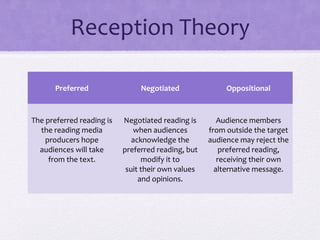
Reception Theory
Preferred Negotiated Oppositional
The preferred reading is
the reading media
producers hope
audiences will take
from the text.
Negotiated reading is
when audiences
acknowledge the
preferred reading, but
modify it to
suit their own values
and opinions.
Audience members
from outside the target
audience may reject the
preferred reading,
receiving their own
alternative message.

Audience response theories

  • 1.
  • 2.
    Consumption Passive Active Audiences arebelieved to respond passively to media products – That is, the media tells them something, and they all respond in the same way Audiences are made up of individuals who each respond in different ways, depending on their own opinions, experiences and personalities
  • 4.
    Hypodermic Needle Model The hypodermicsyringe theory is that the media is like a syringe which injects ideas, attitudes and beliefs into the audience • In some cases this may work, but the problem is that people are affected in different ways by the media - films, advertising, newspapers, television etc. • The ‘audience’ are also now much more critically aware of the media and having ideas ‘injected’ into them. • However, this theory still has uses - i.e. watching violent crimes can make you violent, for example the Jamie Bulger killers, copycat crimes, the ‘Power Rangers’ fighting in play grounds.
  • 6.
    Two Step Flow Thetwo-step flow theory suggests: • We are much more likely to be affected by the media if we discuss it with others. • Our opinions are affected by the way our friends etc have viewed the media, i.e. discussions on Eastenders - Cat and Zoe, views on documentaries etc. • The people we discuss our ideas with are called ‘opinion leaders’. • This is another theory where the James Bulger case has been cited - apparently one boy talked to his friend about a film he had watched and apparently influenced the other’s behaviour.
  • 8.
    Uses and Gratifications Theory Accordingto uses and gratification theory we all have different uses for the media and we make choices over what we want to watch. We are expecting something from our use of the media. 1. Information - we may want to find out about society and the world. We want to satisfy our curiosity. 2. Personal Identity - we may watch television for models for our behaviour. For instance - we may identify with soap characters or their situations. 3. Integration and Social Interaction - we use the media to find out more about the circumstances of other people perhaps through empathy or sympathy. 4. Entertainment - enjoyment, relaxation, fill the time. CRITICISMS: You don’t always choose what media you use - you may be a secondary or tertiary user. Your mum has the remote control! You have no control over what posters you see on your way to work or college.
  • 9.
  • 10.
    Reception Theory Preferred NegotiatedOppositional The preferred reading is the reading media producers hope audiences will take from the text. Negotiated reading is when audiences acknowledge the preferred reading, but modify it to suit their own values and opinions. Audience members from outside the target audience may reject the preferred reading, receiving their own alternative message.