Active and Passive audience 
theory. 
By Aziezatt Salisu
The Hypoermic Syringe Mode. 
The Passive Audience. 
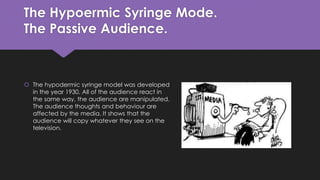
 The hypodermic syringe model was developed 
in the year 1930. All of the audience react in 
the same way, the audience are manipulated. 
The audience thoughts and behaviour are 
affected by the media. It shows that the 
audience will copy whatever they see on the 
television.
Uses And Gratifications Mode. 
 This theory suggests that media audience make active use of the media in order to fulfil 
their needs. 
 Blumler and Katz 1974 developed the uses and gratifications model to identify four needs 
which are escapism, information, social interaction, personal identification. These four 
needs were fulfilled by viewing television 
 Escapism/Entertainment is a from of escape from everyday pressure. A source of 
entertainment. 
 Information/Surveillance is information about what’s in the world. 
 Personal identity is comparing own life with characters and situations portrayed and to 
explore individual problems and perspectives. 
 Social interaction is sociability through discussion about TV with other people.
Reception Theory. 
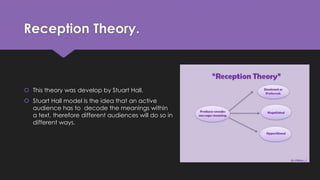
 This theory was develop by Stuart Hall. 
 Stuart Hall model Is the idea that an active 
audience has to decode the meanings within 
a text, therefore different audiences will do so in 
different ways.

Active and passive audience theory

  • 1.
    Active and Passiveaudience theory. By Aziezatt Salisu
  • 2.
    The Hypoermic SyringeMode. The Passive Audience.  The hypodermic syringe model was developed in the year 1930. All of the audience react in the same way, the audience are manipulated. The audience thoughts and behaviour are affected by the media. It shows that the audience will copy whatever they see on the television.
  • 3.
    Uses And GratificationsMode.  This theory suggests that media audience make active use of the media in order to fulfil their needs.  Blumler and Katz 1974 developed the uses and gratifications model to identify four needs which are escapism, information, social interaction, personal identification. These four needs were fulfilled by viewing television  Escapism/Entertainment is a from of escape from everyday pressure. A source of entertainment.  Information/Surveillance is information about what’s in the world.  Personal identity is comparing own life with characters and situations portrayed and to explore individual problems and perspectives.  Social interaction is sociability through discussion about TV with other people.
  • 4.
    Reception Theory. This theory was develop by Stuart Hall.  Stuart Hall model Is the idea that an active audience has to decode the meanings within a text, therefore different audiences will do so in different ways.