Audience Theory
Aim: to explore audience theory and apply to
 coursework in preparation for exam question
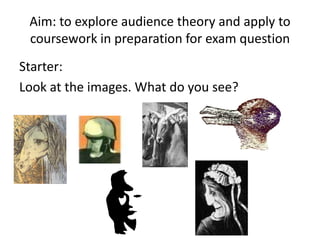
Starter:
Look at the images. What do you see?
Aim: to explore audience theory and apply to
 coursework in preparation for exam question

Do the producers influence the audience?
or
Does the audience influence the producers?
Aim: to explore audience theory and apply to
coursework in preparation for exam question

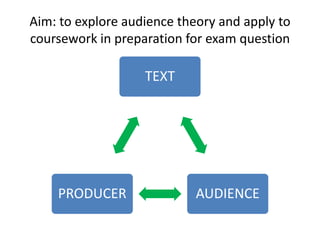
                   TEXT


    PRODUCER                AUDIENCE
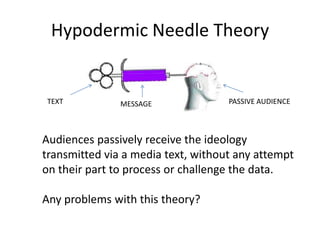
Hypodermic Needle Theory


TEXT           MESSAGE              PASSIVE AUDIENCE


Audiences passively receive the ideology
transmitted via a media text, without any attempt
on their part to process or challenge the data.

Any problems with this theory?
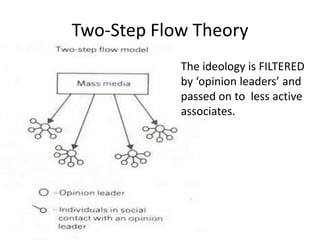
Two-Step Flow Theory
            The ideology is FILTERED
            by ‘opinion leaders’ and
            passed on to less active
            associates.
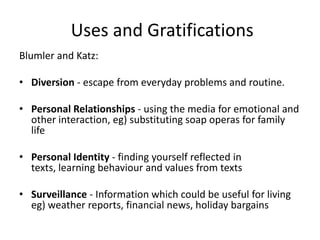
Uses and Gratifications
Blumler and Katz:

• Diversion - escape from everyday problems and routine.

• Personal Relationships - using the media for emotional and
  other interaction, eg) substituting soap operas for family
  life

• Personal Identity - finding yourself reflected in
  texts, learning behaviour and values from texts

• Surveillance - Information which could be useful for living
  eg) weather reports, financial news, holiday bargains
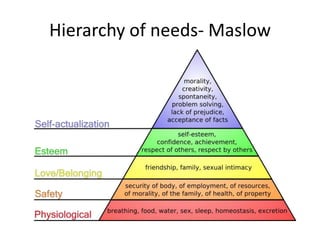
Hierarchy of needs- Maslow
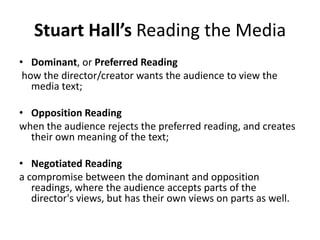
Stuart Hall’s Reading the Media
• Dominant, or Preferred Reading
 how the director/creator wants the audience to view the
   media text;

• Opposition Reading
when the audience rejects the preferred reading, and creates
  their own meaning of the text;

• Negotiated Reading
a compromise between the dominant and opposition
   readings, where the audience accepts parts of the
   director's views, but has their own views on parts as well.
Laura Mulvey’s Male Gaze
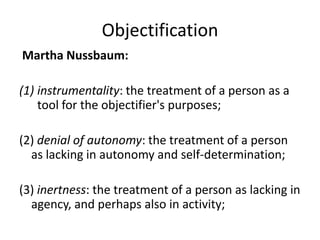
Objectification
Martha Nussbaum:

(1) instrumentality: the treatment of a person as a
    tool for the objectifier's purposes;

(2) denial of autonomy: the treatment of a person
  as lacking in autonomy and self-determination;

(3) inertness: the treatment of a person as lacking in
  agency, and perhaps also in activity;
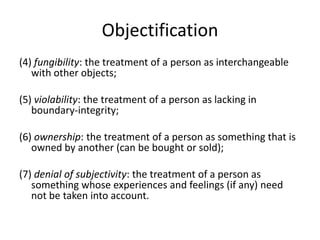
Objectification
(4) fungibility: the treatment of a person as interchangeable
   with other objects;

(5) violability: the treatment of a person as lacking in
   boundary-integrity;

(6) ownership: the treatment of a person as something that is
   owned by another (can be bought or sold);

(7) denial of subjectivity: the treatment of a person as
   something whose experiences and feelings (if any) need
   not be taken into account.
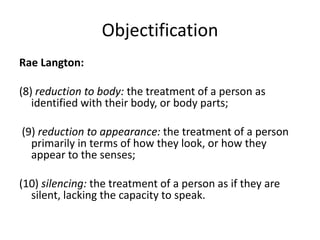
Objectification
Rae Langton:

(8) reduction to body: the treatment of a person as
   identified with their body, or body parts;

(9) reduction to appearance: the treatment of a person
  primarily in terms of how they look, or how they
  appear to the senses;

(10) silencing: the treatment of a person as if they are
  silent, lacking the capacity to speak.
Aim: to explore audience theory and apply to
 coursework in preparation for exam question
Other theories you might want to research:

Marxism
Postmodernism
Structuralism
Abercrombie and Langhurst-Hegemony
Richard Dyer- genre and escapism
Fandom

Audience theory 1

  • 1.
  • 2.
    Aim: to exploreaudience theory and apply to coursework in preparation for exam question Starter: Look at the images. What do you see?
  • 3.
    Aim: to exploreaudience theory and apply to coursework in preparation for exam question Do the producers influence the audience? or Does the audience influence the producers?
  • 4.
    Aim: to exploreaudience theory and apply to coursework in preparation for exam question TEXT PRODUCER AUDIENCE
  • 5.
    Hypodermic Needle Theory TEXT MESSAGE PASSIVE AUDIENCE Audiences passively receive the ideology transmitted via a media text, without any attempt on their part to process or challenge the data. Any problems with this theory?
  • 6.
    Two-Step Flow Theory The ideology is FILTERED by ‘opinion leaders’ and passed on to less active associates.
  • 7.
    Uses and Gratifications Blumlerand Katz: • Diversion - escape from everyday problems and routine. • Personal Relationships - using the media for emotional and other interaction, eg) substituting soap operas for family life • Personal Identity - finding yourself reflected in texts, learning behaviour and values from texts • Surveillance - Information which could be useful for living eg) weather reports, financial news, holiday bargains
  • 8.
  • 9.
    Stuart Hall’s Readingthe Media • Dominant, or Preferred Reading how the director/creator wants the audience to view the media text; • Opposition Reading when the audience rejects the preferred reading, and creates their own meaning of the text; • Negotiated Reading a compromise between the dominant and opposition readings, where the audience accepts parts of the director's views, but has their own views on parts as well.
  • 10.
  • 11.
    Objectification Martha Nussbaum: (1) instrumentality:the treatment of a person as a tool for the objectifier's purposes; (2) denial of autonomy: the treatment of a person as lacking in autonomy and self-determination; (3) inertness: the treatment of a person as lacking in agency, and perhaps also in activity;
  • 12.
    Objectification (4) fungibility: thetreatment of a person as interchangeable with other objects; (5) violability: the treatment of a person as lacking in boundary-integrity; (6) ownership: the treatment of a person as something that is owned by another (can be bought or sold); (7) denial of subjectivity: the treatment of a person as something whose experiences and feelings (if any) need not be taken into account.
  • 13.
    Objectification Rae Langton: (8) reductionto body: the treatment of a person as identified with their body, or body parts; (9) reduction to appearance: the treatment of a person primarily in terms of how they look, or how they appear to the senses; (10) silencing: the treatment of a person as if they are silent, lacking the capacity to speak.
  • 14.
    Aim: to exploreaudience theory and apply to coursework in preparation for exam question Other theories you might want to research: Marxism Postmodernism Structuralism Abercrombie and Langhurst-Hegemony Richard Dyer- genre and escapism Fandom