Audience
Amy Clout
The Purpose of our Teaser
Trailer
   The purpose of our teaser trailer was to make the
    audience want to come and see our film.
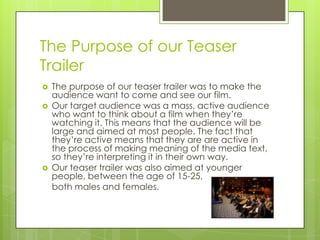
   Our target audience was a mass, active audience
    who want to think about a film when they’re
    watching it. This means that the audience will be
    large and aimed at most people. The fact that
    they’re active means that they are are active in
    the process of making meaning of the media text,
    so they’re interpreting it in their own way.
   Our teaser trailer was also aimed at younger
    people, between the age of 15-25,
    both males and females.
Active and Passive Audiences
   An active audience means that the audience is active in
    the process of making meaning of the media text, so they
    interpret it in their own way.
   A passive audience is a consumer who is vulnerable to the
    influence of media messages (they just watch it).
   Stuart Halls came up with a theory that the producers
    encode media text, meaning a media text has an
    intended meaning and the audience have to decode it,
    meaning they interpret its content and meaning in different
    ways, taking meanings from it that may or may not be the
    actual intended meaning.
   Therefore when a media text is being produced the creator
    or the producer will need to take into account weather or
    not their target audience is active or passive and what the
    intended meaning of the media text is.
The Intended Meaning
   The intended meaning of our teaser trailer was that a young girl was
    being followed and that she may be in some kind of danger
    because of a package. We wanted our teaser trailer to make
    people want to watch the whole film in the cinema.
   Stuart Halls readings:
•   Dominant reading: A dominant reading is where the audience
    agree with what the producer is intending.
•   Oppositional reading: This is where the audience don’t agree with
    what is being intended.
•   Negotiated reading: Where the audience come up with their own
    idea about what the producer is intending.
   The audience may interpret our teaser trailer in different ways and
    may come up with different ideas on what the package could be
    and why the man following the young girl could want it so badly,
    and how she even has the package in the first place. These different
    questions that are asked by the audience and the different ideas
    that they come up with are the things that will make them want to
    go and see the full film.
Conclusion
   To conclude I think there is many intended
    meanings in our teaser trailer and this is what
    makes the target audience want to go and
    see the film. There have been films similar to
    ours before so we know that this type of film
    appeals to younger people of both genres,
    however it can appeal to older people too.
   From our audience feedback we found that
    they did ask many questions about the plot
    and this could mean that they want these
    questions answered and therefore want to go
    and see the full film.

Audience powerpoint

  • 1.
  • 2.
    The Purpose ofour Teaser Trailer  The purpose of our teaser trailer was to make the audience want to come and see our film.  Our target audience was a mass, active audience who want to think about a film when they’re watching it. This means that the audience will be large and aimed at most people. The fact that they’re active means that they are are active in the process of making meaning of the media text, so they’re interpreting it in their own way.  Our teaser trailer was also aimed at younger people, between the age of 15-25, both males and females.
  • 3.
    Active and PassiveAudiences  An active audience means that the audience is active in the process of making meaning of the media text, so they interpret it in their own way.  A passive audience is a consumer who is vulnerable to the influence of media messages (they just watch it).  Stuart Halls came up with a theory that the producers encode media text, meaning a media text has an intended meaning and the audience have to decode it, meaning they interpret its content and meaning in different ways, taking meanings from it that may or may not be the actual intended meaning.  Therefore when a media text is being produced the creator or the producer will need to take into account weather or not their target audience is active or passive and what the intended meaning of the media text is.
  • 4.
    The Intended Meaning  The intended meaning of our teaser trailer was that a young girl was being followed and that she may be in some kind of danger because of a package. We wanted our teaser trailer to make people want to watch the whole film in the cinema.  Stuart Halls readings: • Dominant reading: A dominant reading is where the audience agree with what the producer is intending. • Oppositional reading: This is where the audience don’t agree with what is being intended. • Negotiated reading: Where the audience come up with their own idea about what the producer is intending.  The audience may interpret our teaser trailer in different ways and may come up with different ideas on what the package could be and why the man following the young girl could want it so badly, and how she even has the package in the first place. These different questions that are asked by the audience and the different ideas that they come up with are the things that will make them want to go and see the full film.
  • 5.
    Conclusion  To conclude I think there is many intended meanings in our teaser trailer and this is what makes the target audience want to go and see the film. There have been films similar to ours before so we know that this type of film appeals to younger people of both genres, however it can appeal to older people too.  From our audience feedback we found that they did ask many questions about the plot and this could mean that they want these questions answered and therefore want to go and see the full film.