AUDIENCE Robyn Marshall-Dawson
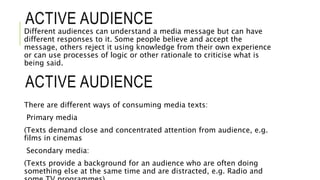
ACTIVE AUDIENCE
Different audiences can understand a media message but can have
different responses to it. Some people believe and accept the
message, others reject it using knowledge from their own experience
or can use processes of logic or other rationale to criticise what is
being said.
ACTIVE AUDIENCE
There are different ways of consuming media texts:
Primary media
(Texts demand close and concentrated attention from audience, e.g.
films in cinemas
Secondary media:
(Texts provide a background for an audience who are often doing
something else at the same time and are distracted, e.g. Radio and
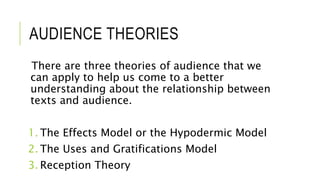
AUDIENCE THEORIES
There are three theories of audience that we
can apply to help us come to a better
understanding about the relationship between
texts and audience.
1. The Effects Model or the Hypodermic Model
2. The Uses and Gratifications Model
3. Reception Theory
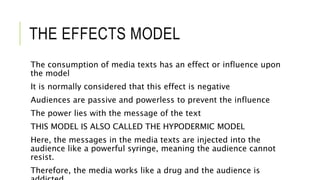
THE EFFECTS MODEL
The consumption of media texts has an effect or influence upon
the model
It is normally considered that this effect is negative
Audiences are passive and powerless to prevent the influence
The power lies with the message of the text
THIS MODEL IS ALSO CALLED THE HYPODERMIC MODEL
Here, the messages in the media texts are injected into the
audience like a powerful syringe, meaning the audience cannot
resist.
Therefore, the media works like a drug and the audience is
THE EFFECTS MODEL
Key evidence for the Effects Model
1. The Frankfurt school theorised in the 1920’s and 30’s that the
mass media acted to restrict and control audiences to the benefit
of corporate capitalism and governments.
2. The Bobo Doll Experiment:
This is a very controversial piece of research that apparently proved
that children copy violent behaviour. This is where children watched a
video where an adult violently attacked a toy clown, the children were
then taken to a room with attractive toys that they were not permitted
to touch. The children were then led to another room with Bobo Dolls.
88% of children imitated the behaviour that they had earlier viewed. 8
months later, 40% of the children reproduced the same violent
behaviour.
KEY EXAMPLES SITED AS CAUSING
OR BEING CONTRIBUTORY
FACTORS ARE:
The film Childs Play 3, was the cause of the
murder of James Bulger in 1993, as the young
children that committed the crime had recently
watched the film.
The game Manhunt in the murder of Stefan
Pakeerah in 2004 by his friend Warren LeBlanc.
The film A Clockwork Orange in a number of
rapes and violent attacks.
THE USES AND GRATIFICATIONS
MODEL
The yses and gratifications model is the opposite of the effects
model.
The audience is active.
The audiences uses the texts and is NOT used by it.
The audience uses the texts for their own gratification or pleasure.
Here, power lies with the audience NOT the producers.
This theory emphasises what audiences do with media texts - how
and why they use them.
Far from being addicted to the media, the audience is free to reject,
use or play with media meanings as they see fit.
THE USES AND GRATIFICATIONS
MODEL
Audiences therefore use media texts to gratify needs
for :
1. Diversion
2. Escapism
3. Information
4. Pleasure
5. Comparing relationships and lifestyles with ones
own
6. Sexual stimulation
THE USES AND GRATIFICATIONS
MODEL
The audience is in control and consumption of the media helps
people with issues such as:
1. Learning
2. Emotional satisfaction
3. Relaxation
4. Help with issues of personal identity
5. Help with issues of social identity
6. Help with issues of aggression and violence
RECEPTION THEORY
Given that the Effects Model and the Uses and Gratifications
have their problems and limitations a different approach to
audiences was developed by the academic Stuart Hall at
Birmingham University in the 1970’s.
This considered how texts were encoded with meaning by
producers and then decoded by the audience.
The theory suggests that:
When a producer constructs a text it is encoded with a meaning
or message that the producer wishes to convey to the audience
In some instances audiences will correctly decode the message
and understand what the producer was trying to say
In some instances the audience will either reject or fail to
RECEPTION THEORY
Stuart Hall identified three types of
audience readings of the text:
1.Dominant or preferred
2.Negotiated
3.Oppositional
DOMINANT
Where the audience
decodes the message as the
producer wants them to do
and broadly agrees with it
E.g. watching a political
speech and agreeing with it
NEGOTIATED
Where the audience accepts,
rejects or refines elements of the
text in light of previously held
views
E.g. neither agreeing or
disagreeing with the political
speech or being disinterested.
OPPOSITIONAL
Where the dominant meaning is
recognised but rejected for
cultural, political or ideological
reasons.
E.g. Total rejection of the political
speech and active opposition

Audience

  • 1.
  • 2.
    ACTIVE AUDIENCE Different audiencescan understand a media message but can have different responses to it. Some people believe and accept the message, others reject it using knowledge from their own experience or can use processes of logic or other rationale to criticise what is being said. ACTIVE AUDIENCE There are different ways of consuming media texts: Primary media (Texts demand close and concentrated attention from audience, e.g. films in cinemas Secondary media: (Texts provide a background for an audience who are often doing something else at the same time and are distracted, e.g. Radio and
  • 3.
    AUDIENCE THEORIES There arethree theories of audience that we can apply to help us come to a better understanding about the relationship between texts and audience. 1. The Effects Model or the Hypodermic Model 2. The Uses and Gratifications Model 3. Reception Theory
  • 4.
    THE EFFECTS MODEL Theconsumption of media texts has an effect or influence upon the model It is normally considered that this effect is negative Audiences are passive and powerless to prevent the influence The power lies with the message of the text THIS MODEL IS ALSO CALLED THE HYPODERMIC MODEL Here, the messages in the media texts are injected into the audience like a powerful syringe, meaning the audience cannot resist. Therefore, the media works like a drug and the audience is
  • 5.
    THE EFFECTS MODEL Keyevidence for the Effects Model 1. The Frankfurt school theorised in the 1920’s and 30’s that the mass media acted to restrict and control audiences to the benefit of corporate capitalism and governments. 2. The Bobo Doll Experiment: This is a very controversial piece of research that apparently proved that children copy violent behaviour. This is where children watched a video where an adult violently attacked a toy clown, the children were then taken to a room with attractive toys that they were not permitted to touch. The children were then led to another room with Bobo Dolls. 88% of children imitated the behaviour that they had earlier viewed. 8 months later, 40% of the children reproduced the same violent behaviour.
  • 6.
    KEY EXAMPLES SITEDAS CAUSING OR BEING CONTRIBUTORY FACTORS ARE: The film Childs Play 3, was the cause of the murder of James Bulger in 1993, as the young children that committed the crime had recently watched the film. The game Manhunt in the murder of Stefan Pakeerah in 2004 by his friend Warren LeBlanc. The film A Clockwork Orange in a number of rapes and violent attacks.
  • 7.
    THE USES ANDGRATIFICATIONS MODEL The yses and gratifications model is the opposite of the effects model. The audience is active. The audiences uses the texts and is NOT used by it. The audience uses the texts for their own gratification or pleasure. Here, power lies with the audience NOT the producers. This theory emphasises what audiences do with media texts - how and why they use them. Far from being addicted to the media, the audience is free to reject, use or play with media meanings as they see fit.
  • 8.
    THE USES ANDGRATIFICATIONS MODEL Audiences therefore use media texts to gratify needs for : 1. Diversion 2. Escapism 3. Information 4. Pleasure 5. Comparing relationships and lifestyles with ones own 6. Sexual stimulation
  • 9.
    THE USES ANDGRATIFICATIONS MODEL The audience is in control and consumption of the media helps people with issues such as: 1. Learning 2. Emotional satisfaction 3. Relaxation 4. Help with issues of personal identity 5. Help with issues of social identity 6. Help with issues of aggression and violence
  • 10.
    RECEPTION THEORY Given thatthe Effects Model and the Uses and Gratifications have their problems and limitations a different approach to audiences was developed by the academic Stuart Hall at Birmingham University in the 1970’s. This considered how texts were encoded with meaning by producers and then decoded by the audience. The theory suggests that: When a producer constructs a text it is encoded with a meaning or message that the producer wishes to convey to the audience In some instances audiences will correctly decode the message and understand what the producer was trying to say In some instances the audience will either reject or fail to
  • 11.
    RECEPTION THEORY Stuart Hallidentified three types of audience readings of the text: 1.Dominant or preferred 2.Negotiated 3.Oppositional
  • 12.
    DOMINANT Where the audience decodesthe message as the producer wants them to do and broadly agrees with it E.g. watching a political speech and agreeing with it
  • 13.
    NEGOTIATED Where the audienceaccepts, rejects or refines elements of the text in light of previously held views E.g. neither agreeing or disagreeing with the political speech or being disinterested.
  • 14.
    OPPOSITIONAL Where the dominantmeaning is recognised but rejected for cultural, political or ideological reasons. E.g. Total rejection of the political speech and active opposition