AUDIENCE MODELS   HOW AUDIENCE USE/INTERACT WITH MAGAZINES LESSON AIMS Understanding audience theory including passive and active audience models Application of knowledge through examples of how audiences actively/passively use a variety magazines
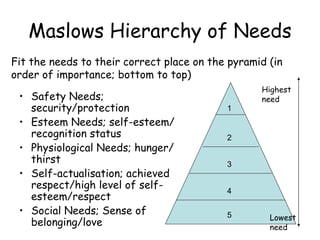
Maslows Hierarchy of Needs Safety Needs; security/protection Esteem Needs; self-esteem/recognition status Physiological Needs; hunger/thirst Self-actualisation; achieved respect/high level of self-esteem/respect Social Needs; Sense of belonging/love Fit the needs to their correct place on the pyramid (in order of importance; bottom to top) 1 2 3 4 5 Highest need Lowest need
Maslows Hierarchy of Needs An American psychologist,   Abraham Maslow , suggested that we all have different layers of needs. We have to achieve certain needs before going on to the next layer. Basically we all need to be able to eat and sleep in safety before we can go on to more complex social needs, such as getting married. His   Hierarchy of Needs   suggests that once people have their basic needs met like housing, food, safety, shopping, technology, and a job they can then go on to satisfy successively 'higher needs' that occupy a set hierarchy or system of rank In relationship to magazines  this can be linked to the idea that consuming particular media texts fulfils self-esteem, as does buying certain products.
Activity In a nutshell Maslow is suggesting that if you buy a new pair of trainers of the right brand as shown to you on in the media, then you will feel better about your self, because you have the respect of other people. Can you prove or disprove this theory from your experience? Draw a pyramid with five levels. Leave the spaces blank. Fill in each level with examples of media texts which attempt to fulfil that particular level of needs in Maslow’s pyramid. E.G. take the second from bottom layer – safety needs. An advertisement for car insurance or life insurance offers a general level of safety needs. Some cars are sold on their safety features – what does this tell us about the audience (people) who buy a car for these reasons?
Audience Research Primary  research is the direct investigation of the needs, desires and media habits of an audience. It involves contacting and talking directly to members of the target audience individually, on the phone, by email or questionnaire or in groups.
 
 Secondary  research looks at data and other research that has already been undertaken about the audience  ミ   today secondary research is very largely carried out on the internet, and by consulting books, magazines and journals. By consulting a wide range of opinions and sources a sound critical analysis can be constructed.
 
 Quantitative research  is about collecting facts and figures and other data to do with the size of the audience. This can be a breakdown of the number of people, including their gender, age and location, who make up an audience. TV audiences are measured in a quantitative way by BARB  ミ   Broadcasters ユ   Audience Research Board  www.barb.org.uk Qualitative research  is about investigating the reasons why audiences consume a particular text. Qualitative research is done through discussion and by setting up focus groups. Questionnaires can be constructed to establish audience preferences, opinions, tastes and desires, or to measure the success of a media text or product.
What effects do media texts have on audiences?   The relationship between audiences and media Passive & Active audience models Passive Audience – Hypodermic model Active Audience – Uses and gratification model (It Is important to remember that with the increase in New Media Technologies audiences are becoming more and more active)
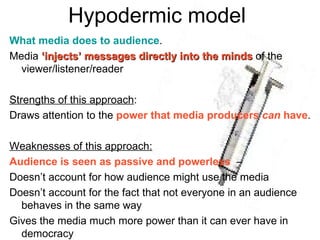
Hypodermic model  What media does to audience . Media  ‘injects’ messages directly into the minds  of the viewer/listener/reader Strengths of this approach : Draws attention to the  power that media producers  can  have . Weaknesses of this approach: Audience is seen as passive and powerless   –  Doesn’t account for how audience might use the media Doesn’t account for the fact that not everyone in an audience behaves in the same way  Gives the media much more power than it can ever have in democracy
Uses & gratification model  What the Audience does with the media . Takes into account people’s personalities and personal needs (stems back to Maslow) Strengths of this approach : Audience is active – they have ‘power’ and make ‘choices ’.  Life experience is more influential than experience of the media.  Pleasure that media gives is not negative. Weaknesses of this approach: Can  ignore the influence  that  media institutions  & ownership  might have on media texts .
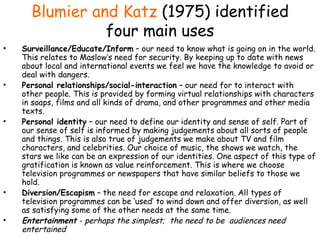
Blumier and Katz   (1975) identified four main uses Surveillance/Educate/Inform  – our need to know what is going on in the world.   This relates to Maslow’s need for security. By keeping up to date with news about local and international events we feel we have the knowledge to avoid or deal with dangers. Personal relationships/social-interaction  – our need for to interact with other people.   This is provided by forming virtual relationships with characters in soaps, films and all kinds of drama, and other programmes and other media texts. Personal identity  – our need to define our identity and sense of self.   Part of our sense of self is informed by making judgements about all sorts of people and things. This is also true of judgements we make about TV and film characters, and celebrities. Our choice of music, the shows we watch, the stars we like can be an expression of our identities. One aspect of this type of gratification is known as value reinforcement. This is where we choose television programmes or newspapers that have similar beliefs to those we hold. Diversion/Escapism  – the need for escape and relaxation.   All types of television programmes can be ‘used’ to wind down and offer diversion, as well as satisfying some of the other needs at the same time. Entertainment  - perhaps the simplest;  the need to be  audiences need entertained
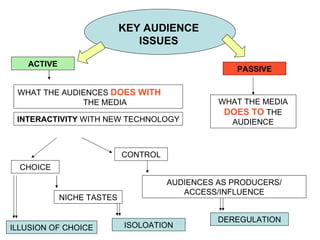
KEY AUDIENCE ISSUES CHOICE CONTROL INTERACTIVITY  WITH NEW TECHNOLOGY ACTIVE AUDIENCES AS PRODUCERS/ ACCESS/INFLUENCE NICHE TASTES PASSIVE ISOLOATION DEREGULATION ILLUSION OF CHOICE WHAT THE AUDIENCES  DOES WITH   THE MEDIA WHAT THE MEDIA  DOES TO  THE AUDIENCE
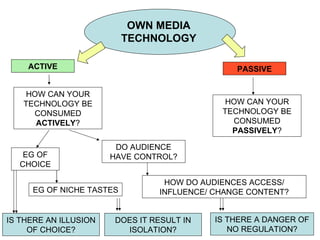
OWN MEDIA TECHNOLOGY EG OF CHOICE DO AUDIENCE HAVE CONTROL? ACTIVE HOW DO AUDIENCES ACCESS/ INFLUENCE/ CHANGE CONTENT? EG OF NICHE TASTES PASSIVE IS THERE A DANGER OF NO REGULATION? IS THERE AN ILLUSION OF CHOICE? HOW CAN YOUR TECHNOLOGY BE CONSUMED  ACTIVELY ? HOW CAN YOUR TECHNOLOGY BE CONSUMED  PASSIVELY ? DOES IT RESULT IN ISOLATION?

Audience Models

  • 1.
    AUDIENCE MODELS HOW AUDIENCE USE/INTERACT WITH MAGAZINES LESSON AIMS Understanding audience theory including passive and active audience models Application of knowledge through examples of how audiences actively/passively use a variety magazines
  • 2.
    Maslows Hierarchy ofNeeds Safety Needs; security/protection Esteem Needs; self-esteem/recognition status Physiological Needs; hunger/thirst Self-actualisation; achieved respect/high level of self-esteem/respect Social Needs; Sense of belonging/love Fit the needs to their correct place on the pyramid (in order of importance; bottom to top) 1 2 3 4 5 Highest need Lowest need
  • 3.
    Maslows Hierarchy ofNeeds An American psychologist, Abraham Maslow , suggested that we all have different layers of needs. We have to achieve certain needs before going on to the next layer. Basically we all need to be able to eat and sleep in safety before we can go on to more complex social needs, such as getting married. His Hierarchy of Needs suggests that once people have their basic needs met like housing, food, safety, shopping, technology, and a job they can then go on to satisfy successively 'higher needs' that occupy a set hierarchy or system of rank In relationship to magazines this can be linked to the idea that consuming particular media texts fulfils self-esteem, as does buying certain products.
  • 4.
    Activity In anutshell Maslow is suggesting that if you buy a new pair of trainers of the right brand as shown to you on in the media, then you will feel better about your self, because you have the respect of other people. Can you prove or disprove this theory from your experience? Draw a pyramid with five levels. Leave the spaces blank. Fill in each level with examples of media texts which attempt to fulfil that particular level of needs in Maslow’s pyramid. E.G. take the second from bottom layer – safety needs. An advertisement for car insurance or life insurance offers a general level of safety needs. Some cars are sold on their safety features – what does this tell us about the audience (people) who buy a car for these reasons?
  • 5.
    Audience Research Primary research is the direct investigation of the needs, desires and media habits of an audience. It involves contacting and talking directly to members of the target audience individually, on the phone, by email or questionnaire or in groups.
 
 Secondary research looks at data and other research that has already been undertaken about the audience ミ today secondary research is very largely carried out on the internet, and by consulting books, magazines and journals. By consulting a wide range of opinions and sources a sound critical analysis can be constructed.
 
 Quantitative research is about collecting facts and figures and other data to do with the size of the audience. This can be a breakdown of the number of people, including their gender, age and location, who make up an audience. TV audiences are measured in a quantitative way by BARB ミ Broadcasters ユ Audience Research Board www.barb.org.uk Qualitative research is about investigating the reasons why audiences consume a particular text. Qualitative research is done through discussion and by setting up focus groups. Questionnaires can be constructed to establish audience preferences, opinions, tastes and desires, or to measure the success of a media text or product.
  • 6.
    What effects domedia texts have on audiences? The relationship between audiences and media Passive & Active audience models Passive Audience – Hypodermic model Active Audience – Uses and gratification model (It Is important to remember that with the increase in New Media Technologies audiences are becoming more and more active)
  • 7.
    Hypodermic model What media does to audience . Media ‘injects’ messages directly into the minds of the viewer/listener/reader Strengths of this approach : Draws attention to the power that media producers can have . Weaknesses of this approach: Audience is seen as passive and powerless – Doesn’t account for how audience might use the media Doesn’t account for the fact that not everyone in an audience behaves in the same way Gives the media much more power than it can ever have in democracy
  • 8.
    Uses & gratificationmodel What the Audience does with the media . Takes into account people’s personalities and personal needs (stems back to Maslow) Strengths of this approach : Audience is active – they have ‘power’ and make ‘choices ’. Life experience is more influential than experience of the media. Pleasure that media gives is not negative. Weaknesses of this approach: Can ignore the influence that media institutions & ownership might have on media texts .
  • 9.
    Blumier and Katz (1975) identified four main uses Surveillance/Educate/Inform – our need to know what is going on in the world. This relates to Maslow’s need for security. By keeping up to date with news about local and international events we feel we have the knowledge to avoid or deal with dangers. Personal relationships/social-interaction – our need for to interact with other people. This is provided by forming virtual relationships with characters in soaps, films and all kinds of drama, and other programmes and other media texts. Personal identity – our need to define our identity and sense of self. Part of our sense of self is informed by making judgements about all sorts of people and things. This is also true of judgements we make about TV and film characters, and celebrities. Our choice of music, the shows we watch, the stars we like can be an expression of our identities. One aspect of this type of gratification is known as value reinforcement. This is where we choose television programmes or newspapers that have similar beliefs to those we hold. Diversion/Escapism – the need for escape and relaxation. All types of television programmes can be ‘used’ to wind down and offer diversion, as well as satisfying some of the other needs at the same time. Entertainment - perhaps the simplest; the need to be audiences need entertained
  • 10.
    KEY AUDIENCE ISSUESCHOICE CONTROL INTERACTIVITY WITH NEW TECHNOLOGY ACTIVE AUDIENCES AS PRODUCERS/ ACCESS/INFLUENCE NICHE TASTES PASSIVE ISOLOATION DEREGULATION ILLUSION OF CHOICE WHAT THE AUDIENCES DOES WITH THE MEDIA WHAT THE MEDIA DOES TO THE AUDIENCE
  • 11.
    OWN MEDIA TECHNOLOGYEG OF CHOICE DO AUDIENCE HAVE CONTROL? ACTIVE HOW DO AUDIENCES ACCESS/ INFLUENCE/ CHANGE CONTENT? EG OF NICHE TASTES PASSIVE IS THERE A DANGER OF NO REGULATION? IS THERE AN ILLUSION OF CHOICE? HOW CAN YOUR TECHNOLOGY BE CONSUMED ACTIVELY ? HOW CAN YOUR TECHNOLOGY BE CONSUMED PASSIVELY ? DOES IT RESULT IN ISOLATION?