AUDIENCE 
THEORIES 
By David K-Saka
Audience theories 
• There are 2 key theories and they can vary on whether they’re passive or active. In 
this post, I will analyse these theories, stating whether they’re passive or active. 
• The passive theories suggest that audiences can not resist the power of the media, 
and therefore soak up the empty promises of mass entertainment. Passive audiences 
tend to believe whatever is portrayed to them without questioning the events which 
have occurred. 
• However, active audience theories suggest that we use the media to gratify our 
needs. An active audience would question the media content and would not 
instantaneously believe the media text. 
By David K-Saka
Hypodermic Syringe Theory 
• The hypodermic needle theory insinuates that mass media can be consumed 
by the audience without any sort of reaction that would potentially dispute 
or disagree with the media. It also implies that the audience wouldn’t use the 
media to gratify their needs, which is basically them not gaining something 
specific out of the media. 
• In the 50’s governments delivered radio broadcasts to inform listeners of 
their intent and thoughts. The propaganda was believed by the audience 
without any questions, thus proving the theory has some foundation. 
By David K-Saka
Hypodermic Syringe Theory 
• The hypodermic needle theory uses the analogy of an injection from a needle taking 
in a substance to describe how audiences are influenced by the media, this 
‘substance’ being the media consumed. In this theory audiences are seen to be 
credulous as it states that as an audience we don’t question the media text in which 
we are consuming. 
• The ‘needle’ is introduced into the theory as it states that the media injects certain 
beliefs, images and values into audiences, so there is no longer individuality within 
society. Arguably the input of the media can be quite dangerous within society as 
the product can have a negative impact on audiences. 
By David K-Saka
Hypodermic Syringe Theory 
• The hypodermic needle is a passive theory, as the media text is believed by 
the audience without questioning it. It would be active if the audience 
challenged it and used it to gratify their needs, but they fail to do so, 
therefore showing that this theory is passive. 
• Based on this theory, after the audience has watched our trailer, would 
believe that individuals with super-powers lived amongst us and that the 
villain is capable of defeating the hero. Which could scare the audience 
immensely going by this theory. They would believe what they have 
consumed without questioning the trailer. 
By David K-Saka
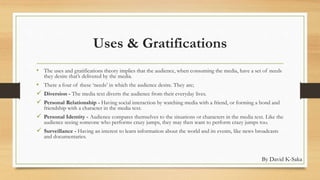
Uses & Gratifications 
• The uses and gratifications theory implies that the audience, when consuming the media, have a set of needs 
they desire that’s delivered by the media. 
• There a four of these ‘needs’ in which the audience desire. They are; 
 Diversion - The media text diverts the audience from their everyday lives. 
 Personal Relationship - Having social interaction by watching media with a friend, or forming a bond and 
friendship with a character in the media text. 
 Personal Identity - Audience compares themselves to the situations or characters in the media text. Like the 
audience seeing someone who performs crazy jumps, they may then want to perform crazy jumps too. 
 Surveillance - Having an interest to learn information about the world and its events, like news broadcasts 
and documentaries. 
By David K-Saka
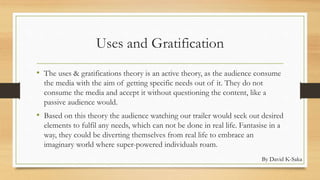
Uses and Gratification 
• The uses & gratifications theory is an active theory, as the audience consume 
the media with the aim of getting specific needs out of it. They do not 
consume the media and accept it without questioning the content, like a 
passive audience would. 
• Based on this theory the audience watching our trailer would seek out desired 
elements to fulfil any needs, which can not be done in real life. Fantasise in a 
way, they could be diverting themselves from real life to embrace an 
imaginary world where super-powered individuals roam. 
By David K-Saka

Audience theories

  • 1.
  • 2.
    Audience theories •There are 2 key theories and they can vary on whether they’re passive or active. In this post, I will analyse these theories, stating whether they’re passive or active. • The passive theories suggest that audiences can not resist the power of the media, and therefore soak up the empty promises of mass entertainment. Passive audiences tend to believe whatever is portrayed to them without questioning the events which have occurred. • However, active audience theories suggest that we use the media to gratify our needs. An active audience would question the media content and would not instantaneously believe the media text. By David K-Saka
  • 3.
    Hypodermic Syringe Theory • The hypodermic needle theory insinuates that mass media can be consumed by the audience without any sort of reaction that would potentially dispute or disagree with the media. It also implies that the audience wouldn’t use the media to gratify their needs, which is basically them not gaining something specific out of the media. • In the 50’s governments delivered radio broadcasts to inform listeners of their intent and thoughts. The propaganda was believed by the audience without any questions, thus proving the theory has some foundation. By David K-Saka
  • 4.
    Hypodermic Syringe Theory • The hypodermic needle theory uses the analogy of an injection from a needle taking in a substance to describe how audiences are influenced by the media, this ‘substance’ being the media consumed. In this theory audiences are seen to be credulous as it states that as an audience we don’t question the media text in which we are consuming. • The ‘needle’ is introduced into the theory as it states that the media injects certain beliefs, images and values into audiences, so there is no longer individuality within society. Arguably the input of the media can be quite dangerous within society as the product can have a negative impact on audiences. By David K-Saka
  • 5.
    Hypodermic Syringe Theory • The hypodermic needle is a passive theory, as the media text is believed by the audience without questioning it. It would be active if the audience challenged it and used it to gratify their needs, but they fail to do so, therefore showing that this theory is passive. • Based on this theory, after the audience has watched our trailer, would believe that individuals with super-powers lived amongst us and that the villain is capable of defeating the hero. Which could scare the audience immensely going by this theory. They would believe what they have consumed without questioning the trailer. By David K-Saka
  • 6.
    Uses & Gratifications • The uses and gratifications theory implies that the audience, when consuming the media, have a set of needs they desire that’s delivered by the media. • There a four of these ‘needs’ in which the audience desire. They are;  Diversion - The media text diverts the audience from their everyday lives.  Personal Relationship - Having social interaction by watching media with a friend, or forming a bond and friendship with a character in the media text.  Personal Identity - Audience compares themselves to the situations or characters in the media text. Like the audience seeing someone who performs crazy jumps, they may then want to perform crazy jumps too.  Surveillance - Having an interest to learn information about the world and its events, like news broadcasts and documentaries. By David K-Saka
  • 7.
    Uses and Gratification • The uses & gratifications theory is an active theory, as the audience consume the media with the aim of getting specific needs out of it. They do not consume the media and accept it without questioning the content, like a passive audience would. • Based on this theory the audience watching our trailer would seek out desired elements to fulfil any needs, which can not be done in real life. Fantasise in a way, they could be diverting themselves from real life to embrace an imaginary world where super-powered individuals roam. By David K-Saka