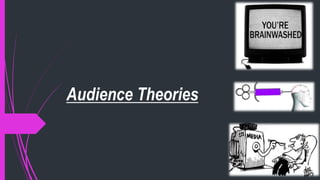
Audience Theories
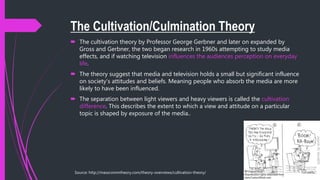
The Cultivation/Culmination Theory
 The cultivation theory by Professor George Gerbner and later on expanded by
Gross and Gerbner, the two began research in 1960s attempting to study media
effects, and if watching television influences the audiences perception on everyday
life.
 The theory suggest that media and television holds a small but significant influence
on society’s attitudes and beliefs. Meaning people who absorb the media are more
likely to have been influenced.
 The separation between light viewers and heavy viewers is called the cultivation
difference. This describes the extent to which a view and attitude on a particular
topic is shaped by exposure of the media..
Source: http://masscommtheory.com/theory-overviews/cultivation-theory/
The Two Step Flow
 The theory was introduced by Paul Lazarsfeld, Bernard Berelson and Hzel Gaudet, the theory was later
developed by Katz and Lazarsfeld.
 The study focused on the 1940s Presidential election Campaign and the people’s decision making towards
the campaign. They found the media messages (radio and newspapers) are less influential than informal,
personal communication on voting behaviour.
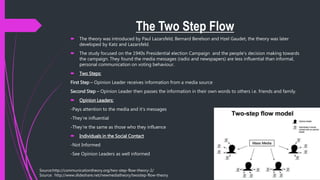
 Two Steps:
First Step – Opinion Leader receives information from a media source
Second Step – Opinion Leader then passes the information in their own words to others i.e. friends and family.
 Opinion Leaders:
-Pays attention to the media and it’s messages
-They’re influential
-They’re the same as those who they influence
 Individuals in the Social Contact
-Not Informed
-See Opinion Leaders as well informed
Source:http://communicationtheory.org/two-step-flow-theory-2/
Source: http://www.slideshare.net/newmediatheory/twostep-flow-theory
Hypodermic Needle Model
(The Magic Bullet Theory)
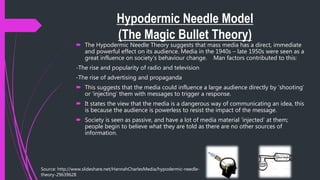
 The Hypodermic Needle Theory suggests that mass media has a direct, immediate
and powerful effect on its audience. Media in the 1940s – late 1950s were seen as a
great influence on society’s behaviour change. Man factors contributed to this:
-The rise and popularity of radio and television
-The rise of advertising and propaganda
 This suggests that the media could influence a large audience directly by ‘shooting’
or ‘injecting’ them with messages to trigger a response.
 It states the view that the media is a dangerous way of communicating an idea, this
is because the audience is powerless to resist the impact of the message.
 Society is seen as passive, and have a lot of media material ‘injected’ at them;
people begin to believe what they are told as there are no other sources of
information.
Source: http://www.slideshare.net/HannahCharlesMedia/hypodermic-needle-
theory-29639628
Reception Theory
 The audience themselves create the meaning of a text, each will interoperate a
piece of text differently as a result of their way of living and experiences they’ve
had.
 The Reception theory has found certain factor such as gender, class, and the time
in which the text is read can impact on the meaning the piece of media has. The
makers of the piece of media would have encoded the text with their own
experience, however the audience may see this in a different way.
 Stuart Hall identified three ways in which an audience reads a message:
1. Dominant – How the maker wants the audience to see the piece of media.
2. Negotiated - The audience accepts parts of the makers views.
3. Oppositional – The audience rejects the creators view and had their own meaning.
Mass Audience Theory
 There is one problem with the mass audience theory. The problem is that the
theory relies on the assumptions of the people reviewing the mass audience.
 The passive theory implies that the audience can not fight the power of the media.
A passive audience does not question what is shown to them, therefore causing
them to believe stories in the media.
 The active audience theory implies that the audience use the media to satisfy their
beliefs, meaning an active audience would not automatically believe a piece of
media text.

Audience theories

  • 1.
  • 2.
    The Cultivation/Culmination Theory The cultivation theory by Professor George Gerbner and later on expanded by Gross and Gerbner, the two began research in 1960s attempting to study media effects, and if watching television influences the audiences perception on everyday life.  The theory suggest that media and television holds a small but significant influence on society’s attitudes and beliefs. Meaning people who absorb the media are more likely to have been influenced.  The separation between light viewers and heavy viewers is called the cultivation difference. This describes the extent to which a view and attitude on a particular topic is shaped by exposure of the media.. Source: http://masscommtheory.com/theory-overviews/cultivation-theory/
  • 3.
    The Two StepFlow  The theory was introduced by Paul Lazarsfeld, Bernard Berelson and Hzel Gaudet, the theory was later developed by Katz and Lazarsfeld.  The study focused on the 1940s Presidential election Campaign and the people’s decision making towards the campaign. They found the media messages (radio and newspapers) are less influential than informal, personal communication on voting behaviour.  Two Steps: First Step – Opinion Leader receives information from a media source Second Step – Opinion Leader then passes the information in their own words to others i.e. friends and family.  Opinion Leaders: -Pays attention to the media and it’s messages -They’re influential -They’re the same as those who they influence  Individuals in the Social Contact -Not Informed -See Opinion Leaders as well informed Source:http://communicationtheory.org/two-step-flow-theory-2/ Source: http://www.slideshare.net/newmediatheory/twostep-flow-theory
  • 4.
    Hypodermic Needle Model (TheMagic Bullet Theory)  The Hypodermic Needle Theory suggests that mass media has a direct, immediate and powerful effect on its audience. Media in the 1940s – late 1950s were seen as a great influence on society’s behaviour change. Man factors contributed to this: -The rise and popularity of radio and television -The rise of advertising and propaganda  This suggests that the media could influence a large audience directly by ‘shooting’ or ‘injecting’ them with messages to trigger a response.  It states the view that the media is a dangerous way of communicating an idea, this is because the audience is powerless to resist the impact of the message.  Society is seen as passive, and have a lot of media material ‘injected’ at them; people begin to believe what they are told as there are no other sources of information. Source: http://www.slideshare.net/HannahCharlesMedia/hypodermic-needle- theory-29639628
  • 5.
    Reception Theory  Theaudience themselves create the meaning of a text, each will interoperate a piece of text differently as a result of their way of living and experiences they’ve had.  The Reception theory has found certain factor such as gender, class, and the time in which the text is read can impact on the meaning the piece of media has. The makers of the piece of media would have encoded the text with their own experience, however the audience may see this in a different way.  Stuart Hall identified three ways in which an audience reads a message: 1. Dominant – How the maker wants the audience to see the piece of media. 2. Negotiated - The audience accepts parts of the makers views. 3. Oppositional – The audience rejects the creators view and had their own meaning.
  • 6.
    Mass Audience Theory There is one problem with the mass audience theory. The problem is that the theory relies on the assumptions of the people reviewing the mass audience.  The passive theory implies that the audience can not fight the power of the media. A passive audience does not question what is shown to them, therefore causing them to believe stories in the media.  The active audience theory implies that the audience use the media to satisfy their beliefs, meaning an active audience would not automatically believe a piece of media text.