AUDIENCE INVESTIGATION

What is audience?
A group of people, large or small, that consume media texts. They can differ in a number of
ways so these groups may consist of subgroups and we categorise audiences in sub groups.

All media texts are made with an audience in mind. i.e. the people who will receive it make
sense out of it. Groups of people are categorized by their demographics and psycho-dynamics.
Audience Theorists
   The Hypodermic Needle Model
    Dated from the 1920's, the model was the first attempt to
    explain how mass audiences might react to mass media.
    It suggests that audiences passively receive information via a
    media text without any attempt to challenge the text,
    accepting these dominant ideologies as the norm. The model
    proposed that the information from a text passes into
    the consciousness of the audience unmediated.
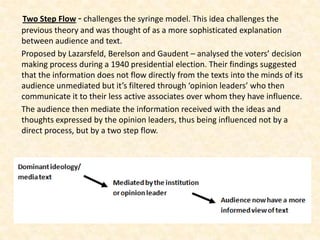
Two Step Flow - challenges the syringe model. This idea challenges the
previous theory and was thought of as a more sophisticated explanation
between audience and text.
Proposed by Lazarsfeld, Berelson and Gaudent – analysed the voters’ decision
making process during a 1940 presidential election. Their findings suggested
that the information does not flow directly from the texts into the minds of its
audience unmediated but it’s filtered through ‘opinion leaders’ who then
communicate it to their less active associates over whom they have influence.
The audience then mediate the information received with the ideas and
thoughts expressed by the opinion leaders, thus being influenced not by a
direct process, but by a two step flow.
Uses and Gratification Theory
  Researchers Blulmer and Katz 1974 expanded the theory Laswell has
  propsed in 1948 suggesting that media texts had several functions for
  individuals and society. They publised their own and stated that
  individuals use media texts in different ways and for different reasons:

• Diversion - method of escapism from reality and everyday life.
• Personal Relationships - using media for emotional and other
  interaction.
• Personal Identity - finding yourself reflected in media texts.
• Surveillance - source of information which could be useful.


  Reception theory
  research was conducted on how individuals received and
  interpreted a media text. Finding suggested that it depended on
  demographics and psychographics.
The hypodermic syringe model can be linked to the genre of
horror as a common belief amongst many people was that
audiences watching horror films would be encouraged to carry
out such violence that they were being portrayed to, influencing
the consumer.
However this idea has drawn many counter arguments against it,
as it is not possible to suggest that every individual who watches
horror films will become a serial killer and take example from the
characters in the film.

Audience

  • 1.
    AUDIENCE INVESTIGATION What isaudience? A group of people, large or small, that consume media texts. They can differ in a number of ways so these groups may consist of subgroups and we categorise audiences in sub groups. All media texts are made with an audience in mind. i.e. the people who will receive it make sense out of it. Groups of people are categorized by their demographics and psycho-dynamics.
  • 2.
    Audience Theorists The Hypodermic Needle Model Dated from the 1920's, the model was the first attempt to explain how mass audiences might react to mass media. It suggests that audiences passively receive information via a media text without any attempt to challenge the text, accepting these dominant ideologies as the norm. The model proposed that the information from a text passes into the consciousness of the audience unmediated.
  • 3.
    Two Step Flow- challenges the syringe model. This idea challenges the previous theory and was thought of as a more sophisticated explanation between audience and text. Proposed by Lazarsfeld, Berelson and Gaudent – analysed the voters’ decision making process during a 1940 presidential election. Their findings suggested that the information does not flow directly from the texts into the minds of its audience unmediated but it’s filtered through ‘opinion leaders’ who then communicate it to their less active associates over whom they have influence. The audience then mediate the information received with the ideas and thoughts expressed by the opinion leaders, thus being influenced not by a direct process, but by a two step flow.
  • 4.
    Uses and GratificationTheory Researchers Blulmer and Katz 1974 expanded the theory Laswell has propsed in 1948 suggesting that media texts had several functions for individuals and society. They publised their own and stated that individuals use media texts in different ways and for different reasons: • Diversion - method of escapism from reality and everyday life. • Personal Relationships - using media for emotional and other interaction. • Personal Identity - finding yourself reflected in media texts. • Surveillance - source of information which could be useful. Reception theory research was conducted on how individuals received and interpreted a media text. Finding suggested that it depended on demographics and psychographics.
  • 5.
    The hypodermic syringemodel can be linked to the genre of horror as a common belief amongst many people was that audiences watching horror films would be encouraged to carry out such violence that they were being portrayed to, influencing the consumer. However this idea has drawn many counter arguments against it, as it is not possible to suggest that every individual who watches horror films will become a serial killer and take example from the characters in the film.