Audience
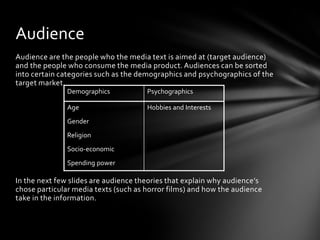
Audience are the people who the media text is aimed at (target audience)
and the people who consume the media product. Audiences can be sorted
into certain categories such as the demographics and psychographics of the
target market.
               Demographics           Psychographics

               Age                    Hobbies and Interests
               Gender
               Religion
               Socio-economic
               Spending power

In the next few slides are audience theories that explain why audience’s
chose particular media texts (such as horror films) and how the audience
take in the information.
Uses and Gratification
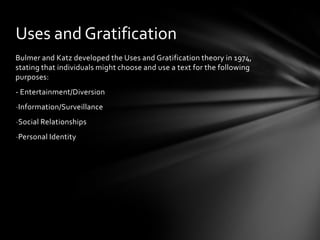
Bulmer and Katz developed the Uses and Gratification theory in 1974,
stating that individuals might choose and use a text for the following
purposes:
- Entertainment/Diversion
-Information/Surveillance
-Social Relationships
-Personal Identity
Hypodermic Syringe Model
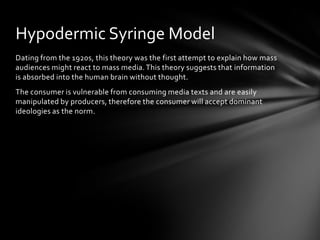
Dating from the 1920s, this theory was the first attempt to explain how mass
audiences might react to mass media. This theory suggests that information
is absorbed into the human brain without thought.
The consumer is vulnerable from consuming media texts and are easily
manipulated by producers, therefore the consumer will accept dominant
ideologies as the norm.
Two Step Flow
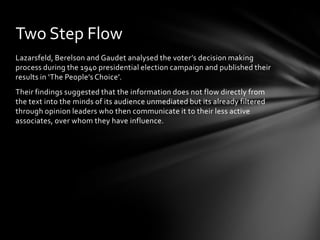
Lazarsfeld, Berelson and Gaudet analysed the voter’s decision making
process during the 1940 presidential election campaign and published their
results in ‘The People’s Choice’.
Their findings suggested that the information does not flow directly from
the text into the minds of its audience unmediated but its already filtered
through opinion leaders who then communicate it to their less active
associates, over whom they have influence.
Reception Theory
Thirty years ago research was conducted on how individuals receive and
interpret a media text, and whether their individual circumstances (age,
gender, class) affected their reading.
Stuart Hall addressed this concluding that audiences take on their own
theories of a media text as people are all different hand have different
ideologies.
These audience theories can be relatable to the horror genre.
This can include many people believing that from the
hypodermic syringe model, this can influence the consumer to
then commit these crimes. This perception has led to the
banning of films such as The Exorcist in the past.
 However studies have argued this theory claiming that by
viewing horror films it allows us to gain the feeling of the
crimes without having to commit it which therefore satisfies
the consumer. It also allows the consumer to share the
experience with others and gain a sense of empathy.

Audience investigation

  • 1.
    Audience Audience are thepeople who the media text is aimed at (target audience) and the people who consume the media product. Audiences can be sorted into certain categories such as the demographics and psychographics of the target market. Demographics Psychographics Age Hobbies and Interests Gender Religion Socio-economic Spending power In the next few slides are audience theories that explain why audience’s chose particular media texts (such as horror films) and how the audience take in the information.
  • 2.
    Uses and Gratification Bulmerand Katz developed the Uses and Gratification theory in 1974, stating that individuals might choose and use a text for the following purposes: - Entertainment/Diversion -Information/Surveillance -Social Relationships -Personal Identity
  • 3.
    Hypodermic Syringe Model Datingfrom the 1920s, this theory was the first attempt to explain how mass audiences might react to mass media. This theory suggests that information is absorbed into the human brain without thought. The consumer is vulnerable from consuming media texts and are easily manipulated by producers, therefore the consumer will accept dominant ideologies as the norm.
  • 4.
    Two Step Flow Lazarsfeld,Berelson and Gaudet analysed the voter’s decision making process during the 1940 presidential election campaign and published their results in ‘The People’s Choice’. Their findings suggested that the information does not flow directly from the text into the minds of its audience unmediated but its already filtered through opinion leaders who then communicate it to their less active associates, over whom they have influence.
  • 5.
    Reception Theory Thirty yearsago research was conducted on how individuals receive and interpret a media text, and whether their individual circumstances (age, gender, class) affected their reading. Stuart Hall addressed this concluding that audiences take on their own theories of a media text as people are all different hand have different ideologies.
  • 6.
    These audience theoriescan be relatable to the horror genre. This can include many people believing that from the hypodermic syringe model, this can influence the consumer to then commit these crimes. This perception has led to the banning of films such as The Exorcist in the past. However studies have argued this theory claiming that by viewing horror films it allows us to gain the feeling of the crimes without having to commit it which therefore satisfies the consumer. It also allows the consumer to share the experience with others and gain a sense of empathy.