two-step flow theory
History:
It was first introduced in 1948 by Paul Lazarsfeld and Elihu Katz, after research on the process of decision-making during
a Presidential election campaign. Before their study, it was assumed that mass media have a direct influence on audience’s
decisions and behaviours. Surprisingly, they found that interpersonal interaction has a stronger effect on shaping public
opinion than mass media. Factors such as interpersonal communication with family members, friends, and social circle
members came out to be better predictor of a person’s voting behaviour.
Concept:
Mass media plays an important role in formation of public opinion on various issues. However, the messages conveyed by
the media are always mediated by the opinion leaders. As Katz and Lazarsfeld said, ‘Ideas flow from radio and print
media to opinion leaders and from them to less active sections of the population.’ For instance, village level workers or
panchayat leaders are opinion leaders in rural areas. Heads of committees and associations are opinion leaders in urban
areas. They interpret the messages of media to their groups.
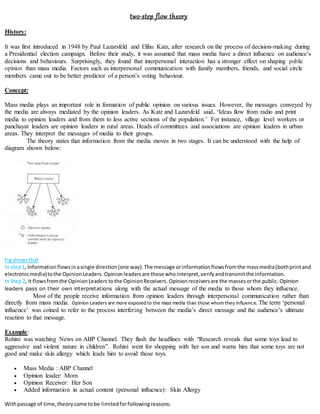
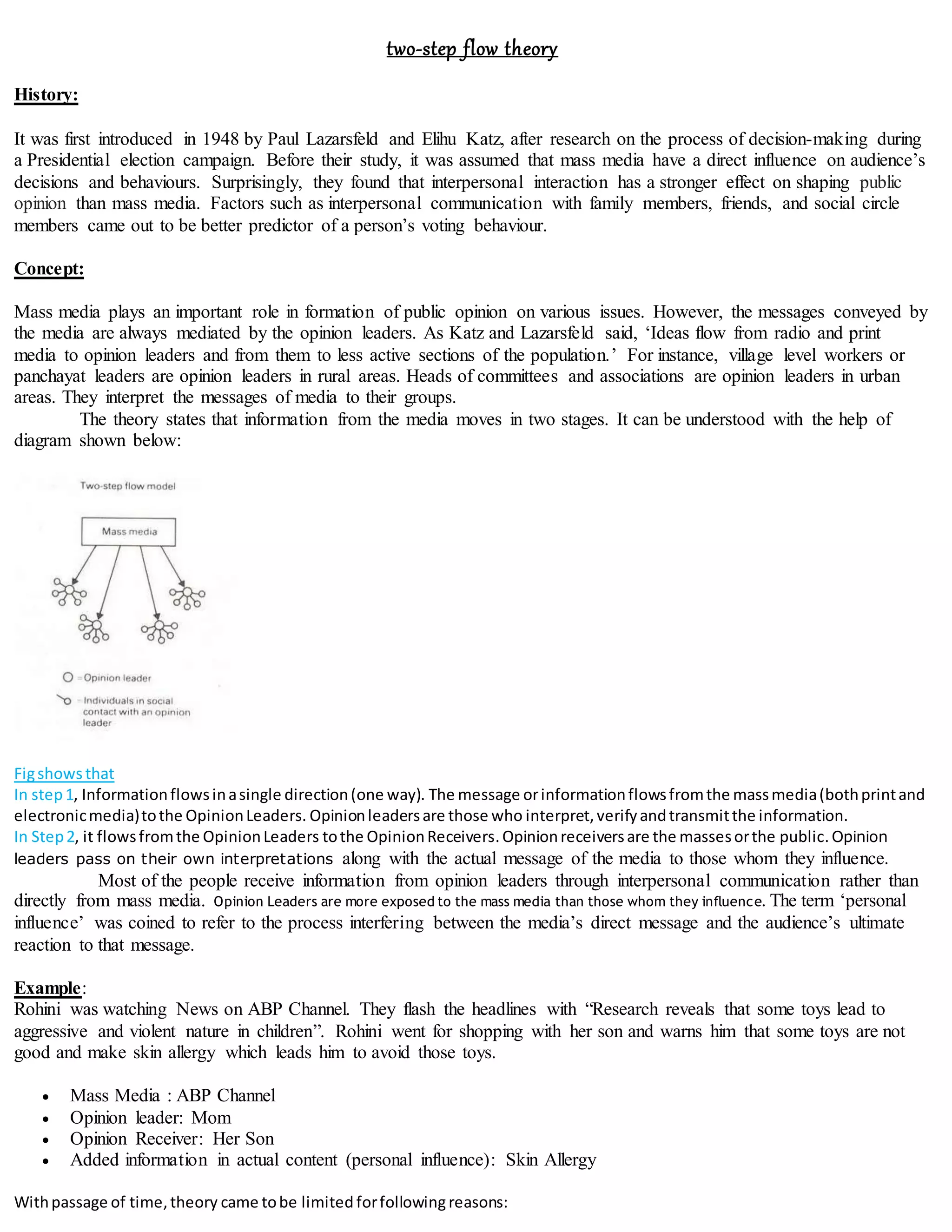
The theory states that information from the media moves in two stages. It can be understood with the help of
diagram shown below:
Figshows that
In step1, Informationflowsinasingle direction(one way). The message orinformationflowsfromthe massmedia(bothprintand
electronicmedia)tothe OpinionLeaders. Opinionleadersare those who interpret,verifyandtransmitthe information.
In Step2, it flowsfromthe OpinionLeaders tothe OpinionReceivers.Opinionreceiversare the massesorthe public.Opinion
leaders pass on their own interpretations along with the actual message of the media to those whom they influence.
Most of the people receive information from opinion leaders through interpersonal communication rather than
directly from mass media. Opinion Leaders are more exposed to the mass media than those whom they influence. The term ‘personal
influence’ was coined to refer to the process interfering between the media’s direct message and the audience’s ultimate
reaction to that message.
Example:
Rohini was watching News on ABP Channel. They flash the headlines with “Research reveals that some toys lead to
aggressive and violent nature in children”. Rohini went for shopping with her son and warns him that some toys are not
good and make skin allergy which leads him to avoid those toys.
 Mass Media : ABP Channel
 Opinion leader: Mom
 Opinion Receiver: Her Son
 Added information in actual content (personal influence): Skin Allergy
Withpassage of time,theory came tobe limitedforfollowingreasons:
 Diminishes the original direct influence of mass media.
 The theory was formulated during a time when television and the Internet did not exist.
 Not every receiver has same effect of the message transmitted by mass media.
 Opinionleadersare selective inprovidinginformation.Theymightgive wrongornoinformationtothe public.
 As perthe theory,informationflowisone-wayfromthe opinionleadertoopinionreceivers.Inreality,informationdoesnot
flowone way;bothpartiesexchange information.Also,communicationneednotalwaysbe forwardone -way,initiatedbythe
opinionleader.Itcouldalsobe initiatedbythe masseswhoaskthe “leader”forinformationandadvice.
Conclusion: The theoryistwo-steppedinthe sense thatitpresentsOpinionLeadersasdirectrecipientsof informationfromthe
Mass Media,and thenthey forward thisinformationtothe general public withtheirpersonalinterpretation.
Communication experts came out with a conclusion that human behaviour and thoughts are not changed by just merely
getting the message. It takes much time. This process is very slow. It’s transmitted by the opinion leader. Therefore,
researchers of mass communication can’t treat public as a homogenous mass audience that actively processes and
responds to media messages uniformly. This theory has improved our understanding of how the mass media influence
decision making.

Two step flow theory

  • 1.
    two-step flow theory History: Itwas first introduced in 1948 by Paul Lazarsfeld and Elihu Katz, after research on the process of decision-making during a Presidential election campaign. Before their study, it was assumed that mass media have a direct influence on audience’s decisions and behaviours. Surprisingly, they found that interpersonal interaction has a stronger effect on shaping public opinion than mass media. Factors such as interpersonal communication with family members, friends, and social circle members came out to be better predictor of a person’s voting behaviour. Concept: Mass media plays an important role in formation of public opinion on various issues. However, the messages conveyed by the media are always mediated by the opinion leaders. As Katz and Lazarsfeld said, ‘Ideas flow from radio and print media to opinion leaders and from them to less active sections of the population.’ For instance, village level workers or panchayat leaders are opinion leaders in rural areas. Heads of committees and associations are opinion leaders in urban areas. They interpret the messages of media to their groups. The theory states that information from the media moves in two stages. It can be understood with the help of diagram shown below: Figshows that In step1, Informationflowsinasingle direction(one way). The message orinformationflowsfromthe massmedia(bothprintand electronicmedia)tothe OpinionLeaders. Opinionleadersare those who interpret,verifyandtransmitthe information. In Step2, it flowsfromthe OpinionLeaders tothe OpinionReceivers.Opinionreceiversare the massesorthe public.Opinion leaders pass on their own interpretations along with the actual message of the media to those whom they influence. Most of the people receive information from opinion leaders through interpersonal communication rather than directly from mass media. Opinion Leaders are more exposed to the mass media than those whom they influence. The term ‘personal influence’ was coined to refer to the process interfering between the media’s direct message and the audience’s ultimate reaction to that message. Example: Rohini was watching News on ABP Channel. They flash the headlines with “Research reveals that some toys lead to aggressive and violent nature in children”. Rohini went for shopping with her son and warns him that some toys are not good and make skin allergy which leads him to avoid those toys.  Mass Media : ABP Channel  Opinion leader: Mom  Opinion Receiver: Her Son  Added information in actual content (personal influence): Skin Allergy Withpassage of time,theory came tobe limitedforfollowingreasons:
  • 2.
     Diminishes theoriginal direct influence of mass media.  The theory was formulated during a time when television and the Internet did not exist.  Not every receiver has same effect of the message transmitted by mass media.  Opinionleadersare selective inprovidinginformation.Theymightgive wrongornoinformationtothe public.  As perthe theory,informationflowisone-wayfromthe opinionleadertoopinionreceivers.Inreality,informationdoesnot flowone way;bothpartiesexchange information.Also,communicationneednotalwaysbe forwardone -way,initiatedbythe opinionleader.Itcouldalsobe initiatedbythe masseswhoaskthe “leader”forinformationandadvice. Conclusion: The theoryistwo-steppedinthe sense thatitpresentsOpinionLeadersasdirectrecipientsof informationfromthe Mass Media,and thenthey forward thisinformationtothe general public withtheirpersonalinterpretation. Communication experts came out with a conclusion that human behaviour and thoughts are not changed by just merely getting the message. It takes much time. This process is very slow. It’s transmitted by the opinion leader. Therefore, researchers of mass communication can’t treat public as a homogenous mass audience that actively processes and responds to media messages uniformly. This theory has improved our understanding of how the mass media influence decision making.