Conservation practices and produce food safety
in California
Rob Atwill, D.V.M., Ph.D.
University of California-Davis
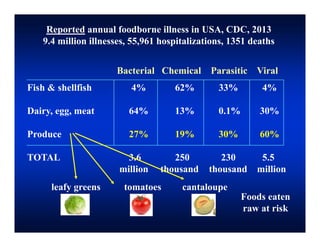
Reported annual foodborne illness in USA, CDC, 2013
9.4 million illnesses, 55,961 hospitalizations, 1351 deaths
Bacterial Chemical Parasitic Viral
Fish & shellfish 4% 62% 33% 4%
Dairy, egg, meat 64% 13% 0.1% 30%
Produce 27% 19% 30% 60%
TOTAL 3.6 250 230 5.5
million thousand thousand million
Reported annual foodborne illness in USA, CDC, 2013
9.4 million illnesses, 55,961 hospitalizations, 1351 deaths
Bacterial Chemical Parasitic Viral
Fish & shellfish 4% 62% 33% 4%
Dairy, egg, meat 64% 13% 0.1% 30%
Produce 27% 19% 30% 60%
TOTAL 3.6 250 230 5.5
million thousand thousand million
leafy greens tomatoes cantaloupe
Foods eaten
raw at risk
Fall 2006 spinach outbreak of E. coli O157:H7
Product originated from a field in San Benito County, CA
Outbreak in
late Aug to early September
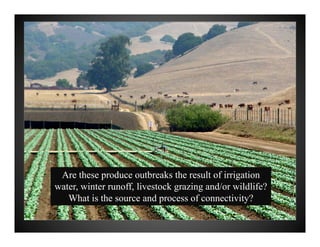
Are these produce outbreaks the result of irrigation
water, winter runoff, livestock grazing and/or wildlife?
What is the source and process of connectivity?
Microbiological safety of irrigation water
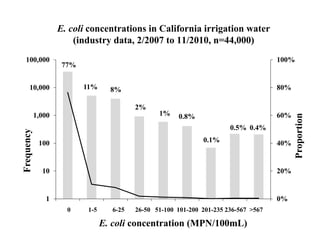
E. coli concentrations in California irrigation water
(industry data, 2/2007 to 11/2010, n=44,000)
77%
11% 8%
2%
1% 0.8%
0.1%
0.5% 0.4%
0%
20%
40%
60%
80%
100%
1
10
100
1,000
10,000
100,000
Proportion
Frequency
E. coli concentration (MPN/100mL)
0 1-5 6-25 26-50 51-100 101-200 201-235 236-567 >567
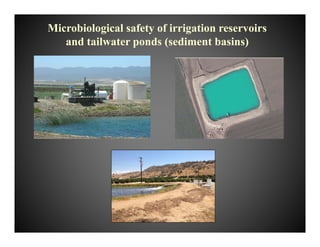
Microbiological safety of irrigation reservoirs
and tailwater ponds (sediment basins)
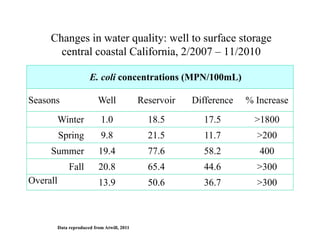
E. coli concentrations (MPN/100mL)
Seasons Well Reservoir Difference % Increase
Winter 1.0 18.5 17.5 >1800
Spring 9.8 21.5 11.7 >200
Summer 19.4 77.6 58.2 400
Fall 20.8 65.4 44.6 >300
Overall 13.9 50.6 36.7 >300
Changes in water quality: well to surface storage
central coastal California, 2/2007 – 11/2010
Data reproduced from Atwill, 2011
9
Fencing to exclude fecal deposition by terrestrial wildlife
Chemical treatments
Dewater in fall, dry out the sediments
Removal
Other ideas
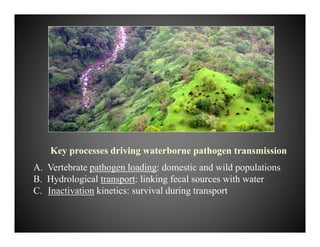
Key processes driving waterborne pathogen transmission
A. Vertebrate pathogen loading: domestic and wild populations
B. Hydrological transport: linking fecal sources with water
C. Inactivation kinetics: survival during transport
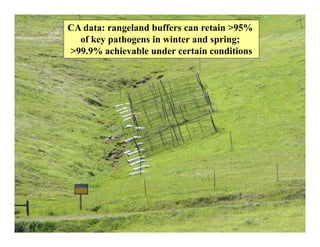
CA data: rangeland buffers can retain >95%
of key pathogens in winter and spring;
>99.9% achievable under certain conditions
Herd pos n prev (%)
A 0 489 0.0
B 7 480 1.5
C 0 200 0.0
D 44 434 10.1
E 0 61 0.0
F 6 386 1.6
G 2 271 0.7
H 9 256 3.5
Total 68 2715 2.5
Cow-calf herds, central coastal CA, 2008-2010
E. coli O157 infection ranged from 0% to 10%
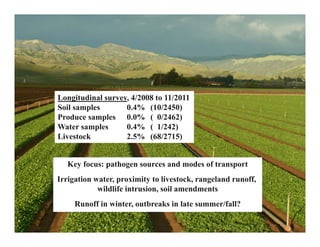
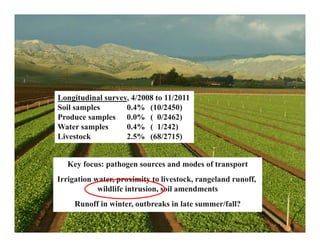
Key focus: pathogen sources and modes of transport
Irrigation water, proximity to livestock, rangeland runoff,
wildlife intrusion, soil amendments
Runoff in winter, outbreaks in late summer/fall?
Longitudinal survey, 4/2008 to 11/2011
Soil samples 0.4% (10/2450)
Produce samples 0.0% ( 0/2462)
Water samples 0.4% ( 1/242)
Livestock 2.5% (68/2715)
Key focus: pathogen sources and modes of transport
Irrigation water, proximity to livestock, rangeland runoff,
wildlife intrusion, soil amendments
Runoff in winter, outbreaks in late summer/fall?
Longitudinal survey, 4/2008 to 11/2011
Soil samples 0.4% (10/2450)
Produce samples 0.0% ( 0/2462)
Water samples 0.4% ( 1/242)
Livestock 2.5% (68/2715)
E. coli O157:H7, 2008-10
Feral pig 10/200 (5%)
Coyote 2/95 (2%)
Am. crow 5/93 (5%)
Cowbird 2/60 (3%)
Rabbit 0/108 (0%)
Skunk 0/63 (0%)
Blackbird 0/112 (0%)
Raccoon 0/28 (0%)
Beef cattle 68/2715 (2.5%)
Clarify sources of Ec O157
and we can better design:
• fencing style
• modify specific habitat
• target specific wildlife
E. coli O157:H7 in wildlife
and cattle
Rodent species Cryptosporidium Giardia
CA parasitic mouse 11% 13%
Deer mouse 33% 27%
Dusky-footed wood rat 17% 17%
TOTAL 28% 25%
Prevalence of pathogens in wild rodents in
produce production fields, central California
Preliminary data: Crypto appears human infectious, Giardia mostly not
E. coli O157:H7 2/1,043 (0.2%)
Salmonella 30/1,043 (2.9%)
When wildlife congregate
then food safety risks are magnified
Randomized field trials of romaine lettuce
Salinas Valley, 2011 & 2012
scat
BED BED
FURROW
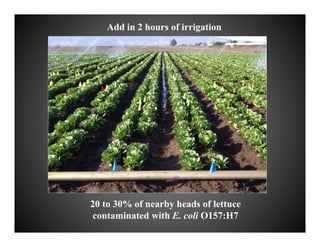
20 to 30% of nearby heads of lettuce
contaminated with E. coli O157:H7
Add in 2 hours of irrigation
0
1
100
10,000
1,000,000
10 15 20 25
Distance between lettuce and scat (inches)
E.coliO157:H7/headlettuce E. coli O157:H7 per head of Romaine lettuce
10
100
1,000
10,000
100,000
0 10 20 30 40 50 60 70 80
Age of scat (hrs) prior to irrigation
E.coliO157:H7/headlettuce E. coli O157:H7 per head of Romaine lettuce
Animal intrusion <24 hrs prior
Drip irrigation versus overhead sprinkler
regarding fecal splash
Exclude wildlife by fencing, trapping
and habitat modification,
dust abatement
Vegetative or Bare Ground Buffers
• Bare ground may reduce food and cover for some rodents.
• Con: eliminates pathogen reduction benefits of vegetation.
• Con: causes soil erosion & sedimentation.
• Con: degrades water quality & aquatic habitat.
Daniel Mountjoy, NRCS
Vegetative Conservation Practice in Question:
Grassed Waterways
• Pro: Convey runoff without
causing erosion or flooding.
• Pro: Reduce gulley erosion.
• Pro: Protect and improve water
quality.
• Pro: Can be mowed and
maintained to discourage rodents.
• Con: Considered by some as
possible cover for rodents or
amphibians (foreign object
concern).
Daniel Mountjoy, NRCS
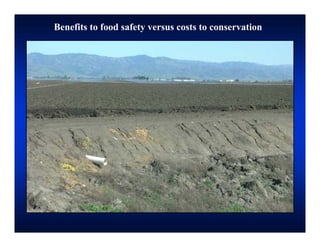
Benefits to food safety versus costs to conservation
Questions?

Atwill solutions to new challenges

  • 1.
    Conservation practices andproduce food safety in California Rob Atwill, D.V.M., Ph.D. University of California-Davis
  • 2.
    Reported annual foodborneillness in USA, CDC, 2013 9.4 million illnesses, 55,961 hospitalizations, 1351 deaths Bacterial Chemical Parasitic Viral Fish & shellfish 4% 62% 33% 4% Dairy, egg, meat 64% 13% 0.1% 30% Produce 27% 19% 30% 60% TOTAL 3.6 250 230 5.5 million thousand thousand million
  • 3.
    Reported annual foodborneillness in USA, CDC, 2013 9.4 million illnesses, 55,961 hospitalizations, 1351 deaths Bacterial Chemical Parasitic Viral Fish & shellfish 4% 62% 33% 4% Dairy, egg, meat 64% 13% 0.1% 30% Produce 27% 19% 30% 60% TOTAL 3.6 250 230 5.5 million thousand thousand million leafy greens tomatoes cantaloupe Foods eaten raw at risk
  • 4.
    Fall 2006 spinachoutbreak of E. coli O157:H7 Product originated from a field in San Benito County, CA Outbreak in late Aug to early September
  • 5.
    Are these produceoutbreaks the result of irrigation water, winter runoff, livestock grazing and/or wildlife? What is the source and process of connectivity?
  • 6.
    Microbiological safety ofirrigation water
  • 7.
    E. coli concentrationsin California irrigation water (industry data, 2/2007 to 11/2010, n=44,000) 77% 11% 8% 2% 1% 0.8% 0.1% 0.5% 0.4% 0% 20% 40% 60% 80% 100% 1 10 100 1,000 10,000 100,000 Proportion Frequency E. coli concentration (MPN/100mL) 0 1-5 6-25 26-50 51-100 101-200 201-235 236-567 >567
  • 8.
    Microbiological safety ofirrigation reservoirs and tailwater ponds (sediment basins)
  • 9.
    E. coli concentrations(MPN/100mL) Seasons Well Reservoir Difference % Increase Winter 1.0 18.5 17.5 >1800 Spring 9.8 21.5 11.7 >200 Summer 19.4 77.6 58.2 400 Fall 20.8 65.4 44.6 >300 Overall 13.9 50.6 36.7 >300 Changes in water quality: well to surface storage central coastal California, 2/2007 – 11/2010 Data reproduced from Atwill, 2011 9
  • 10.
    Fencing to excludefecal deposition by terrestrial wildlife Chemical treatments Dewater in fall, dry out the sediments Removal Other ideas
  • 11.
    Key processes drivingwaterborne pathogen transmission A. Vertebrate pathogen loading: domestic and wild populations B. Hydrological transport: linking fecal sources with water C. Inactivation kinetics: survival during transport
  • 12.
    CA data: rangelandbuffers can retain >95% of key pathogens in winter and spring; >99.9% achievable under certain conditions
  • 13.
    Herd pos nprev (%) A 0 489 0.0 B 7 480 1.5 C 0 200 0.0 D 44 434 10.1 E 0 61 0.0 F 6 386 1.6 G 2 271 0.7 H 9 256 3.5 Total 68 2715 2.5 Cow-calf herds, central coastal CA, 2008-2010 E. coli O157 infection ranged from 0% to 10%
  • 14.
    Key focus: pathogensources and modes of transport Irrigation water, proximity to livestock, rangeland runoff, wildlife intrusion, soil amendments Runoff in winter, outbreaks in late summer/fall? Longitudinal survey, 4/2008 to 11/2011 Soil samples 0.4% (10/2450) Produce samples 0.0% ( 0/2462) Water samples 0.4% ( 1/242) Livestock 2.5% (68/2715)
  • 15.
    Key focus: pathogensources and modes of transport Irrigation water, proximity to livestock, rangeland runoff, wildlife intrusion, soil amendments Runoff in winter, outbreaks in late summer/fall? Longitudinal survey, 4/2008 to 11/2011 Soil samples 0.4% (10/2450) Produce samples 0.0% ( 0/2462) Water samples 0.4% ( 1/242) Livestock 2.5% (68/2715)
  • 16.
    E. coli O157:H7,2008-10 Feral pig 10/200 (5%) Coyote 2/95 (2%) Am. crow 5/93 (5%) Cowbird 2/60 (3%) Rabbit 0/108 (0%) Skunk 0/63 (0%) Blackbird 0/112 (0%) Raccoon 0/28 (0%) Beef cattle 68/2715 (2.5%) Clarify sources of Ec O157 and we can better design: • fencing style • modify specific habitat • target specific wildlife E. coli O157:H7 in wildlife and cattle
  • 17.
    Rodent species CryptosporidiumGiardia CA parasitic mouse 11% 13% Deer mouse 33% 27% Dusky-footed wood rat 17% 17% TOTAL 28% 25% Prevalence of pathogens in wild rodents in produce production fields, central California Preliminary data: Crypto appears human infectious, Giardia mostly not E. coli O157:H7 2/1,043 (0.2%) Salmonella 30/1,043 (2.9%)
  • 18.
    When wildlife congregate thenfood safety risks are magnified
  • 19.
    Randomized field trialsof romaine lettuce Salinas Valley, 2011 & 2012
  • 20.
  • 21.
    20 to 30%of nearby heads of lettuce contaminated with E. coli O157:H7 Add in 2 hours of irrigation
  • 22.
    0 1 100 10,000 1,000,000 10 15 2025 Distance between lettuce and scat (inches) E.coliO157:H7/headlettuce E. coli O157:H7 per head of Romaine lettuce
  • 23.
    10 100 1,000 10,000 100,000 0 10 2030 40 50 60 70 80 Age of scat (hrs) prior to irrigation E.coliO157:H7/headlettuce E. coli O157:H7 per head of Romaine lettuce Animal intrusion <24 hrs prior
  • 24.
    Drip irrigation versusoverhead sprinkler regarding fecal splash
  • 25.
    Exclude wildlife byfencing, trapping and habitat modification, dust abatement
  • 26.
    Vegetative or BareGround Buffers • Bare ground may reduce food and cover for some rodents. • Con: eliminates pathogen reduction benefits of vegetation. • Con: causes soil erosion & sedimentation. • Con: degrades water quality & aquatic habitat. Daniel Mountjoy, NRCS
  • 27.
    Vegetative Conservation Practicein Question: Grassed Waterways • Pro: Convey runoff without causing erosion or flooding. • Pro: Reduce gulley erosion. • Pro: Protect and improve water quality. • Pro: Can be mowed and maintained to discourage rodents. • Con: Considered by some as possible cover for rodents or amphibians (foreign object concern). Daniel Mountjoy, NRCS
  • 28.
    Benefits to foodsafety versus costs to conservation
  • 29.