Antibiotic-resistant
Bacteria along the Qi-Shan river
SPEAKER CHENG-HAN LIU ADVISOR HANS-UWE DAHMS DATE SEP. 25TH, 2019
Antibiotics
2
A type of antibacterial medicine
To prevent/ treat bacterial infections
Bactericidal: killing bacteria
Bacteriostatic: inhibiting bacterial growth
Penicillin Tetracycline
Kümmerer 2009 a,b
Antibiotic resistance / ABR
3
Antibiotics emerge in environment
Antibiotics kill environmental bacteria
Resistant bacteria survive from antibiotics
Resistant bacteria thrive and spread
Kümmerer 2009 a,b
Ability to resist antibiotics
4
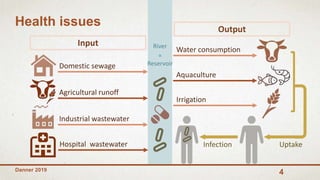
Health issues
River
Domestic sewage
Agricultural runoff
Industrial wastewater
Hospital wastewater
Input
Output
Water consumption
Aquaculture
Irrigation
Infection Uptake
Danner 2019
=
Reservoir
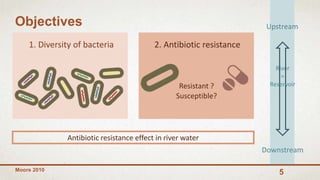
2. Antibiotic resistance
5
Objectives
1. Diversity of bacteria
Antibiotic resistance effect in river water
Moore 2010
Upstream
Downstream
Resistant ?
Susceptible?
River
=
Reservoir
Qi-Shan river / 旗山溪
6
Main tributary of the Kao-Ping river
Agriculture irrigation & drainage
楊萬全, 1997
Source of Nan-Hua reservoir
Importance in health issue
1
2
3
4
5
6
7
8
7
22°47'35.5"N 120°27'46.9"E
23°17'17.2"N 120°43'12.0"E
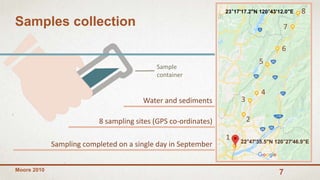
Samples collection
Sampling completed on a single day in September
Sample
container
8 sampling sites (GPS co-ordinates)
Water and sediments
Moore 2010
Bacterial identification
8
Flow chart
Bacterial isolation
Antibiotic resistance test
Methods & materials
9
Bacterial isolation
Spread plate Quadrant streak
Colony
forming
unit
Agar plate
Spreader
Inoculation loop
Tryptic soy agar
Nutrient agar
LB agar
Samples processed within 48hrs
Plates incubated at 20°C for 48hrs
100μl inoculated; dilution: 100-10-2
Sprute 2019
Agar plate
Phylogenetic tree: Evolutionary
relationships among species
Patel 2001 10
Bacterial identification
Methods & materials
Inoculation
Culture
DNA extraction
Isolated DNA
PCR
PCR amplicon
16S rRNA
Universal
Variable
Evolving at constant rate
Multi-copy gene
DNA extraction: Proteinase K
Sanger sequencing
(1-2*108 Colony forming units/mL)
Bacteria conc.: OD600 of 0.06
11
Antibiotic resistance test
Disk diffusion
Methods & materials
Inhibition zone
Inoculation
Culture
Plates incubated at 35°C for 24hrs
Swab streak back-and-forth
Minimum inhibitory concentrationAntibiotics
Erythromycin
Gentamicin
Vancomycin
Ciprofloxacin
Amoxicillin
Tetracycline
Trimethoprim
Ceftriaxone
Müller-Hinton agar
Hudzicki 2009
2. Antibiotic resistance
X: Distance from river source
Y: Bacterial resistance
DownstreamUpstream
12
Expected results
1. Diversity of bacteria
• Possible isolated species
• Possibly diverse in downstream
Antibiotic resistance of bacterial populations in the Qi-Shan river
Moore 2010 Ayandiran 2014
Enterobacter spp.
Enterococcus spp.
Staphylococcus aureus
Pseudomonas spp.
Bacillus spp.
Escherichia coli
Upstream
Downstream
1
8
1. Diversity of bacteria
13
Discussion
Naturally intrinsic ABR
Acquired ABR in pathogens
Acquired ABR from exposure
2. Antibiotic resistance
Resistant ?
Susceptible?
Upstream
Downstream
Moore 2010
Ubiquitous
Likely transferring resistance gene
Pathogenic
14
Discussion
Diversity of ABR bacteria
Enterobacter spp.
Enterococcus spp.
Staphylococcus aureus
Pseudomonas spp.
Bacillus spp.
Escherichia coli
Which species to test for resistance ?
Common in polluted waters
Considerations:
Kümmerer, K., 2009. Antibiotics in the aquatic environment–a review–part I. Chemosphere, 75(4), pp.417-434.
Kümmerer, K., 2009. Antibiotics in the aquatic environment–a review–part II. Chemosphere, 75(4), pp.435-441.
Moore, J.E., Moore, P.J., Millar, B.C., Goldsmith, C.E., Loughrey, A., Rooney, P.J. and Rao, J.R., 2010. The
presence of antibiotic resistant bacteria along the River Lagan. Agricultural Water Management, 98(1),
pp.217-221.
楊萬全, 1997. 高屏溪流域和屏東平原的水資源. 國立臺灣師範大學地理研究報告.
Danner, M.C., Robertson, A., Behrends, V. and Reiss, J., 2019. Antibiotic pollution in surface fresh waters:
occurrence and effects. Science of the Total Environment , 664, pp.793-804.
Sprute, J., 2019. Streaking Agar Plates: 4 Quadrant Streak Method. [online] Microbiology learning: The "why"
ology of microbial testing. Available at: https://microbiologylearning.weebly.com/streaking-agar-plates-4-
quadrant-streak-method.html
Patel, J.B., 2001. 16S rRNA gene sequencing for bacterial pathogen identification in the clinical
laboratory. Molecular Diagnosis, 6(4), pp.313-321.
Hudzicki, J., 2009. Kirby-Bauer disk diffusion susceptibility test protocol [manual].
Ayandiran, T.A., Ayandele, A.A., Dahunsi, S.O. and Ajala, O.O., 2014. Microbial assessment and prevalence of
antibiotic resistance in polluted Oluwa River, Nigeria. The Egyptian Journal of Aquatic Research, 40(3),
pp.291-299.
References
Thank you for attention
SPEAKER CHENG-HAN LIU ADVISOR HANS-UWE DAHMS DATE SEP. 25TH, 2019
Q & A

Antibiotic-resistant Bacteria along the Qi-Shan river

  • 1.
    Antibiotic-resistant Bacteria along theQi-Shan river SPEAKER CHENG-HAN LIU ADVISOR HANS-UWE DAHMS DATE SEP. 25TH, 2019
  • 2.
    Antibiotics 2 A type ofantibacterial medicine To prevent/ treat bacterial infections Bactericidal: killing bacteria Bacteriostatic: inhibiting bacterial growth Penicillin Tetracycline Kümmerer 2009 a,b
  • 3.
    Antibiotic resistance /ABR 3 Antibiotics emerge in environment Antibiotics kill environmental bacteria Resistant bacteria survive from antibiotics Resistant bacteria thrive and spread Kümmerer 2009 a,b Ability to resist antibiotics
  • 4.
    4 Health issues River Domestic sewage Agriculturalrunoff Industrial wastewater Hospital wastewater Input Output Water consumption Aquaculture Irrigation Infection Uptake Danner 2019 = Reservoir
  • 5.
    2. Antibiotic resistance 5 Objectives 1.Diversity of bacteria Antibiotic resistance effect in river water Moore 2010 Upstream Downstream Resistant ? Susceptible? River = Reservoir
  • 6.
    Qi-Shan river /旗山溪 6 Main tributary of the Kao-Ping river Agriculture irrigation & drainage 楊萬全, 1997 Source of Nan-Hua reservoir Importance in health issue
  • 7.
    1 2 3 4 5 6 7 8 7 22°47'35.5"N 120°27'46.9"E 23°17'17.2"N 120°43'12.0"E Samplescollection Sampling completed on a single day in September Sample container 8 sampling sites (GPS co-ordinates) Water and sediments Moore 2010
  • 8.
    Bacterial identification 8 Flow chart Bacterialisolation Antibiotic resistance test
  • 9.
    Methods & materials 9 Bacterialisolation Spread plate Quadrant streak Colony forming unit Agar plate Spreader Inoculation loop Tryptic soy agar Nutrient agar LB agar Samples processed within 48hrs Plates incubated at 20°C for 48hrs 100μl inoculated; dilution: 100-10-2 Sprute 2019 Agar plate
  • 10.
    Phylogenetic tree: Evolutionary relationshipsamong species Patel 2001 10 Bacterial identification Methods & materials Inoculation Culture DNA extraction Isolated DNA PCR PCR amplicon 16S rRNA Universal Variable Evolving at constant rate Multi-copy gene DNA extraction: Proteinase K Sanger sequencing
  • 11.
    (1-2*108 Colony formingunits/mL) Bacteria conc.: OD600 of 0.06 11 Antibiotic resistance test Disk diffusion Methods & materials Inhibition zone Inoculation Culture Plates incubated at 35°C for 24hrs Swab streak back-and-forth Minimum inhibitory concentrationAntibiotics Erythromycin Gentamicin Vancomycin Ciprofloxacin Amoxicillin Tetracycline Trimethoprim Ceftriaxone Müller-Hinton agar Hudzicki 2009
  • 12.
    2. Antibiotic resistance X:Distance from river source Y: Bacterial resistance DownstreamUpstream 12 Expected results 1. Diversity of bacteria • Possible isolated species • Possibly diverse in downstream Antibiotic resistance of bacterial populations in the Qi-Shan river Moore 2010 Ayandiran 2014 Enterobacter spp. Enterococcus spp. Staphylococcus aureus Pseudomonas spp. Bacillus spp. Escherichia coli Upstream Downstream 1 8
  • 13.
    1. Diversity ofbacteria 13 Discussion Naturally intrinsic ABR Acquired ABR in pathogens Acquired ABR from exposure 2. Antibiotic resistance Resistant ? Susceptible? Upstream Downstream Moore 2010
  • 14.
    Ubiquitous Likely transferring resistancegene Pathogenic 14 Discussion Diversity of ABR bacteria Enterobacter spp. Enterococcus spp. Staphylococcus aureus Pseudomonas spp. Bacillus spp. Escherichia coli Which species to test for resistance ? Common in polluted waters Considerations:
  • 15.
    Kümmerer, K., 2009.Antibiotics in the aquatic environment–a review–part I. Chemosphere, 75(4), pp.417-434. Kümmerer, K., 2009. Antibiotics in the aquatic environment–a review–part II. Chemosphere, 75(4), pp.435-441. Moore, J.E., Moore, P.J., Millar, B.C., Goldsmith, C.E., Loughrey, A., Rooney, P.J. and Rao, J.R., 2010. The presence of antibiotic resistant bacteria along the River Lagan. Agricultural Water Management, 98(1), pp.217-221. 楊萬全, 1997. 高屏溪流域和屏東平原的水資源. 國立臺灣師範大學地理研究報告. Danner, M.C., Robertson, A., Behrends, V. and Reiss, J., 2019. Antibiotic pollution in surface fresh waters: occurrence and effects. Science of the Total Environment , 664, pp.793-804. Sprute, J., 2019. Streaking Agar Plates: 4 Quadrant Streak Method. [online] Microbiology learning: The "why" ology of microbial testing. Available at: https://microbiologylearning.weebly.com/streaking-agar-plates-4- quadrant-streak-method.html Patel, J.B., 2001. 16S rRNA gene sequencing for bacterial pathogen identification in the clinical laboratory. Molecular Diagnosis, 6(4), pp.313-321. Hudzicki, J., 2009. Kirby-Bauer disk diffusion susceptibility test protocol [manual]. Ayandiran, T.A., Ayandele, A.A., Dahunsi, S.O. and Ajala, O.O., 2014. Microbial assessment and prevalence of antibiotic resistance in polluted Oluwa River, Nigeria. The Egyptian Journal of Aquatic Research, 40(3), pp.291-299. References
  • 16.
    Thank you forattention SPEAKER CHENG-HAN LIU ADVISOR HANS-UWE DAHMS DATE SEP. 25TH, 2019 Q & A