Microcystin: 
The Freshwater Killer 
By: Nubia Cervantes and Noah Craney 
https://encrypted-tbn1.google.com/images?q=tbn:ANd9GcSdk3gNxUbpYk6jW_K5xkLVnUyNnOm2j4v1aRGAbVcQ2i6MX-BIJw
Introduction 
• Significant increase in the awareness of the 
interactions between terrestrial and marine 
ecosystems (positive and negative) 
• Microcystin is one of these negative interactions. 
• It has been proven to be deadly in sea otters which 
is why they will be the target species of this project. 
https://encrypted-tbn3.google.com/images?q=tbn:ANd9GcTqGlgGKd7JHrJbDnuV2XM2y7MG4V-RlQYgGh_Ru-CMYpnCWlgw
Microcystin: What is it and where does 
it comes from? 
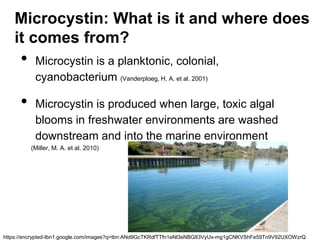
• Microcystin is a planktonic, colonial, 
cyanobacterium (Vanderploeg, H. A. et al. 2001) 
• Microcystin is produced when large, toxic algal 
blooms in freshwater environments are washed 
downstream and into the marine environment 
(Miller, M. A. et al. 2010) 
https://encrypted-tbn1.google.com/images?q=tbn:ANd9GcTKRdfTTfn1eNl3eNBG83VyUx-mg1gCNKVShFe59Tn9V92UXOWzrQ
Questions 
1) Characterize spatial and temporal dispersion of 
microcystin. 
A) How far does microcystin extend into the Pacific 
Ocean? 
B) How long will it take for the bacteria to reach the 
ocean? 
2) Is the vector for microcystin the water itself or the 
invertebrates that otters prey on?
Two Hypotheses About Dispersal 
A) 
• Microcystin will not 
extend more than 5 
kilometers into the 
Pacific Ocean at a 
level of 400 
micrograms/liter. 
• Currents and 
upwelling will 
disturb the bacteria. 
B) 
• Microcystin floats in 
the current. 
• This means that the 
bacteria should 
reach the ocean 
within a day or two 
of the bloom.
Two Hypotheses About the Vector 
Invertebrates as the Vector 
• Toxin is absorbed by the 
algae which are pushed 
downstream into the 
ocean. 
• Shellfish, and other 
invertebrates, then feed on 
the algae that carries 
microcystin. 
• The sea otters eat shellfish 
and are then intoxicated 
with high levels of 
microcystin. 
Water as the Vector 
• The water itself is carrying 
the toxins into the ocean. 
As otters swim and feed in 
the water, some is 
eventually swallowed. 
• This could lead to an 
accumulation of 
microcystin in a sea otter 
just because it lives in the 
ocean.
Methods 
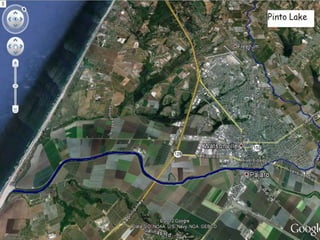
1) Collect water (at 1ft, 5ft, 10ft, and 15ft) and 
invertebrate samples from Pinto Lake, Corralitos 
Creek, the Pajaro River, and the Pacific Ocean. 
- Use the SPATT (Solid Phase Adsorption Toxin 
Tracking) method to test this water for blooms. This 
was proven effective in Miller’s study of microcystin 
in Pinto Lake. 
(MacKenzie L. et al. 2010) 
2) Factor in the current by sampling water and 
invertebrates north and south of the Pajaro River.
Methods 
3) Conduct targeted sampling of sea otters on every other 
day using the method from (Wild and Ames 1974) 
o Take samples of the liver tissues, blood, and 
stomach contents and test them for microcystin. 
-Use the ELISA method and the protein 
phosphatase inhibition assay (Bressie et al. 2011) 
4) Repeat this entire process multiple times over a five year 
period. 
https://encrypted-tbn1.google.com/images?q=tbn:ANd9GcTHka2ELSWybJW3es9fK8sC0C98P3iPl0JmRCvn1dHtmfwph4paDw
Results (Spatial and Temporal) 
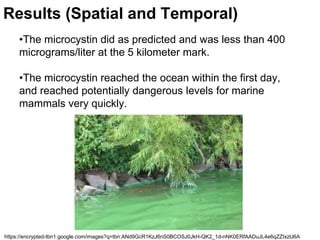
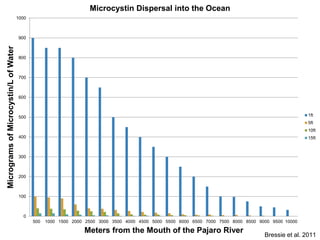
•The microcystin did as predicted and was less than 400 
micrograms/liter at the 5 kilometer mark. 
•The microcystin reached the ocean within the first day, 
and reached potentially dangerous levels for marine 
mammals very quickly. 
https://encrypted-tbn1.google.com/images?q=tbn:ANd9GcR1KzJ6nS0BCOSJ0JkH-QK2_1d-nNK0ERfAADuJL4e6qZZIxzlJ6A
1000 
900 
800 
700 
600 
500 
400 
300 
200 
100 
0 
Microcystin Dispersal into the Ocean 
500 1000 1500 2000 2500 3000 3500 4000 4500 5000 5500 6000 6500 7000 7500 8000 8500 9000 9500 10000 
Micrograms of Microcystin/L of Water 
Meters from the Mouth of the Pajaro River 
1ft 
5ft 
10ft 
15ft 
Bressie et al. 2011
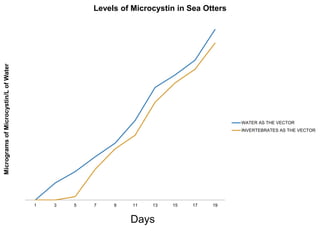
1 3 5 7 9 11 13 15 17 19 
Micrograms of Microcystin/L of Water 
Levels of Microcystin in Sea Otters 
WATER AS THE VECTOR 
INVERTEBRATES AS THE VECTOR 
Days
Results (invertebrates) 
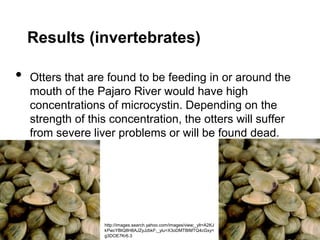
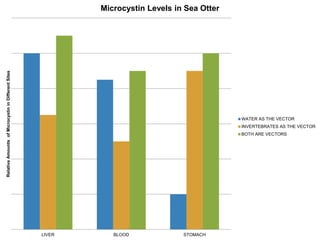
• Otters that are found to be feeding in or around the 
mouth of the Pajaro River would have high 
concentrations of microcystin. Depending on the 
strength of this concentration, the otters will suffer 
from severe liver problems or will be found dead. 
http://images.search.yahoo.com/images/view;_ylt=A2KJ 
kPwcYBtQ8H8AJZyJzbkF;_ylu=X3oDMTBlMTQ4cGxy= 
g3DOE7Kr6.3
Results (Water) 
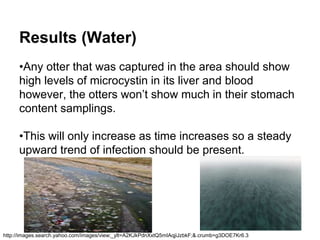
•Any otter that was captured in the area should show 
high levels of microcystin in its liver and blood 
however, the otters won’t show much in their stomach 
content samplings. 
•This will only increase as time increases so a steady 
upward trend of infection should be present. 
http://images.search.yahoo.com/images/view;_ylt=A2KJkPdnXxtQ5mIAqjiJzbkF;&.crumb=g3DOE7Kr6.3
Results (Both) 
•It is possible that both water and invertebrates 
are vectors for microcystin. In this case, all 
otters should show some level of infection after 
the first few days…however, these levels will 
be extremely high in the stomach as well as 
blood and liver.
LIVER BLOOD STOMACH 
Relative Amounts of Microcystin in Different Sites 
Microcystin Levels in Sea Otter 
WATER AS THE VECTOR 
INVERTEBRATES AS THE VECTOR 
BOTH ARE VECTORS
Why is this important? 
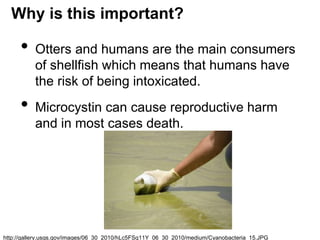
• Otters and humans are the main consumers 
of shellfish which means that humans have 
the risk of being intoxicated. 
• Microcystin can cause reproductive harm 
and in most cases death. 
http://gallery.usgs.gov/images/06_30_2010/hLc5FSq11Y_06_30_2010/medium/Cyanobacteria_15.JPG
References 
• Vanderploeg H.A.; Liebig J.R.; Carmichael W.W.; Agy M.A.; Johengen 
T.H.; Fahnenstiel G.L.; Nalepa T.F. Canadian Journal of Fisheries and 
Aquatic Sciences, Volume 58, Number 6, June 2001 , pp. 1208-1221(14) 
• Miller MA, Kudela RM, Mekebri A, Crane D, Oates SC, et al. (2010) 
Evidence for a Novel Marine Harmful Algal Bloom: Cyanotoxin 
(Microcystin) Transfer from Land to Sea Otters. PLoS ONE 5(9): e12576. 
doi:10.1371/journal.pone.0012576 
• Wild, Paul W. and Ames, Jack A. (1974) A report on the sea otter, Enhydra 
lutris L., in California. Long Beach, CA, California Department of Fish and 
Game, (Marine Resources Technical Report, 20) 
• Bressi, J.D. ; Kashian D; Pothoven S. (September 23, 2011) Evalutation od 
the Hazard of Microcystis Blooms for Human Health through Fish 
Comsumption 
http://www.glerl.noaa.gov/res/Task_rpts/2005/aislandrum05/1.html#top 
https://encrypted-tbn0.google.com/images?q=tbn:ANd9GcQzV-8Nmp2BuMGQvaNS-bnbZ99MP4AkCEjzKDjqPHahJ2qRytrR
Acknowledgements 
We would like to thank many people for their help in putting this presentation together. 
Chief among these are: 
•Robin Dunkin: Our TA and our main advisor in this project. 
•Shawn Noren: Our professor and the one who taught us so 
much about marine mammals. 
•Jen Rodgers: The best teacher fellow ever, who guided us 
through every academic step of Cosmos. 
•Walter Heady: Our secondary professor who enkindled our 
love for ecology, especially in the freshwater environment. 
•D.J. Stoll and Jimena Garcia: our two amazing RAs who 
made sure we stayed on track and made Cluster 3 all that it 
is. 
Thanks Everyone!!!
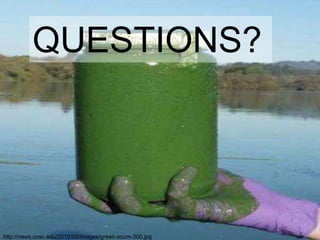
QUESTIONS? 
http://gallery.usgs.gov/photos/371#.UBd0hKOs_uc 
http://news.ucsc.edu/2010/09/images/green-scum-300.jpg

Final Draft - Noah Craney and Nubia Cervantes

  • 1.
    Microcystin: The FreshwaterKiller By: Nubia Cervantes and Noah Craney https://encrypted-tbn1.google.com/images?q=tbn:ANd9GcSdk3gNxUbpYk6jW_K5xkLVnUyNnOm2j4v1aRGAbVcQ2i6MX-BIJw
  • 2.
    Introduction • Significantincrease in the awareness of the interactions between terrestrial and marine ecosystems (positive and negative) • Microcystin is one of these negative interactions. • It has been proven to be deadly in sea otters which is why they will be the target species of this project. https://encrypted-tbn3.google.com/images?q=tbn:ANd9GcTqGlgGKd7JHrJbDnuV2XM2y7MG4V-RlQYgGh_Ru-CMYpnCWlgw
  • 3.
    Microcystin: What isit and where does it comes from? • Microcystin is a planktonic, colonial, cyanobacterium (Vanderploeg, H. A. et al. 2001) • Microcystin is produced when large, toxic algal blooms in freshwater environments are washed downstream and into the marine environment (Miller, M. A. et al. 2010) https://encrypted-tbn1.google.com/images?q=tbn:ANd9GcTKRdfTTfn1eNl3eNBG83VyUx-mg1gCNKVShFe59Tn9V92UXOWzrQ
  • 4.
    Questions 1) Characterizespatial and temporal dispersion of microcystin. A) How far does microcystin extend into the Pacific Ocean? B) How long will it take for the bacteria to reach the ocean? 2) Is the vector for microcystin the water itself or the invertebrates that otters prey on?
  • 5.
    Two Hypotheses AboutDispersal A) • Microcystin will not extend more than 5 kilometers into the Pacific Ocean at a level of 400 micrograms/liter. • Currents and upwelling will disturb the bacteria. B) • Microcystin floats in the current. • This means that the bacteria should reach the ocean within a day or two of the bloom.
  • 6.
    Two Hypotheses Aboutthe Vector Invertebrates as the Vector • Toxin is absorbed by the algae which are pushed downstream into the ocean. • Shellfish, and other invertebrates, then feed on the algae that carries microcystin. • The sea otters eat shellfish and are then intoxicated with high levels of microcystin. Water as the Vector • The water itself is carrying the toxins into the ocean. As otters swim and feed in the water, some is eventually swallowed. • This could lead to an accumulation of microcystin in a sea otter just because it lives in the ocean.
  • 7.
    Methods 1) Collectwater (at 1ft, 5ft, 10ft, and 15ft) and invertebrate samples from Pinto Lake, Corralitos Creek, the Pajaro River, and the Pacific Ocean. - Use the SPATT (Solid Phase Adsorption Toxin Tracking) method to test this water for blooms. This was proven effective in Miller’s study of microcystin in Pinto Lake. (MacKenzie L. et al. 2010) 2) Factor in the current by sampling water and invertebrates north and south of the Pajaro River.
  • 9.
    Methods 3) Conducttargeted sampling of sea otters on every other day using the method from (Wild and Ames 1974) o Take samples of the liver tissues, blood, and stomach contents and test them for microcystin. -Use the ELISA method and the protein phosphatase inhibition assay (Bressie et al. 2011) 4) Repeat this entire process multiple times over a five year period. https://encrypted-tbn1.google.com/images?q=tbn:ANd9GcTHka2ELSWybJW3es9fK8sC0C98P3iPl0JmRCvn1dHtmfwph4paDw
  • 10.
    Results (Spatial andTemporal) •The microcystin did as predicted and was less than 400 micrograms/liter at the 5 kilometer mark. •The microcystin reached the ocean within the first day, and reached potentially dangerous levels for marine mammals very quickly. https://encrypted-tbn1.google.com/images?q=tbn:ANd9GcR1KzJ6nS0BCOSJ0JkH-QK2_1d-nNK0ERfAADuJL4e6qZZIxzlJ6A
  • 11.
    1000 900 800 700 600 500 400 300 200 100 0 Microcystin Dispersal into the Ocean 500 1000 1500 2000 2500 3000 3500 4000 4500 5000 5500 6000 6500 7000 7500 8000 8500 9000 9500 10000 Micrograms of Microcystin/L of Water Meters from the Mouth of the Pajaro River 1ft 5ft 10ft 15ft Bressie et al. 2011
  • 12.
    1 3 57 9 11 13 15 17 19 Micrograms of Microcystin/L of Water Levels of Microcystin in Sea Otters WATER AS THE VECTOR INVERTEBRATES AS THE VECTOR Days
  • 13.
    Results (invertebrates) •Otters that are found to be feeding in or around the mouth of the Pajaro River would have high concentrations of microcystin. Depending on the strength of this concentration, the otters will suffer from severe liver problems or will be found dead. http://images.search.yahoo.com/images/view;_ylt=A2KJ kPwcYBtQ8H8AJZyJzbkF;_ylu=X3oDMTBlMTQ4cGxy= g3DOE7Kr6.3
  • 14.
    Results (Water) •Anyotter that was captured in the area should show high levels of microcystin in its liver and blood however, the otters won’t show much in their stomach content samplings. •This will only increase as time increases so a steady upward trend of infection should be present. http://images.search.yahoo.com/images/view;_ylt=A2KJkPdnXxtQ5mIAqjiJzbkF;&.crumb=g3DOE7Kr6.3
  • 15.
    Results (Both) •Itis possible that both water and invertebrates are vectors for microcystin. In this case, all otters should show some level of infection after the first few days…however, these levels will be extremely high in the stomach as well as blood and liver.
  • 16.
    LIVER BLOOD STOMACH Relative Amounts of Microcystin in Different Sites Microcystin Levels in Sea Otter WATER AS THE VECTOR INVERTEBRATES AS THE VECTOR BOTH ARE VECTORS
  • 17.
    Why is thisimportant? • Otters and humans are the main consumers of shellfish which means that humans have the risk of being intoxicated. • Microcystin can cause reproductive harm and in most cases death. http://gallery.usgs.gov/images/06_30_2010/hLc5FSq11Y_06_30_2010/medium/Cyanobacteria_15.JPG
  • 18.
    References • VanderploegH.A.; Liebig J.R.; Carmichael W.W.; Agy M.A.; Johengen T.H.; Fahnenstiel G.L.; Nalepa T.F. Canadian Journal of Fisheries and Aquatic Sciences, Volume 58, Number 6, June 2001 , pp. 1208-1221(14) • Miller MA, Kudela RM, Mekebri A, Crane D, Oates SC, et al. (2010) Evidence for a Novel Marine Harmful Algal Bloom: Cyanotoxin (Microcystin) Transfer from Land to Sea Otters. PLoS ONE 5(9): e12576. doi:10.1371/journal.pone.0012576 • Wild, Paul W. and Ames, Jack A. (1974) A report on the sea otter, Enhydra lutris L., in California. Long Beach, CA, California Department of Fish and Game, (Marine Resources Technical Report, 20) • Bressi, J.D. ; Kashian D; Pothoven S. (September 23, 2011) Evalutation od the Hazard of Microcystis Blooms for Human Health through Fish Comsumption http://www.glerl.noaa.gov/res/Task_rpts/2005/aislandrum05/1.html#top https://encrypted-tbn0.google.com/images?q=tbn:ANd9GcQzV-8Nmp2BuMGQvaNS-bnbZ99MP4AkCEjzKDjqPHahJ2qRytrR
  • 19.
    Acknowledgements We wouldlike to thank many people for their help in putting this presentation together. Chief among these are: •Robin Dunkin: Our TA and our main advisor in this project. •Shawn Noren: Our professor and the one who taught us so much about marine mammals. •Jen Rodgers: The best teacher fellow ever, who guided us through every academic step of Cosmos. •Walter Heady: Our secondary professor who enkindled our love for ecology, especially in the freshwater environment. •D.J. Stoll and Jimena Garcia: our two amazing RAs who made sure we stayed on track and made Cluster 3 all that it is. Thanks Everyone!!!
  • 20.