Attribution done right to
Maximize Incrementality
Tuomas Mäki
tuomas.maki@smartly.io
Data Scientist
Why this training?
Major impact on real results
Attribution is a way to measure
Marketing Performance
A complex model used wrong can
hurt performance
What is the problem we are
trying to solve?
“Half the money I spend on advertising is wasted;
the trouble is, I don’t know which half"
-John Wanamaker
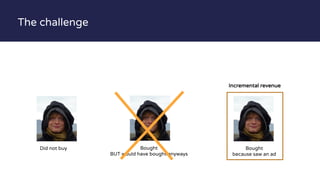
The challenge
Did not buy Bought
BUT would have bought anyways
Bought
because saw an ad
Incremental revenue
Attribution model should
Mimic Incremental Revenue
Additional complexities:
Lifetime Value
Network Effect
Late Conversions
Even more complex:
Organization might value chosen attribution model
over incrementality
All attribution models are wrong
A simple model used right is very
helpful
Contents
What is an attribution model used for?
Types of attribution models
So what should I do?
Bid and Budget
Overall investment level
Interpret test results
Employee bonuses
Bid and Budget
Overall investment level
Interpret test results
Employee bonuses
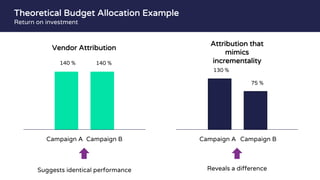
Campaign A Campaign B
140 %
Vendor Attribution
Campaign A Campaign B
Attribution that
mimics
incrementality140 %
130 %
75 %
Suggests identical performance Reveals a difference
Theoretical Budget Allocation Example
Return on investment
Contents
What is an attribution model used for?
Types of attribution models
So what should I do?
Econometric models
Vendor attribution models
Rule-based models
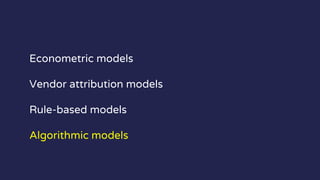
Algorithmic models
Econometric models
Vendor attribution models
Rule-based models
Algorithmic models
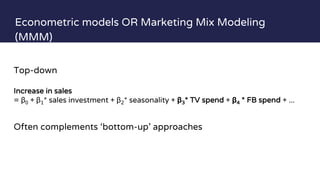
Econometric models OR Marketing Mix Modeling
(MMM)
Simplified
Top-down
Increase in sales
= β0 + β1* sales investment + β2* seasonality + β3* TV spend + β4 * FB spend + ...
Often complements ‘bottom-up’ approaches
Econometric models
Vendor attribution models
Rule-based models
Algorithmic models
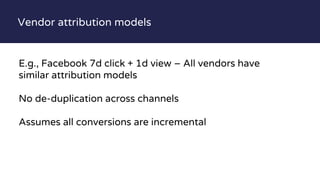
Vendor attribution models
E.g., Facebook 7d click + 1d view – All vendors have
similar attribution models
No de-duplication across channels
Assumes all conversions are incremental
How to choose attribution window
for vendor-based models?
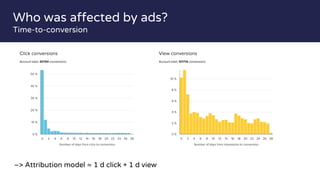
–> Attribution model ≈ 1 d click + 1 d view
Who was affected by ads?
Time-to-conversion
Challenges with Time-to-conversion method
It’s more complex than that
We might have just made the decision faster
The “Retargeting hammer effect” – If we reach every
customer every day, whenever they purchase, they
end up being attributed to the first day after
click/impression
Econometric models
Vendor attribution models
Rule-based models
Algorithmic models
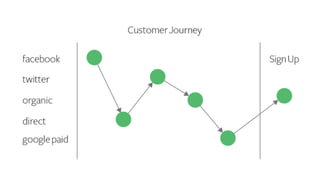
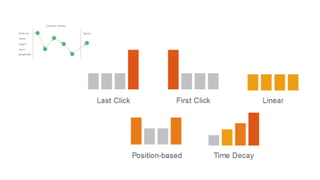
Rule-based attribution models
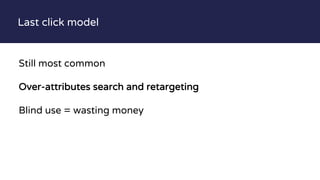
Last click model
Still most common
Over-attributes search and retargeting
Blind use = wasting money
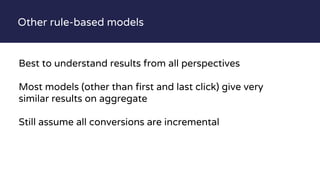
Other rule-based models
Best to understand results from all perspectives
Most models (other than first and last click) give very
similar results on aggregate
Still assume all conversions are incremental
How to deal with model
imperfections?
Check results with lift studies
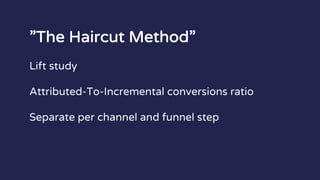
”The Haircut Method”
Lift study
Attributed-To-Incremental conversions ratio
Separate per channel and funnel step
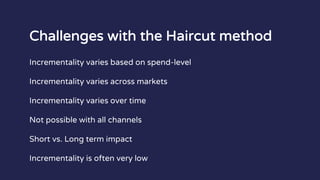
Challenges with the Haircut method
Incrementality varies based on spend-level
Incrementality varies across markets
Incrementality varies over time
Not possible with all channels
Short vs. Long term impact
Incrementality is often very low
Task 1
A customer is looking at both FB and Google Analytics attribution
There is a large discrepancy in the numbers.
Why does this happen?
Which one should they trust?
Task 2
Can I put prospecting and retargeting campaigns in the same
budget pool?
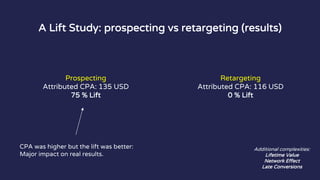
A Lift Study: prospecting vs retargeting (results)
Prospecting
Attributed CPA: 135 USD
75 % Lift
Retargeting
Attributed CPA: 116 USD
0 % Lift
CPA was higher but the lift was better:
Major impact on real results.
Additional complexities:
Lifetime Value
Network Effect
Late Conversions
Econometric models
Vendor attribution models
Rule-based models
Algorithmic models
Algorithmic attribution models
Sidenote:
Mobile Measurement Partners
≠
Multi-Touch Attribution solutions
Algorithmic attribution models
Complex Machine Learning models on individual
customer journey level
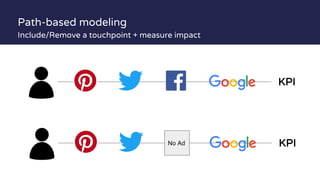
Path-based modeling
Include/Remove a touchpoint + measure impact
KPI
KPINo Ad
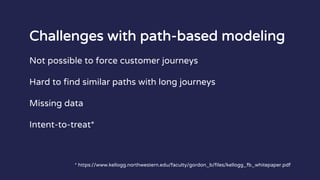
Challenges with path-based modeling
Not possible to force customer journeys
Hard to find similar paths with long journeys
Missing data
Intent-to-treat*
* https://www.kellogg.northwestern.edu/faculty/gordon_b/files/kellogg_fb_whitepaper.pdf
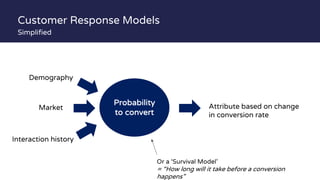
Customer Response Models
Simplified
Probability
to convert
Demography
Market
Interaction history
Attribute based on change
in conversion rate
Or a ‘Survival Model’
= “How long will it take before a conversion
happens”
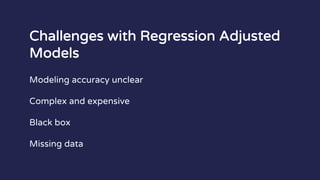
Challenges with Regression Adjusted
Models
Modeling accuracy unclear
Complex and expensive
Black box
Missing data
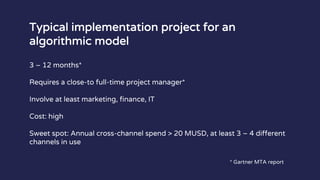
Typical implementation project for an
algorithmic model
3 – 12 months*
Requires a close-to full-time project manager*
Involve at least marketing, finance, IT
Cost: high
Sweet spot: Annual cross-channel spend > 20 MUSD, at least 3 – 4 different
channels in use
* Gartner MTA report
Contents
What is an attribution model used for?
Types of attribution models
So what should I do?
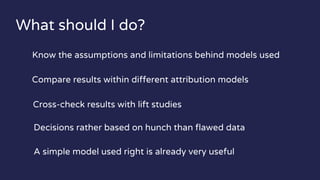
What should I do?
Know the assumptions and limitations behind models used
Compare results within different attribution models
Cross-check results with lift studies
Decisions rather based on hunch than flawed data
A simple model used right is already very useful
”Incrementality-calibrated
algorithmic MTA is the holy grail of
Attribution”
But not worth the investment for everyone
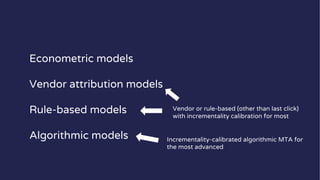
Econometric models
Vendor attribution models
Rule-based models
Algorithmic models
Vendor or rule-based (other than last click)
with incrementality calibration for most
Incrementality-calibrated algorithmic MTA for
the most advanced
Read more (or use Google):
“Kellogg Whitepaper” – Why measuring incrementality is difficult without a Randomized Controlled
Trial
Gartner Report for Multi-Touch Attribution Market
“The Good, The Bad, and The Ugly blog post”
Read more about Econometric Approach to attribution

Multi-Touch Attribution Models: Improve Your Advertising ROI