Attribution Modeling in
Performance Marketing
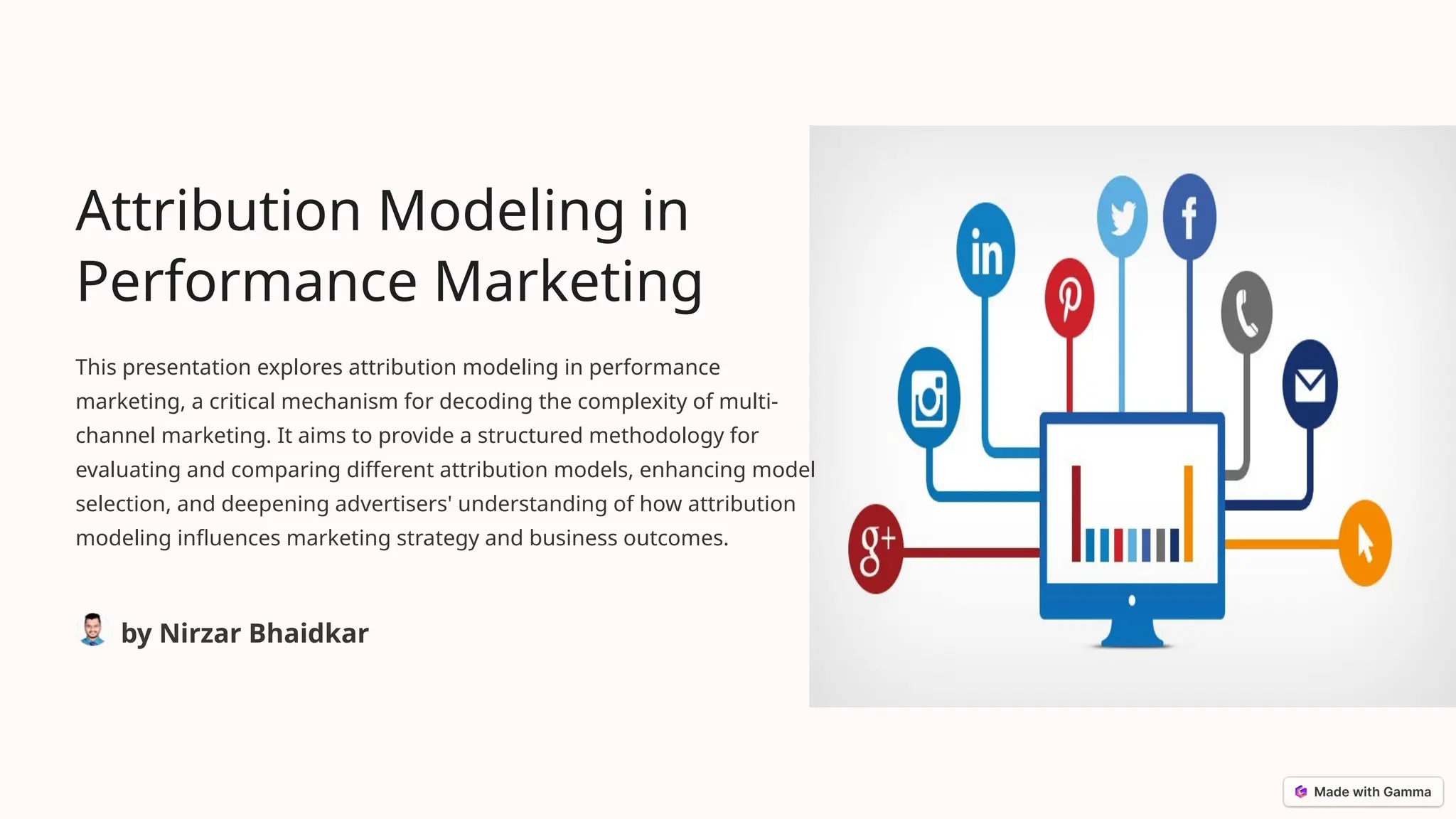
This presentation explores attribution modeling in performance
marketing, a critical mechanism for decoding the complexity of multi-
channel marketing. It aims to provide a structured methodology for
evaluating and comparing different attribution models, enhancing model
selection, and deepening advertisers' understanding of how attribution
modeling influences marketing strategy and business outcomes.
by Nirzar Bhaidkar
Objectives and Significance
1 Comprehensive
Understanding
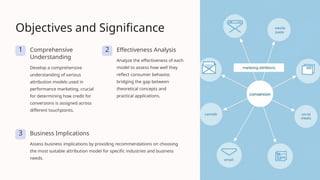
Develop a comprehensive
understanding of various
attribution models used in
performance marketing, crucial
for determining how credit for
conversions is assigned across
different touchpoints.
2 Effectiveness Analysis
Analyze the effectiveness of each
model to assess how well they
reflect consumer behavior,
bridging the gap between
theoretical concepts and
practical applications.
3 Business Implications
Assess business implications by providing recommendations on choosing
the most suitable attribution model for specific industries and business
needs.
Research Methodology
Web Analytics Data
Extracted from Google Analytics via
API, analyzing 500,000 website
sessions classified by traffic source and
campaign. Multi-touchpoint
interactions were mapped for granular
understanding.
Marketing Campaign Data
Sourced from HubSpot, Salesforce, and
Marketo, including performance data
from over 50 campaigns spanning
search, social media, email, and display
advertising. Aggregated insights from
a full year.
Customer Surveys
Quantitative data supplemented with
qualitative insights from customer
surveys, with 100 respondents, to
understand user perceptions of
marketing efforts and conversion
motivations.
Evolution of Attribution
Modeling
1 Early Approaches
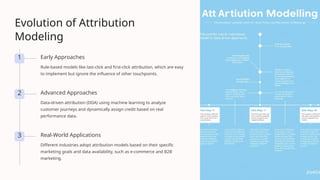
Rule-based models like last-click and first-click attribution, which are easy
to implement but ignore the influence of other touchpoints.
2 Advanced Approaches
Data-driven attribution (DDA) using machine learning to analyze
customer journeys and dynamically assign credit based on real
performance data.
3 Real-World Applications
Different industries adopt attribution models based on their specific
marketing goals and data availability, such as e-commerce and B2B
marketing.
Types of Attribution Models
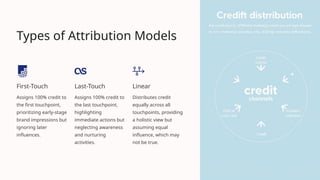
First-Touch
Assigns 100% credit to
the first touchpoint,
prioritizing early-stage
brand impressions but
ignoring later
influences.
Last-Touch
Assigns 100% credit to
the last touchpoint,
highlighting
immediate actions but
neglecting awareness
and nurturing
activities.
Linear
Distributes credit
equally across all
touchpoints, providing
a holistic view but
assuming equal
influence, which may
not be true.
Selection Criteria
Marketing Objectives
The ultimate goal of marketing
efforts significantly impacts the
selection of an attribution
model, such as brand
awareness or direct sales.
Customer Journey
Complexity
Different businesses have
varying customer journey
lengths and structures,
requiring multi-touch or
algorithmic attribution for
complex sales funnels.
Data Availability
The level of data granularity influences the feasibility of implementing
advanced attribution models, with customer-level data enabling
sophisticated models.
Key Findings
Attribution Model Variability
The choice of attribution model plays a crucial role in shaping the
insights derived from marketing data and, consequently, how
resources are allocated across various channels.
Recency and Frequency Effects
The timing of exposure and frequency of interactions with a brand
significantly influence conversion rates, with recent and repeated
exposures boosting conversions.
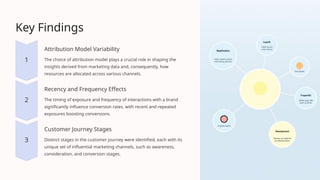
Customer Journey Stages
Distinct stages in the customer journey were identified, each with its
unique set of influential marketing channels, such as awareness,
consideration, and conversion stages.
Conclusions and
Recommendations
To build more accurate attribution models, businesses should adopt multi-
touch attribution, leverage time-decay attribution, utilize advanced data-
driven models, re-evaluate models for different funnel stages, fill data
gaps, focus on incremental lift, continuously evaluate models, and invest in
cross-channel solutions.

Attribution-Modeling-in-Performance-Marketing.pptx

  • 1.
    Attribution Modeling in PerformanceMarketing This presentation explores attribution modeling in performance marketing, a critical mechanism for decoding the complexity of multi- channel marketing. It aims to provide a structured methodology for evaluating and comparing different attribution models, enhancing model selection, and deepening advertisers' understanding of how attribution modeling influences marketing strategy and business outcomes. by Nirzar Bhaidkar
  • 2.
    Objectives and Significance 1Comprehensive Understanding Develop a comprehensive understanding of various attribution models used in performance marketing, crucial for determining how credit for conversions is assigned across different touchpoints. 2 Effectiveness Analysis Analyze the effectiveness of each model to assess how well they reflect consumer behavior, bridging the gap between theoretical concepts and practical applications. 3 Business Implications Assess business implications by providing recommendations on choosing the most suitable attribution model for specific industries and business needs.
  • 3.
    Research Methodology Web AnalyticsData Extracted from Google Analytics via API, analyzing 500,000 website sessions classified by traffic source and campaign. Multi-touchpoint interactions were mapped for granular understanding. Marketing Campaign Data Sourced from HubSpot, Salesforce, and Marketo, including performance data from over 50 campaigns spanning search, social media, email, and display advertising. Aggregated insights from a full year. Customer Surveys Quantitative data supplemented with qualitative insights from customer surveys, with 100 respondents, to understand user perceptions of marketing efforts and conversion motivations.
  • 4.
    Evolution of Attribution Modeling 1Early Approaches Rule-based models like last-click and first-click attribution, which are easy to implement but ignore the influence of other touchpoints. 2 Advanced Approaches Data-driven attribution (DDA) using machine learning to analyze customer journeys and dynamically assign credit based on real performance data. 3 Real-World Applications Different industries adopt attribution models based on their specific marketing goals and data availability, such as e-commerce and B2B marketing.
  • 5.
    Types of AttributionModels First-Touch Assigns 100% credit to the first touchpoint, prioritizing early-stage brand impressions but ignoring later influences. Last-Touch Assigns 100% credit to the last touchpoint, highlighting immediate actions but neglecting awareness and nurturing activities. Linear Distributes credit equally across all touchpoints, providing a holistic view but assuming equal influence, which may not be true.
  • 6.
    Selection Criteria Marketing Objectives Theultimate goal of marketing efforts significantly impacts the selection of an attribution model, such as brand awareness or direct sales. Customer Journey Complexity Different businesses have varying customer journey lengths and structures, requiring multi-touch or algorithmic attribution for complex sales funnels. Data Availability The level of data granularity influences the feasibility of implementing advanced attribution models, with customer-level data enabling sophisticated models.
  • 7.
    Key Findings Attribution ModelVariability The choice of attribution model plays a crucial role in shaping the insights derived from marketing data and, consequently, how resources are allocated across various channels. Recency and Frequency Effects The timing of exposure and frequency of interactions with a brand significantly influence conversion rates, with recent and repeated exposures boosting conversions. Customer Journey Stages Distinct stages in the customer journey were identified, each with its unique set of influential marketing channels, such as awareness, consideration, and conversion stages.
  • 8.
    Conclusions and Recommendations To buildmore accurate attribution models, businesses should adopt multi- touch attribution, leverage time-decay attribution, utilize advanced data- driven models, re-evaluate models for different funnel stages, fill data gaps, focus on incremental lift, continuously evaluate models, and invest in cross-channel solutions.