Disruption of Attachments
Research into the disruption of
attachments
- John
John
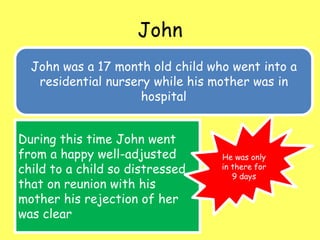
John was a 17 month old child who went into a
residential nursery while his mother was in
hospital
During this time John went
from a happy well-adjusted
child to a child so distressed
that on reunion with his
mother his rejection of her
was clear
He was only
in there for
9 days
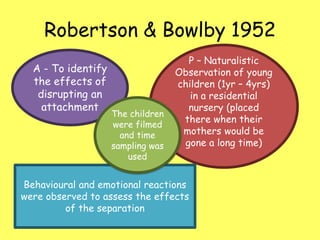
Robertson & Bowlby 1952
A - To identify
the effects of
disrupting an
attachment
P – Naturalistic
Observation of young
children (1yr – 4yrs)
in a residential
nursery (placed
there when their
mothers would be
gone a long time)
Behavioural and emotional reactions
were observed to assess the effects
of the separation
The children
were filmed
and time
sampling was
used
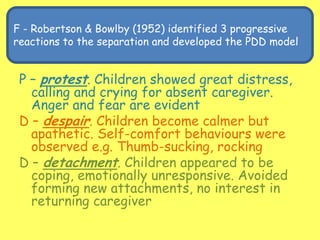
P – protest. Children showed great distress,
calling and crying for absent caregiver.
Anger and fear are evident
D – despair. Children become calmer but
apathetic. Self-comfort behaviours were
observed e.g. Thumb-sucking, rocking
D – detachment. Children appeared to be
coping, emotionally unresponsive. Avoided
forming new attachments, no interest in
returning caregiver
F - Robertson & Bowlby (1952) identified 3 progressive
reactions to the separation and developed the PDD model
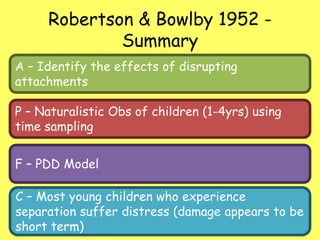
Robertson & Bowlby 1952 -
Summary
C – Most young children who experience
separation suffer distress (damage appears to be
short term)
F – PDD Model
P – Naturalistic Obs of children (1-4yrs) using
time sampling
A – Identify the effects of disrupting
attachments
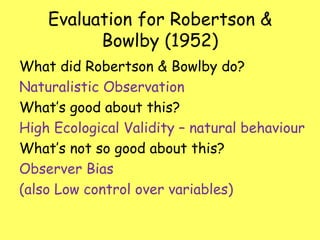
Evaluation for Robertson &
Bowlby (1952)
What did Robertson & Bowlby do?
Naturalistic Observation
What’s good about this?
High Ecological Validity – natural behaviour
What’s not so good about this?
Observer Bias
(also Low control over variables)
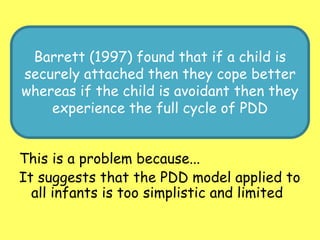
This is a problem because...
It suggests that the PDD model applied to
all infants is too simplistic and limited
Barrett (1997) found that if a child is
securely attached then they cope better
whereas if the child is avoidant then they
experience the full cycle of PDD
P Diddy – PDD model
Song Missing You –
Separation
R’n’B music –
Robertson & Bowlby
Other than
attachment
type
What factors might
affect a child’s response
to disruption?
Age of the Child
Shaffer & Callender (1959) studied
76 babies 3-51 weeks who were
admitted into a children’s hospital.
Children under 7 months shown
minimal upset, after this the strength
of the response increased up to 18
months
Other than
attachment
type
What factors might
affect a child’s response
to disruption?
Sex of the Child
Boys seem to react more strongly
to separations than girls although
there are wide variations within
each sex as well as between the
sexes
1. Outline two factors that can affect an
infants’ response to short term
separation (4 marks)
2. Outline the findings from Robertson &
Bowlby’s research (4 marks)
3. Identify one criticism of the research
into the PDD model (2 marks)

Disruption of attachments

  • 1.
    Disruption of Attachments Researchinto the disruption of attachments - John
  • 2.
    John John was a17 month old child who went into a residential nursery while his mother was in hospital During this time John went from a happy well-adjusted child to a child so distressed that on reunion with his mother his rejection of her was clear He was only in there for 9 days
  • 3.
    Robertson & Bowlby1952 A - To identify the effects of disrupting an attachment P – Naturalistic Observation of young children (1yr – 4yrs) in a residential nursery (placed there when their mothers would be gone a long time) Behavioural and emotional reactions were observed to assess the effects of the separation The children were filmed and time sampling was used
  • 4.
    P – protest.Children showed great distress, calling and crying for absent caregiver. Anger and fear are evident D – despair. Children become calmer but apathetic. Self-comfort behaviours were observed e.g. Thumb-sucking, rocking D – detachment. Children appeared to be coping, emotionally unresponsive. Avoided forming new attachments, no interest in returning caregiver F - Robertson & Bowlby (1952) identified 3 progressive reactions to the separation and developed the PDD model
  • 5.
    Robertson & Bowlby1952 - Summary C – Most young children who experience separation suffer distress (damage appears to be short term) F – PDD Model P – Naturalistic Obs of children (1-4yrs) using time sampling A – Identify the effects of disrupting attachments
  • 6.
    Evaluation for Robertson& Bowlby (1952) What did Robertson & Bowlby do? Naturalistic Observation What’s good about this? High Ecological Validity – natural behaviour What’s not so good about this? Observer Bias (also Low control over variables)
  • 7.
    This is aproblem because... It suggests that the PDD model applied to all infants is too simplistic and limited Barrett (1997) found that if a child is securely attached then they cope better whereas if the child is avoidant then they experience the full cycle of PDD
  • 8.
    P Diddy –PDD model Song Missing You – Separation R’n’B music – Robertson & Bowlby
  • 9.
    Other than attachment type What factorsmight affect a child’s response to disruption? Age of the Child Shaffer & Callender (1959) studied 76 babies 3-51 weeks who were admitted into a children’s hospital. Children under 7 months shown minimal upset, after this the strength of the response increased up to 18 months
  • 10.
    Other than attachment type What factorsmight affect a child’s response to disruption? Sex of the Child Boys seem to react more strongly to separations than girls although there are wide variations within each sex as well as between the sexes
  • 11.
    1. Outline twofactors that can affect an infants’ response to short term separation (4 marks) 2. Outline the findings from Robertson & Bowlby’s research (4 marks) 3. Identify one criticism of the research into the PDD model (2 marks)