PROGRAMME LEARNINGMATERIALON PERIODIC
CLASSIFICATION OF ELEMENTS
MADE BY-
SAKSHI SHAW
ID- 14162076
B.ED- SCI & EDU
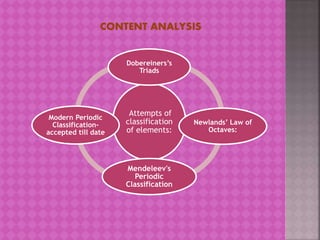
CONTENT ANALYSIS
Attempts of
classification
of elements:
Dobereiners’s
Triads
Newlands’ Law of
Octaves:
Mendeleev's
Periodic
Classification
Modern Periodic
Classification-
accepted till date
CONTENT OBJECTIVE
•STUDENTS WILL BE ABLE TO DEFINE PERIODIC CLASSIFICATION
OF ELEMENTS
•STUDENTS WILL BE ABLE TO UNDERSTAND THE NEED OF
CLASSIFICATION OF ELEMENTS.
•STUDENTS WILL BE ABLE TO ANALYSE THE DISCOVERIES &
EARLYATTEMPTS OF CLASSIFYING ELEMNTS.
•STUDENTS WILL BE ABLE TO DEDUCE THE MERITS & DEMERITS
OF SEVERAL CLASSICAL ATTEMPTS OF CLASSIFICATION OF
ELEMENTS.
•STUDENTS WILL BE ABLE TO ANALYSE THE IMPORTANCE OF
MODERN PERIODIC TABLE OVER OTHER CLASSICAL ATTEMPTS
OF CLASSIFICATION.
•STUDENTS WILL BE ABLE TO DESIGN MODERN PERIODIC TABLE
BASED ON PROPERTIES OF ELEMENTS.
•STUDENTS WILL BE ABLE TO SOLVE PROBLEMS ON PERIODIC
CLASSIFICATION OF PROBLEMS.
DEAR STUDENT, READ THE WRITTEN
DOCUMENT CAREFULLY ; TO UNVEIL THE
SECRET ANSWERS TO QUESTIONS LYING
WITHIN….
CLICK HERE
Q.1 Q.2 Q.3 Q.4 Q.5
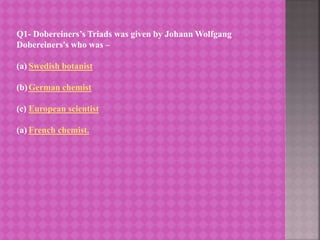
Q1- Dobereiners’s Triads was given by Johann Wolfgang
Dobereiners's who was –
(a) Swedish botanist
(b)German chemist
(c) European scientist
(a) French chemist.
PLEASE CLICK HERE & READ THE DOCUMENT
AGAIN.
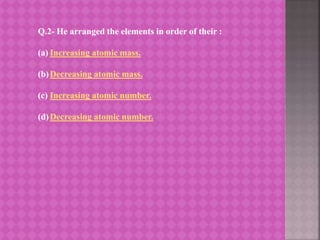
Q.2- He arranged the elements in order of their :
(a) Increasing atomic mass.
(b)Decreasing atomic mass.
(c) Increasing atomic number.
(d)Decreasing atomic number.
PLEASE CLICK HERE & READ THE
DOCUMENT AGAIN.
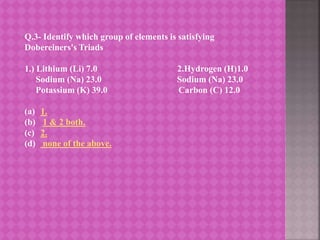
Q.3- Identify which group of elements is satisfying
Dobereiners's Triads
1.) Lithium (Li) 7.0 2.Hydrogen (H)1.0
Sodium (Na) 23.0 Sodium (Na) 23.0
Potassium (K) 39.0 Carbon (C) 12.0
(a) 1.
(b) 1 & 2 both.
(c) 2.
(d) none of the above.
PLEASE CLICK HERE & READ THE
DOCUMENT AGAIN.
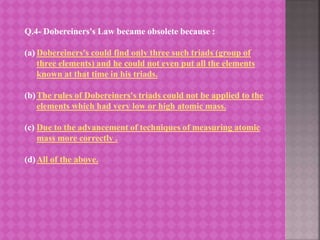
Q.4- Dobereiners's Law became obsolete because :
(a) Dobereiners's could find only three such triads (group of
three elements) and he could not even put all the elements
known at that time in his triads.
(b)The rules of Dobereiners's triads could not be applied to the
elements which had very low or high atomic mass.
(c) Due to the advancement of techniques of measuring atomic
mass more correctly .
(d)All of the above.
PLEASE CLICK HERE & READ THE
DOCUMENT AGAIN.
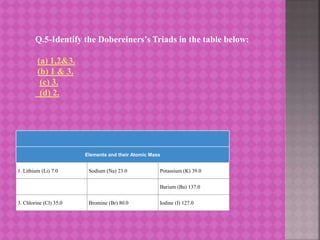
Q.5-Identify the Dobereiners’s Triads in the table below:
(a) 1,2&3.
(b) 1 & 3.
(c) 3.
(d) 2.
Elements and their Atomic Mass
1. Lithium (Li) 7.0 Sodium (Na) 23.0 Potassium (K) 39.0
2. Nitrogen (N) 14.0 Calcium (Ca) 40.0 Barium (Ba) 137.0
3. Chlorine (Cl) 35.0 Bromine (Br) 80.0 Iodine (I) 127.0
PLEASE CLICK HERE & READ THE DOCUMENT
AGAIN.
DEAR STUDENT, READ THE WRITTEN
DOCUMENT CAREFULLY ; TO UNVEIL THE
SECRET ANSWERS TO QUESTIONS LYING
WITHIN….
CLICK HERE
Q.1 Q.2 Q.3 Q.4 Q.5
Q.1- In Mendeleev's periodic table Elements are arranged
in the periodic table in the order of :
(a) Decreasing atomic size.
(b)Decreasing atomic number.
(c) Increasing relative atomic masses.
(a) Increasing relative atomic number.
PLEASE CLICK HERE & READ THE DOCUMENT
AGAIN.
Q.2- The law of Newlands’ Law of Octaves depicts that :
(a) Elements are arranged in the periodic table in the increasing
order of their relative atomic masses.
(b)Groups from I to VII are meant for normal elements and
group VIII is for transition elements.

(c) Any given element will exhibit analogous behavior to the
eighth element following it in the table.
(d)All of the above.
PLEASE CLICK HERE & READ THE
DOCUMENT AGAIN.
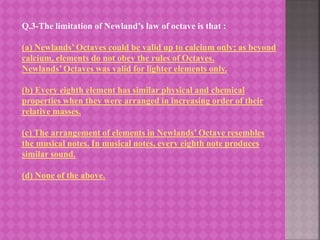
Q.3-The limitation of Newland’s law of octave is that :
(a) Newlands’ Octaves could be valid up to calcium only; as beyond
calcium, elements do not obey the rules of Octaves.
Newlands’ Octaves was valid for lighter elements only.
(b) Every eighth element has similar physical and chemical
properties when they were arranged in increasing order of their
relative masses.
(c) The arrangement of elements in Newlands’ Octave resembles
the musical notes. In musical notes, every eighth note produces
similar sound.
(d) None of the above.
PLEASE CLICK & READ THE
DOCUMENT AGAIN.
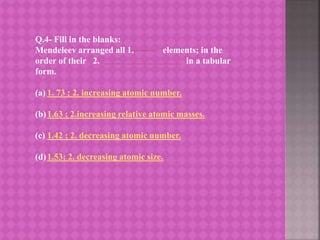
Q.4- Fill in the blanks:
Mendeleev arranged all 1. elements; in the
order of their 2. in a tabular
form.
(a) 1. 73 ; 2. increasing atomic number.
(b)1.63 ; 2.increasing relative atomic masses.
(c) 1.42 ; 2. decreasing atomic number.
(d)1.53; 2. decreasing atomic size.
PLEASE CLICK HERE & READ THE
DOCUMENT AGAIN.
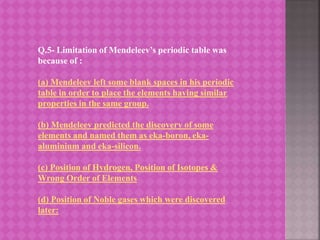
Q.5- Limitation of Mendeleev’s periodic table was
because of :
(a) Mendeleev left some blank spaces in his periodic
table in order to place the elements having similar
properties in the same group.
(b) Mendeleev predicted the discovery of some
elements and named them as eka-boron, eka-
aluminium and eka-silicon.
(c) Position of Hydrogen, Position of Isotopes &
Wrong Order of Elements
(d) Position of Noble gases which were discovered
later:
PLEASE CLICK HERE & READ THE DOCUMENT
AGAIN.
DEAR STUDENT, READ THE WRITTEN
DOCUMENT CAREFULLY ; TO UNVEIL THE
SECRET ANSWERS TO QUESTIONS LYING
WITHIN….
CLICK HERE
Q.1 Q.2 Q.3 Q.4 Q.5
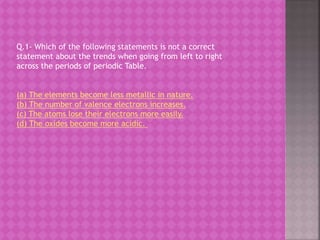
Q.1- Which of the following statements is not a correct
statement about the trends when going from left to right
across the periods of periodic Table.
(a) The elements become less metallic in nature.
(b) The number of valence electrons increases.
(c) The atoms lose their electrons more easily.
(d) The oxides become more acidic.
PLEASE CLICK HERE & READ THE DOCUMENT
AGAIN.
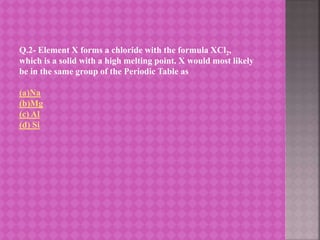
Q.2- Element X forms a chloride with the formula XCl2,
which is a solid with a high melting point. X would most likely
be in the same group of the Periodic Table as
(a)Na
(b)Mg
(c) Al
(d) Si
PLEASE CLICK HERE & READ THE
DOCUMENT AGAIN.
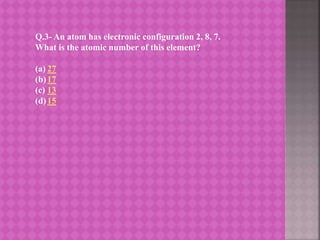
Q.3- An atom has electronic configuration 2, 8, 7.
What is the atomic number of this element?
(a) 27
(b)17
(c) 13
(d)15
PLEASE CLICK HERE & READ THE
DOCUMENT AGAIN.
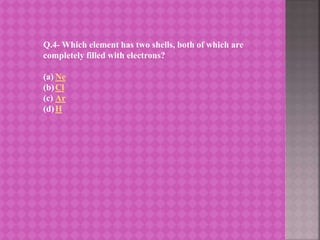
Q.4- Which element has two shells, both of which are
completely filled with electrons?
(a) Ne
(b)Cl
(c) Ar
(d)H
PLEASE CLICK HERE & READ THE
DOCUMENT AGAIN.
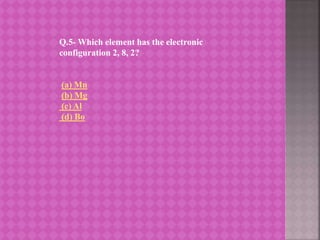
Q.5- Which element has the electronic
configuration 2, 8, 2?
(a) Mn
(b) Mg
(c) Al
(d) Bo
PLEASE CLICK HERE & READ THE
DOCUMENT AGAIN.
FURTHERREADING
VIDEO CLASS
PERIODIC TABLE SONG
ENCYCLOPEDIA
GOOGLE BABA
Plm science

Plm science

  • 1.
    PROGRAMME LEARNINGMATERIALON PERIODIC CLASSIFICATIONOF ELEMENTS MADE BY- SAKSHI SHAW ID- 14162076 B.ED- SCI & EDU
  • 2.
    CONTENT ANALYSIS Attempts of classification ofelements: Dobereiners’s Triads Newlands’ Law of Octaves: Mendeleev's Periodic Classification Modern Periodic Classification- accepted till date
  • 3.
    CONTENT OBJECTIVE •STUDENTS WILLBE ABLE TO DEFINE PERIODIC CLASSIFICATION OF ELEMENTS •STUDENTS WILL BE ABLE TO UNDERSTAND THE NEED OF CLASSIFICATION OF ELEMENTS. •STUDENTS WILL BE ABLE TO ANALYSE THE DISCOVERIES & EARLYATTEMPTS OF CLASSIFYING ELEMNTS. •STUDENTS WILL BE ABLE TO DEDUCE THE MERITS & DEMERITS OF SEVERAL CLASSICAL ATTEMPTS OF CLASSIFICATION OF ELEMENTS. •STUDENTS WILL BE ABLE TO ANALYSE THE IMPORTANCE OF MODERN PERIODIC TABLE OVER OTHER CLASSICAL ATTEMPTS OF CLASSIFICATION. •STUDENTS WILL BE ABLE TO DESIGN MODERN PERIODIC TABLE BASED ON PROPERTIES OF ELEMENTS. •STUDENTS WILL BE ABLE TO SOLVE PROBLEMS ON PERIODIC CLASSIFICATION OF PROBLEMS.
  • 4.
    DEAR STUDENT, READTHE WRITTEN DOCUMENT CAREFULLY ; TO UNVEIL THE SECRET ANSWERS TO QUESTIONS LYING WITHIN…. CLICK HERE Q.1 Q.2 Q.3 Q.4 Q.5
  • 5.
    Q1- Dobereiners’s Triadswas given by Johann Wolfgang Dobereiners's who was – (a) Swedish botanist (b)German chemist (c) European scientist (a) French chemist.
  • 6.
    PLEASE CLICK HERE& READ THE DOCUMENT AGAIN.
  • 8.
    Q.2- He arrangedthe elements in order of their : (a) Increasing atomic mass. (b)Decreasing atomic mass. (c) Increasing atomic number. (d)Decreasing atomic number.
  • 10.
    PLEASE CLICK HERE& READ THE DOCUMENT AGAIN.
  • 11.
    Q.3- Identify whichgroup of elements is satisfying Dobereiners's Triads 1.) Lithium (Li) 7.0 2.Hydrogen (H)1.0 Sodium (Na) 23.0 Sodium (Na) 23.0 Potassium (K) 39.0 Carbon (C) 12.0 (a) 1. (b) 1 & 2 both. (c) 2. (d) none of the above.
  • 13.
    PLEASE CLICK HERE& READ THE DOCUMENT AGAIN.
  • 14.
    Q.4- Dobereiners's Lawbecame obsolete because : (a) Dobereiners's could find only three such triads (group of three elements) and he could not even put all the elements known at that time in his triads. (b)The rules of Dobereiners's triads could not be applied to the elements which had very low or high atomic mass. (c) Due to the advancement of techniques of measuring atomic mass more correctly . (d)All of the above.
  • 15.
    PLEASE CLICK HERE& READ THE DOCUMENT AGAIN.
  • 17.
    Q.5-Identify the Dobereiners’sTriads in the table below: (a) 1,2&3. (b) 1 & 3. (c) 3. (d) 2. Elements and their Atomic Mass 1. Lithium (Li) 7.0 Sodium (Na) 23.0 Potassium (K) 39.0 2. Nitrogen (N) 14.0 Calcium (Ca) 40.0 Barium (Ba) 137.0 3. Chlorine (Cl) 35.0 Bromine (Br) 80.0 Iodine (I) 127.0
  • 18.
    PLEASE CLICK HERE& READ THE DOCUMENT AGAIN.
  • 20.
    DEAR STUDENT, READTHE WRITTEN DOCUMENT CAREFULLY ; TO UNVEIL THE SECRET ANSWERS TO QUESTIONS LYING WITHIN…. CLICK HERE Q.1 Q.2 Q.3 Q.4 Q.5
  • 21.
    Q.1- In Mendeleev'speriodic table Elements are arranged in the periodic table in the order of : (a) Decreasing atomic size. (b)Decreasing atomic number. (c) Increasing relative atomic masses. (a) Increasing relative atomic number.
  • 22.
    PLEASE CLICK HERE& READ THE DOCUMENT AGAIN.
  • 24.
    Q.2- The lawof Newlands’ Law of Octaves depicts that : (a) Elements are arranged in the periodic table in the increasing order of their relative atomic masses. (b)Groups from I to VII are meant for normal elements and group VIII is for transition elements. (c) Any given element will exhibit analogous behavior to the eighth element following it in the table. (d)All of the above.
  • 25.
    PLEASE CLICK HERE& READ THE DOCUMENT AGAIN.
  • 27.
    Q.3-The limitation ofNewland’s law of octave is that : (a) Newlands’ Octaves could be valid up to calcium only; as beyond calcium, elements do not obey the rules of Octaves. Newlands’ Octaves was valid for lighter elements only. (b) Every eighth element has similar physical and chemical properties when they were arranged in increasing order of their relative masses. (c) The arrangement of elements in Newlands’ Octave resembles the musical notes. In musical notes, every eighth note produces similar sound. (d) None of the above.

  • 29.
    PLEASE CLICK &READ THE DOCUMENT AGAIN.
  • 30.
    Q.4- Fill inthe blanks: Mendeleev arranged all 1. elements; in the order of their 2. in a tabular form. (a) 1. 73 ; 2. increasing atomic number. (b)1.63 ; 2.increasing relative atomic masses. (c) 1.42 ; 2. decreasing atomic number. (d)1.53; 2. decreasing atomic size.
  • 31.
    PLEASE CLICK HERE& READ THE DOCUMENT AGAIN.
  • 33.
    Q.5- Limitation ofMendeleev’s periodic table was because of : (a) Mendeleev left some blank spaces in his periodic table in order to place the elements having similar properties in the same group. (b) Mendeleev predicted the discovery of some elements and named them as eka-boron, eka- aluminium and eka-silicon. (c) Position of Hydrogen, Position of Isotopes & Wrong Order of Elements (d) Position of Noble gases which were discovered later:
  • 34.
    PLEASE CLICK HERE& READ THE DOCUMENT AGAIN.
  • 36.
    DEAR STUDENT, READTHE WRITTEN DOCUMENT CAREFULLY ; TO UNVEIL THE SECRET ANSWERS TO QUESTIONS LYING WITHIN…. CLICK HERE Q.1 Q.2 Q.3 Q.4 Q.5
  • 37.
    Q.1- Which ofthe following statements is not a correct statement about the trends when going from left to right across the periods of periodic Table. (a) The elements become less metallic in nature. (b) The number of valence electrons increases. (c) The atoms lose their electrons more easily. (d) The oxides become more acidic.
  • 38.
    PLEASE CLICK HERE& READ THE DOCUMENT AGAIN.
  • 40.
    Q.2- Element Xforms a chloride with the formula XCl2, which is a solid with a high melting point. X would most likely be in the same group of the Periodic Table as (a)Na (b)Mg (c) Al (d) Si
  • 41.
    PLEASE CLICK HERE& READ THE DOCUMENT AGAIN.
  • 43.
    Q.3- An atomhas electronic configuration 2, 8, 7. What is the atomic number of this element? (a) 27 (b)17 (c) 13 (d)15
  • 45.
    PLEASE CLICK HERE& READ THE DOCUMENT AGAIN.
  • 46.
    Q.4- Which elementhas two shells, both of which are completely filled with electrons? (a) Ne (b)Cl (c) Ar (d)H
  • 47.
    PLEASE CLICK HERE& READ THE DOCUMENT AGAIN.
  • 49.
    Q.5- Which elementhas the electronic configuration 2, 8, 2? (a) Mn (b) Mg (c) Al (d) Bo
  • 51.
    PLEASE CLICK HERE& READ THE DOCUMENT AGAIN.
  • 52.
    FURTHERREADING VIDEO CLASS PERIODIC TABLESONG ENCYCLOPEDIA GOOGLE BABA