ATM                  By
  Kauleshwarnath Pandey
         Maravar Kannan
Asynchronous Transfer Mode
 • ATM is the cell relay protocol designed by
   ATM Forum and adopted by ITU-T.
 • The combination of ATM & B-ISDN will allow
   high-speed interconnection of all the world’s
   networks.
 • In fact, ATM can be thought of as the
   “highway” of the information superhighway.
 • ATM operates at a speed of 155 & 622 Mbps &
   is a connection oriented network
Design Goals
• Need for a transmission system to optimize the use of high-
  data-rate transmission media, in particular optical fiber.
• A system that can interface with the existing systems, such
  as various packet networks, & to provide wide area
  interconnectivity between them without lowering their
  effectiveness or requiring their replacement.
• design that can be implemented inexpensively
• able to work with & support the existing telecommunications
  hierarchies
• must be connection oriented to ensure accurate &
  predictable delivery.
• to move as many of the functions to hardware as possible
  and eliminate as many software functions as possible
Packet Networks
 • Data communications today are based on
   packet switching & packet networks. A
   packet is a combination of data & overhead
   bits that can be passed through the
   network as a self contained unit. The
   overhead bits, in the form of a header &
   trailer, act as an envelope that provides
   identification & addressing information as
   well as the data required for routing, flow
   control, error control, …
ATM LANs
  Issues to be resolved
 • Connectionless Vs Connection-oriented
 • Physical Addresses Vs Virtual
    Connection Identifier
 • Multicasting & Broadcasting delivery
 • varying size & intricacy
 • To improve utilization
Cell Networks
• Many of the packet internetworking problems are solved
  by adopting a concept called cell networking.
• A cell is a small data unit of fixed size. In a cell network,
  all data are loaded into identical cells that can be
  transmitted with complete predictability & uniformity.
• As packets of different sizes & formats reach the cell
  network from a tributory network, they are split into
  multiple small data units of equal length & loaded into
  cells.
• Because of the same size, the problems associated with
  multiplexing different sized packets are avoided.
Advantages of Cells
• High speed of the link coupled with the
  small size of the cells
• A cell network can handle real time data
• To a cell network, the smallest unit is a
  cell, not a bit.
• Switching & multiplexing can be
  implemented in hardware rather than
  software
Asynchronous TDM
 • ATM uses asynchronous TDM (that’s why
   called as ATM) to multiplex cells coming from
   different channels. It uses fixed size slots.
 • ATM mux fill a slot with a cell from any input
   channel that has a cell, the slot is empty if none
   of the channels has a cell to send.
 • At the first tick of the clock, the multiplexer fills
   the slot with a cell from each channel. When all
   the cells from all the channels are multiplexed.
   The output slots are empty.
ATM Switching:
Contentionless Time Division
 • Advantages
  • Non-blocking
  • Deterministic performance—probability of cell loss = 0
  • Flexible port speeds
  – (DS-1, E-1, DS-3, E-3, 100M, 155M, 622M)
  • Hardware multicast without increasing fabric cell traffic
  • Low transit delays
 • Disadvantages
  • Limited scalability on single TDM fabric
  – Use time-space-time to expand
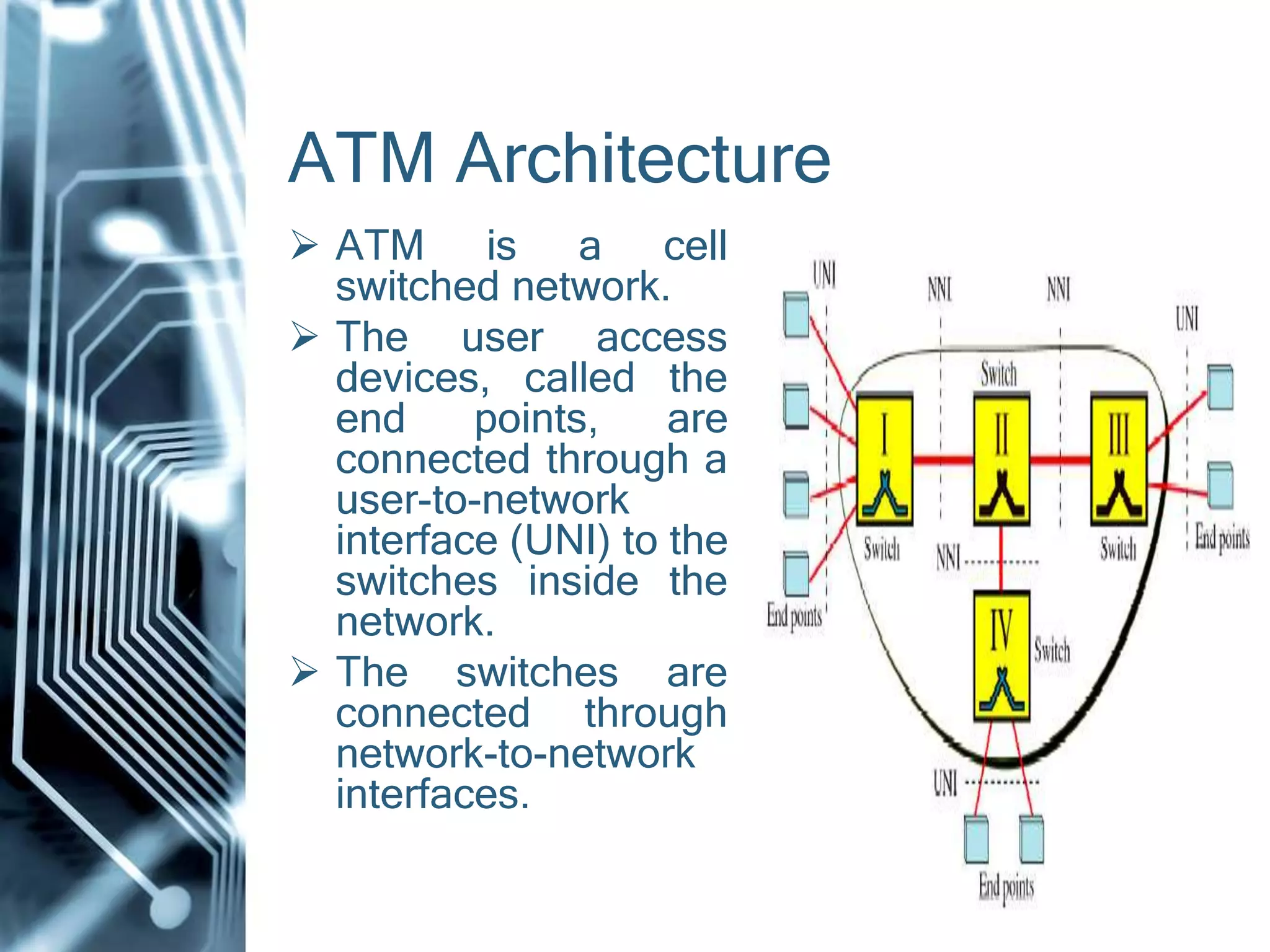
ATM Architecture
 ATM is a cell
  switched network.
 The user access
  devices, called the
  end     points,    are
  connected through a
  user-to-network
  interface (UNI) to the
  switches inside the
  network.
 The switches are
  connected through
  network-to-network
  interfaces.
ATM Protocol Stack

      Upper Layers
   ATM Adaptation Layer
        ATM Layer
      Physical Layer
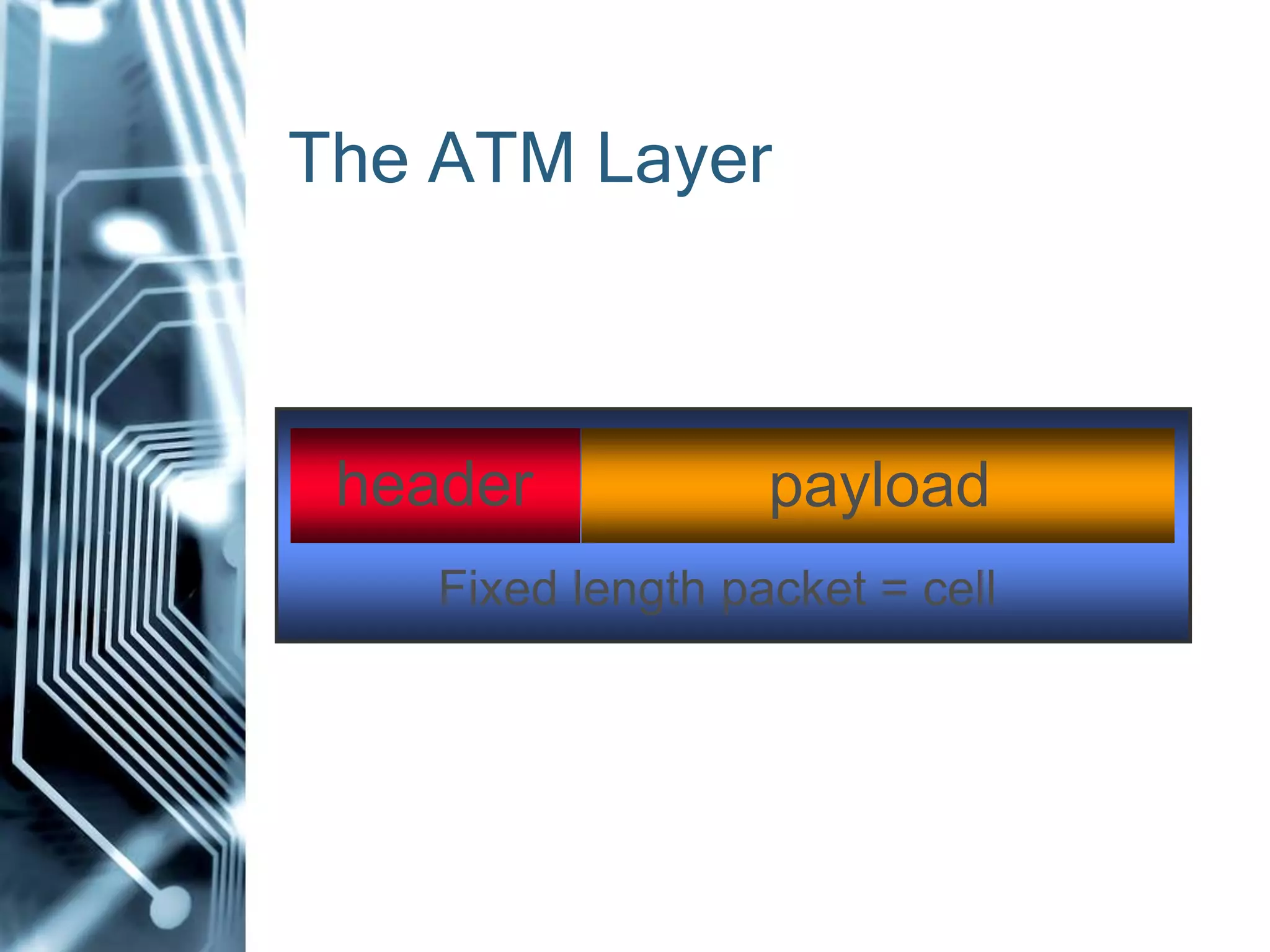
The ATM Layer


 header            payload
    Fixed length packet = cell
ATM Layers in end-point
devices & switches
The end points use all three layers while the
switches use only the two bottom layers.
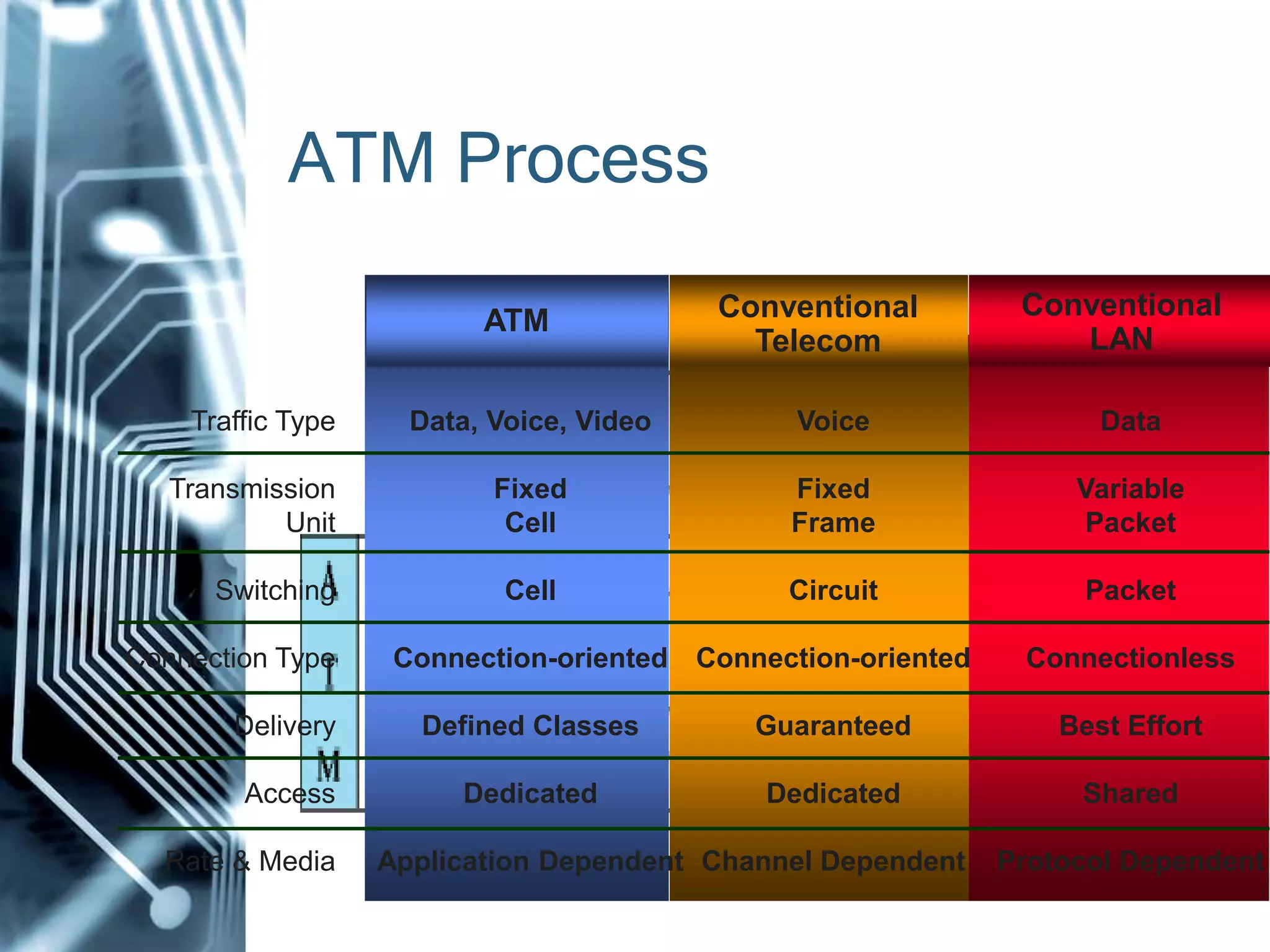
ATM Process
                                          Conventional         Conventional
                          ATM
                                            Telecom               LAN

    Traffic Type     Data, Voice, Video        Voice                 Data

   Transmission            Fixed              Fixed                Variable
           Unit             Cell              Frame                Packet

      Switching             Cell              Circuit               Packet

Connection Type     Connection-oriented Connection-oriented    Connectionless

       Delivery      Defined Classes        Guaranteed            Best Effort

        Access           Dedicated           Dedicated             Shared

  Rate & Media     Application Dependent Channel Dependent    Protocol Dependent
ATM Process
                                          Conventional         Conventional
                          ATM
                                            Telecom               LAN

    Traffic Type     Data, Voice, Video        Voice                 Data

   Transmission            Fixed              Fixed                Variable
           Unit             Cell              Frame                Packet

      Switching             Cell              Circuit               Packet

Connection Type     Connection-oriented Connection-oriented    Connectionless

       Delivery      Defined Classes        Guaranteed            Best Effort

        Access           Dedicated           Dedicated             Shared

  Rate & Media     Application Dependent Channel Dependent    Protocol Dependent
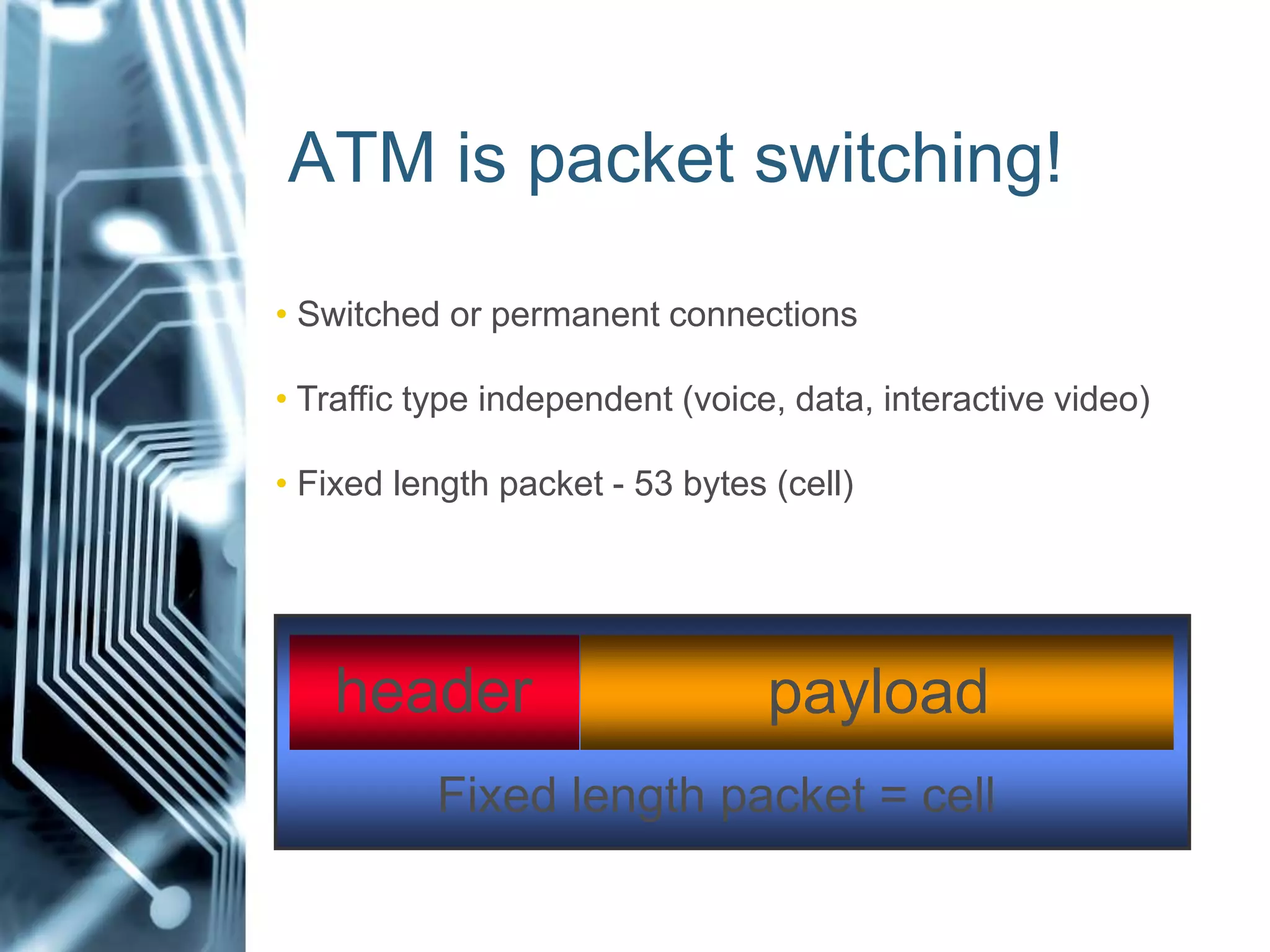
ATM is packet switching!

• Switched or permanent connections

• Traffic type independent (voice, data, interactive video)

• Fixed length packet - 53 bytes (cell)


   header                        payload
          Fixed length packet = cell
Anatomy of an ATM Cell
           8     7         6         5   4     3      2      1
Byte 1          GFC (UNI) or VPI (NNI)                VPI
Byte 2                         VPI                    VCI
Byte 3                                         VCI                 Header
Byte 4               VCI                      PTI           CLP
Byte 5                                         HEC


                                48 Bytes                           Payload


   VPI: Virtual Path Identifier               CLP: Cell Loss Priority
 VCI: Virtual Channel Identifier             HEC: Header Error Check
 PTI: Payload Type Indicator                 GFC: Generic Flow Control
Thank You

Atm

  • 1.
    ATM By Kauleshwarnath Pandey Maravar Kannan
  • 2.
    Asynchronous Transfer Mode • ATM is the cell relay protocol designed by ATM Forum and adopted by ITU-T. • The combination of ATM & B-ISDN will allow high-speed interconnection of all the world’s networks. • In fact, ATM can be thought of as the “highway” of the information superhighway. • ATM operates at a speed of 155 & 622 Mbps & is a connection oriented network
  • 3.
    Design Goals • Needfor a transmission system to optimize the use of high- data-rate transmission media, in particular optical fiber. • A system that can interface with the existing systems, such as various packet networks, & to provide wide area interconnectivity between them without lowering their effectiveness or requiring their replacement. • design that can be implemented inexpensively • able to work with & support the existing telecommunications hierarchies • must be connection oriented to ensure accurate & predictable delivery. • to move as many of the functions to hardware as possible and eliminate as many software functions as possible
  • 4.
    Packet Networks •Data communications today are based on packet switching & packet networks. A packet is a combination of data & overhead bits that can be passed through the network as a self contained unit. The overhead bits, in the form of a header & trailer, act as an envelope that provides identification & addressing information as well as the data required for routing, flow control, error control, …
  • 5.
    ATM LANs Issues to be resolved • Connectionless Vs Connection-oriented • Physical Addresses Vs Virtual Connection Identifier • Multicasting & Broadcasting delivery • varying size & intricacy • To improve utilization
  • 6.
    Cell Networks • Manyof the packet internetworking problems are solved by adopting a concept called cell networking. • A cell is a small data unit of fixed size. In a cell network, all data are loaded into identical cells that can be transmitted with complete predictability & uniformity. • As packets of different sizes & formats reach the cell network from a tributory network, they are split into multiple small data units of equal length & loaded into cells. • Because of the same size, the problems associated with multiplexing different sized packets are avoided.
  • 7.
    Advantages of Cells •High speed of the link coupled with the small size of the cells • A cell network can handle real time data • To a cell network, the smallest unit is a cell, not a bit. • Switching & multiplexing can be implemented in hardware rather than software
  • 8.
    Asynchronous TDM •ATM uses asynchronous TDM (that’s why called as ATM) to multiplex cells coming from different channels. It uses fixed size slots. • ATM mux fill a slot with a cell from any input channel that has a cell, the slot is empty if none of the channels has a cell to send. • At the first tick of the clock, the multiplexer fills the slot with a cell from each channel. When all the cells from all the channels are multiplexed. The output slots are empty.
  • 9.
    ATM Switching: Contentionless TimeDivision • Advantages • Non-blocking • Deterministic performance—probability of cell loss = 0 • Flexible port speeds – (DS-1, E-1, DS-3, E-3, 100M, 155M, 622M) • Hardware multicast without increasing fabric cell traffic • Low transit delays • Disadvantages • Limited scalability on single TDM fabric – Use time-space-time to expand
  • 10.
    ATM Architecture  ATMis a cell switched network.  The user access devices, called the end points, are connected through a user-to-network interface (UNI) to the switches inside the network.  The switches are connected through network-to-network interfaces.
  • 11.
    ATM Protocol Stack Upper Layers ATM Adaptation Layer ATM Layer Physical Layer
  • 12.
    The ATM Layer header payload Fixed length packet = cell
  • 13.
    ATM Layers inend-point devices & switches The end points use all three layers while the switches use only the two bottom layers.
  • 14.
    ATM Process Conventional Conventional ATM Telecom LAN Traffic Type Data, Voice, Video Voice Data Transmission Fixed Fixed Variable Unit Cell Frame Packet Switching Cell Circuit Packet Connection Type Connection-oriented Connection-oriented Connectionless Delivery Defined Classes Guaranteed Best Effort Access Dedicated Dedicated Shared Rate & Media Application Dependent Channel Dependent Protocol Dependent
  • 15.
    ATM Process Conventional Conventional ATM Telecom LAN Traffic Type Data, Voice, Video Voice Data Transmission Fixed Fixed Variable Unit Cell Frame Packet Switching Cell Circuit Packet Connection Type Connection-oriented Connection-oriented Connectionless Delivery Defined Classes Guaranteed Best Effort Access Dedicated Dedicated Shared Rate & Media Application Dependent Channel Dependent Protocol Dependent
  • 16.
    ATM is packetswitching! • Switched or permanent connections • Traffic type independent (voice, data, interactive video) • Fixed length packet - 53 bytes (cell) header payload Fixed length packet = cell
  • 17.
    Anatomy of anATM Cell 8 7 6 5 4 3 2 1 Byte 1 GFC (UNI) or VPI (NNI) VPI Byte 2 VPI VCI Byte 3 VCI Header Byte 4 VCI PTI CLP Byte 5 HEC 48 Bytes Payload VPI: Virtual Path Identifier CLP: Cell Loss Priority VCI: Virtual Channel Identifier HEC: Header Error Check PTI: Payload Type Indicator GFC: Generic Flow Control
  • 18.