Aileen Buckley, Esri
abuckley@esri.com
@mappingcenter
Greg Allord
• A human-technology civilization.
• Technologies merge with each other
and humans merge with technology.
• Technology will shape us as much
as we shape it.
http://www.esquire.com/news-politics/news/a14457/hybrid-age-9715111/
PUBLIC SAFETY
• “Technology futurists Ayesha and Parag Khanna
declare that we are rapidly moving from a point of
co-existence with technology to a phase of co-
evolution with it.”
• “Technology no longer just processes our
instruction; it has its own agency, and we respond
to it as much as it responds to us.”
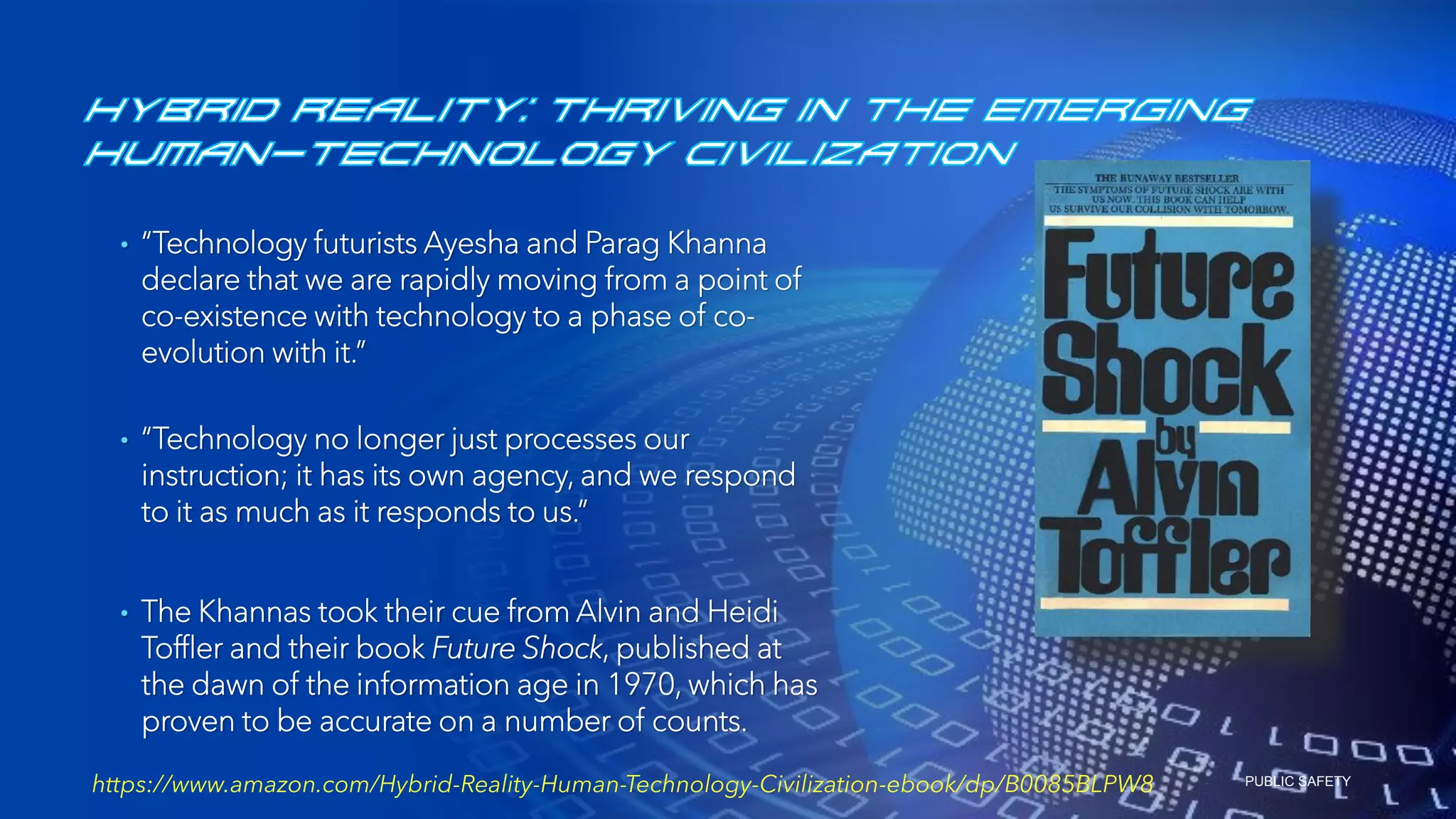
• The Khannas took their cue from Alvin and Heidi
Toffler and their book Future Shock, published at
the dawn of the information age in 1970, which has
proven to be accurate on a number of counts.
https://www.amazon.com/Hybrid-Reality-Human-Technology-Civilization-ebook/dp/B0085BLPW8
Stone Age
(250,000 BP)
• Nomadic bands
• Hunting and gathering
• Simple stone tools
Agrarian Age
(10,000 BP)
• Sedentary farmers
• Cultivating crops
• Plow, wheel
Industrial Age
(18th & 19th centuries)
• Factory workers
• Large-scale manufacturing
• Printing-press, mechanical clock
Information Age
(1970s)
• Knowledge workers
• Data creation and communication
• Personal computer, and later the
WWW and mobile phones
• Ubiquitous computing (with trillions of sensors covering our environment)
• Intelligent machines (devices communicating with each other as well as with us)
• Social technologies (encouraging us to develop emotional relationships with them)
• Integrated scientific fields (such as information technology, biotechnology, pervasive
computing, robotics, neuroscience and nanotechnology  hybridization of the “Bio Age”,
the “Nano Age”, and the “Neuro Age”)
• Rapidly-adaptive development strategies (with the ability quickly read and act on signals
of change)
• It is worldwide; collective; politically-, economically-, religiously-, and socially-agnostic
1. Ubiquitous
2. Intelligent
3. Social
4. Integrated
5. Disruptive
• Computers  PCs  smart devices 
molecular computers
• Small computing machines will evolve to be
in every object in our lives, including our
bodies
• By 2020, we will live “in technology”
• No longer deaf, dumb, and blind
• Intelligent, multisensory, intuitive, autonomous,
collective
• E.g., Watson beat two human competitors on
Jeopardy in February 2011 using language
comprehension, the highest marker of human
intelligence
• Anthropomorphic
• More natural interaction (language, no
keyboard)
• Voice and gesture-based commands
• Responsive (like humans) and reactive
• We’ll form emotional ties t the
technologies
• Neuroscience, nanoscience, bioscience,
and more will be integrated
• E.g., biomechanicotronics = biology +
mechanical engineering + electronics
• Bring products and services to the masses very rapidly
• Disrupt older models of thought, business, action,
politics, economics, science, etc.
• Force us to adapt quickly
• It will become global quickly
• Therefore, the poor and underprivileged with access
to technology will create opportunities and
disruptions
• A fundamental change—human nature
ceases to be a discrete or immutable truth.
• Evolution doesn’t have to be accidental
and contingent, it can be directed and
technologically assisted.
• Uniting genetics, neuroscience, synthetic
biology and other fields, a systematic
effort is under way to break the codes of
gene-behavior relations and accelerate
our ability to augment ourselves.
Information Age
Hybrid Age
???
Computers
Digital media
Singularity
1970s
2010s
2040s
Runaway technological growth
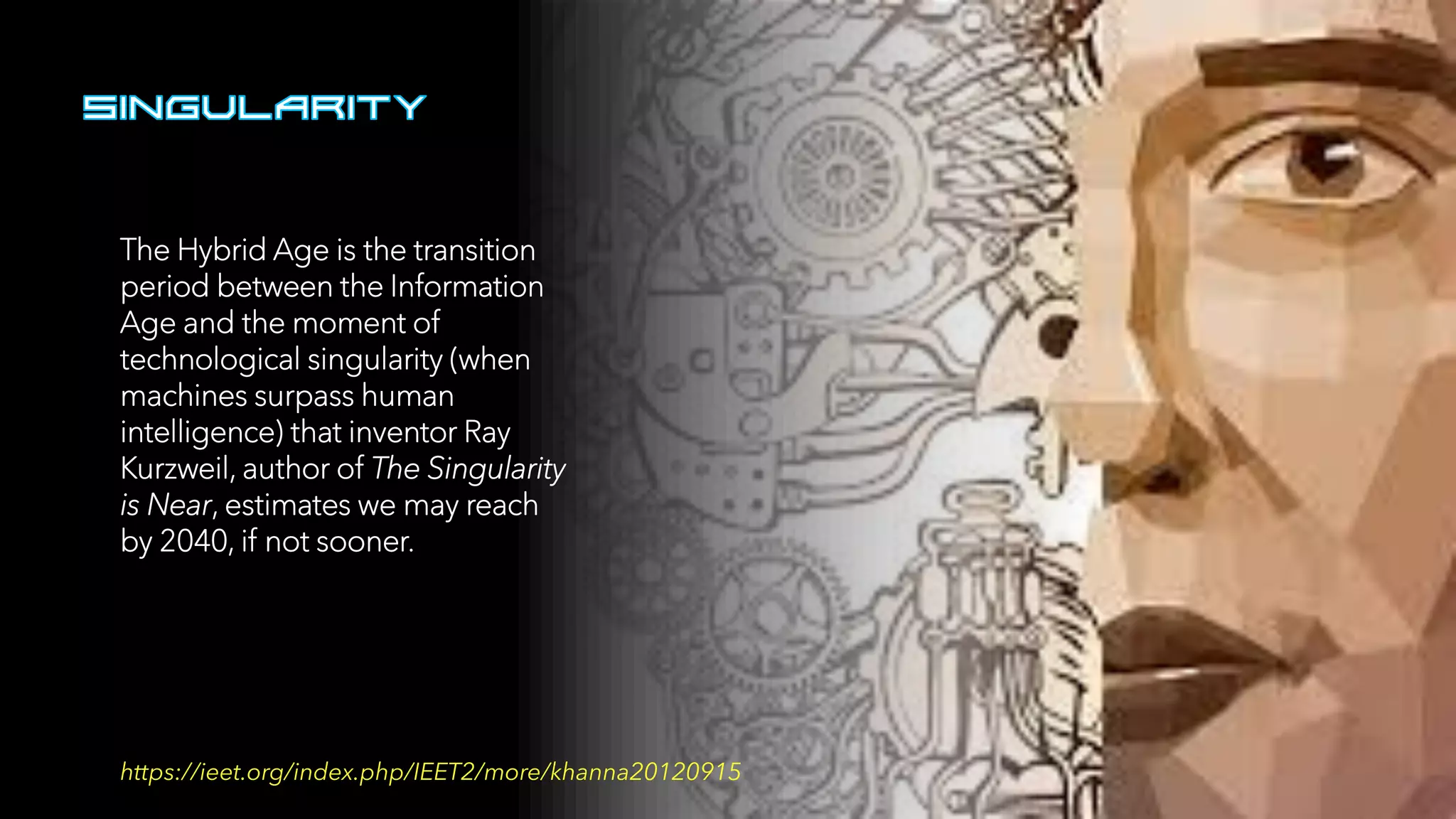
The Hybrid Age is the transition
period between the Information
Age and the moment of
technological singularity (when
machines surpass human
intelligence) that inventor Ray
Kurzweil, author of The Singularity
is Near, estimates we may reach
by 2040, if not sooner.
https://ieet.org/index.php/IEET2/more/khanna20120915
• Technology provides intelligent feedback
• Technologies are not just lighter and smaller,
but invisible and integrated
• Technologies are physically integrated with humans
• Technologies allow us to augment ourselves
• The “computer” as an object will physically disappear from our view and will
instead be invisibly integrated into ourselves and our built environment
• A person’s technology quotient (TQ) becomes more important than
their intelligence quotient (IQ) or emotional quotient (EQ)
• Opportunity
• Prosperity
• Chaos
• Uncertainty
• …
Not unlike other ages
• Ride the wave
• Prepare yourself and your organization (raise your TQ)
• Anticipate and mitigate the implications for:
- Geoscience (geopolitics, geoeconomics, geophysics, geoecology, …)
• And, for us, embrace the new age of mapping (the creation, dissemination, and use of
maps)
Learn Assimilate
Respond/
React
Anticipate/
Plan
• Integrated into our foundational knowledge
• Easily searchable and queryable
• Presented in ways that are intuitive to
understand and integrated into our existing
knowledge base
• The need for spatial knowledge is anticipated
• Responsive to changes in or additions to our
knowledge base
• Spatial information will allow individuals to
connect to each other directly and indirectly
• Spatial information will allow services to be
provided for quickly and easily
https://www.amazon.com/Hybrid-Reality-Human-Technology-Civilization-ebook/dp/B0085BLPW8
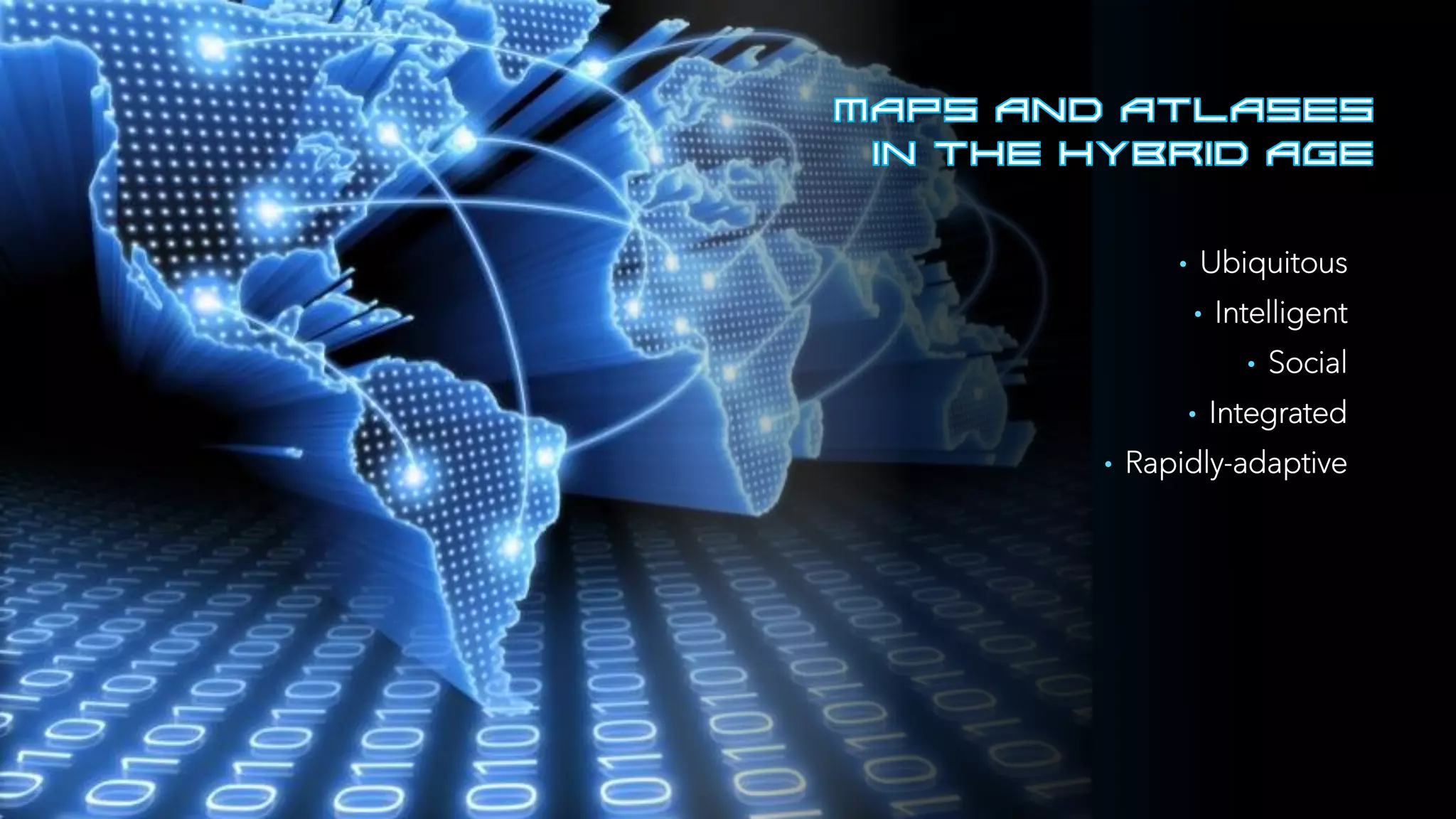
• Ubiquitous
• Intelligent
• Social
• Integrated
• Rapidly-adaptive
• Ubiquitous: Web services provide easy access to the atlas content through ubiquitous
computing on a wide range and large number of devices connected via the Internet.
• Intelligent: The user experience supports intelligent exploration through contextual
understanding, intuitive findability, and desirable comparison.
• Integrated: The user interface seamlessly integrates the maps and supporting content.
• Social: The atlases are social, providing useful opportunities to communicate and
collaborate with others.
• Adaptable: The atlas can be integrated with external data to provide responsive query and
exploration.
• No access restrictions or limitations
• No linguistic limitations (in your
language; at your language level)
• No cognitive limitations (at your level
of understanding; spatial cognition
limitations are overcome -- color
deficiency, map reading ability, etc.)
• Complete and correct (no more “bad
maps”; the problems of uncertainty
are solved)
• Complete data currency (present,
past, and future)
• Completely responsive and even
anticipatory (new maps based on
real-time data or projections)
• Easy to access, search, and query
• Easy to understand and assimilate
• Personal and individual (on-
demand knowledge based on your
needs, e.g., coffee versus world
security)
• Safe (the problems of privacy are
solved)
• More???
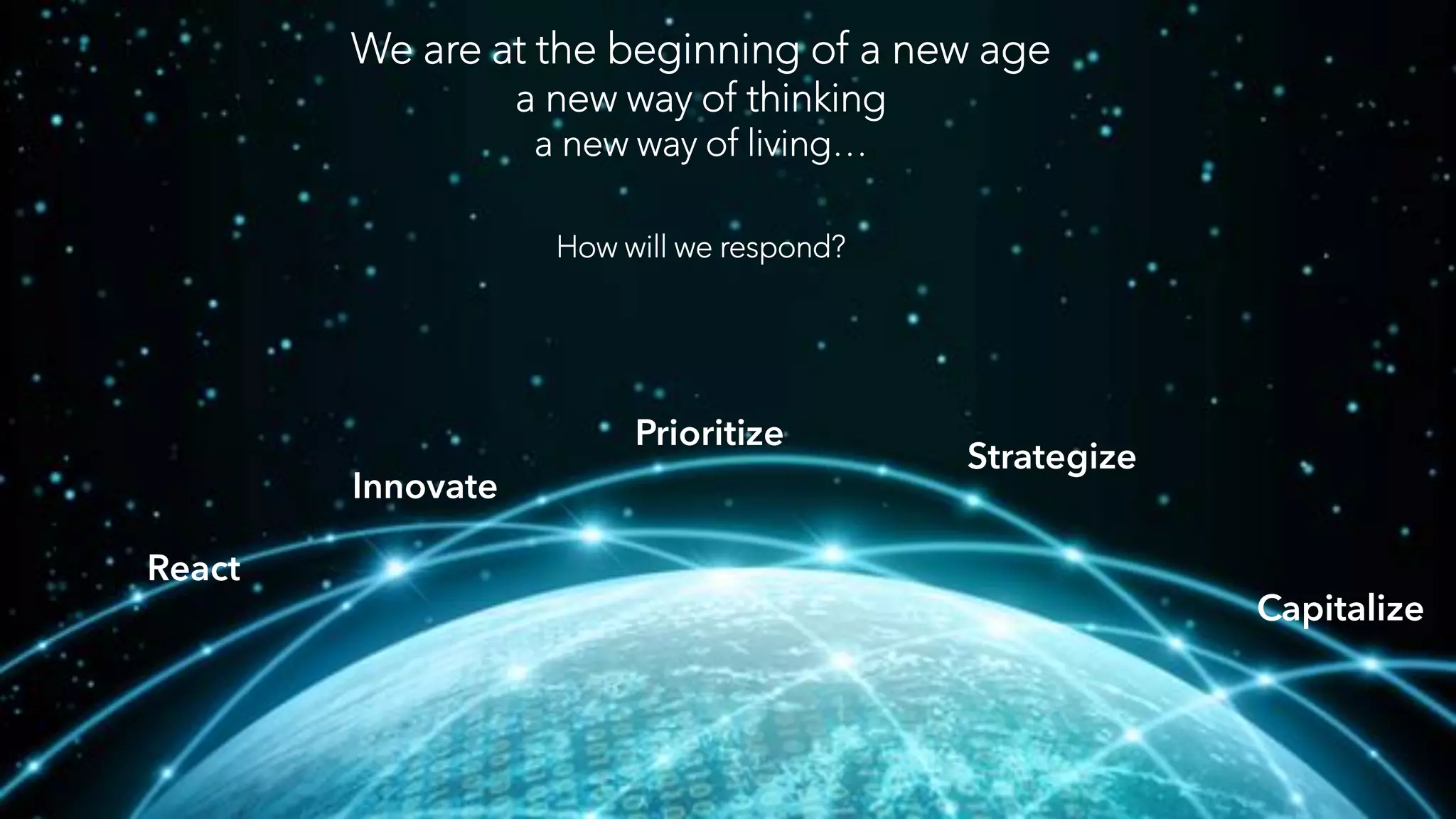
We are at the beginning of a new age
a new way of thinking
a new way of living…
How will we respond?
React
Innovate
Prioritize
Strategize
Capitalize
Aileen Buckley, Esri
abuckley@esri.com
@mappingcenter
Greg Allord
allordgreg@gmail.com

Atlas Mapping in the Hybrid Age

  • 1.
  • 2.
    • A human-technologycivilization. • Technologies merge with each other and humans merge with technology. • Technology will shape us as much as we shape it. http://www.esquire.com/news-politics/news/a14457/hybrid-age-9715111/
  • 3.
    PUBLIC SAFETY • “Technologyfuturists Ayesha and Parag Khanna declare that we are rapidly moving from a point of co-existence with technology to a phase of co- evolution with it.” • “Technology no longer just processes our instruction; it has its own agency, and we respond to it as much as it responds to us.” • The Khannas took their cue from Alvin and Heidi Toffler and their book Future Shock, published at the dawn of the information age in 1970, which has proven to be accurate on a number of counts. https://www.amazon.com/Hybrid-Reality-Human-Technology-Civilization-ebook/dp/B0085BLPW8
  • 4.
    Stone Age (250,000 BP) •Nomadic bands • Hunting and gathering • Simple stone tools Agrarian Age (10,000 BP) • Sedentary farmers • Cultivating crops • Plow, wheel Industrial Age (18th & 19th centuries) • Factory workers • Large-scale manufacturing • Printing-press, mechanical clock Information Age (1970s) • Knowledge workers • Data creation and communication • Personal computer, and later the WWW and mobile phones
  • 5.
    • Ubiquitous computing(with trillions of sensors covering our environment) • Intelligent machines (devices communicating with each other as well as with us) • Social technologies (encouraging us to develop emotional relationships with them) • Integrated scientific fields (such as information technology, biotechnology, pervasive computing, robotics, neuroscience and nanotechnology  hybridization of the “Bio Age”, the “Nano Age”, and the “Neuro Age”) • Rapidly-adaptive development strategies (with the ability quickly read and act on signals of change) • It is worldwide; collective; politically-, economically-, religiously-, and socially-agnostic
  • 6.
    1. Ubiquitous 2. Intelligent 3.Social 4. Integrated 5. Disruptive
  • 7.
    • Computers PCs  smart devices  molecular computers • Small computing machines will evolve to be in every object in our lives, including our bodies • By 2020, we will live “in technology”
  • 8.
    • No longerdeaf, dumb, and blind • Intelligent, multisensory, intuitive, autonomous, collective • E.g., Watson beat two human competitors on Jeopardy in February 2011 using language comprehension, the highest marker of human intelligence
  • 9.
    • Anthropomorphic • Morenatural interaction (language, no keyboard) • Voice and gesture-based commands • Responsive (like humans) and reactive • We’ll form emotional ties t the technologies
  • 10.
    • Neuroscience, nanoscience,bioscience, and more will be integrated • E.g., biomechanicotronics = biology + mechanical engineering + electronics
  • 11.
    • Bring productsand services to the masses very rapidly • Disrupt older models of thought, business, action, politics, economics, science, etc. • Force us to adapt quickly • It will become global quickly • Therefore, the poor and underprivileged with access to technology will create opportunities and disruptions
  • 12.
    • A fundamentalchange—human nature ceases to be a discrete or immutable truth. • Evolution doesn’t have to be accidental and contingent, it can be directed and technologically assisted. • Uniting genetics, neuroscience, synthetic biology and other fields, a systematic effort is under way to break the codes of gene-behavior relations and accelerate our ability to augment ourselves.
  • 13.
    Information Age Hybrid Age ??? Computers Digitalmedia Singularity 1970s 2010s 2040s Runaway technological growth
  • 14.
    The Hybrid Ageis the transition period between the Information Age and the moment of technological singularity (when machines surpass human intelligence) that inventor Ray Kurzweil, author of The Singularity is Near, estimates we may reach by 2040, if not sooner. https://ieet.org/index.php/IEET2/more/khanna20120915
  • 15.
    • Technology providesintelligent feedback • Technologies are not just lighter and smaller, but invisible and integrated • Technologies are physically integrated with humans • Technologies allow us to augment ourselves • The “computer” as an object will physically disappear from our view and will instead be invisibly integrated into ourselves and our built environment • A person’s technology quotient (TQ) becomes more important than their intelligence quotient (IQ) or emotional quotient (EQ)
  • 16.
    • Opportunity • Prosperity •Chaos • Uncertainty • … Not unlike other ages
  • 18.
    • Ride thewave • Prepare yourself and your organization (raise your TQ) • Anticipate and mitigate the implications for: - Geoscience (geopolitics, geoeconomics, geophysics, geoecology, …) • And, for us, embrace the new age of mapping (the creation, dissemination, and use of maps) Learn Assimilate Respond/ React Anticipate/ Plan
  • 19.
    • Integrated intoour foundational knowledge • Easily searchable and queryable • Presented in ways that are intuitive to understand and integrated into our existing knowledge base • The need for spatial knowledge is anticipated • Responsive to changes in or additions to our knowledge base • Spatial information will allow individuals to connect to each other directly and indirectly • Spatial information will allow services to be provided for quickly and easily https://www.amazon.com/Hybrid-Reality-Human-Technology-Civilization-ebook/dp/B0085BLPW8
  • 20.
    • Ubiquitous • Intelligent •Social • Integrated • Rapidly-adaptive
  • 21.
    • Ubiquitous: Webservices provide easy access to the atlas content through ubiquitous computing on a wide range and large number of devices connected via the Internet. • Intelligent: The user experience supports intelligent exploration through contextual understanding, intuitive findability, and desirable comparison. • Integrated: The user interface seamlessly integrates the maps and supporting content. • Social: The atlases are social, providing useful opportunities to communicate and collaborate with others. • Adaptable: The atlas can be integrated with external data to provide responsive query and exploration.
  • 22.
    • No accessrestrictions or limitations • No linguistic limitations (in your language; at your language level) • No cognitive limitations (at your level of understanding; spatial cognition limitations are overcome -- color deficiency, map reading ability, etc.) • Complete and correct (no more “bad maps”; the problems of uncertainty are solved) • Complete data currency (present, past, and future)
  • 23.
    • Completely responsiveand even anticipatory (new maps based on real-time data or projections) • Easy to access, search, and query • Easy to understand and assimilate • Personal and individual (on- demand knowledge based on your needs, e.g., coffee versus world security) • Safe (the problems of privacy are solved) • More???
  • 24.
    We are atthe beginning of a new age a new way of thinking a new way of living… How will we respond? React Innovate Prioritize Strategize Capitalize
  • 25.