


Emerging media technology:
Today’s benefits and tomorrow’s perils
James E Katz, Boston University
Boston, MA USA
Talk outline
• Mobile communication conquers the world
• Internet of Things (IoT)
• Intelligent networks
• Robots and intelligent agents
• Challenge ahead
Mobile communication takes
over the world
Last thing at night
• Young people = 18-30 year olds
• 95% use phone for something just before going to bed
• 90% sleep with them
• http://www.businessinsider.com/90-of-18-29-year-olds-sleep-with-their-smartphones-2012-11
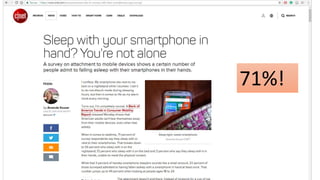
71%!
The Whole World’s Waking
Perpetual contact in the USA
• 38% of U.S. adult consumers never disconnect from their
smartphones
• Only 7% shut down entirely on vacation
• 89% check their smartphones at least several times a day, and 36%
constantly check their devices
• Millennials (39%) say they are most likely to interact with their
smartphone more than anyone or anything else, including their
significant other (27%)
• Teens: 9 hours of social/screen media engagement daily
http://newsroom.bankofamerica.com/press-releases/consumer-banking/perpetually-plugged-
americas-smartphone-obsession-continues-many-adm
http://newsroom.bankofamerica.com/press-releases/consumer-
banking/fess-majority-americans-deny-their-smartphone-
behaviors
• Social relationships
• Small group relationships
• Building blocks leading to level of
culture
Speaking of dating . . .
• Dating apps like Tinder
• Open new vistas
• Source of wonderful relationships in
some cases
• Opportunity structure (R. K.
Merton) leads to less satisfaction
with current situation
Management of social relations
Forbidden pleasures in a museum
No cell use allowed in art museum
Increasingly aiding health and personal safety
• Monitor health
• Track and correct behavior
• Also poses risks
f
• Blue tooth
• Isolation
• Accelerometer
• Physical activity
• Ambient light
• sleep environment
• Camera
• Tracks facial expressions,
• Eye movements
• Touch screen
• Response times for tasks
• Tremors
• Microphone
• tone of voice reveals mood
• ambient social environment
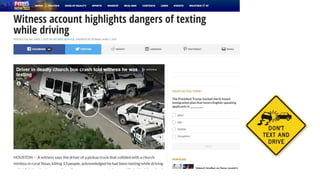
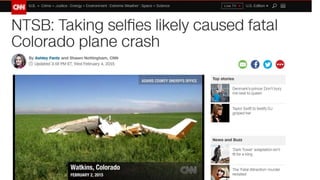
All these activities leave traces
• Allow investigators and authorities to track, monitor and recover
activities & information
• Flash function used just before airplane crash
• Texts gave context and messages of teen convicted of encouraging suicide
• Big trail that can be used to influence and control people & their
behaviors
• A topic I’ll return to later
Next steps
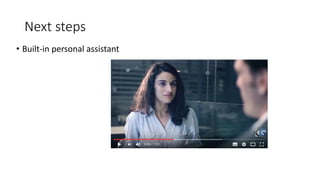
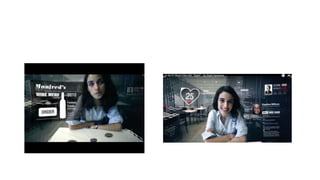
• Built-in personal assistant
Much enjoyment, benefits and use in mobile
communication
• But also downsides
• Physical health
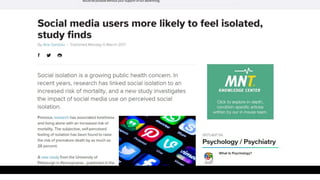
• Mental health
• Social relationships
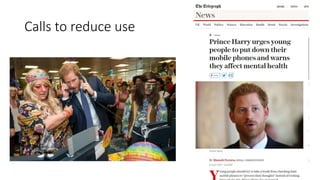
Calls to reduce use
Talk outline
• Mobile communication conquers the world
• Internet of Things (IoT)
• Intelligent networks
• Robots and intelligent agents
• Challenge ahead
IoT/Internet of OUR things (IoOT)
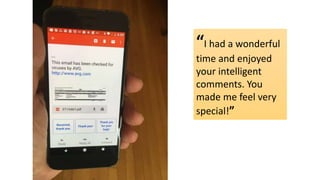
• Automation of interaction and emotion
“I had a wonderful
time and enjoyed
your intelligent
comments. You
made me feel very
special!”
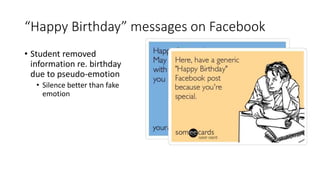
“Happy Birthday” messages on Facebook
• Student removed
information re. birthday
due to pseudo-emotion
• Silence better than fake
emotion
People very sensitive to fake emotion
• How meaningful?
• Algorithms to send,
alter message yearly
• False signaling of bond when none
exists
• Evolutionarily costly
IoOT allows transparency:
• Outward, to reveal to us more about the environment
• Inward, allowing the environment (and entities in it) to know more
about us
• Let’s discuss “Outward” first
Accountability in other areas
• “Meet your meat”
• Dole Food Company
• Web site allows virtual visits to banana farms
• Tracking numbers on fruit allow identification of specific locale of origin, including satellite
images
• “It’s really just a way for us to be as open and as transparent as possible with our consumers”
VP marketing & communications of Dole
• Several Japanese supermarkets
• Installed computers to allow shoppers to trace vegetables back to date of harvest, see photos
of farmers
• Source: Foreign Policy magazineclick
Rate rides and restaurants
• But they rate me too!
Ratings and rankings
• Wisdom of the crowd
• Demand for performance
• Monitoring and accountability
• Yelp restaurant reviews (sued by unhappy subject)
• Uber: You rate the driver, AND driver rates you!
• Satisfaction surveys widespread in customer service
• Critique of psychotherapy applicable to this area
• https://playingintheworldgame.files.wordpress.com/2014/06/nq1lev4.jpg
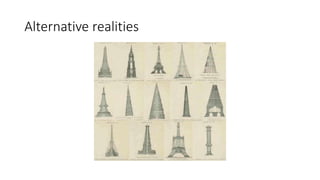
Alternative realities
Talk outline
• Mobile communication conquers the world
• Internet of Things (IoT)
• Intelligent networks
• Robots and intelligent agents
• Challenge ahead
Intelligent networks
• Ambiently “aware”
• Integrated
• Situationally responsive
• Allow collection of “Big data”
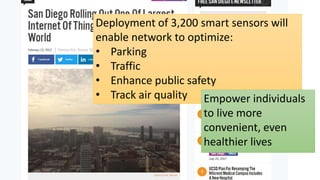
Deployment of 3,200 smart sensors will
enable network to optimize:
• Parking
• Traffic
• Enhance public safety
• Track air quality Empower individuals
to live more
convenient, even
healthier lives
Our intelligent stuff
• Through changes in technology, objects are able to collect, report and
coordinate information and then take action
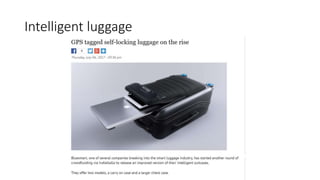
Intelligent luggage
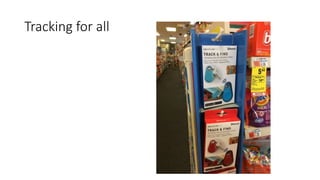
Tracking for all
Better service through loss of privacy
• Loyalty cards allow tracking and special offers
• Cameras can detect who comes through the door of a store
• Individual details
• Demographic composition of customer base
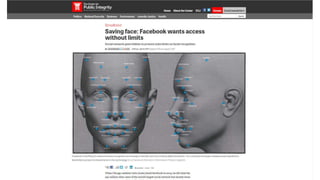
Already tracks via queries, websites
visited, and across websites
Ask about flights to Chile,
suddenly get lots of ads about
hotels in Santiago
Students use this knowledge to
manipulate system to their
advantage (care repairs; pizzas)
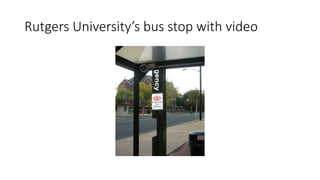
Rutgers University’s bus stop with video
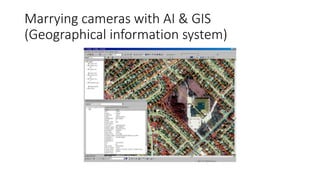
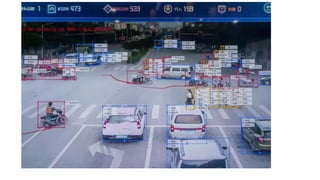
Marrying cameras with AI & GIS
(Geographical information system)
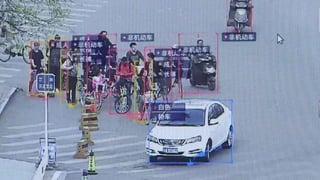
An electronic sign in Shenzhen, China,
shows the faces of people caught
jaywalking by surveillance cameras.
WALL STREET JOURNAL
https://blogs.wsj.com/cio/2017/06/27/the-morning-download-chinas-facial-recognition-ids-citizens-and-soon-may-score-their-behavior/
Free flow of information a receding dream?
• Once upon a time, people thought that digital age information
would move freely, beyond the control of governments
• Free movement of information would promote individual
freedom.
• Now with algorithms and artificial intelligence. Information no
longer can flow freely.
• And us?
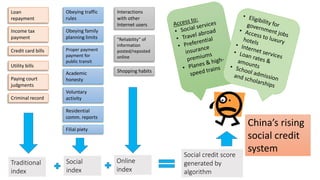
Loan
repayment
Income tax
payment
Paying court
judgments
Credit card bills
Utility bills
Obeying traffic
rules
Obeying family
planning limits
Academic
honesty
Voluntary
activity
Proper payment
payment for
public transit
Interactions
with other
Internet users
Shopping habits
“Reliability” of
information
posted/reposted
online
Filial piety
Traditional
index
Social
index
Online
index
Social credit score
generated by
algorithm
China’s rising
social credit
system
Criminal record
Residential
comm. reports
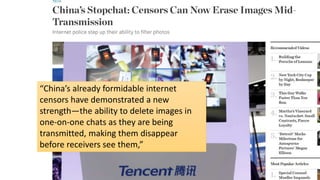
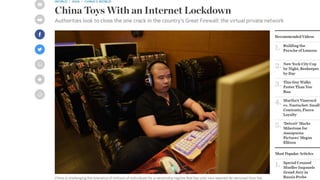
“China’s already formidable internet
censors have demonstrated a new
strength—the ability to delete images in
one-on-one chats as they are being
transmitted, making them disappear
before receivers see them,”
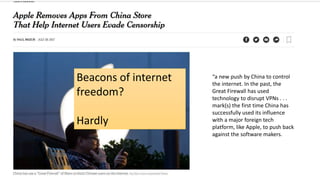
“a new push by China to control
the internet. In the past, the
Great Firewall has used
technology to disrupt VPNs . . .
mark(s) the first time China has
successfully used its influence
with a major foreign tech
platform, like Apple, to push back
against the software makers.
Beacons of internet
freedom?
Hardly
Talk outline
• Mobile communication conquers the world
• Internet of Things (IoT)
• Intelligent networks
• Robots and intelligent agents
• Challenge ahead
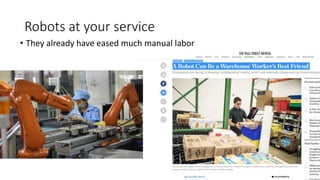
Robots at your service
• They already have eased much manual labor
Artificial intelligence (AI) coming
Nearly 4k people in worldwide online survey (2016) by ARM-Northstar:
• 61% see artificial intelligence making the world a better place
• 57% would prefer an AI doctor perform an eye exam
• 55% would trust an autonomous car
• 57% worried AI machines become more intelligent than people
http://pages.arm.com/rs/312-SAX-488/images/arm-ai-survey-report.pdf
Meet your boss: A computer!
• Artificial Intelligence comes to the workplace
Can they do “emotional labor”
• Offloading emotional connections
• Robot pets engineered to be responsive and give compassionate responses to
tone of voice
• Robot companions
• Developing emotions
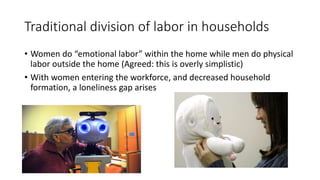
Traditional division of labor in households
• Women do “emotional labor” within the home while men do physical
labor outside the home (Agreed: this is overly simplistic)
• With women entering the workforce, and decreased household
formation, a loneliness gap arises
Holographic wife
• Meet Azuma Hikari
• holographic virtual assistant
• sends messages to owner
• E.g., "come home early"
• "can't wait to see you.“ ’
http://www.newsweek.com/holographic-wife-
japans-answer-amazon-echo-532641
Talk outline
• Mobile communication conquers the world
• Internet of Things (IoT)
• Intelligent networks
• Robots and intelligent agents
• Challenge ahead
Summary
• Mobile communication has given us much happiness, safety &
satisfaction. But there are costs both centrally & at the margin
• Digital technologies, intelligently connected and ever-shrinking, along
with synthetic entities, will give us:
• Greater power over ourselves and our environment
• Give others greater power over ourselves through the use and misuse of
technology
Risks severe
• They pose a risk to the quality of life
• Psychological deadening; political expression chilling; hollowed out social
relationships; draining meaning from life
• AND new interpersonal relationships; reduction in loneliness; opportunities
for finding like-minded others; organizing for community improvement;
individual and group fulfillment
• Opportunities for collective expression of political views, and also
suppression of them
The road before us
• These developments pose an unprecedented challenge to
humankind.
• By having the fruits of science scientific inquiry and critical analysis,
we can be on our guard to build systems that will be of benefit rather
than of enslavement.
• The road before us splits in two directions. By being engaged citizens,
we can pursue the path that will limit the abuse of power and lead to
the advancement of societal & intellectual well-being
Gracias
Questions, comments, discussion?
This protester with bright pink finger nails took a selfie in front of a blazing
• rise in short-form communications may be fostering a sense of
instant gratification.
• The majority (67 percent) of Americans feel the appropriate response
time to a text is under an hour, with 43 percent citing under 10
minutes and 10 percent thinking it should be instantly.
http://newsroom.bankofamerica.com/press-releases/consumer-
banking/fess-majority-americans-deny-their-smartphone-
behaviors
http://newsroom.bankofamerica.com/press-
releases/consumer-banking/fess-majority-
americans-deny-their-smartphone-behaviors
rise in short-form communications may be fostering a
sense of instant gratification. The majority (67 percent) of
Americans feel the appropriate response time to a text is
under an hour, with 43 percent citing under 10 minutes
and 10 percent thinking it should be instantly.
Three challenges as these forces combine
• People vs. self
• People vs. people
• People vs. virtual companions
• People vs. power
• Matrix
• Solution: Awareness, Law, Vigilance, and always guard the guardians!
(and the guardians guards!).
Virtual’s war on cash
32
40
6
7
21
17
11
7
3
4
0 5 10 15 20 25 30 35 40 45
2016
2012
Other
Electronic
Debit
Credit
Check
Cash
Source: https://www.wsj.com/articles/visa-takes-war-on-cash-to-restaurants-1499853601
Data from SFO Federal Reserve
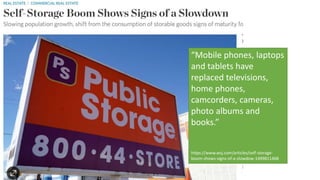
“Mobile phones, laptops
and tablets have
replaced televisions,
home phones,
camcorders, cameras,
photo albums and
books.”
https://www.wsj.com/articles/self-storage-
boom-shows-signs-of-a-slowdow-1499811468
https://www.youtube.com/watch?v=fSU0lTCM
TZw&ab_channel=PatrickBateman
4 forces converging to transform interior of our
lives (digitalization; mobility; robotization; big
data)• What they see: communication but not intelligent network
• Everything on a plain (telegraph)
• Long-standing concern about loss of privacy
• Yet many protections put into place in West (France)
• Maybe people don’t really care?
• But what’s going on in China? Maybe it’s different this time?
• Things are disappearing from our lives and our brains
• Moving into digital archives lost in space
• Mobility-can bring distant to present location, mod-present situation
• Reality becoming blended (as it always has– Stonehenge, pyramids, Japanese animism, Pat Boone and broken crosses –, but now faster and more profound)– e.g. buildings, electric lights (globe lights affect mood; paint color affects mood)
• Things can assume directed agency in service of humans (self-driving cars, uber, luggage); internet of things
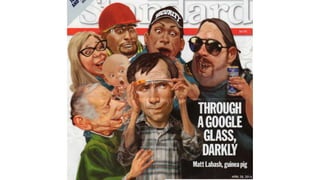
• Google glass,
• Ties that bind: we write others, but they rate us. Professors, restaurants, hotels, neighbors, dates
• China taking this to great lengths
• Big data nudge by governments
• Watch voting records; reading material indicates who you are
• Self-monitoring
• Result?
• Care w what we say (Hanne restricts what she posts on FB); smaller, narrower lives as everything can come back to bite us
• Companies that don’t agree with particularpolicies boycotted, individuals pressured/ruined (Mozillaexec re gay marriage)
• More easily manipulable as parameters of acceptability within sub-groups strains for conformity
• Gap between “filter bubbles” grow; separate communities, but conflict points
• Human freedom & autonomy becomes quite costly, harder to achieve
• Telegraph “plane”: Maybe this time wolf is at the door
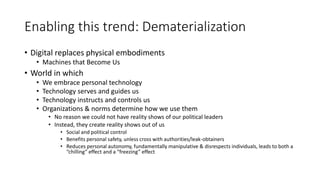
Enabling this trend: Dematerialization
• Digital replaces physical embodiments
• Machines that Become Us
• World in which
• We embrace personal technology
• Technology serves and guides us
• Technology instructs and controls us
• Organizations & norms determine how we use them
• No reason we could not have reality shows of our political leaders
• Instead, they create reality shows out of us
• Social and political control
• Benefits personal safety, unless cross with authorities/leak-obtainers
• Reduces personal autonomy, fundamentally manipulative & disrespects individuals, leads to both a
“chilling” effect and a “freezing” effect
• All mankind on a plain, 1984 St. Louis visual telegraph
• Hard when everything was big and unintelligent
• Now, machines are becoming us
• Efficiency is a driving force: can quantify. Human feelings, privacy, not so much. Therefore one drives out the
other.
• Dematerialization, network intelligence (often missed), robotization (toys)
• Shrinking storage; devices becoming intelligent. Self driving cars. Self-finding luggage (luggage will soon have
“black boxes” to show impact, temperature). Corollary: digital re-creation via visual, virtual, tactile experiences
& embodiments
• Google suggests answers to my emails! Already have organizations that represent views, auto-send messages.
Can fake Obama video-Why not full chat bots speaking for us, maybe even after we are dead (Talking
Tombstones) jap movie of cyber companion
• Revolution in monitoring selves
• Health, fitness, sleep, [mind can manipulate objects]; joggers compete x-nation
• Hyper-vigilance; the observed self; Gina Neff; Google Glass extensions
• Others
• Tinder effect-compose self to meet perceived others (guys w dogs [after all dogs have hijacked human char.) is
movie of dating
• Rating services/others rating us/LinkedIn/taxi/restaurants/tweeting performances
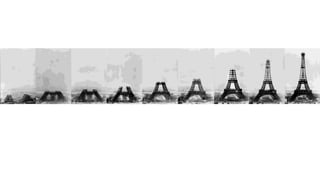
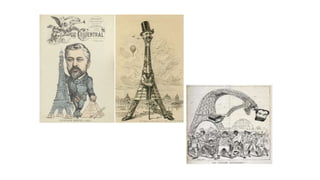
• Social media rating; internet score [china, Eiffel tour]
• Societal monitoring
• Chinese model  facial recognition; social rating; message intercept; $.50 army
• Good policing
Ties that bind: mobile communication
technology, transparency, and social control
• Technology alters pace of life
• Gives us information & control over environment
• Vast data collection efforts let us know traffic, events, friends’ whereabouts
• Reciprocal
• Voluntary giving up
• Passively collected (ez pass ticketing for speeding); facial recognition (London)
• Evaluations
• Others
• Ourselves
• Control our own env’t, but also opportunities opened & foreclosed
• Privacy (Secret ballot)
• Actions allow nudging
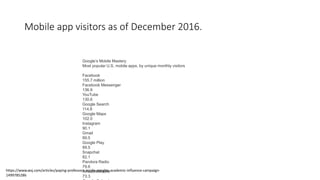
Mobile app visitors as of December 2016.
Google’s Mobile Mastery
Most popular U.S. mobile apps, by unique monthly visitors
Facebook
155.7 million
Facebook Messenger
136.9
YouTube
130.6
Google Search
114.8
Google Maps
102.0
Instagram
90.1
Gmail
89.5
Google Play
89.5
Snapchat
82.1
Pandora Radio
79.6
Amazon Mobile
73.3
https://www.wsj.com/articles/paying-professors-inside-googles-academic-influence-campaign-
1499785286
• “Machines will rule if we don't curb surveillance”
• “Machines rather than people could soon be running Britain because the
country has sleepwalked into a surveillance society”
• Nov. 1, 2006
• We ask machines to command us
• Sets our daily routines
• Wake us up; keep us from drowsy driving; track & remind us: All is with remote others!
• Give travel routing, recommend activities
• Answers our emails
• Soon to come: algorithms to represent us
• AI bosses wanted by many
• Emotional labor of AI companions
• We leave a trail of activities
• opens/closes opportunities (purchase, promotions)
• Nudges
• Taking “us” out of the equation
• Interface with reality
• Psych. consequences of largely interfacing w distant others, media content not people
• Leaves record to update & influence others
• Greater social presence in data-sphere:
• direct, (Even make movies)
• Indirect
• , hidden
• Evaluate others
• But others evaluate us!
• Fact of commentary takes us out of the experience
• World in which everybody is somebody
• FB, Instagram self-stories
• Big grid ruling us
• Put all these together and you have Chinese system
• Beautiful fruits, but in our power whether they are poison, healthy. Garden of Eden?
Unilever’s Mike Clementi, with interns including Saniya Jaffer, far left, at the company’s Englewood Cliffs, N.J., office, earlier this month.
KEVIN HAGEN FOR THE WALL STREET JOURNAL
The also knows. A radical hiring experiment is under way at Unilever PLC, the London-based maker of Dove soap and Axe deodorant,
It starts with targeted ads. Interested parties who click on ads on Facebook and career-advice sites such as Way Up and the Muse are d
Apply algorithm. An algorithm scans those applications—275,400 in all so far—to surface candidates who meet a given role’s requiremen
Gamify skill search. Candidates then play a set of 12 short online games designed to assess skills like concentration under pressure and
Apply artificial intelligence. AI uses data points such as how quickly they respond to questions, their facial expressions and vocabulary to
Enter humans. The last step is a final in-person interview with Unilever human-resources executives and managers.

James Katz en MoRe

  • 1.
    Emerging media technology: Today’sbenefits and tomorrow’s perils James E Katz, Boston University Boston, MA USA
  • 2.
    Talk outline • Mobilecommunication conquers the world • Internet of Things (IoT) • Intelligent networks • Robots and intelligent agents • Challenge ahead
  • 3.
  • 4.
    Last thing atnight • Young people = 18-30 year olds • 95% use phone for something just before going to bed • 90% sleep with them • http://www.businessinsider.com/90-of-18-29-year-olds-sleep-with-their-smartphones-2012-11
  • 5.
  • 6.
  • 7.
    Perpetual contact inthe USA • 38% of U.S. adult consumers never disconnect from their smartphones • Only 7% shut down entirely on vacation • 89% check their smartphones at least several times a day, and 36% constantly check their devices • Millennials (39%) say they are most likely to interact with their smartphone more than anyone or anything else, including their significant other (27%) • Teens: 9 hours of social/screen media engagement daily http://newsroom.bankofamerica.com/press-releases/consumer-banking/perpetually-plugged- americas-smartphone-obsession-continues-many-adm http://newsroom.bankofamerica.com/press-releases/consumer- banking/fess-majority-americans-deny-their-smartphone- behaviors
  • 8.
    • Social relationships •Small group relationships • Building blocks leading to level of culture
  • 9.
    Speaking of dating. . . • Dating apps like Tinder • Open new vistas • Source of wonderful relationships in some cases • Opportunity structure (R. K. Merton) leads to less satisfaction with current situation
  • 10.
  • 12.
    Forbidden pleasures ina museum No cell use allowed in art museum
  • 13.
    Increasingly aiding healthand personal safety • Monitor health • Track and correct behavior • Also poses risks
  • 14.
    f • Blue tooth •Isolation • Accelerometer • Physical activity • Ambient light • sleep environment • Camera • Tracks facial expressions, • Eye movements • Touch screen • Response times for tasks • Tremors • Microphone • tone of voice reveals mood • ambient social environment
  • 20.
    All these activitiesleave traces • Allow investigators and authorities to track, monitor and recover activities & information • Flash function used just before airplane crash • Texts gave context and messages of teen convicted of encouraging suicide • Big trail that can be used to influence and control people & their behaviors • A topic I’ll return to later
  • 21.
    Next steps • Built-inpersonal assistant
  • 23.
    Much enjoyment, benefitsand use in mobile communication • But also downsides • Physical health • Mental health • Social relationships
  • 26.
  • 27.
    Talk outline • Mobilecommunication conquers the world • Internet of Things (IoT) • Intelligent networks • Robots and intelligent agents • Challenge ahead
  • 28.
    IoT/Internet of OURthings (IoOT) • Automation of interaction and emotion
  • 29.
    “I had awonderful time and enjoyed your intelligent comments. You made me feel very special!”
  • 30.
    “Happy Birthday” messageson Facebook • Student removed information re. birthday due to pseudo-emotion • Silence better than fake emotion
  • 31.
    People very sensitiveto fake emotion • How meaningful? • Algorithms to send, alter message yearly • False signaling of bond when none exists • Evolutionarily costly
  • 32.
    IoOT allows transparency: •Outward, to reveal to us more about the environment • Inward, allowing the environment (and entities in it) to know more about us • Let’s discuss “Outward” first
  • 33.
    Accountability in otherareas • “Meet your meat” • Dole Food Company • Web site allows virtual visits to banana farms • Tracking numbers on fruit allow identification of specific locale of origin, including satellite images • “It’s really just a way for us to be as open and as transparent as possible with our consumers” VP marketing & communications of Dole • Several Japanese supermarkets • Installed computers to allow shoppers to trace vegetables back to date of harvest, see photos of farmers • Source: Foreign Policy magazineclick
  • 36.
    Rate rides andrestaurants • But they rate me too!
  • 37.
    Ratings and rankings •Wisdom of the crowd • Demand for performance • Monitoring and accountability • Yelp restaurant reviews (sued by unhappy subject) • Uber: You rate the driver, AND driver rates you! • Satisfaction surveys widespread in customer service • Critique of psychotherapy applicable to this area
  • 38.
  • 40.
  • 41.
    Talk outline • Mobilecommunication conquers the world • Internet of Things (IoT) • Intelligent networks • Robots and intelligent agents • Challenge ahead
  • 42.
    Intelligent networks • Ambiently“aware” • Integrated • Situationally responsive • Allow collection of “Big data”
  • 43.
    Deployment of 3,200smart sensors will enable network to optimize: • Parking • Traffic • Enhance public safety • Track air quality Empower individuals to live more convenient, even healthier lives
  • 44.
    Our intelligent stuff •Through changes in technology, objects are able to collect, report and coordinate information and then take action
  • 45.
  • 46.
  • 47.
    Better service throughloss of privacy • Loyalty cards allow tracking and special offers • Cameras can detect who comes through the door of a store • Individual details • Demographic composition of customer base
  • 48.
    Already tracks viaqueries, websites visited, and across websites Ask about flights to Chile, suddenly get lots of ads about hotels in Santiago Students use this knowledge to manipulate system to their advantage (care repairs; pizzas)
  • 50.
  • 51.
    Marrying cameras withAI & GIS (Geographical information system)
  • 52.
    An electronic signin Shenzhen, China, shows the faces of people caught jaywalking by surveillance cameras. WALL STREET JOURNAL https://blogs.wsj.com/cio/2017/06/27/the-morning-download-chinas-facial-recognition-ids-citizens-and-soon-may-score-their-behavior/
  • 59.
    Free flow ofinformation a receding dream? • Once upon a time, people thought that digital age information would move freely, beyond the control of governments • Free movement of information would promote individual freedom. • Now with algorithms and artificial intelligence. Information no longer can flow freely. • And us?
  • 60.
    Loan repayment Income tax payment Paying court judgments Creditcard bills Utility bills Obeying traffic rules Obeying family planning limits Academic honesty Voluntary activity Proper payment payment for public transit Interactions with other Internet users Shopping habits “Reliability” of information posted/reposted online Filial piety Traditional index Social index Online index Social credit score generated by algorithm China’s rising social credit system Criminal record Residential comm. reports
  • 61.
    “China’s already formidableinternet censors have demonstrated a new strength—the ability to delete images in one-on-one chats as they are being transmitted, making them disappear before receivers see them,”
  • 63.
    “a new pushby China to control the internet. In the past, the Great Firewall has used technology to disrupt VPNs . . . mark(s) the first time China has successfully used its influence with a major foreign tech platform, like Apple, to push back against the software makers. Beacons of internet freedom? Hardly
  • 64.
    Talk outline • Mobilecommunication conquers the world • Internet of Things (IoT) • Intelligent networks • Robots and intelligent agents • Challenge ahead
  • 65.
    Robots at yourservice • They already have eased much manual labor
  • 66.
    Artificial intelligence (AI)coming Nearly 4k people in worldwide online survey (2016) by ARM-Northstar: • 61% see artificial intelligence making the world a better place • 57% would prefer an AI doctor perform an eye exam • 55% would trust an autonomous car • 57% worried AI machines become more intelligent than people http://pages.arm.com/rs/312-SAX-488/images/arm-ai-survey-report.pdf
  • 67.
    Meet your boss:A computer! • Artificial Intelligence comes to the workplace
  • 69.
    Can they do“emotional labor” • Offloading emotional connections • Robot pets engineered to be responsive and give compassionate responses to tone of voice • Robot companions • Developing emotions
  • 70.
    Traditional division oflabor in households • Women do “emotional labor” within the home while men do physical labor outside the home (Agreed: this is overly simplistic) • With women entering the workforce, and decreased household formation, a loneliness gap arises
  • 71.
    Holographic wife • MeetAzuma Hikari • holographic virtual assistant • sends messages to owner • E.g., "come home early" • "can't wait to see you.“ ’ http://www.newsweek.com/holographic-wife- japans-answer-amazon-echo-532641
  • 73.
    Talk outline • Mobilecommunication conquers the world • Internet of Things (IoT) • Intelligent networks • Robots and intelligent agents • Challenge ahead
  • 74.
    Summary • Mobile communicationhas given us much happiness, safety & satisfaction. But there are costs both centrally & at the margin • Digital technologies, intelligently connected and ever-shrinking, along with synthetic entities, will give us: • Greater power over ourselves and our environment • Give others greater power over ourselves through the use and misuse of technology
  • 75.
    Risks severe • Theypose a risk to the quality of life • Psychological deadening; political expression chilling; hollowed out social relationships; draining meaning from life • AND new interpersonal relationships; reduction in loneliness; opportunities for finding like-minded others; organizing for community improvement; individual and group fulfillment • Opportunities for collective expression of political views, and also suppression of them
  • 76.
    The road beforeus • These developments pose an unprecedented challenge to humankind. • By having the fruits of science scientific inquiry and critical analysis, we can be on our guard to build systems that will be of benefit rather than of enslavement. • The road before us splits in two directions. By being engaged citizens, we can pursue the path that will limit the abuse of power and lead to the advancement of societal & intellectual well-being
  • 77.
  • 78.
  • 80.
    This protester withbright pink finger nails took a selfie in front of a blazing
  • 81.
    • rise inshort-form communications may be fostering a sense of instant gratification. • The majority (67 percent) of Americans feel the appropriate response time to a text is under an hour, with 43 percent citing under 10 minutes and 10 percent thinking it should be instantly. http://newsroom.bankofamerica.com/press-releases/consumer- banking/fess-majority-americans-deny-their-smartphone- behaviors
  • 82.
    http://newsroom.bankofamerica.com/press- releases/consumer-banking/fess-majority- americans-deny-their-smartphone-behaviors rise in short-formcommunications may be fostering a sense of instant gratification. The majority (67 percent) of Americans feel the appropriate response time to a text is under an hour, with 43 percent citing under 10 minutes and 10 percent thinking it should be instantly.
  • 83.
    Three challenges asthese forces combine • People vs. self • People vs. people • People vs. virtual companions • People vs. power • Matrix • Solution: Awareness, Law, Vigilance, and always guard the guardians! (and the guardians guards!).
  • 84.
    Virtual’s war oncash 32 40 6 7 21 17 11 7 3 4 0 5 10 15 20 25 30 35 40 45 2016 2012 Other Electronic Debit Credit Check Cash Source: https://www.wsj.com/articles/visa-takes-war-on-cash-to-restaurants-1499853601 Data from SFO Federal Reserve
  • 85.
    “Mobile phones, laptops andtablets have replaced televisions, home phones, camcorders, cameras, photo albums and books.” https://www.wsj.com/articles/self-storage- boom-shows-signs-of-a-slowdow-1499811468
  • 86.
  • 88.
    4 forces convergingto transform interior of our lives (digitalization; mobility; robotization; big data)• What they see: communication but not intelligent network • Everything on a plain (telegraph) • Long-standing concern about loss of privacy • Yet many protections put into place in West (France) • Maybe people don’t really care? • But what’s going on in China? Maybe it’s different this time? • Things are disappearing from our lives and our brains • Moving into digital archives lost in space • Mobility-can bring distant to present location, mod-present situation • Reality becoming blended (as it always has– Stonehenge, pyramids, Japanese animism, Pat Boone and broken crosses –, but now faster and more profound)– e.g. buildings, electric lights (globe lights affect mood; paint color affects mood) • Things can assume directed agency in service of humans (self-driving cars, uber, luggage); internet of things • Google glass, • Ties that bind: we write others, but they rate us. Professors, restaurants, hotels, neighbors, dates • China taking this to great lengths • Big data nudge by governments • Watch voting records; reading material indicates who you are • Self-monitoring • Result? • Care w what we say (Hanne restricts what she posts on FB); smaller, narrower lives as everything can come back to bite us • Companies that don’t agree with particularpolicies boycotted, individuals pressured/ruined (Mozillaexec re gay marriage) • More easily manipulable as parameters of acceptability within sub-groups strains for conformity • Gap between “filter bubbles” grow; separate communities, but conflict points • Human freedom & autonomy becomes quite costly, harder to achieve • Telegraph “plane”: Maybe this time wolf is at the door
  • 94.
    Enabling this trend:Dematerialization • Digital replaces physical embodiments • Machines that Become Us • World in which • We embrace personal technology • Technology serves and guides us • Technology instructs and controls us • Organizations & norms determine how we use them • No reason we could not have reality shows of our political leaders • Instead, they create reality shows out of us • Social and political control • Benefits personal safety, unless cross with authorities/leak-obtainers • Reduces personal autonomy, fundamentally manipulative & disrespects individuals, leads to both a “chilling” effect and a “freezing” effect
  • 95.
    • All mankindon a plain, 1984 St. Louis visual telegraph • Hard when everything was big and unintelligent • Now, machines are becoming us • Efficiency is a driving force: can quantify. Human feelings, privacy, not so much. Therefore one drives out the other. • Dematerialization, network intelligence (often missed), robotization (toys) • Shrinking storage; devices becoming intelligent. Self driving cars. Self-finding luggage (luggage will soon have “black boxes” to show impact, temperature). Corollary: digital re-creation via visual, virtual, tactile experiences & embodiments • Google suggests answers to my emails! Already have organizations that represent views, auto-send messages. Can fake Obama video-Why not full chat bots speaking for us, maybe even after we are dead (Talking Tombstones) jap movie of cyber companion • Revolution in monitoring selves • Health, fitness, sleep, [mind can manipulate objects]; joggers compete x-nation • Hyper-vigilance; the observed self; Gina Neff; Google Glass extensions • Others • Tinder effect-compose self to meet perceived others (guys w dogs [after all dogs have hijacked human char.) is movie of dating • Rating services/others rating us/LinkedIn/taxi/restaurants/tweeting performances • Social media rating; internet score [china, Eiffel tour] • Societal monitoring • Chinese model  facial recognition; social rating; message intercept; $.50 army • Good policing
  • 96.
    Ties that bind:mobile communication technology, transparency, and social control • Technology alters pace of life • Gives us information & control over environment • Vast data collection efforts let us know traffic, events, friends’ whereabouts • Reciprocal • Voluntary giving up • Passively collected (ez pass ticketing for speeding); facial recognition (London) • Evaluations • Others • Ourselves • Control our own env’t, but also opportunities opened & foreclosed • Privacy (Secret ballot) • Actions allow nudging
  • 97.
    Mobile app visitorsas of December 2016. Google’s Mobile Mastery Most popular U.S. mobile apps, by unique monthly visitors Facebook 155.7 million Facebook Messenger 136.9 YouTube 130.6 Google Search 114.8 Google Maps 102.0 Instagram 90.1 Gmail 89.5 Google Play 89.5 Snapchat 82.1 Pandora Radio 79.6 Amazon Mobile 73.3 https://www.wsj.com/articles/paying-professors-inside-googles-academic-influence-campaign- 1499785286
  • 98.
    • “Machines willrule if we don't curb surveillance” • “Machines rather than people could soon be running Britain because the country has sleepwalked into a surveillance society” • Nov. 1, 2006
  • 99.
    • We askmachines to command us • Sets our daily routines • Wake us up; keep us from drowsy driving; track & remind us: All is with remote others! • Give travel routing, recommend activities • Answers our emails • Soon to come: algorithms to represent us • AI bosses wanted by many • Emotional labor of AI companions • We leave a trail of activities • opens/closes opportunities (purchase, promotions) • Nudges • Taking “us” out of the equation • Interface with reality • Psych. consequences of largely interfacing w distant others, media content not people • Leaves record to update & influence others • Greater social presence in data-sphere: • direct, (Even make movies) • Indirect • , hidden • Evaluate others • But others evaluate us! • Fact of commentary takes us out of the experience • World in which everybody is somebody • FB, Instagram self-stories • Big grid ruling us • Put all these together and you have Chinese system • Beautiful fruits, but in our power whether they are poison, healthy. Garden of Eden?
  • 100.
    Unilever’s Mike Clementi,with interns including Saniya Jaffer, far left, at the company’s Englewood Cliffs, N.J., office, earlier this month. KEVIN HAGEN FOR THE WALL STREET JOURNAL The also knows. A radical hiring experiment is under way at Unilever PLC, the London-based maker of Dove soap and Axe deodorant, It starts with targeted ads. Interested parties who click on ads on Facebook and career-advice sites such as Way Up and the Muse are d Apply algorithm. An algorithm scans those applications—275,400 in all so far—to surface candidates who meet a given role’s requiremen Gamify skill search. Candidates then play a set of 12 short online games designed to assess skills like concentration under pressure and Apply artificial intelligence. AI uses data points such as how quickly they respond to questions, their facial expressions and vocabulary to Enter humans. The last step is a final in-person interview with Unilever human-resources executives and managers.