
Semiloka Internasional, 5 Oktober 2012


      Science & Technology
  Past and future developments


RICHARD MENGKO

Kelompok Keahlian Teknik Biomedika
Institut Teknologi Bandung
Prolog
   IEEE Proceedings have just published a Centenial Special Issue,
    (vol 100, May 13th,2012) – celebrating its 100 years after the
    Institute of Radio Engineers was founded (May 1912)


   This presentation will focus on one of the topics published in this
    special issue :
          100 years in the past and 100 years in the future
                             (Peter Cochrane)


   After a brief discussion on the above issue, at the end of this
    presentation you will find some of my thoughts to be discussed
    especially for developing countries including Indonesia


      grabbing attention & awareness to what we are facing …….


2
A wave of innovation powered by a war
 The world have experienced a tremendous S&T development
  after the 2nd world war :
     • setting up of the NSF in US
     • the first rocket more than 100 miles into space
     • penicillin went into mass production
     • the first transistor from Bell Labs
     • emergence of sonar, radar, microwave
     • semiconductor devices & computers


           No one was seriuosly predicting pocket calculators,
                mobile phones, PCs, iPad, internet ……


3
a world with full of optimism
 right after this innovation wave, movies, magazines, books,
  comics were full of visions depicting space travels, levitating
  vehicles, intelligent robots, instant communication etc ….


 but …..the future did not exactly work out like that …


 we found new things to do with our technologies & time,
  creating new devices, new industries, new doors to discover
  enriching our knowledge base

                  the key element of discovery was
                   electronics, computing power &
                           instrumentation
                         ……up to present …..


4
acceleration by creative feedback loops
 Our thinking is largely predicated on slow linear growth and
  quantities within our span, grasp & time scale
 Over the past three decades we have experienced an
  exponential change due to the ‘creative feedback loop’ –
  where the the creative users (amateurs, hobbiests, gamers)
  became the lead in new products ….


       Interviewer :
       Dr Cray have you heard that Apple are buying your latest
       Computer to help them design the next generation of laptops ?

       Seymour Cray :
       That’s interesting, because I just bought one of their laptops
       to help me design my next generation of super computers !


5
internet push innovation to the edge
 www, cloud computing, social net will push innovation further
  to the edge, facilitating the complex creative feedback loop
 Bright individuals are now augmented by powerful machines &
  networked teams migrating from singular to multidiciplinary
  activities
 Linear independence of the past has been overtaken by the
  complexity of networking (non linear & complex)
 Without computing power & networks, no hope of being able
  to understand the world we now live in, and worse no chance
  of managing the migration into the future …..


         English language become a must for every one,
           more than 80% in the internet is in English


6
the next industrial revolution
 Today, we live in a ‘digital everything’ world. Our transistors
  are now smaller than a flu virus
 What of the future ?
 The biggest threat to mankind is not the new technologies &
  associated serious errors, but our inability to change, adopt
  the new & to let go the past :
             Economic growth  sustainable futures
              food to waste  food to waste to food
 Some of the prediction before : nuclear fision & fusion supply
  all of our energy needs, wireless power over distance,
  underwater cities, supersonic transport etc
 Why it did not happened ? – optimistic beyond our ignorance
  level ? – economics, politics, public opinion subverted the
  opportunity ? – fundamental physic law could not be
  circumvented in the time frame ?
7
the next industrial revolution
 However, there were far more discoveries than anticipated :
 The microprocessor has changed everything from agriculture
  to industry, communication, computing, medecine, commerce
  and entertainment
 Computer chips, www became the base of human networking
  today
 Bio engineers have created medical instruments (MRI, CTscan,
  Digital Angiography, etc) and also some body spare parts
  seen as an ‘almost science fiction’

            Can we say what will be 100 years in front ?
                     not in detail for sure, but
              we can map some interesting trends ….


8
the next industrial revolution
 It is possible to extrapolate the visible technology trends with
  reasonable confidence, but from our past experience we are in
  many cases pesimistic & mostly achieve far more than we
  imagine
    We do not have any idea how societies in the future will
    change on what will be acceptable or not
 So, the best what we can do is making an expert (educated)
  guess …….


               We are bordering science fiction ……. !!


9
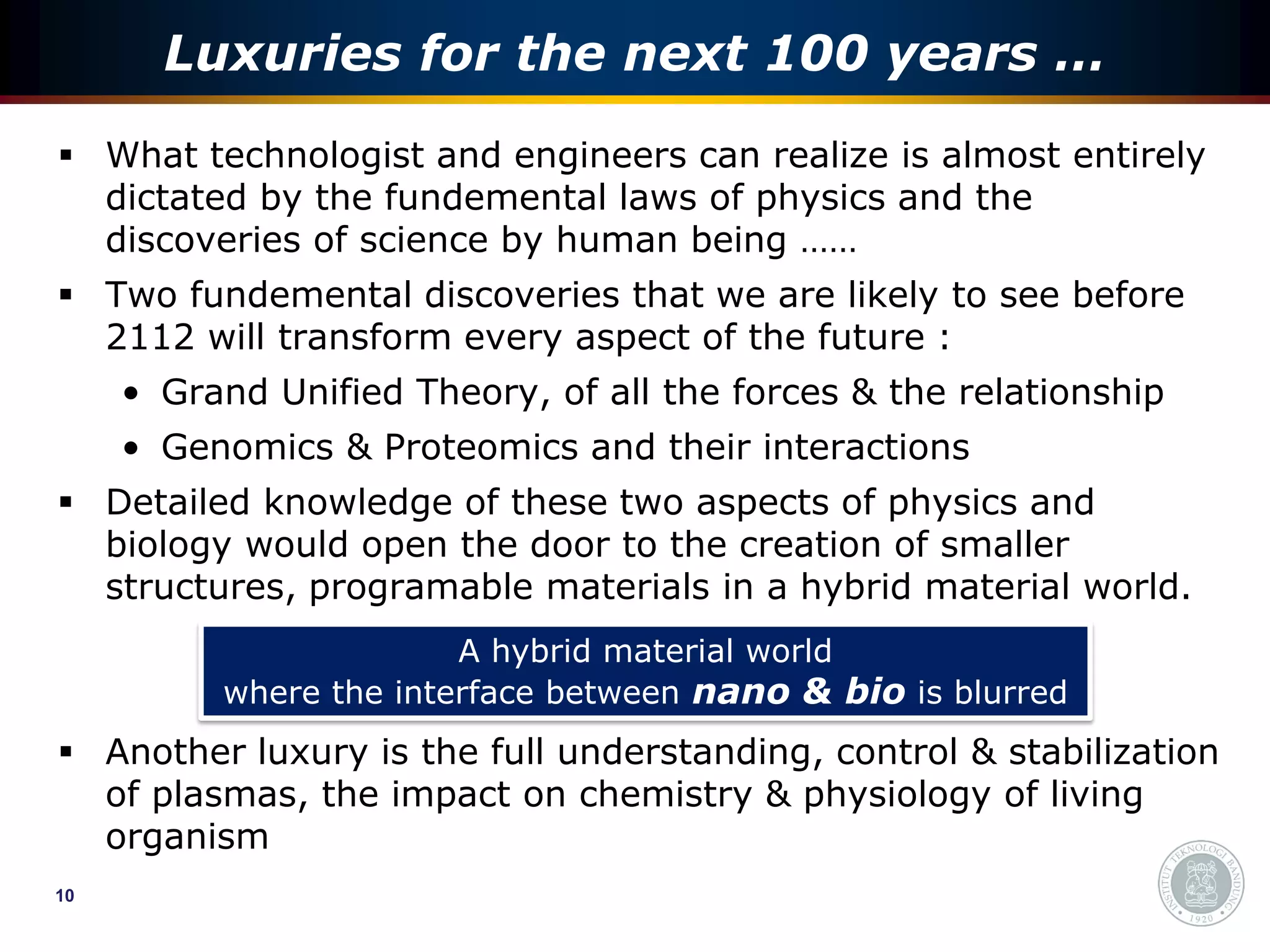
Luxuries for the next 100 years …
 What technologist and engineers can realize is almost entirely
  dictated by the fundemental laws of physics and the
  discoveries of science by human being ……
 Two fundemental discoveries that we are likely to see before
  2112 will transform every aspect of the future :
     • Grand Unified Theory, of all the forces & the relationship
     • Genomics & Proteomics and their interactions
 Detailed knowledge of these two aspects of physics and
  biology would open the door to the creation of smaller
  structures, programable materials in a hybrid material world.
                        A hybrid material world
          where the interface between nano & bio is blurred
 Another luxury is the full understanding, control & stabilization
  of plasmas, the impact on chemistry & physiology of living
  organism
10
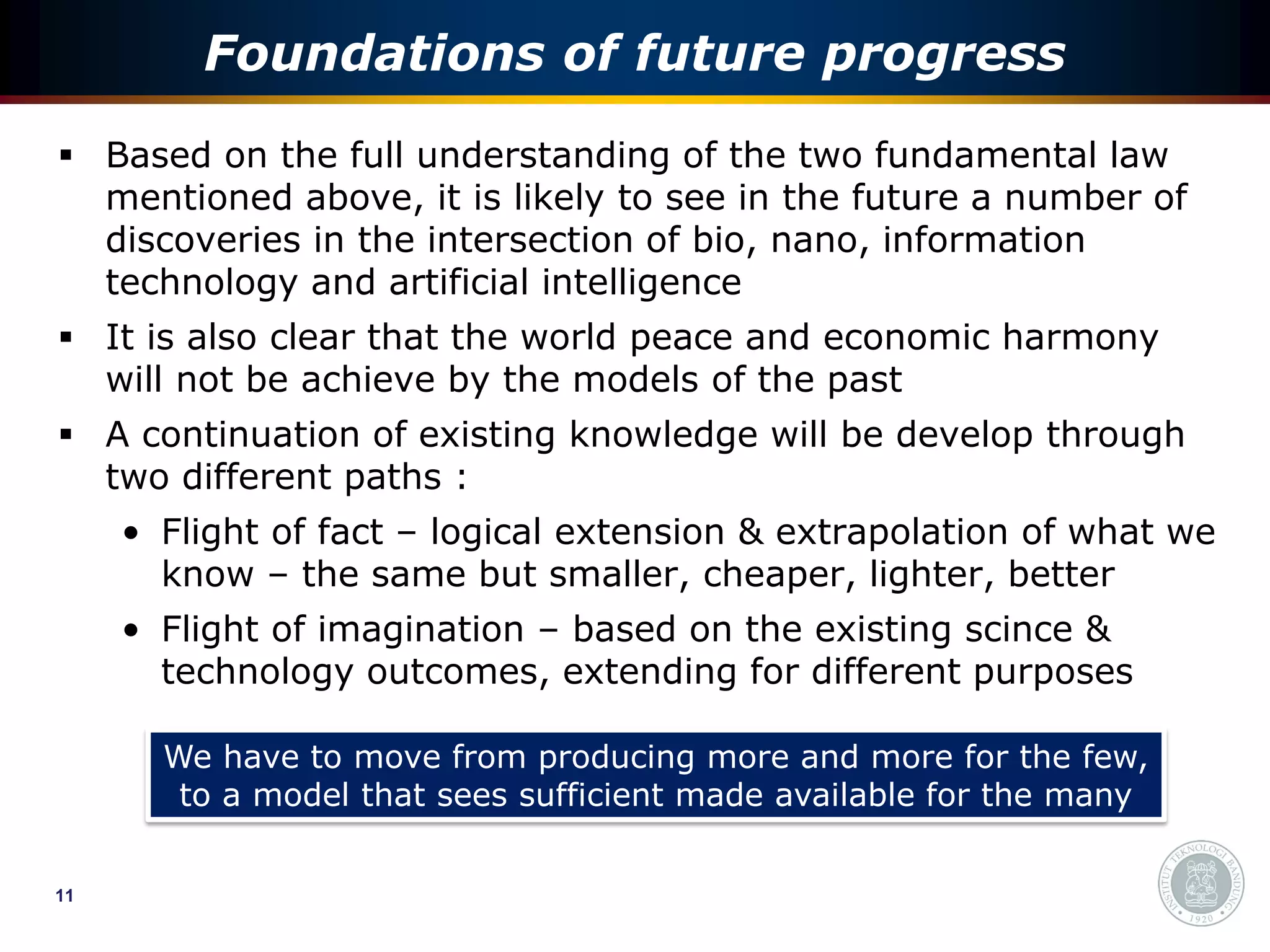
Foundations of future progress
 Based on the full understanding of the two fundamental law
  mentioned above, it is likely to see in the future a number of
  discoveries in the intersection of bio, nano, information
  technology and artificial intelligence
 It is also clear that the world peace and economic harmony
  will not be achieve by the models of the past
 A continuation of existing knowledge will be develop through
  two different paths :
     • Flight of fact – logical extension & extrapolation of what we
       know – the same but smaller, cheaper, lighter, better
     • Flight of imagination – based on the existing scince &
       technology outcomes, extending for different purposes

       We have to move from producing more and more for the few,
        to a model that sees sufficient made available for the many


11
changes to come
 Implants & tagging human :
     • by 2112 most of the today’s implants (pacemakers,
       respiratory stimulators, pancreas etc) will be replaced by
       artificial organs.
     • more electronics into our body, location tags, passports,
       ID, medical records
     • many enhancement offers for eyes, ears etc
     • self diagnostic chip implants
     • Drug designs for customized individual body specifications
     • Robotic surgery & automated procedures
     • Best of the best expertise in the planet to the point of need


12
changes to come
     • The capability to cure vital infections and cancer by
       inhibiting a foreign body or reprogramming the
       communication between protein and genome
      With the decode of genome & protein, we can produce a
       body simulator to identify a range of tendencies & specific
       disease and propose a body specific drug & treatments

 Automobiles & transports :
      Unless a GUT reveals, our aircraft will still burning some
       kind of synthezised fuels, far less damaging to ecology
      New materials is likelyto be used to minimize drag.
      Train with levitation up to the speed just below the sound
       barrier
      Ultralight electric vehicles with high efficient batteries and
       programable ‘skin’ with any color, self repairing all minor
       damage, mostly driverless with programmable destination
13
changes to come
 Telecommunications :
     • Optical fibers will be installed to every node in order to
       deliver 10Gb/s to anything for monitoring, communication
       & control
     • The whole radio spectrum is becoming ‘one’ singular big
       bandwidth categorized by the intended use and demand
       with intelligent ‘repeaters’


 Education :
     • Internet with all of the accesible information will act more
       and more as the ‘world brain’
     • A more ‘open’ education system is likely to be chosen as
       the system of the future, with ‘the guide at the side’ and
       all materials online


14
changes to come
 Design :
     • Today CAD will be augmented with AI systems, based on
       previous experience to create the new generation of
       machines that design machines with a great detail and
       complexity, displacing a large part (if not totally) of human
       hand and mind.
     • This will automatically lead to the creation of human-
       robotic ecosystems which will raise a new set of ethical
       tension.
     • Perhaps the most problematic of these will be the
       inclussion of biological ‘living’ elements in the design
 Energy :
 Storage is the key problem of the progress. We have no
  shortage of energy or the means to produce it, but we have to
  focus on those solutions that minimize ecological damage

15
changes to come
     • Our battery technologies belong to the previous century
       and our big energy storage (city level) needs civil
       engineering in a massive scale
     • Energy consumption has its huge peaks in every form
       (industry, automobile, train etc). Our eco-friendly source
       (wind, solar, tidal wave etc) are also sporadic, incosistent
       and unreliable. Some form of demand – supply ‘smoothing’
       is therefore necessary
     • At a city level we can expect to see ‘subsurface’ liquid
       metal energy storage combined with other energy supplies
       including solar and algae based systems
 Human interface :
     • Will we be able to input and output directly to and from the
       brain ? Can we augment our natural abilities by directly
       linking to others or the global network of machines ?

16
changes to come
     • Undoubtedly the answer has to be yes, but to what degree,
       we can only guess
     • Information input rate to the brain far exceeds our output
     • Faster input through our visual cortex are possible using
       direct laser and electronic interfaces, but how do we get
       more out verbally ? – the only logical connection without
       wire tapping is using scanning technologies able to probe
       down to a neuron level
     • At this time, no such scanner exist and to create will
       demand new understanding of electromagnetic fields and
       the biology-chemistry of thinking


17
discussion
Our job is not only to ‘engineer’ the best system and outcomes, but to guide
    our managers, politicians and society to the best workable solution,
                         towards a sustainable future


                                   Danger :
         In many countries, a huge & fast development is obtained in
            the political and economy sector, with less priority for
                building the ecosystem for S&T development


       In most of the developing countries, many ‘old’ problem still exist,
                re-evaluation is needed, to set up a strategy of
                   ‘old-new problems vs old-new technologies


  18
Science & Technology - Past and Future Development

Science & Technology - Past and Future Development

  • 1.
    Semiloka Internasional, 5Oktober 2012 Science & Technology Past and future developments RICHARD MENGKO Kelompok Keahlian Teknik Biomedika Institut Teknologi Bandung
  • 2.
    Prolog  IEEE Proceedings have just published a Centenial Special Issue, (vol 100, May 13th,2012) – celebrating its 100 years after the Institute of Radio Engineers was founded (May 1912)  This presentation will focus on one of the topics published in this special issue : 100 years in the past and 100 years in the future (Peter Cochrane)  After a brief discussion on the above issue, at the end of this presentation you will find some of my thoughts to be discussed especially for developing countries including Indonesia grabbing attention & awareness to what we are facing ……. 2
  • 3.
    A wave ofinnovation powered by a war  The world have experienced a tremendous S&T development after the 2nd world war : • setting up of the NSF in US • the first rocket more than 100 miles into space • penicillin went into mass production • the first transistor from Bell Labs • emergence of sonar, radar, microwave • semiconductor devices & computers No one was seriuosly predicting pocket calculators, mobile phones, PCs, iPad, internet …… 3
  • 4.
    a world withfull of optimism  right after this innovation wave, movies, magazines, books, comics were full of visions depicting space travels, levitating vehicles, intelligent robots, instant communication etc ….  but …..the future did not exactly work out like that …  we found new things to do with our technologies & time, creating new devices, new industries, new doors to discover enriching our knowledge base the key element of discovery was electronics, computing power & instrumentation ……up to present ….. 4
  • 5.
    acceleration by creativefeedback loops  Our thinking is largely predicated on slow linear growth and quantities within our span, grasp & time scale  Over the past three decades we have experienced an exponential change due to the ‘creative feedback loop’ – where the the creative users (amateurs, hobbiests, gamers) became the lead in new products …. Interviewer : Dr Cray have you heard that Apple are buying your latest Computer to help them design the next generation of laptops ? Seymour Cray : That’s interesting, because I just bought one of their laptops to help me design my next generation of super computers ! 5
  • 6.
    internet push innovationto the edge  www, cloud computing, social net will push innovation further to the edge, facilitating the complex creative feedback loop  Bright individuals are now augmented by powerful machines & networked teams migrating from singular to multidiciplinary activities  Linear independence of the past has been overtaken by the complexity of networking (non linear & complex)  Without computing power & networks, no hope of being able to understand the world we now live in, and worse no chance of managing the migration into the future ….. English language become a must for every one, more than 80% in the internet is in English 6
  • 7.
    the next industrialrevolution  Today, we live in a ‘digital everything’ world. Our transistors are now smaller than a flu virus  What of the future ?  The biggest threat to mankind is not the new technologies & associated serious errors, but our inability to change, adopt the new & to let go the past : Economic growth  sustainable futures food to waste  food to waste to food  Some of the prediction before : nuclear fision & fusion supply all of our energy needs, wireless power over distance, underwater cities, supersonic transport etc  Why it did not happened ? – optimistic beyond our ignorance level ? – economics, politics, public opinion subverted the opportunity ? – fundamental physic law could not be circumvented in the time frame ? 7
  • 8.
    the next industrialrevolution  However, there were far more discoveries than anticipated :  The microprocessor has changed everything from agriculture to industry, communication, computing, medecine, commerce and entertainment  Computer chips, www became the base of human networking today  Bio engineers have created medical instruments (MRI, CTscan, Digital Angiography, etc) and also some body spare parts seen as an ‘almost science fiction’ Can we say what will be 100 years in front ? not in detail for sure, but we can map some interesting trends …. 8
  • 9.
    the next industrialrevolution  It is possible to extrapolate the visible technology trends with reasonable confidence, but from our past experience we are in many cases pesimistic & mostly achieve far more than we imagine  We do not have any idea how societies in the future will change on what will be acceptable or not  So, the best what we can do is making an expert (educated) guess ……. We are bordering science fiction ……. !! 9
  • 10.
    Luxuries for thenext 100 years …  What technologist and engineers can realize is almost entirely dictated by the fundemental laws of physics and the discoveries of science by human being ……  Two fundemental discoveries that we are likely to see before 2112 will transform every aspect of the future : • Grand Unified Theory, of all the forces & the relationship • Genomics & Proteomics and their interactions  Detailed knowledge of these two aspects of physics and biology would open the door to the creation of smaller structures, programable materials in a hybrid material world. A hybrid material world where the interface between nano & bio is blurred  Another luxury is the full understanding, control & stabilization of plasmas, the impact on chemistry & physiology of living organism 10
  • 11.
    Foundations of futureprogress  Based on the full understanding of the two fundamental law mentioned above, it is likely to see in the future a number of discoveries in the intersection of bio, nano, information technology and artificial intelligence  It is also clear that the world peace and economic harmony will not be achieve by the models of the past  A continuation of existing knowledge will be develop through two different paths : • Flight of fact – logical extension & extrapolation of what we know – the same but smaller, cheaper, lighter, better • Flight of imagination – based on the existing scince & technology outcomes, extending for different purposes We have to move from producing more and more for the few, to a model that sees sufficient made available for the many 11
  • 12.
    changes to come Implants & tagging human : • by 2112 most of the today’s implants (pacemakers, respiratory stimulators, pancreas etc) will be replaced by artificial organs. • more electronics into our body, location tags, passports, ID, medical records • many enhancement offers for eyes, ears etc • self diagnostic chip implants • Drug designs for customized individual body specifications • Robotic surgery & automated procedures • Best of the best expertise in the planet to the point of need 12
  • 13.
    changes to come • The capability to cure vital infections and cancer by inhibiting a foreign body or reprogramming the communication between protein and genome  With the decode of genome & protein, we can produce a body simulator to identify a range of tendencies & specific disease and propose a body specific drug & treatments  Automobiles & transports :  Unless a GUT reveals, our aircraft will still burning some kind of synthezised fuels, far less damaging to ecology  New materials is likelyto be used to minimize drag.  Train with levitation up to the speed just below the sound barrier  Ultralight electric vehicles with high efficient batteries and programable ‘skin’ with any color, self repairing all minor damage, mostly driverless with programmable destination 13
  • 14.
    changes to come Telecommunications : • Optical fibers will be installed to every node in order to deliver 10Gb/s to anything for monitoring, communication & control • The whole radio spectrum is becoming ‘one’ singular big bandwidth categorized by the intended use and demand with intelligent ‘repeaters’  Education : • Internet with all of the accesible information will act more and more as the ‘world brain’ • A more ‘open’ education system is likely to be chosen as the system of the future, with ‘the guide at the side’ and all materials online 14
  • 15.
    changes to come Design : • Today CAD will be augmented with AI systems, based on previous experience to create the new generation of machines that design machines with a great detail and complexity, displacing a large part (if not totally) of human hand and mind. • This will automatically lead to the creation of human- robotic ecosystems which will raise a new set of ethical tension. • Perhaps the most problematic of these will be the inclussion of biological ‘living’ elements in the design  Energy :  Storage is the key problem of the progress. We have no shortage of energy or the means to produce it, but we have to focus on those solutions that minimize ecological damage 15
  • 16.
    changes to come • Our battery technologies belong to the previous century and our big energy storage (city level) needs civil engineering in a massive scale • Energy consumption has its huge peaks in every form (industry, automobile, train etc). Our eco-friendly source (wind, solar, tidal wave etc) are also sporadic, incosistent and unreliable. Some form of demand – supply ‘smoothing’ is therefore necessary • At a city level we can expect to see ‘subsurface’ liquid metal energy storage combined with other energy supplies including solar and algae based systems  Human interface : • Will we be able to input and output directly to and from the brain ? Can we augment our natural abilities by directly linking to others or the global network of machines ? 16
  • 17.
    changes to come • Undoubtedly the answer has to be yes, but to what degree, we can only guess • Information input rate to the brain far exceeds our output • Faster input through our visual cortex are possible using direct laser and electronic interfaces, but how do we get more out verbally ? – the only logical connection without wire tapping is using scanning technologies able to probe down to a neuron level • At this time, no such scanner exist and to create will demand new understanding of electromagnetic fields and the biology-chemistry of thinking 17
  • 18.
    discussion Our job isnot only to ‘engineer’ the best system and outcomes, but to guide our managers, politicians and society to the best workable solution, towards a sustainable future Danger : In many countries, a huge & fast development is obtained in the political and economy sector, with less priority for building the ecosystem for S&T development In most of the developing countries, many ‘old’ problem still exist, re-evaluation is needed, to set up a strategy of ‘old-new problems vs old-new technologies 18