Communicating spatial
information visually
Aileen Buckley, PhD
Research Cartographer
Esri - Redlands
Communicating scientific information =
science communication
• According to the Science Literacy Project, scientific research and
novel technologies “play a major role in key political, economic,
cultural and social policy discussions, as well as in public dialogue.”
• In an age of “alternative facts” and shrinking science budgets, and a
time when the U.S. risks losing its edge in research and development,
advocating for an evidence-based approach to decision making,
which is independent of political views, has become crucial.
https://blogs.egu.eu/geolog/2017/10/17/geoscience-communication-a-smart-investment/
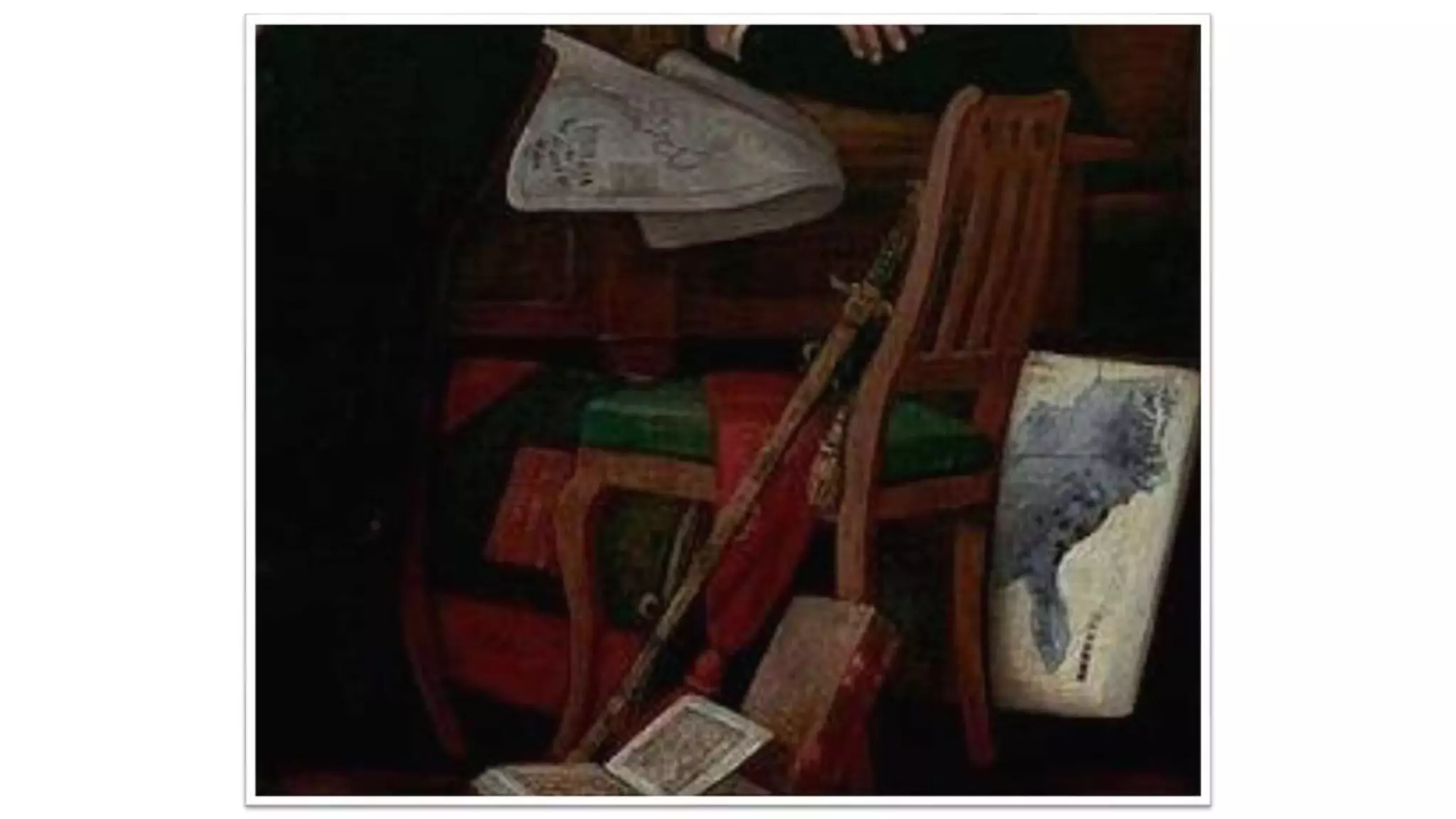
"Map showing the distribution of the slave population of the Southern states of the United States. Compiled from the census
of 1860. Drawn by E. Hergesheimer. Engr. by Th. Leonhardt." Library of Congress, American Memory Map Collections.
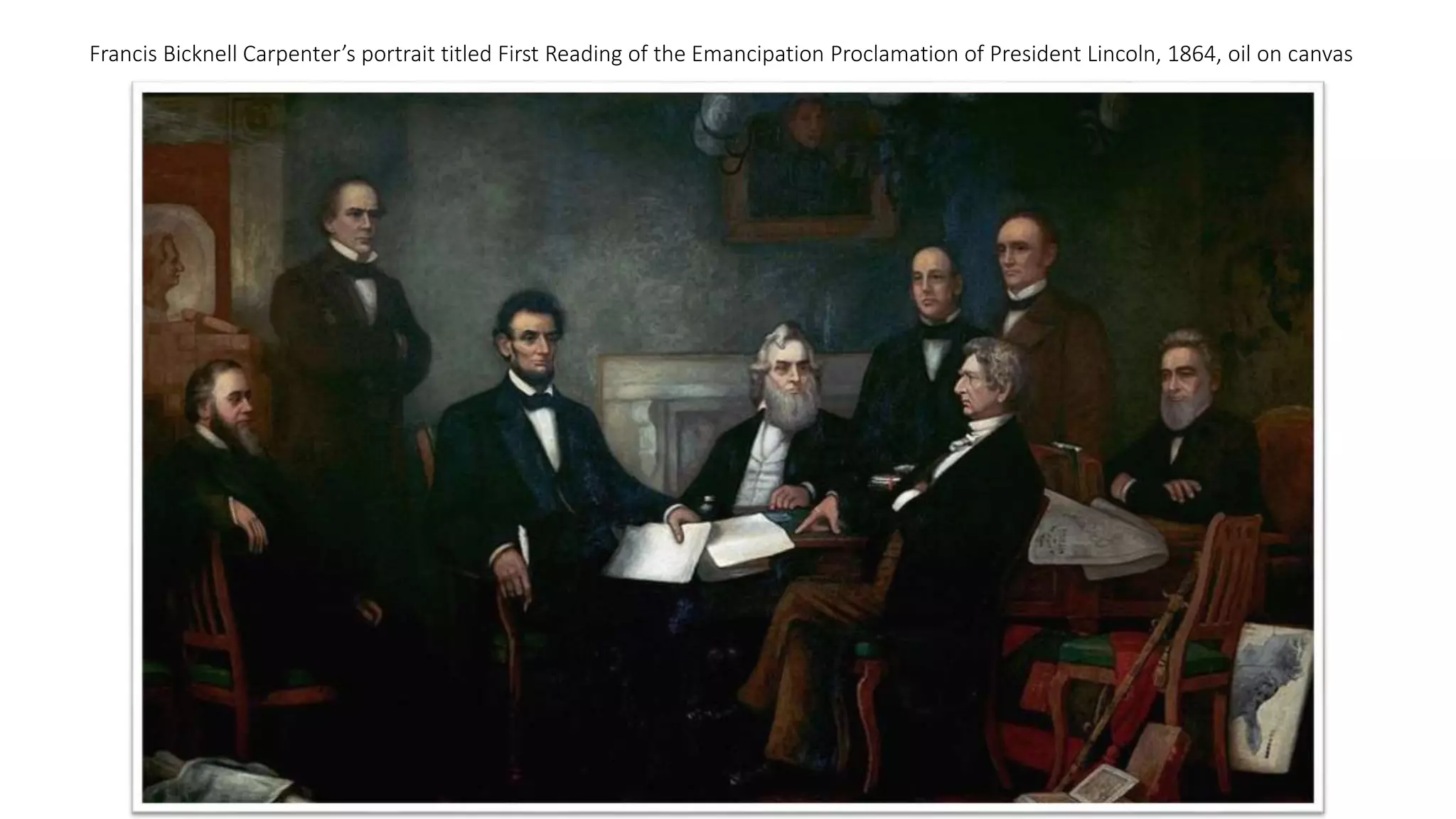
Francis Bicknell Carpenter’s portrait titled First Reading of the Emancipation Proclamation of President Lincoln, 1864, oil on canvas
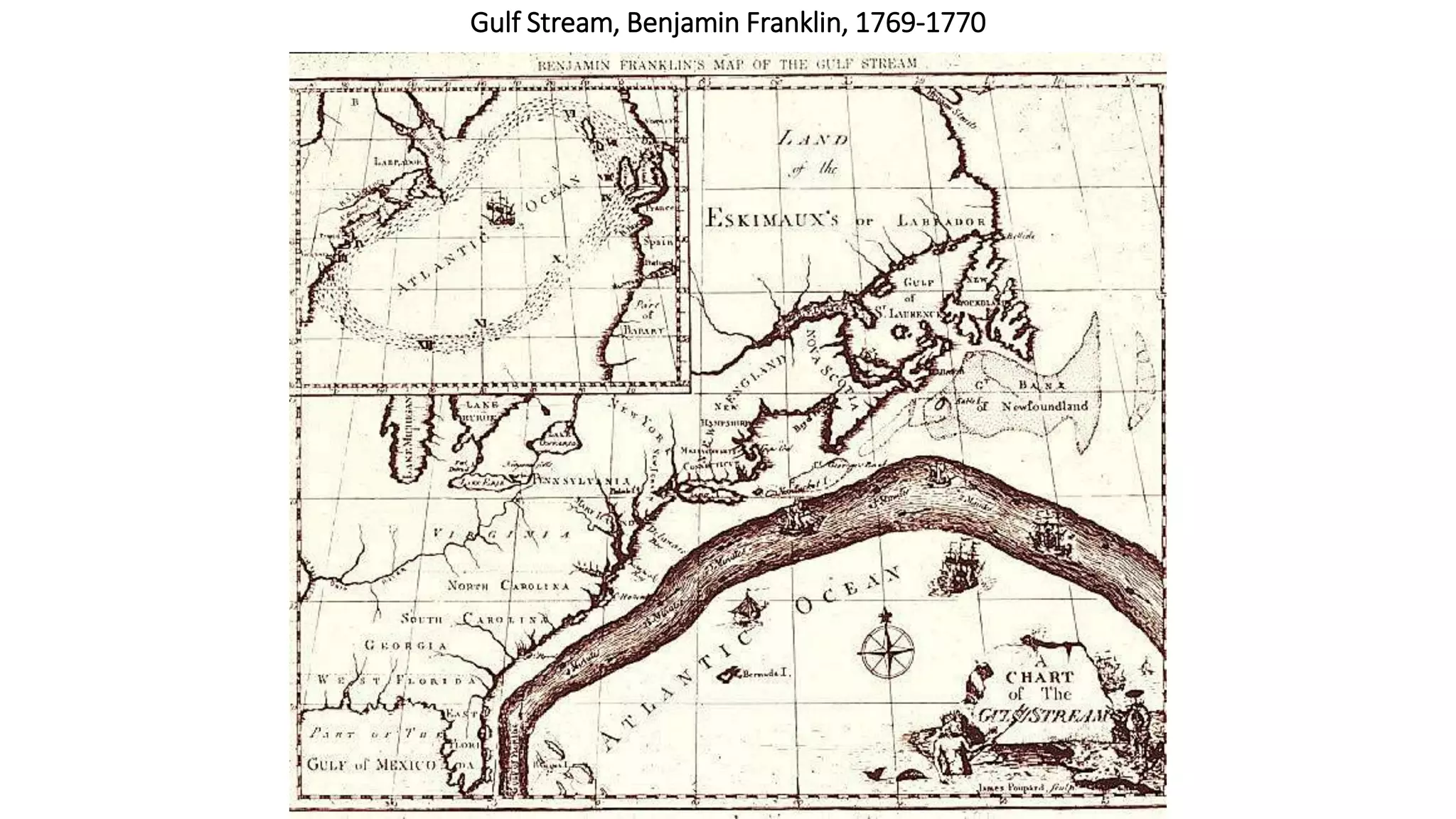
Gulf Stream, Benjamin Franklin, 1769-1770
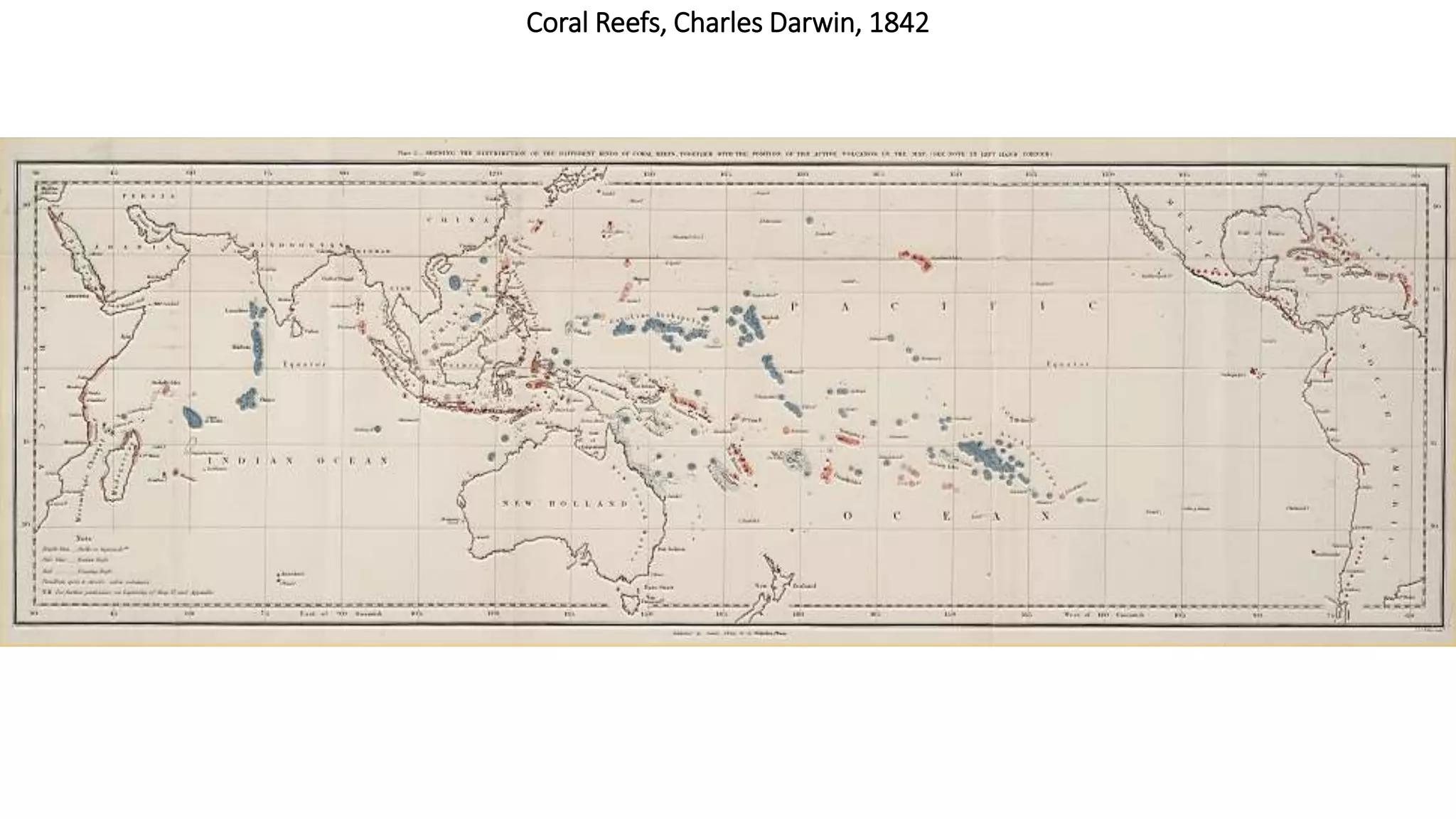
Coral Reefs, Charles Darwin, 1842
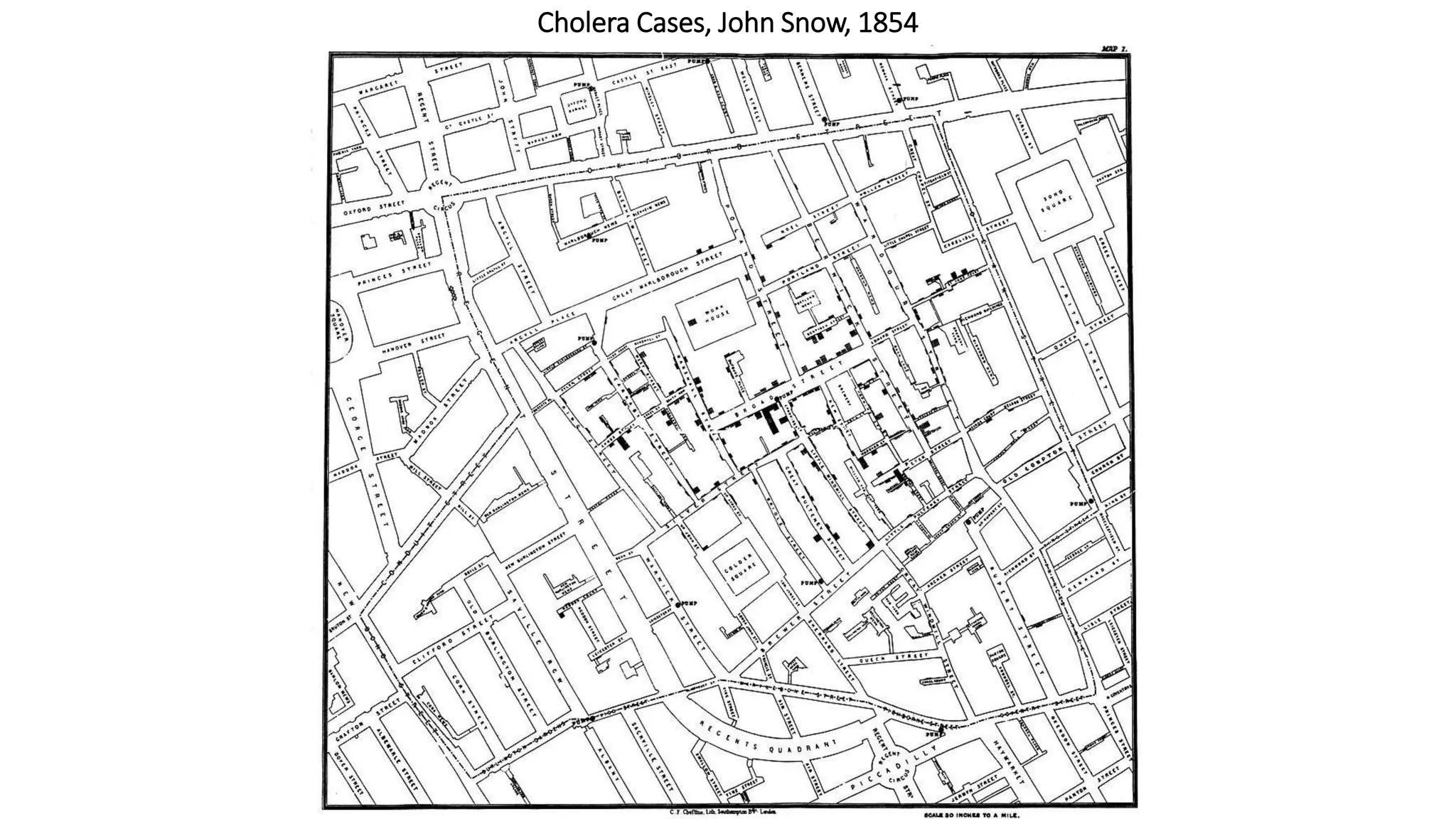
Cholera Cases, John Snow, 1854
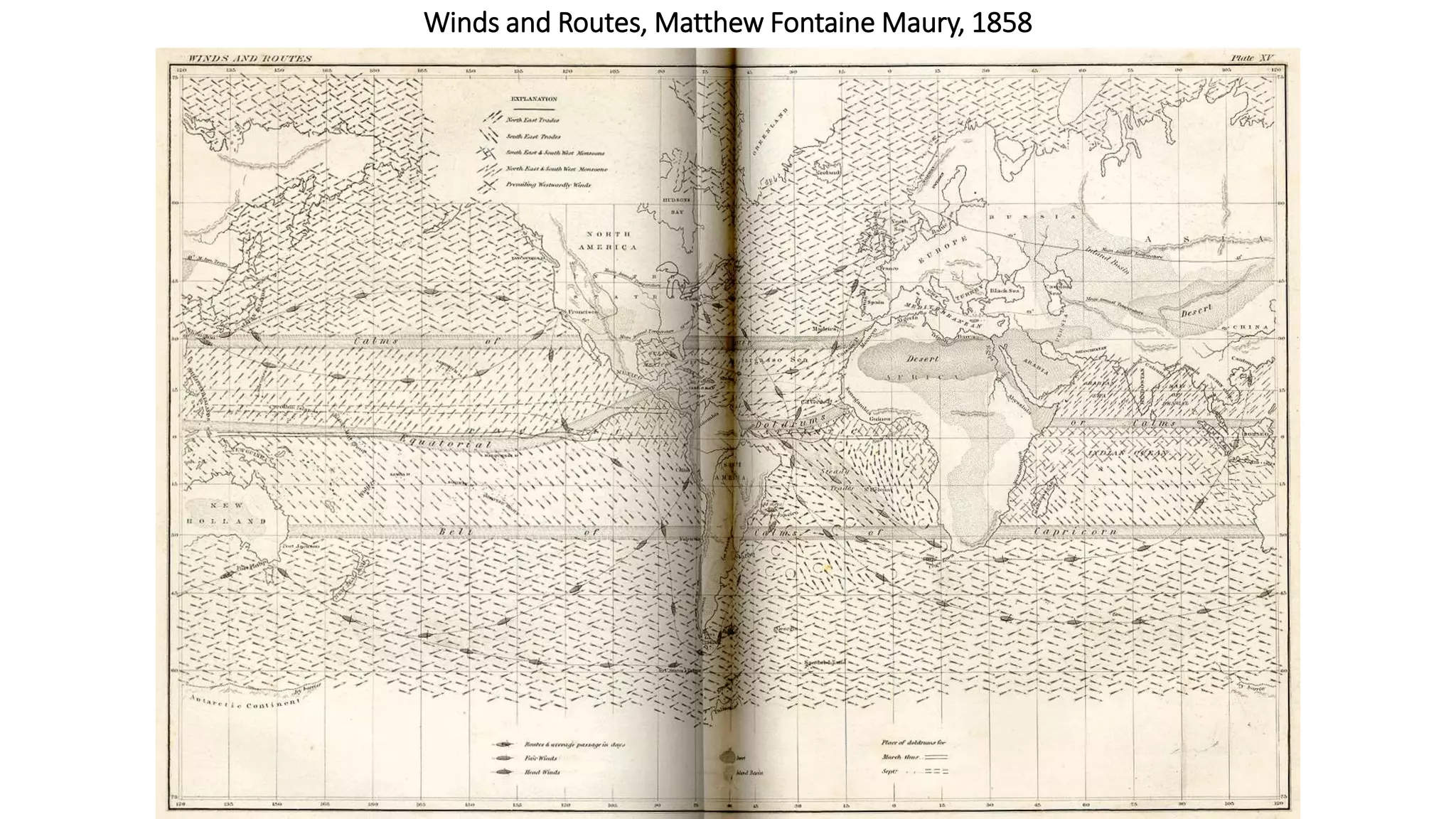
Winds and Routes, Matthew Fontaine Maury, 1858
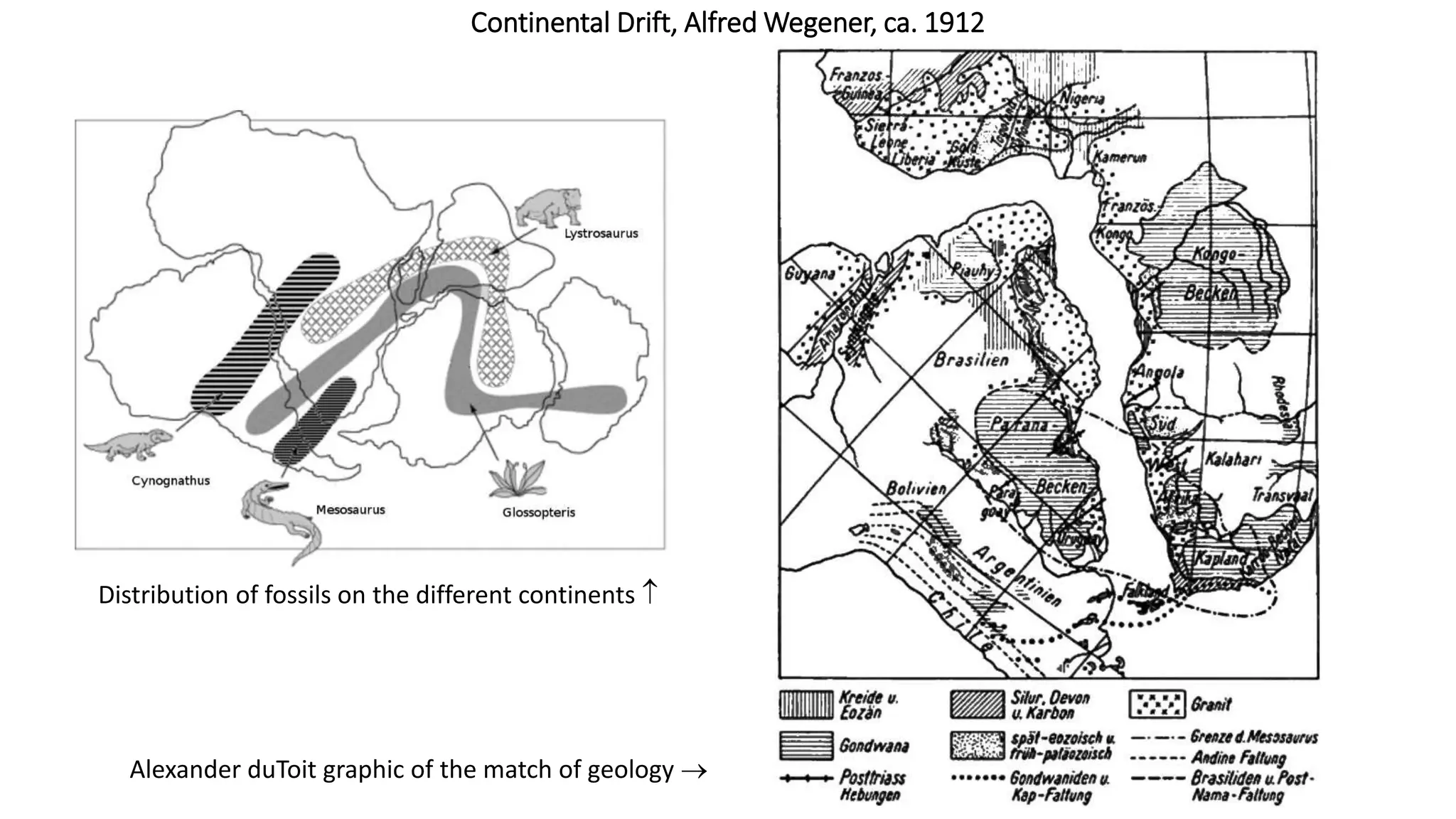
Continental Drift, Alfred Wegener, ca. 1912
Distribution of fossils on the different continents 
Alexander duToit graphic of the match of geology 
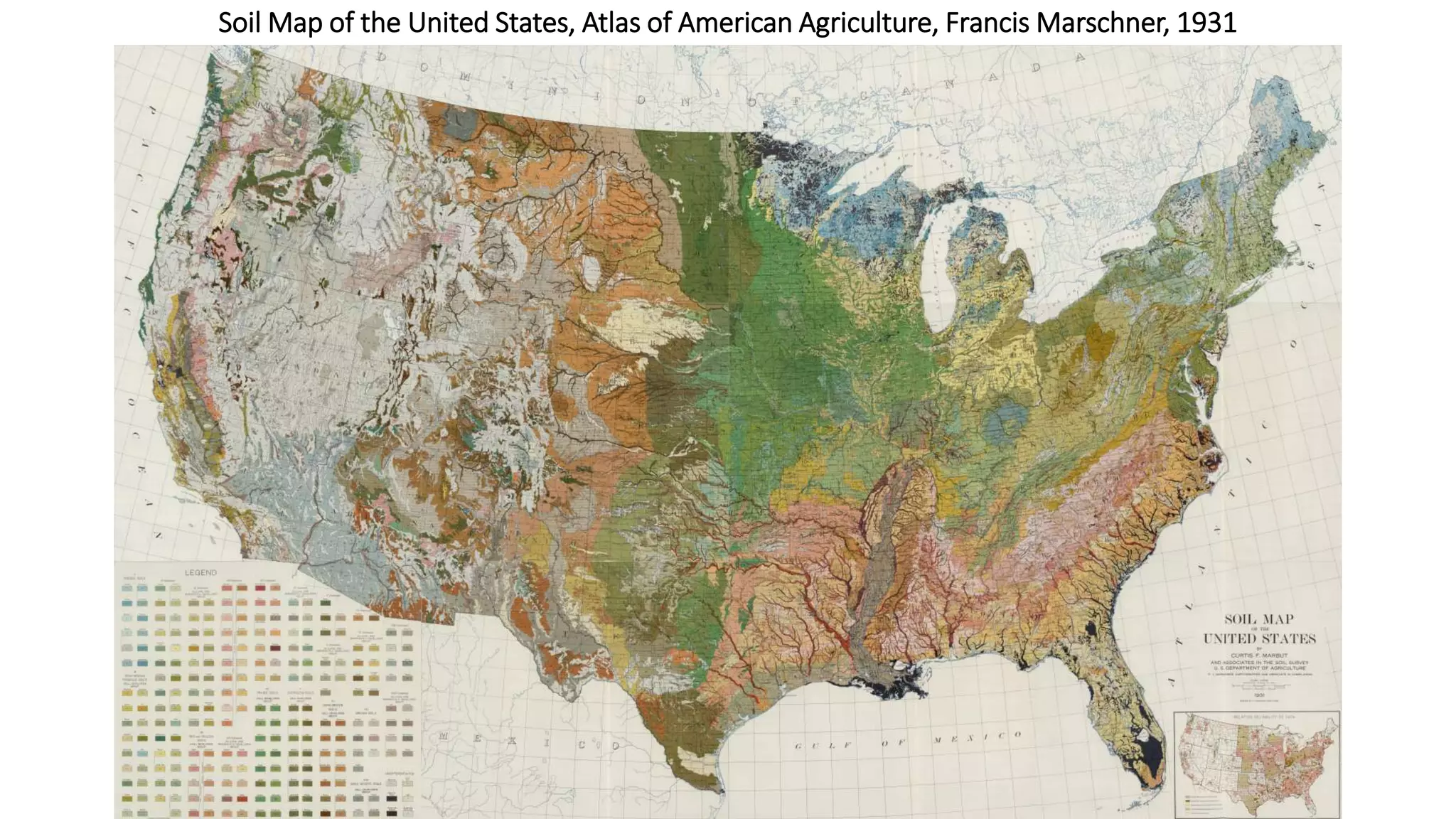
Soil Map of the United States, Atlas of American Agriculture, Francis Marschner, 1931
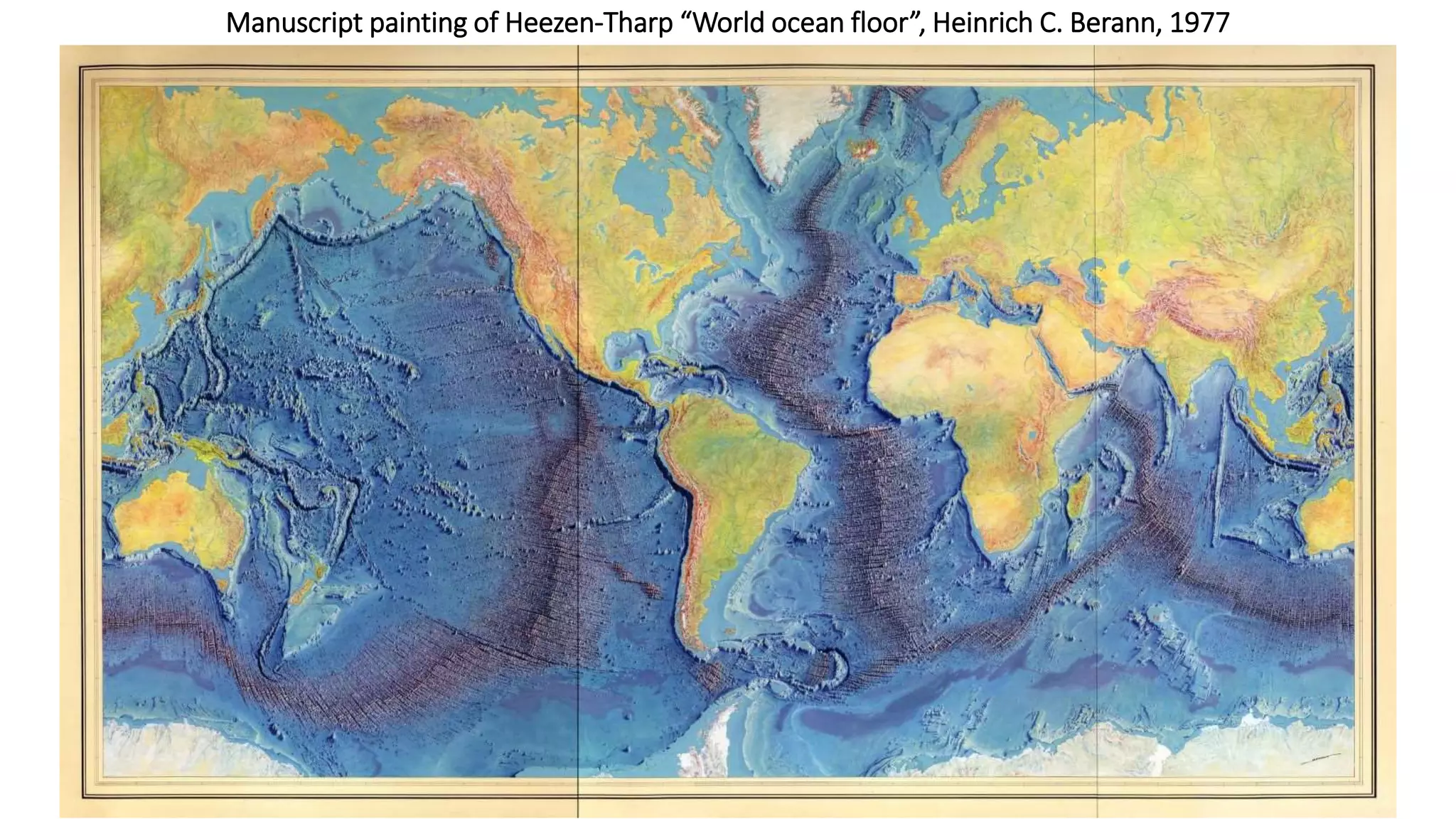
Manuscript painting of Heezen-Tharp “World ocean floor”, Heinrich C. Berann, 1977
Science communication
• Helps scientists disseminate their research
• Makes their research accessible to a broad audience
• Boosts the public’s understanding of the study results or
science in general
• Promotes civil discourse, including public discourse
Good science communication
• Completeness – make sure the story is comprehensive and complete
• Context – describe linkages and develop comparisons
• Visualizations – envision and visually combine elements
• Synthesis – combine datasets and ideas to form a system
Not the same as scientific writing
Scientific writing
• Focus on results and
interpretation
• Provide scientific context
• Text > graphics
• Exclusive authorship
Science communication
• Focus on conclusions and
recommendations
• Provide social context
• Text = graphics
• Inclusive authorship
ian.umces.edu
How do we communicate science visually
• Maps
• Conceptual diagrams
• Photos
• Charts, graphs, tables
• Videos
• Infographics
ian.umces.edu
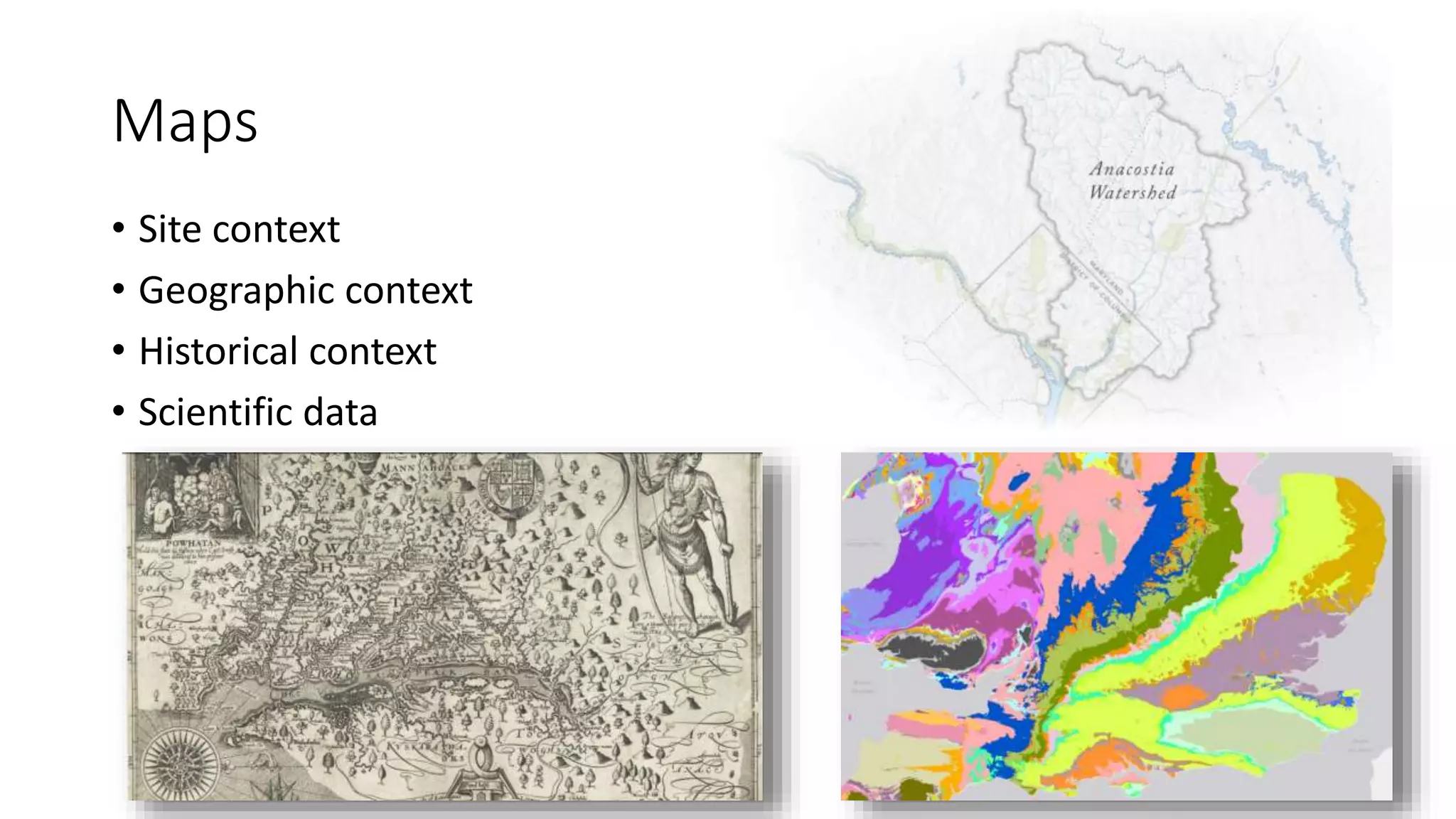
Maps
• Site context
• Geographic context
• Historical context
• Scientific data
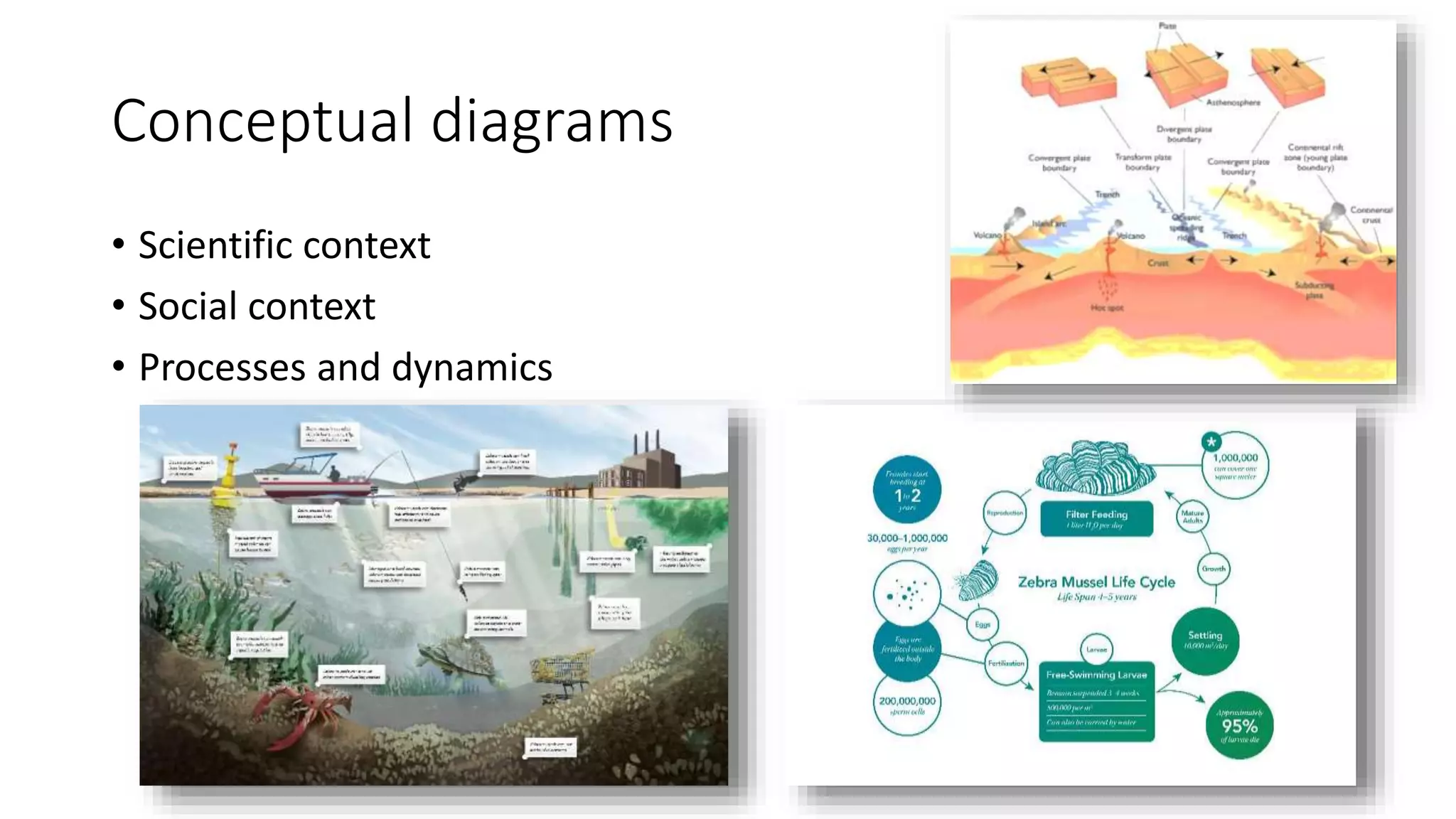
Conceptual diagrams
• Scientific context
• Social context
• Processes and dynamics
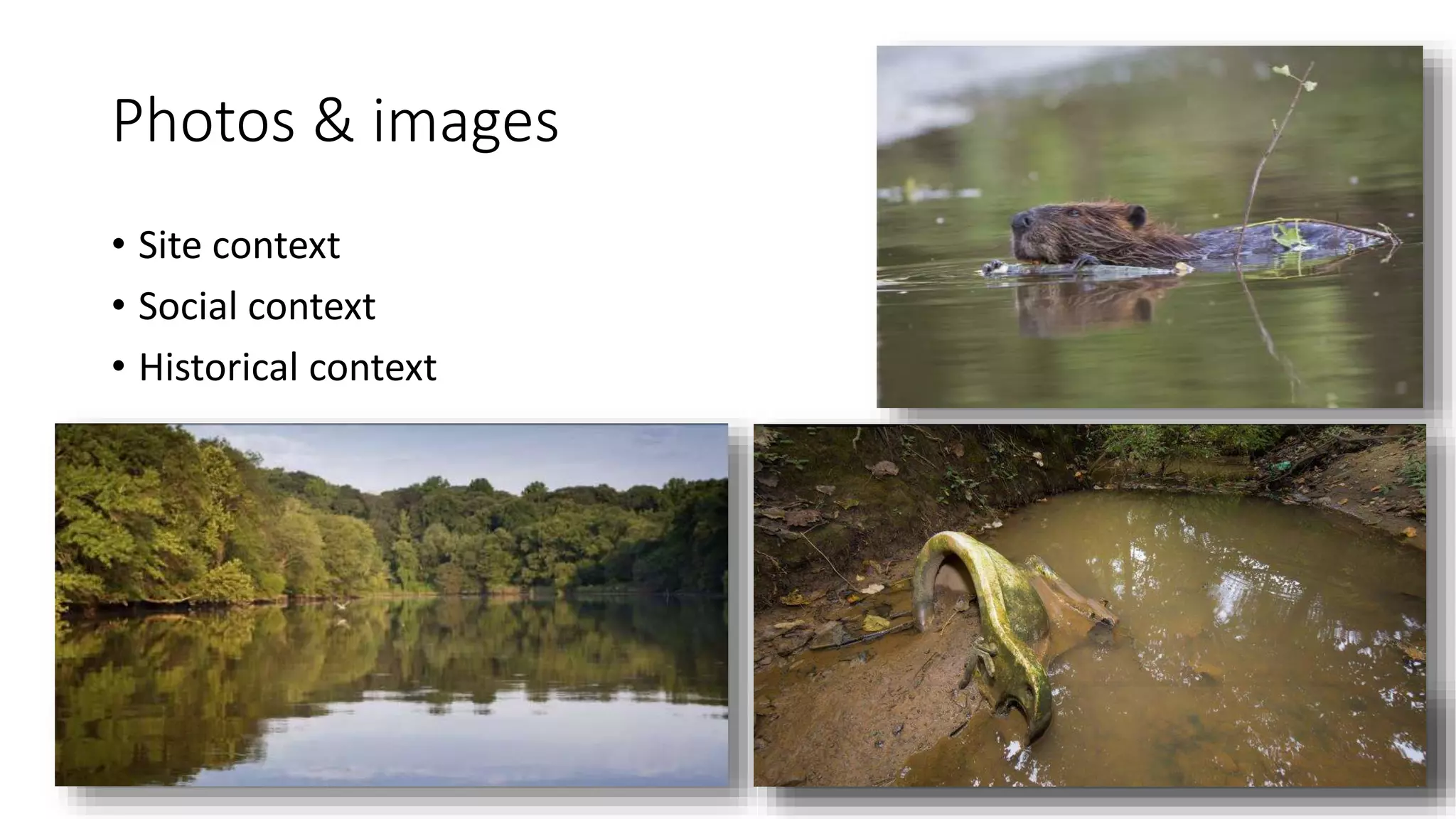
Photos & images
• Site context
• Social context
• Historical context
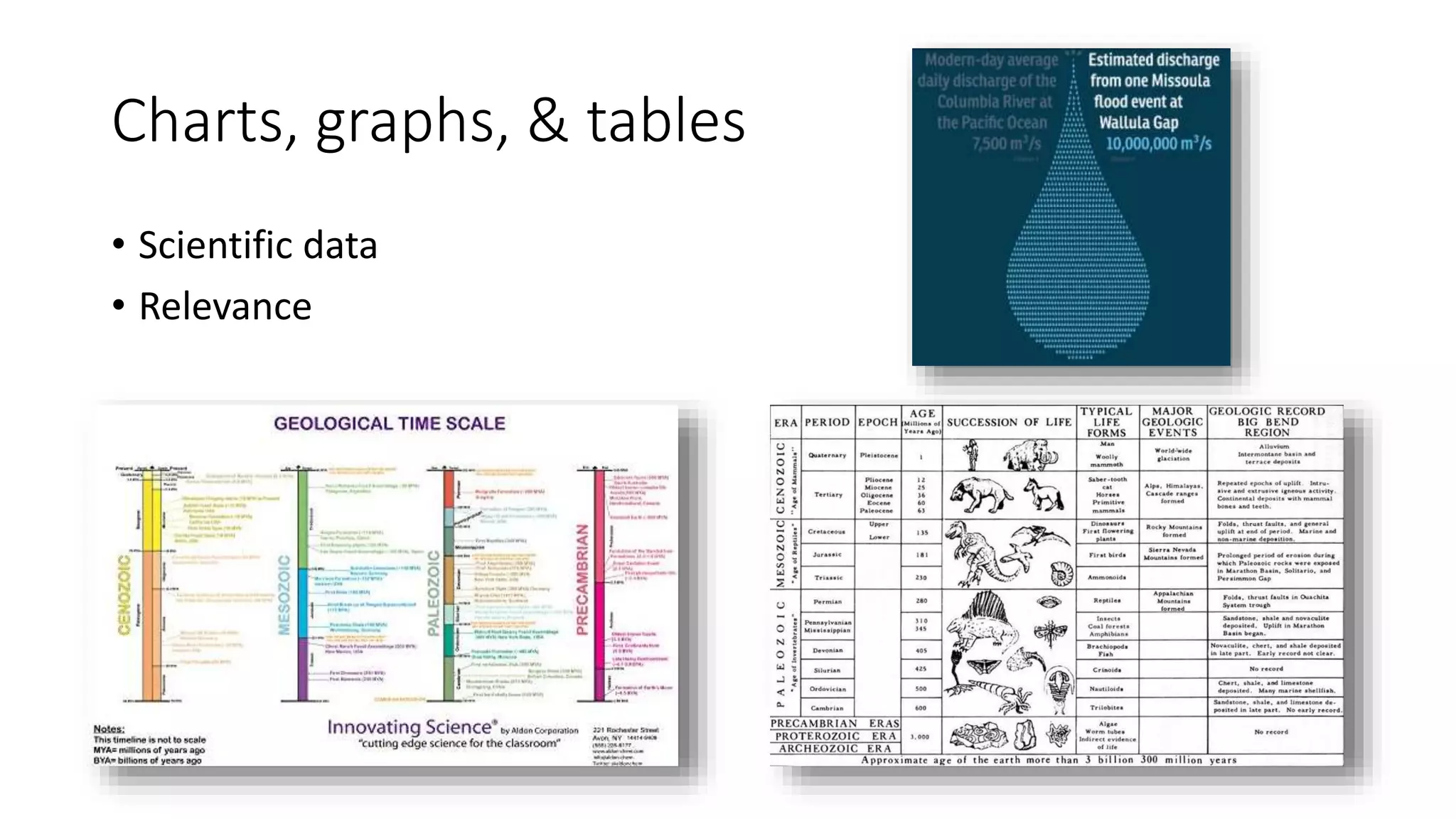
Charts, graphs, & tables
• Scientific data
• Relevance
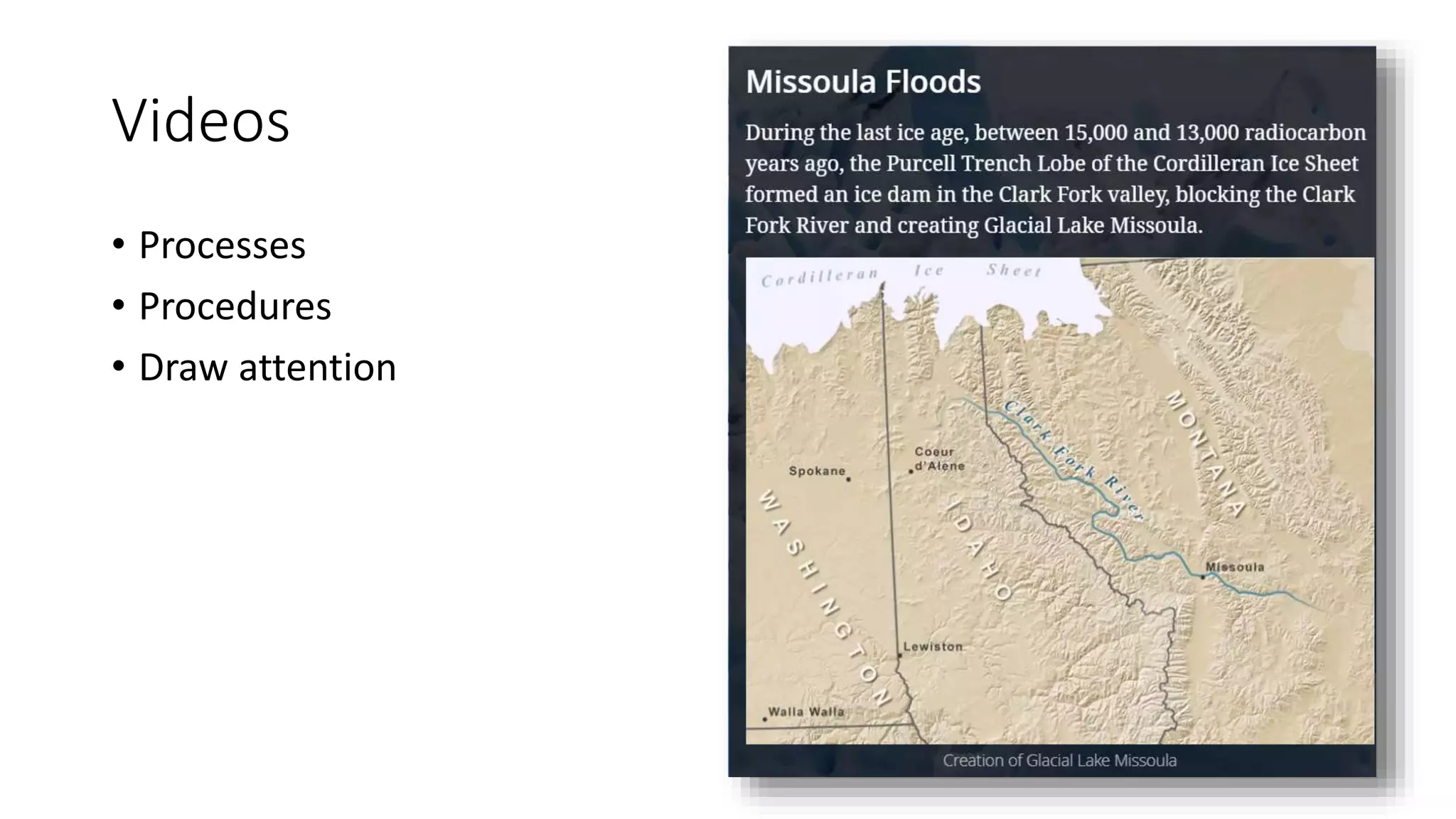
Videos
• Processes
• Procedures
• Draw attention
Infographics
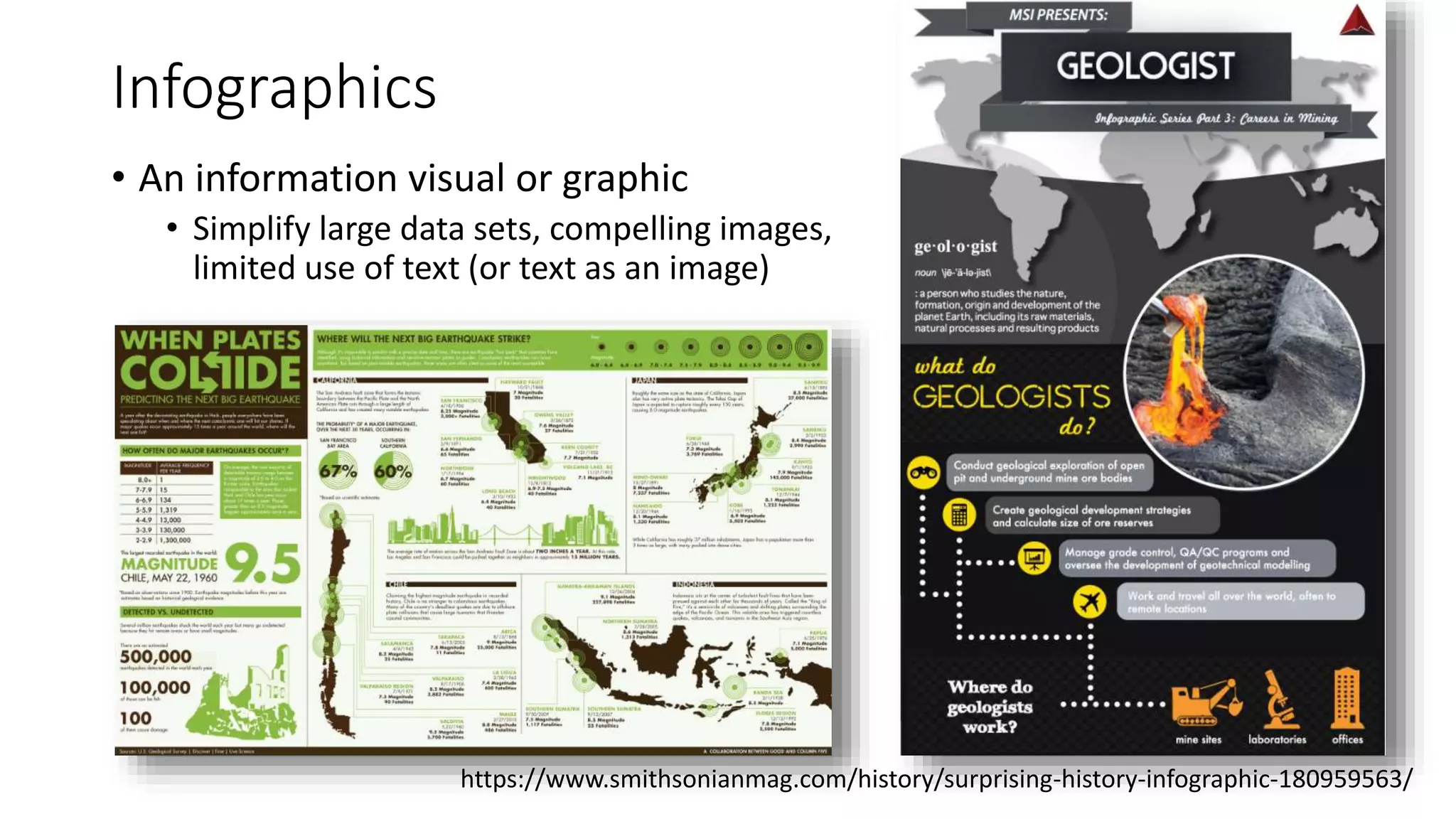
• An information visual or graphic
• Simplify large data sets, compelling images,
limited use of text (or text as an image)
https://www.smithsonianmag.com/history/surprising-history-infographic-180959563/
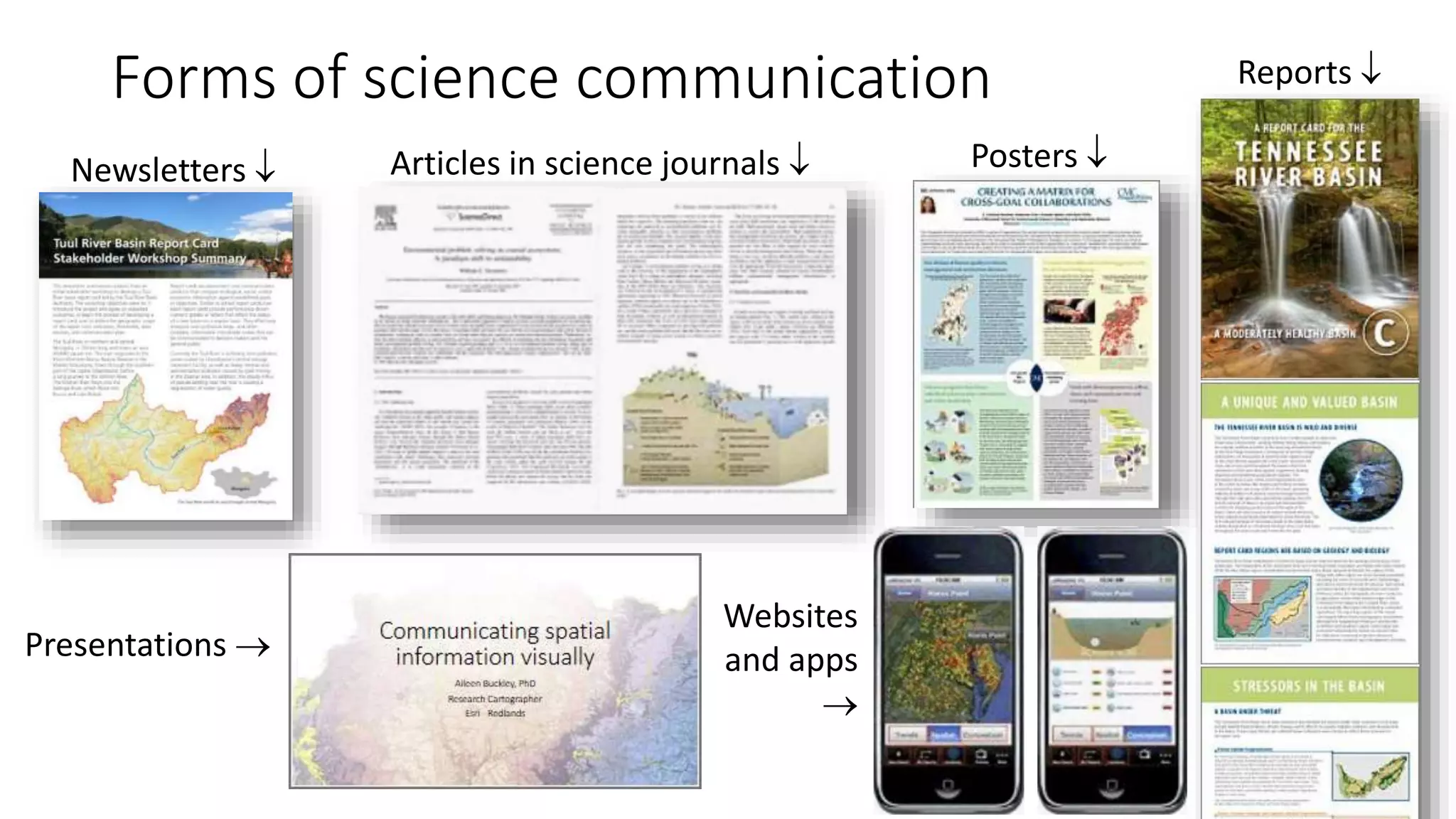
Forms of science communication
ian.umces.edu
Newsletters  Posters Articles in science journals 
Websites
and apps

Reports 
Presentations 
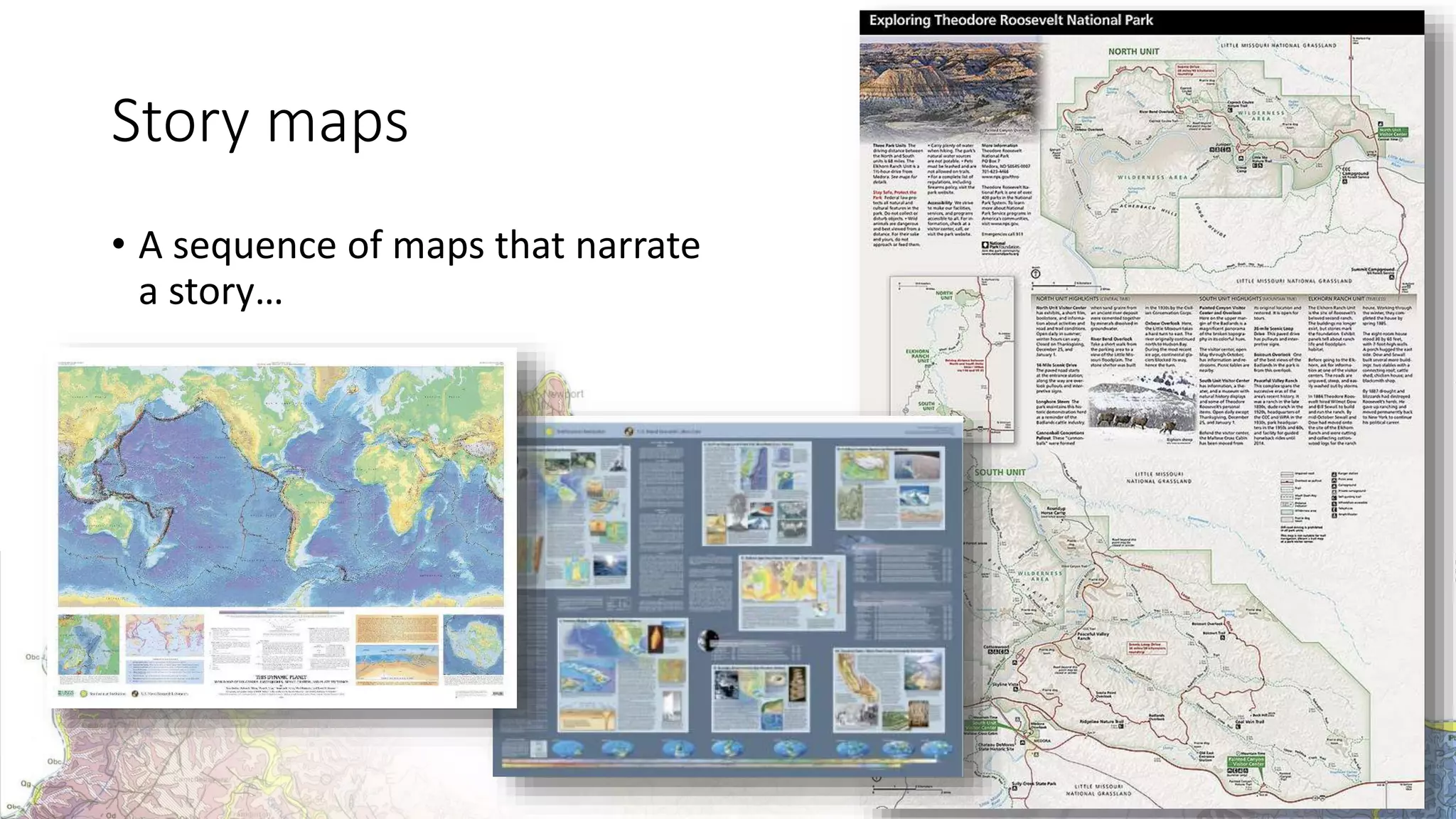
Story maps
• A sequence of maps that narrate
a story…
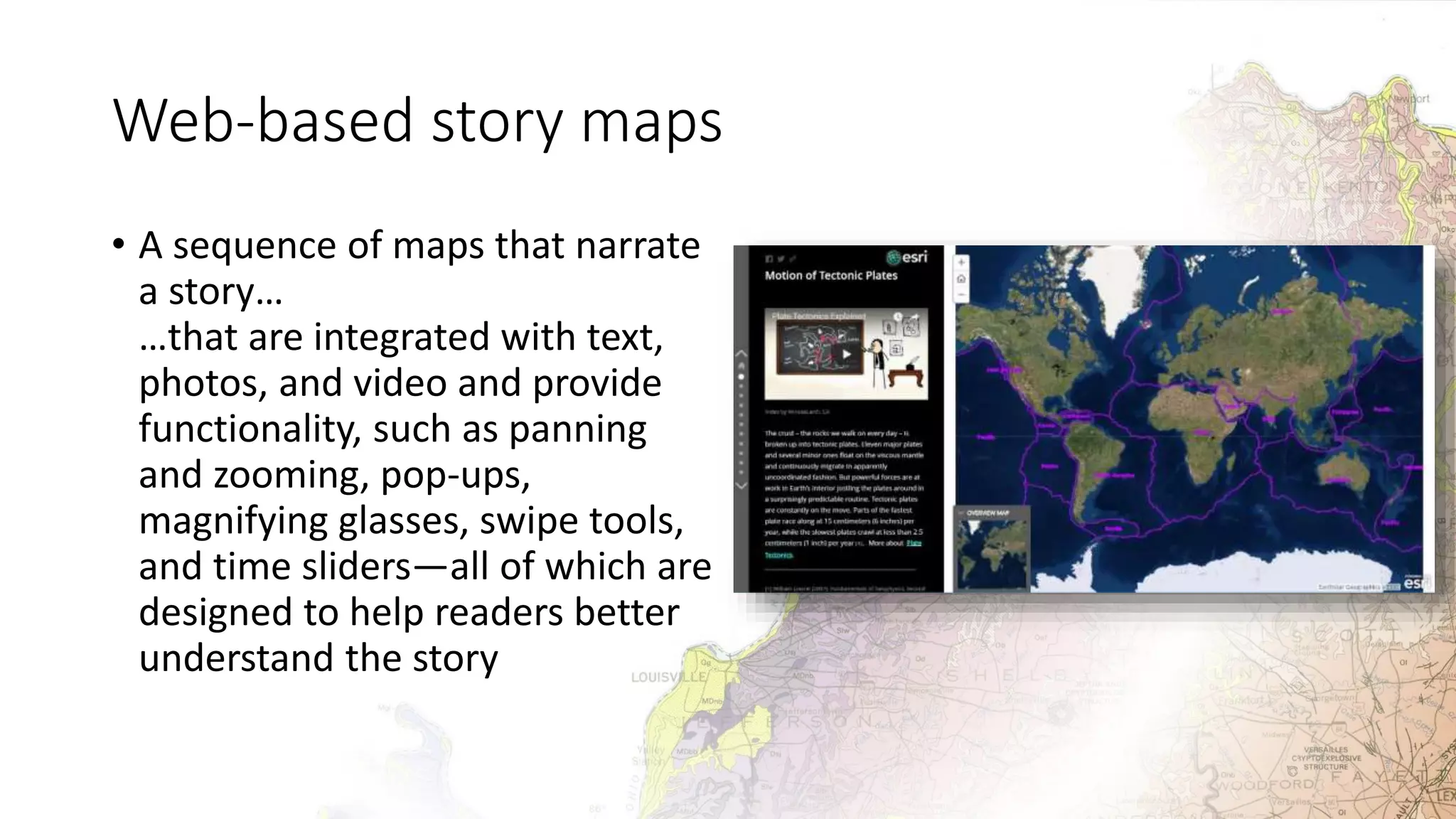
Web-based story maps
• A sequence of maps that narrate
a story…
…that are integrated with text,
photos, and video and provide
functionality, such as panning
and zooming, pop-ups,
magnifying glasses, swipe tools,
and time sliders—all of which are
designed to help readers better
understand the story
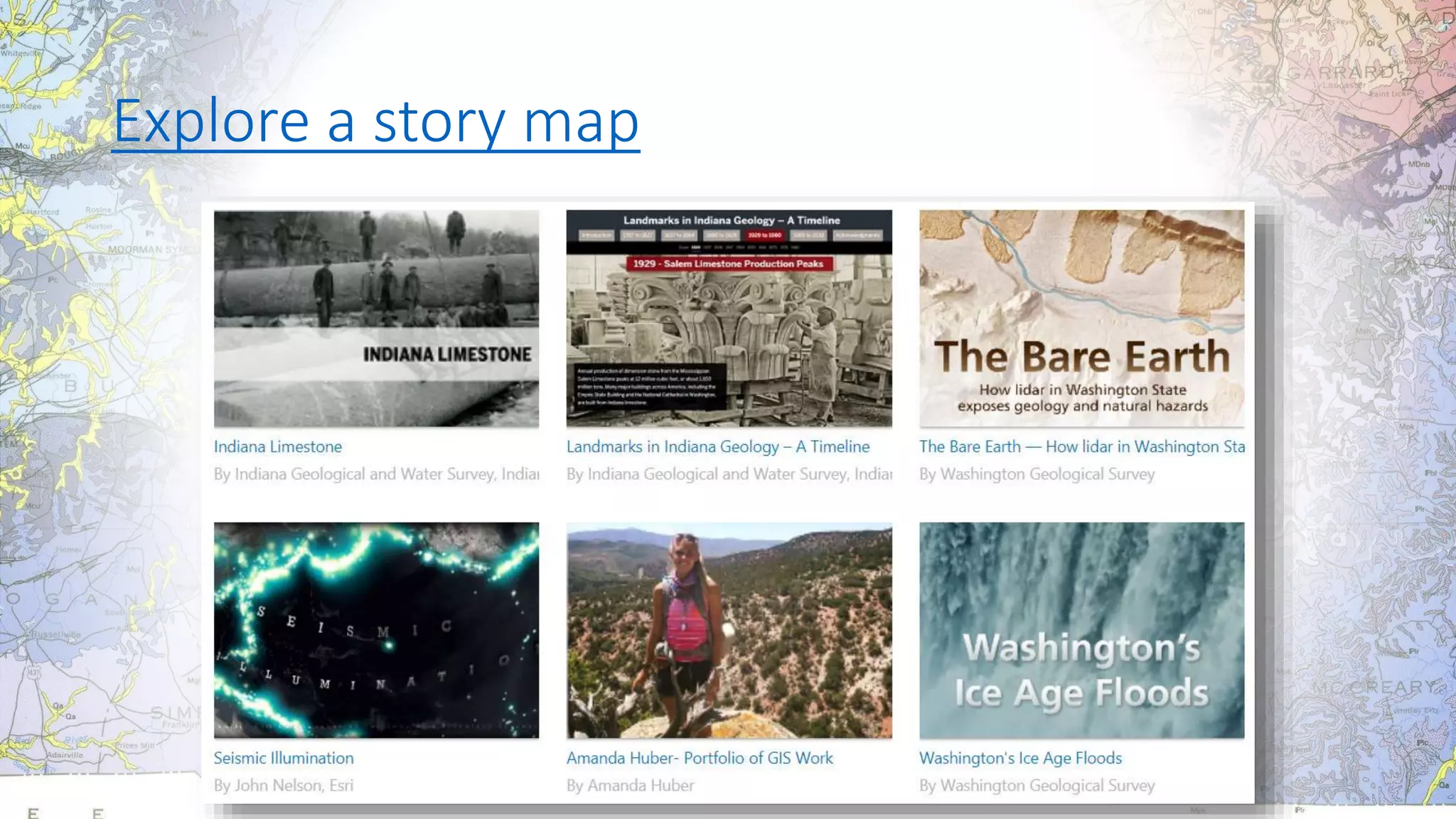
Explore a story map
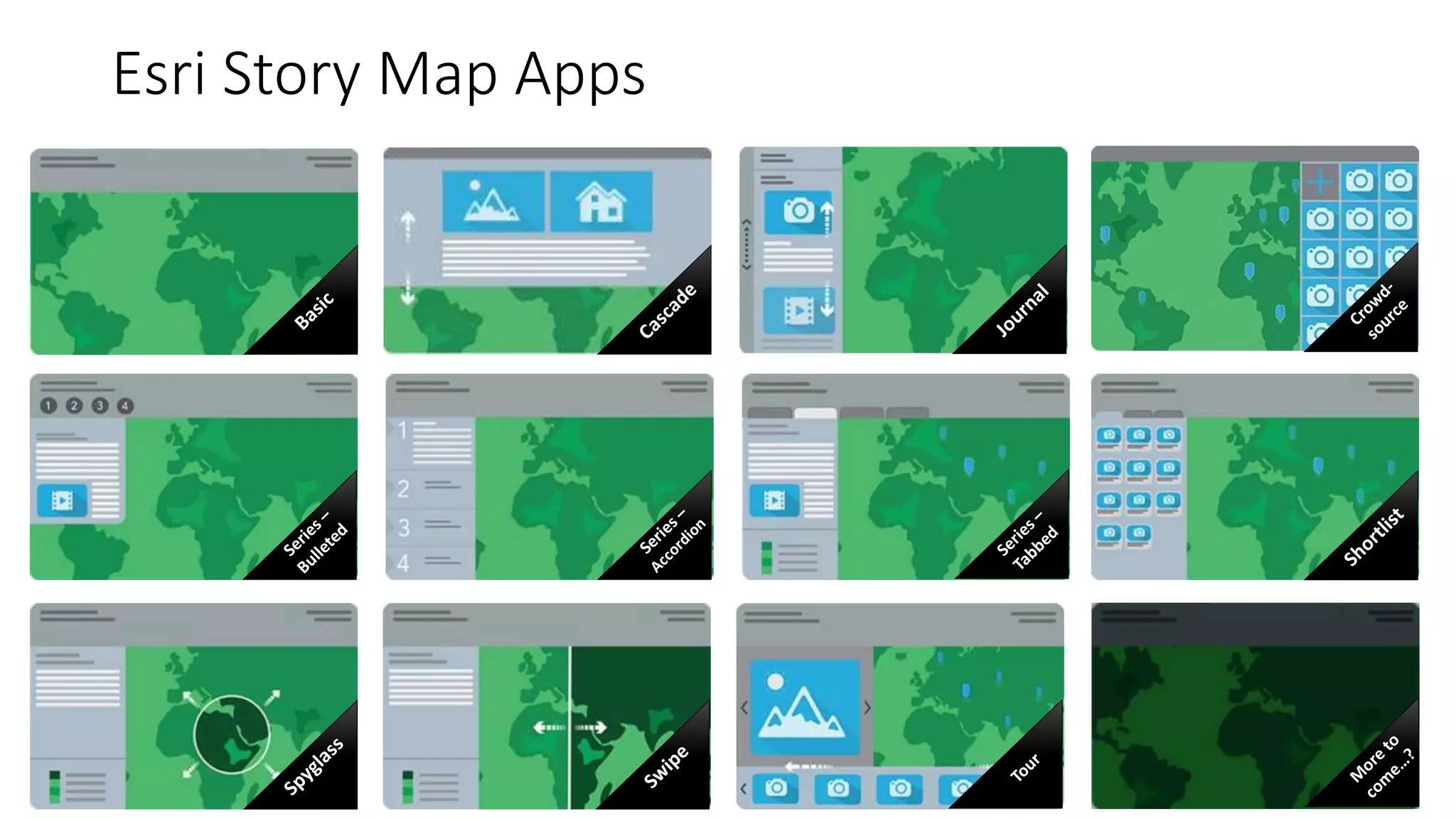
Esri Story Map Apps
Uses of story maps
• Share specific information
• Make sense of our world
• Celebrate special places
• Raise awareness about an issue
• As a tool for education
• Inspire action
• As a reporting mechanism
• To imagine different possibilities
“Stories are remembered up to 22
times more than facts alone,
according to Jennifer Aaker, a
marketing professor at Stanford's
Graduate School of Business.”
https://www.mnn.com/lifestyle/arts-culture/stories/why-do-we-tell-stories/
“Our common mission,” writes Alison
Fromme in The Science Writers’
Handbook, “is to explain very
complicated things with both
maximum simplicity and maximum
accuracy.”
Science communication is a skill – and an art!
• It’s easy to become mired in jargon
• There may be gaps between what scientists assume the public knows
and what it actually does
• Most scientists receive little to no formal training on how to science
communication
• There is often little incentive to prioritize this
• Creation of visual forms of science communication has required
specialized software – in the past!
Article in the Journal of Undergraduate Neuroscience Education (https://www.ncbi.nlm.nih.gov/pmc/articles/PMC3852879/)
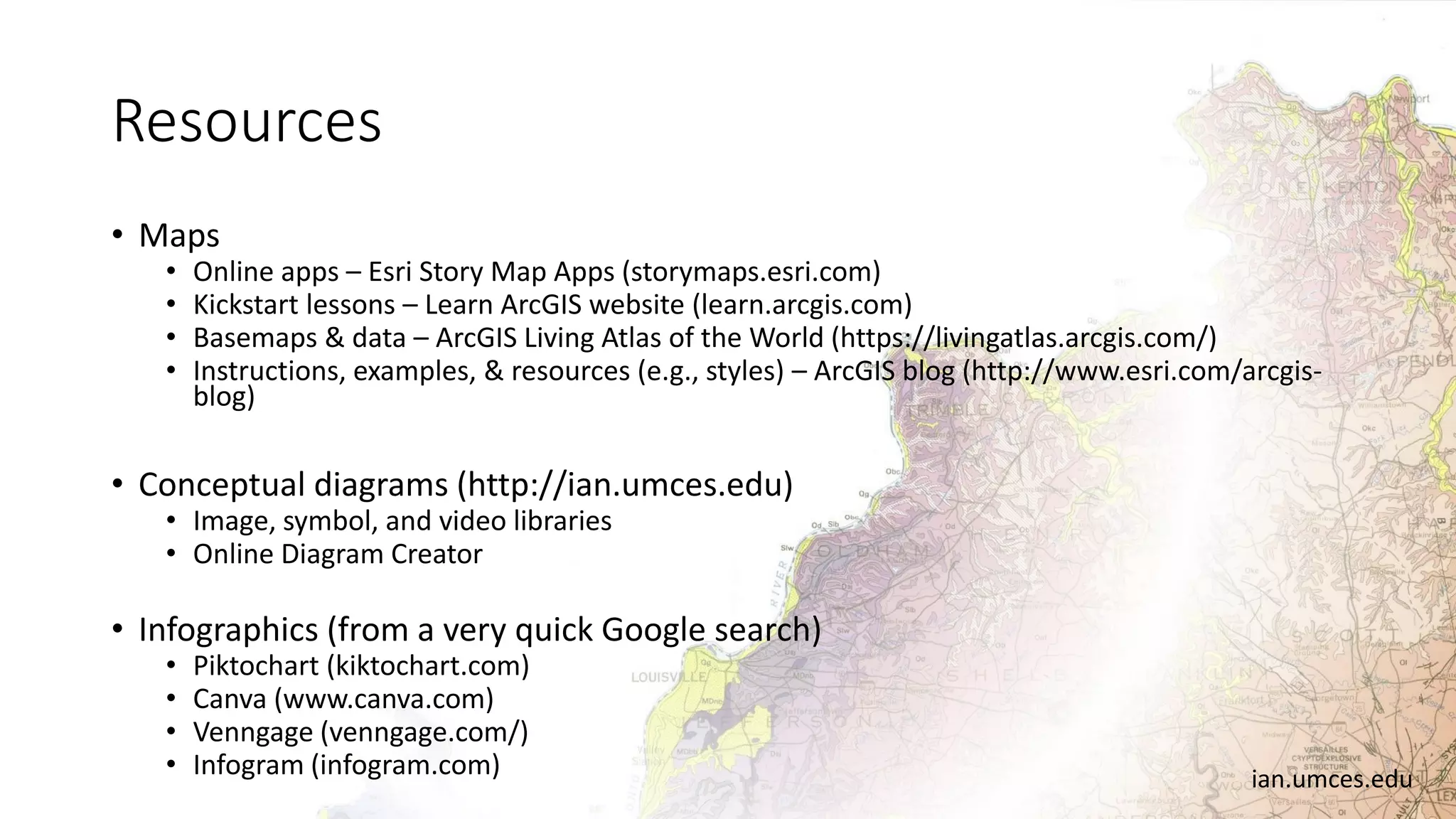
Resources
• Maps
• Online apps – Esri Story Map Apps (storymaps.esri.com)
• Kickstart lessons – Learn ArcGIS website (learn.arcgis.com)
• Basemaps & data – ArcGIS Living Atlas of the World (https://livingatlas.arcgis.com/)
• Instructions, examples, & resources (e.g., styles) – ArcGIS blog (http://www.esri.com/arcgis-
blog)
• Conceptual diagrams (http://ian.umces.edu)
• Image, symbol, and video libraries
• Online Diagram Creator
• Infographics (from a very quick Google search)
• Piktochart (kiktochart.com)
• Canva (www.canva.com)
• Venngage (venngage.com/)
• Infogram (infogram.com) ian.umces.edu
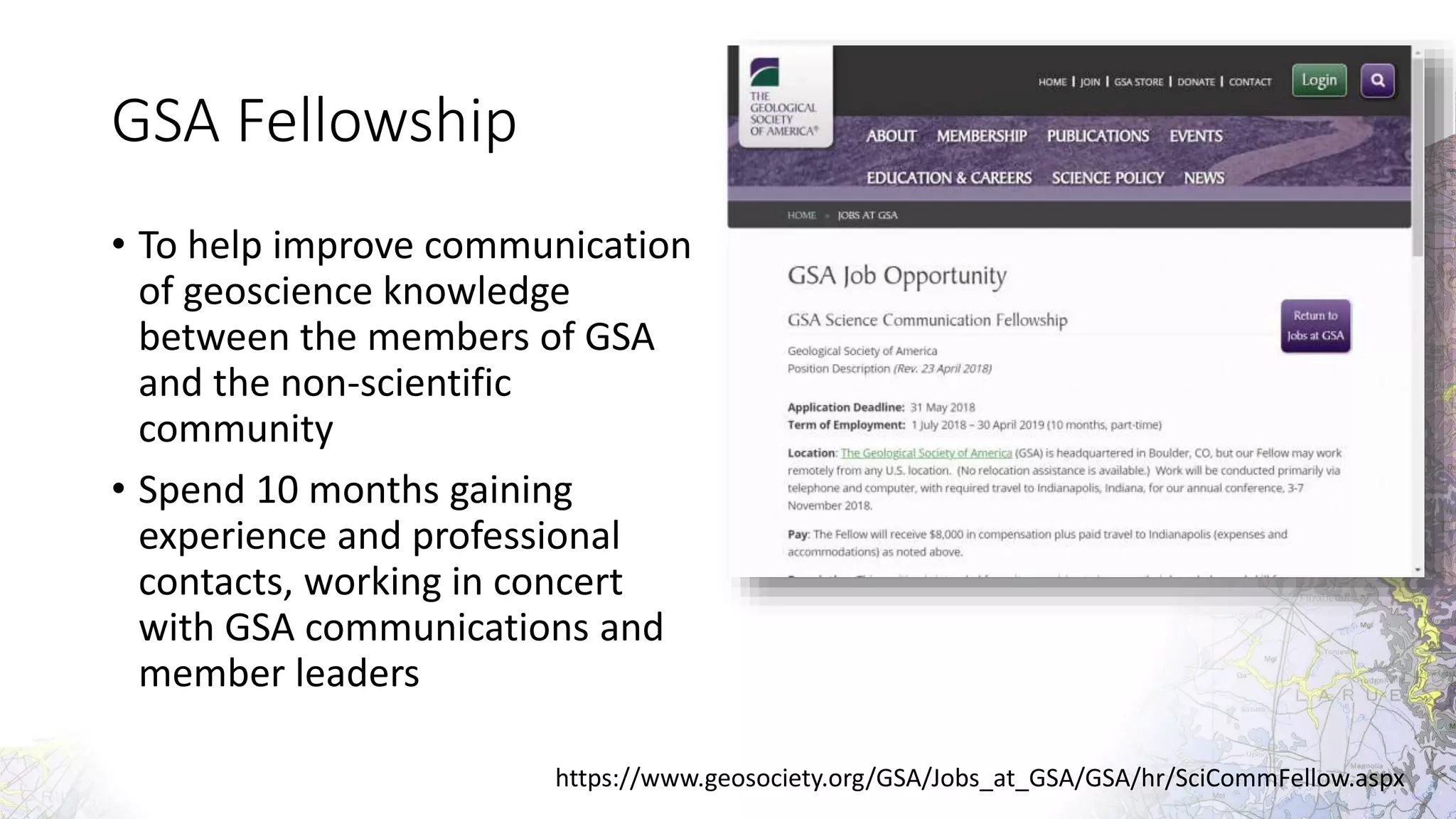
GSA Fellowship
• To help improve communication
of geoscience knowledge
between the members of GSA
and the non-scientific
community
• Spend 10 months gaining
experience and professional
contacts, working in concert
with GSA communications and
member leaders
https://www.geosociety.org/GSA/Jobs_at_GSA/GSA/hr/SciCommFellow.aspx
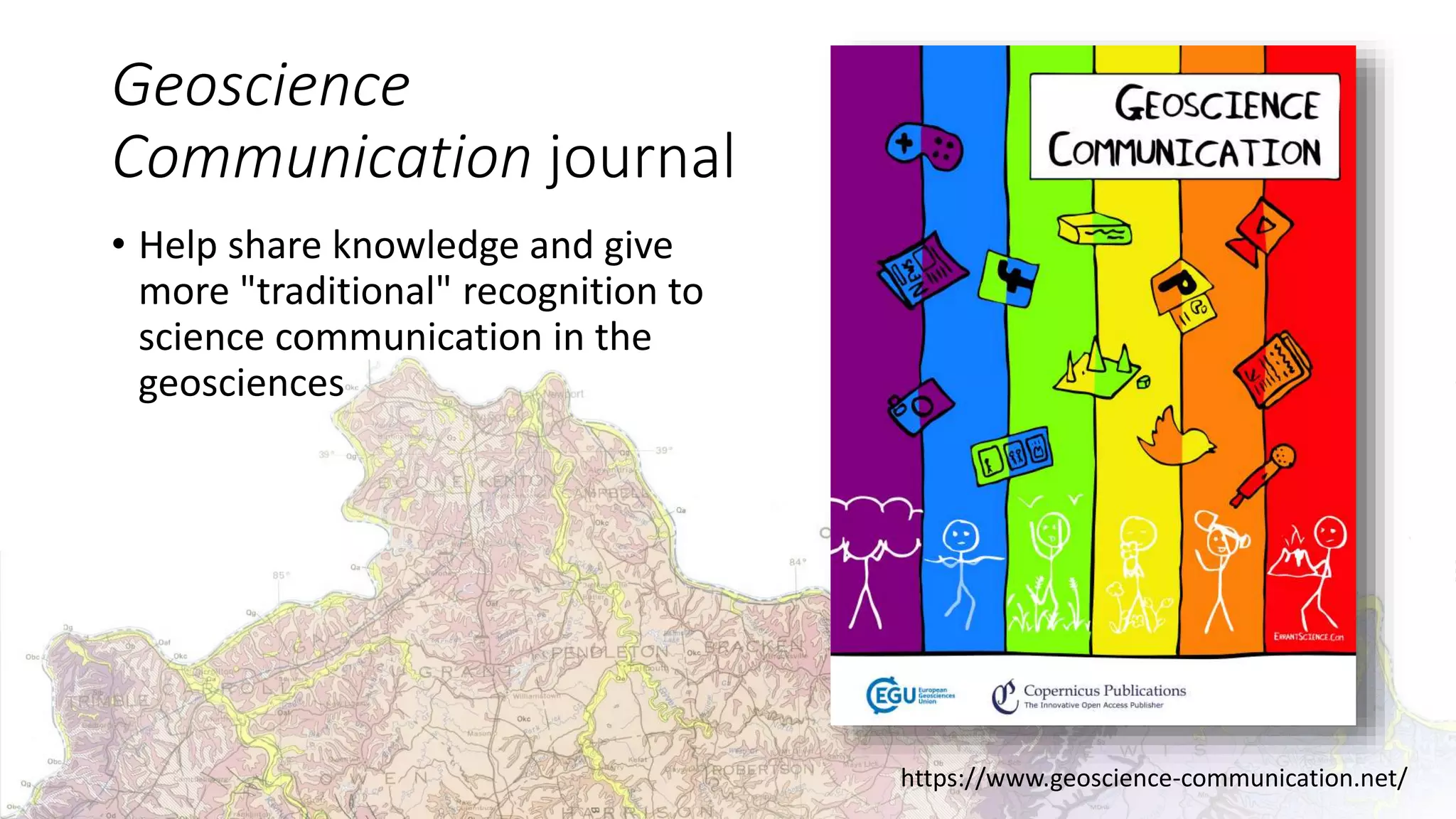
Geoscience
Communication journal
• Help share knowledge and give
more "traditional" recognition to
science communication in the
geosciences
https://www.geoscience-communication.net/
Thank you!
These slides are posted on Slideshare:
slideshare.net  search Aileen Buckley

Communicating spatial information visually

  • 1.
    Communicating spatial information visually AileenBuckley, PhD Research Cartographer Esri - Redlands
  • 2.
    Communicating scientific information= science communication • According to the Science Literacy Project, scientific research and novel technologies “play a major role in key political, economic, cultural and social policy discussions, as well as in public dialogue.” • In an age of “alternative facts” and shrinking science budgets, and a time when the U.S. risks losing its edge in research and development, advocating for an evidence-based approach to decision making, which is independent of political views, has become crucial. https://blogs.egu.eu/geolog/2017/10/17/geoscience-communication-a-smart-investment/
  • 3.
    "Map showing thedistribution of the slave population of the Southern states of the United States. Compiled from the census of 1860. Drawn by E. Hergesheimer. Engr. by Th. Leonhardt." Library of Congress, American Memory Map Collections.
  • 4.
    Francis Bicknell Carpenter’sportrait titled First Reading of the Emancipation Proclamation of President Lincoln, 1864, oil on canvas
  • 6.
    Gulf Stream, BenjaminFranklin, 1769-1770
  • 7.
  • 8.
  • 9.
    Winds and Routes,Matthew Fontaine Maury, 1858
  • 10.
    Continental Drift, AlfredWegener, ca. 1912 Distribution of fossils on the different continents  Alexander duToit graphic of the match of geology 
  • 11.
    Soil Map ofthe United States, Atlas of American Agriculture, Francis Marschner, 1931
  • 12.
    Manuscript painting ofHeezen-Tharp “World ocean floor”, Heinrich C. Berann, 1977
  • 13.
    Science communication • Helpsscientists disseminate their research • Makes their research accessible to a broad audience • Boosts the public’s understanding of the study results or science in general • Promotes civil discourse, including public discourse
  • 14.
    Good science communication •Completeness – make sure the story is comprehensive and complete • Context – describe linkages and develop comparisons • Visualizations – envision and visually combine elements • Synthesis – combine datasets and ideas to form a system
  • 15.
    Not the sameas scientific writing Scientific writing • Focus on results and interpretation • Provide scientific context • Text > graphics • Exclusive authorship Science communication • Focus on conclusions and recommendations • Provide social context • Text = graphics • Inclusive authorship ian.umces.edu
  • 16.
    How do wecommunicate science visually • Maps • Conceptual diagrams • Photos • Charts, graphs, tables • Videos • Infographics ian.umces.edu
  • 17.
    Maps • Site context •Geographic context • Historical context • Scientific data
  • 18.
    Conceptual diagrams • Scientificcontext • Social context • Processes and dynamics
  • 19.
    Photos & images •Site context • Social context • Historical context
  • 20.
    Charts, graphs, &tables • Scientific data • Relevance
  • 21.
  • 22.
    Infographics • An informationvisual or graphic • Simplify large data sets, compelling images, limited use of text (or text as an image) https://www.smithsonianmag.com/history/surprising-history-infographic-180959563/
  • 23.
    Forms of sciencecommunication ian.umces.edu Newsletters  Posters Articles in science journals  Websites and apps  Reports  Presentations 
  • 24.
    Story maps • Asequence of maps that narrate a story…
  • 25.
    Web-based story maps •A sequence of maps that narrate a story… …that are integrated with text, photos, and video and provide functionality, such as panning and zooming, pop-ups, magnifying glasses, swipe tools, and time sliders—all of which are designed to help readers better understand the story
  • 26.
  • 27.
  • 28.
    Uses of storymaps • Share specific information • Make sense of our world • Celebrate special places • Raise awareness about an issue • As a tool for education • Inspire action • As a reporting mechanism • To imagine different possibilities “Stories are remembered up to 22 times more than facts alone, according to Jennifer Aaker, a marketing professor at Stanford's Graduate School of Business.” https://www.mnn.com/lifestyle/arts-culture/stories/why-do-we-tell-stories/
  • 29.
    “Our common mission,”writes Alison Fromme in The Science Writers’ Handbook, “is to explain very complicated things with both maximum simplicity and maximum accuracy.”
  • 30.
    Science communication isa skill – and an art! • It’s easy to become mired in jargon • There may be gaps between what scientists assume the public knows and what it actually does • Most scientists receive little to no formal training on how to science communication • There is often little incentive to prioritize this • Creation of visual forms of science communication has required specialized software – in the past! Article in the Journal of Undergraduate Neuroscience Education (https://www.ncbi.nlm.nih.gov/pmc/articles/PMC3852879/)
  • 31.
    Resources • Maps • Onlineapps – Esri Story Map Apps (storymaps.esri.com) • Kickstart lessons – Learn ArcGIS website (learn.arcgis.com) • Basemaps & data – ArcGIS Living Atlas of the World (https://livingatlas.arcgis.com/) • Instructions, examples, & resources (e.g., styles) – ArcGIS blog (http://www.esri.com/arcgis- blog) • Conceptual diagrams (http://ian.umces.edu) • Image, symbol, and video libraries • Online Diagram Creator • Infographics (from a very quick Google search) • Piktochart (kiktochart.com) • Canva (www.canva.com) • Venngage (venngage.com/) • Infogram (infogram.com) ian.umces.edu
  • 32.
    GSA Fellowship • Tohelp improve communication of geoscience knowledge between the members of GSA and the non-scientific community • Spend 10 months gaining experience and professional contacts, working in concert with GSA communications and member leaders https://www.geosociety.org/GSA/Jobs_at_GSA/GSA/hr/SciCommFellow.aspx
  • 33.
    Geoscience Communication journal • Helpshare knowledge and give more "traditional" recognition to science communication in the geosciences https://www.geoscience-communication.net/
  • 34.
    Thank you! These slidesare posted on Slideshare: slideshare.net  search Aileen Buckley

Editor's Notes

  • #2 Geologic Map of Kentucky: https://ngmdb.usgs.gov/Prodesc/proddesc_16355.htm
  • #7 https://en.wikipedia.org/wiki/Oceanography Ten Classic Scientific Maps: http://ian.umces.edu/blog/2013/12/27/ten-classic-scientific-maps/
  • #8 http://darwin-online.org.uk/converted/published/1842_Coral_F271/1842_Coral_F271.html Ten Classic Scientific Maps: http://ian.umces.edu/blog/2013/12/27/ten-classic-scientific-maps/
  • #9 https://en.wikipedia.org/wiki/1854_Broad_Street_cholera_outbreak Ten Classic Scientific Maps: http://ian.umces.edu/blog/2013/12/27/ten-classic-scientific-maps/
  • #10 http://oceanmotion.org/html/background/timeline1800.htm Ten Classic Scientific Maps: http://ian.umces.edu/blog/2013/12/27/ten-classic-scientific-maps/
  • #11 http://www.scientus.org/Wegener-Continental-Drift.html Ten Classic Scientific Maps: http://ian.umces.edu/blog/2013/12/27/ten-classic-scientific-maps/
  • #12 https://www.davidrumsey.com/luna/servlet/detail/RUMSEY~8~1~206832~3003298:-Composite-of---Soil-Map-of-the-Uni# Ten Classic Scientific Maps: http://ian.umces.edu/blog/2013/12/27/ten-classic-scientific-maps/
  • #13 https://blogs.loc.gov/teachers/2015/10/primary-sources-in-science-classrooms-mapping-the-ocean-floor-marie-tharp-and-making-arguments-from-evidence-part-1/ Ten Classic Scientific Maps: http://ian.umces.edu/blog/2013/12/27/ten-classic-scientific-maps/
  • #14 https://commons.wikimedia.org/wiki/File:Map_plate_tectonics_world.gif Ten Classic Scientific Maps: http://ian.umces.edu/blog/2013/12/27/ten-classic-scientific-maps/
  • #17 ian.umces.edu
  • #18 ian.umces.edu
  • #25 ian.umces.edu
  • #31 https://ngmdb.usgs.gov/Prodesc/proddesc_16355.htm
  • #32 https://blogs.egu.eu/geolog/2017/10/17/geoscience-communication-a-smart-investment/
  • #33 https://ngmdb.usgs.gov/Prodesc/proddesc_16355.htm
  • #34 ian.umces.edu
  • #35 https://www.geosociety.org/GSA/News/sciComFellow/GSA/News/sciComFellow.aspx