Personal Study
Kieran Johnson
Theories
Auteur Theory
• The Auteur Theory suggests that modern-day directors of films have so
much control over their products that they essentially “author” of the
entire project, using their distinctive artistic style across multiple films,
usually original screenplays.
• Idea originated from French film magazine Cahiers du Cinema in the
1950s –critics grew tired of French films, watched American films and
noticed certain directors had certain traits based on their works.
• This led to French New Wave films becoming a thing at the turn of the decade,
with the magazine encouraging French directors to treat film-making as more
of an art style. Directors such as Goddard and Truffaut flourished during this
period.
• Other examples of Auteur directors are Alfred Hitchcock, Steven Spielberg, and
George Lucas.
• Andrew Sarris (1960s) also made the point that these directors tended
use a model of 3 concentric circles to base their directing skills: those
being Technician (directing techniques), Stylist (personal style), and
Auteur (interior meaning, sometimes based on the Auteur’s life
events).
• Some arguments against the Auteur theory include that it doesn’t take
into account that making an entire film is a collaborative effort, praising
the directors whilst ignoring writers, actors, and musicians. It also fails
to acknowledge the power of which studios hold on film-making.
Reception Theory
• Stuart Hall (1980) detailed that media products are
encoded by producers – basically, they produce their
texts with the intention to load their values and
messages. These texts are then decoded by its audience,
of whom will likely value the text in different ways
depending on their contexts, and possibly in ways that
are different to the producer.
• Hall stated that audience members will position
themselves in one of 3 ways when reading the text:
• Preferred/Dominant reading – they agree with the producer
• Negotiated reading – they pick apart on bits they agree and
disagree
• Oppositional reading – they disagree with the producer, creating
their own meaning of the text
• Reasons why audience members take their position vary
from age, life experiences, culture, beliefs, gender, etc.
Hypodermic Needle Theory
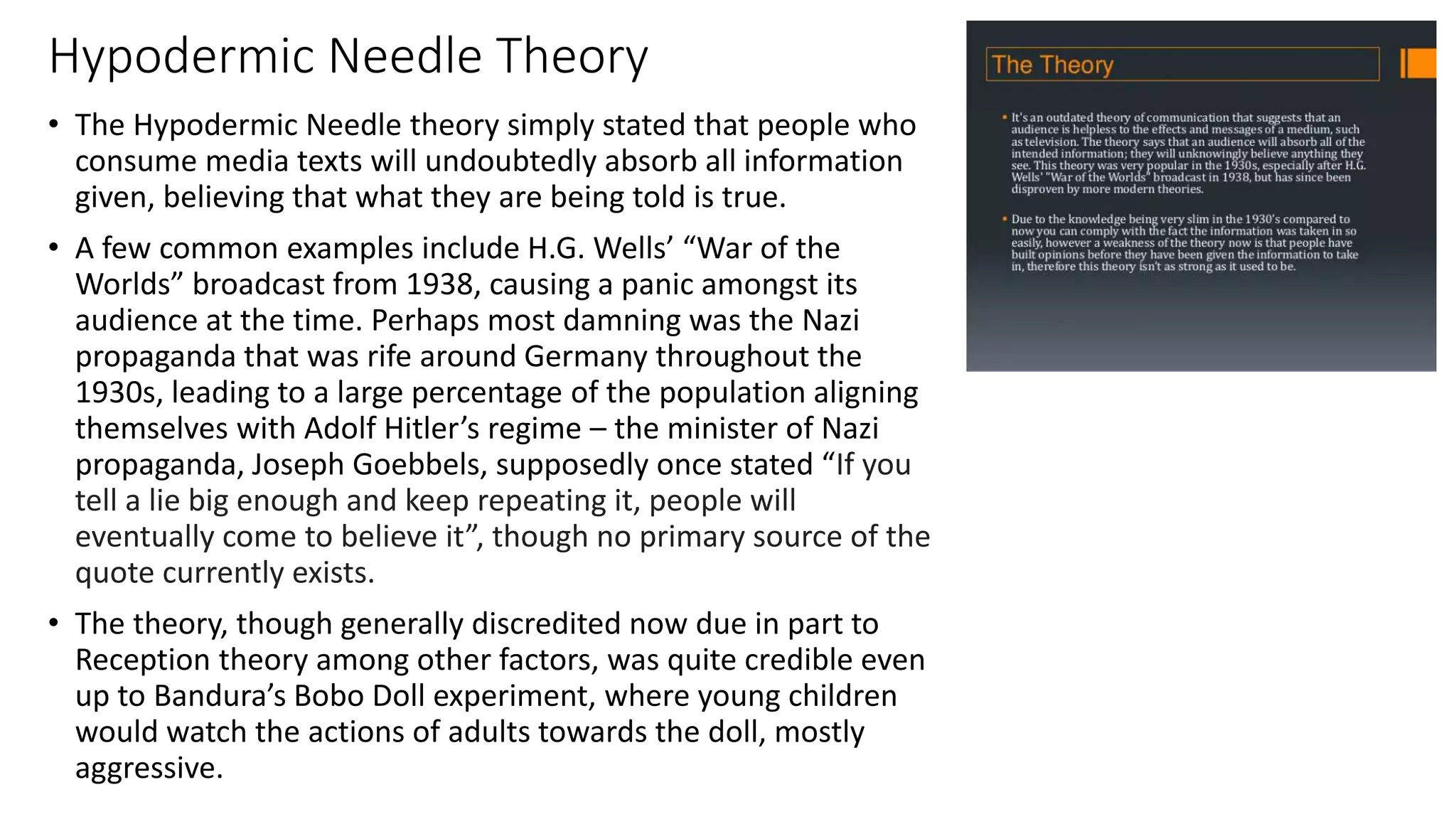
• The Hypodermic Needle theory simply stated that people who
consume media texts will undoubtedly absorb all information
given, believing that what they are being told is true.
• A few common examples include H.G. Wells’ “War of the
Worlds” broadcast from 1938, causing a panic amongst its
audience at the time. Perhaps most damning was the Nazi
propaganda that was rife around Germany throughout the
1930s, leading to a large percentage of the population aligning
themselves with Adolf Hitler’s regime – the minister of Nazi
propaganda, Joseph Goebbels, supposedly once stated “If you
tell a lie big enough and keep repeating it, people will
eventually come to believe it”, though no primary source of the
quote currently exists.
• The theory, though generally discredited now due in part to
Reception theory among other factors, was quite credible even
up to Bandura’s Bobo Doll experiment, where young children
would watch the actions of adults towards the doll, mostly
aggressive.
Male Gaze
• Cultivated by Laura Mulvey (with influence from Freud and
Jacques Lucan) - the representation of women in media and
film (and as a consequences, in society in general) is seen as
being dominated by a male point of view. Therefore, she sees
the world is a patriarchy and men are "active", whilst women
are "passive".
• In media texts (most notably films), men are traditionally seen
to be in active roles that drive the narrative, whilst women play
passive roles as love interests, tending to slow the narrative
down. Additionally, male roles have typically outnumbered
female roles in individual films, and women have also had
scarce opportunities to play leading roles.
• The bulk of this theory is that women are stereotyped to be
physically attractive to overpower and distract men, whilst also
being willing to settle down despite their high intellect.
Mulvey puts this concisely as voyeuristic and fetishistic.
• A potential argument to this theory is that it is slowly
diminishing in the present day – women's roles in film and
society are in a period of improvement (e.g. Black Widow, Alien
and Wonder Woman), though it's impossible to claim the male
gaze has completely disappeared as there is still an element of
voyeurism in place.
Reception Theory
Source 1
• Suggested by Stuart Hall in 1980, Reception theory states two things – the first
thing is that media texts are encoded with certain values and meanings by their
producers, and that those meanings are then decoded by its audience, all in
different ways that may sway away from what the producers initially interpreted.
• The second part of Hall’s take on the theory is that the audiences then split
themselves into one of three positions regarding how they interpret the media
text:
• Preferred or dominant reading: The audience’s position of the text matches with the
producer’s, they interpret the same, or similar thing.
• Negotiated reading: A compromise between preferred and dominant readings, the audience
may accept a portion of the producers interpretation, but also has their own separate views
on the meanings as well.
• Oppositional reading: The audience rejects, perhaps even dislikes, the producer’s
interpretation, and instead creates their own meaning of the text.
• There are lots of factors that may affect whether audience members choose to
take a preferred, negotiated, or oppositional stance on media texts; these include
the reader’s age, life experiences, culture & beliefs, gender, and mood at the time
of living.
Source 2
• Reception theory, within the medium of literature work, came to be in the
late 1960s, mostly from the work of Hans-Robert Jauss, and was at its most
influential from the early 70s and early 80s in the USA and Germany
amongst some of the most notable works in Western Europe.
• The approach for analysing critical work relies on the use of negotiation
and opposition from the audience, and creative work is not passively
accepted by people – this is therefore a direct challenge to the Hypodermic
Needle theory. Instead, audiences interpret their own meanings of media
texts based on their own life and cultural experiences.
• The meaning of the text isn’t explicitly made clear within itself, but more so it is
created by the relationship between the reader and the text itself.
• There is also a suggestion that reception can be influenced by role models
of society, such as celebrities, who can act as leaders of oppositional or
preferred readings for certain media texts.
Source 3
• How the spectator defines themselves as a person and as a member of a
larger society affects how she or he will view a film. If a film has a strong
feminist message, for example, it will likely be viewed differently by a
person who considers herself a feminist than by a person who does not.
Similarly, a film about racial struggle will probably be read in different ways
by audience members depending on whether or not they are themselves
members of a racial minority. Thus a spectator will watch films from several
subject positions at the same time, and in each cinema experience
different positions will be appealed to at different times.
• A viewer's expectations for a film, and the experience of the film, can also
be affected their experiences and thoughts on the film's genre; its actors,
writers, director, or other production personnel, the circumstances of its
production (for example, if there were reports of problems on the set), and
its marketing or merchandising. The conditions of a film's exhibition also
factor in to its eventual reception.
Source 4
• Hall was born in 1932 into a middle class family in Kingston, Jamaica. Jamaica did not gain
independence from Great Britain until 1962, so Stuart spent the first 30 years of his life under
British colonial rule. After graduating from college, he started writing influential articles and
published a number of books about how people interact with each other and media. He became
one of Britain’s leading cultural theorists. Growing up as a minority in white colonial Jamaica, it is
likely that his ethnicity and upbringing played a large role in the development of his theories.
• In his numerous publications, his writing focused primarily on the ideas of racial prejudice, media,
and social and cultural theories. He also spent an extensive amount of time writing about
hegemony. Hegemony is the political, military or economical ruling of one group over another
group of people, and the main purpose is to provide structure in social settings in which people
could not survive without.
• Because of his ethnicity and growing up in a British colony, it is likely that Hall had first hand
experience with decoders taking different meanings from the same message due to factors such
as one’s personal background. Hall, coming up with his own theory around the same time as Eco,
took these ideas, edited them, and added on to them what he thought was important and true.
Researching Metallica’s St. Anger
Some Kind of Monster & This Monster Lives
• By 2001, the band was nearing on implosion. Ulrich had spent the previous year
pursuing a lawsuit case against Napster, a peer-2-peer network site, Newsted had
left, leaving Bob Rock, the band’s then-producer since their eponymous Black
Album, to fill in on bass guitar for St. Anger sessions, during which, Hetfield
checked into rehab to treat his alcoholism, leaving just Ulrich and Hammett to
fend for themselves.
• "James flew to Russia to shoot bears and drown himself in vodka... When he returned, things
deteriorated quickly. James and Lars were at each other's throats."
• Even their relationship was dwindling, Kirk didn’t inform Lars of his 40th birthday
party, which was held at the group’s HQ. Kirk and the rest of the crew appeared in
Hawaiian dress-ups, whilst Lars turned up in his everyday clothes unaware of the
festivities.
• “Lars felt snubbed and stalked into another room with a plate of food to eat in silence…”,
[Lars] sulked “Nobody throws me a birthday party… Life is an eternal birthday party for
someone else…”
Album artwork
• It appears that Metallica initially had the idea of making
multiple editions of the album, with some copies being in
limited edition artwork of varying colour schemes.
• “As we are speaking, the idea is to do a limited print run of 3
other colour options for your choosing and viewing pleasure.
We are still finalizing the exact specific details to this multiple
cover run. But we wanted to give you the visuals first…”
• They also announced that Pushead (real name Brian Schroeder)
was the artist of the artwork.
• There is existence of the
green/purple version of the
cover, which was shown on
Reddit, though it is unclear
whether the other covers do
exist.
Pushead's work
• Schroeder's work has mostly been based within the thrash
metal and hardcore punk cultures. His art style mostly
consists of elements such as skulls that are gruesome and
weathered.
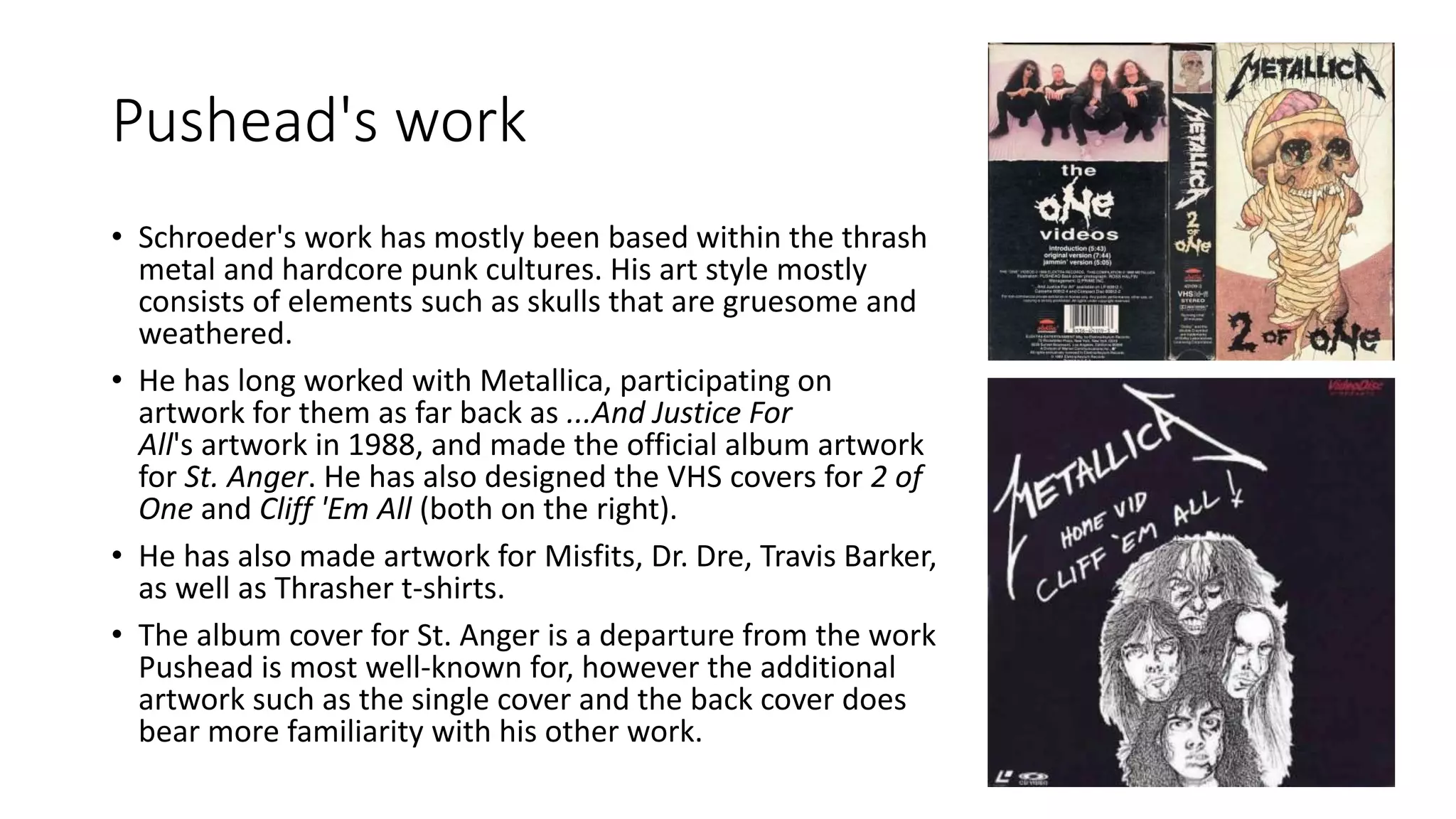
• He has long worked with Metallica, participating on
artwork for them as far back as ...And Justice For
All's artwork in 1988, and made the official album artwork
for St. Anger. He has also designed the VHS covers for 2 of
One and Cliff 'Em All (both on the right).
• He has also made artwork for Misfits, Dr. Dre, Travis Barker,
as well as Thrasher t-shirts.
• The album cover for St. Anger is a departure from the work
Pushead is most well-known for, however the additional
artwork such as the single cover and the back cover does
bear more familiarity with his other work.
Reviews of the album
• Fans and drummers have consistently criticised the thin, snapping
sound of the drum throughout the album, however, Ulrich defended
the record when asked if he stands behind the divisive snare sound.
• “I stand behind it 100% because, at that moment, that was the truth, just my
personality, I’m always just looking ahead, always thinking about the next
thing.
• To many within the metal community, St. Anger is generally seen as a
symbol of disappointment, and partly in tune with the inner conflict
that reflected Metallica at this point in their career. The members
themselves saw the effort as an important step in regards to
rebuilding their relationships with each other, as well as channelling
their collective anger in a positive and creative aspect.
Analysing the St. Anger artwork
St. Anger album artwork:
• The colour scheme: The clashing of a solid, cardinal red and a sharp, solid, flame shade of orange
do well to symbolise aggression and a fiery temper – linking to the mood of the band’s situation
at the time.
• The rope: The rope being wrapped around the hand has many links towards anger – one could
argue that the figure being held back from unloading their aggression because of it, others may
say the rope is being used in an attempt to help them channel that aggression within
themselves, depending on how the audience receives it. These all anchor with the lyrical themes
the album go towards, pondering over whether letting the anger out, or holding it inside is the
better option.
• More morbidly, ropes also tend to have a connection to suicide by hanging – another thing
that some of the songs’ lyrics touch on – “medallion noose, I hang myself, St. Anger round
my neck”, St. Anger [the title track].
• The clenched fist: Another obvious symbol of aggression – clenching fists is usually a sign that
someone is going to strike a punch, or at the very least is experiencing an emotion of frustration
because of someone to the point of which they make consider striking a punch.
• The art style: It’s cel-shaded, which is a slight departure from what Metallica had previously
aimed for with their album artworks, which ranged from well-elaborated and detailed drawings,
as is the case in …And Justice For All, to abstract art from Load and ReLoad.
• The comic explosion: Overall, the artwork makes it appear that the fist, despite being restrained by the rope, has managed to destroy something, in an effort
to let out the figurative anger that was being held inside – an example I saw it as beforehand was
• The lack of any copy whatsoever: The artwork does not feature the names of either the album or the artist, although they can still be found on the spine of
the album case. This was possibly done in an attempt to let the artwork try to sell the album and not necessarily the artist’s name – Metallica were still one
of the biggest music artists in the world by 2003, and St. Anger, despite it’s critical divisiveness, notably due to there being no guitar solos at all and a wild
drum sound, still made it to number 1 in many countries, such as the US and Canada, as well as number 3 in the UK
• The parental advisory logo: A well-known indication that the album that one is about to listen to will include an excessive amount of swearing, or that lyrics
will be based around adult themes. St. Anger is no exception to this, becoming the only Metallica album to date that has been slapped by the infamous black
and white logo.
St. Anger promotional singles artwork:
• Notable factors about the figure: The figure involved in the artwork has many distinct features
about them, which will be spoken about in the following bullet points.
• The halo: The figure has a slightly visible halo just behind their head, therefore we can
depict them to be some for of angel, or saint (hence the name St. Anger).
• The screaming: An obvious sign of anger being let out, also a sign of someone being in
pain or suffering.
• Their neck is red: Red marks on a person’s body tends to be a more physical sign that
someone is suffering and in pain, again linking to lyrical themes of the album.
• The rope wrapped around them: The rope is blocking any attempt made whatsoever by
the saint to fly away, or walk anywhere, as it is wrapped around both their wings and their
feet. The lack of freedom appears to be a depiction regarding issues such as anxiety, which
gets explored on further in the lyrics to The Unnamed Feeling – “been here before”,
“found safety in this loneliness, but I cannot stand it anymore”. People who suffer from
these types of issues often feel so trapped in their own mind that they begin to lose the
ability to free themselves from it, leading to a vicious cycle.
• The artwork for the St. Anger single was used as a template for the other singles that were
released to promote the album; these were Frantic, The Unnamed Feeling, and Some Kind of
Monster (the latter was also used to promote its eponymous documentary that uncovers how
the album was made, as well as how the member’s relationships with one another and general
morale dwindled over this period).
• The colour schemes: St. Anger’s single artwork makes use of a somewhat neutral choice of
colours, which does make the saint feel somewhat more humanistic. Some Kind of Monster’s
artwork is basically the same, just with the figure framed in a close-up. By comparison, Frantic
seems to adopt the same, or a similar colour scheme to the album artwork, using the warmer
shades of red and orange, whilst The Unnamed Feeling uses a negative-style filter, with the
figure appearing in black and white and seeming more like a monster, or something not
conventional, fitting with the song’s title.
Bibliography
1. Anon. (2015). St. Anger alternate cover art. Found this in Wal-Mart around 2015 (surprisingly). I’m curious if anyone else has a copy and if so where they found it. Available:
https://www.reddit.com/r/Metallica/comments/gw9610/st_anger_alternate_cover_art_found_this_in/?utm_source=BD&utm_medium=Search&utm_name=Bing&utm_con
tent=PSR1. Last accessed 2nd Nov 2021.
2. Anon. (2021). The Album Art of Pushead (Brian Schroeder). Available: https://rateyourmusic.com/list/monocle/the_album_art_of_pushead__brian_schroeder_/3/. Last
accessed 12th Nov 2021.
3. Berlinger, J & Milner, G (2004). Metallica: This Monster Lives: The Inside Story of Some Kind of Monster. New York: St. Martin's Press. p1-338.
4. Berlinger, J & Sinofsky, B (2004) Metallica: Some Kind of Monster
5. Bower, R. (2013). Hypodermic Needle Theory. Available: https://www.slideshare.net/rbower12/hypodermic-needle-theory-29037842?qid=57eb92e6-17ca-41bd-b5d0-
39123adfc042&v=&b=&from_search=3. Last accessed 10th Sept 2021.
6. Harris, B. (2020). In Defence Of: Metallica’s ‘St. Anger’. Available: https://musicfeeds.com.au/features/in-defence-of-metallicas-st-anger/. Last accessed 17th Dec 2021.
7. Leslie, E. (2013). Reception theory-audience-response-stuart-hall-1980. Available: https://www.slideshare.net/salemsabrina/reception-
theoryaudienceresponsestuarthall1980?qid=cfef1cd4-8bfa-45d0-8728-dbea1796b24e&v=&b=&from_search=1. Last accessed 10th Sept 2021.
8. Lorenz, Z. (2011). Laura Mulvey - The Male Gaze. Available: https://www.slideshare.net/zlorhenley/laura-mulvey-the-male-gaze-10557918. Last accessed 13th Sept 2021.
9. Metallica. (2003). St. Anger Cover Art. Available: https://www.metallica.com/news/345974.html. Last accessed 22nd Oct 2021.
10. Phillips, D. (2008). Reception Theory. Available: https://www.slideshare.net/dphillips4363/reception-theory-presentation. Last accessed 8th Oct 2021.
11. Pushead (2003) St. Anger album cover
12. Reilly, N. (2020). Metallica’s Lars Ulrich defends ‘St Anger’ snare sound: “I stand behind it 100%”. Available: https://www.nme.com/news/music/metallicas-lars-ulrich-
defends-st-anger-snare-sound-i-stand-behind-it-a-hundred-percent-2718309. Last accessed 22nd Oct 2021.
13. Teel, A. (2017). The Application of Stuart Hall’s Audience Reception Theory to Help Us Understand #WhichLivesMatter?. Available: https://medium.com/@ateel/the-
application-of-stuart-halls-audience-reception-theory-to-help-us-understand-whichlivesmatter-3d4e9e10dae5. Last accessed 8th Oct 2021.
14. Wagner, K. (n.d.). Reception Theory. Available: https://www.encyclopedia.com/arts/encyclopedias-almanacs-transcripts-and-maps/reception-theory. Last accessed 8th Oct
2021.
15. Wright, S. (2013). Auteur Theory (TV Y1). Available: https://www.slideshare.net/simonwright85/auteur-theory-fd-a-year-1. Last accessed 10th Sept 2021.

Personal Study - Powerpoint

  • 1.
  • 2.
  • 3.
    Auteur Theory • TheAuteur Theory suggests that modern-day directors of films have so much control over their products that they essentially “author” of the entire project, using their distinctive artistic style across multiple films, usually original screenplays. • Idea originated from French film magazine Cahiers du Cinema in the 1950s –critics grew tired of French films, watched American films and noticed certain directors had certain traits based on their works. • This led to French New Wave films becoming a thing at the turn of the decade, with the magazine encouraging French directors to treat film-making as more of an art style. Directors such as Goddard and Truffaut flourished during this period. • Other examples of Auteur directors are Alfred Hitchcock, Steven Spielberg, and George Lucas. • Andrew Sarris (1960s) also made the point that these directors tended use a model of 3 concentric circles to base their directing skills: those being Technician (directing techniques), Stylist (personal style), and Auteur (interior meaning, sometimes based on the Auteur’s life events). • Some arguments against the Auteur theory include that it doesn’t take into account that making an entire film is a collaborative effort, praising the directors whilst ignoring writers, actors, and musicians. It also fails to acknowledge the power of which studios hold on film-making.
  • 4.
    Reception Theory • StuartHall (1980) detailed that media products are encoded by producers – basically, they produce their texts with the intention to load their values and messages. These texts are then decoded by its audience, of whom will likely value the text in different ways depending on their contexts, and possibly in ways that are different to the producer. • Hall stated that audience members will position themselves in one of 3 ways when reading the text: • Preferred/Dominant reading – they agree with the producer • Negotiated reading – they pick apart on bits they agree and disagree • Oppositional reading – they disagree with the producer, creating their own meaning of the text • Reasons why audience members take their position vary from age, life experiences, culture, beliefs, gender, etc.
  • 5.
    Hypodermic Needle Theory •The Hypodermic Needle theory simply stated that people who consume media texts will undoubtedly absorb all information given, believing that what they are being told is true. • A few common examples include H.G. Wells’ “War of the Worlds” broadcast from 1938, causing a panic amongst its audience at the time. Perhaps most damning was the Nazi propaganda that was rife around Germany throughout the 1930s, leading to a large percentage of the population aligning themselves with Adolf Hitler’s regime – the minister of Nazi propaganda, Joseph Goebbels, supposedly once stated “If you tell a lie big enough and keep repeating it, people will eventually come to believe it”, though no primary source of the quote currently exists. • The theory, though generally discredited now due in part to Reception theory among other factors, was quite credible even up to Bandura’s Bobo Doll experiment, where young children would watch the actions of adults towards the doll, mostly aggressive.
  • 6.
    Male Gaze • Cultivatedby Laura Mulvey (with influence from Freud and Jacques Lucan) - the representation of women in media and film (and as a consequences, in society in general) is seen as being dominated by a male point of view. Therefore, she sees the world is a patriarchy and men are "active", whilst women are "passive". • In media texts (most notably films), men are traditionally seen to be in active roles that drive the narrative, whilst women play passive roles as love interests, tending to slow the narrative down. Additionally, male roles have typically outnumbered female roles in individual films, and women have also had scarce opportunities to play leading roles. • The bulk of this theory is that women are stereotyped to be physically attractive to overpower and distract men, whilst also being willing to settle down despite their high intellect. Mulvey puts this concisely as voyeuristic and fetishistic. • A potential argument to this theory is that it is slowly diminishing in the present day – women's roles in film and society are in a period of improvement (e.g. Black Widow, Alien and Wonder Woman), though it's impossible to claim the male gaze has completely disappeared as there is still an element of voyeurism in place.
  • 7.
  • 8.
    Source 1 • Suggestedby Stuart Hall in 1980, Reception theory states two things – the first thing is that media texts are encoded with certain values and meanings by their producers, and that those meanings are then decoded by its audience, all in different ways that may sway away from what the producers initially interpreted. • The second part of Hall’s take on the theory is that the audiences then split themselves into one of three positions regarding how they interpret the media text: • Preferred or dominant reading: The audience’s position of the text matches with the producer’s, they interpret the same, or similar thing. • Negotiated reading: A compromise between preferred and dominant readings, the audience may accept a portion of the producers interpretation, but also has their own separate views on the meanings as well. • Oppositional reading: The audience rejects, perhaps even dislikes, the producer’s interpretation, and instead creates their own meaning of the text. • There are lots of factors that may affect whether audience members choose to take a preferred, negotiated, or oppositional stance on media texts; these include the reader’s age, life experiences, culture & beliefs, gender, and mood at the time of living.
  • 9.
    Source 2 • Receptiontheory, within the medium of literature work, came to be in the late 1960s, mostly from the work of Hans-Robert Jauss, and was at its most influential from the early 70s and early 80s in the USA and Germany amongst some of the most notable works in Western Europe. • The approach for analysing critical work relies on the use of negotiation and opposition from the audience, and creative work is not passively accepted by people – this is therefore a direct challenge to the Hypodermic Needle theory. Instead, audiences interpret their own meanings of media texts based on their own life and cultural experiences. • The meaning of the text isn’t explicitly made clear within itself, but more so it is created by the relationship between the reader and the text itself. • There is also a suggestion that reception can be influenced by role models of society, such as celebrities, who can act as leaders of oppositional or preferred readings for certain media texts.
  • 10.
    Source 3 • Howthe spectator defines themselves as a person and as a member of a larger society affects how she or he will view a film. If a film has a strong feminist message, for example, it will likely be viewed differently by a person who considers herself a feminist than by a person who does not. Similarly, a film about racial struggle will probably be read in different ways by audience members depending on whether or not they are themselves members of a racial minority. Thus a spectator will watch films from several subject positions at the same time, and in each cinema experience different positions will be appealed to at different times. • A viewer's expectations for a film, and the experience of the film, can also be affected their experiences and thoughts on the film's genre; its actors, writers, director, or other production personnel, the circumstances of its production (for example, if there were reports of problems on the set), and its marketing or merchandising. The conditions of a film's exhibition also factor in to its eventual reception.
  • 11.
    Source 4 • Hallwas born in 1932 into a middle class family in Kingston, Jamaica. Jamaica did not gain independence from Great Britain until 1962, so Stuart spent the first 30 years of his life under British colonial rule. After graduating from college, he started writing influential articles and published a number of books about how people interact with each other and media. He became one of Britain’s leading cultural theorists. Growing up as a minority in white colonial Jamaica, it is likely that his ethnicity and upbringing played a large role in the development of his theories. • In his numerous publications, his writing focused primarily on the ideas of racial prejudice, media, and social and cultural theories. He also spent an extensive amount of time writing about hegemony. Hegemony is the political, military or economical ruling of one group over another group of people, and the main purpose is to provide structure in social settings in which people could not survive without. • Because of his ethnicity and growing up in a British colony, it is likely that Hall had first hand experience with decoders taking different meanings from the same message due to factors such as one’s personal background. Hall, coming up with his own theory around the same time as Eco, took these ideas, edited them, and added on to them what he thought was important and true.
  • 12.
  • 13.
    Some Kind ofMonster & This Monster Lives • By 2001, the band was nearing on implosion. Ulrich had spent the previous year pursuing a lawsuit case against Napster, a peer-2-peer network site, Newsted had left, leaving Bob Rock, the band’s then-producer since their eponymous Black Album, to fill in on bass guitar for St. Anger sessions, during which, Hetfield checked into rehab to treat his alcoholism, leaving just Ulrich and Hammett to fend for themselves. • "James flew to Russia to shoot bears and drown himself in vodka... When he returned, things deteriorated quickly. James and Lars were at each other's throats." • Even their relationship was dwindling, Kirk didn’t inform Lars of his 40th birthday party, which was held at the group’s HQ. Kirk and the rest of the crew appeared in Hawaiian dress-ups, whilst Lars turned up in his everyday clothes unaware of the festivities. • “Lars felt snubbed and stalked into another room with a plate of food to eat in silence…”, [Lars] sulked “Nobody throws me a birthday party… Life is an eternal birthday party for someone else…”
  • 14.
    Album artwork • Itappears that Metallica initially had the idea of making multiple editions of the album, with some copies being in limited edition artwork of varying colour schemes. • “As we are speaking, the idea is to do a limited print run of 3 other colour options for your choosing and viewing pleasure. We are still finalizing the exact specific details to this multiple cover run. But we wanted to give you the visuals first…” • They also announced that Pushead (real name Brian Schroeder) was the artist of the artwork. • There is existence of the green/purple version of the cover, which was shown on Reddit, though it is unclear whether the other covers do exist.
  • 15.
    Pushead's work • Schroeder'swork has mostly been based within the thrash metal and hardcore punk cultures. His art style mostly consists of elements such as skulls that are gruesome and weathered. • He has long worked with Metallica, participating on artwork for them as far back as ...And Justice For All's artwork in 1988, and made the official album artwork for St. Anger. He has also designed the VHS covers for 2 of One and Cliff 'Em All (both on the right). • He has also made artwork for Misfits, Dr. Dre, Travis Barker, as well as Thrasher t-shirts. • The album cover for St. Anger is a departure from the work Pushead is most well-known for, however the additional artwork such as the single cover and the back cover does bear more familiarity with his other work.
  • 16.
    Reviews of thealbum • Fans and drummers have consistently criticised the thin, snapping sound of the drum throughout the album, however, Ulrich defended the record when asked if he stands behind the divisive snare sound. • “I stand behind it 100% because, at that moment, that was the truth, just my personality, I’m always just looking ahead, always thinking about the next thing. • To many within the metal community, St. Anger is generally seen as a symbol of disappointment, and partly in tune with the inner conflict that reflected Metallica at this point in their career. The members themselves saw the effort as an important step in regards to rebuilding their relationships with each other, as well as channelling their collective anger in a positive and creative aspect.
  • 17.
    Analysing the St.Anger artwork
  • 18.
    St. Anger albumartwork: • The colour scheme: The clashing of a solid, cardinal red and a sharp, solid, flame shade of orange do well to symbolise aggression and a fiery temper – linking to the mood of the band’s situation at the time. • The rope: The rope being wrapped around the hand has many links towards anger – one could argue that the figure being held back from unloading their aggression because of it, others may say the rope is being used in an attempt to help them channel that aggression within themselves, depending on how the audience receives it. These all anchor with the lyrical themes the album go towards, pondering over whether letting the anger out, or holding it inside is the better option. • More morbidly, ropes also tend to have a connection to suicide by hanging – another thing that some of the songs’ lyrics touch on – “medallion noose, I hang myself, St. Anger round my neck”, St. Anger [the title track]. • The clenched fist: Another obvious symbol of aggression – clenching fists is usually a sign that someone is going to strike a punch, or at the very least is experiencing an emotion of frustration because of someone to the point of which they make consider striking a punch. • The art style: It’s cel-shaded, which is a slight departure from what Metallica had previously aimed for with their album artworks, which ranged from well-elaborated and detailed drawings, as is the case in …And Justice For All, to abstract art from Load and ReLoad. • The comic explosion: Overall, the artwork makes it appear that the fist, despite being restrained by the rope, has managed to destroy something, in an effort to let out the figurative anger that was being held inside – an example I saw it as beforehand was • The lack of any copy whatsoever: The artwork does not feature the names of either the album or the artist, although they can still be found on the spine of the album case. This was possibly done in an attempt to let the artwork try to sell the album and not necessarily the artist’s name – Metallica were still one of the biggest music artists in the world by 2003, and St. Anger, despite it’s critical divisiveness, notably due to there being no guitar solos at all and a wild drum sound, still made it to number 1 in many countries, such as the US and Canada, as well as number 3 in the UK • The parental advisory logo: A well-known indication that the album that one is about to listen to will include an excessive amount of swearing, or that lyrics will be based around adult themes. St. Anger is no exception to this, becoming the only Metallica album to date that has been slapped by the infamous black and white logo.
  • 19.
    St. Anger promotionalsingles artwork: • Notable factors about the figure: The figure involved in the artwork has many distinct features about them, which will be spoken about in the following bullet points. • The halo: The figure has a slightly visible halo just behind their head, therefore we can depict them to be some for of angel, or saint (hence the name St. Anger). • The screaming: An obvious sign of anger being let out, also a sign of someone being in pain or suffering. • Their neck is red: Red marks on a person’s body tends to be a more physical sign that someone is suffering and in pain, again linking to lyrical themes of the album. • The rope wrapped around them: The rope is blocking any attempt made whatsoever by the saint to fly away, or walk anywhere, as it is wrapped around both their wings and their feet. The lack of freedom appears to be a depiction regarding issues such as anxiety, which gets explored on further in the lyrics to The Unnamed Feeling – “been here before”, “found safety in this loneliness, but I cannot stand it anymore”. People who suffer from these types of issues often feel so trapped in their own mind that they begin to lose the ability to free themselves from it, leading to a vicious cycle. • The artwork for the St. Anger single was used as a template for the other singles that were released to promote the album; these were Frantic, The Unnamed Feeling, and Some Kind of Monster (the latter was also used to promote its eponymous documentary that uncovers how the album was made, as well as how the member’s relationships with one another and general morale dwindled over this period). • The colour schemes: St. Anger’s single artwork makes use of a somewhat neutral choice of colours, which does make the saint feel somewhat more humanistic. Some Kind of Monster’s artwork is basically the same, just with the figure framed in a close-up. By comparison, Frantic seems to adopt the same, or a similar colour scheme to the album artwork, using the warmer shades of red and orange, whilst The Unnamed Feeling uses a negative-style filter, with the figure appearing in black and white and seeming more like a monster, or something not conventional, fitting with the song’s title.
  • 20.
    Bibliography 1. Anon. (2015).St. Anger alternate cover art. Found this in Wal-Mart around 2015 (surprisingly). I’m curious if anyone else has a copy and if so where they found it. Available: https://www.reddit.com/r/Metallica/comments/gw9610/st_anger_alternate_cover_art_found_this_in/?utm_source=BD&utm_medium=Search&utm_name=Bing&utm_con tent=PSR1. Last accessed 2nd Nov 2021. 2. Anon. (2021). The Album Art of Pushead (Brian Schroeder). Available: https://rateyourmusic.com/list/monocle/the_album_art_of_pushead__brian_schroeder_/3/. Last accessed 12th Nov 2021. 3. Berlinger, J & Milner, G (2004). Metallica: This Monster Lives: The Inside Story of Some Kind of Monster. New York: St. Martin's Press. p1-338. 4. Berlinger, J & Sinofsky, B (2004) Metallica: Some Kind of Monster 5. Bower, R. (2013). Hypodermic Needle Theory. Available: https://www.slideshare.net/rbower12/hypodermic-needle-theory-29037842?qid=57eb92e6-17ca-41bd-b5d0- 39123adfc042&v=&b=&from_search=3. Last accessed 10th Sept 2021. 6. Harris, B. (2020). In Defence Of: Metallica’s ‘St. Anger’. Available: https://musicfeeds.com.au/features/in-defence-of-metallicas-st-anger/. Last accessed 17th Dec 2021. 7. Leslie, E. (2013). Reception theory-audience-response-stuart-hall-1980. Available: https://www.slideshare.net/salemsabrina/reception- theoryaudienceresponsestuarthall1980?qid=cfef1cd4-8bfa-45d0-8728-dbea1796b24e&v=&b=&from_search=1. Last accessed 10th Sept 2021. 8. Lorenz, Z. (2011). Laura Mulvey - The Male Gaze. Available: https://www.slideshare.net/zlorhenley/laura-mulvey-the-male-gaze-10557918. Last accessed 13th Sept 2021. 9. Metallica. (2003). St. Anger Cover Art. Available: https://www.metallica.com/news/345974.html. Last accessed 22nd Oct 2021. 10. Phillips, D. (2008). Reception Theory. Available: https://www.slideshare.net/dphillips4363/reception-theory-presentation. Last accessed 8th Oct 2021. 11. Pushead (2003) St. Anger album cover 12. Reilly, N. (2020). Metallica’s Lars Ulrich defends ‘St Anger’ snare sound: “I stand behind it 100%”. Available: https://www.nme.com/news/music/metallicas-lars-ulrich- defends-st-anger-snare-sound-i-stand-behind-it-a-hundred-percent-2718309. Last accessed 22nd Oct 2021. 13. Teel, A. (2017). The Application of Stuart Hall’s Audience Reception Theory to Help Us Understand #WhichLivesMatter?. Available: https://medium.com/@ateel/the- application-of-stuart-halls-audience-reception-theory-to-help-us-understand-whichlivesmatter-3d4e9e10dae5. Last accessed 8th Oct 2021. 14. Wagner, K. (n.d.). Reception Theory. Available: https://www.encyclopedia.com/arts/encyclopedias-almanacs-transcripts-and-maps/reception-theory. Last accessed 8th Oct 2021. 15. Wright, S. (2013). Auteur Theory (TV Y1). Available: https://www.slideshare.net/simonwright85/auteur-theory-fd-a-year-1. Last accessed 10th Sept 2021.