Narrative theory
Why is narrative so important?
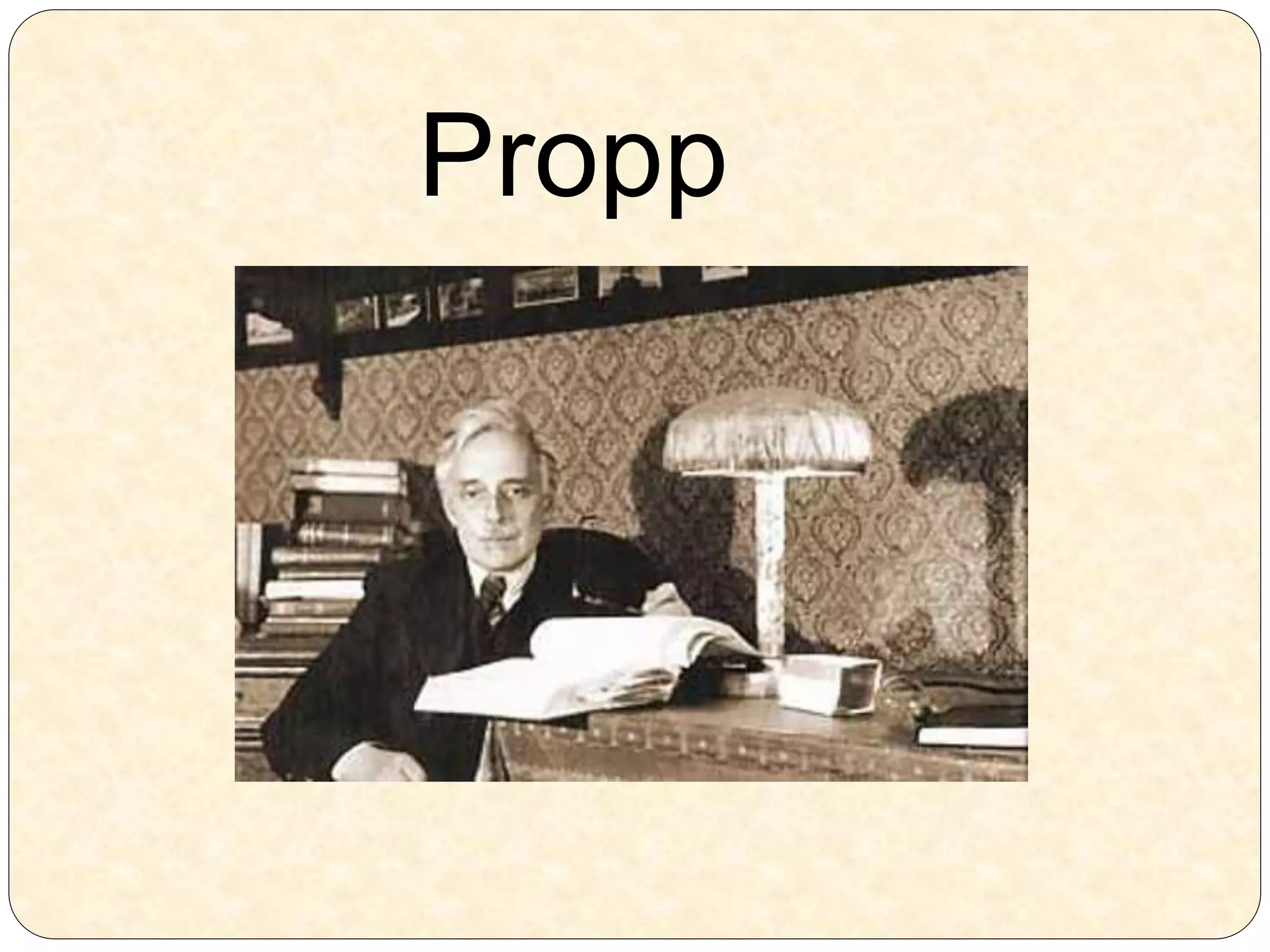
Propp
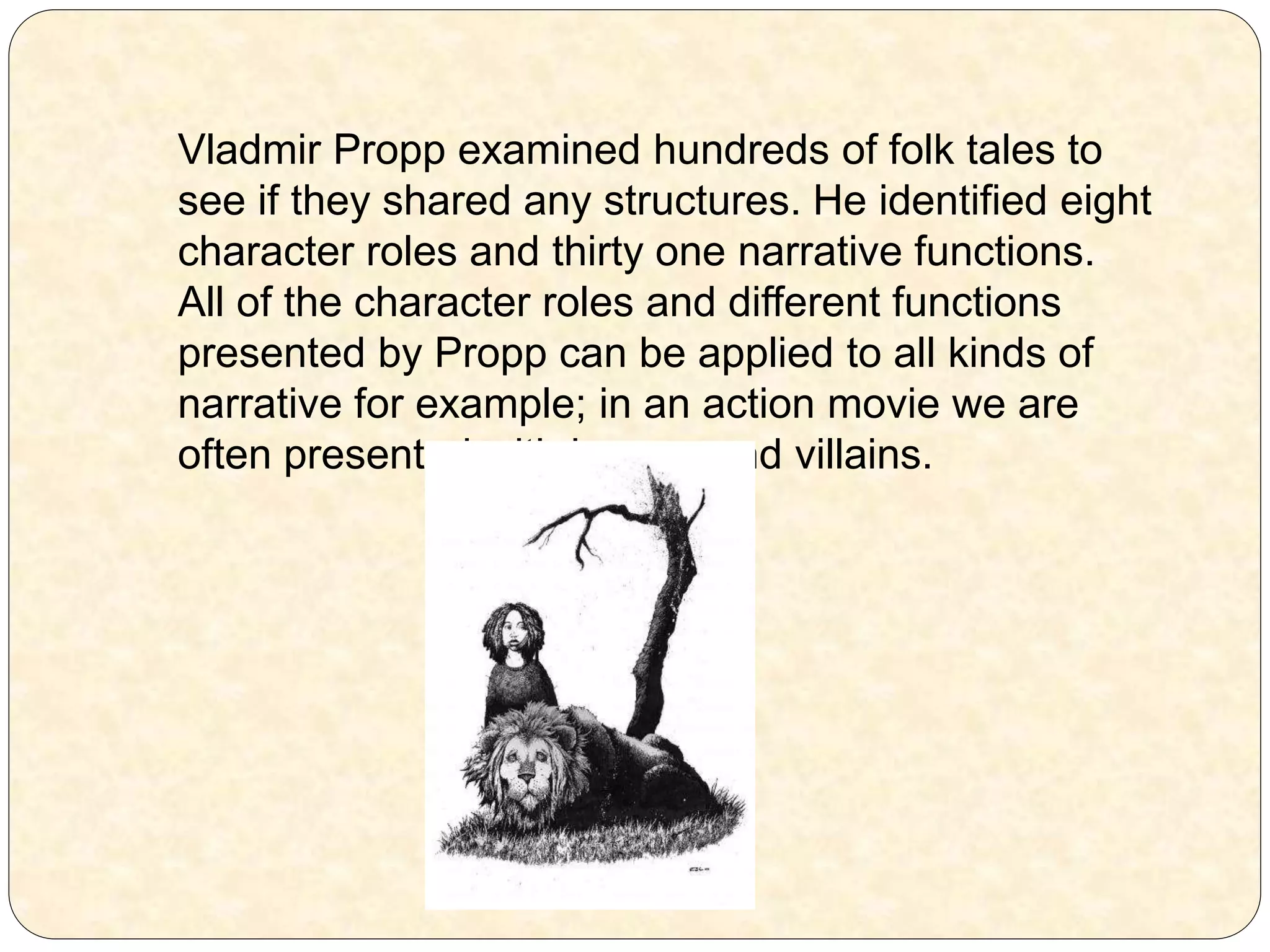
Vladmir Propp examined hundreds of folk tales to
see if they shared any structures. He identified eight
character roles and thirty one narrative functions.
All of the character roles and different functions
presented by Propp can be applied to all kinds of
narrative for example; in an action movie we are
often presented with heroes and villains.
Propp’s eight character roles.
The villain— struggles against the hero-
The Hero – is the one who strives to do
good but often needs help (lacks
something)
The dispatcher—character who makes
the lack known and sends the hero off
The helper — helps the hero in the
journey
The donor —prepares the hero or gives
the hero some magical object
False hero — takes credit for the hero’s
actions or tries to marry the princess
The princess or prize — the hero
deserves her throughout the story but is
unable to marry her because of an unfair
evil, usually because of the villain. the
hero's journey is often ended when he
marries the princess, thereby beating the
villain-
Her father — gives the task to the hero,
identifies the false hero, marries the hero,
often sought for during the narrative -
Bordwell and Thompson
Bordwell and Thompson never did come up with
a complete narrative theory, they did however
come up with some interesting ideas.
They believed that chain of events within a
media form cause effects on a relationship
occurring in time and space and the narrative
shapes this material in terms of time space such
as; where and when things take place. This can
be portrayed through using effects to show the
time and space by using flash backs, forwarding
time, slow motion and speeding up.
CAUSE AND EFFECT
Claude Levi
Strauss
Claude Levi- Strauss looked at narrative structure in terms
of " Binary oppositions" focusing on the different sets of
opposite values which reveal the structure of the media
texts. His narrative theory is different compared to other
theorists as he focused more on the arrangement of themes
rather than the order of a media text.
Examples of these binary
oppositions could be :
Earth – space
Good – bad
Past- Present
Normal- abnormal
Humans- Aliens
Known- Unknown
Dead- Alive
Happy- sad
Weak- strong
Tzvetan Todorov
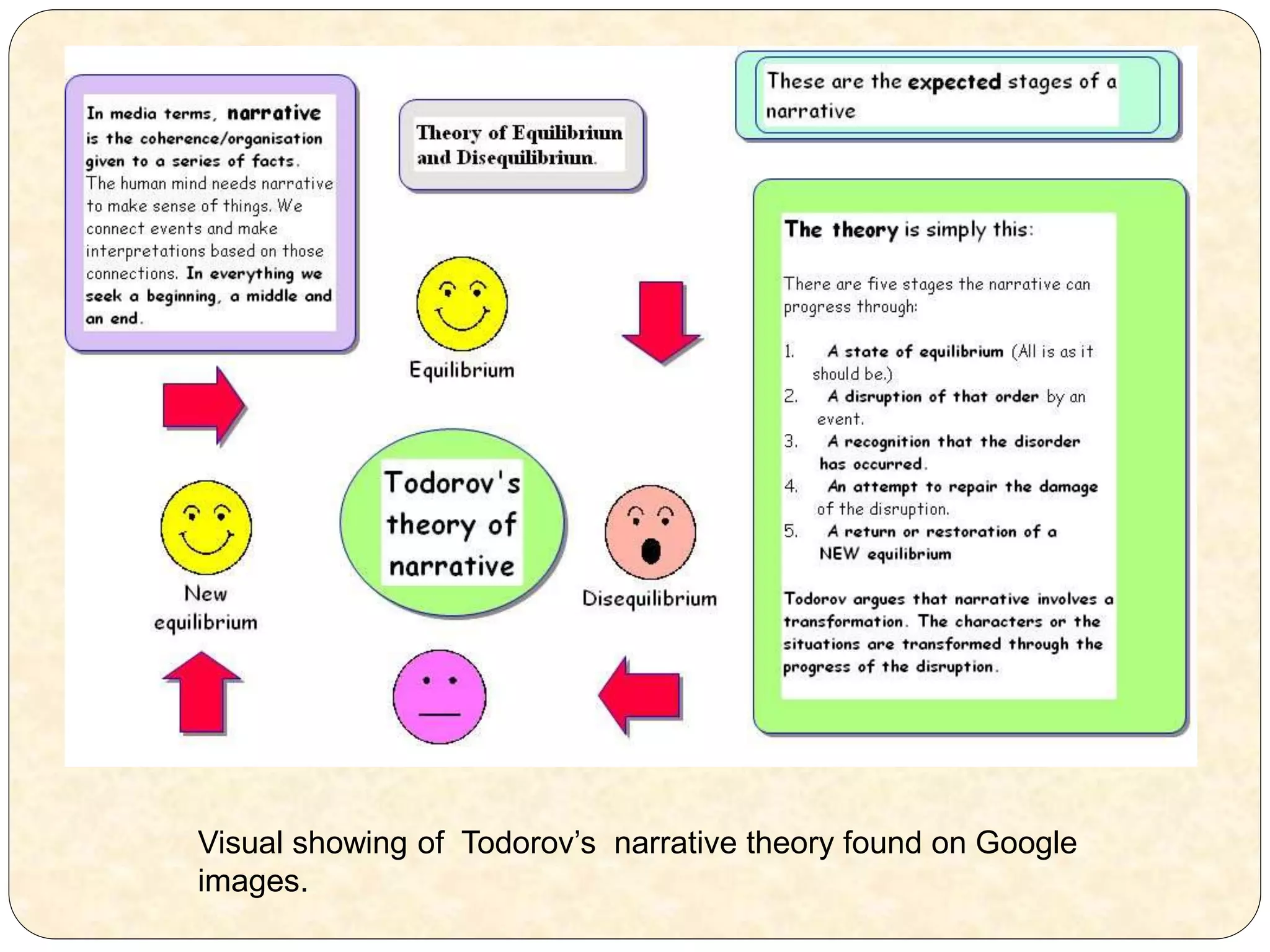
Todorov was a Bulgarian linguist who produced
and published influential narrative theory work
from the 1960’s onwards. His theory suggested
that stories begin with an equilibrium where any
opposing force are in balance. This equilibrium
is then disrupted by an event which leads to a
series of other events leading to the
stereotypical end of all major events being
restored.
Visual showing of Todorov’s narrative theory found on Google
images.
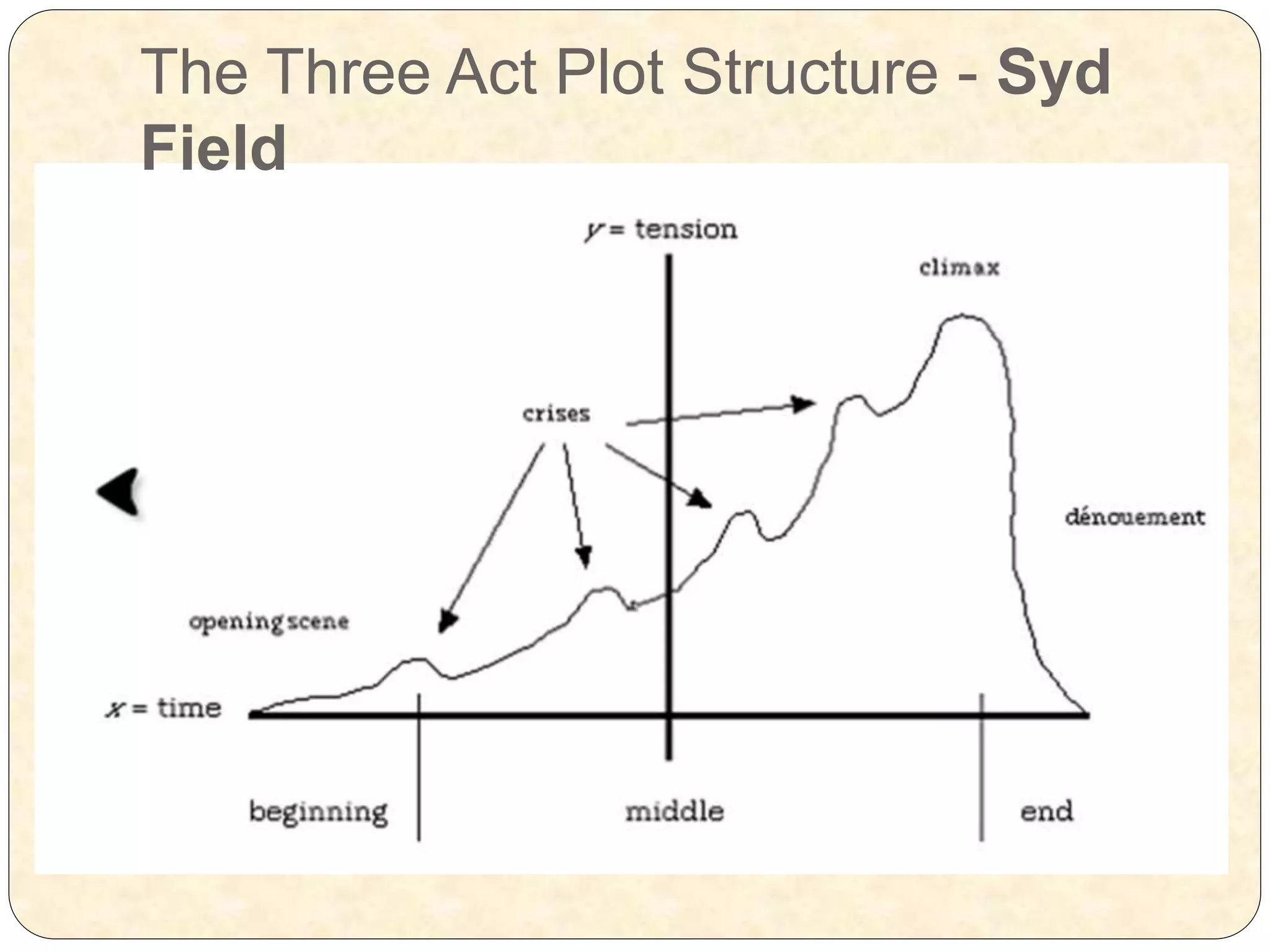
The Three Act Plot Structure - Syd
Field
How to write about Narrative
 State the narrative theory you are going to talk
about
 Briefly describe it to show that you understand it
 Discuss how you used or challenged it with
specific details from your work
 Explain why is was important to use or challenge
the narrative theory
 Cover at least four theories and try to give at least
one example of how you challenged narrative
ideas!
Preparing your notes
 Answer the following questions as fully as possible.
Remember that you can only talk about ONE
production
 What is the structure of the narrative in your
production? For example, is it linear or non-linear?
Why? Is it chronological or does it use flash backs?
Why? Are there two or more narratives working
together at once? Why? How does your production
(micro elements) tell its story? What governs the
beginning, middle and end of your narrative? What
narrative issues did you raise in your opening that
could develop later? What narrative theories are
present in your work? Why these theories? Why not
others? How have you challenged narrative
conventions. What role does genre play in narrative?
Why is narrative important? How does your audience

Narrative

  • 1.
    Narrative theory Why isnarrative so important?
  • 2.
  • 3.
    Vladmir Propp examinedhundreds of folk tales to see if they shared any structures. He identified eight character roles and thirty one narrative functions. All of the character roles and different functions presented by Propp can be applied to all kinds of narrative for example; in an action movie we are often presented with heroes and villains.
  • 4.
    Propp’s eight characterroles. The villain— struggles against the hero- The Hero – is the one who strives to do good but often needs help (lacks something) The dispatcher—character who makes the lack known and sends the hero off The helper — helps the hero in the journey The donor —prepares the hero or gives the hero some magical object False hero — takes credit for the hero’s actions or tries to marry the princess
  • 5.
    The princess orprize — the hero deserves her throughout the story but is unable to marry her because of an unfair evil, usually because of the villain. the hero's journey is often ended when he marries the princess, thereby beating the villain- Her father — gives the task to the hero, identifies the false hero, marries the hero, often sought for during the narrative -
  • 6.
  • 7.
    Bordwell and Thompsonnever did come up with a complete narrative theory, they did however come up with some interesting ideas. They believed that chain of events within a media form cause effects on a relationship occurring in time and space and the narrative shapes this material in terms of time space such as; where and when things take place. This can be portrayed through using effects to show the time and space by using flash backs, forwarding time, slow motion and speeding up. CAUSE AND EFFECT
  • 8.
  • 9.
    Claude Levi- Strausslooked at narrative structure in terms of " Binary oppositions" focusing on the different sets of opposite values which reveal the structure of the media texts. His narrative theory is different compared to other theorists as he focused more on the arrangement of themes rather than the order of a media text.
  • 10.
    Examples of thesebinary oppositions could be : Earth – space Good – bad Past- Present Normal- abnormal Humans- Aliens Known- Unknown Dead- Alive Happy- sad Weak- strong
  • 11.
  • 12.
    Todorov was aBulgarian linguist who produced and published influential narrative theory work from the 1960’s onwards. His theory suggested that stories begin with an equilibrium where any opposing force are in balance. This equilibrium is then disrupted by an event which leads to a series of other events leading to the stereotypical end of all major events being restored.
  • 13.
    Visual showing ofTodorov’s narrative theory found on Google images.
  • 14.
    The Three ActPlot Structure - Syd Field
  • 15.
    How to writeabout Narrative  State the narrative theory you are going to talk about  Briefly describe it to show that you understand it  Discuss how you used or challenged it with specific details from your work  Explain why is was important to use or challenge the narrative theory  Cover at least four theories and try to give at least one example of how you challenged narrative ideas!
  • 16.
    Preparing your notes Answer the following questions as fully as possible. Remember that you can only talk about ONE production  What is the structure of the narrative in your production? For example, is it linear or non-linear? Why? Is it chronological or does it use flash backs? Why? Are there two or more narratives working together at once? Why? How does your production (micro elements) tell its story? What governs the beginning, middle and end of your narrative? What narrative issues did you raise in your opening that could develop later? What narrative theories are present in your work? Why these theories? Why not others? How have you challenged narrative conventions. What role does genre play in narrative? Why is narrative important? How does your audience