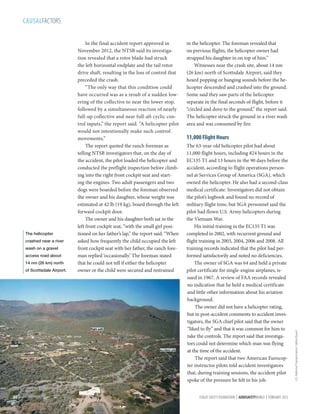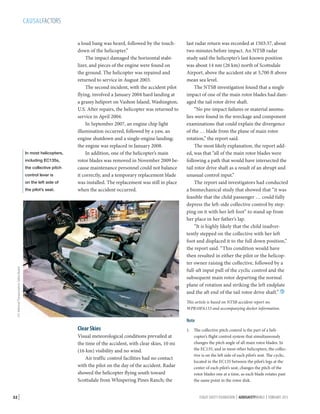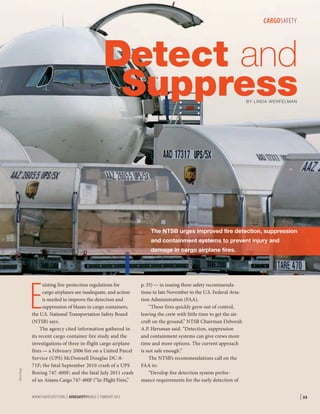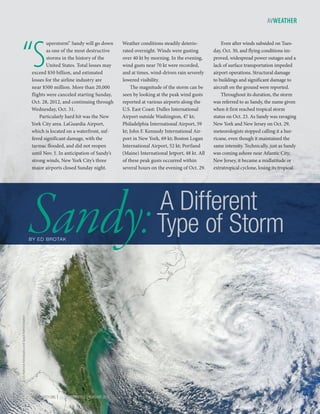

AeroSafety
WO R L D

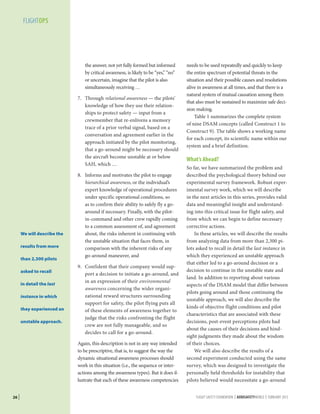
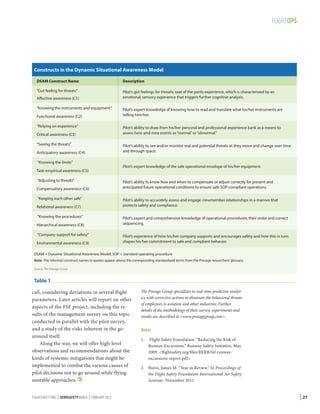
NO GO-AROUND
The psychology of continued unstable approaches
UNINTENDED CONSEQUENCES
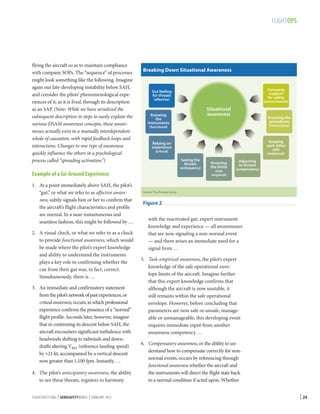
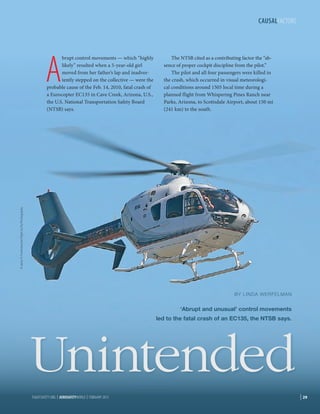
Fatal control movements in EC135
CEASE FIRE
Suppressing cargo airplane fires

BENEFITS OF WAKE VORTEX MEASUREMENT

TRAILING INDICATORS
THE JOURNAL OF FLIGHT SAFETY FOUNDATION

FEBRUARY 2013
The Foundation would like to give special recognition to our BARS Benefactors, Benefactor
and Patron members. We value your membership and your high levels of commitment
to the world of safety. Without your support, the Foundation’s mission of the
continuous improvement of global aviation safety would not be possible.
bars benefactors

benefactors

Snecma

patrons
PRESIDENT’SMESSAGE

CHANGE AT

The Helm
O

n Jan. 1, I assumed the helm of the Flight
Safety Foundation, the most respected
independent and impartial international aviation safety organization in
the world. Following in the sizeable footsteps
of our founder, the late Jerry Lederer, and the
Foundation’s most recent president and CEO,
Bill Voss, will not be an easy task, but it is a
challenge that I sought and about which I am
very excited.
Bill’s background as a pilot and air traffic
controller gave him a well-rounded perspective
of the basics of aviation safety. His many years
at the U.S. Federal Aviation Administration
and the International Civil Aviation Organization gave him an appreciation for what can be
achieved when regulators and industry partners
work together to improve aviation safety. When
he joined the Foundation in November 2006, Bill
immediately began visiting state regulators, aviation organizations and industry groups, resulting
in dozens of trips annually, hundreds of speeches
and presentations, and even more meetings, conferences and one-on-one sessions — all in quest
of advancing aviation safety.
His appearances were not limited to the developed world. Bill traveled to areas where help
was needed most, where regulators, operators
and industry needed to become better informed
on safety issues. Sudan and the Middle East were
among the places where Bill made a significant
difference in how aviation operations and safety
are handled.

FLIGHTSAFETY.ORG | AEROSAFETYWORLD | FEBRUARY 2013

Traveling on behalf of the Foundation took
countless hours away from the office and, most
importantly, away from his family. Without his wife,
Carol’s, support and understanding, that would
have not been possible. For that, I would like to recognize and thank her on behalf of the Foundation.
Throughout Bill’s tenure at the Foundation, he
was known for his insight into individual safety
issues. He has a gift for shaping an issue so it can
be understood by everyone, inside and outside
of the aviation community. For that, we will be
forever indebted.
This spring, Bill plans to write one more
column for AeroSafety World, and to provide
us with his unique perspective on global aviation safety and on his tenure at the Foundation.
I look forward to reading that piece and seeing
and consulting with Bill as he embarks on a new
flight path here in Washington.
As the new president and CEO, I am excited
to share my thoughts with you each month in this
column as I, along with the Foundation Board
of Governors and a very dedicated and talented
staff, move the Foundation into a new generation!

Capt. Kevin L. Hiatt
President and CEO
Flight Safety Foundation

|1
contents
AeroSafetyWORLD

February 2013 Vol 8 Issue 1

features
12	

22	

FlightOps | Dissecting Go-Around Decisions

29	

CausalFactors | Abrupt Collective Input
CargoSafety | Fire Detection and Suppression
AvWeather | Fathoming Superstorm Sandy

42	

18

2012Review | CFIT’s Unwelcome Return

37	

22

18	

33	

12

CoverStory | Wake Vortex Perspectives

SeminarsIASS | Pan American Accomplishments

departments
1	
5	

EditorialPage | The Right Decision

7	

SafetyCalendar | Industry Events

8	
2|

President’sMessage | Change at the Helm

AirMail | Letters From Our Readers
FLIGHT SAFETY FOUNDATION | AEROSAFETYWORLD | FEBRUARY 2013
37

29
33

AeroSafetyWORLD
9	

InBrief | Safety News

47	

DataLink | C-FOQA Trends

52	

InfoScan | SMS Under the Microscope

57	

OnRecord | Fatal Flight Test

telephone: +1 703.739.6700

Capt. Kevin L. Hiatt, publisher,
FSF president and CEO
hiatt@flightsafety.org

Frank Jackman, editor-in-chief,
FSF director of publications
jackman@flightsafety.org, ext. 116

Wayne Rosenkrans, senior editor
rosenkrans@flightsafety.org, ext. 115

Linda Werfelman, senior editor
werfelman@flightsafety.org, ext. 122

Rick Darby, associate editor
darby@flightsafety.org, ext. 113

Jennifer Moore, art director
jennifer@emeraldmediaus.com

Susan D. Reed, production specialist
About the Cover
Operations at London Gatwick.
© Steve Morris/Jetphotos.net

reed@flightsafety.org, ext. 123

Editorial Advisory Board
David North, EAB chairman, consultant
We Encourage Reprints (For permissions, go to flightsafety.org/aerosafety-world-magazine)
Share Your Knowledge
If you have an article proposal, manuscript or technical paper that you believe would make a useful contribution to the ongoing dialogue about aviation safety, we will be
glad to consider it. Send it to Director of Publications Frank Jackman, 801 N. Fairfax St., Suite 400, Alexandria, VA 22314-1774 USA or jackman@flightsafety.org.
The publications staff reserves the right to edit all submissions for publication. Copyright must be transferred to the Foundation for a contribution to be published, and
payment is made to the author upon publication.

Sales Contact
Emerald Media
Cheryl Goldsby, cheryl@emeraldmediaus.com +1 703.737.6753
Kelly Murphy, kelly@emeraldmediaus.com +1 703.716.0503

Subscriptions: All members of Flight Safety Foundation automatically get a subscription to AeroSafety World magazine. For more information, please contact the
membership department, Flight Safety Foundation, 801 N. Fairfax St., Suite 400, Alexandria, VA 22314-1774 USA, +1 703.739.6700 or membership@flightsafety.org.
AeroSafety World © Copyright 2013 by Flight Safety Foundation Inc. All rights reserved. ISSN 1934-4015 (print)/ ISSN 1937-0830 (digital). Published 11 times a year.
Suggestions and opinions expressed in AeroSafety World are not necessarily endorsed by Flight Safety Foundation.
Nothing in these pages is intended to supersede operators’ or manufacturers’ policies, practices or requirements, or to supersede government regulations.

FLIGHTSAFETY.ORG | AEROSAFETYWORLD | FEBRUARY 2013

Frank Jackman, EAB executive secretary
Flight Safety Foundation
Steven J. Brown, senior vice president–operations
National Business Aviation Association
Barry Eccleston, president and CEO
Airbus North America
Don Phillips, freelance transportation
reporter
Russell B. Rayman, M.D., executive director
Aerospace Medical Association, retired

|3
Select the Integrated Air Safety Management
Software Solution...
SMS

IAMS

FAA

Airline

Quality

JSA IOSA

Flight Control

Safety Audits

Risk Matrix

Safety

Integrated
Aviation Security
IOSA Environmental

JSA

SMS

FAA Risk Management IAMS

SMS

IAMS

JSA

SMS

IATA Operational Safety Audit Flight Control

FAA

Job Safety Analysis IATA Risk Matrix
Safety Management System Job Safety Analysis

Risk Assessment

JSA

JSA Environmental

Integrated Airline Management System
Federal Aviation Administration

IOSA Airline Industry IAMS Aviation Risk Assessment
SMS Safety Audits
Aerosafety

Risk Management

IOSA

Risk Matrix

Flight Control

Airline

IAMS

Air Safety

IAMS

IOSA
Airline Safety JSA

SMS

SMS Airline

FAA

FAA

IATA

Safety Audits

Safety Audits

Flight Control
Reporting JSA

Reporting

IOSA

IATA

Quality
Integrated

Airline
Safety

IOSA

Reporting

Flight Control

Job Safety Analysis

Aerosafety

Safety Audits
Risk Management IATA Airline Industry

FAA

SMS

Best Practices: Integrated modules for Aviation Safety Management:
Document Control • Reporting • Audits • Training • Job Safety Analysis
CAPA • Safety Incident Reporting • Risk Assessment ...and more!

SMS

JSA Aviation

FAA

...with the most VALUE

Safety Assurance: Handles daily events, hazard analysis, and controls
related to Aviation Safety Management
System Assessment  Corrective Action: Uses intelligent Decision trees
to determine whether event conform to requirements, and take
Corrective Action to known events
Safety Risk Management: Intuitive process for determining potential
hazards using Job Safety Analysis, FMEA and similar tools
Risk Assessment: Identifies, mitigates, and prevents high-risk events in
the Aviation Safety Management System
Change Control: Implement Controls to mitigate risks and Change
Management to change processes related to known hazards
Integration: Integrates with 3rd party business systems
Scalable: Readily adapts to enterprise environments, and multi-site
Deployments
Business Intelligence: Enterprise reporting tracks KPIs, aids in
decision-making with hundreds of configurable charts and reports

800-354-4476 • info@etq.com

www.etq.com/airsafety
EDITORIALPAGE

THE RIGHT

Decision
S

everal years ago, my wife and I were flying to
the U.S. Virgin Islands for a little mid-winter
RR sans kids. Moments before anticipated
touchdown at St. Thomas’ Cyril E. King Airport, it flashed through my mind that the airplane
was landing long. Almost at that same moment, we
heard and felt the roar of the engines as the pilots opted to go around and try again. A little spooked, my
wife asked what had just happened. As I explained
the concept of a go-around she started to laugh.
After years of patiently listening to me blather on
about this or that technology or process, she found
it funny that “go-around” really is a technical term.
But go-arounds are no laughing matter. Runway excursions account for one-third of all accidents, and the greatest risk factor for excursions
is the unstable approach. An unstable approach
should result in a go-around, but usually does
not. In fact, according to Foundation research,
only 3 percent of all unstable approaches result
in go-arounds. Why is that?
In 2011, the Foundation launched a Go-Around
Decision Making and Execution Project, the intent
of which is to mitigate runway excursions caused
by unstable approaches by achieving a higher level
of pilot compliance with go-around policies. With
this issue of AeroSafety World, we are beginning a
series of articles that will take an in-depth look at
the results of the project’s work to date. The first
article in the series begins on p. 22 and was written by J. Martin Smith, Ph.D.; David W. Jamieson,
FLIGHTSAFETY.ORG | AEROSAFETYWORLD | FEBRUARY 2013

Ph.D.; and Capt. William F. Curtis of The Presage
Group. I’d like to thank all three gentlemen for their
work on the Foundation’s go-around project and
for the hours they put into crafting the article. I’m
looking forward to the next installment.
As always, we welcome feedback from our
readers.

Kudos and Thanks
While I’m handing out thanks, I want to mention
long-time Director of Technical Programs Jim
Burin. Careful readers of ASW will note on p. 6
that Jim has a new title and is transitioning into
the role of Foundation Fellow. We won’t be seeing
Jim in the office as much, but he will continue to
be engaged in the Foundation’s activities. In my
nearly 10 months at the Foundation, Jim has been
an invaluable source of knowledge and ideas, and
has never been shy about letting me know what
details he likes and doesn’t like in ASW articles.
Sometimes the best medicine is the most difficult
to swallow. Thanks, Jim.

Frank Jackman
Editor-in-Chief
AeroSafety World

|5
Serving Aviation Safety Interests
for More Than 60 Years
OFFICERS AND STAFF


Chairman
Board of Governors	

David McMillan


President and CEO	

Capt. Kevin L. Hiatt


General Counsel
and Secretary	


Treasurer	

Kenneth P. Quinn, Esq.
David J. Barger

ADMINISTRATIVE

	
Manager of
	 Support Services and
	
Executive Assistant	

Stephanie Mack

FINANCIAL


Financial Operations
Manager	


Director of Events
and Seminars	


Seminar and
Exhibit Coordinator	

	Membership
	 Services Coordinator	

MemberGuide
Flight Safety Foundation
801 N. Fairfax St., Suite 400, Alexandria VA 22314-1774 USA
tel +1 703.739.6700 fax +1 703.739.6708 flightsafety.org

Susan M. Lausch
Kelcey Mitchell
Namratha Apparao

Member enrollment	

ext. 102
wahdan@flightsafety.org

Seminar registration	

ext. 101
apparao@flightsafety.org

Seminar sponsorships/Exhibitor opportunities	

Jaime Northington

MEMBERSHIP AND BUSINESS DEVELOPMENT

	
Senior Director of
	
Membership and
	 Business Development	

F

light Safety Foundation is an international membership organization dedicated to
the continuous improvement of aviation safety. Nonprofit and independent, the
Foundation was launched officially in 1947 in response to the aviation industry’s need
for a neutral clearinghouse to disseminate objective safety information, and for a credible
and knowledgeable body that would identify threats to safety, analyze the problems and
recommend practical solutions to them. Since its beginning, the Foundation has acted in the
public interest to produce positive influence on aviation safety. Today, the Foundation provides
leadership to more than 1,000 individuals and member organizations in 150 countries.

ext. 105
mitchell@flightsafety.org

Ahlam Wahdan, membership services coordinator	
Namratha Apparao, seminar and exhibit coordinator	
Kelcey Mitchell, director of events and seminars	

Donations/Endowments	

ext. 112
lausch@flightsafety.org

Susan M. Lausch, senior director of membership and development	

FSF awards programs	

ext. 105
mitchell@flightsafety.org

Technical product orders	

ext. 101
apparao@flightsafety.org

Seminar proceedings	

ext. 101
apparao@flightsafety.org

Kelcey Mitchell, director of events and seminars	
Namratha Apparao, seminar and exhibit coordinator	

Ahlam Wahdan

Namratha Apparao, seminar and exhibit coordinator	

COMMUNICATIONS


Director of
Communications	

Website	

ext. 126
mcgee@flightsafety.org

Emily McGee, director of communications	

Emily McGee

Basic Aviation Risk Standard

Greg Marshall, BARS managing director	
GLOBAL PROGRAMS


Director of
Global Programs	
Foundation Fellow	

BARS Program Office: Level 6, 278 Collins Street, Melbourne, Victoria 3000 Australia
tel +61 1300.557.162 fax +61 1300.557.182

Rudy Quevedo


marshall@flightsafety.org

James M. Burin

BASIC AVIATION RISK STANDARD

	BARS Managing Director	

Greg Marshall


William R. Voss

Past President	

	
Founder	 Jerome Lederer
		1902–2004

facebook.com/flightsafetyfoundation
@flightsafety
www.linkedin.com/groups?gid=1804478

FLIGHT SAFETY FOUNDATION | AEROSAFETYWORLD | FEBRUARY 2013
➤ SAFETYCALENDAR
FEB. 7–8➤ Emergency Response Planning
and Crisis Management. Vortex Training
Seminars. Denver. Stephanie Brewer, info@
vortexfsm.com, www.vortex fsm.com/
seminars, +1 303.800.5526.

MARCH 8➤ ABCs of SMS (free course). 
Aviation Consulting Group. San Juan, Puerto
Rico. Robert Baron, inquiries@tacgworldwide.
com, www.tacgworldwide.com/master.htm,
800.294.0872, +1 954.803.5807.

FEB. 8➤ ABCs of SMS (free course). Aviation
Consulting Group. Honolulu, Hawaii, U.S. Robert
Baron, inquiries@tacgworldwide.com, www.
tacgworldwide.com/master.htm, 800.294.0872,
+1 954.803.5807.

MARCH 4–7➤ Heli-Expo 2013. Helicopter
Association International. Las Vegas. Heliexpo@
rotor.com, www.rotor.com/Events/
HELIEXPO2013.aspx, +1 703.683.4646.

FEB. 11–15➤ Human Factors in Aviation/
CRM Instructor Training. Vortex Training
Seminars. Denver. Stephanie Brewer, info@
vortexfsm.com, www.vortexfsm.com/
seminars, +1 303.800.5526.
FEB. 12–13➤ Regulatory Affairs Training. 
JDA Aviation Technology Solutions. Bethesda,
Maryland, U.S. info@jdasolutions.aero,
jdasolutions.aero/services/regulatory-affairs.
php, 877.532.2376, +1 301.941.1460.
FEB. 12–14➤ World ATM Congress. Civil
Air Navigation Services Organisation and Air
Traffic Control Association. Madrid. Rugger
Smith, Rugger.Smith@worldatmcongress.
org, www.worldatmcongress.org/Home.
aspx?refer=1, +1 703.299.2430, ext. 318; Ellen
Van Ree, Ellen.Van.Ree@worldatmcongress.
org, +31 (0)23 568 5387.
FEB. 18–20➤ SMS Initial. Curt Lewis 
Associates. Seattle. Masood Karim, masood@
curt-lewis.com, +1 425.949.2120. (Also FEB.
25–27, Dallas.)
FEB. 19–21➤ Air Transportation of
Hazardous Materials. U.S. Department of
Transportation, Transportation Safety Institute.
Oklahoma City, Oklahoma, U.S. Lisa Colasanti,
AviationTrainingEnrollment@dot.gov, 1.usa.
gov/YLcjB8, 800.858.2107, +1 405.954.7751.
(Also MAY 2–3, Anchorage, Alaska, U.S.; JULY 30–
AUG. 1, Oklahoma City.)
FEB. 21–22➤ European Business Aviation
Safety Conference. Aviation Screening. Munich,
Germany. Christian Beckert, info@ebascon.eu,
www.ebascon.eu, +49 7158 913 44 20.
FEB. 21–22➤ Safety Indoctrination: Train the
Trainer. Curt Lewis  Associates. Seattle. Masood
Karim, masood@curt-lewis.com,
+1 425.949.2120.
MARCH 1➤ ABCs of SMS (free course). 
Aviation Consulting Group. Myrtle Beach,
South Carolina, U.S. Robert Baron, inquiries@
tacgworldwide.com, www.tacgworldwide.com/
master.htm, 800.294.0872, +1 954.803.5807.

FLIGHTSAFETY.ORG | AEROSAFETYWORLD | FEBRUARY 2013

MARCH 11–15➤ Aircraft Maintenance
Investigation. Southern California Safety Institute.
San Pedro, California, U.S. Denise Davalloo, denise.
davalloo@scsi-inc.com, www.scsi-inc.com/AMI.
php, +1 310.940.0027, ext.104. (Also AUG. 26–30.)
MARCH 12–13➤ Safety Across HighConsequence Industries Conference. Parks
College of Engineering, Aviation and Technology,
Saint Louis University. St. Louis, Missouri, U.S.
Damon Lercel, dlercel@slu.edu, www.slu.
edu, +1 314.977.8527.
MARCH 12–13➤ Risk Management.
ScandiAvia. Stockholm. morten@scandiavia.
net, bit.ly/U9yyPm , +4791184182.
MARCH 18–20➤ CHC Helicopter Safety and
Quality Summit. Vancouver, British Columbia,
Canada. summit@chc.ca, bit.ly/tmyQll,
+1 604.232.7424.
MARCH 18–22➤ Investigation Management.
Southern California Safety Institute. San Pedro,
California, U.S. Denise Davalloo, denise.davalloo@
scsi-inc.com, www.scsi-inc.com/IM.php,
+1 310.940.0027, ext.104.
APRIL 10–11➤ 58th annual Business
Aviation Safety Seminar. Flight Safety
Foundation and National Business Aviation
Association. Montreal. Namratha Apparao,
Apparao@flightsafety.org, flightsafety.org/
aviation-safety-seminars/business-aviationsafety-seminar, +1 703.739.6700, ext. 101.
APRIL 11–13➤ Internal Evaluation Program
Theory and Application. U.S. Transportation
Safety Institute. Oklahoma City, Oklahoma, U.S.
Troy Jackson, troy.jackson@dot.gov, www.tsi.
dot.gov, +1 405.954.2602. (Also SEPT. 17–19.)
APRIL 15–17➤ Ops Conference.
International Air Transport Association. 
Vienna. www.iata.org/events/Pages/opsconference.aspx.
APRIL 29–MAY 3➤ Aircraft Accident
Investigation. Embry-Riddle Aeronautical
University. Daytona Beach, Florida, U.S. Sarah Ochs,
case@erau.edu, bit.ly/wtWHln, +1 386.226.6000.

APRIL 15–19➤ OSHA/Aviation Ground
Safety. Embry-Riddle Aeronautical University.
Daytona Beach, Florida, U.S. Sarah Ochs, case@
erau.edu, bit.ly/wtWHln, +1 386.226.6000.
APRIL 22–26➤ Aviation Safety Program
Management. Embry-Riddle Aeronautical
University. Daytona Beach, Florida, U.S. Sarah Ochs,
case@erau.edu, bit.ly/wtWHln, +1 386.226.6000.
APRIL 23–25➤ International Accident
Investigation Forum. Air Accident Investigation
Bureau of Singapore. Singapore. Steven Teo,
steven_teo@mot.gov.sg, fax: (65) 6542-2394.
MAY 2–3➤ Air Transportation of
Hazardous Materials. U.S. Department
of Transportation, Transportation Safety
Insititute. Anchorage, Alaska, U.S. Lisa Colasanti,
AviationTrainingEnrollment@dot.gov, 1.usa.
gov/VRFRYQ, +1 405.954.7751. (Also JULY 30–
AUG. 1, Oklahoma City, Oklahoma, U.S.)
MAY 6–10➤ Advanced Aircraft Accident
Investigation. Embry-Riddle Aeronautical
University. Prescott, Arizona, U.S. Sarah
Ochs, case@erau.edu, bit.ly/wtWHln,
+1 386.226.6000.
MAY 14–16➤ Advanced Rotorcraft
Accident Investigation. U.S. Department of
Transportation, Transportation Safety Insititute.
Okahoma City, Oklahoma, U.S. Lisa Colasanti,
AviationTrainingEnrollment@dot.gov, 1.usa.
gov/ZM138r, +1 405.954.7751.
MAY 20–24➤ Unmanned Aircraft Systems. 
Southern California Safety Institute. Prague, Czech
Republic. Denise Davalloo, denise.davalloo@
scsi-inc.com, www.scsi-inc.com/unmannedaircraft-systems.php, +1 310.940.0027, ext.104.
MAY 30–31➤ 2Gether 4Safety African
Aviation Safety Seminar. AviAssist Foundation.
Lusaka, Zambia. events@aviassist.org, bit.ly/
TtMkqD, +44 (0)1326-340308.

Aviation safety event coming up?
Tell industry leaders about it.
If you have a safety-related conference,
seminar or meeting, we’ll list it. Get the
information to us early. Send listings to
Rick Darby at Flight Safety Foundation,
801 N. Fairfax St., Suite 400, Alexandria,
VA 22314-1774 USA, or darby@
flightsafety.org.
Be sure to include a phone number and/
or an e-mail address for readers to contact
you about the event.

|7
AIRMAIL

Landing Weight at ‘Special’ Airport

I

note the article by Mark Lacagnina,
“Double Whammy” [ASW, 9/12,
p. 34] and the follow-up [“Speed
Brake Warnings,” ASW, 10/12, p. 12].
One aspect is briefly mentioned
but receives no attention from anyone thereafter. It is noted that Jackson
Hole is a “special airport,” and that “the
runway is usually slippery during the ski

AeroSafety World encourages
comments from readers, and will
assume that letters and e-mails
are meant for publication unless
otherwise stated. Correspondence
is subject to editing for length
and clarity.
Write to Frank Jackman, director
of publications, Flight Safety
Foundation, 801 N. Fairfax St.,
Suite 400, Alexandria, VA
22314-1774 USA, or e-mail
jackman@flightsafety.org.

8|

season and that high landing weights are
common when operating at the airport.” I am sure that great care is taken;
however, would it not reduce the risk
factor if it were arranged to arrive at this
airport well below the maximum landing weight? We all know how quickly
the landing margins can be eroded. I am
assuming that the high landing weight
is due to fuel and I have no doubt that
there seem to be good reasons for operating in this way, but if that is the case, I
do think that more attention should be
given to this aspect.
Richard T. Slatter
Engine (Identification) Failure?

I

enjoy your magazine and appreciate
the opportunity to read it at my place
of employment. However, a recent
article [“Double Whammy”] caught
my attention.
Specifically, a causal factor is erroneously identified as a “sync-lock”
mechanism on 757s/767s equipped
with Pratt  Whitney engines. In fact,
the airplane in question (and all American Airlines 757s) have the Rolls-Royce

[RB211-]535 series engine.
The end note no. 54 in the
NTSB report, page 21, states that PWequipped airplanes are the only Boeing
planes that have this potential, but
that note appears also to be erroneous.
The photograph in the accompanying
article clearly shows RR engines.
Darren Dresser
Mark Lacagnina replies: The only
mention of PW engines in the Causal
Factors article is in the statement: “The
thrust-reverser system on 757s and 767s
equipped with Pratt  Whitney engines
has a ‘sync-lock’ mechanism that is
intended to prevent the translating sleeves
from extending accidentally due to a fault
in the system.”
That statement is included in
the capsulization of NTSB’s findings
about why the incident crew and other
American Airlines pilots likely believed
thrust reverser lock was not possible and
thus were not prepared to handle it. The
sync-lock mechanism was not identified
by NTSB or by the article as a “causal
factor” of the incident.
FLIGHT SAFETY FOUNDATION | AEROSAFETYWORLD | FEBRUARY 2013
Safety News

INBRIEF

Proactive Safety

Proposed Penalties

he European Commission (EC) says it
is proposing “ambitious and comprehensive” steps to develop a proactive,
e
­ vidence-based aviation safety system, with an
emphasis on comprehensive data-gathering.
“The current aviation regulatory system
is primarily a reactive system relying on technological progress, the adoption of legislation
overseen by effective regulatory authorities
and detailed accident investigations leading to
recommendations for safety improvements,”
the EC said in a December memo.
“However, whilst the ability to learn
lessons from an accident is crucial, systems
which are essentially reactive are showing
their limits in being able to drive further
improvements in the accident rate.”
The answer, the EC said, is to gather
and analyze all available aviation safety
information.
The EC proposals include establishing “an
appropriate environment to encourage aviation
professionals to report safety-related information by protecting them from punishment except in cases of gross negligence” and ensuring
that “the scope of mandatory reporting covers
major potential risks and that the appropriate
means to capture any safety threat are established [through] voluntary reporting schemes.”
In addition, the proposals call for confidential safety information to be made available
only to maintain or improve aviation safety.
The EC added that its intent is to “diminish the
negative effect that the use of such data by judicial authorities may have on aviation safety.”
Other proposals call for improving the
“quality and completeness” of occurrence
reports, developing a better exchange of information among EC member states and improving data analysis at the European Union
(EU) level so that it complements analysis
performed at the national level.
The EC proposal must be approved by
the European Parliament and the Council of
member states before it takes effect.
EU transport ministers also called for an
external aviation policy that will strengthen the
competitiveness of the European aviation industry, in part by developing EU-level air transport
agreements with neighboring countries.

he U.S. Federal Aviation Administration (FAA) has proposed $633,000
in civil penalties against Trans States Airlines for its operation of two
Embraer 145 regional jets on 3,660 passenger flights while the aircraft allegedly were out of compliance with Federal Aviation Regulations.
The FAA said that the airline operated two airplanes on 268 revenue passenger flights while the airplanes were equipped with improperly installed
radio altimeter antenna cables. One aircraft was operated on 3,392 passenger
flights with improperly installed electrical wiring in its fuel supply system,
the FAA said.
In an unrelated case, the FAA proposed a $275,000 civil penalty against
Pinnacle Airlines for allegedly operating a Bombardier CRJ on 11 flights after
maintenance personnel failed to install a required part when they replaced an
engine. The FAA said that, because Pinnacle is being reorganized under U.S.
bankruptcy laws, the notice of proposed penalty is not a demand for payment.

T

FLIGHTSAFETY.ORG | AEROSAFETYWORLD | FEBRUARY 2013

T

© Boeing

787 Grounding

T

he U.S. Federal Aviation Administration (FAA) on Jan. 16 grounded all
U.S.-registered Boeing 787s, citing an in-flight “battery incident” earlier
in the day on an All Nippon Airways (ANA) 787. The FAA said it would
issue an emergency airworthiness directive to address the risk of battery fires
in the airplanes.
Other civil aviation authorities worldwide immediately took similar
action to keep 787s out of the skies. ANA and Japan Airlines had grounded
their 787s prior to the FAA action.
“The FAA will work with the manufacturer and carriers to develop a corrective action plan to allow the U.S. 787 fleet to resume operations as quickly
and safely as possible,” the agency said. “Before further flight, operators of
U.S.-registered Boeing 787 aircraft must demonstrate to the [FAA] that the
batteries are safe.”
Boeing Chairman, President and CEO Jim McNerney said the company is
“committed to supporting the FAA and finding answers as quickly as possible.
…We are confident the 787 is safe, and we stand behind its overall integrity.”
Published reports said the in-flight incident involved warning lights
indicating a battery problem in a 787 on a domestic flight in Japan and quoted
Yoshitomo Tamaki, director general of the Japan Transport Safety Board, as
saying there was a bulge in the metal case that housed the battery.
The grounding came five days after the FAA announced a review of the
787’s critical systems, especially its electrical systems; that action came in the
wake of a battery fire in a Japan Airlines 787 parked at Logan International
Airport in Boston.
Fifty 787s had been in service worldwide.

|9
INBRIEF

SMS Start-Up

T

he U.S. Federal Aviation Administration (FAA) should
consider asking Congress to provide additional protections
for data gathered through safety management systems
(SMS), a U.S. government watchdog agency says.
The Government Accountability Office (GAO) said in a
December report on the FAA’s progress in SMS implementation
— both within the agency and throughout the aviation industry — that data protection concerns “could prevent aviation
stakeholders from fully embracing SMS implementation, thus
hindering its effectiveness.
“Without assurance of protection from state [freedom of
information] laws, some aviation stakeholders may choose to
collect only the bare minimum of safety-related data or may
choose to limit the extent to which collected information is
shared among aviation stakeholders.”
In addition, GAO said, “the ability of FAA to identify safety
risks, develop mitigation strategies and measure outcomes is
hindered by limited access to complete and meaningful data.”
GAO said that the FAA and the aviation industry are
making progress in SMS implementation, although it will take

years to accomplish the “cultural and procedural shift” in FAA
internal operations and in the agency’s oversight of airlines,
airports and other aviation stakeholders.
“Going forward, if FAA is to attain the full benefits of
SMS, it will be important for the agency to remain committed to fully implementing SMS across its business lines,” GAO
said. “FAA has taken a number of steps that align with practices we identified as important to successful project planning and implementation but has not addressed or has only
partially addressed other key practices … [that] are important
for large-scale transformative projects such as SMS.”
GAO’s other recommendations included calls for development of a data-collection system to be used in evaluating
whether SMS is meeting designated goals and implementation of a system of evaluating employee performance as
related to SMS.
GAO also recommended developing a system to track
SMS implementation and conducting a workforce analysis to
identify employee skills and strategies for addressing SMSrelated skills gaps.

Flight Simulation Goals

Workplace Safety

he Australian Civil Aviation Safety Authority (CASA), urging
the increased use of flight simulators throughout the aviation
industry, has established six related goals for flight simulation
over the next two years.
The goals include adopting the International Civil Aviation
Organization framework for simulator classification, mandating that
simulators be used for training and checking of high-risk emergency
procedures in some aircraft types, and encouraging operators to
upgrade and maintain their simulators.
“Technological advances have seen significant improvement in
the fidelity of flight simulation devices at all levels,” CASA said in
its Flight Simulation Operational Plan 2012–2014. “Flight simulators provide more in-depth training, particularly in the practice of
emergency and abnormal operations, than
can be accomplished
in aircraft.”
CASA said that
Australia currently has
34 full-flight simulators; five flight training
devices, which do
not have motion; and
91 instrument flight
trainers.

orkplace safety standards for flight attendants should be enforced by the U.S.
Occupational Safety and Health Administration (OSHA), the Federal Aviation Administration (FAA) said in proposing a regulation to expand
OSHA’s authority.
“While the FAA’s aviation safety regulations take
precedence, the agency is proposing that OSHA
be able to enforce certain occupational safety and
health standards currently not covered by FAA
oversight,” the FAA said.
Under the proposal, flight attendants could
report workplace injury and illness complaints to
OSHA, which would have the authority to investigate.
Workplace issues could include exposure to noise and
disease-causing microorganisms, the FAA said.
“The policy … [would] not only enhance the
health and safety of flight attendants by connecting them directly with OSHA but will by extension
improve the flying experience of millions of airline
passengers,” said U.S. Labor Secretary Hilda L. Solis.
A final policy will be announced after authorities have reviewed public comments on the
proposed regulation. The comment period was
scheduled to end Jan. 22.

T

W

© CAE

10 |

FLIGHT SAFETY FOUNDATION | AEROSAFETYWORLD | FEBRUARY 2013
INBRIEF

Information Sharing

F
© Konstantin Tyurpeko/RUSpottersTeam

Engine Warning

O

perators of aircraft with Rolls-Royce RB211-524 engines
have been warned of a potential for degradation of the
engines’ intermediate-pressure turbine blade interlocking
shrouds, which, if not corrected, could result in the cracking
and loss of turbine blades, the Australian Transport Safety
Bureau (ATSB) says.
The ATSB cited the May 9, 2011, malfunction of an engine
on a Qantas Airways Boeing 747-400 during a flight from
Sydney, New South Wales, Australia, to Singapore. The crew
observed abnormal indications from the no. 4 engine during
a climb from 36,000 ft to 38,000 ft. The crew shut down the
engine, continued the flight to Singapore and landed without
further incident.
The ATSB investigation traced the problem to the “failure
and separation of a single intermediate-pressure turbine
blade … [which] fractured following the initiation and
growth of a fatigue crack from an origin area near the blade
inner root platform.”
The cause of the blade failure was not immediately identified, but the manufacturer’s post-accident analysis revealed
that “wear and loss of material from the turbine blade outer
interlocking shrouds had reduced the rigidity and damping effects of the shroud and may have contributed to the high-cycle
fatigue cracking and failure.”
The manufacturer’s analysis was continuing.
The ATSB said that Rolls-Royce issued non-modification
service bulletin 72-G739 in October 2011, directing operators to inspect the intermediate-pressure turbine blades in the
affected engines to determine if any shroud interlock material
was missing. Qantas had completed the required inspections
and found no instances of excessive wear, the ATSB said.
The agency said three similar events have been reported
in RB211-524 history and the probability of further events is
“extremely low.” Blade separation probably will result in engine
malfunctions and an in-flight engine shutdown, but risks to
the safety of continued flight are minor, the ATSB said.

light Safety Foundation (FSF) and the International
Civil Aviation Organization (ICAO) have begun a new
cooperative effort to promote and share aviation safety
information and metrics.
The new worldwide initiative is designed to support
ICAO guidance for safety management systems, which
calls for increased monitoring, analysis and reporting of
safety data.
“The establishment of this framework for enhanced
cooperation with FSF is an important step in helping us
achieve the highest levels of aviation safety worldwide,”
said Roberto Kobe González, president of the ICAO Council. “Aviation safety knows no borders, and these types of
collaborative data sharing and risk mitigation efforts are
essential to help states and industry address safety risks
before they lead to a serious incident or accident.”
The memorandum of cooperation calls for ICAO and
the Foundation to work together to encourage compliance
with ICAO standards and recommended practices and
related guidance material.
The memorandum also “promotes joint activities
between the organizations in the areas of data sharing and
analysis, training and technical assistance,” according to
the announcement of the agreement. “The joint analyses
developed will facilitate the harmonization of proactive
and predictive safety metrics and the promotion of a just
safety culture globally.”
William R. Voss, then FSF president and CEO, noting
that some U.S. air carriers and the U.S. Federal Aviation
Administration already operate under cooperative datasharing agreements, said the new cooperative agreement
would help other countries “establish models that are
suited to their unique needs and constraints.”
Regional forums will be convened soon to aid in establishing information-sharing goals.

In Other News …
Michael Huerta was sworn in as administrator of the U.S.
Federal Aviation Administration in early January, after serving as acting administrator for more than one year. … The
European Union and Eurocontrol have agreed to establish
a new framework for cooperation in implementing the
Single European Sky program. … The European Commission has removed all air carriers certified in Mauritania
from its list of those banned from operating in the European
Union. The December revision added to the list air carriers
certified in Eritrea.
Compiled and edited by Linda Werfelman.

FLIGHTSAFETY.ORG | AEROSAFETYWORLD | FEBRUARY 2013

| 11
COVERSTORY

T

oday’s portable sensors and data-analysis
techniques enable scientists worldwide to
visualize dimensions, measure velocities
and track positions of wake vortices generated by specific variants of large commercial jets.
That’s a far cry from igniting elevated smoke pots
for low-level overflights in the early 1970s, says
Steven Lang, director of the U.S. Center for Air
Traffic Systems and Operations at the John A.
Volpe National Transportation Systems Center.
“Wake turbulence is an inevitable consequence of flight — aircraft lift generation,” Lang
said during a Web briefing for news media in
November 2012. “Wake turbulence separations
in a sense reduce capacity at airports because you
have to add spacing behind the larger aircraft for
safety mitigation.”
The evolving precision partly explains how
several redesigns of air traffic procedures have
been accomplished recently, he said, summarizing a paper published in October.1 In the
United States, Volpe and the Federal Aviation
Administration (FAA), often in partnership

with European counterparts, have used field
research to build safety cases verifying that risks
in proposed changes to air traffic control (ATC)
procedures are acceptable. .
Essentially, the National Airspace System
has begun to see the results of a decision in 2001
that set near-term, mid-term and long-term
goals “to focus on operationally feasible solutions rather than just looking at wake science as
a solution,” Lang said. Flexibility was added, too,
to explore solutions to practical problems other
than encounters with heavy-jet wake vortices (see
“Airbus Measures Relative Wake Vortex Characteristics,” p. 14). Lang also credited clear-cut,
stakeholder advisory processes launched then
under the FAA’s safety management system.
In the past 30 years, various sensors and
techniques incrementally improved study of
wake generation, transport and decay. The most
radical change came from pulsed lidar, which
Lang described as “a radar-laser type of device
that actually measures the vortex as it’s generated
from the aircraft [and] shed from the aircraft. …

Outmaneuvered
AIRFLOW
BY WAYNE ROSENKRANS

U.S. wake vortex science safely updates approach and

departure concepts essential to NextGen capacity gains.

12 |

FLIGHT SAFETY FOUNDATION | AEROSAFETYWORLD | FEBRUARY 2013
© Steve Morris/AirTeamImages.com

COVERSTORY
The entire safety region that we have to
be concerned with is now measurable by
pulsed lidar.”
Cooperation among global networks
of scientists also has accelerated the
development of practical solutions for
wake vortex mitigation. Another factor
has been bringing together pilots, airline
safety specialists, air traffic controllers,
the science community and regulators.
“Before that, it was purely a science effort,” he recalled. “The scientists decided
what they wanted to study, what they
wanted to research and there was little
involvement from the people that actually had to fly or operate the system.”
The ATC innovations discussed fall
into two types: closely spaced parallel
runway operations and single-runway
in-trail wake separation operations. The
FAA defines closely spaced parallel runways as runways that have less than 2,500
ft (762 m) between their centerlines.
In planning the Next Generation Air
Transportation System (NextGen), increased system capacity will come partly
from satellite-based communication,
navigation and surveillance advances
that enable aircraft to be operated with
minimum spacing needed for safety. But
Lang said, “All those things are wonderful, but the last piece … is the maximum
spacing needed, which is wake turbulence separation. … It’s good that you
did all of that navigation improvement
and surveillance improvement and
everything else that goes along with that,
but if you don’t solve the wake problem,
you can’t put aircraft closer together. …
So it’s very important that wake turbulence gets solved in time for NextGen.
… Unless wake turbulence is addressed,
you’re stuck with what you have. …
Many concepts would not realize their
full potential.”
For example, one of the long-term
ATC standards within NextGen will be
FLIGHTSAFETY.ORG | AEROSAFETYWORLD | FEBRUARY 2013

dynamic pairwise separation. “That’s
where the aircraft weight configuration, the weather condition … the time
of arrival, the route of flight are all
taken into account and then [ATC will]
develop the separation standard for that
specific scenario,” he said. “So one day,
you might be 4 nm [7.4 km] behind
an aircraft; the next day you might
be 3 nm [5.6 km] behind the aircraft
because of the configuration, the weight
and the [meteorological] conditions.
… So it’s a system that … delivers a
spacing, a yea-or-nay spacing, to the
controller that [says] ‘Yes, you can do it,’
or ‘No, you cannot do it.’”

With that still on the far horizon,
FAA and Volpe also revisited procedures
that had been based on now-outdated
wake vortex measurements. One effort
proved with safety-case data that positioning a smaller aircraft at least 1.5 nm
(2.8 km) from any larger aircraft during
their arrivals to closely spaced parallel
runways could be done safely (Figure 1).
Safety cases now are being prepared
to add two more airports to the eight
for which such runway pairings were
authorized as of October 2012.
“By using the parallel runways,
you actually reduce the risk of a wake
encounter for the parallel-runway

Staggered ILS Approaches to Closely Spaced Parallel Runways

Threshold
stagger
2,500 ft
(762 m)
separation

Aircraft #2 may be any
weight type, and uses a
GSA for higher approach;
ATC in-trail standard
separation rules (as for
single runways) apply for
an aircraft following #2.
ATC = air traffic control
CSPR = closely spaced parallel runways
GSA = glide slope angle

Diagonal withinpair spacing at least
1.5 nm (2.8 km)

Aircraft #1, the lead
aircraft of the reducedseparation pair, is
restricted to large or small
weight type for ATC to
apply this staggered CSPR
arrival procedure,
typically with GSA for
lower approach.

ILS = instrument landing system
IMC = instrument meteorological conditions

Note: This ATC procedure during IMC has been implemented at eight major U.S. airports, enabling
controllers to safely apply this minimum 1.5-nm within-pair spacing regardless of wake vortices or wind
conditions. GSAs vary from 2.75 to 3.1 degrees.
Source: Steven R. Lang and U.S. Federal Aviation Administration Air Traffic Organization, “1.5-Nautical Mile Dependent Approaches
to Parallel Runways Spaced Less Than 2,500 Feet Apart,” Policy JO 7110.308 CHG 3, effective Oct. 30, 2012.

Figure 1

| 13
COVERSTORY

Airbus Measures Relative Wake Vortex Characteristics

W

ake vortex encounters severe enough to threaten
an upset of one large commercial jet flying behind
another have been rare for simple reasons, suggest
recent presentations of data from experiments by Airbus.
Benign encounters are very common, however, says Claude
Lelaie, senior vice president and product safety officer,
Airbus, and a former Airbus test pilot and airline captain.
“The probability to have a severe encounter is in fact very
low,” Lelaie said. “Why? Because you have to enter the vortex,
a very small tube … about 6 m [20 ft] diameter. You have to
enter exactly in the center, and you have to enter with the
proper [10-degree] angle. … If you have turbulence and so
on, everything disappears. … Even when trying to have a
strong encounter every time, we did not manage to have a
strong encounter every time.”
Nevertheless, the Airbus analysis also has concluded that
“there is a possibility to have a severe encounter in flight
where there is a type of generating aircraft at a distance
[more than] the standard minimum 5 nm [9 km] separation
and with 1,000 ft vertical separation,” he said.
Airbus presented these data and conclusions to the
Wake Vortex Study Group of the International Civil Aviation
Organization (ICAO), which has been updating recommendations for flight crews and air traffic controllers. Lelaie also
briefed Flight Safety Foundation’s International Air Safety
Seminar in October 2012 in Santiago, Chile.
The 200 encounters Airbus studied were carefully orchestrated missions — at a cruise altitude of about 35,000 ft — to
insert a follower aircraft into the center of the strongest/
worst wake vortices/contrails to induce effects associated with in-flight upset, Lelaie said. The missions involved
precisely positioning the generator-follower pairs in ideal,
repeatable calm-weather conditions. An Airbus A380 with an
adjacent A340-600 or a Boeing 747-400 on a parallel flight
path were used as the wake vortex–generators. The A340600 and an Airbus A318 took turns as follower aircraft. He
described one test protocol.
“Two aircraft were flying side by side [into the wind], the
A380 and the reference aircraft, which was either a 340-600 or
the 747,” Lelaie said. “An A318 was flying behind and below at
a distance between 5 and 15 nm, and we had above a Falcon
20 from the DLR [German Aerospace Center] with an onboard
lidar.”1 A 10-degree entry angle was considered the most critical case. “If you are almost parallel, you will be ejected from the
vortex,” he said. “If you cross perpendicularly, [the encounter]
will be very short and almost nothing will happen.”
Some findings ran counter to conventional assumptions
about wake vortex effects on the existing design of reduced
vertical separation minimums operations, notably what he

termed an incorrect assumption that wake vortices from a 747
do not descend more than 800 or 900 ft.
Airline pilot knowledge and training to correct an unexpected roll remain sufficient mitigations for wake vortex
encounters involving one large commercial jet behind
another, he noted. “In the vortex … you can get strong vertical
acceleration, positive or negative,” Lelaie said. “For the vortex
encounter, what we clearly recommend [to Airbus flight crews]
is please do nothing. Release controls and do nothing, and
once you have passed the vortex, nothing will happen. …
The roll [response] is just normal roll control.” International
guidance on airplane upset prevention and recovery has been
published by government and industry.2
One part of the Airbus study focused on measuring the
rate of descent of wake vortices from each generator aircraft.
Another focused on effects on the follower aircraft. The most
important effect was roll acceleration, the direct indicator of
vortex strength (Table 1, p. 16). Less interesting to researchers in practical terms were altitude loss, bank angle, vertical
acceleration and roll rate, he said. Scientific instruments and
video cameras also documented the bank, buffeting and the
pilot’s correction of uncommanded bank.
Regarding the rates of descent of vortices while flying at
Mach 0.85, there was no difference between the A380 and
747-400, Lelaie said. He noted, “There was a slight difference
with the A340-600 flying at Mach 0.82, but at the end of the
day, all vortices [had descended] 1,000 feet at around 12, 14,
15 nm [22, 26, 28 km]. … This showed clearly that … at 15
nm behind any of these aircraft, you can find a vortex. … The
[strength/roll rate acceleration] decrease with the distance is
rather slow. At 5 nm, you have a good encounter; at 15 [nm]
you have decreased [strength of ] maybe 30 to 40 percent, it’s
not a lot.”
As expected, lateral-acceleration maximum load factor
and minimum load factor were significantly different in the
forces recorded at the back of the follower-aircraft fuselage
versus those felt by occupants because the airplane’s turning
point actually is in front of the aircraft. “These load factors are
not what the passenger or what the pilot can feel,” he said.
“[They’re] much higher.” Nevertheless, occupants may feel
strong lateral acceleration on the order of 2.5 g, 2.5 times
normal gravitational acceleration. “Even at 18 nm [33 km], we
have with all aircraft 2 g, again at the back,” he added, and
data in some cases showed small negative-g values.
“One which is interesting is this one, 747 and A318,” he
said. “Look at that: –0.7 [g],” he said. “In the middle of the fuselage it would have been –0.4 or –0.3 [g] but the [unrestrained
person] in that seat will bump on the ceiling.” Cases of the
A380 followed by the A318 and the A380 followed by the
Continued on p. 16

14 |

FLIGHT SAFETY FOUNDATION | AEROSAFETYWORLD | FEBRUARY 2013
COVERSTORY
aircraft versus going in-trail,” Lang said,
explaining that “by placing an aircraft in
a staggered position, it has less risk of a
wake encounter than if you put it single
file to the same runway.”
Data collection and building of
safety cases for arrivals positioned
FAA/Volpe to pursue similar concepts
to make simultaneous departures of
disparate-size aircraft on closely spaced
parallel runways feasible mainly by taking into account the effect of a favorable
wind direction and velocity through
a new wake turbulence mitigation for
departure (WTMD) system.
To mitigate the risk of a wake
encounter, “physics tells you that if [one
aircraft] is a heavy jet, you would have
to stop this [other, lighter] aircraft from
departing for three minutes in this geometry (Figure 2) or two minutes if this
[runway end is staggered by] less than
500 ft [152 m],” he said. “If the wind is
blowing this direction, this wake for the
most part cannot transport against the
wind and get over to that [parallel] runway. … The controllers have a system
in the control tower at … three airports
— going live in January at Houston and
then in San Francisco and Memphis.”
The system advises the controller with
a red light/green light display when the
required conditions exist.
When fully available in Houston, “we
envision [WTMD] will increase their
capacity significantly [by] three, maybe
four departures an hour,” Lang added.
The third focus of practical solutions
derived from advanced measurement
has been single-runway solutions. Essentially, this program recategorizes aircraft
from their legacy ATC-spacing categories, based on wide ranges of maximum
takeoff weights and wingspans, to a new
set of six categories based on different
parameters. Under the legacy system,
both a Boeing 747 that weighs about
FLIGHTSAFETY.ORG | AEROSAFETYWORLD | FEBRUARY 2013

900,000 lb (408,233 kg) and a 767 that
pairwise separation will be supported
weighs about 320,000 lb (147,417 kg)
in weather-based phase 3. Lang said
were in the heavy category B.
that such changes typically take time
“These two aircraft have to be 4 nm
to generate predictable and measurapart because they are in that same
able capacity benefits while the local
category, regardless of [which] is in
ATC personnel become accustomed to
front, [and that] doesn’t make a lot of
new procedures.
sense,” he said. “The [767] behind [the
Related applications of wake vortex
747] probably needed 4 nm but the 747
data have enabled the FAA to divide
following [the 767] did not need 4 nm.”
three variants of the 757 within U.S.
The resulting program, implemented in
ATC separation and in separation stanMemphis in November, is called Wake
dards of the International Civil AviaRECAT phase 1 and includes additional tion Organization. Another example
safety buffers for the lightest aircraft
he cited was Volpe’s wake data collec3 Preliminary reports estimate at
types.
tion for Boeing during testing of the
least a 10-percent capacity boost, and
747‑800 for standards development.
possibly 20 percent.
“In Memphis, the one
Concept of Wake Turbulence Mitigation
observation that FedEx has
for Departures
made is they used to have
backups at the runway both for
arrivals and departures, and
Wind direction
now they find themselves ‘drying up,’ as they call it,” he said.
1,300 ft
“Recategorization has now
made it [so] that there is no
queue, and now they’re having
to rethink how they get the
Wake vortices
aircraft out of the ramp areas,
out to the runway to be able to
30L
take advantage of the empty
runway.” This system operates
1,500 ft
independently of meteorological conditions.
The main reason that
30R
other airports cannot implement Wake RECAT phase 1
STL = Lambert–St. Louis International Airport
IAH = Houston Intercontinental Airport
in the same time frame has
MEM = Memphis International Airport
involved local variations in
SFO = San Francisco International Airport
Note: An operational demonstration at three U.S. airports
ATC automation systems, he
with closely spaced parallel runways (IAH, MEM and
said. Wake RECAT phase 2,
SFO; not including STL used here for illustration) permits
upwind-runway departures to occur simultaneously with
also under way, supports ATC
downwind-runway departures that meet specified realstatic pairwise separation —
time wind criteria with conditions of approximately 3 mi
(5 km) visibility and a minimum 1,000 ft ceiling.
that is, separation based on
Source: Steven R. Lang, John A. Volpe National Transportation Systems
airport-specific categories of
Center, U.S. Department of Transportation
aircraft. As noted, the longFigure 2
term move to ATC dynamic

| 15
COVERSTORY

Airbus Measures Relative Wake Vortex Characteristics (continued)
A340-600 also showed that “you can have something quite
strong in terms of g,” he said.
Lelaie also pointed to ongoing work by a Eurocontrol–
Delft University of Technology study, looking at the correlation between actual wake vortex encounters and mapped
hot spots, areas where encounters were predicted based on
European air traffic data, as a promising path to further risk
reduction.
— WR

Notes
Lidar means light detection and ranging, and pulsed lidar
combines laser and radar sensor technology to visualize and
measure wake vortex characteristics.

1.	

2. 	 One such resource that discusses wake turbulence is the
Airplane Upset Recovery Training Aid, Revision 2 (November
2008) available at flightsafety.org/archives-and-resources/
airplane-upset-recovery-training-aid.

Wake Vortex-Induced Main Upsets for Selected Cases in Encounters Tested by Airbus
Vertical Separation 1,000 ft
Generator airplane

A380

A340-600

B747-400

Vertical Separation 1,000 ft

B747-400

A380

A380

B747-400

A380

A340-600

A340-600

Follower airplane

A318

A318

A318

A318

A318

A318

Horizontal separation (nm)

12.2

12.3

5.32

14.9

13.5

18.1

15.8

19.3

Vertical separation (ft)

838

608

432

832

851

1,015

1,038

1,168

49

75

69

146

24

68

109

12

Roll rate (deg/s)

24

35

18

36

5

20

31

7

Bank (degrees)

46

38

35

31

10

29

34

10

Roll acceleration

(deg/s2)

deg/sec2 = degrees per second per second
deg/sec = degrees per second
Note:
The A318, A340-600 and A380 are Airbus aircraft types; the 747-400 is a Boeing aircraft type. Airbus also reported the lateral and vertical accelerations
of the follower aircraft; these are not shown.
Source: Claude Lelaie

Table 1

Rethinking wake turbulence risk has involved
more than the research capability. For example,
meteorological and short-term wind nowcasting
have improved significantly. “One thing FAA is has
been pursuing, and we have been supporting, is
getting wind [data] off the aircraft [in real time],”
Lang said. “Currently, that’s probably the best sensor in existence [but so far] the system does not
receive wind off of the aircraft.”
Volpe also has been working with FAA’s
Aviation Safety Information Analysis and Sharing program and the FAA-industry Commercial
Aviation Safety Team in seeking to eventually
acquire aggregated, de-identified data that
might better link the scientists to airline experiences with wake encounters. 
16 |

Notes
1.	 Tittsworth, Jeffrey A.; Lang, Steven R.; Johnson,
Edward J.; Barnes, Stephen. “Federal Aviation
Administration Wake Turbulence Program — Recent
Highlights.” Paper presented to Air Traffic Control
Association Annual Conference and Exhibition,
Oct. 1–3, 2012. ntl.bts.gov/lib/45000/45900/45912/
Lang__Wake_Turbulence_Program.pdf
2.	 FAA. “1.5-Nautical Mile Dependent Approaches to
Parallel Runways Spaced Less Than 2,500 Feet Apart.”
Air Traffic Organization Policy JO 7110.308 CHG 3,
effective Oct. 30, 2012.
3.	 FAA. “Guidance for the Implementation of Wake
Turbulence Recategorization Separation Standards
at Memphis International Airport.” Air Traffic
Organization Policy N JO 7110.608, effective Nov.
1, 2012.
FLIGHT SAFETY FOUNDATION | AEROSAFETYWORLD | FEBRUARY 2013
Theme:
Building an Accident Free Legacy:
Predictive Safety to Avoid ‘the Inevitable’
18th - 20th March 2013
Westin Bayshore Resort  Marina,
Vancouver, BC, Canada

Improving Safety in aviation
E xc e ptional Value
Wor ld- Class Spe ake rs
Ou ts tanding Ne twork ing
Un p receden te d Training Oppor tunitie s
registra tion is now open
w w w. c h c s a f e t y q u a l i t y s u m m i t . c o m
2012REVIEW

T

he year 2012 set records globally for the
fewest major accidents involving commercial jets and commercial turboprops.
The decreasing trend in the commercial
jet accident rate was extended. The 2011 record
rate, 0.28 major accidents1 per million departures for commercial jets, was reduced by 50
percent to a record low of 0.14. For the second
year in a row, there were no commercial jet
upset aircraft accidents.

But the increase in controlled flight into
terrain (CFIT) accidents continued. Three of
the seven commercial jet accidents were CFIT.
Commercial turboprops also set a record low for
the number of major accidents, although CFIT
again dominated their fatality numbers. Business jets had 13 major accidents, slightly above
their 12-year average.
There are now more than 22,000 commercial jets in the world. Of these, approximately

CFIT claimed the lives
of all 127 occupants
of a Boeing 737 in a
crash on approach to
Islamabad, Pakistan.

CFIT’s
Unwelcome Return

Accident numbers and rates decreased further in 2012, but CFIT is still a concern.

BY JAMES M. BURIN

18 |

FLIGHT SAFETY FOUNDATION | AEROSAFETYWORLD | FEBRUARY 2013
FLIGHTSAFETY.ORG | AEROSAFETYWORLD | FEBRUARY 2013

Major Accidents, Worldwide Commercial Jets, 2012
Date

Aircraft Location

Phase

April 20 Bhoja Airlines

737

Approach

May 9

Sukhoi

Su-100 Mount Salak, Indonesia En route

June 2

Allied Air

727

June 3

Operator

Dana Air

Accra, Ghana

MD-83

Lagos, Nigeria

IL-76

Brazzaville, Congo

Dec. 25 Air Bagan

F-100

Heho, Myanmar

Dec. 29 Red Wings Airlines Tu-204 Moscow, Russia
  Controlled flight into terrain (CFIT) accident 

Fatal

127
45
Landing
0
Approach 153
Landing
6
Landing
1
Landing
5

Islamabad, Pakistan

Nov. 30 Aero Service

  Runway excursion

Source: Ascend

Table 1
Commercial Jet Major Accidents, 2001–2012
Western-built

Eastern-built

20
19
Number of accidents

5 percent are Eastern-built. The world’s commercial turboprop fleet is 20 percent Easternbuilt. About 9 percent of the total commercial
jet fleet is inactive, including almost 50 percent
of the Eastern-built aircraft. Fifteen percent of
the 6,012 turboprops are inactive. For the third
year in a row, there were inactive business jets,
including 3 percent of the inventory.
The commercial jet inventory grew about
1 percent from the 2011 numbers, while the
commercial turboprop inventory decreased 2
percent. The business jet inventory continued
to lead in growth, with the current inventory
of 17,642 aircraft representing a 2.5 percent
increase from the previous year.
Seven major accidents involving scheduled
and unscheduled passenger and cargo operations, for Western- and Eastern-built commercial jets, occurred in 2012 (Table 1). Six of the
seven were approach and landing accidents.
Three of the seven were CFIT, and there were
two runway excursion accidents.
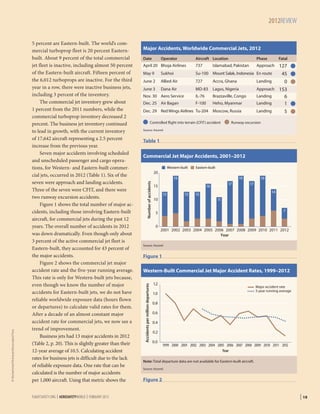
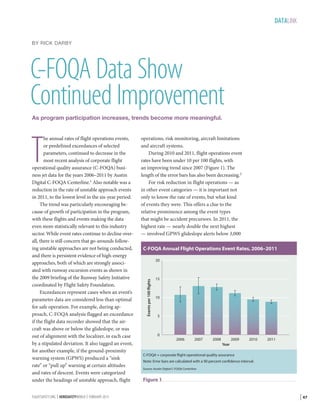
Figure 1 shows the total number of major accidents, including those involving Eastern-built
aircraft, for commercial jets during the past 12
years. The overall number of accidents in 2012
was down dramatically. Even though only about
3 percent of the active commercial jet fleet is
Eastern-built, they accounted for 43 percent of
the major accidents.
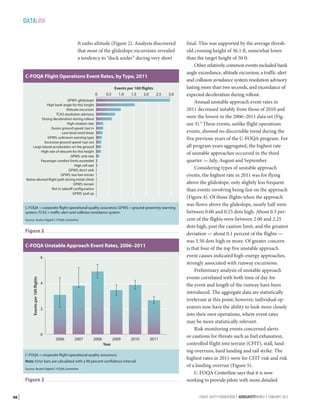
Figure 2 shows the commercial jet major
accident rate and the five-year running average.
This rate is only for Western-built jets because,
even though we know the number of major
accidents for Eastern-built jets, we do not have
reliable worldwide exposure data (hours flown
or departures) to calculate valid rates for them.
After a decade of an almost constant major
accident rate for commercial jets, we now see a
trend of improvement.
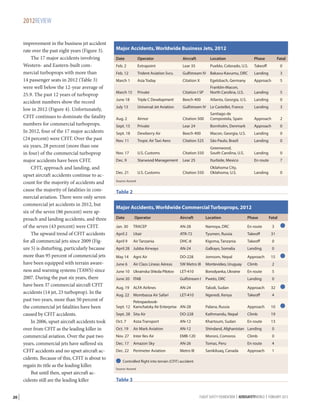
Business jets had 13 major accidents in 2012
(Table 2, p. 20). This is slightly greater than their
12-year average of 10.5. Calculating accident
rates for business jets is difficult due to the lack
of reliable exposure data. One rate that can be
calculated is the number of major accidents
per 1,000 aircraft. Using that metric shows the

19

15

17

16
13

10

13

19
17
14

13
11

7

5
0

2001 2002 2003 2004 2005 2006 2007 2008 2009 2010 2011 2012
Year

Source: Ascend

Figure 1
Western-Built Commercial Jet Major Accident Rates, 1999–2012
Accidents per million departures

© Muhammed Muheisen|Associated Press

2012REVIEW

1.2

Major accident rate
5-year running average

1.0
0.8
0.6
0.4
0.2
0.0

1999 2000 2001 2002 2003 2004 2005 2006 2007 2008 2009 2010 2011 2012
Year

Note: Total departure data are not available for Eastern-built aircraft.
Source: Ascend

Figure 2

| 19
2012REVIEW
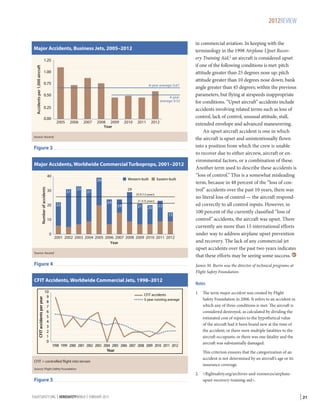
improvement in the business jet accident
rate over the past eight years (Figure 3).
The 17 major accidents involving
Western- and Eastern-built commercial turboprops with more than
14 passenger seats in 2012 (Table 3)
were well below the 12-year average of
25.9. The past 12 years of turboprop
accident numbers show the record
low in 2012 (Figure 4). Unfortunately,
CFIT continues to dominate the fatality
numbers for commercial turboprops.
In 2012, four of the 17 major accidents
(24 percent) were CFIT. Over the past
six years, 28 percent (more than one
in four) of the commercial turboprop
major accidents have been CFIT.
CFIT, approach and landing, and
upset aircraft accidents continue to account for the majority of accidents and
cause the majority of fatalities in commercial aviation. There were only seven
commercial jet accidents in 2012, but
six of the seven (86 percent) were approach and landing accidents, and three
of the seven (43 percent) were CFIT.
The upward trend of CFIT accidents
for all commercial jets since 2009 (Figure 5) is disturbing, particularly because
more than 95 percent of commercial jets
have been equipped with terrain awareness and warning systems (TAWS) since
2007. During the past six years, there
have been 37 commercial aircraft CFIT
accidents (14 jet, 23 turboprop). In the
past two years, more than 50 percent of
the commercial jet fatalities have been
caused by CFIT accidents.
In 2006, upset aircraft accidents took
over from CFIT as the leading killer in
commercial aviation. Over the past two
years, commercial jets have suffered six
CFIT accidents and no upset aircraft accidents. Because of this, CFIT is about to
regain its title as the leading killer.
But until then, upset aircraft accidents still are the leading killer
20 |

Major Accidents, Worldwide Business Jets, 2012
Date

Operator

Aircraft

Location

Phase

Fatal

Feb. 2

Extrapoint

Lear 35

Pueblo, Colorado, U.S.

Takeoff

0

Feb. 12

Trident Aviation Svcs.

Gulfstream IV Bakavu-Kavumu, DRC

Landing

3

March 1

Asia Today

Citation X

Egelsbach, Germany

Approach

5

Landing

5

Landing

0

Landing

3

March 15

Private

Citation I SP

Franklin-Macon,
North Carolina, U.S.

June 18

Triple C Development

Beech 400

Atlanta, Georgia, U.S.

July 13

Universal Jet Aviation

Gulfstream IV Le Castellet, France

Aug. 2

Airnor

Citation 500

Santiago de
Compostela, Spain

Approach

2

Sept. 15

Private

Lear 24

Bornholm, Denmark

Approach

0

Sept. 18

Dewberry Air

Beech 400

Macon, Georgia, U.S.

Landing

0

Nov. 11

Tropic Air Taxi Aero

Citation 525

São Paulo, Brazil

Landing

0

Nov. 17

U.S. Customs

Citation 550

Greenwood,
South Carolina, U.S.

Landing

0

Dec. 9

Starwood Management

Lear 25

Iturbide, Mexico

En route

7

Citation 550

Oklahoma City,
Oklahoma, U.S.

Landing

0

Dec. 21

U.S. Customs

Source: Ascend

Table 2
Major Accidents, Worldwide Commercial Turboprops, 2012
Date

Operator

Aircraft

Location

Phase

Fatal

Jan. 30

TRACEP

AN-28

Namoya, DRC

En route

3

April 2

Utair

ATR-72

Tyumen, Russia

Takeoff

31

April 9

Air Tanzania

DHC-8

Kigoma, Tanzania

Takeoff

0

April 28 Jubba Airways

AN-24

Galkayo, Somalia

Landing

0

May 14

Agni Air

DO-228

Jomsom, Nepal

Approach

15

June 6

Air Class Líneas Aéreas

SW Metro III

Montevideo, Uruguay

Climb

2

June 10 Ukrainska Shkola Pilotov

LET-410

Borodyanka, Ukraine

En route

5

June 20 ITAB

Gulfstream I

Pweto, DRC

Landing

0

Aug. 19 ALFA Airlines

AN-24

Talodi, Sudan

Approach

32

Aug. 22 Mombassa Air Safari

LET-410

Ngeredi, Kenya

Takeoff

4

PetropavlovskSept. 12 Kamchatsky Air Enterprise AN-28

Palana, Russia

Approach

10

Sept. 28 Sita Air

Kathmandu, Nepal

Climb

19

DO-228

Oct. 7

Azza Transport

AN-12

Khartoum, Sudan

En route

13

Oct. 19

Air Mark Aviation

AN-12

Shindand, Afghanistan Landing

0

Nov. 27

Inter Iles Air

EMB-120

Moroni, Comoros

Climb

0

Dec. 17

Amazon Sky

AN-26

Tomas, Peru

En route

4

Dec. 22

Perimeter Aviation

Metro III

Sanikiluaq, Canada

Approach

1

  Controlled flight into terrain (CFIT) accident
Source: Ascend

Table 3
FLIGHT SAFETY FOUNDATION | AEROSAFETYWORLD | FEBRUARY 2013
2012REVIEW

Major Accidents, Business Jets, 2005–2012

Accidents per 1,000 aircraft

1.25
1.00
0.75

8-year average: 0.67

0.50

4-year
average: 0.52

0.25
0.00

2005

2006

2007

2008 2009
Year

2010

2011

2012

Source: Ascend

Figure 3
Major Accidents, Worldwide Commercial Turboprops, 2001–2012

Number of accidents

40

Western-built

39

30

31

33

29

31

22

20

Eastern-built

25.9 (12 years)

24

21.4 (5 years)

24

21

20

23
15

10
0

2001 2002 2003 2004 2005 2006 2007 2008 2009 2010 2011 2012
Year

Source: Ascend

Figure 4

James M. Burin was the director of technical programs at
Flight Safety Foundation.

CFIT accidents per year

CFIT Accidents, Worldwide Commercial Jets, 1998–2012
10
9
8
7
6
5
4
3
2
1
0

CFIT accidents
5-year running average

1998 1999 2000 2001 2002 2003 2004 2005 2006 2007 2008 2009 2010 2011 2012
Year

CFIT = controlled flight into terrain
Source: Flight Safety Foundation

Figure 5
FLIGHTSAFETY.ORG | AEROSAFETYWORLD | FEBRUARY 2013

in commercial aviation. In keeping with the
terminology in the 1998 Airplane Upset Recovery Training Aid,2 an aircraft is considered upset
if one of the following conditions is met: pitch
attitude greater than 25 degrees nose up; pitch
attitude greater than 10 degrees nose down; bank
angle greater than 45 degrees; within the previous
parameters, but flying at airspeeds inappropriate
for conditions. “Upset aircraft” accidents include
accidents involving related terms such as loss of
control, lack of control, unusual attitude, stall,
extended envelope and advanced maneuvering.
An upset aircraft accident is one in which
the aircraft is upset and unintentionally flown
into a position from which the crew is unable
to recover due to either aircrew, aircraft or environmental factors, or a combination of these.
Another term used to describe these accidents is
“loss of control.” This is a somewhat misleading
term, because in 48 percent of the “loss of control” accidents over the past 10 years, there was
no literal loss of control — the aircraft responded correctly to all control inputs. However, in
100 percent of the currently classified “loss of
control” accidents, the aircraft was upset. There
currently are more than 15 international efforts
under way to address airplane upset prevention
and recovery. The lack of any commercial jet
upset accidents over the past two years indicates
that these efforts may be seeing some success. 

Notes
1.	 The term major accident was created by Flight
Safety Foundation in 2006. It refers to an accident in
which any of three conditions is met: The aircraft is
considered destroyed, as calculated by dividing the
estimated cost of repairs to the hypothetical value
of the aircraft had it been brand new at the time of
the accident; or there were multiple fatalities to the
aircraft occupants; or there was one fatality and the
aircraft was substantially damaged.
	

This criterion ensures that the categorization of an
accident is not determined by an aircraft’s age or its
insurance coverage.

2.	flightsafety.org/archives-and-resources/airplaneupset-recovery-training-aid.

| 21
FLIGHTOPS

Failure to Mitigate
BY J. MARTIN SMITH, DAVID W. JAMIESON AND WILLIAM F. CURTIS

Studying the psychology of decision making
during unstable approaches and why go-around
policies are ineffective.

T

he Flight Safety Foundation has analyzed
the past 16 years of aircraft accident data
and found that the most common type of
accident is the runway excursion, which
accounts for 33 percent of all aircraft accidents.1
The highest risk factor for runway excursions
is the unstable approach.2 Unstable approaches
occur on 3.5 to 4.0 percent of all approaches,
but only 3 percent of these unstable approaches
result in a go-around being called in the cockpit:
almost all aircrew in this state — 97 percent —
continue to land. It can be argued, therefore, that
22 |

the almost complete failure to call go-arounds as
a preventive mitigation of the risk of continuing
to fly approaches that are unstable constitutes
the number one cause of runway excursions, and
therefore of approach and landing accidents. If
our go-around policies were effective even 50
percent of the time, the industry accident rate
would be reduced 10 to 18 percent. There is no
other single decision, or procedure, beyond calling the go-around according to SOPs that could
have as significant an effect in reducing our accident rate. Why, then, is compliance so poor?
FLIGHT SAFETY FOUNDATION | AEROSAFETYWORLD | FEBRUARY 2013
© Ismael Jorda/AirTeamImages.com

FLIGHTOPS

The Foundation in 2011 initiated a Goaround Decision Making and Execution Project designed to mitigate runway excursions
caused by unstable approaches by achieving a
high level of pilot compliance with go-around
policies. This project expects enhanced compliance to result from answering the research
question, “Why are go-around decisions, that
should be made according to policy, actually not being made during so many unstable
approaches?” and then making recommendations based on the findings. The project,
which is ongoing, also will examine the psychosocial contributions behind flight operations management’s role in the phenomenon,
as well as the risks associated with flying the
go-around maneuver itself.
In a series of articles to be published in
AeroSafety World over the course of this year,
we will describe the latest results of the project’s work, which to date includes a worldwide pilot survey conducted on behalf of the
Foundation by The Presage Group. The survey
is designed to understand the psychology of
decisions to go around rather than to continue
to fly unstable approaches.
This first article describes a novel strategy
for understanding this psychology, which
we call the Dynamic Situational Awareness
Model (DSAM), that we successfully have
applied in several other operational contexts
to help mitigate risk and increase compliance. The remaining articles will include the
results of two experiments conducted within
the pilot survey in which we assessed factors
leading up to a decision. The experiments
attempted to answer such questions as: “Are
go-arounds associated more with some kinds
of instabilities than with others?”; “What sorts
of pilot characteristics, if any, are associated
with go-around decision making?”; “What
information did pilots solicit to assess risk
prior to making their decisions?”; “What is
the implicit incentive structure for flying
FLIGHTSAFETY.ORG | AEROSAFETYWORLD | FEBRUARY 2013

go-arounds versus continuing the unstable
approach that pilots perceive in their organization’s culture?”; “What is the nature of the
crew interactions that support compliance
with go-around policies?”; “In hindsight, to
what factors do pilots attribute their decisions
to go around or continue with an unstable
approach, and do these reflect all the experiences that were actually inputs to their decisions?”; “What are the true key drivers of their
risk assessments and decisions?”; “Do pilots
experience any post-decisional regret for noncompliance with go-around decision making protocols?”; “Do pilots accept the basic
definitions set by their organizations for what
defines an unstable condition, as well as the
standard operating procedures (SOPs) their
organizations have set out to handle them?”;
and “Apart from their company’s definitions,
beyond what thresholds of instability on key
flight parameters do pilots personally define
themselves to be in an unstable state that warrants a go-around decision?”
By understanding more completely the
answers to these questions, our goal is to bring
new thinking to bear on the topic of noncompliance with unstable approach SOPs, and
to offer ideas about how to mitigate these risks
based on a better alignment of pilot psychology
with company policy.

Dynamic Situational Awareness Model
Why is an investigation into situational awareness a valuable method for understanding a
pilot’s decision making? Well, put very simply,
prior to the pilots’ ability to accurately assess
the operational landscape for potential threats
and risks to aircraft stability, which would then
shape their decision making around compliance, they must first and foremost be fully
aware of the objective world around them.
In other words, the pilots’ very first psychological or cognitive act is being aware of their
environment, in all of its facets, and it is this

| 23
FLIGHTOPS

Within the DSAM
model, situational
awareness comprises
nine distinct but
interconnected and
seamless sub-aspects
of awareness.

awareness that shapes and molds subsequent
perceptions of operational risks and threats, and
of the manageability of those risks and threats.
These perceptions and judgments in turn
inform decision making around risk appetite
and compliance. From a psychological research
point of view, it makes sense to test whether low
situational awareness does in fact equate with
poor risk assessments and increased rates of
non-compliance during the unstable approach.
In order to fully picture how DSAM is lived by
pilots during an unstable approach, consider the
following description.
Imagine, a pilot-in-command and his/her
crew are flying a routine approach when they
experience a late-developing instability below
stable approach height (SAH; as defined by their
company). How might we describe the psychology of this situation up to and including the
moment when this pilot decides to go around or
not, and the experiences of both the pilot flying
and other crewmembers as they handle this
rapidly changing situation under time pressure
and heavy workload?
In the cognitive realm, what thoughts,
beliefs, expectations and information factor
into their situational appraisal of the instabilities and their manageability? By what cognitive
calculus do they assess risks of both choices,
continuing to land or going around? What

How Situational Awareness Plays a Role in Decision Making

Objective
conditions

Situational
awareness

Risk
assessment

Psychological

Source: The Presage Group

Figure 1
24 |

Decision
making

other pre-cognitive, intuitive, emotional and
implicit knowledge comes into play? And how
does their immediate cockpit environment
— the social realm, including the important
contributions of crewmembers, of communications styles and of interpersonal dynamics —
influence their decisions?
In Figure 1, we present the simplified
sequence of events leading up to a decision between continuing an approach that is unstable in
this scenario versus deciding to fly a go-around
maneuver. Changing objective flight conditions and developing instabilities (step 1 in the
sequence) must be noticed via the pilot’s senses,
registered and mentally processed in light of
their always-developing expectations about their
current situation.
Situational awareness of the environment, in
all its facets and continuous state of flux (step 2),
is the psychological prerequisite state for a pilot
to judge risk at any moment (step 3), and then
to make a subsequent decision to maintain compliance and safety in light of that judgment (step
4). This state of awareness must be continuously
updated and refreshed based on a stream of
sensory inputs and knowledge provided by the
pilots’ instruments, the kinesthetic and other
senses, the crewmembers’ inputs and so forth.
This study employed DSAM for measuring and interpreting the psychological and
social factors that collectively make up situational awareness. Within this model, situational
awareness comprises nine distinct but interconnected and seamless sub-aspects of awareness
(Figure 2). Much of the following discussion
will be framed around how each of these subaspects influences a pilot’s risk assessment
and ­ ecision-making processes, singly and in
d
concert with one another, to remain compliant versus non-compliant in the face of aircraft
instabilities while on approach.
In a typical response to the unstable approach
event we have imagined, a typical situational
awareness profile (SAP) emerges for the pilot
FLIGHT SAFETY FOUNDATION | AEROSAFETYWORLD | FEBRUARY 2013
FLIGHTOPS

flying the aircraft so as to maintain compliance
with company SOPs. The “sequence” of processes
might look something like the following. Imagine
again our late-developing instability below SAH,
and consider the pilots’ phenomenological experiences of it, as it is lived, through its description
as an SAP. (Note: While we have serialized the
subsequent description in steps to easily explain the
various DSAM awareness concepts, these awarenesses actually exist in a mutually interdependent
whole of causation, with rapid feedback loops and
interactions. Changes to one type of awareness
quickly influence the others in a psychological
process called “spreading activation.”)

Breaking Down Situational Awareness

(affective)

2.	 A visual check, or what we refer to as a check
to provide functional awareness, which would
be made where the pilot’s expert knowledge
and ability to understand the instruments
plays a key role in confirming whether the
cue from their gut was, in fact, correct.
Simultaneously, there is …
3.	 An immediate and confirmatory statement
from the pilot’s network of past experiences, or
critical awareness, occurs, in which professional
experience confirms the presence of a “normal”
flight profile. Seconds later, however, imagine
that in continuing its descent below SAH, the
aircraft encounters significant turbulence with
headwinds shifting to tailwinds and downdrafts altering VREF (reference landing speed)
by +21 kt, accompanied by a vertical descent
now greater than 1,100 fpm. Instantly, …
4.	 The pilot’s anticipatory awareness, the ability
to see these threats, registers in harmony
FLIGHTSAFETY.ORG | AEROSAFETYWORLD | FEBRUARY 2013

(environmental)

Situational
awareness

Knowing
the
instruments

Knowing the
procedures
(hierarchical)

(functional)

Keeping
each other
safe

Relying on
experience
(critical)

(relational)

Seeing the
threats

(anticipatory)

Example of a Go-Around Experience
1.	 At a point immediately above SAH, the pilot’s
“gut,” or what we refer to as affective awareness, subtly signals him or her to confirm that
the aircraft’s flight characteristics and profile
are normal. In a near-instantaneous and
seamless fashion, this might be followed by …

Company
support
for safety

Gut feeling
for threats

Knowing
the limits
(task
empirical)

Adjusting
to threats

(compensatory)

Source: The Presage Group

Figure 2
with the reactivated gut, expert instrument
knowledge and experience — all awarenesses
that are now signaling a non-normal event
— and there arises an immediate need for a
signal from …
5.	 Task-empirical awareness, the pilot’s expert
knowledge of the safe operational envelope limits of the aircraft. Imagine further
that this expert knowledge confirms that
although the aircraft is now unstable, it
still remains within the safe operational
envelope. However, before concluding that
parameters are now safe or unsafe, manageable or unmanageable, this developing event
requires immediate input from another
awareness competency …
6.	 Compensatory awareness, or the ability to understand how to compensate correctly for nonnormal events, occurs by referencing through
functional awareness whether the aircraft and
the instruments will direct the flight state back
to a normal condition if acted upon. Whether

| 25
FLIGHTOPS

the answer, not yet fully formed but informed
by critical awareness, is likely to be “yes,” “no”
or uncertain, imagine that the pilot is also
simultaneously receiving …
7.	Through relational awareness — the pilots’
knowledge of how they use their relationships to protect safety — input from a
crewmember that re-enlivens a memory
trace of a prior verbal signal, based on a
conversation and agreement earlier in the
approach initiated by the pilot monitoring,
that a go-around might be necessary should
the aircraft become unstable at or below
SAH, which …

We will describe the
results from more
than 2,300 pilots
asked to recall
in detail the last
instance in which
they experienced an
unstable approach.

8.	 Informs and motivates the pilot to engage
hierarchical awareness, or the individual’s
expert knowledge of operational procedures
under specific operational conditions, so
as to confirm their ability to safely fly a goaround if necessary. Finally, with the pilotin-command and other crew rapidly coming
to a common assessment of, and agreement
about, the risks inherent in continuing with
the unstable situation that faces them, in
comparison with the inherent risks of any
go-around maneuver, and
9.	 Confident that their company would support a decision to initiate a go-around, and
in an expression of their environmental
awareness concerning the wider organizational reward structures surrounding
support for safety, the pilot flying puts all
of these elements of awareness together to
judge that the risks confronting the flight
crew are not fully manageable, and so
decides to call for a go-around.
Again, this description is not in any way intended
to be prescriptive, that is, to suggest the way the
dynamic situational awareness processes should
work in this situation (i.e., the sequence or interactions among the awareness types). But it does illustrate that each of these awareness competencies

26 |

needs to be used repeatedly and quickly to keep
the entire spectrum of potential threats in the
situation and their possible causes and resolutions
alive in awareness at all times, and that there is a
natural system of mutual causation among them
that also must be sustained to maximize safe decision making.
Table 1 summarizes the complete system
of nine DSAM concepts (called Construct 1 to
Construct 9). The table shows a working name
for each concept, its scientific name within our
system and a brief definition.

What’s Ahead?
So far, we have summarized the problem and
described the psychological theory behind our
experimental survey framework. Robust experimental survey work, which we will describe
in the next articles in this series, provides valid
data and meaningful insight and understanding into this critical issue for flight safety, and
from which we can begin to define necessary
corrective actions.
In these articles, we will describe the results
from analyzing data from more than 2,300 pilots asked to recall in detail the last instance in
which they experienced an unstable approach
that either led to a go-around decision or a
decision to continue in the unstable state and
land. In addition to reporting about various
aspects of the DSAM model that differ between
pilots going around and those continuing the
unstable approach, we will also describe the
kinds of objective flight conditions and pilot
characteristics that are associated with these
decisions, post-event perceptions pilots had
about the causes of their decisions and hindsight judgments they made about the wisdom
of their choices.
We will also describe the results of a
second experiment conducted using the same
survey, which was designed to investigate the
personally held thresholds for instability that
pilots believed would necessitate a go-around
FLIGHT SAFETY FOUNDATION | AEROSAFETYWORLD | FEBRUARY 2013
FLIGHTOPS

Constructs in the Dynamic Situational Awareness Model
DSAM Construct Name

Description

“Gut feeling for threats”

Pilot’s gut feelings for threats; seat of the pants experience, which is characterized by an
emotional, sensory experience that triggers further cognitive analysis.

Affective awareness (C1)
“Knowing the instruments and equipment”
Functional awareness (C2)
“Relying on experience”
Critical awareness (C3)
“Seeing the threats”
Anticipatory awareness (C4)
“Knowing the limits”
Task-empirical awareness (C5)
“Adjusting to threats”
Compensatory awareness (C6)
“Keeping each other safe”
Relational awareness (C7)
“Knowing the procedures”
Hierarchical awareness (C8)
“Company support for safety”
Environmental awareness (C9)

Pilot’s expert knowledge of knowing how to read and translate what his/her instruments are
telling him/her.
Pilot’s ability to draw from his/her personal and professional experience bank as a means to
assess here-and-now events as “normal” or “abnormal.”
Pilot’s ability to see and/or monitor real and potential threats as they move and change over time
and through space.
Pilot’s expert knowledge of the safe operational envelope of his/her equipment.
Pilot’s ability to know how and when to compensate or adjust correctly for present and
anticipated future operational conditions to ensure safe SOP-compliant operations.
Pilot’s ability to accurately assess and engage crewmember relationships in a manner that
protects safety and compliance.
Pilot’s expert and comprehensive knowledge of operational procedures, their order and correct
sequencing.
Pilot’s experience of how his/her company supports and encourages safety and how this in turn
shapes his/her commitment to safe and compliant behavior.

DSAM = Dynamic Situational Awareness Model; SOP = standard operating procedure
Note: The informal construct names in quotes appear above the corresponding standardized terms from the Presage researchers’ glossary.
Source: The Presage Group

Table 1
call, considering deviations in several flight
parameters. Later articles will report on other
aspects of the FSF project, including the results of the management survey on this topic
conducted in parallel with the pilot survey,
and a study of the risks inherent in the goaround itself.
Along the way, we will offer high-level
observations and recommendations about the
kinds of systemic mitigations that might be
implemented to combat the various causes of
pilot decisions not to go around while flying
unstable approaches. 
FLIGHTSAFETY.ORG | AEROSAFETYWORLD | FEBRUARY 2013

The Presage Group specializes in real-time predictive analytics with corrective actions to eliminate the behavioral threats
of employees in aviation and other industries. Further
details of the methodology of their survey, experiments and
results are described at www.presagegroup.com.

Notes
1.	 Flight Safety Foundation. “Reducing the Risk of
Runway Excursions.” Runway Safety Initiative, May
2009. flightsafety.org/files/RERR/fsf-runwayexcursions-report.pdf
2.	 Burin, James M. “Year in Review.” In Proceedings of
the Flight Safety Foundation International Air Safety
Seminar. November 2011.

| 27
PRISM

Complete Safety Management Solution

PRISM’s unique internet-enabled solutions coupled with our dedicated
in-house Helicopter Safety Experts address the challenges of setting
up a functional and effective Safety Management System (SMS)
PRISM Affiliations:

PRISM Services Include:
•	SMS	Briefings	for	Executives
•	Training	Classes	available	for	Helicopter	
Operators	(Delivered	in	English	or	Spanish)
•	SMS	Facilitation	Services	(Develop,	Plan,	
Implement)
•	On-site	SMS	Evaluation	and	Guidance
•	Manual	Review	and	Development
•	Certification	Consultant
•	“ARMOR”	a	Web-based	Safety	and	Quality	
Management	Tool	Compatible	with	iPad®

prism.sales@prism.aero

+1 513.852.1010

www.prism.aero
CAUSALFACTORS

A

The NTSB cited as a contributing factor the “absence of proper cockpit discipline from the pilot.”
The pilot and all four passengers were killed in
the crash, which occurred in visual meteorological conditions around 1505 local time during a
planned flight from Whispering Pines Ranch near
Parks, Arizona, to Scottsdale Airport, about 150 mi
(241 km) to the south.

© Jason R. Fortenbacher/Fight to Fly Photography

brupt control movements — which “highly
likely” resulted when a 5-year-old girl
moved from her father’s lap and inadvertently stepped on the collective — were the
probable cause of the Feb. 14, 2010, fatal crash of
a Eurocopter EC135 in Cave Creek, Arizona, U.S.,
the U.S. National Transportation Safety Board
(NTSB) says.

BY LINDA WERFELMAN

‘Abrupt and unusual’ control movements
led to the fatal crash of an EC135, the NTSB says.

Unintended
FLIGHTSAFETY.ORG | AEROSAFETYWORLD | FEBRUARY 2013

| 29
CAUSALFACTORS

crashed near a river
wash on a gravel
access road about
14 nm (26 km) north
of Scottsdale Airport.

30 |

in the helicopter. The foreman revealed that
on previous flights, the helicopter owner had
strapped his daughter in on top of him.”
Witnesses near the crash site, about 14 nm
(26 km) north of Scottsdale Airport, said they
heard popping or banging sounds before the helicopter descended and crashed into the ground.
Some said they saw parts of the helicopter
separate in the final seconds of flight, before it
“circled and dove to the ground,” the report said.
The helicopter struck the ground in a river wash
area and was consumed by fire.

11,000 Flight Hours
The 63-year-old helicopter pilot had about
11,000 flight hours, including 824 hours in the
EC135 T1 and 13 hours in the 90 days before the
accident, according to flight operations personnel at Services Group of America (SGA), which
owned the helicopter. He also had a second-class
medical certificate. Investigators did not obtain
the pilot’s logbook and found no record of
military flight time, but SGA personnel said the
pilot had flown U.S. Army helicopters during
the Vietnam War.
His initial training in the EC135 T1 was
completed in 2002, with recurrent ground and
flight training in 2003, 2004, 2006 and 2008. All
training records indicated that the pilot had performed satisfactorily and noted no deficiencies.
The owner of SGA was 64 and held a private
pilot certificate for single-engine airplanes, issued in 1967. A review of FAA records revealed
no indication that he held a medical certificate
and little other information about his aviation
background.
The owner did not have a helicopter rating,
but in post-accident comments to accident investigators, the SGA chief pilot said that the owner
“liked to fly” and that it was common for him to
take the controls. The report said that investigators could not determine which man was flying
at the time of the accident.
The report said that two American Eurocopter instructor pilots told accident investigators
that, during training sessions, the accident pilot
spoke of the pressure he felt in his job.
FLIGHT SAFETY FOUNDATION | AEROSAFETYWORLD | FEBRUARY 2013

U.S. National Transportation Safety Board

The helicopter

In the final accident report approved in
November 2012, the NTSB said its investigation revealed that a rotor blade had struck
the left horizontal endplate and the tail rotor
drive shaft, resulting in the loss of control that
preceded the crash.
“The only way that this condition could
have occurred was as a result of a sudden lowering of the collective to near the lower stop,
followed by a simultaneous reaction of nearly
full-up collective and near full-aft cyclic control inputs,” the report said. “A helicopter pilot
would not intentionally make such control
movements.”
The report quoted the ranch foreman as
telling NTSB investigators that, on the day of
the accident, the pilot loaded the helicopter and
conducted the preflight inspection before climbing into the right front cockpit seat and starting the engines. Two adult passengers and two
dogs were boarded before the foreman observed
the owner and his daughter, whose weight was
estimated at 42 lb (19 kg), board through the left
forward cockpit door.
The owner and his daughter both sat in the
left front cockpit seat, “with the small girl positioned on her father’s lap,” the report said. “When
asked how frequently the child occupied the left
front cockpit seat with her father, the ranch foreman replied ‘occasionally.’ The foreman stated
that he could not tell if either the helicopter
owner or the child were secured and restrained
CAUSALFACTORS

Three Incidents
The accident helicopter was manufactured in
1999, was purchased by SGA from its original
FLIGHTSAFETY.ORG | AEROSAFETYWORLD | FEBRUARY 2013

Eurocopter EC135 T1
© Łukasz Golowanow  Maciek Hypś, Konflikty.pl/Wikimedia

One instructor said the accident pilot “displayed an abnormally high degree of perceived
pressure to accomplish flights from the owner
of the helicopter” and was “visibly shaken when
discussing the amount of pressure he received.”
The instructor said that, during initial transition ground school training in 2002, the accident pilot had told him “that it would not be
uncommon to fly the helicopter’s owner from
Seattle to his home of Vashon Island when the
weather conditions at night were so poor that
they would follow the ferryboat lights to navigate across the bay under foggy conditions.”
The other instructor said that, during a
2008 training session, the accident pilot had
commented “about the owner dominating the
cockpit duties prior to a flight.
“I emphasized the importance of following
the checklist and always performing the hydraulic check. He commented that when the owner
flies, he gets in the cockpit and ‘flips switches
and goes.’ I felt [the accident pilot] was intimidated by the owner and would not insist proper
aircraft procedures be followed.”
In information submitted by SGA for the
accident investigation, the company’s chief pilot
questioned the instructors’ accounts. He wrote
that he considered the accident pilot as “not a
pilot who would be intimidated” and “a conscientious and professional pilot, in every sense of
the word.”
Noting that the instructors had “inferred
that [the accident pilot] feared for his job if he
did not perform his trips regardless of risk,”
the chief pilot said, “After 24 years of service
with Services Group of America, there could be
nothing further from the truth. I do not believe
that an individual could stay at any company
that long if they felt such pressure from their
employer.” The accident pilot had left SGA in
the late 1990s but returned three years later and
remained with the company until his death, the
chief pilot said.

T

he EC135 is a twin-turbine light helicopter first flown in 1988 with
two Allison 250-C20R engines.
The T1, first delivered to a U.S. customer in 1996, is the
Turbomeca engine version. The accident helicopter was equipped with
two TM USA Arrius 2B1 turboshaft engines.
The helicopter can be equipped to seat up to eight people. It has
a maximum normal takeoff weight of 5,997 lb (2,720 kg), maximum
cruising speed at sea level of 139 kt and a maximum range at sea level
with standard fuel of 402 nm (745 km).

Source: Jane’s All the World’s Aircraft, U.S. National Transportation Safety Board Accident Report No.
WPR10FA133

owner in 2002 and had accumulated 1,116
operating hours. It had been maintained in accordance with the manufacturer’s recommendations, and its most recent annual inspection had
been conducted Oct. 30, 2009.
The helicopter had two Turbomeca USA
Arrius 2B1 turboshaft engines. At the time of
the October 2009 inspection, the left engine had
recorded 1,103 hours total time since new, and
the right engine, 227 hours.
The helicopter had been involved in three
incidents before the crash, the report said.
In the first incident, in May 2003, the
helicopter’s owner was at the controls when the
left seat — reportedly “not in the proper detent
position” — slid aft, the report said.
“The helicopter dropped about 50 ft but
was recovered by a quick collective input,” the
report said. “In an incident report submitted
by American Eurocopter, it was reported that

| 31
CAUSALFACTORS

In most helicopters,
including EC135s,
the collective pitch
control lever is
on the left side of

U.S. National Transportation Safety Board

the pilot’s seat.

a loud bang was heard, followed by the touchdown of the helicopter.”
The impact damaged the horizontal stabilizer, and pieces of the engine were found on
the ground. The helicopter was repaired and
returned to service in August 2003.
The second incident, with the accident pilot
flying, involved a January 2004 hard landing at
a grassy heliport on Vashon Island, Washington,
U.S. After repairs, the helicopter was returned to
service in April 2004.
In September 2007, an engine chip light
illumination occurred, followed by a yaw, an
engine shutdown and a single-engine landing;
the engine was replaced in January 2008.
In addition, one of the helicopter’s main
rotor blades was removed in November 2009 because maintenance personnel could not balance
it correctly, and a temporary replacement blade
was installed. The replacement was still in place
when the accident occurred.

This article is based on NTSB accident report no.
WPR10FA133 and accompanying docket information.

Note

Clear Skies
Visual meteorological conditions prevailed at
the time of the accident, with clear skies, 10 mi
(16 km) visibility and no wind.
Air traffic control facilities had no contact
with the pilot on the day of the accident. Radar
showed the helicopter flying south toward
Scottsdale from Whispering Pines Ranch; the
32 |

last radar return was recorded at 1503:37, about
two minutes before impact. An NTSB radar
study said the helicopter’s last known position
was about 14 nm (26 km) north of Scottsdale
Airport, above the accident site at 3,700 ft above
mean sea level.
The NTSB investigation found that a single
impact of one of the main rotor blades had damaged the tail rotor drive shaft.
“No pre-impact failures or material anomalies were found in the wreckage and component
examinations that could explain the divergence
of the … blade from the plane of main rotor
rotation,” the report said.
The most likely explanation, the report added, was that “all of the main rotor blades were
following a path that would have intersected the
tail rotor drive shaft as a result of an abrupt and
unusual control input.”
The report said investigators had conducted
a biomechanical study that showed that “it was
feasible that the child passenger … could fully
depress the left-side collective control by stepping on it with her left foot” to stand up from
her place in her father’s lap.
“It is highly likely that the child inadvertently stepped on the collective with her left
foot and displaced it to the full down position,”
the report said. “This condition would have
then resulted in either the pilot or the helicopter owner raising the collective, followed by a
full-aft input pull of the cyclic control and the
subsequent main rotor departing the normal
plane of rotation and striking the left endplate
and the aft end of the tail rotor drive shaft.” 

1.	 The collective pitch control is the part of a helicopter’s flight control system that simultaneously
changes the pitch angle of all main rotor blades. In
the EC135, and in most other helicopters, the collective is on the left side of each pilot’s seat. The cyclic,
located in the EC135 between the pilot’s legs at the
center of each pilot’s seat, changes the pitch of the
rotor blades one at a time, as each blade rotates past
the same point in the rotor disk.
FLIGHT SAFETY FOUNDATION | AEROSAFETYWORLD | FEBRUARY 2013
CARGOSAFETY

Detect and
Suppress
BY LINDA WERFELMAN

The NTSB urges improved fire detection, suppression
and containment systems to prevent injury and
damage in cargo airplane fires.

©Kris Klop

E

xisting fire-protection regulations for
cargo airplanes are inadequate, and action
is needed to improve the detection and
suppression of blazes in cargo containers,
the U.S. National Transportation Safety Board
(NTSB) says.
The agency cited information gathered in
its recent cargo container fire study and the
investigations of three in-flight cargo airplane
fires — a February 2006 fire on a United Parcel
Service (UPS) McDonnell Douglas DC-871F; the fatal September 2010 crash of a UPS
Boeing 747-400F; and the fatal July 2011 crash
of an Asiana Cargo 747-400F (“In-Flight Fires,”
WWW.FLIGHTSAFETY.ORG | AEROSAFETYWORLD | FEBRUARY 2013

p. 35) — in issuing three safety recommendations in late November to the U.S. Federal Aviation Administration (FAA).
“These fires quickly grew out of control,
leaving the crew with little time to get the aircraft on the ground,” NTSB Chairman Deborah
A.P. Hersman said. “Detection, suppression
and containment systems can give crews more
time and more options. The current approach
is not safe enough.”
The NTSB’s recommendations call on the
FAA to:
“Develop fire detection system performance requirements for the early detection of

| 33
Smoke billows from
an aluminum and
polycarbonate cargo
container during
flammability tests.

34 |

fires originating within cargo containers and
pallets and, once developed, implement the
new requirements;
“Ensure that cargo container construction
materials meet the same flammability requirements as all other cargo compartment materials in accordance with [U.S. Federal Aviation
Regulations (FARs) Part 25.855]; and,
“Require the installation and use of active
fire suppression systems in all aircraft cargo
compartments or containers, or both, such that
fires are not allowed to develop.”
Cargo aircraft currently are subject to the
same FAA fire-protection regulations that
govern all transport category aircraft, the NTSB
said.
“Although these regulations limit the flammability of construction materials used in cargo
compartments and also specify minimum fire
resistance requirements for cargo compartment
liners, there is limited regulation concerning fire
protection associated with cargo containers,” the
NTSB said.
For example, the agency noted that materials
selected for the construction of cargo containers undergo a horizontal Bunsen burner test,
“which does not prevent the use of highly combustible materials.”

In addition, “the effect of the use of containers and pallets to contain cargo is not factored
into the current overall fire protection strategy
or certification process,” the NTSB said, noting
that the certification process is conducted using
empty cargo compartments.
In a letter to then-Acting FAA Administrator Michael Huerta that accompanied the safety
recommendations, the NTSB discussed the
findings of accident investigations and a series
of tests conducted in August 2011 to develop
a better understanding of cargo container fires
and the most appropriate prevention strategies.1
The tests — designed in part to examine
the burning characteristics of cargo container
fires — prompted researchers to conclude that
“container design has a significant effect on
the time it takes for an internal fire to become
detectable to a smoke detector outside the
container” and that “container construction
materials have a significant effect on the total
fire load2 and energy release rate of a cargo
fire,” the NTSB said.
In the two accidents in 2010 and 2011,
investigators found “a relatively short interval
between the time a fire warning indication
was delivered to the flight crew and the onset
of flight control and aircraft system failures,”
the NTSB said. In the fatal UPS crash, about
2 minutes 30 seconds elapsed between the
first fire warning and the loss of some aircraft
systems; timing information has not been
released in the ongoing Asiana investigation,
the NTSB said.
The NTSB’s report on the 2011 tests, published in a report in March 2012, concluded that
“the time it takes for a fire detection system to
detect a fire originating within a cargo container
may easily exceed the one-minute time frame
specified in … Part 25.858(a)” and that “the
growth rate of container fires after they become
detectable by the aircraft’s smoke detection
system can be extremely fast, precluding any
mitigating action and resulting in an overwhelming fire.”
In tests of cargo containers, the NTSB found
that the time between fire initiation and fire
FLIGHT SAFETY FOUNDATION | AEROSAFETYWORLD | FEBRUARY 2013

U.S. National Transportation Safety Board

CARGOSAFETY
CARGOSAFETY
detection ranged from 2 minutes 30 seconds to
18 minutes 30 seconds — longer than the oneminute detection time currently required.
“The fires grew very large, capable of causing significant damage to an aircraft, shortly after becoming a detectable fire,” the report said.
“The NTSB is concerned that, when fires inside
containers become detectable to the aircraft’s
smoke-detection system, there is little time
until the fires reach levels that can compromise
the integrity of the cargo compartment and
then threaten the structure and systems of the
aircraft. …
“If the fire were to be detected while generating smoke inside the container, valuable time
would be gained for alerting flight crews and
mitigating the effects of the fire.”
Because existing regulations dealing with
flammability limits are “very limited” for cargo
container materials, those materials can significantly increase the fire load within a cargo
compartment, the NTSB said.
For example, the agency cited collapsible
containers made from corrugated polypropylene
as “significant contributors” to fire intensity.

Fire Suppression
Most current practices base fire suppression
in main deck cargo compartments on passive suppression systems, such as the use of
fire-resistant materials and oxygen deprivation. Because the compartments are so large,
however, fires can become very large before
oxygen deprivation slows their growth, the
NTSB said.
In the 2006 UPS blaze, the agency said,
“the aircraft did not achieve depressurization
[which aids in suppressing flames] until after
system failures and flight control issues began
to occur.”
Tests by FAA researchers have found that,
although depressurization contributes to fire
suppression, when an aircraft descends to a more
oxygen-rich environment, the fire again begins
to grow.
“Hence, experience from the UPS [Dubai]
accident, as well as FAA experiments, suggest
WWW.FLIGHTSAFETY.ORG | AEROSAFETYWORLD | FEBRUARY 2013

In-Flight Fires

T

hree in-flight cargo airplane fires were cited by the U.S. National
Transportation Safety Board (NTSB) in its recommendations for
improved fire safety.
The first was a Feb. 7, 2006, fire in a United Parcel Service
(UPS) McDonnell Douglas DC-8-71F, which landed at Philadelphia
International Airport after the crew smelled smoke and then — 20 minutes later — the “CARGO SMOKE” light illuminated (ASW, 4/08, p. 28).
All three crewmembers were treated for minor injuries from
smoke inhalation, and the airplane was destroyed. The NTSB said the
cargo fire began “from an unknown source,” probably inside one of
the DC-8’s cargo containers; contributing factors were the “inadequate certification test requirements for smoke and fire detection
systems and the lack of an on-board fire suppression system.”1
Deborah Hersman, a member of the NTSB and now its chairman, said during the agency’s public hearing on the accident that
the flight was “seconds from disaster.”
The second fire broke out on a UPS Boeing 747-400F
that crashed Sept. 3, 2010, inside an army base near Dubai
International Airport (DXB) in the United Arab Emirates. The two
flight crewmembers were killed, and the airplane was destroyed.
An interim report by the UAE General Civil Aviation Authority
(GCAA) said that a fire warning light illuminated about 22 minutes
after takeoff from DXB while the airplane was in cruise at 32,000 ft.
The crew declared an emergency, and the airplane crashed as they
maneuvered to land at DBX. The investigation is continuing.2
The third fire occurred July 28, 2011, on an Asiana Cargo
747-400F, which crashed 70 nm (130 km) west of Jeju Island,
Republic of Korea, as the flight crew attempted to divert to Jeju
International Airport because of the fire. Both pilots were killed,
and the airplane was destroyed. The investigation by the South
Korean Aircraft and Railway Accident Investigation Board (ARAIB)
is continuing.3
— LW
Notes
1.	

NTSB. Accident Report No. NTSB/AAR-07/07, “Inflight Cargo Fire; United
Parcel Service Company Flight 1307; McDonnell Douglas DC-8-71F,
N748UP; Philadelphia, Pennsylvania; February 7, 2006.” Dec. 4, 2007.

2.	

GCAA. Accident Reference 13-2010, “Air Accident Investigation
Interim Report: Boeing 747-44AF, N571UP; Dubai, United Arab
Emirates; September 03, 2010.”

3.	

ARAIB. ARAIB/AAR1105, “Aircraft Accident Investigation Interim
Report: Crash Into the Sea After an In-Flight Fire; Asiana Airlines,
B747-400F/HL7604; 130 Km West of Jeju International Airport; July
28, 2011.”

that passive fire suppression in large cargo compartments due to oxygen deprivation may not
be effective,” the NTSB said.

| 35
CARGOSAFETY
The agency noted that, in 2007, as a result of
its investigation of the 2006 fire, it had recommended that the FAA require fire-suppression
systems for the cargo compartments of all FARs
Part 121 cargo airplanes. The NTSB reported that
the FAA’s response had been that the cost of installing “compartment-flooding fire-suppression
systems, as those used in Class C cargo compartments,3 was not justified for the main deck cargo
compartments of aircraft of any weight.”
However, the NTSB said that the fires in 2010
and 2011 “continue to demonstrate the critical
need to suppress cargo fires.”
As an alternative to the compartment-­
flooding system evaluated by the FAA, the
NTSB suggested alternatives, including the
“aircraft-based system” used by FedEx and incontainer suppression systems being developed
by the industry.

‘Multi-Layered Approach’
The NTSB’s issuance of the safety recommendations coincided with an announcement by UPS
that it had developed a “multi-layered approach
consisting of matched solutions that include
checklists, training and new technologies” to
mitigate in-flight cargo fires.
Among those new technologies are fireresistant fiber-reinforced plastic containers, experimental fire-suppression units that “smother
a fire with potassium aerosol powder and can
save 95 percent of packages in the container”
and fire-containment covers for palletized cargo.
The approach was developed by a UPS/Independent Pilots Association task force that had
identified as its first step “increasing the time a
crew had to manage a smoke or fire event,” said
Capt. Bob Brown, a task force member.
The group’s goal was to contain a fire inside
a unit load device (ULD) for four hours. In a
test in October, a ULD containing 215 packages,
including “20 working laptops with batteries, 50
working cell phones with batteries and 300 bulkshipped lithium ion batteries, was set on fire by
six lithium ion batteries,” Brown wrote in Leading Edge, the UPS flight operations and safety
magazine.4 “Although temperatures reached as
36 |

high as 1,200 degrees [F (649 degrees C)], the
fire was suppressed for four hours and 95 percent of the packages were undamaged. Even the
laptops worked.”
UPS said that it also is installing quickdonning integrated oxygen masks and smoke
goggles in all aircraft, and the VisionSafe Corp.
Emergency Vision Assurance System (EVAS),
designed to displace smoke in a pilot’s vision
path to allow him or her to see basic flight
instruments and the flight path, as well as
emergency checklists and navigation charts.5

Automatic Suppression Systems
FedEx Express began installing on-board automatic fire-suppression systems in its aircraft in
2009, the same year it won the FSF-Honeywell
Bendix Trophy for Aviation Safety for developing the devices (ASW, 11/09, p. 39).
The system incorporated infrared heat sensors, foaming-agent generators and an overhead
cargo-container injector. If the sensors detect
heat in a cargo container, the overhead firesuppression equipment activates, piercing the
container and injecting argon foam. At the
same time, the crew is alerted. 
Notes
1.	 NTSB. Materials Laboratory Study Report No. 12019. March 21, 2012. In addition to addressing the
burning characteristics of container fires, the study
also examined the fire-load contribution of lithium
and lithium-ion batteries. The NTSB noted that the
involvement of these types of batteries “has come
into question” in both the 2006 fire and the 2010 fire.
2.	 Fire load is defined by the NTSB as “the amount of combustible material that can become involved in a fire.”
3.	 Class C cargo compartments have smoke or fire
detector systems that provide warnings on the flight
deck; built-in, pilot-controlled, fire-suppression
systems; methods of excluding hazardous amounts
of smoke from any occupied portions of the airplane;
and methods of controlled compartment ventilation.
4.	 Brown, Bob. “UPS/IPA Safety Task Force Pioneers
Advancements in Aviation Safety.” Leading Edge (Fall
2012): 2.
5.	 VisionSafe Corp. EVAS. visionsafecorporation.com/
VisionSafe_Corporation/Product_Info.html.
FLIGHT SAFETY FOUNDATION | AEROSAFETYWORLD | FEBRUARY 2013
AVWEATHER

“S

uperstorm” Sandy will go down
as one of the most destructive
storms in the history of the
United States. Total losses may
exceed $50 billion, and estimated
losses for the airline industry are
near $500 million. More than 20,000
flights were canceled starting Sunday,
Oct. 28, 2012, and continuing through
Wednesday, Oct. 31.
Particularly hard hit was the New
York City area. LaGuardia Airport,
which is located on a waterfront, suffered significant damage, with the
tarmac flooded, and did not reopen
until Nov. 1. In anticipation of Sandy’s
strong winds, New York City’s three
major airports closed Sunday night.

Weather conditions steadily deteriorated overnight. Winds were gusting
over 40 kt by morning. In the evening,
wind gusts near 70 kt were recorded,
and at times, wind-driven rain severely
lowered visibility.
The magnitude of the storm can be
seen by looking at the peak wind gusts
reported at various airports along the
U.S. East Coast: Dulles International
Airport outside Washington, 47 kt;
Philadelphia International Airport, 59
kt; John F. Kennedy International Airport in New York, 69 kt; Boston Logan
International Airport, 52 kt; Portland
(Maine) International Jetport, 48 kt. All
of these peak gusts occurred within
several hours on the evening of Oct. 29.

Sandy:

A Different
Type of Storm

U.S. National Aeronautics and Space Administration

BY ED BROTAK

Even after winds subsided on Tuesday, Oct. 30, and flying conditions improved, widespread power outages and a
lack of surface transportation impeded
airport operations. Structural damage
to buildings and significant damage to
aircraft on the ground were reported.
Throughout its duration, the storm
was referred to as Sandy, the name given
when it first reached tropical storm
status on Oct. 23. As Sandy was ravaging
New York and New Jersey on Oct. 29,
meteorologists stopped calling it a hurricane, even though it maintained the
same intensity. Technically, just as Sandy
was coming ashore near Atlantic City,
New Jersey, it became a midlatitude or
extratropical cyclone, losing its tropical

FLIGHTSAFETY.ORG | AEROSAFETYWORLD | FEBRUARY 2013

| 37
AVWEATHER

38 |

area above the surface low. This removal of air
lowers the surface pressure. For extratropical
cyclones, the divergence aloft is produced on
the east side of a pre-existent upper-level trough
of low pressure. When this upper trough moves
over a surface front, cyclogenesis — the process
by which the low pressure area develops — occurs. For tropical cyclones, there are no preexistent upper features. However, over time, the
towering cumulonimbus clouds release enough
heat aloft to develop a high pressure area over
the low-level cyclone. This self-developed high,
miles above the surface, provides the divergence
aloft needed to maintain the surface storm.
It is not unusual for tropical cyclones to become extratropical. If the tropical system moves
into higher latitudes, especially in the late fall, it
can merge with a midlatitude frontal system and
its attendant upper trough. Some of these converted storms can be very strong. The “textbook
case” was Hurricane Hazel, which moved up the
East Coast in 1954. Hazel came ashore along
the extreme southern coast of North Carolina
on Oct. 15. It was a powerful Category 4 (ASW,
7/12, p. 29) hurricane with maximum sustained
winds of 110 kt and a minimum central pressure
of 937 mb (27.67 in Hg). It almost immediately
joined a strong cold front and began to accelerate to the north. Cold air poured into the
system from the west, quickly transitioning
the storm into an extratropical system. Unfortunately, weakening was limited, and by the
next day, it passed Washington with a central

The storm was
1,000 mi (1,609 km)
across, more than
twice the size of the
large and extremely
destructive Hurricane
Irene that affected
this same region
in August 2011.

Figure 1

U.S. National Aeronautics and Space Administration

characteristics. The U.S. National Weather Service continued to use the name Sandy to avoid
public confusion. The results — the wind, the
rain and the massive storm surge — were the
same, regardless of the nature of the storm.
So, why should we be concerned if a storm
is tropical, extratropical or something in between? Consider these elements of Sandy: The
storm was 1,000 mi (1,609 km) across, more
than twice the size of the large and extremely
destructive Hurricane Irene that affected this
same region in August 2011. When Irene came
up the East Coast, it weakened considerably
over the cooler waters, typical of a true tropical
system. Sandy did not weaken, even though it
traversed the same waters nearly two months
later in the year. In fact, it strengthened. The
central pressure fell to 940 millibars (mb; 27.76
in Hg), 20 mb lower than the famed superstorm
that moved up the East Coast in March 1993.
What are the differences between tropical
cyclones such as hurricanes and extratropical
cyclones, the typical winter storms?
Tropical cyclones only develop over warm
waters, usually in the lower latitudes. Extratropical cyclones can develop over land or water
where the air is colder and have even occurred
in Arctic regions. Extratropical cyclones require
a temperature contrast to develop. They usually
form along fronts that separate warm and cold
air masses. Tropical cyclones develop within
a single warm, humid air mass with no fronts
involved. Tropical cyclones get their energy
from the warm ocean water. Evaporation puts
vast amounts of water vapor in the air. When
the air is lifted in the storm’s circulation, the
water vapor condenses in the towering cumulonimbus clouds, releasing latent heat that drives
the storm. Extratropical cyclones derive their
energy from the temperature contrast between
warm and cold air masses. Energy is released as
the warm air is lifted over the cold.
An earlier article (ASW, 2/12, p. 48)
described how a surface low pressure area is
produced. Air is removed from above in the
process called divergence. Air is lifted by the
low pressure and then spreads over a larger

FLIGHT SAFETY FOUNDATION | AEROSAFETYWORLD | FEBRUARY 2013
AVWEATHER

Figure 2

Figure 3

FLIGHTSAFETY.ORG | AEROSAFETYWORLD | FEBRUARY 2013

sustained winds of 100 kt and a central
pressure of 954 mb (28.17 in Hg; Figure
1, p. 38). Tropical storm or gale force
winds (34 kt or greater) spanned a
diameter of 200 mi (322 km). By the
next day, a weakened Sandy continued
to move northward toward the Bahamas. The central pressure had risen to
969 mb (28.61 in Hg), and maximum
winds were barely hurricane force (64
kt), but the storm had doubled in size
with gale force winds covering 400 mi
(644 km). And by late in the day on Oct.
26, Sandy no longer looked like a true
tropical system on satellite imagery. It
was still warm core with convection
near the center, but it now had a long
frontal-looking cloud band associated
with it. Forecasters at the National Hurricane Center said in their technical
discussion that they were dealing with

a “hybrid cyclone,” part tropical system,
part extratropical system.
Meteorologists have known about
hybrid storms for years. They have even
classified one type of hybrid storm, the
subtropical cyclone. These low pressure
areas develop only over ocean areas and
have characteristics of both extratropical
and tropical cyclones. Most subtropical
cyclones develop from midlatitude, deep
upper-level troughs or closed lows. They
actually develop downward and eventually produce a surface low. The cloud
pattern resembles a comma, very noticeable on satellite imagery. The strongest
winds, which can exceed hurricane force,
are found well away from the center of
the storm, unlike tropical systems. If this
system sits over warm water, convection
may develop near the center. The storm
can become warm-core and tropical in

Figure 4

Images: U.S. National Oceanic and Atmospheric Administration

pressure of 970 mb (28.64 in Hg) and
the transformed Hazel produced a gust
at Washington National Airport (now
Ronald Reagan Washington National
Airport) of 98 mph, a record that still
stands. Hazel continued hundreds of
miles northward into Canada, still producing hurricane force winds, although
its track was well inland.
Sandy made the transition to fully
extratropical, probably a few hours
before landfall on Oct. 29. Of more
interest was what was happening with
Sandy in the days prior to this. Sandy
started as a pure tropical system. It
formed in the Caribbean Sea on Oct.
22. Three days later, as it was coming ashore on the south coast of Cuba,
Sandy was at its maximum strength
as a purely tropical system — a strong
Category 2 hurricane with maximum

| 39
AVWEATHER
nature. The convection and warm core
are often confined to a small central
region, surrounded by the extratropical
part of the storm. So you can have a tropical cyclone embedded within a larger
subtropical or even extratropical system.
Subtropical cyclones are not limited to
the Atlantic. The “Kona storms” that
sometimes affect the Hawaiian Islands in
winter are subtropical. Other subtropical
cyclones have occurred in the Mediterranean Sea and the Indian Ocean.
Prior to Sandy, probably the most
famous of the hybrids was the so-called
Perfect Storm of 1991. Developing in
the North Atlantic, south of Nova Scotia,
Canada, in late October, this cyclone
had peak sustained winds of 65 kt and
a minimum central pressure of 972 mb
(28.70 in Hg). Although it never came
ashore, severe beach erosion occurred
from the Canadian Maritimes to North
Figure 5

Carolina. A buoy in the open ocean
measured a wave height of 100 ft. At one
point, convection developed near the
storm center, and the inner core took on
the structure of a tropical cyclone.
Sandy began to resemble a subtropical cyclone (Figure 2, p. 39), but Sandy
was a tropical system that was acquiring extratropical characteristics, not
vice versa. It featured a warm, tropical
core embedded within a much larger
non-tropical cyclone. It had two wind
maxima, one near the center and one
over 100 mi (161 km) north of the
center. The surface map for 0000 coordinated universal time (UTC) on Oct.
28, 2012 (Figure 3, p. 39) shows Sandy
off the Southeast coast. The front it will
eventually merge with is to the west.
The 500 mb (~18,500 ft, 5,500 m) chart
for the same time (Figure 4, p. 39) depicts Hurricane Sandy as a warm core

low off the Southeast coast. A powerful trough (cold core) is located in the
middle of the United States. Not only is
the trough steering Sandy to the north,
but the divergence on the trough’s eastern side is causing the pressure to fall
in the storm, 10 mb in one day. Cooler
water and increased wind shear should
have weakened the storm. Sandy’s peak
winds remained the nearly the same,
but the storm continued to grow in size.
Sandy moved parallel to the coastline
on Oct. 28, while its central pressure
continued to fall and the storm grew. The
1200 UTC Oct. 29 surface chart (Figure
5) shows Sandy well off the Virginia coast.
The 500 mb chart for the same time
(Figure 6) shows a large upper-level high
over the Canadian Maritimes, blocking
Sandy’s northward march. At the same
time, a closed, cold core low has formed
over North Carolina. Sandy is being

Figure 6

Images: U.S. National Oceanic and Atmospheric Administration

Figure 7

40 |

FLIGHT SAFETY FOUNDATION | AEROSAFETYWORLD | FEBRUARY 2013
AVWEATHER

pulled to the west into the stronger system. Convection near Sandy’s center continued to develop
(Figure 7). The central pressure also continued to
fall, reaching 940 mb by 2100 UTC. Sandy’s hybrid
nature was a double-edged sword. Had Sandy
been a pure tropical hurricane, with such low pressure, it would have been a Category 4 hurricane
with maximum sustained winds of 114 to 135 kt.
Instead, winds were still holding near 70 kt, but
the wind field was huge, with gale force winds now
covering nearly 1,000 mi.
Sandy likely became a true extratropical
cyclone just before it came ashore in southern
New Jersey with maximum sustained winds of
70 kt and a central pressure of 946 mb (27.94 in
Hg). The surface map for 0000 UTC on Oct. 30
(Figure 8) shows a fully transformed Sandy now
associated with an array of fronts. In terms of
pressure, Sandy was the strongest storm ever to
make landfall this far north. Although winds
of 70 kt ordinarily wouldn’t produce an excessive storm surge, because of Sandy’s huge size, it
brought devastatingly high tides to the New Jersey and New York shorelines. The 0000 UTC 500
mb chart (Figure 9) shows that the two 500 mb
lows have basically merged over eastern Maryland. Sandy’s residual pool of warm air can be
seen over eastern Pennsylvania and New Jersey.
Can these hybrid or transitioning cyclones
be forecast? In the case of Sandy, the answer
is yes. Computer models accurately forecast
Sandy’s intensity and even its point of landfall
days ahead. Advance warnings saved lives. However, the property destruction and disruptions
to airline service were unavoidable.
FLIGHTSAFETY.ORG | AEROSAFETYWORLD | FEBRUARY 2013

Images: U.S. National Oceanic and Atmospheric Administration

Figure 8

Figure 9

The precise forecasts helped prevent flight
incidents associated with Sandy. It was easy
to cancel flights and even close airports based
on the accurate predictions. But these hybrid
storms may not always be forecast that well. Errors in track or intensity predictions could result
in little warning of dangerous flying conditions.
How is climate change involved in all this?
Obviously, the earth is getting warmer. As the
air and water warm, there will be more energy
available for all types of storms. Another way to
look at this: The purpose of storms (cyclones) is
to transport energy on the earth, basically from
the equator, where it’s hot, to the poles, where
it’s cold. A warmer earth would mean more
storms and potentially stronger storms. Sandy
could just be a harbinger of things to come. 
Edward Brotak, Ph.D., retired in 2007 after 25 years
as a professor and program director in the Department
of Atmospheric Sciences at the University of North
Carolina, Asheville.

| 41
SEMINARSIASS

Pan American
Style
BY WAYNE ROSENKRANS

Regional aviation leaders share expertise and operational

F

or Latin American and Caribbean airlines
and their regulators, today’s threats are far
more alike than different compared with
those facing airlines in other parts of the
world, according to regional aviation specialists
who also say flight data analysis and unprecedented sharing of information hold the key to
further significant safety improvements.
Flight operational safety has no single
owner; the responsibility for safety belongs to
everyone on both the public and private sides
of aviation, said Jaime Alarcón Pérez, director
general of the Dirección General de Aeronáutica
Civil of Chile (DGAC). That means, in effect,

42 |

that every new initiative implies both sides
working together with greater unity of purpose
than ever. He was among presenters in October
2012 at Flight Safety Foundation’s International
Air Safety Seminar in Santiago, Chile.
Chile has followed the internationally accepted road map for all states in implementing a national program for operational safety
in aviation, recently publishing version 2.0 of
its integrated policy for aviation management,
setting upgraded standards for air traffic service
providers including a safety management system
(SMS) rule, an SMS rule for airports, an SMS
rule for aviation maintenance centers and an
FLIGHT SAFETY FOUNDATION | AEROSAFETYWORLD | FEBRUARY 2013

© Anton Balazh - Fotolia.com

safety intelligence on managing risks of projected growth.
SEMINARSIASS
SMS rule for other types of aviation businesses.
Alarcón said phase one elements of the road
map have been completed successfully, the second phase is in progress, and the final phase is
slated to be done by the end of 2015. More than
50 SMS courses have been taught in Chile since
2006, and 32 percent of the 1,050 DGAC staff
have attended so far, with 80 percent expected to
be SMS-trained by 2015.
David McMillan, then director general of
Eurocontrol and new chairman of the FSF Board
of Governors, quoted Alarcón’s characterization
of the situation as an “explosion of growth” in
both Chile and the region. “It’s important to be
sure that we deliver the safety which is necessary,”
McMillan said, comparing these circumstances
with those in some other regions, such as Europe,
now facing tough cost-cutting among airlines and
air navigation service providers alike.
“The issue is how you … make sure that
safety gets the resources it needs at a time when
tough action is indeed being taken to address
those costs,” he said. “Europe has a great safety
record. But as you know, it took a lot of work to
get there, and it’s extremely important not to fall
into the trap of complacent thinking or to think
that excellent safety practices can be sustained
without effort.”

Regional Aviation Safety Group
The Regional Aviation Safety Group–Pan
America (RASG-PA), a government-industry
partnership, was formed in 2008 in Costa Rica
under the framework of the International Civil
Aviation Organization (ICAO) Global Aviation
Safety Plan and Global Aviation Safety Roadmap to support a performance-based aviation
safety system.
Chile, which has not had a fatal accident
involving a major air carrier in 24 years, inspires
regional leaders to mitigate their key risks, said
Loretta Martin, secretary of RASG-PA and regional director for ICAO’s North America, Central America and Caribbean Regional Office,
which encompasses 20 states and 12 territories.
According to ICAO definitions, Pan
America had 52 accidents, including four fatal
FLIGHTSAFETY.ORG | AEROSAFETYWORLD | FEBRUARY 2013

accidents, in 2011. The five-year moving average
for the period ending in 2011 showed “basically,
globally, that [the trend is] going down slightly
and very slightly in the Pan America region,”
Martin said. RASG-PA currently focuses on
“three main killers” that account for 73 percent
of all accidents worldwide — runway excursions, loss of control–in flight and controlled
flight into terrain (CFIT) — because of their
equal regional relevance.
RASG-PA has promoted the use of standardized CFIT awareness training, tool kits for
runway excursion reduction and runway safety
teams; conducted research on go-arounds and
mitigation of unstable approaches; added to
flight training an advanced maneuvers manual
and tool kits on pilot monitoring; conducted
safety workshops; issued a runway-maintenance
manual in conjunction with Airports Council
International; and issued the first in a series of
safety advisories, covering airplane automation
mode awareness and energy state management
risks.
“We had air navigation safety and aviation
security, but until this group was established,
we never quite had a forum for states together
with industry to [focus on operational safety]
— RASG-PA is it,” said Oscar Derby, director
general of the Jamaican Civil Aviation Authority and government co-chair of RASG-PA. The
group especially has been strong in providing
states with data-driven guidance on compliance with eight critical elements defined by
ICAO and making the world’s best information
resources readily available — and mostly free
of charge — through the group’s website www.
rasg-pa.org.
From the beginning, RASG-PA leaders realized that implementation of safety management
systems was hampered by inadequate event reporting linked to absence of voluntary, nonpunitive reporting systems. “In some [legal] systems,
if you make a report, it is mandatory that you
be prosecuted for making the report,” Derby
said, “And so it took us three years to develop a
legal framework that would suit the various legal
systems and allow for the protection of safety

“It’s extremely
important not to
fall into the trap
of complacent
thinking or to
think that excellent
safety practices
can be sustained
without effort.”

| 43
SEMINARSIASS
information.” This work has enabled
the group to conduct training sessions
and seminars that equip states to roll
out this legal framework.
Derby cited regional versus global
data on air transport accident rates.1
“The 10-year moving average from
1990 through 2000 for all regions …
was 1.2 [accidents per million departures],” he said. “The [Latin America
and Caribbean region’s comparable]
10-year moving average was 3.8. … In
the 2010 10-year moving average, Latin
America has made huge strides in moving that accident rate down [to 2.3],
with the world rate going down to 1.0
per million.”
Derby noted that RASG-PA has
been acutely aware of the disparity in
safety performance among operators of
large commercial jets versus operators
of turboprop airplanes in some parts of
the region, and the group’s issue analysis team soon will determine whether
new targeted mitigations are warranted.
The group nevertheless has a few
areas of concern. “One of them is infrastructure,” said Alex de Gunten, executive director of the Latin American
and Caribbean Air Transport Association (ALTA) and industry co-chair of
RASG-PA. “We’ve got a major concern
as to where … are we going to land [a
much larger fleet of] airplanes in the
next 20 years, because our airports are
already saturated.”
None of the region’s airlines that
participate in the International Air
Transport Association (IATA) Operational Safety Audit (IOSA) program
has had a fatal accident in four years,
de Gunten said. “We’ve got a few
priorities in the region, number one is
IOSA. … If we look at the accident
rate of IOSA versus non-IOSA [carriers] for Latin America over the last
four years … the Latin American
44 |

carriers are about the world average,
actually slightly below the world average. But where you see a big jump is
in the non-IOSA carriers, and this is an
area that concerns us all. … We have
a number of governments that have
already taken IOSA as part of their
certification and requirements; Chile
is one of those countries, Brazil [is another]. However, we still need to make
sure that we do not create two levels of
aviation in the region.”
RASG-PA and IATA in 2012 collaborated on data sharing and shared
trend analysis. As of November, data
from flights reflecting more than 80
percent of available seat kilometers
have been collected in a new data
exchange program, de Gunten said. A
small related program has brought together a trusted regional team “working
and sharing information, trend information to again identify opportunities,
identify risks and mitigate them, and
we have already had some very significant results in terms of changes of
procedures, reductions of [traffic-alert
and collision avoidance system alerts],
etc., and a similar program is now also
working in Brazil [and] Chile.”
Among other issues vying for attention, despite ICAO’s standards for pilot–
air traffic controller phraseology, “we
are not where we should be in the region
based on a recent RASG-PA survey [of
the two professions],” he said. “We …
asked them if they knew the standard
ICAO phraseology; about 31 percent
said ‘no.’ We asked those who knew
[it], ‘Do you apply it 100 percent of the
time?’ and about another 25 percent said
‘no.’ … This is an area of concern.”
Contrary to other presenters,
de Gunten downplayed the anxiety
seen among regional lawyers and
some safety professionals about
potential abuses of confidential safety

information. Data-sharing initiatives so
far are flourishing regardless of those
fears “because at the CEO level of the
airlines of ALTA, they strongly feel
that the risk is much smaller than the
benefits that we can get by sharing that
data,” he explained, and the gaps in
protection often have been overcome
by sheer creativity. “ALTA gathers
the data, puts it together and shows it;
we don’t print it, we don’t give it to
the authorities because we’re still not
protected,” he said. “They look at it,
we work together, and then we go and
we do our work.”

Panama’s Data-Sharing Emphasis

Despite an iceberg-size volume of advice floating around about SMS for air
carriers, difficulty in practical implementation of the theories and processes
can leave an airline with the sense that
something essential is still “hidden below the waterline,” said José Eduardo
Rodríguez, a captain and director of
safety and quality assurance for Copa
Airlines. A year-long project at his
company recently reviewed elements
of its SMS — including nonpunitive
safety reporting methods — in consultation with the Autoridad Aeronáutica
Civil of Panama (AAC) and Flight
Safety Foundation.
The current focus of the project is
working closely with the pilot union,
and subsequent phases will involve the
remaining unions to encourage a strong
voluntary reporting culture. “Trying to
build [this] within the company is not an
easy step,” Rodríguez said. “It’s something that takes time. It takes a lot of
training from the organization, a lot of
reception and trust from the rest of the
coworkers.” The only precedent had
been mandatory occurrence reports.
Nonpunitive reporting also involves
safety action groups in operational
FLIGHT SAFETY FOUNDATION | AEROSAFETYWORLD | FEBRUARY 2013
FLIGHTSAFETY.ORG | AEROSAFETYWORLD | FEBRUARY 2013

Colombia. A good fit will be possible
partly by replacing traditional management “silos” with horizontal, processdriven organizational structures under
SMS, he said.

FOQA at LATAM Airlines Group
The 2012 merger of Chile’s LAN Group
and TAM Linhas Aéreas of Brazil required an intensive four-month process
to use flight operational quality assurance (FOQA) to quickly identify and
mitigate new risks associated with the
gradual changes in flight operations,
said Enrique Rosende Alba, corporate
director of safety and security, LATAM
Airlines Group.

Up-to-date FOQA technology and
methods will help LATAM to meet
publicly declared safety commitments
and aspirations, Rosende said, while
becoming the largest air carrier in
the Latin America and Caribbean
region. The new holding company
has nine affiliate airlines operating
309 aircraft among 116 destinations
in countries such as the United States,
Mexico, Colombia, Ecuador, Peru and
Argentina. Plans call for fleet expansion to approximately 500 airplanes
around 2015.
Human errors will be understood
as opportunities to improve operational
safety, but constant emphasis will be

© Carlos P. Valle C. /jetphotos.net

areas, with ultimate oversight by a
safety review board, which keeps the
CEO apprised of how risks are being
managed inside the company and how
accidents are being prevented. Goalsetting and a regulatory and internal
structural framework for a related initiative called Pan American Voluntary
Safety Information Program — involving a memorandum of understanding
among the civil aviation authority, pilot
union and Copa — recently have been
in progress. First on the agenda will be
analysis focused on a set of 300 events
involving a loss of required air traffic
separation, and steps to ensure that employees will trust the system enough to
voluntarily submit reports to specialists
who can update risk assessments. The
agreement empowers the civil aviation
authority to resolve disagreements.
The second phase of the project will
extend this voluntary reporting to ramp
operations staff, maintenance technicians and flight attendants. Protective measures have yet to be added to
regulations, and for that reason, the
company has partnered with the Panamanian authority to reconfigure the
regulatory structure.
Currently, the airline presents a
monthly report of safety data trend
analysis, based on internal flight data
analysis, to the AAC. As Copa is
Panama’s only air carrier, sharing of
data or trend analysis within the country has not been possible. The company
also participates in industry-level flight
data sharing — for example, unstable
approach data for six Central American
airports through a program based in
Costa Rica.
In November 2012, flight data
monitoring specialists from Copa
Airlines were scheduled to visit their
counterparts at Copa Colombia and
officials of the Aeronáutica Civil of

© Alex Sandro Vicente Barbosa/jetphotos.net

SEMINARSIASS

| 45
SEMINARSIASS

Analysts already have
seen improvement
in the incidence of
unstable approaches
— a noticeably
inverse proportion to
the increasing level
of FOQA program
monitoring and
associated training
of pilots.

placed on avoiding violations of company norms
and standard operating procedures. He called
operational safety the one “non-negotiable
value” among four in the new holding company’s values statement.
Given its mode of “permanent growth”
in fleets and new routes, LATAM Airlines
Group has been submitting each contemplated
change to formal risk analysis, Rosende said.
This was recently completed for Airbus A320
operations and was set to begin for Boeing 767
operations. The risk analyses extend to issues
such as violations of regulations and operational policies on alcohol and drug consumption. During 2012 alone, more than 10,000
employees received corporate-level training on
safety aspects of the holding company–related
changes under way.
Over the years, FOQA has been valuable
from an operational efficiency viewpoint as well
as in risk management, he said. One example
has been monitoring the rollout of required
navigation performance instrument approaches
and verifying that flight crews use them as
intended. Another example has been verifying
crew compliance with “lean fuel” practices that
the company desires and airframe manufacturers recommend.
Confidentiality of FOQA data is assured
partly by a team that has centralized gatekeeper
responsibility at an office at the holding company, collecting data from all the affiliate airlines.
A few conditions in which data confidentiality
can be terminated are specified by policy, such
as a crewmember’s repeated responsibility for
the same type of event.

Almost Infinite Information
Systems to identify and mitigate unstable approaches have been refined significantly in the
context of LATAM changes, Rosende said. A
previously effective LAN Group method was
judged unsuitable for meeting new demands.
With multiple affiliates in mind, version 2.0 of
the unstable approach program has been pilottested at the holding company level. Essentially,
this FOQA analysis takes a deeper and finer
46 |

look at parameters over a longer period of time
during each approach.
This more accurate, TAM-derived process
— beginning at 1,000 ft above ground level — is
best suited for cross-affiliate comparison and
aligned with industry best practices, Rosende
said. Analysts already have seen improvement
in the incidence of unstable approaches — a
noticeably inverse proportion to the increasing
level of FOQA program monitoring and associated training of pilots. The process inherently
encourages pilots to improve, he said, and LATAM also is willing to share the lessons learned
with other airlines through ALTA.
No related operational changes have had to
be introduced to pilots, however. Adherence to
existing SOPs and education of pilots about the
more precise measurement have been sufficient.
Beginning in January, LATAM expected to have
this version 2.0 measurement process fully in
place to help reduce unstable approaches.
Next on the agenda is concentration on
hard landings, deep landings, rejected takeoffs
and normal go-arounds — often involving
operation of aircraft to/from relatively complex
airports in the region, Rosende said. A preliminary look at one set of 46 hard landings,
34 unstable approaches and 59 deep landings
actually found no variable in common between
one event and another, reflecting the analytical
challenges. Other current interests are mitigation of bird strike risks and in-flight shutdown
of engines.
“We firmly believe that this information is
valuable not only to operators but valuable to
the aviation system,” Rosende said. “Therefore,
given the conditions we’re in, we’re predisposed to voluntarily deliver this information
with the ultimate purpose that we all will win
from the viewpoint of operational safety.” 
Note
1.	 Data represent ICAO-defined hull loss accidents, by
airline domicile, involving Western-built transport
airplanes with maximum takeoff weight of 60,000 lb
(27,200 kg) or greater, and using known departures
coupled with indirect estimates of missing departures data from maintenance logs.
FLIGHT SAFETY FOUNDATION | AEROSAFETYWORLD | FEBRUARY 2013
DATALINK
BY RICK DARBY

C-FOQA Data Show
Continued Improvement
As program participation increases, trends become more meaningful.

FLIGHTSAFETY.ORG | AEROSAFETYWORLD | FEBRUARY 2013

operations, risk monitoring, aircraft limitations
and aircraft systems.
During 2010 and 2011, flight operations event
rates have been under 10 per 100 flights, with
an improving trend since 2007 (Figure 1). The
length of the error bars has also been decreasing.2
For risk reduction in flight operations — as
in other event categories — it is important not
only to know the rate of events, but what kind
of events they were. This offers a clue to the
relative prominence among the event types
that might be accident precursors. In 2011, the
highest rate — nearly double the next highest
— involved GPWS glideslope alerts below 3,000
C-FOQA Annual Flight Operations Event Rates, 2006–2011
20

Events per 100 flights

T

he annual rates of flight operations events,
or predefined exceedances of selected
parameters, continued to decrease in the
most recent analysis of corporate flight
operational quality assurance (C-FOQA) business jet data for the years 2006–2011 by Austin
Digital C‑FOQA Centerline.1 Also notable was a
reduction in the rate of unstable approach events
in 2011, to the lowest level in the six-year period.
The trend was particularly encouraging because of growth of participation in the program,
with these flights and events making the data
even more statistically relevant to this industry
sector. While event rates continue to decline overall, there is still concern that go-arounds following unstable approaches are not being conducted,
and there is persistent evidence of high-energy
approaches, both of which are strongly associated with runway excursion events as shown in
the 2009 briefing of the Runway Safety Initiative
coordinated by Flight Safety Foundation.
Exceedances represent cases when an event’s
parameter data are considered less than optimal
for safe operation. For example, during approach, C-FOQA analysis flagged an exceedance
if the flight data recorder showed that the aircraft was above or below the glideslope, or was
out of alignment with the localizer, in each case
by a stipulated deviation. It also tagged an event,
for another example, if the ground-­ roximity
p
warning system (GPWS) produced a “sink
rate” or “pull up” warning at certain altitudes
and rates of descent. Events were categorized
under the headings of unstable approach, flight

15

10

5

0

2006

2007

2008

2009

2010

2011

Year
C-FOQA = corporate flight operational quality assurance
Note: Error bars are calculated with a 90 percent confidence interval.
Source: Austin Digital C-FOQA Centerline

Figure 1

| 47
DATALINK
ft radio altitude (Figure 2). Analysis discovered
that most of the glideslope excursions revealed
a tendency to “duck under” during very short
C-FOQA Flight Operations Event Rates, by Type, 2011
0

0.5

Events per 100 flights
1.0
1.5
2.0
2.5

3.0

GPWS: glideslope
High bank angle for this height
Altitude excursion
TCAS resolution advisory
Strong deceleration during rollout
High rotation rate
Excess ground speed: taxi in
Low-level wind shear
GPWS: unknown warning type
Excessive ground speed: taxi out
Large lateral acceleration on the ground
High rate of descent for this height
GPWS: sink rate
Passenger comfort limits exceeded
High roll rate
GPWS: don’t sink
GPWS: too low terrain
Below desired flight path during initial climb
GPWS: terrain
Not in takeoff configuration
GPWS: pull up

C-FOQA = corporate flight operational quality assurance; GPWS = ground-proximity warning
system; TCAS = traffic-alert and collision avoidance system
Source: Austin Digital C-FOQA Centerline

Figure 2
C-FOQA Unstable Approach Event Rates, 2006–2011

Events per 100 flights

6

4

2

0

2006

2007

2008

2009

2010

Year
C-FOQA = corporate flight operational quality assurance
Note: Error bars are calculated with a 90 percent confidence interval.
Source: Austin Digital C-FOQA Centerline

Figure 3
48 |

2011

final. This was supported by the average threshold crossing height of 36.1 ft, somewhat lower
than the target height of 50 ft.
Other relatively common events included bank
angle exceedance, altitude excursion, a traffic-alert
and collision avoidance system resolution advisory
lasting more than two seconds, and exceedance of
expected deceleration during rollout.
Annual unstable approach event rates in
2011 decreased notably from those of 2010 and
were the lowest in the 2006–2011 data set (Figure 3).3 These events, unlike flight operations
events, showed no discernible trend during the
five previous years of the C-FOQA program. For
all program years aggregated, the highest rate
of unstable approaches occurred in the third
quarter — July, August and September.
Considering types of unstable approach
events, the highest rate in 2011 was for flying
above the glideslope, only slightly less frequent
than events involving being fast on the approach
(Figure 4). Of those flights when the approach
was flown above the glideslope, nearly half were
between 0.00 and 0.25 dots high. About 0.3 percent of the flights were between 2.00 and 2.25
dots high, past the caution limit, and the greatest
deviation — about 0.1 percent of the flights —
was 3.50 dots high or more. Of greater concern
is that four of the top five unstable approach
event causes indicated high-energy approaches,
strongly associated with runway excursions.
Preliminary analysis of unstable approach
events correlated with both time of day for
the event and length of the runway have been
introduced. The aggregate data are statistically
irrelevant at this point; however, individual operators now have the ability to look more closely
into their own operations, where event rates
may be more statistically relevant.
Risk monitoring events concerned alerts
or cautions for threats such as fuel exhaustion,
controlled flight into terrain (CFIT), stall, landing overruns, hard landing and tail strike. The
highest rates in 2011 were for CFIT risk and risk
of a landing overrun (Figure 5).
C-FOQA Centerline says that it is now
working to provide pilots with more detailed
FLIGHT SAFETY FOUNDATION | AEROSAFETYWORLD | FEBRUARY 2013
DATALINK
information concerning the risk of landing
overrun events by offering analysis of landing
performance for the first time. That includes
monitoring threshold crossing height, airspeed
at threshold, float distance, tailwind at threshold
and runway remaining when slowed to 80 kt.
These events will be combined to provide analysis
of the newly drafted stabilized landing concept.
Event rates in 2011 that exceeded the aircraft’s recommended operating limits tended
to be low; those events primarily consisted of
calibrated airspeed beyond the aircraft model’s
flap speed limit, based on the aircraft’s reference
flight manual. That occurred slightly more than
0.7 times per 100 flights. C-FOQA Centerline
says its data suggest that flap overspeed events
generally decline markedly after the first two
years in the program when flight departments
take measures to reduce them.
All the other measured operating limits
exceedances occurred less than 0.2 times per
100 flights.
Aircraft system events for 2011 were negligible in number except for selecting or maintaining reverse thrust while decelerating at relatively
slow speed.
Participation in the C-FOQA program has
grown steadily since it was initiated in 2006 (Figure 6, p. 50). In 2011, more than 10,000 flights
contributed data, for a total of more than 30,000
flights since the program’s origin. Twenty-five
operators participated in 2011, with the data representing 73 aircraft of 16 types or variants.

Pilot Fatigue Barometer
The European Cockpit Association, which represents national pilot associations of 37 European
states, has summarized the results of surveys conducted by some of its members in a report titled
“Pilot Fatigue Barometer.”4 The surveys were
carried out between 2010 and 2012 in Austria,
Denmark, France, Germany, the Netherlands,
Norway, Sweden and the United Kingdom. Some
6,000 pilots responded to queries about how
fatigue affected their flying performance.
Mentioning several well-known accidents in
which pilot fatigue was cited as a causal factor,
FLIGHTSAFETY.ORG | AEROSAFETYWORLD | FEBRUARY 2013

C-FOQA Unstable Approach Event Rates, by Type, 2011
0

Events per 100 flights
0.2
0.4

0.6

Above glideslope on approach
Fast approach [CAS-VAPP]
Below glideslope on approach
Late gear extension
Late final flap extension
Not aligned with runway (localizer deviation)
High rate of descent on final approach
Slow approach [CAS-VAPP]
Approach unsteady in roll
Approach unsteady in pitch
Final flap position not valid for landing

C-FOQA = corporate flight operational quality assurance; CAS = calibrated airspeed;
VAPP = approach speed
Source: Austin Digital C-FOQA Centerline

Figure 4
C-FOQA Risk Monitoring Event Rates, by Type, 2011
0

Events per 100 flights
0.1
0.2
0.3

0.4

Risk of controlled flight into terrain
Risk of runway overrun during landing
Risk of wing or pod strike during landing
Risk of fuel exhaustion

C-FOQA = corporate flight operational quality assurance
Source: Austin Digital C-FOQA Centerline

Figure 5
the report also suggests that fatigue often goes
unreported in accidents and incidents — first,
because pilots are reluctant to admit flying
“under the influence” of fatigue out of concern it
could provoke punitive action by an employer or
even criminal prosecution; second, if the pilots
happen to be killed in an accident, fatigue leaves
no material evidence.
The main potential consequences of fatigue
during flight duty include degradation of
thought processes, perception and reaction
time; periods of unintended sleep; and momentary “micro-sleep.” Percentages of pilots
who reported having experienced fatigue in the
cockpit ranged from 93 percent of those in the
Denmark survey to 45 percent who responded
to the U.K. survey. Pilots who said they had
dozed off or had a spell of micro-sleep ranged

| 49
DATALINK

C-FOQA Participation, 2006–2011
35,000
30,000

Total flights in the program
New flights

Flights

25,000
20,000
15,000
10,000
5,000
0

2006

2007

2008

2009

2010

2011

Year
C-FOQA = corporate flight operational quality assurance
Note: As of end of year 2011, 73 aircraft of the following types contributed to the data set:
Boeing BBJ, Bombardier Challenger 300, Bombardier Challenger 604, Bombardier Challenger
605, Bombardier Global Express, Bombardier Global Express XRS, Cessna Citation X, Dassault
Falcon 2000EX, Dassault Falcon 900DX, Dassault Falcon 900EX, Dassault Falcon 7X, Embraer
ERJ-135, Gulfstream G450, Gulfstream G550, Gulfstream GIV and Gulfstream GV.
Source: Austin Digital C-FOQA Centerline

Figure 6
from 54 percent of respondents from Sweden
to 10 percent of those from France. The report
did not speculate on the reasons for the national
differences among responses.
“More than three out of five pilots in Sweden
(71 percent), Norway (79 percent) and Denmark
(80–90 percent) acknowledge [having] made
mistakes due to fatigue, while in Germany it was
four out of five pilots,” the report says.
Responses indicated that 92 percent of German pilots reported that they had felt “too tired”
or “unfit” for duty on the flight deck at least once
in the previous three years. In the Austrian pilot
association, 85 percent of respondents reported
that they had been too fatigued for flight duty but
nevertheless had reported for their assignments.
Two-thirds of those said they had flown under
that condition more than once. Swedish and
Danish pilots reported similar percentages.
“According to the surveys among pilots,
night flights or a series of night flights are major
contributors to fatigue,” the report says. “For
example, in France, almost 70 percent of the
pilots identify night flights as a cause of fatigue.
Nearly half of the respondents in Germany agree
50 |

that night flights are one of the major causes of
pilot fatigue. …
“The study among British pilots shows that
fatigue prevalence is associated with the number
of sectors, flying and duty hours or [the commander’s decision making] frequency.”
Other identified causes included a series of
morning departures; insufficient rest between
duty periods; being recalled from standby status;
and inadequate rest accommodations.
Nevertheless, the report says, only 20 to 30
percent of the pilots polled reported that they
had acknowledged feeling unfit for duty. “Such
under-reporting of fatigue has been confirmed
by an independent survey of 50 U.K. aviation
medical examiners in April 2011,” the report
says. “The vast majority (70 percent) of the aviation medical examiners believe that pilots are reluctant to report fatigue within their company.”
About a third of the pilots who chose not to file
fatigue reports gave as their reason that they were
too tired at the end of an exhausting workday. 
Notes
1.	 The C-FOQA User’s Group — comprising all program participants — is led by a steering committee
plus Austin Digital, Flight Safety Foundation and
other external parties.
2.	 Austin Digital explains the meaning of error bars:
“When displaying event rates (e.g., events per 100
flights), it is appropriate to compute proportion confidence intervals — error bars — along with the raw
event rate. These bars indicate a range, based on the
number of flights sampled, within which the true rate
likely falls with high confidence. In general, the larger
the sample of data (i.e., more flights), the smaller the
error bar will be and the more confident you can be
that the resulting rate is a statistically significant value.”
3.	 Unstable approach criteria are aligned with the elements published by Flight Safety Foundation, which
include nine requirements, all of which must be
satisfied. The criteria also specify that flights must
be stabilized by 1,000 ft above airport elevation in
instrument meteorological conditions and by 500
ft above airport elevation in visual meteorological
conditions. FSF ALAR Tool Kit, Briefing Note 7.1,
flightsafety.org/files/alar_bn7-1stablizedappr.pdf.
4.	www.eurocockpit.be/sites/default/files/eca_barometer_on_pilot_fatigue_12_1107_f.pdf.

FLIGHT SAFETY FOUNDATION | AEROSAFETYWORLD | FEBRUARY 2013
LEADING THE
CONVERSATION for more than 65 years.
The Foundation membership comprises organizations from around the world — air carriers, business aviation operators,
manufacturers, airports, educational institutions, non-profit and government organizations and support service companies.
Individual members range from pilots to accident investigators to regulators and beyond.
The Foundation achieves its goals by undertaking challenging projects that make aviation safer, thereby benefitting
each member. Our work is exemplified in the following areas:
Media outreach

AeroSafety World

Support for safety data confidentiality

Global training initiatives

Approach and Landing Accident Reduction (ALAR)

Humanitarian efforts

Summits and seminars held around the world

BARS – The Basic Aviation Risk Standard

Membership in the Flight Safety Foundation is your visible commitment to the aviation community’s core value
— a strong, effective global safety culture.

© Chris Sorensen Photography

JOIN THE DIALOGUE
… join the Flight Safety Foundation.
contact us
Flight Safety Foundation
Headquarters:
801 N. Fairfax Street, Suite 400
Alexandria, Virginia U.S. 22314-1774
Tel.: +1 703.739.6700
Fax: +1 703.739.6708
flightsafety.org

Member Enrollment
Ahlam Wahdan
membership services coordinator
Tel.: ext. 102
membership@flightsafety.org

Donations/Endowments/Membership
Susan M. Lausch
managing director of membership
and business development
Tel.: ext. 112
lausch@flightsafety.org

BAR Standard Program Office
Level 6 | 278 Collins Street
Melbourne VIC 3000 Australia
GPO Box 3026
Melbourne VIC 3001 Australia
Tel.: +61 1300 557 162
Fax: +61 1300 557 182
Email: bars@flightsafety.org
INFOSCAN

SMS Under
the Microscope

A systematic review of
Insert document title
the effectiveness of
safety management systems
Dr Matthew J W Thomas | Westwood-Thomas Associates
Location | Date

Has the safety management system
concept been ‘oversold’?
BY RICK DA R BY
Research
Investigation

ATSB Transport Safety Report
Cross-modal Occurrence Investigation
[Insert Mode]Research Investigation
XR-2011-002
XX-YYYY-####
Final

REPORTS

Opinion Versus Evidence
A Systematic Review of the Effectiveness of Safety
Management Systems
Thomas, Matthew J.W., and Westwood-Thomas Associates.
Australian Transport Safety Bureau (ATSB). 46 pp. Figures, tables,
references, appendix. November 2012, updated Dec. 10. Available
at www.atsb.gov.au/publications/2012/xr-2011-002.aspx.

S

afety management systems (SMS) have
a vast amount of academic management
theory behind them, and their principles
seem logical. While there is some variation
in views of the components of an SMS, they
generally include identification of safety hazards; remedial action to reduce those hazards;
continuous monitoring of safety performance;
and continuous improvement of the SMS itself.
SMS might be said to represent a fundamental
conceptual change in risk management. The
emphasis shifts from compliance with reactive, externally generated procedures and
regulations “written in blood” — that is, based
on costly lessons from accidents — toward
internal analysis of hazards uncovered in

52 |

normal operations. Accident causal factors can
be anticipated and, as far as possible, mitigated
before they do their worst.
It is an exciting prospect, with a touch of
magic. We can take charge of the future rather
than just waiting to see what it throws at us.
SMS has been enthusiastically adopted by operators and regulators.
For example, this ATSB report cites an
Australian Civil Aviation Safety Authority
(CASA) document that it says “dedicates a
whole appendix to ‘selling’ the benefits of an
SMS.” Among the suggested benefits of an
SMS are a reduction in incidents and accidents; reduced direct and indirect costs;
safety confidence among the traveling public;
reduced insurance premiums; and proof of
diligence in the event of legal or regulatory
safety investigations.
But science insists: Prove it.
That, it turns out for the authors of this
ATSB report, is a tall order. Their report says,
“Unfortunately, [the CASA document] appendix makes no reference to any scientific
FLIGHT SAFETY FOUNDATION | AEROSAFETYWORLD | FEBRUARY 2013
INFOSCAN

evidence to support these claims, nor legal
evidence with respect to due diligence. Indeed,
much of the regulatory effort with respect to
the adoption of SMS as the primary regulatory
platform has been characterised on uncritical
acceptance, and based on expert opinion and
face validity, rather than subjected to formal
scientific validation.
“Previous published reviews of SMS
research do not appear to provide strong
empirical evidence to support the specific
benefits of adopting an SMS. For instance,
the summary of a 2006 review of evidence
for the effectiveness of SMS across a wide
cross-section of industries suggests that there
has been a ‘less than expected’ reduction in
accident occurrence since the implementation of SMS.” (References can be found in the
original report.)
ATSB commissioned Matthew Thomas
and Westwood-Thomas Associates to undertake a meta-analysis of SMS research. The
authors began with a comprehensive search
of the literature and found 2,009 articles, a
promising start. However, the great majority
of the sources washed out because of rigorous
inclusion criteria. Among other requirements
were that only peer-reviewed articles published between 1980 and 2012 were accepted;
studies “must have clearly defined a research
question that related to the effectiveness
of safety management systems, or specific
components of a safety management system”;
studies must have defined effectiveness in
terms of safety-related outcomes, rather than
other standards such as improved productivity; and studies must have reported quantitative measures. There was also a quality
appraisal based on published guidelines for
methodological soundness.
Ultimately, 37 papers were determined to
be directly relevant to the objectives of the
investigation. However, “only 14 [studies]
involved an SMS designed to avoid low-probability/high-consequence (LP-HC) accidents”
FLIGHTSAFETY.ORG | AEROSAFETYWORLD | FEBRUARY 2013

— one way of looking at aircraft accidents
— “with the remaining 23 studies relating
to work health and safety,” the report says.
“In addition, very few of these studies were
undertaken in transport domains, and many
studies only measured subjective perceptions
of safety rather than objective measures. The
limited [amount of] quality empirical evidence
available relates to the difficulty of measuring
objective safety improvements in industries
where the SMS is aimed at avoiding LP-HC accidents and the relative recency of the application of SMS.”
Even among the 37 papers accepted for
analysis, the study’s authors were less than fully satisfied with the quality of evidence. Only
a single study met the scientific “gold standard,” a randomized, controlled trial. Of the 37
articles included in the systematic review, 19
used objective measures of safety performance.
And 15 of the 19 related to workplace health
and safety, using such metrics as occupational
injuries to workers. “Of these studies, the majority demonstrated significant positive effects
with respect to dimensions of SMS,” the report
says. “A number of studies found general relationships between SMS implementation and
safety performance.”
Eighteen of the 37 articles analyzed in the
systematic review used only subjective, selfreported measures of safety performance, most
with a survey-based methodology in which both
individual perceptions of effectiveness of SMS
components and safety metrics were subjective.
The report notes, however, that across multiple studies, there was scant agreement about
which components of an SMS individually
caused change in safety performance.
The four studies of L-P/H-C industries,
probably the most relevant to aviation, demonstrated “no consistent findings … with respect
to performance on various dimensions of an
SMS and poor safety outcomes. …
“Several studies explored the relationships between components of SMS and

‘Previous published
reviews of SMS
research do not
appear to provide
strong empirical
evidence to support
the specific benefits
of adopting an SMS.’

| 53
INFOSCAN

While an association
may be found between
an SMS ‘model’ and
better safety-related
behavior, it is not
clear whether a causal
relationship exists.

54 |

safety performance in the context of major
hazard facilities. The first of these studies
from an oil refinery environment established
a relationship between self-reported safety
performance and the two components of
(1) management commitment and (2) safety
communication. A second study, undertaken
by the same authors, found no direct effect
of management commitment, but rather (1)
supervision, (2) safety reporting and (3) team
collaboration as the immediate drivers of safe
work practices.
“Slightly different findings were obtained
in another study, whereby (1) management
commitment and (2) safety rules and procedures were found to be directly associated
with safe work practices in major hazard
facilities in India.”
One study seemed to offer some evidence
of what factors were effective in improving
safety performance. “This study, within the
maritime domain, found that safety behaviour
was influenced by safety policy and perceived
supervisor behaviour rather than other components of safety management systems,” the
report says. The authors of that study concluded that “shipping companies should therefore
invest large amounts of money in developing
and implementing safety rules, procedures
and training.”
The report says, “In perhaps one of the
most important studies [published in 2008] in
terms of relevance to high-risk transport industries (using a cross-section of industries), there
was no real relationship established between
everyday safety performance and ­ -P/H-C
L
events. This finding from the U.S. highlights
the lack of clarity in what might actually be
driving ultra-safe performance, and in many
respects, the question as to SMS effectiveness is
unable to be adequately answered by even the
most recent research.”
The report questions the validity of surveys
and structural equation modeling — a statistical technique used to explore the relationship

between a number of different factors, and
their relationship to a particular outcome — in
this research context. Using such a methodology, it says, “to tease out the inter-relationships
between components of safety management
systems, safety climate factors and safety performance might not assist in clarifying the complex
set of factors influencing safety performance,
and does not really assist in enhancing our
understanding with respect to establishing the
effectiveness of SMS.”
A particular problem with surveys and selfreporting is that they “fail to utilise a standard
set of instruments, thus leaving the industry
unsure of exactly what is being measured. Furthermore, there is a tendency to infer causality
from the findings of these models, inasmuch
as increased management commitment leads
to reduced rates of safety occurrence. No such
directional causality can be inferred through
these study designs, and … each of these studies is limited from the perspective of common
method variance.”
In other words, while an association may
be found between an SMS “model” and better
safety-related behavior, it is not clear whether
a causal relationship exists. And if one does, it
has been impossible to determine if the causal
factor is one element of SMS, more than one element or the SMS in its entirety. Another way of
looking at the data, as suggested by the maritime
study, is that management commitment rather
than SMS is the active ingredient.
Textbooks about worker behavior invariably discuss the “Hawthorne effect,” derived
from a series of studies conducted at the
Western Electric Hawthorne Works in Cicero, Illinois, U.S., beginning in the 1920s.
Experimenters tested the effect of increasing
or decreasing the lighting in the employees’
work environment, as well as other variables,
on productivity. The researchers found that
productivity improved with any change, even
if it was only reversion to a previous condition.
Their eventual conclusion was that the output
FLIGHT SAFETY FOUNDATION | AEROSAFETYWORLD | FEBRUARY 2013
INFOSCAN

improved either because the employees were
aware that they were being studied or because
managers seemed to care about the quality of
their working environment.
Although, as with most scientific studies, the
conclusions about the Hawthorne effect have
since been questioned, it is generally accepted
that observation affects behavior and doesn’t
merely measure it. So perhaps part of the reason
for safety improvement attributed to SMS — if
there is objective improvement — is that the
SMS is on everyone’s mind, more than any theoretical content of the system.
The report concludes with some thoughts
about the “frameworks,” “models” and “strategies” that have been upgraded in status to SMS.
It says:
“There is a well-known axiom that states,
‘there was never a randomised control trial for
the effectiveness of the parachute.’ This is to say
that there has never been a study in which one
group jumps from an aeroplane with a parachute, and their survival is compared with a
group that jumps in exactly the same conditions,
but without a parachute.
“The argument here is simple: Some interventions just do not require large-scale experiments to establish their effectiveness. Many
interventions are based on first principles, that
are things that we already know to be true, and
logic. Safety management systems contain many
of these elements. For instance, logic simply dictates that if you are to prevent the reoccurrence
of an event, you need to understand what caused
the event, and put in place strategies such that
those causes are prevented from occurring
again. Hence, the need for accident investigation
is a simple logical necessity that requires no empirical evidence to support its use within safety
management processes.
“This review of the scientific literature
suggests that this logical necessity, which
many might call ‘common sense,’ has driven
much of the development of safety management systems.”
FLIGHTSAFETY.ORG | AEROSAFETYWORLD | FEBRUARY 2013

If so, an SMS is a codification of principles
learned through experience, an evolution rather
than a revolution.
The report suggests another concern, which
is that “it just might be the case that the evergrowing list of components of a safety management system may well result in dilution of effort
across the spectrum of safety management
activities. This dilution of effort may well result
in poorer safety performance as the critical
components receive less time and effort at the
expense of yet another ‘good idea’ dressed up
as a legitimate safety program. Given that, at
present, there is no clear objective empirical
evidence as to whether there are any critical elements, this is a real possibility.”
Scientists, however, have a saying that “absence of evidence is not evidence of absence.”
Given the practical methodological difficulties of studying SMS, it is not surprising
that demonstrating its effectiveness remains
beyond current findings. It would be a rare
flight operations department that would agree
to deliver the presumed benefits of an SMS to
half its operations while denying them to the
other, “control” half — particularly because
the system represents a continuing process,
not a quick fix.
The report concludes, “Even within a vacuum of evidence, the precautionary principle
states that we must not fail to take precautionary action. To this end, it is likely that the
current regime of an aggregate set of components assembled into something, which we
call a ‘safety management system,’ remains an
important tool in the management of safety.”

From Strategy to Action
2012 European Strategy for Human Factors in Aviation
European Human Factors Advisory Group (EHFAG). First issue, Sept.
1, 2012. 8 pp.

A

European Human Factors Strategy
has been developed by the EHFAG in
conjunction with the European Aviation
Safety Agency (EASA). “The strategy sets

| 55
INFOSCAN

Lessons should be
learned and shared
from many sources,
including accident
investigations,
data analysis
and operational
experience.

out to achieve two principal functions,” this
report says. “First, to foster consistency in the
integration of human factors principles in the
regulation, governance, system design, training, licensing, audit and assurance of aviation
activities. Second, it outlines how the practical understanding and application of human
factors can serve in enhancing safety performance across the aviation safety system. The
strategy serves as a framework document to
support the European Aviation Safety
Plan (EASP).”
The strategy encompasses Europe’s aviation
system as a whole — “rule makers, authorities,
investigators, researchers, service providers,
industry and other stakeholders.”
The EHFAG has significant input to EASA
rules and advisory materials, and in turn, the
EASA rules affect operators around the world.
For example, there are about 6,000 repair stations with U.S. Federal Aviation Regulations
Part 145 certificates. About 1,300 of those,
mainly the larger U.S. repair stations, are EASAcertificated. Many technicians working in the
United States are following EASA rules.
The EHFAG describes its guiding principles:
•	 “Providing appropriate governance
and leadership — This would include
consideration of appropriate HF [human
factors] expertise within the regulatory
organisations.”
•	 “Developing a balanced regulatory structure — Human factors principles will
be addressed in all the aviation regulations, whilst recognising the need for the
regulation to be proportionate with an
appropriate balance between rule, acceptable means of compliance (AMC) and
guidance material.”
•	 “Providing guidance and interpretive
material — Adequate tools, guidance and
AMC material to help industry apply human factors principles will be provided.

56 |

[Material] will help regulators oversee
the effective implementation of human
factors by industry and in incident and
accident investigations.”
•	 “Promoting the importance of human
factors — At a European level through
the EASA website, regular newsletters and
bulletins, and EASA conferences; at a national level through the cascading of EASA
promotion and national conferences.”
•	 “Coordinating activities — across organisations, including regulatory organisations, to avoid the transfer of risk from
one domain to another. This coordination should be across both European
and non-European aviation systems (e.g.,
with FAA [U.S. Federal Aviation Administration]). This should also include
coordination with other safety organisations and initiatives such as the European Strategic Safety Initiative; Advisory
Council for Aviation, Research, Innovation in Europe; Eurocontrol; and the
implementation of safety management
systems. EASA and the EHFAG should
seek opportunities to influence and coordinate human factors with international
bodies such as ICAO [International Civil
Aviation Organization].”
Lessons should be learned and shared from
many sources, including accident investigations,
data analysis and operational experience, the
report says.
The EHFAG’s next step will be to develop
an action plan from the strategy, converting it
into a detailed human factors program by the
end of June 2013. “Priority of tasks and actions
will be based on the impact to the overall improvement of safety performance,” the report
says. An appendix lists specific components of
the action plan under several headings, such as
“training and competency” and “regulation and
rulemaking.” 
FLIGHT SAFETY FOUNDATION | AEROSAFETYWORLD | FEBRUARY 2013
ONRECORD

Fatal Flight Test
G650 pilots received no warning of an incipient stall
during a takeoff-performance evaluation.
BY MARK LACAGNINA

The following information provides an awareness of problems that might be avoided in the
future. The information is based on final reports
by official investigative authorities on aircraft
accidents and incidents.

JETS

‘Aggressive Schedule’ Cited
Gulfstream G650. Destroyed. Four fatalities.

T

he manufacturer’s “persistent and increasingly aggressive attempts to achieve V2
[takeoff safety] speeds that were erroneously
low” and its “inadequate investigation” of previous uncommanded rolls during takeoff performance tests were among the probable causes of
the accident that killed all four crewmembers
during certification flight testing of the Gulfstream G650, according to the U.S. National
Transportation Safety Board (NTSB).
The accident occurred at Roswell (New Mexico, U.S.) International Air Center the morning
of April 2, 2011. The flight crew was conducting
a simulated one-engine-inoperative (OEI) takeoff
and was not able to correct an uncommanded
roll that occurred when the right wing stalled
on liftoff. The wing tip struck the runway, and
the experimental ultra-long-range, fly-by-wire
business airplane veered right, struck a concrete
platform housing electrical equipment and was
consumed by a fuel-fed fire. The pilots and both
flight test engineers succumbed to smoke inhalation and thermal injuries.
Flight testing that day, as well as during several
previous tests, had focused on achieving the

FLIGHTSAFETY.ORG | AEROSAFETYWORLD | FEBRUARY 2013

manufacturer’s target for V2, basically the minimum speed that a transport category airplane
must attain at a height of 35 ft to meet the required
OEI climb gradient to 400 ft. The V2 speeds
achieved during the tests had consistently been too
high to meet the manufacturer’s goal of providing
a balanced field length of 6,000 ft (1,829 m).
Various rotation techniques and angleof-attack (AOA) targets had been tried by
Gulfstream Aerospace’s flight-test crews, but
none had succeeded in meeting the target V2
without exceeding the 20-degree pitch angle
that had been set to assure passenger comfort.
The most recently developed technique included an abrupt and rapid rotation, using the
maximum allowed 75 lb (34 kg) of pull force on
the control column, to an initial 9-degree pitch
attitude, then a further increase in pitch attitude
to achieve V2. This technique had produced the
best results, exceeding the target by only 3 kt.
However, in the course of about a dozen
test flights earlier the morning of April 2, the
pilot-in-command (PIC) had decided that
a smooth rotation, pausing only briefly at 9
degrees before increasing pitch to about 16
degrees, might be a better and more repeatable
technique. “I’m not doing that jerk stuff,” he
told a flight test engineer. “It doesn’t work …
and I don’t think the FAA [U.S. Federal Aviation Administration] is going to like it, either.
It’s such a great-flying airplane, you shouldn’t
have to abuse it to get [it] flying.”
The NTSB report noted that both flight
crewmembers had extensive experience as test
pilots. The PIC had 11,237 flight hours, including 263 hours in G650 certification testing. The

| 57
ONRECORD

Because of a
miscalculation of
the G650’s stall AOA
in ground effect,
the threshold for
activation of the
stick shaker and the
primary flight display
pitch-limit indicators
had been set too high.

58 |

second-in-command (SIC) had 3,940 flight
hours, including 140 hours in type.
During some of the earlier test flights that
morning, the use of a smooth rotation with a
brief pause at 9 degrees produced V2 speeds within 4 kt of the target (135 kt). The pilots agreed to
try an even briefer pause at 9 degrees during the
next takeoff, which was conducted on Roswell’s
Runway 21 with flaps extended 10 degrees. As
planned, the SIC moved the right thrust lever to
idle at 105 kt, simulating an engine failure. At 127
kt, the PIC began rotating the airplane for takeoff.
Recorded flight data indicated that there was no
pause when the pitch attitude reached 9 degrees.
AOA quickly exceeded 11 degrees, the outboard
section of the right wing stalled, and the airplane
rolled right. The PIC attempted to level the wings,
but the bank angle increased beyond 16 degrees.
The pilots had received no warning of the
asymmetric stall. Because of a miscalculation
of the G650’s stall AOA in ground effect, the
threshold for activation of the stick shaker and
the primary flight display pitch-limit indicators
had been set too high. “Ground effect refers to
changes in the airflow over the airplane resulting
from the proximity of the airplane to the ground,”
the report explained. “Ground effect results in
increased lift and reduced drag at a given [AOA],
as well as a reduction in the stall AOA.”
The stick shaker activated and the indicated
pitch attitude reached the limit shown on the
primary flight displays only after the stall occurred. The PIC pushed the control column
forward, applied full left control wheel and
rudder, and called for “power.” The SIC already
had moved the right thrust lever full forward.
Despite these inputs, the airplane remained in
a stalled condition. The sound of an automatic
warning when the right bank angle exceeded 30
degrees was captured by the cockpit voice recorder shortly before the recording ceased about
24 seconds after the takeoff was initiated.
The report noted that uncommanded rolls resulting from right outboard wing stalls had been
encountered during two previous test flights. In
both cases, the pilots recovered by reducing AOA.
The events subsequently were attributed to stalls

induced by over-rotation. “If Gulfstream had
performed an in-depth aerodynamic analysis of
these events shortly after they occurred, the company could have recognized before the accident
that the actual in-ground-effect stall AOA was
lower than predicted,” the report said.
Investigators found that the stall precipitating the accident had occurred at an AOA of
11.2 degrees, or about 2 degrees lower than the
predicted stall AOA in ground effect.
The report said that contributing to the
accident was the manufacturer’s “aggressive”
flight-test-program schedule, which was designed
to achieve certification of the G650 by the third
quarter of 2011. “The schedule pressure … led to
a strong focus on keeping the program moving
and a reluctance to challenge key assumptions.”
The report noted that after the accident,
Gulfstream suspended performance flight testing and implemented several corrective actions.
The target V2 was increased by 15 kt, while
maximum takeoff thrust was increased by 5
percent to meet the takeoff performance goals.
Certification of the new airplane eventually was
achieved in September 2012.
The accident investigation generated 10
safety recommendations, including the NTSB’s
call for the FAA to work with the independent
Flight Test Safety Committee to develop detailed
guidance for aircraft manufacturers on flight test
operations (ASW, 11/12, p. 15).

Illness Prompts Diversion
Boeing 777-200. No damage. No injuries.

M

ore than an hour after the airplane departed from Paris for a flight to New York
the morning of Jan. 17, 2011, the captain
became ill. A physician among the passengers
diagnosed gastroenteritis and applied basic antispasmodic treatment, after which the captain
decided to continue the flight, said the report by
the French Bureau d’Enquêtes et d’Analyses.
About 90 minutes later, the captain felt
abdominal pain. “The doctor observed that the
captain was very pale, with stiffness, shaking and
severe pains in the abdominal region,” the report
said. The copilot declared an emergency and
FLIGHT SAFETY FOUNDATION | AEROSAFETYWORLD | FEBRUARY 2013
ONRECORD
diverted the flight to Keflavik, Iceland. “During
the descent, an improvement in the captain’s condition allowed him to assume the duties of PNF
[pilot not flying],” the report said. The airplane
was landed without further incident.
The captain was taken to a hospital, where
he was observed and released the same day.
“The investigation could not determine the exact nature of the captain’s pains,” the report said.

Microburst on Short Final
Airbus A340. Substantial damage. No injuries.

V

isual meteorological conditions (VMC), with
winds from 360 degrees at 5 kt, had been
reported at Darwin (Northern Territory,
Australia) Airport the night of Feb. 28, 2012, but,
while completing the instrument landing system
(ILS) approach to Runway 29, the flight crew saw
heavy rain close to the threshold.
The crew asked the airport traffic controller for an update on the weather conditions.
The controller replied that there was a storm
extending to the east from the runway threshold
but that the reported wind was still from 360
degrees at 5 kt. The Australian Transport Safety
Bureau (ATSB) report noted that the wind data
were derived from sensors located about 2.3 km
(1.2 nm) from the threshold.
“The crew briefed the possibility of a missed
approach if the conditions deteriorated,” the
report said.
Rainfall increased as the aircraft neared the
runway. The crew set maximum continuous
thrust to arrest an increased sink rate encountered at 55 ft above ground level (AGL) but then
reduced thrust to idle shortly thereafter. “As the
aircraft entered the flare, the rain intensified,
significantly reducing visibility,” the report said.
The A340 touched down hard, with a recorded vertical acceleration of 2.71 g. None of
the 116 passengers and eight crewmembers was
hurt, but subsequent engineering inspections
disclosed a broken engine mount and damage
requiring replacement of several main landing
gear components.
The report said that analyses of recorded
flight data indicated that the aircraft might have

FLIGHTSAFETY.ORG | AEROSAFETYWORLD | FEBRUARY 2013

encountered a downburst, an intense localized
downdraft. The data showed that just before
touchdown, the wind had changed from a 9-kt
headwind to a 6-kt tailwind. “At touchdown, the
tailwind was recorded at 18 kt, and the rate of
descent was 783 fpm,” the report said.

Fuel Leak Causes Fire
Boeing 767-300. No damage. No injuries.

T

he 767 was climbing through 9,000 ft after
departing from New York’s John F. Kennedy
International Airport (JFK) for a flight to
Haiti with 201 passengers and 12 crewmembers
the morning of Feb. 8, 2012, when the flight
crew heard a bang that was immediately followed by warnings of a fire in the right engine.
The crew shut down the engine and discharged a fire bottle into the right nacelle. The
fire warning persisted until the crew discharged
the second fire bottle, the NTSB report said.
They declared an emergency and turned back to
JFK. The first officer flew the airplane while the
captain and standby first officer completed the
associated checklists and communicated with
the flight attendants. The crew then landed the
airplane without further incident.
Subsequent examination of the 767 revealed
no damage from the fire or the overweight landing. Investigators found that during maintenance the night before the incident, a bracket
and spray shield for the integrated drive generator’s fuel-oil heat exchanger had been reassembled incorrectly. “A seal under the fuel tube
flange that is held in place by the bracket had the
O-ring partially missing, which was the source
of the fuel leak,” the report said. “Contributing to the cause of the fire was the 767 Aircraft
Maintenance Manual’s lack of any graphical or
pictorial displays of the correct assembly of the
two-piece bracket and spray shield.”

During maintenance
the night before the
incident, a bracket
and spray shield for
the integrated drive
generator’s fuel-oil
heat exchanger had
been reassembled
incorrectly.

Head-On Over the Atlantic
Airbus A319, Boeing 737-800. No damage. No injuries.

A

controller’s loss of awareness of the airplanes’
flight paths resulted in the issuance of a climb
clearance that placed the A319 and the 737
on a head-on collision course off the eastern coast

| 59
ONRECORD
of the United States the evening of Nov. 11, 2010,
according to an NTSB incident report.
The flight crews of both airplanes received,
and followed, traffic-alert and collision avoidance system (TCAS) resolution advisories that
resulted in the A319 and the 737 passing about
1,800 ft vertically and 2.8 nm (5.2 km) laterally of each other about 66 nm (122 km) east of
Hobe Sound, Florida.
The A319 had been southeast-bound at
Flight Level (FL) 360 (approximately 36,000 ft),
en route from Washington to Bogotá, Colombia.
The 737 was northwest-bound at FL 370, en
route from Oranjestad, Aruba, to Atlanta.
The report said that the 737 was still “well
within” Miami Air Route Traffic Control Center
(ARTCC) Sector 21 when the sector controller
handed off the flight to the controller of an adjacent sector, Sector 2, which the 737 eventually
would enter — and which the A319 was transiting. About a minute later, the Sector 2 controller
handed off the A319 to the Sector 21 controller.
The Sector 21 controller had the 737’s data
tag from his radar display and “did not maintain
awareness” of the airplane’s position after handing off the 737 to the Sector 2 controller, the
report said. Unaware of the conflict he was creating, the Sector 21 controller cleared the A319
to climb to FL 370, “which placed the flight in
direct conflict with the 737,” the report said.
Shortly thereafter, the ARTCC’s radar data
processing system generated a conflict alert, and
the sector controllers radioed traffic advisories and
instructions to resolve the conflict. However, the
flight crews of both airplanes replied that they were
following TCAS resolution advisories. The 737
crew also reported that they had the A319 in sight.

Tug Slides on Slippery Ramp
Bombardier CRJ200. Substantial damage. No injuries.

T

he airplane had been dispatched with its
auxiliary power unit (APU) inoperative per
the minimum equipment list and was two
hours behind schedule for departure from Salt
Lake City the night of Nov. 23, 2010. “The captain stated that he started both engines [using
an external power cart] due to a concern that

60 |

by starting one engine only he would encounter
control problems taxiing in the slippery conditions,” said the NTSB report.
Snow was falling, and the ramp area was
covered with snow and ice. “During pushback,
the tug was unable to gain enough traction to
move the airplane and was subsequently replaced with a larger tug,” which initially was able
to move the CRJ, the report said. However, the
airplane, with both engines at idle power, began
to overpower the tug.
“The captain … experienced a sensation of
unusual movement [and] asked the tug driver if
the driver still had control of the airplane,” the
report said. “The tug driver confirmed that he
had control; however, the airplane subsequently
moved forward while still attached to the tug,
which rotated to the right, striking the airplane’s
fuselage.” The collision damaged the CRJ’s lower
fuselage skin and several stringers.
The report said that a factor contributing to
the accident was that “no guidance existed for
either the flight or ground crew regarding pushback procedures in low-traction ramp conditions with an inoperative APU.”

TURBOPROPS

Altitude Deviation Unnoticed
Bombardier DHC-8-100. No damage. No injuries.

I

nadequate monitoring of flight instruments resulted in the continuation of a gradual descent
that placed the Dash 8 on a head-on collision
course with another aircraft off the east coast of
the Hudson Bay the afternoon of Feb. 7, 2011,
said a report by the Transportation Safety Board
of Canada (TSB). The TSB also faulted the absence of simulator training on TCAS maneuvers
for the initial incorrect reactions by the pilots of
both aircraft to TCAS resolution advisories.
The aircraft, both Dash 8s operated by the
same airline, were flying in opposite directions
between Puvirnituq and La Grande-Rivière,
Quebec, in VMC but in airspace not covered by
air traffic control (ATC) radar. The DHC-8-100,
with 28 passengers and three crewmembers, was
northbound to Puvirnituq at FL 230; the other
FLIGHT SAFETY FOUNDATION | AEROSAFETYWORLD | FEBRUARY 2013
ONRECORD
aircraft, a DHC-8-300, was southbound at FL
220 with three crewmembers.
The -100 crew was using the autopilot’s
vertical-speed mode to maintain altitude because of pitch oscillations that often occurred
when the altitude-hold mode was selected. “The
use of [vertical-speed] mode is neither intended
for nor evaluated for this function, but nothing prohibited the flight crew from using it to
maintain altitude,” the report said.
The captain was alone in the cockpit, after the
first officer left for “physiological reasons,” and
did not notice when the -100 began to descend
at about 50 fpm, the report said. “Since the rate
of descent was very slow, the speed and attitude
of the aircraft were very similar to those of cruise
flight. It was therefore impossible to note the descent without reference to the flight instruments.”
During the next 14 minutes, the -100 descended about 700 ft. The captain apparently did not
notice the altitude-warning light. The first officer
was re-entering the cockpit when the TCAS generated a traffic advisory, then a resolution advisory
to climb. The captain disengaged the autopilot and
began a 38-degree-banked right turn. “During
this turn, the aircraft lost just over 50 ft in altitude
before beginning to climb,” the report said, noting
that the right turn might have been an automatic
reaction to opposite-direction traffic.
Meanwhile, the pilot flying the -300, the first
officer, had begun a shallow left climbing turn
after misinterpreting the TCAS “descend” resolution advisory displayed on the vertical speed
indicator. “It is possible that the appearance of
the [-100 target symbol] in the upper right-hand
corner of the display may have caused the [pilot]
to turn left,” the report said.
During these maneuvers, the aircraft passed
within 1,500 ft vertically and 0.8 nm (1.5 km)
laterally. Both aircraft then continued to their
destinations without further incident.

Lesions Induce Disorientation
CASA 212-100. Destroyed. Five fatalities.

A

TC radar and radio contact with the
aircraft were lost about 26 minutes after
it departed from Batam, Indonesia, with

FLIGHTSAFETY.ORG | AEROSAFETYWORLD | FEBRUARY 2013

two pilots and three company engineers for a
functional check flight the afternoon of Feb. 12,
2011. The wreckage was found on Bintan Island,
and subsequent examination revealed that the
propeller on the left engine was not rotating
on impact, said the report by the Indonesian
National Transportation Safety Committee.
Investigators found signs that the left engine
had erroneously been placed in reverse before
the pilots lost control of the aircraft. They found
no check flight plan or authorization for the PIC
to conduct the check flight following replacement of the left engine. The PIC, 61, had 13,027
flight hours, including 3,311 hours in type. The
first officer, 50, had 2,577 flight hours, including
152 hours in type.
A postmortem examination of the PIC
revealed lesions that had caused paralysis of
the vestibular organs in his right inner ear. The
report said this condition meant that the pilot
“could not [respond] normally to three-dimensional motion or movement” and may have
induced spatial disorientation.

Examination of the
windshield revealed
a peel-chip fracture
of the inner ply.

Windshield Shatters
Beech C90 King Air. Minor damage. No injuries.

T

he airplane had departed from Champaign,
Illinois, U.S., and was climbing through
23,400 ft the afternoon of Feb. 9, 2011,
when the flight instructor and commercial pilot
receiving instruction heard a loud bang as the
inner ply of the copilot’s windshield shattered.
“The [instructor] noted that the flight was
in clouds and that the temperature aloft … was
minus 23 degrees C [minus 9 degrees F],” the
NTSB report said. “Additionally, he stated that
there was no visible structural icing present and
the electric window heat was on.”
The instructor declared an emergency and
requested and received vectors from ATC to
the nearest suitable airport, Evansville, Indiana,
where the airplane was landed without further
incident.
Examination of the windshield revealed a
peel-chip fracture of the inner ply. This type
of fracture “has historically been an issue on
the King Air” and prompted the windshield

| 61
ONRECORD
manufacturer in 2001 to incorporate a layer
of urethane “that relieves stresses on the inner
glass ply and prevents peel chip-type fractures,”
the report said. “This airplane did not have the
improved windshield.”

PISTON AIRPLANES

Task Overload Suspected
Beech B55 Baron. Substantial damage. Two serious injuries.

T

he landing gear warning horn sounded
shortly after the airplane departed from San
Luis Obispo, California, U.S., the morning
of Feb. 7, 2011. “The pilot diagnosed the problem and determined that the landing gear had
retracted successfully and that the indication
system was in error,” the NTSB report said. “He
continued the flight with the horn intermittently
sounding.”
Nearing the destination — San Bernardino,
California — the pilot received an unexpected
clearance from ATC to navigate directly to the
airport. “As a result, he rushed through the
descent checklist items,” the report said.
The pilot then requested and received
clearance from ATC to make a low pass over
the runway so that the airport traffic controllers could perform a visual check of the landing
gear. During the low pass, the pilot began to
have difficulty controlling the Baron and did not
realize that the right engine had lost power due
to fuel starvation, as confirmed by the airplane’s
on-board engine-monitoring system.
The pilot subsequently lost control of
the airplane, which crashed in a nose-down,
inverted attitude in a recreational vehicle storage facility.
Examination of the Baron revealed no
airframe or engine anomalies that would have
precluded normal operation. Investigators found
that the pilot had not switched from the auxiliary fuel tanks to the main tanks during descent
or approach, and that the right engine had lost
power after the fuel in the right auxiliary tank
was exhausted.
The report said that the unexpected approach clearance and the low pass over the

62 |

runway might have caused the pilot to experience “task overload” that contributed to his
improper fuel system management.

Descent Beneath Low Clouds
Cessna 340. Destroyed. Two fatalities.

T

he pilot was en route under visual flight
rules from Henderson, Nevada, U.S., to
Compton, California, the afternoon of Jan.
18, 2010. He held a private pilot certificate with
a multiengine rating but did not have an instrument rating. His total flight time was 474 hours.
The airplane was cruising at 10,500 ft when
it encountered instrument meteorological
conditions, and the pilot initiated a descent. Recorded ATC radar data showed an “erratic and
circling flight path” before radar contact was lost
at 4,800 ft. “It is likely that the pilot was having
difficulty determining his location and desired
flight track,” the NTSB report said.
A glider pilot, who was driving on a highway in the area, saw an airplane matching the
description of the 340 flying at 200 ft AGL just
below the clouds and in “bad” visibility. About
eight minutes after the witness lost sight of the
airplane, the 340 struck the slope of a gully at
about 2,490 ft near Lytle Creek, California.

Engine Fails, Control Lost
Piper Twin Comanche. Substantial damage. One serious injury.

T

he airplane recently had undergone maintenance that included overhaul of both engines. The pilot had called the maintenance
facility after landing in Big Bear City, California, U.S., on Jan. 29, 2011, to report that the
right engine was running rough. “A mechanic
was not available to help him, and he was told
that he should not fly the airplane,” the NTSB
report said.
The pilot apparently had no further contact
with the maintenance facility before attempting
to depart from Big Bear City for a flight to Pacoima, California, the next morning. A witness
heard the engines popping and backfiring before
the airplane began the takeoff roll.
The pilot told investigators that he was
turning onto a left crosswind when the right
FLIGHT SAFETY FOUNDATION | AEROSAFETYWORLD | FEBRUARY 2013
ONRECORD
engine lost power. “He continued the left turn to
downwind and made sure to keep the airspeed
above the single-engine control speed of 90
mph,” the report said. “The pilot’s last recollection was turning to final approach and seeing
the runway.”
The report said that the pilot allowed
airspeed to decrease below the single-engine
control speed; information recovered from the
Twin Comanche’s global positioning system
indicated that the groundspeed was 76 mph
about 1,400 ft (427 m) from the runway threshold. “The airplane subsequently impacted the
roof of a private residence located about 900 ft
[274 m] from the runway threshold,” the report
said. “The airplane came to rest inverted in the
front yard.”
Examination of the wreckage revealed nothing to explain the loss of power, but the report
said that a contributing factor in the accident
was “the pilot’s decision to fly with a known
deficiency in one engine.”

able to escape, but the instructor and the passenger succumbed to thermal injuries.
Investigators found that the bolt securing
the lower flight control push-pull tube to the
left-front hydraulic servo had detached while
the helicopter was on the ground following the
simulated hydraulic failure. “The ‘feel’ of the
flight control fault [would have] mimicked a
hydraulic system failure,” the report said.
Although the precise cause of the bolt
detachment was not determined, investigators
found that “a number of self-locking nuts from
other aircraft, of the same specification as that
used to secure safety-critical fasteners in [the
accident helicopter] were identified to have
cracked due to hydrogen embrittlement.”
The report noted that the aluminum fuel
tanks in the helicopter had not been replaced
with bladder tanks, as recommended by a service bulletin issued by the manufacturer in December 2010 to “improve the R44 fuel system’s
resistance to a post-accident fuel leak.”

HELICOPTERS

Control Lost After Tail Strike

Control Fastener Detaches
Robinson R44 Astro. Destroyed. Two fatalities, one serious injury.

A

s part of a biennial flight review at Cessnock Aerodrome in New South Wales,
Australia, the morning of Feb. 4, 2011,
the instructor simulated a failure of the flight
control hydraulic boost system. After landing the helicopter, the pilot told the instructor that the hydraulic system would not
re-engage.
The passenger, who normally flew the
helicopter, told the instructor that the system
had been leaking and that he had replenished
the reservoir that morning. “The instructor announced that he would reposition the helicopter
to the apron to facilitate examination of the
hydraulic system,” the ATSB report said.
The instructor lost control of the R44 shortly
after becoming airborne. The helicopter was in
a steep left bank when it struck the runway and
came to rest on its left side. A fire erupted and
rapidly engulfed the helicopter. The pilot was

FLIGHTSAFETY.ORG | AEROSAFETYWORLD | FEBRUARY 2013

McDonnell Douglas 369FF. Substantial damage. One fatality, two
serious injuries, one minor injury.

T

he police helicopter was being used to
scout a 3,600-ft mountaintop near Marana,
Arizona, U.S., for installation of emergency
communications equipment the morning of Jan.
31, 2011. The NTSB report said that the weather
conditions, which included 10- to 15-kt winds,
were “within the helicopter’s and the pilot’s
performance capabilities.”
The pilot circled the peak before attempting
a pinnacle landing. “The passengers reported
that during the landing attempt, they felt a
bump, the helicopter rose a few feet, then the
nose pitched down and the helicopter began to
spin to the right,” the report said. “The helicopter tumbled and slid about 120 ft [37 m] down a
shallow canyon … before it was halted by rocks
and scrub vegetation.”
Investigators determined that the pilot, who
was killed in the crash, had lost control of the
helicopter after the tail rotor struck the ground
during the attempted pinnacle landing. 

| 63
ONRECORD
Preliminary Reports, December 2012
Date

Location

Aircraft Type

Aircraft Damage

Injuries

Dec. 5

Drakensberg, South Africa

Aero Modifications C-47TP

destroyed

11 fatalities

The turbine-modified Douglas DC-3, operated by the South African air force, struck a mountain while being flown in severe weather conditions.
Dec. 7

La Yesca, Mexico

Britten-Norman Islander

destroyed

NA

The Islander was departing for an air ambulance flight when it encountered a strong crosswind and drifted sideways into trees. All three occupants
survived the crash.
Dec. 9

Iturbide, Mexico

Learjet 25

destroyed

7 fatal

The Learjet was on a charter flight from Monterrey to Toluca when it entered a high-speed descent from 28,000 ft and struck mountainous terrain.
Dec. 10

Compton, Illinois, U.S.

MBB BK-117A-3

substantial

3 fatal

The helicopter crashed during an emergency medical services positioning flight from Rockford to Mendota, Illinois.
Dec. 12

Zulia, Colombia

Piper Seneca

destroyed

4 fatal

The Seneca was en route under visual flight rules when it struck rising terrain in instrument meteorological conditions.
Dec. 14

Amarillo, Texas, U.S.

Beech King Air E90

destroyed

2 fatal

Shortly after departing from Amarillo and receiving clearance to deviate from course to avoid weather, the pilot lost control of the King Air, which then
broke up in flight.
Dec. 15

Ely, Nevada, U.S.

Piper Cheyenne

destroyed

2 fatal

The Cheyenne was cruising at 24,000 ft in visual meteorological conditions (VMC) when it entered a right turn and descended within 30 seconds to
14,500 ft, where radar contact was lost. The airplane broke up before crashing in a canyon.
Dec. 17

Tomas, Peru

Antonov 26-100

destroyed

4 fatal

substantial

1 fatal

The An-26 crashed in the Andes during a cargo flight from Lima to Las Malvinas.
Dec. 18

Payson, Arizona, U.S.

Piper Chieftain

The cargo airplane was nearing Payson when the pilot requested and received clearance to divert to Phoenix due to poor visibility at the destination.
Shortly thereafter, the Chieftain struck a mountain at about 7,000 ft.
Dec. 18

Libby, Montana, U.S.

Beech King Air B100

substantial

2 fatal

Night VMC prevailed at the airport when the King Air struck trees and crashed in mountainous terrain during a visual approach.
Dec. 20

Holtanna Glacier, Antarctica

Basler BT-67

substantial

2 minor, 13 none

The air-tour airplane struck a snow drift while lifting off from an unprepared airstrip. The turbine-modified DC-3 then stalled and landed hard,
collapsing the main gear.
Dec. 21

Oklahoma City, Oklahoma, U.S.

Cessna 550 Citation

substantial

1 minor, 1 none

The Customs Service airplane overran the runway after the nose landing gear collapsed on touchdown.
Dec. 22

Sanikiluaq, Nunavut, Canada

Swearingen Metro III

destroyed

1 fatal, 2 serious, 6 minor

The flight crew was attempting a second approach in adverse weather conditions when the Metro touched down hard and overran the runway.
Dec. 24

Leesburg, Florida, U.S.

Piper Chieftain

NA

1 fatal

Witnesses said that the engines were not functioning properly when the Chieftain stalled and crashed on approach.
Dec. 25

Shymkent, Kazakhstan

Antonov 72-100

destroyed

27 fatal

Visibility was about 800 m (1/2 mi) in heavy snow and the ceiling was at 400 ft at Shymkent when the An-72 crashed on approach, about 20 km (11
nm) from the airport.
Dec. 25

Heho, Myanmar

Fokker 100

destroyed

2 fatal, 8 serious, 62 minor

One person on the ground was killed when the Fokker struck power lines on approach in fog and crashed about 1 km (0.5 nm) from the runway.
Dec. 29

Moscow, Russia

Tupolev 204-100V

destroyed

5 fatal, 3 serious

The surface winds were from 280 degrees at 16 kt, gusting to 29 kt, when the Tu-204 overran Runway 19 on landing and struck a highway
embankment during a positioning flight.
Dec. 31

San Pedro Sula, Honduras

British Aerospace Jetstream 31

substantial

1 minor, 18 none

VMC with light winds prevailed when the Jetstream veered off the runway on landing and struck a ditch.
NA = not available
This information, gathered from various government and media sources, is subject to change as the investigations of the accidents and incidents are completed.

64 |

FLIGHT SAFETY FOUNDATION | AEROSAFETYWORLD | FEBRUARY 2013
singulier et associés - Photo : Getty Images

CASSIOPEE
PUT YOUR FLIGHT DATA TO WORK

Cassiopee: Airline  Operator Services by Sagem
Airlines and operators of all shapes and sizes can boost financial and environmental performance with Cassiopee services, an
integrated package of flight data management hardware and software. Improve your safety (FOQA), contain your maintenance
costs (MOQA) reduce your fleet’s fuel consumption and CO2 emissions, optimize your crew management and boost your
organization. You can count on Sagem’s proven solutions to raise your business profile. www.sagem-ds.com
Regi

fligh

stra
tion

tsafe

N

ow O
ty.or
pen!
g/BA
SS201
3

58th annual business aviation safety seminar

BASS 2013
april

10–11, 2013

fairmont queen elizabeth hotel

montreal, canada

supported by

Keynote Speakers:
Raymond Benjamin

„	 register or exhibit at the seminar, contact Namratha Apparao,
To

Secretary General,
anization
International Civil Aviation Org

Merlin Preuss


s,

Regulatory Affair
Vice President of Government and
ociation
Canadian Business Aviation Ass

„	 sponsor an event, contact Kelcey Mitchell,
To
	

flightsafety.org/BASS2013

tel: +1.703.739.6700 ext. 105, mitchell@flightsafety.org.

„	 receive membership information, contact Susan Lausch,
To
	

For full agenda visit

tel: +1.703.739.6700, ext. 101, apparao@flightsafety.org.

tel: +1.703.739.6700 ext. 112, lausch@flightsafety.org.

„	 advertise in AeroSafety World magazine, contact Emerald Media,
To
	

Cheryl Goldsby, tel: +1.703.737.6753, cheryl@emeraldmediaus.com


Kelly Murphy, tel: +1.703.716.0503, kelly@emeraldmediaus.com

Asw feb13 low

  • 1.
    AeroSafety WO R LD NO GO-AROUND The psychology of continued unstable approaches UNINTENDED CONSEQUENCES Fatal control movements in EC135 CEASE FIRE Suppressing cargo airplane fires BENEFITS OF WAKE VORTEX MEASUREMENT TRAILING INDICATORS THE JOURNAL OF FLIGHT SAFETY FOUNDATION FEBRUARY 2013
  • 2.
    The Foundation wouldlike to give special recognition to our BARS Benefactors, Benefactor and Patron members. We value your membership and your high levels of commitment to the world of safety. Without your support, the Foundation’s mission of the continuous improvement of global aviation safety would not be possible. bars benefactors benefactors Snecma patrons
  • 3.
    PRESIDENT’SMESSAGE CHANGE AT The Helm O nJan. 1, I assumed the helm of the Flight Safety Foundation, the most respected independent and impartial international aviation safety organization in the world. Following in the sizeable footsteps of our founder, the late Jerry Lederer, and the Foundation’s most recent president and CEO, Bill Voss, will not be an easy task, but it is a challenge that I sought and about which I am very excited. Bill’s background as a pilot and air traffic controller gave him a well-rounded perspective of the basics of aviation safety. His many years at the U.S. Federal Aviation Administration and the International Civil Aviation Organization gave him an appreciation for what can be achieved when regulators and industry partners work together to improve aviation safety. When he joined the Foundation in November 2006, Bill immediately began visiting state regulators, aviation organizations and industry groups, resulting in dozens of trips annually, hundreds of speeches and presentations, and even more meetings, conferences and one-on-one sessions — all in quest of advancing aviation safety. His appearances were not limited to the developed world. Bill traveled to areas where help was needed most, where regulators, operators and industry needed to become better informed on safety issues. Sudan and the Middle East were among the places where Bill made a significant difference in how aviation operations and safety are handled. FLIGHTSAFETY.ORG | AEROSAFETYWORLD | FEBRUARY 2013 Traveling on behalf of the Foundation took countless hours away from the office and, most importantly, away from his family. Without his wife, Carol’s, support and understanding, that would have not been possible. For that, I would like to recognize and thank her on behalf of the Foundation. Throughout Bill’s tenure at the Foundation, he was known for his insight into individual safety issues. He has a gift for shaping an issue so it can be understood by everyone, inside and outside of the aviation community. For that, we will be forever indebted. This spring, Bill plans to write one more column for AeroSafety World, and to provide us with his unique perspective on global aviation safety and on his tenure at the Foundation. I look forward to reading that piece and seeing and consulting with Bill as he embarks on a new flight path here in Washington. As the new president and CEO, I am excited to share my thoughts with you each month in this column as I, along with the Foundation Board of Governors and a very dedicated and talented staff, move the Foundation into a new generation! Capt. Kevin L. Hiatt President and CEO Flight Safety Foundation |1
  • 4.
    contents AeroSafetyWORLD February 2013 Vol8 Issue 1 features 12 22 FlightOps | Dissecting Go-Around Decisions 29 CausalFactors | Abrupt Collective Input CargoSafety | Fire Detection and Suppression AvWeather | Fathoming Superstorm Sandy 42 18 2012Review | CFIT’s Unwelcome Return 37 22 18 33 12 CoverStory | Wake Vortex Perspectives SeminarsIASS | Pan American Accomplishments departments 1 5 EditorialPage | The Right Decision 7 SafetyCalendar | Industry Events 8 2| President’sMessage | Change at the Helm AirMail | Letters From Our Readers FLIGHT SAFETY FOUNDATION | AEROSAFETYWORLD | FEBRUARY 2013
  • 5.
    37 29 33 AeroSafetyWORLD 9 InBrief | SafetyNews 47 DataLink | C-FOQA Trends 52 InfoScan | SMS Under the Microscope 57 OnRecord | Fatal Flight Test telephone: +1 703.739.6700 Capt. Kevin L. Hiatt, publisher, FSF president and CEO hiatt@flightsafety.org Frank Jackman, editor-in-chief, FSF director of publications jackman@flightsafety.org, ext. 116 Wayne Rosenkrans, senior editor rosenkrans@flightsafety.org, ext. 115 Linda Werfelman, senior editor werfelman@flightsafety.org, ext. 122 Rick Darby, associate editor darby@flightsafety.org, ext. 113 Jennifer Moore, art director jennifer@emeraldmediaus.com Susan D. Reed, production specialist About the Cover Operations at London Gatwick. © Steve Morris/Jetphotos.net reed@flightsafety.org, ext. 123 Editorial Advisory Board David North, EAB chairman, consultant We Encourage Reprints (For permissions, go to flightsafety.org/aerosafety-world-magazine) Share Your Knowledge If you have an article proposal, manuscript or technical paper that you believe would make a useful contribution to the ongoing dialogue about aviation safety, we will be glad to consider it. Send it to Director of Publications Frank Jackman, 801 N. Fairfax St., Suite 400, Alexandria, VA 22314-1774 USA or jackman@flightsafety.org. The publications staff reserves the right to edit all submissions for publication. Copyright must be transferred to the Foundation for a contribution to be published, and payment is made to the author upon publication. Sales Contact Emerald Media Cheryl Goldsby, cheryl@emeraldmediaus.com +1 703.737.6753 Kelly Murphy, kelly@emeraldmediaus.com +1 703.716.0503 Subscriptions: All members of Flight Safety Foundation automatically get a subscription to AeroSafety World magazine. For more information, please contact the membership department, Flight Safety Foundation, 801 N. Fairfax St., Suite 400, Alexandria, VA 22314-1774 USA, +1 703.739.6700 or membership@flightsafety.org. AeroSafety World © Copyright 2013 by Flight Safety Foundation Inc. All rights reserved. ISSN 1934-4015 (print)/ ISSN 1937-0830 (digital). Published 11 times a year. Suggestions and opinions expressed in AeroSafety World are not necessarily endorsed by Flight Safety Foundation. Nothing in these pages is intended to supersede operators’ or manufacturers’ policies, practices or requirements, or to supersede government regulations. FLIGHTSAFETY.ORG | AEROSAFETYWORLD | FEBRUARY 2013 Frank Jackman, EAB executive secretary Flight Safety Foundation Steven J. Brown, senior vice president–operations National Business Aviation Association Barry Eccleston, president and CEO Airbus North America Don Phillips, freelance transportation reporter Russell B. Rayman, M.D., executive director Aerospace Medical Association, retired |3
  • 6.
    Select the IntegratedAir Safety Management Software Solution... SMS IAMS FAA Airline Quality JSA IOSA Flight Control Safety Audits Risk Matrix Safety Integrated Aviation Security IOSA Environmental JSA SMS FAA Risk Management IAMS SMS IAMS JSA SMS IATA Operational Safety Audit Flight Control FAA Job Safety Analysis IATA Risk Matrix Safety Management System Job Safety Analysis Risk Assessment JSA JSA Environmental Integrated Airline Management System Federal Aviation Administration IOSA Airline Industry IAMS Aviation Risk Assessment SMS Safety Audits Aerosafety Risk Management IOSA Risk Matrix Flight Control Airline IAMS Air Safety IAMS IOSA Airline Safety JSA SMS SMS Airline FAA FAA IATA Safety Audits Safety Audits Flight Control Reporting JSA Reporting IOSA IATA Quality Integrated Airline Safety IOSA Reporting Flight Control Job Safety Analysis Aerosafety Safety Audits Risk Management IATA Airline Industry FAA SMS Best Practices: Integrated modules for Aviation Safety Management: Document Control • Reporting • Audits • Training • Job Safety Analysis CAPA • Safety Incident Reporting • Risk Assessment ...and more! SMS JSA Aviation FAA ...with the most VALUE Safety Assurance: Handles daily events, hazard analysis, and controls related to Aviation Safety Management System Assessment Corrective Action: Uses intelligent Decision trees to determine whether event conform to requirements, and take Corrective Action to known events Safety Risk Management: Intuitive process for determining potential hazards using Job Safety Analysis, FMEA and similar tools Risk Assessment: Identifies, mitigates, and prevents high-risk events in the Aviation Safety Management System Change Control: Implement Controls to mitigate risks and Change Management to change processes related to known hazards Integration: Integrates with 3rd party business systems Scalable: Readily adapts to enterprise environments, and multi-site Deployments Business Intelligence: Enterprise reporting tracks KPIs, aids in decision-making with hundreds of configurable charts and reports 800-354-4476 • info@etq.com www.etq.com/airsafety
  • 7.
    EDITORIALPAGE THE RIGHT Decision S everal yearsago, my wife and I were flying to the U.S. Virgin Islands for a little mid-winter RR sans kids. Moments before anticipated touchdown at St. Thomas’ Cyril E. King Airport, it flashed through my mind that the airplane was landing long. Almost at that same moment, we heard and felt the roar of the engines as the pilots opted to go around and try again. A little spooked, my wife asked what had just happened. As I explained the concept of a go-around she started to laugh. After years of patiently listening to me blather on about this or that technology or process, she found it funny that “go-around” really is a technical term. But go-arounds are no laughing matter. Runway excursions account for one-third of all accidents, and the greatest risk factor for excursions is the unstable approach. An unstable approach should result in a go-around, but usually does not. In fact, according to Foundation research, only 3 percent of all unstable approaches result in go-arounds. Why is that? In 2011, the Foundation launched a Go-Around Decision Making and Execution Project, the intent of which is to mitigate runway excursions caused by unstable approaches by achieving a higher level of pilot compliance with go-around policies. With this issue of AeroSafety World, we are beginning a series of articles that will take an in-depth look at the results of the project’s work to date. The first article in the series begins on p. 22 and was written by J. Martin Smith, Ph.D.; David W. Jamieson, FLIGHTSAFETY.ORG | AEROSAFETYWORLD | FEBRUARY 2013 Ph.D.; and Capt. William F. Curtis of The Presage Group. I’d like to thank all three gentlemen for their work on the Foundation’s go-around project and for the hours they put into crafting the article. I’m looking forward to the next installment. As always, we welcome feedback from our readers. Kudos and Thanks While I’m handing out thanks, I want to mention long-time Director of Technical Programs Jim Burin. Careful readers of ASW will note on p. 6 that Jim has a new title and is transitioning into the role of Foundation Fellow. We won’t be seeing Jim in the office as much, but he will continue to be engaged in the Foundation’s activities. In my nearly 10 months at the Foundation, Jim has been an invaluable source of knowledge and ideas, and has never been shy about letting me know what details he likes and doesn’t like in ASW articles. Sometimes the best medicine is the most difficult to swallow. Thanks, Jim. Frank Jackman Editor-in-Chief AeroSafety World |5
  • 8.
    Serving Aviation SafetyInterests for More Than 60 Years OFFICERS AND STAFF Chairman Board of Governors David McMillan President and CEO Capt. Kevin L. Hiatt General Counsel and Secretary Treasurer Kenneth P. Quinn, Esq. David J. Barger ADMINISTRATIVE Manager of Support Services and Executive Assistant Stephanie Mack FINANCIAL Financial Operations Manager Director of Events and Seminars Seminar and Exhibit Coordinator Membership Services Coordinator MemberGuide Flight Safety Foundation 801 N. Fairfax St., Suite 400, Alexandria VA 22314-1774 USA tel +1 703.739.6700 fax +1 703.739.6708 flightsafety.org Susan M. Lausch Kelcey Mitchell Namratha Apparao Member enrollment ext. 102 wahdan@flightsafety.org Seminar registration ext. 101 apparao@flightsafety.org Seminar sponsorships/Exhibitor opportunities Jaime Northington MEMBERSHIP AND BUSINESS DEVELOPMENT Senior Director of Membership and Business Development F light Safety Foundation is an international membership organization dedicated to the continuous improvement of aviation safety. Nonprofit and independent, the Foundation was launched officially in 1947 in response to the aviation industry’s need for a neutral clearinghouse to disseminate objective safety information, and for a credible and knowledgeable body that would identify threats to safety, analyze the problems and recommend practical solutions to them. Since its beginning, the Foundation has acted in the public interest to produce positive influence on aviation safety. Today, the Foundation provides leadership to more than 1,000 individuals and member organizations in 150 countries. ext. 105 mitchell@flightsafety.org Ahlam Wahdan, membership services coordinator Namratha Apparao, seminar and exhibit coordinator Kelcey Mitchell, director of events and seminars Donations/Endowments ext. 112 lausch@flightsafety.org Susan M. Lausch, senior director of membership and development FSF awards programs ext. 105 mitchell@flightsafety.org Technical product orders ext. 101 apparao@flightsafety.org Seminar proceedings ext. 101 apparao@flightsafety.org Kelcey Mitchell, director of events and seminars Namratha Apparao, seminar and exhibit coordinator Ahlam Wahdan Namratha Apparao, seminar and exhibit coordinator COMMUNICATIONS Director of Communications Website ext. 126 mcgee@flightsafety.org Emily McGee, director of communications Emily McGee Basic Aviation Risk Standard Greg Marshall, BARS managing director GLOBAL PROGRAMS Director of Global Programs Foundation Fellow BARS Program Office: Level 6, 278 Collins Street, Melbourne, Victoria 3000 Australia tel +61 1300.557.162 fax +61 1300.557.182 Rudy Quevedo marshall@flightsafety.org James M. Burin BASIC AVIATION RISK STANDARD BARS Managing Director Greg Marshall William R. Voss Past President Founder Jerome Lederer 1902–2004 facebook.com/flightsafetyfoundation @flightsafety www.linkedin.com/groups?gid=1804478 FLIGHT SAFETY FOUNDATION | AEROSAFETYWORLD | FEBRUARY 2013
  • 9.
    ➤ SAFETYCALENDAR FEB. 7–8➤Emergency Response Planning and Crisis Management. Vortex Training Seminars. Denver. Stephanie Brewer, info@ vortexfsm.com, www.vortex fsm.com/ seminars, +1 303.800.5526. MARCH 8➤ ABCs of SMS (free course). Aviation Consulting Group. San Juan, Puerto Rico. Robert Baron, inquiries@tacgworldwide. com, www.tacgworldwide.com/master.htm, 800.294.0872, +1 954.803.5807. FEB. 8➤ ABCs of SMS (free course). Aviation Consulting Group. Honolulu, Hawaii, U.S. Robert Baron, inquiries@tacgworldwide.com, www. tacgworldwide.com/master.htm, 800.294.0872, +1 954.803.5807. MARCH 4–7➤ Heli-Expo 2013. Helicopter Association International. Las Vegas. Heliexpo@ rotor.com, www.rotor.com/Events/ HELIEXPO2013.aspx, +1 703.683.4646. FEB. 11–15➤ Human Factors in Aviation/ CRM Instructor Training. Vortex Training Seminars. Denver. Stephanie Brewer, info@ vortexfsm.com, www.vortexfsm.com/ seminars, +1 303.800.5526. FEB. 12–13➤ Regulatory Affairs Training. JDA Aviation Technology Solutions. Bethesda, Maryland, U.S. info@jdasolutions.aero, jdasolutions.aero/services/regulatory-affairs. php, 877.532.2376, +1 301.941.1460. FEB. 12–14➤ World ATM Congress. Civil Air Navigation Services Organisation and Air Traffic Control Association. Madrid. Rugger Smith, Rugger.Smith@worldatmcongress. org, www.worldatmcongress.org/Home. aspx?refer=1, +1 703.299.2430, ext. 318; Ellen Van Ree, Ellen.Van.Ree@worldatmcongress. org, +31 (0)23 568 5387. FEB. 18–20➤ SMS Initial. Curt Lewis Associates. Seattle. Masood Karim, masood@ curt-lewis.com, +1 425.949.2120. (Also FEB. 25–27, Dallas.) FEB. 19–21➤ Air Transportation of Hazardous Materials. U.S. Department of Transportation, Transportation Safety Institute. Oklahoma City, Oklahoma, U.S. Lisa Colasanti, AviationTrainingEnrollment@dot.gov, 1.usa. gov/YLcjB8, 800.858.2107, +1 405.954.7751. (Also MAY 2–3, Anchorage, Alaska, U.S.; JULY 30– AUG. 1, Oklahoma City.) FEB. 21–22➤ European Business Aviation Safety Conference. Aviation Screening. Munich, Germany. Christian Beckert, info@ebascon.eu, www.ebascon.eu, +49 7158 913 44 20. FEB. 21–22➤ Safety Indoctrination: Train the Trainer. Curt Lewis Associates. Seattle. Masood Karim, masood@curt-lewis.com, +1 425.949.2120. MARCH 1➤ ABCs of SMS (free course). Aviation Consulting Group. Myrtle Beach, South Carolina, U.S. Robert Baron, inquiries@ tacgworldwide.com, www.tacgworldwide.com/ master.htm, 800.294.0872, +1 954.803.5807. FLIGHTSAFETY.ORG | AEROSAFETYWORLD | FEBRUARY 2013 MARCH 11–15➤ Aircraft Maintenance Investigation. Southern California Safety Institute. San Pedro, California, U.S. Denise Davalloo, denise. davalloo@scsi-inc.com, www.scsi-inc.com/AMI. php, +1 310.940.0027, ext.104. (Also AUG. 26–30.) MARCH 12–13➤ Safety Across HighConsequence Industries Conference. Parks College of Engineering, Aviation and Technology, Saint Louis University. St. Louis, Missouri, U.S. Damon Lercel, dlercel@slu.edu, www.slu. edu, +1 314.977.8527. MARCH 12–13➤ Risk Management. ScandiAvia. Stockholm. morten@scandiavia. net, bit.ly/U9yyPm , +4791184182. MARCH 18–20➤ CHC Helicopter Safety and Quality Summit. Vancouver, British Columbia, Canada. summit@chc.ca, bit.ly/tmyQll, +1 604.232.7424. MARCH 18–22➤ Investigation Management. Southern California Safety Institute. San Pedro, California, U.S. Denise Davalloo, denise.davalloo@ scsi-inc.com, www.scsi-inc.com/IM.php, +1 310.940.0027, ext.104. APRIL 10–11➤ 58th annual Business Aviation Safety Seminar. Flight Safety Foundation and National Business Aviation Association. Montreal. Namratha Apparao, Apparao@flightsafety.org, flightsafety.org/ aviation-safety-seminars/business-aviationsafety-seminar, +1 703.739.6700, ext. 101. APRIL 11–13➤ Internal Evaluation Program Theory and Application. U.S. Transportation Safety Institute. Oklahoma City, Oklahoma, U.S. Troy Jackson, troy.jackson@dot.gov, www.tsi. dot.gov, +1 405.954.2602. (Also SEPT. 17–19.) APRIL 15–17➤ Ops Conference. International Air Transport Association. Vienna. www.iata.org/events/Pages/opsconference.aspx. APRIL 29–MAY 3➤ Aircraft Accident Investigation. Embry-Riddle Aeronautical University. Daytona Beach, Florida, U.S. Sarah Ochs, case@erau.edu, bit.ly/wtWHln, +1 386.226.6000. APRIL 15–19➤ OSHA/Aviation Ground Safety. Embry-Riddle Aeronautical University. Daytona Beach, Florida, U.S. Sarah Ochs, case@ erau.edu, bit.ly/wtWHln, +1 386.226.6000. APRIL 22–26➤ Aviation Safety Program Management. Embry-Riddle Aeronautical University. Daytona Beach, Florida, U.S. Sarah Ochs, case@erau.edu, bit.ly/wtWHln, +1 386.226.6000. APRIL 23–25➤ International Accident Investigation Forum. Air Accident Investigation Bureau of Singapore. Singapore. Steven Teo, steven_teo@mot.gov.sg, fax: (65) 6542-2394. MAY 2–3➤ Air Transportation of Hazardous Materials. U.S. Department of Transportation, Transportation Safety Insititute. Anchorage, Alaska, U.S. Lisa Colasanti, AviationTrainingEnrollment@dot.gov, 1.usa. gov/VRFRYQ, +1 405.954.7751. (Also JULY 30– AUG. 1, Oklahoma City, Oklahoma, U.S.) MAY 6–10➤ Advanced Aircraft Accident Investigation. Embry-Riddle Aeronautical University. Prescott, Arizona, U.S. Sarah Ochs, case@erau.edu, bit.ly/wtWHln, +1 386.226.6000. MAY 14–16➤ Advanced Rotorcraft Accident Investigation. U.S. Department of Transportation, Transportation Safety Insititute. Okahoma City, Oklahoma, U.S. Lisa Colasanti, AviationTrainingEnrollment@dot.gov, 1.usa. gov/ZM138r, +1 405.954.7751. MAY 20–24➤ Unmanned Aircraft Systems. Southern California Safety Institute. Prague, Czech Republic. Denise Davalloo, denise.davalloo@ scsi-inc.com, www.scsi-inc.com/unmannedaircraft-systems.php, +1 310.940.0027, ext.104. MAY 30–31➤ 2Gether 4Safety African Aviation Safety Seminar. AviAssist Foundation. Lusaka, Zambia. events@aviassist.org, bit.ly/ TtMkqD, +44 (0)1326-340308. Aviation safety event coming up? Tell industry leaders about it. If you have a safety-related conference, seminar or meeting, we’ll list it. Get the information to us early. Send listings to Rick Darby at Flight Safety Foundation, 801 N. Fairfax St., Suite 400, Alexandria, VA 22314-1774 USA, or darby@ flightsafety.org. Be sure to include a phone number and/ or an e-mail address for readers to contact you about the event. |7
  • 10.
    AIRMAIL Landing Weight at‘Special’ Airport I note the article by Mark Lacagnina, “Double Whammy” [ASW, 9/12, p. 34] and the follow-up [“Speed Brake Warnings,” ASW, 10/12, p. 12]. One aspect is briefly mentioned but receives no attention from anyone thereafter. It is noted that Jackson Hole is a “special airport,” and that “the runway is usually slippery during the ski AeroSafety World encourages comments from readers, and will assume that letters and e-mails are meant for publication unless otherwise stated. Correspondence is subject to editing for length and clarity. Write to Frank Jackman, director of publications, Flight Safety Foundation, 801 N. Fairfax St., Suite 400, Alexandria, VA 22314-1774 USA, or e-mail jackman@flightsafety.org. 8| season and that high landing weights are common when operating at the airport.” I am sure that great care is taken; however, would it not reduce the risk factor if it were arranged to arrive at this airport well below the maximum landing weight? We all know how quickly the landing margins can be eroded. I am assuming that the high landing weight is due to fuel and I have no doubt that there seem to be good reasons for operating in this way, but if that is the case, I do think that more attention should be given to this aspect. Richard T. Slatter Engine (Identification) Failure? I enjoy your magazine and appreciate the opportunity to read it at my place of employment. However, a recent article [“Double Whammy”] caught my attention. Specifically, a causal factor is erroneously identified as a “sync-lock” mechanism on 757s/767s equipped with Pratt Whitney engines. In fact, the airplane in question (and all American Airlines 757s) have the Rolls-Royce [RB211-]535 series engine. The end note no. 54 in the NTSB report, page 21, states that PWequipped airplanes are the only Boeing planes that have this potential, but that note appears also to be erroneous. The photograph in the accompanying article clearly shows RR engines. Darren Dresser Mark Lacagnina replies: The only mention of PW engines in the Causal Factors article is in the statement: “The thrust-reverser system on 757s and 767s equipped with Pratt Whitney engines has a ‘sync-lock’ mechanism that is intended to prevent the translating sleeves from extending accidentally due to a fault in the system.” That statement is included in the capsulization of NTSB’s findings about why the incident crew and other American Airlines pilots likely believed thrust reverser lock was not possible and thus were not prepared to handle it. The sync-lock mechanism was not identified by NTSB or by the article as a “causal factor” of the incident. FLIGHT SAFETY FOUNDATION | AEROSAFETYWORLD | FEBRUARY 2013
  • 11.
    Safety News INBRIEF Proactive Safety ProposedPenalties he European Commission (EC) says it is proposing “ambitious and comprehensive” steps to develop a proactive, e ­ vidence-based aviation safety system, with an emphasis on comprehensive data-gathering. “The current aviation regulatory system is primarily a reactive system relying on technological progress, the adoption of legislation overseen by effective regulatory authorities and detailed accident investigations leading to recommendations for safety improvements,” the EC said in a December memo. “However, whilst the ability to learn lessons from an accident is crucial, systems which are essentially reactive are showing their limits in being able to drive further improvements in the accident rate.” The answer, the EC said, is to gather and analyze all available aviation safety information. The EC proposals include establishing “an appropriate environment to encourage aviation professionals to report safety-related information by protecting them from punishment except in cases of gross negligence” and ensuring that “the scope of mandatory reporting covers major potential risks and that the appropriate means to capture any safety threat are established [through] voluntary reporting schemes.” In addition, the proposals call for confidential safety information to be made available only to maintain or improve aviation safety. The EC added that its intent is to “diminish the negative effect that the use of such data by judicial authorities may have on aviation safety.” Other proposals call for improving the “quality and completeness” of occurrence reports, developing a better exchange of information among EC member states and improving data analysis at the European Union (EU) level so that it complements analysis performed at the national level. The EC proposal must be approved by the European Parliament and the Council of member states before it takes effect. EU transport ministers also called for an external aviation policy that will strengthen the competitiveness of the European aviation industry, in part by developing EU-level air transport agreements with neighboring countries. he U.S. Federal Aviation Administration (FAA) has proposed $633,000 in civil penalties against Trans States Airlines for its operation of two Embraer 145 regional jets on 3,660 passenger flights while the aircraft allegedly were out of compliance with Federal Aviation Regulations. The FAA said that the airline operated two airplanes on 268 revenue passenger flights while the airplanes were equipped with improperly installed radio altimeter antenna cables. One aircraft was operated on 3,392 passenger flights with improperly installed electrical wiring in its fuel supply system, the FAA said. In an unrelated case, the FAA proposed a $275,000 civil penalty against Pinnacle Airlines for allegedly operating a Bombardier CRJ on 11 flights after maintenance personnel failed to install a required part when they replaced an engine. The FAA said that, because Pinnacle is being reorganized under U.S. bankruptcy laws, the notice of proposed penalty is not a demand for payment. T FLIGHTSAFETY.ORG | AEROSAFETYWORLD | FEBRUARY 2013 T © Boeing 787 Grounding T he U.S. Federal Aviation Administration (FAA) on Jan. 16 grounded all U.S.-registered Boeing 787s, citing an in-flight “battery incident” earlier in the day on an All Nippon Airways (ANA) 787. The FAA said it would issue an emergency airworthiness directive to address the risk of battery fires in the airplanes. Other civil aviation authorities worldwide immediately took similar action to keep 787s out of the skies. ANA and Japan Airlines had grounded their 787s prior to the FAA action. “The FAA will work with the manufacturer and carriers to develop a corrective action plan to allow the U.S. 787 fleet to resume operations as quickly and safely as possible,” the agency said. “Before further flight, operators of U.S.-registered Boeing 787 aircraft must demonstrate to the [FAA] that the batteries are safe.” Boeing Chairman, President and CEO Jim McNerney said the company is “committed to supporting the FAA and finding answers as quickly as possible. …We are confident the 787 is safe, and we stand behind its overall integrity.” Published reports said the in-flight incident involved warning lights indicating a battery problem in a 787 on a domestic flight in Japan and quoted Yoshitomo Tamaki, director general of the Japan Transport Safety Board, as saying there was a bulge in the metal case that housed the battery. The grounding came five days after the FAA announced a review of the 787’s critical systems, especially its electrical systems; that action came in the wake of a battery fire in a Japan Airlines 787 parked at Logan International Airport in Boston. Fifty 787s had been in service worldwide. |9
  • 12.
    INBRIEF SMS Start-Up T he U.S.Federal Aviation Administration (FAA) should consider asking Congress to provide additional protections for data gathered through safety management systems (SMS), a U.S. government watchdog agency says. The Government Accountability Office (GAO) said in a December report on the FAA’s progress in SMS implementation — both within the agency and throughout the aviation industry — that data protection concerns “could prevent aviation stakeholders from fully embracing SMS implementation, thus hindering its effectiveness. “Without assurance of protection from state [freedom of information] laws, some aviation stakeholders may choose to collect only the bare minimum of safety-related data or may choose to limit the extent to which collected information is shared among aviation stakeholders.” In addition, GAO said, “the ability of FAA to identify safety risks, develop mitigation strategies and measure outcomes is hindered by limited access to complete and meaningful data.” GAO said that the FAA and the aviation industry are making progress in SMS implementation, although it will take years to accomplish the “cultural and procedural shift” in FAA internal operations and in the agency’s oversight of airlines, airports and other aviation stakeholders. “Going forward, if FAA is to attain the full benefits of SMS, it will be important for the agency to remain committed to fully implementing SMS across its business lines,” GAO said. “FAA has taken a number of steps that align with practices we identified as important to successful project planning and implementation but has not addressed or has only partially addressed other key practices … [that] are important for large-scale transformative projects such as SMS.” GAO’s other recommendations included calls for development of a data-collection system to be used in evaluating whether SMS is meeting designated goals and implementation of a system of evaluating employee performance as related to SMS. GAO also recommended developing a system to track SMS implementation and conducting a workforce analysis to identify employee skills and strategies for addressing SMSrelated skills gaps. Flight Simulation Goals Workplace Safety he Australian Civil Aviation Safety Authority (CASA), urging the increased use of flight simulators throughout the aviation industry, has established six related goals for flight simulation over the next two years. The goals include adopting the International Civil Aviation Organization framework for simulator classification, mandating that simulators be used for training and checking of high-risk emergency procedures in some aircraft types, and encouraging operators to upgrade and maintain their simulators. “Technological advances have seen significant improvement in the fidelity of flight simulation devices at all levels,” CASA said in its Flight Simulation Operational Plan 2012–2014. “Flight simulators provide more in-depth training, particularly in the practice of emergency and abnormal operations, than can be accomplished in aircraft.” CASA said that Australia currently has 34 full-flight simulators; five flight training devices, which do not have motion; and 91 instrument flight trainers. orkplace safety standards for flight attendants should be enforced by the U.S. Occupational Safety and Health Administration (OSHA), the Federal Aviation Administration (FAA) said in proposing a regulation to expand OSHA’s authority. “While the FAA’s aviation safety regulations take precedence, the agency is proposing that OSHA be able to enforce certain occupational safety and health standards currently not covered by FAA oversight,” the FAA said. Under the proposal, flight attendants could report workplace injury and illness complaints to OSHA, which would have the authority to investigate. Workplace issues could include exposure to noise and disease-causing microorganisms, the FAA said. “The policy … [would] not only enhance the health and safety of flight attendants by connecting them directly with OSHA but will by extension improve the flying experience of millions of airline passengers,” said U.S. Labor Secretary Hilda L. Solis. A final policy will be announced after authorities have reviewed public comments on the proposed regulation. The comment period was scheduled to end Jan. 22. T W © CAE 10 | FLIGHT SAFETY FOUNDATION | AEROSAFETYWORLD | FEBRUARY 2013
  • 13.
    INBRIEF Information Sharing F © KonstantinTyurpeko/RUSpottersTeam Engine Warning O perators of aircraft with Rolls-Royce RB211-524 engines have been warned of a potential for degradation of the engines’ intermediate-pressure turbine blade interlocking shrouds, which, if not corrected, could result in the cracking and loss of turbine blades, the Australian Transport Safety Bureau (ATSB) says. The ATSB cited the May 9, 2011, malfunction of an engine on a Qantas Airways Boeing 747-400 during a flight from Sydney, New South Wales, Australia, to Singapore. The crew observed abnormal indications from the no. 4 engine during a climb from 36,000 ft to 38,000 ft. The crew shut down the engine, continued the flight to Singapore and landed without further incident. The ATSB investigation traced the problem to the “failure and separation of a single intermediate-pressure turbine blade … [which] fractured following the initiation and growth of a fatigue crack from an origin area near the blade inner root platform.” The cause of the blade failure was not immediately identified, but the manufacturer’s post-accident analysis revealed that “wear and loss of material from the turbine blade outer interlocking shrouds had reduced the rigidity and damping effects of the shroud and may have contributed to the high-cycle fatigue cracking and failure.” The manufacturer’s analysis was continuing. The ATSB said that Rolls-Royce issued non-modification service bulletin 72-G739 in October 2011, directing operators to inspect the intermediate-pressure turbine blades in the affected engines to determine if any shroud interlock material was missing. Qantas had completed the required inspections and found no instances of excessive wear, the ATSB said. The agency said three similar events have been reported in RB211-524 history and the probability of further events is “extremely low.” Blade separation probably will result in engine malfunctions and an in-flight engine shutdown, but risks to the safety of continued flight are minor, the ATSB said. light Safety Foundation (FSF) and the International Civil Aviation Organization (ICAO) have begun a new cooperative effort to promote and share aviation safety information and metrics. The new worldwide initiative is designed to support ICAO guidance for safety management systems, which calls for increased monitoring, analysis and reporting of safety data. “The establishment of this framework for enhanced cooperation with FSF is an important step in helping us achieve the highest levels of aviation safety worldwide,” said Roberto Kobe González, president of the ICAO Council. “Aviation safety knows no borders, and these types of collaborative data sharing and risk mitigation efforts are essential to help states and industry address safety risks before they lead to a serious incident or accident.” The memorandum of cooperation calls for ICAO and the Foundation to work together to encourage compliance with ICAO standards and recommended practices and related guidance material. The memorandum also “promotes joint activities between the organizations in the areas of data sharing and analysis, training and technical assistance,” according to the announcement of the agreement. “The joint analyses developed will facilitate the harmonization of proactive and predictive safety metrics and the promotion of a just safety culture globally.” William R. Voss, then FSF president and CEO, noting that some U.S. air carriers and the U.S. Federal Aviation Administration already operate under cooperative datasharing agreements, said the new cooperative agreement would help other countries “establish models that are suited to their unique needs and constraints.” Regional forums will be convened soon to aid in establishing information-sharing goals. In Other News … Michael Huerta was sworn in as administrator of the U.S. Federal Aviation Administration in early January, after serving as acting administrator for more than one year. … The European Union and Eurocontrol have agreed to establish a new framework for cooperation in implementing the Single European Sky program. … The European Commission has removed all air carriers certified in Mauritania from its list of those banned from operating in the European Union. The December revision added to the list air carriers certified in Eritrea. Compiled and edited by Linda Werfelman. FLIGHTSAFETY.ORG | AEROSAFETYWORLD | FEBRUARY 2013 | 11
  • 14.
    COVERSTORY T oday’s portable sensorsand data-analysis techniques enable scientists worldwide to visualize dimensions, measure velocities and track positions of wake vortices generated by specific variants of large commercial jets. That’s a far cry from igniting elevated smoke pots for low-level overflights in the early 1970s, says Steven Lang, director of the U.S. Center for Air Traffic Systems and Operations at the John A. Volpe National Transportation Systems Center. “Wake turbulence is an inevitable consequence of flight — aircraft lift generation,” Lang said during a Web briefing for news media in November 2012. “Wake turbulence separations in a sense reduce capacity at airports because you have to add spacing behind the larger aircraft for safety mitigation.” The evolving precision partly explains how several redesigns of air traffic procedures have been accomplished recently, he said, summarizing a paper published in October.1 In the United States, Volpe and the Federal Aviation Administration (FAA), often in partnership with European counterparts, have used field research to build safety cases verifying that risks in proposed changes to air traffic control (ATC) procedures are acceptable. . Essentially, the National Airspace System has begun to see the results of a decision in 2001 that set near-term, mid-term and long-term goals “to focus on operationally feasible solutions rather than just looking at wake science as a solution,” Lang said. Flexibility was added, too, to explore solutions to practical problems other than encounters with heavy-jet wake vortices (see “Airbus Measures Relative Wake Vortex Characteristics,” p. 14). Lang also credited clear-cut, stakeholder advisory processes launched then under the FAA’s safety management system. In the past 30 years, various sensors and techniques incrementally improved study of wake generation, transport and decay. The most radical change came from pulsed lidar, which Lang described as “a radar-laser type of device that actually measures the vortex as it’s generated from the aircraft [and] shed from the aircraft. … Outmaneuvered AIRFLOW BY WAYNE ROSENKRANS U.S. wake vortex science safely updates approach and departure concepts essential to NextGen capacity gains. 12 | FLIGHT SAFETY FOUNDATION | AEROSAFETYWORLD | FEBRUARY 2013
  • 15.
    © Steve Morris/AirTeamImages.com COVERSTORY Theentire safety region that we have to be concerned with is now measurable by pulsed lidar.” Cooperation among global networks of scientists also has accelerated the development of practical solutions for wake vortex mitigation. Another factor has been bringing together pilots, airline safety specialists, air traffic controllers, the science community and regulators. “Before that, it was purely a science effort,” he recalled. “The scientists decided what they wanted to study, what they wanted to research and there was little involvement from the people that actually had to fly or operate the system.” The ATC innovations discussed fall into two types: closely spaced parallel runway operations and single-runway in-trail wake separation operations. The FAA defines closely spaced parallel runways as runways that have less than 2,500 ft (762 m) between their centerlines. In planning the Next Generation Air Transportation System (NextGen), increased system capacity will come partly from satellite-based communication, navigation and surveillance advances that enable aircraft to be operated with minimum spacing needed for safety. But Lang said, “All those things are wonderful, but the last piece … is the maximum spacing needed, which is wake turbulence separation. … It’s good that you did all of that navigation improvement and surveillance improvement and everything else that goes along with that, but if you don’t solve the wake problem, you can’t put aircraft closer together. … So it’s very important that wake turbulence gets solved in time for NextGen. … Unless wake turbulence is addressed, you’re stuck with what you have. … Many concepts would not realize their full potential.” For example, one of the long-term ATC standards within NextGen will be FLIGHTSAFETY.ORG | AEROSAFETYWORLD | FEBRUARY 2013 dynamic pairwise separation. “That’s where the aircraft weight configuration, the weather condition … the time of arrival, the route of flight are all taken into account and then [ATC will] develop the separation standard for that specific scenario,” he said. “So one day, you might be 4 nm [7.4 km] behind an aircraft; the next day you might be 3 nm [5.6 km] behind the aircraft because of the configuration, the weight and the [meteorological] conditions. … So it’s a system that … delivers a spacing, a yea-or-nay spacing, to the controller that [says] ‘Yes, you can do it,’ or ‘No, you cannot do it.’” With that still on the far horizon, FAA and Volpe also revisited procedures that had been based on now-outdated wake vortex measurements. One effort proved with safety-case data that positioning a smaller aircraft at least 1.5 nm (2.8 km) from any larger aircraft during their arrivals to closely spaced parallel runways could be done safely (Figure 1). Safety cases now are being prepared to add two more airports to the eight for which such runway pairings were authorized as of October 2012. “By using the parallel runways, you actually reduce the risk of a wake encounter for the parallel-runway Staggered ILS Approaches to Closely Spaced Parallel Runways Threshold stagger 2,500 ft (762 m) separation Aircraft #2 may be any weight type, and uses a GSA for higher approach; ATC in-trail standard separation rules (as for single runways) apply for an aircraft following #2. ATC = air traffic control CSPR = closely spaced parallel runways GSA = glide slope angle Diagonal withinpair spacing at least 1.5 nm (2.8 km) Aircraft #1, the lead aircraft of the reducedseparation pair, is restricted to large or small weight type for ATC to apply this staggered CSPR arrival procedure, typically with GSA for lower approach. ILS = instrument landing system IMC = instrument meteorological conditions Note: This ATC procedure during IMC has been implemented at eight major U.S. airports, enabling controllers to safely apply this minimum 1.5-nm within-pair spacing regardless of wake vortices or wind conditions. GSAs vary from 2.75 to 3.1 degrees. Source: Steven R. Lang and U.S. Federal Aviation Administration Air Traffic Organization, “1.5-Nautical Mile Dependent Approaches to Parallel Runways Spaced Less Than 2,500 Feet Apart,” Policy JO 7110.308 CHG 3, effective Oct. 30, 2012. Figure 1 | 13
  • 16.
    COVERSTORY Airbus Measures RelativeWake Vortex Characteristics W ake vortex encounters severe enough to threaten an upset of one large commercial jet flying behind another have been rare for simple reasons, suggest recent presentations of data from experiments by Airbus. Benign encounters are very common, however, says Claude Lelaie, senior vice president and product safety officer, Airbus, and a former Airbus test pilot and airline captain. “The probability to have a severe encounter is in fact very low,” Lelaie said. “Why? Because you have to enter the vortex, a very small tube … about 6 m [20 ft] diameter. You have to enter exactly in the center, and you have to enter with the proper [10-degree] angle. … If you have turbulence and so on, everything disappears. … Even when trying to have a strong encounter every time, we did not manage to have a strong encounter every time.” Nevertheless, the Airbus analysis also has concluded that “there is a possibility to have a severe encounter in flight where there is a type of generating aircraft at a distance [more than] the standard minimum 5 nm [9 km] separation and with 1,000 ft vertical separation,” he said. Airbus presented these data and conclusions to the Wake Vortex Study Group of the International Civil Aviation Organization (ICAO), which has been updating recommendations for flight crews and air traffic controllers. Lelaie also briefed Flight Safety Foundation’s International Air Safety Seminar in October 2012 in Santiago, Chile. The 200 encounters Airbus studied were carefully orchestrated missions — at a cruise altitude of about 35,000 ft — to insert a follower aircraft into the center of the strongest/ worst wake vortices/contrails to induce effects associated with in-flight upset, Lelaie said. The missions involved precisely positioning the generator-follower pairs in ideal, repeatable calm-weather conditions. An Airbus A380 with an adjacent A340-600 or a Boeing 747-400 on a parallel flight path were used as the wake vortex–generators. The A340600 and an Airbus A318 took turns as follower aircraft. He described one test protocol. “Two aircraft were flying side by side [into the wind], the A380 and the reference aircraft, which was either a 340-600 or the 747,” Lelaie said. “An A318 was flying behind and below at a distance between 5 and 15 nm, and we had above a Falcon 20 from the DLR [German Aerospace Center] with an onboard lidar.”1 A 10-degree entry angle was considered the most critical case. “If you are almost parallel, you will be ejected from the vortex,” he said. “If you cross perpendicularly, [the encounter] will be very short and almost nothing will happen.” Some findings ran counter to conventional assumptions about wake vortex effects on the existing design of reduced vertical separation minimums operations, notably what he termed an incorrect assumption that wake vortices from a 747 do not descend more than 800 or 900 ft. Airline pilot knowledge and training to correct an unexpected roll remain sufficient mitigations for wake vortex encounters involving one large commercial jet behind another, he noted. “In the vortex … you can get strong vertical acceleration, positive or negative,” Lelaie said. “For the vortex encounter, what we clearly recommend [to Airbus flight crews] is please do nothing. Release controls and do nothing, and once you have passed the vortex, nothing will happen. … The roll [response] is just normal roll control.” International guidance on airplane upset prevention and recovery has been published by government and industry.2 One part of the Airbus study focused on measuring the rate of descent of wake vortices from each generator aircraft. Another focused on effects on the follower aircraft. The most important effect was roll acceleration, the direct indicator of vortex strength (Table 1, p. 16). Less interesting to researchers in practical terms were altitude loss, bank angle, vertical acceleration and roll rate, he said. Scientific instruments and video cameras also documented the bank, buffeting and the pilot’s correction of uncommanded bank. Regarding the rates of descent of vortices while flying at Mach 0.85, there was no difference between the A380 and 747-400, Lelaie said. He noted, “There was a slight difference with the A340-600 flying at Mach 0.82, but at the end of the day, all vortices [had descended] 1,000 feet at around 12, 14, 15 nm [22, 26, 28 km]. … This showed clearly that … at 15 nm behind any of these aircraft, you can find a vortex. … The [strength/roll rate acceleration] decrease with the distance is rather slow. At 5 nm, you have a good encounter; at 15 [nm] you have decreased [strength of ] maybe 30 to 40 percent, it’s not a lot.” As expected, lateral-acceleration maximum load factor and minimum load factor were significantly different in the forces recorded at the back of the follower-aircraft fuselage versus those felt by occupants because the airplane’s turning point actually is in front of the aircraft. “These load factors are not what the passenger or what the pilot can feel,” he said. “[They’re] much higher.” Nevertheless, occupants may feel strong lateral acceleration on the order of 2.5 g, 2.5 times normal gravitational acceleration. “Even at 18 nm [33 km], we have with all aircraft 2 g, again at the back,” he added, and data in some cases showed small negative-g values. “One which is interesting is this one, 747 and A318,” he said. “Look at that: –0.7 [g],” he said. “In the middle of the fuselage it would have been –0.4 or –0.3 [g] but the [unrestrained person] in that seat will bump on the ceiling.” Cases of the A380 followed by the A318 and the A380 followed by the Continued on p. 16 14 | FLIGHT SAFETY FOUNDATION | AEROSAFETYWORLD | FEBRUARY 2013
  • 17.
    COVERSTORY aircraft versus goingin-trail,” Lang said, explaining that “by placing an aircraft in a staggered position, it has less risk of a wake encounter than if you put it single file to the same runway.” Data collection and building of safety cases for arrivals positioned FAA/Volpe to pursue similar concepts to make simultaneous departures of disparate-size aircraft on closely spaced parallel runways feasible mainly by taking into account the effect of a favorable wind direction and velocity through a new wake turbulence mitigation for departure (WTMD) system. To mitigate the risk of a wake encounter, “physics tells you that if [one aircraft] is a heavy jet, you would have to stop this [other, lighter] aircraft from departing for three minutes in this geometry (Figure 2) or two minutes if this [runway end is staggered by] less than 500 ft [152 m],” he said. “If the wind is blowing this direction, this wake for the most part cannot transport against the wind and get over to that [parallel] runway. … The controllers have a system in the control tower at … three airports — going live in January at Houston and then in San Francisco and Memphis.” The system advises the controller with a red light/green light display when the required conditions exist. When fully available in Houston, “we envision [WTMD] will increase their capacity significantly [by] three, maybe four departures an hour,” Lang added. The third focus of practical solutions derived from advanced measurement has been single-runway solutions. Essentially, this program recategorizes aircraft from their legacy ATC-spacing categories, based on wide ranges of maximum takeoff weights and wingspans, to a new set of six categories based on different parameters. Under the legacy system, both a Boeing 747 that weighs about FLIGHTSAFETY.ORG | AEROSAFETYWORLD | FEBRUARY 2013 900,000 lb (408,233 kg) and a 767 that pairwise separation will be supported weighs about 320,000 lb (147,417 kg) in weather-based phase 3. Lang said were in the heavy category B. that such changes typically take time “These two aircraft have to be 4 nm to generate predictable and measurapart because they are in that same able capacity benefits while the local category, regardless of [which] is in ATC personnel become accustomed to front, [and that] doesn’t make a lot of new procedures. sense,” he said. “The [767] behind [the Related applications of wake vortex 747] probably needed 4 nm but the 747 data have enabled the FAA to divide following [the 767] did not need 4 nm.” three variants of the 757 within U.S. The resulting program, implemented in ATC separation and in separation stanMemphis in November, is called Wake dards of the International Civil AviaRECAT phase 1 and includes additional tion Organization. Another example safety buffers for the lightest aircraft he cited was Volpe’s wake data collec3 Preliminary reports estimate at types. tion for Boeing during testing of the least a 10-percent capacity boost, and 747‑800 for standards development. possibly 20 percent. “In Memphis, the one Concept of Wake Turbulence Mitigation observation that FedEx has for Departures made is they used to have backups at the runway both for arrivals and departures, and Wind direction now they find themselves ‘drying up,’ as they call it,” he said. 1,300 ft “Recategorization has now made it [so] that there is no queue, and now they’re having to rethink how they get the Wake vortices aircraft out of the ramp areas, out to the runway to be able to 30L take advantage of the empty runway.” This system operates 1,500 ft independently of meteorological conditions. The main reason that 30R other airports cannot implement Wake RECAT phase 1 STL = Lambert–St. Louis International Airport IAH = Houston Intercontinental Airport in the same time frame has MEM = Memphis International Airport involved local variations in SFO = San Francisco International Airport Note: An operational demonstration at three U.S. airports ATC automation systems, he with closely spaced parallel runways (IAH, MEM and said. Wake RECAT phase 2, SFO; not including STL used here for illustration) permits upwind-runway departures to occur simultaneously with also under way, supports ATC downwind-runway departures that meet specified realstatic pairwise separation — time wind criteria with conditions of approximately 3 mi (5 km) visibility and a minimum 1,000 ft ceiling. that is, separation based on Source: Steven R. Lang, John A. Volpe National Transportation Systems airport-specific categories of Center, U.S. Department of Transportation aircraft. As noted, the longFigure 2 term move to ATC dynamic | 15
  • 18.
    COVERSTORY Airbus Measures RelativeWake Vortex Characteristics (continued) A340-600 also showed that “you can have something quite strong in terms of g,” he said. Lelaie also pointed to ongoing work by a Eurocontrol– Delft University of Technology study, looking at the correlation between actual wake vortex encounters and mapped hot spots, areas where encounters were predicted based on European air traffic data, as a promising path to further risk reduction. — WR Notes Lidar means light detection and ranging, and pulsed lidar combines laser and radar sensor technology to visualize and measure wake vortex characteristics. 1. 2. One such resource that discusses wake turbulence is the Airplane Upset Recovery Training Aid, Revision 2 (November 2008) available at flightsafety.org/archives-and-resources/ airplane-upset-recovery-training-aid. Wake Vortex-Induced Main Upsets for Selected Cases in Encounters Tested by Airbus Vertical Separation 1,000 ft Generator airplane A380 A340-600 B747-400 Vertical Separation 1,000 ft B747-400 A380 A380 B747-400 A380 A340-600 A340-600 Follower airplane A318 A318 A318 A318 A318 A318 Horizontal separation (nm) 12.2 12.3 5.32 14.9 13.5 18.1 15.8 19.3 Vertical separation (ft) 838 608 432 832 851 1,015 1,038 1,168 49 75 69 146 24 68 109 12 Roll rate (deg/s) 24 35 18 36 5 20 31 7 Bank (degrees) 46 38 35 31 10 29 34 10 Roll acceleration (deg/s2) deg/sec2 = degrees per second per second deg/sec = degrees per second Note: The A318, A340-600 and A380 are Airbus aircraft types; the 747-400 is a Boeing aircraft type. Airbus also reported the lateral and vertical accelerations of the follower aircraft; these are not shown. Source: Claude Lelaie Table 1 Rethinking wake turbulence risk has involved more than the research capability. For example, meteorological and short-term wind nowcasting have improved significantly. “One thing FAA is has been pursuing, and we have been supporting, is getting wind [data] off the aircraft [in real time],” Lang said. “Currently, that’s probably the best sensor in existence [but so far] the system does not receive wind off of the aircraft.” Volpe also has been working with FAA’s Aviation Safety Information Analysis and Sharing program and the FAA-industry Commercial Aviation Safety Team in seeking to eventually acquire aggregated, de-identified data that might better link the scientists to airline experiences with wake encounters.  16 | Notes 1. Tittsworth, Jeffrey A.; Lang, Steven R.; Johnson, Edward J.; Barnes, Stephen. “Federal Aviation Administration Wake Turbulence Program — Recent Highlights.” Paper presented to Air Traffic Control Association Annual Conference and Exhibition, Oct. 1–3, 2012. ntl.bts.gov/lib/45000/45900/45912/ Lang__Wake_Turbulence_Program.pdf 2. FAA. “1.5-Nautical Mile Dependent Approaches to Parallel Runways Spaced Less Than 2,500 Feet Apart.” Air Traffic Organization Policy JO 7110.308 CHG 3, effective Oct. 30, 2012. 3. FAA. “Guidance for the Implementation of Wake Turbulence Recategorization Separation Standards at Memphis International Airport.” Air Traffic Organization Policy N JO 7110.608, effective Nov. 1, 2012. FLIGHT SAFETY FOUNDATION | AEROSAFETYWORLD | FEBRUARY 2013
  • 19.
    Theme: Building an AccidentFree Legacy: Predictive Safety to Avoid ‘the Inevitable’ 18th - 20th March 2013 Westin Bayshore Resort Marina, Vancouver, BC, Canada Improving Safety in aviation E xc e ptional Value Wor ld- Class Spe ake rs Ou ts tanding Ne twork ing Un p receden te d Training Oppor tunitie s registra tion is now open w w w. c h c s a f e t y q u a l i t y s u m m i t . c o m
  • 20.
    2012REVIEW T he year 2012set records globally for the fewest major accidents involving commercial jets and commercial turboprops. The decreasing trend in the commercial jet accident rate was extended. The 2011 record rate, 0.28 major accidents1 per million departures for commercial jets, was reduced by 50 percent to a record low of 0.14. For the second year in a row, there were no commercial jet upset aircraft accidents. But the increase in controlled flight into terrain (CFIT) accidents continued. Three of the seven commercial jet accidents were CFIT. Commercial turboprops also set a record low for the number of major accidents, although CFIT again dominated their fatality numbers. Business jets had 13 major accidents, slightly above their 12-year average. There are now more than 22,000 commercial jets in the world. Of these, approximately CFIT claimed the lives of all 127 occupants of a Boeing 737 in a crash on approach to Islamabad, Pakistan. CFIT’s Unwelcome Return Accident numbers and rates decreased further in 2012, but CFIT is still a concern. BY JAMES M. BURIN 18 | FLIGHT SAFETY FOUNDATION | AEROSAFETYWORLD | FEBRUARY 2013
  • 21.
    FLIGHTSAFETY.ORG | AEROSAFETYWORLD| FEBRUARY 2013 Major Accidents, Worldwide Commercial Jets, 2012 Date Aircraft Location Phase April 20 Bhoja Airlines 737 Approach May 9 Sukhoi Su-100 Mount Salak, Indonesia En route June 2 Allied Air 727 June 3 Operator Dana Air Accra, Ghana MD-83 Lagos, Nigeria IL-76 Brazzaville, Congo Dec. 25 Air Bagan F-100 Heho, Myanmar Dec. 29 Red Wings Airlines Tu-204 Moscow, Russia   Controlled flight into terrain (CFIT) accident  Fatal 127 45 Landing 0 Approach 153 Landing 6 Landing 1 Landing 5 Islamabad, Pakistan Nov. 30 Aero Service   Runway excursion Source: Ascend Table 1 Commercial Jet Major Accidents, 2001–2012 Western-built Eastern-built 20 19 Number of accidents 5 percent are Eastern-built. The world’s commercial turboprop fleet is 20 percent Easternbuilt. About 9 percent of the total commercial jet fleet is inactive, including almost 50 percent of the Eastern-built aircraft. Fifteen percent of the 6,012 turboprops are inactive. For the third year in a row, there were inactive business jets, including 3 percent of the inventory. The commercial jet inventory grew about 1 percent from the 2011 numbers, while the commercial turboprop inventory decreased 2 percent. The business jet inventory continued to lead in growth, with the current inventory of 17,642 aircraft representing a 2.5 percent increase from the previous year. Seven major accidents involving scheduled and unscheduled passenger and cargo operations, for Western- and Eastern-built commercial jets, occurred in 2012 (Table 1). Six of the seven were approach and landing accidents. Three of the seven were CFIT, and there were two runway excursion accidents. Figure 1 shows the total number of major accidents, including those involving Eastern-built aircraft, for commercial jets during the past 12 years. The overall number of accidents in 2012 was down dramatically. Even though only about 3 percent of the active commercial jet fleet is Eastern-built, they accounted for 43 percent of the major accidents. Figure 2 shows the commercial jet major accident rate and the five-year running average. This rate is only for Western-built jets because, even though we know the number of major accidents for Eastern-built jets, we do not have reliable worldwide exposure data (hours flown or departures) to calculate valid rates for them. After a decade of an almost constant major accident rate for commercial jets, we now see a trend of improvement. Business jets had 13 major accidents in 2012 (Table 2, p. 20). This is slightly greater than their 12-year average of 10.5. Calculating accident rates for business jets is difficult due to the lack of reliable exposure data. One rate that can be calculated is the number of major accidents per 1,000 aircraft. Using that metric shows the 19 15 17 16 13 10 13 19 17 14 13 11 7 5 0 2001 2002 2003 2004 2005 2006 2007 2008 2009 2010 2011 2012 Year Source: Ascend Figure 1 Western-Built Commercial Jet Major Accident Rates, 1999–2012 Accidents per million departures © Muhammed Muheisen|Associated Press 2012REVIEW 1.2 Major accident rate 5-year running average 1.0 0.8 0.6 0.4 0.2 0.0 1999 2000 2001 2002 2003 2004 2005 2006 2007 2008 2009 2010 2011 2012 Year Note: Total departure data are not available for Eastern-built aircraft. Source: Ascend Figure 2 | 19
  • 22.
    2012REVIEW improvement in thebusiness jet accident rate over the past eight years (Figure 3). The 17 major accidents involving Western- and Eastern-built commercial turboprops with more than 14 passenger seats in 2012 (Table 3) were well below the 12-year average of 25.9. The past 12 years of turboprop accident numbers show the record low in 2012 (Figure 4). Unfortunately, CFIT continues to dominate the fatality numbers for commercial turboprops. In 2012, four of the 17 major accidents (24 percent) were CFIT. Over the past six years, 28 percent (more than one in four) of the commercial turboprop major accidents have been CFIT. CFIT, approach and landing, and upset aircraft accidents continue to account for the majority of accidents and cause the majority of fatalities in commercial aviation. There were only seven commercial jet accidents in 2012, but six of the seven (86 percent) were approach and landing accidents, and three of the seven (43 percent) were CFIT. The upward trend of CFIT accidents for all commercial jets since 2009 (Figure 5) is disturbing, particularly because more than 95 percent of commercial jets have been equipped with terrain awareness and warning systems (TAWS) since 2007. During the past six years, there have been 37 commercial aircraft CFIT accidents (14 jet, 23 turboprop). In the past two years, more than 50 percent of the commercial jet fatalities have been caused by CFIT accidents. In 2006, upset aircraft accidents took over from CFIT as the leading killer in commercial aviation. Over the past two years, commercial jets have suffered six CFIT accidents and no upset aircraft accidents. Because of this, CFIT is about to regain its title as the leading killer. But until then, upset aircraft accidents still are the leading killer 20 | Major Accidents, Worldwide Business Jets, 2012 Date Operator Aircraft Location Phase Fatal Feb. 2 Extrapoint Lear 35 Pueblo, Colorado, U.S. Takeoff 0 Feb. 12 Trident Aviation Svcs. Gulfstream IV Bakavu-Kavumu, DRC Landing 3 March 1 Asia Today Citation X Egelsbach, Germany Approach 5 Landing 5 Landing 0 Landing 3 March 15 Private Citation I SP Franklin-Macon, North Carolina, U.S. June 18 Triple C Development Beech 400 Atlanta, Georgia, U.S. July 13 Universal Jet Aviation Gulfstream IV Le Castellet, France Aug. 2 Airnor Citation 500 Santiago de Compostela, Spain Approach 2 Sept. 15 Private Lear 24 Bornholm, Denmark Approach 0 Sept. 18 Dewberry Air Beech 400 Macon, Georgia, U.S. Landing 0 Nov. 11 Tropic Air Taxi Aero Citation 525 São Paulo, Brazil Landing 0 Nov. 17 U.S. Customs Citation 550 Greenwood, South Carolina, U.S. Landing 0 Dec. 9 Starwood Management Lear 25 Iturbide, Mexico En route 7 Citation 550 Oklahoma City, Oklahoma, U.S. Landing 0 Dec. 21 U.S. Customs Source: Ascend Table 2 Major Accidents, Worldwide Commercial Turboprops, 2012 Date Operator Aircraft Location Phase Fatal Jan. 30 TRACEP AN-28 Namoya, DRC En route 3 April 2 Utair ATR-72 Tyumen, Russia Takeoff 31 April 9 Air Tanzania DHC-8 Kigoma, Tanzania Takeoff 0 April 28 Jubba Airways AN-24 Galkayo, Somalia Landing 0 May 14 Agni Air DO-228 Jomsom, Nepal Approach 15 June 6 Air Class Líneas Aéreas SW Metro III Montevideo, Uruguay Climb 2 June 10 Ukrainska Shkola Pilotov LET-410 Borodyanka, Ukraine En route 5 June 20 ITAB Gulfstream I Pweto, DRC Landing 0 Aug. 19 ALFA Airlines AN-24 Talodi, Sudan Approach 32 Aug. 22 Mombassa Air Safari LET-410 Ngeredi, Kenya Takeoff 4 PetropavlovskSept. 12 Kamchatsky Air Enterprise AN-28 Palana, Russia Approach 10 Sept. 28 Sita Air Kathmandu, Nepal Climb 19 DO-228 Oct. 7 Azza Transport AN-12 Khartoum, Sudan En route 13 Oct. 19 Air Mark Aviation AN-12 Shindand, Afghanistan Landing 0 Nov. 27 Inter Iles Air EMB-120 Moroni, Comoros Climb 0 Dec. 17 Amazon Sky AN-26 Tomas, Peru En route 4 Dec. 22 Perimeter Aviation Metro III Sanikiluaq, Canada Approach 1   Controlled flight into terrain (CFIT) accident Source: Ascend Table 3 FLIGHT SAFETY FOUNDATION | AEROSAFETYWORLD | FEBRUARY 2013
  • 23.
    2012REVIEW Major Accidents, BusinessJets, 2005–2012 Accidents per 1,000 aircraft 1.25 1.00 0.75 8-year average: 0.67 0.50 4-year average: 0.52 0.25 0.00 2005 2006 2007 2008 2009 Year 2010 2011 2012 Source: Ascend Figure 3 Major Accidents, Worldwide Commercial Turboprops, 2001–2012 Number of accidents 40 Western-built 39 30 31 33 29 31 22 20 Eastern-built 25.9 (12 years) 24 21.4 (5 years) 24 21 20 23 15 10 0 2001 2002 2003 2004 2005 2006 2007 2008 2009 2010 2011 2012 Year Source: Ascend Figure 4 James M. Burin was the director of technical programs at Flight Safety Foundation. CFIT accidents per year CFIT Accidents, Worldwide Commercial Jets, 1998–2012 10 9 8 7 6 5 4 3 2 1 0 CFIT accidents 5-year running average 1998 1999 2000 2001 2002 2003 2004 2005 2006 2007 2008 2009 2010 2011 2012 Year CFIT = controlled flight into terrain Source: Flight Safety Foundation Figure 5 FLIGHTSAFETY.ORG | AEROSAFETYWORLD | FEBRUARY 2013 in commercial aviation. In keeping with the terminology in the 1998 Airplane Upset Recovery Training Aid,2 an aircraft is considered upset if one of the following conditions is met: pitch attitude greater than 25 degrees nose up; pitch attitude greater than 10 degrees nose down; bank angle greater than 45 degrees; within the previous parameters, but flying at airspeeds inappropriate for conditions. “Upset aircraft” accidents include accidents involving related terms such as loss of control, lack of control, unusual attitude, stall, extended envelope and advanced maneuvering. An upset aircraft accident is one in which the aircraft is upset and unintentionally flown into a position from which the crew is unable to recover due to either aircrew, aircraft or environmental factors, or a combination of these. Another term used to describe these accidents is “loss of control.” This is a somewhat misleading term, because in 48 percent of the “loss of control” accidents over the past 10 years, there was no literal loss of control — the aircraft responded correctly to all control inputs. However, in 100 percent of the currently classified “loss of control” accidents, the aircraft was upset. There currently are more than 15 international efforts under way to address airplane upset prevention and recovery. The lack of any commercial jet upset accidents over the past two years indicates that these efforts may be seeing some success.  Notes 1. The term major accident was created by Flight Safety Foundation in 2006. It refers to an accident in which any of three conditions is met: The aircraft is considered destroyed, as calculated by dividing the estimated cost of repairs to the hypothetical value of the aircraft had it been brand new at the time of the accident; or there were multiple fatalities to the aircraft occupants; or there was one fatality and the aircraft was substantially damaged. This criterion ensures that the categorization of an accident is not determined by an aircraft’s age or its insurance coverage. 2. flightsafety.org/archives-and-resources/airplaneupset-recovery-training-aid. | 21
  • 24.
    FLIGHTOPS Failure to Mitigate BYJ. MARTIN SMITH, DAVID W. JAMIESON AND WILLIAM F. CURTIS Studying the psychology of decision making during unstable approaches and why go-around policies are ineffective. T he Flight Safety Foundation has analyzed the past 16 years of aircraft accident data and found that the most common type of accident is the runway excursion, which accounts for 33 percent of all aircraft accidents.1 The highest risk factor for runway excursions is the unstable approach.2 Unstable approaches occur on 3.5 to 4.0 percent of all approaches, but only 3 percent of these unstable approaches result in a go-around being called in the cockpit: almost all aircrew in this state — 97 percent — continue to land. It can be argued, therefore, that 22 | the almost complete failure to call go-arounds as a preventive mitigation of the risk of continuing to fly approaches that are unstable constitutes the number one cause of runway excursions, and therefore of approach and landing accidents. If our go-around policies were effective even 50 percent of the time, the industry accident rate would be reduced 10 to 18 percent. There is no other single decision, or procedure, beyond calling the go-around according to SOPs that could have as significant an effect in reducing our accident rate. Why, then, is compliance so poor? FLIGHT SAFETY FOUNDATION | AEROSAFETYWORLD | FEBRUARY 2013
  • 25.
    © Ismael Jorda/AirTeamImages.com FLIGHTOPS TheFoundation in 2011 initiated a Goaround Decision Making and Execution Project designed to mitigate runway excursions caused by unstable approaches by achieving a high level of pilot compliance with go-around policies. This project expects enhanced compliance to result from answering the research question, “Why are go-around decisions, that should be made according to policy, actually not being made during so many unstable approaches?” and then making recommendations based on the findings. The project, which is ongoing, also will examine the psychosocial contributions behind flight operations management’s role in the phenomenon, as well as the risks associated with flying the go-around maneuver itself. In a series of articles to be published in AeroSafety World over the course of this year, we will describe the latest results of the project’s work, which to date includes a worldwide pilot survey conducted on behalf of the Foundation by The Presage Group. The survey is designed to understand the psychology of decisions to go around rather than to continue to fly unstable approaches. This first article describes a novel strategy for understanding this psychology, which we call the Dynamic Situational Awareness Model (DSAM), that we successfully have applied in several other operational contexts to help mitigate risk and increase compliance. The remaining articles will include the results of two experiments conducted within the pilot survey in which we assessed factors leading up to a decision. The experiments attempted to answer such questions as: “Are go-arounds associated more with some kinds of instabilities than with others?”; “What sorts of pilot characteristics, if any, are associated with go-around decision making?”; “What information did pilots solicit to assess risk prior to making their decisions?”; “What is the implicit incentive structure for flying FLIGHTSAFETY.ORG | AEROSAFETYWORLD | FEBRUARY 2013 go-arounds versus continuing the unstable approach that pilots perceive in their organization’s culture?”; “What is the nature of the crew interactions that support compliance with go-around policies?”; “In hindsight, to what factors do pilots attribute their decisions to go around or continue with an unstable approach, and do these reflect all the experiences that were actually inputs to their decisions?”; “What are the true key drivers of their risk assessments and decisions?”; “Do pilots experience any post-decisional regret for noncompliance with go-around decision making protocols?”; “Do pilots accept the basic definitions set by their organizations for what defines an unstable condition, as well as the standard operating procedures (SOPs) their organizations have set out to handle them?”; and “Apart from their company’s definitions, beyond what thresholds of instability on key flight parameters do pilots personally define themselves to be in an unstable state that warrants a go-around decision?” By understanding more completely the answers to these questions, our goal is to bring new thinking to bear on the topic of noncompliance with unstable approach SOPs, and to offer ideas about how to mitigate these risks based on a better alignment of pilot psychology with company policy. Dynamic Situational Awareness Model Why is an investigation into situational awareness a valuable method for understanding a pilot’s decision making? Well, put very simply, prior to the pilots’ ability to accurately assess the operational landscape for potential threats and risks to aircraft stability, which would then shape their decision making around compliance, they must first and foremost be fully aware of the objective world around them. In other words, the pilots’ very first psychological or cognitive act is being aware of their environment, in all of its facets, and it is this | 23
  • 26.
    FLIGHTOPS Within the DSAM model,situational awareness comprises nine distinct but interconnected and seamless sub-aspects of awareness. awareness that shapes and molds subsequent perceptions of operational risks and threats, and of the manageability of those risks and threats. These perceptions and judgments in turn inform decision making around risk appetite and compliance. From a psychological research point of view, it makes sense to test whether low situational awareness does in fact equate with poor risk assessments and increased rates of non-compliance during the unstable approach. In order to fully picture how DSAM is lived by pilots during an unstable approach, consider the following description. Imagine, a pilot-in-command and his/her crew are flying a routine approach when they experience a late-developing instability below stable approach height (SAH; as defined by their company). How might we describe the psychology of this situation up to and including the moment when this pilot decides to go around or not, and the experiences of both the pilot flying and other crewmembers as they handle this rapidly changing situation under time pressure and heavy workload? In the cognitive realm, what thoughts, beliefs, expectations and information factor into their situational appraisal of the instabilities and their manageability? By what cognitive calculus do they assess risks of both choices, continuing to land or going around? What How Situational Awareness Plays a Role in Decision Making Objective conditions Situational awareness Risk assessment Psychological Source: The Presage Group Figure 1 24 | Decision making other pre-cognitive, intuitive, emotional and implicit knowledge comes into play? And how does their immediate cockpit environment — the social realm, including the important contributions of crewmembers, of communications styles and of interpersonal dynamics — influence their decisions? In Figure 1, we present the simplified sequence of events leading up to a decision between continuing an approach that is unstable in this scenario versus deciding to fly a go-around maneuver. Changing objective flight conditions and developing instabilities (step 1 in the sequence) must be noticed via the pilot’s senses, registered and mentally processed in light of their always-developing expectations about their current situation. Situational awareness of the environment, in all its facets and continuous state of flux (step 2), is the psychological prerequisite state for a pilot to judge risk at any moment (step 3), and then to make a subsequent decision to maintain compliance and safety in light of that judgment (step 4). This state of awareness must be continuously updated and refreshed based on a stream of sensory inputs and knowledge provided by the pilots’ instruments, the kinesthetic and other senses, the crewmembers’ inputs and so forth. This study employed DSAM for measuring and interpreting the psychological and social factors that collectively make up situational awareness. Within this model, situational awareness comprises nine distinct but interconnected and seamless sub-aspects of awareness (Figure 2). Much of the following discussion will be framed around how each of these subaspects influences a pilot’s risk assessment and ­ ecision-making processes, singly and in d concert with one another, to remain compliant versus non-compliant in the face of aircraft instabilities while on approach. In a typical response to the unstable approach event we have imagined, a typical situational awareness profile (SAP) emerges for the pilot FLIGHT SAFETY FOUNDATION | AEROSAFETYWORLD | FEBRUARY 2013
  • 27.
    FLIGHTOPS flying the aircraftso as to maintain compliance with company SOPs. The “sequence” of processes might look something like the following. Imagine again our late-developing instability below SAH, and consider the pilots’ phenomenological experiences of it, as it is lived, through its description as an SAP. (Note: While we have serialized the subsequent description in steps to easily explain the various DSAM awareness concepts, these awarenesses actually exist in a mutually interdependent whole of causation, with rapid feedback loops and interactions. Changes to one type of awareness quickly influence the others in a psychological process called “spreading activation.”) Breaking Down Situational Awareness (affective) 2. A visual check, or what we refer to as a check to provide functional awareness, which would be made where the pilot’s expert knowledge and ability to understand the instruments plays a key role in confirming whether the cue from their gut was, in fact, correct. Simultaneously, there is … 3. An immediate and confirmatory statement from the pilot’s network of past experiences, or critical awareness, occurs, in which professional experience confirms the presence of a “normal” flight profile. Seconds later, however, imagine that in continuing its descent below SAH, the aircraft encounters significant turbulence with headwinds shifting to tailwinds and downdrafts altering VREF (reference landing speed) by +21 kt, accompanied by a vertical descent now greater than 1,100 fpm. Instantly, … 4. The pilot’s anticipatory awareness, the ability to see these threats, registers in harmony FLIGHTSAFETY.ORG | AEROSAFETYWORLD | FEBRUARY 2013 (environmental) Situational awareness Knowing the instruments Knowing the procedures (hierarchical) (functional) Keeping each other safe Relying on experience (critical) (relational) Seeing the threats (anticipatory) Example of a Go-Around Experience 1. At a point immediately above SAH, the pilot’s “gut,” or what we refer to as affective awareness, subtly signals him or her to confirm that the aircraft’s flight characteristics and profile are normal. In a near-instantaneous and seamless fashion, this might be followed by … Company support for safety Gut feeling for threats Knowing the limits (task empirical) Adjusting to threats (compensatory) Source: The Presage Group Figure 2 with the reactivated gut, expert instrument knowledge and experience — all awarenesses that are now signaling a non-normal event — and there arises an immediate need for a signal from … 5. Task-empirical awareness, the pilot’s expert knowledge of the safe operational envelope limits of the aircraft. Imagine further that this expert knowledge confirms that although the aircraft is now unstable, it still remains within the safe operational envelope. However, before concluding that parameters are now safe or unsafe, manageable or unmanageable, this developing event requires immediate input from another awareness competency … 6. Compensatory awareness, or the ability to understand how to compensate correctly for nonnormal events, occurs by referencing through functional awareness whether the aircraft and the instruments will direct the flight state back to a normal condition if acted upon. Whether | 25
  • 28.
    FLIGHTOPS the answer, notyet fully formed but informed by critical awareness, is likely to be “yes,” “no” or uncertain, imagine that the pilot is also simultaneously receiving … 7. Through relational awareness — the pilots’ knowledge of how they use their relationships to protect safety — input from a crewmember that re-enlivens a memory trace of a prior verbal signal, based on a conversation and agreement earlier in the approach initiated by the pilot monitoring, that a go-around might be necessary should the aircraft become unstable at or below SAH, which … We will describe the results from more than 2,300 pilots asked to recall in detail the last instance in which they experienced an unstable approach. 8. Informs and motivates the pilot to engage hierarchical awareness, or the individual’s expert knowledge of operational procedures under specific operational conditions, so as to confirm their ability to safely fly a goaround if necessary. Finally, with the pilotin-command and other crew rapidly coming to a common assessment of, and agreement about, the risks inherent in continuing with the unstable situation that faces them, in comparison with the inherent risks of any go-around maneuver, and 9. Confident that their company would support a decision to initiate a go-around, and in an expression of their environmental awareness concerning the wider organizational reward structures surrounding support for safety, the pilot flying puts all of these elements of awareness together to judge that the risks confronting the flight crew are not fully manageable, and so decides to call for a go-around. Again, this description is not in any way intended to be prescriptive, that is, to suggest the way the dynamic situational awareness processes should work in this situation (i.e., the sequence or interactions among the awareness types). But it does illustrate that each of these awareness competencies 26 | needs to be used repeatedly and quickly to keep the entire spectrum of potential threats in the situation and their possible causes and resolutions alive in awareness at all times, and that there is a natural system of mutual causation among them that also must be sustained to maximize safe decision making. Table 1 summarizes the complete system of nine DSAM concepts (called Construct 1 to Construct 9). The table shows a working name for each concept, its scientific name within our system and a brief definition. What’s Ahead? So far, we have summarized the problem and described the psychological theory behind our experimental survey framework. Robust experimental survey work, which we will describe in the next articles in this series, provides valid data and meaningful insight and understanding into this critical issue for flight safety, and from which we can begin to define necessary corrective actions. In these articles, we will describe the results from analyzing data from more than 2,300 pilots asked to recall in detail the last instance in which they experienced an unstable approach that either led to a go-around decision or a decision to continue in the unstable state and land. In addition to reporting about various aspects of the DSAM model that differ between pilots going around and those continuing the unstable approach, we will also describe the kinds of objective flight conditions and pilot characteristics that are associated with these decisions, post-event perceptions pilots had about the causes of their decisions and hindsight judgments they made about the wisdom of their choices. We will also describe the results of a second experiment conducted using the same survey, which was designed to investigate the personally held thresholds for instability that pilots believed would necessitate a go-around FLIGHT SAFETY FOUNDATION | AEROSAFETYWORLD | FEBRUARY 2013
  • 29.
    FLIGHTOPS Constructs in theDynamic Situational Awareness Model DSAM Construct Name Description “Gut feeling for threats” Pilot’s gut feelings for threats; seat of the pants experience, which is characterized by an emotional, sensory experience that triggers further cognitive analysis. Affective awareness (C1) “Knowing the instruments and equipment” Functional awareness (C2) “Relying on experience” Critical awareness (C3) “Seeing the threats” Anticipatory awareness (C4) “Knowing the limits” Task-empirical awareness (C5) “Adjusting to threats” Compensatory awareness (C6) “Keeping each other safe” Relational awareness (C7) “Knowing the procedures” Hierarchical awareness (C8) “Company support for safety” Environmental awareness (C9) Pilot’s expert knowledge of knowing how to read and translate what his/her instruments are telling him/her. Pilot’s ability to draw from his/her personal and professional experience bank as a means to assess here-and-now events as “normal” or “abnormal.” Pilot’s ability to see and/or monitor real and potential threats as they move and change over time and through space. Pilot’s expert knowledge of the safe operational envelope of his/her equipment. Pilot’s ability to know how and when to compensate or adjust correctly for present and anticipated future operational conditions to ensure safe SOP-compliant operations. Pilot’s ability to accurately assess and engage crewmember relationships in a manner that protects safety and compliance. Pilot’s expert and comprehensive knowledge of operational procedures, their order and correct sequencing. Pilot’s experience of how his/her company supports and encourages safety and how this in turn shapes his/her commitment to safe and compliant behavior. DSAM = Dynamic Situational Awareness Model; SOP = standard operating procedure Note: The informal construct names in quotes appear above the corresponding standardized terms from the Presage researchers’ glossary. Source: The Presage Group Table 1 call, considering deviations in several flight parameters. Later articles will report on other aspects of the FSF project, including the results of the management survey on this topic conducted in parallel with the pilot survey, and a study of the risks inherent in the goaround itself. Along the way, we will offer high-level observations and recommendations about the kinds of systemic mitigations that might be implemented to combat the various causes of pilot decisions not to go around while flying unstable approaches.  FLIGHTSAFETY.ORG | AEROSAFETYWORLD | FEBRUARY 2013 The Presage Group specializes in real-time predictive analytics with corrective actions to eliminate the behavioral threats of employees in aviation and other industries. Further details of the methodology of their survey, experiments and results are described at www.presagegroup.com. Notes 1. Flight Safety Foundation. “Reducing the Risk of Runway Excursions.” Runway Safety Initiative, May 2009. flightsafety.org/files/RERR/fsf-runwayexcursions-report.pdf 2. Burin, James M. “Year in Review.” In Proceedings of the Flight Safety Foundation International Air Safety Seminar. November 2011. | 27
  • 30.
    PRISM Complete Safety ManagementSolution PRISM’s unique internet-enabled solutions coupled with our dedicated in-house Helicopter Safety Experts address the challenges of setting up a functional and effective Safety Management System (SMS) PRISM Affiliations: PRISM Services Include: • SMS Briefings for Executives • Training Classes available for Helicopter Operators (Delivered in English or Spanish) • SMS Facilitation Services (Develop, Plan, Implement) • On-site SMS Evaluation and Guidance • Manual Review and Development • Certification Consultant • “ARMOR” a Web-based Safety and Quality Management Tool Compatible with iPad® prism.sales@prism.aero +1 513.852.1010 www.prism.aero
  • 31.
    CAUSALFACTORS A The NTSB citedas a contributing factor the “absence of proper cockpit discipline from the pilot.” The pilot and all four passengers were killed in the crash, which occurred in visual meteorological conditions around 1505 local time during a planned flight from Whispering Pines Ranch near Parks, Arizona, to Scottsdale Airport, about 150 mi (241 km) to the south. © Jason R. Fortenbacher/Fight to Fly Photography brupt control movements — which “highly likely” resulted when a 5-year-old girl moved from her father’s lap and inadvertently stepped on the collective — were the probable cause of the Feb. 14, 2010, fatal crash of a Eurocopter EC135 in Cave Creek, Arizona, U.S., the U.S. National Transportation Safety Board (NTSB) says. BY LINDA WERFELMAN ‘Abrupt and unusual’ control movements led to the fatal crash of an EC135, the NTSB says. Unintended FLIGHTSAFETY.ORG | AEROSAFETYWORLD | FEBRUARY 2013 | 29
  • 32.
    CAUSALFACTORS crashed near ariver wash on a gravel access road about 14 nm (26 km) north of Scottsdale Airport. 30 | in the helicopter. The foreman revealed that on previous flights, the helicopter owner had strapped his daughter in on top of him.” Witnesses near the crash site, about 14 nm (26 km) north of Scottsdale Airport, said they heard popping or banging sounds before the helicopter descended and crashed into the ground. Some said they saw parts of the helicopter separate in the final seconds of flight, before it “circled and dove to the ground,” the report said. The helicopter struck the ground in a river wash area and was consumed by fire. 11,000 Flight Hours The 63-year-old helicopter pilot had about 11,000 flight hours, including 824 hours in the EC135 T1 and 13 hours in the 90 days before the accident, according to flight operations personnel at Services Group of America (SGA), which owned the helicopter. He also had a second-class medical certificate. Investigators did not obtain the pilot’s logbook and found no record of military flight time, but SGA personnel said the pilot had flown U.S. Army helicopters during the Vietnam War. His initial training in the EC135 T1 was completed in 2002, with recurrent ground and flight training in 2003, 2004, 2006 and 2008. All training records indicated that the pilot had performed satisfactorily and noted no deficiencies. The owner of SGA was 64 and held a private pilot certificate for single-engine airplanes, issued in 1967. A review of FAA records revealed no indication that he held a medical certificate and little other information about his aviation background. The owner did not have a helicopter rating, but in post-accident comments to accident investigators, the SGA chief pilot said that the owner “liked to fly” and that it was common for him to take the controls. The report said that investigators could not determine which man was flying at the time of the accident. The report said that two American Eurocopter instructor pilots told accident investigators that, during training sessions, the accident pilot spoke of the pressure he felt in his job. FLIGHT SAFETY FOUNDATION | AEROSAFETYWORLD | FEBRUARY 2013 U.S. National Transportation Safety Board The helicopter In the final accident report approved in November 2012, the NTSB said its investigation revealed that a rotor blade had struck the left horizontal endplate and the tail rotor drive shaft, resulting in the loss of control that preceded the crash. “The only way that this condition could have occurred was as a result of a sudden lowering of the collective to near the lower stop, followed by a simultaneous reaction of nearly full-up collective and near full-aft cyclic control inputs,” the report said. “A helicopter pilot would not intentionally make such control movements.” The report quoted the ranch foreman as telling NTSB investigators that, on the day of the accident, the pilot loaded the helicopter and conducted the preflight inspection before climbing into the right front cockpit seat and starting the engines. Two adult passengers and two dogs were boarded before the foreman observed the owner and his daughter, whose weight was estimated at 42 lb (19 kg), board through the left forward cockpit door. The owner and his daughter both sat in the left front cockpit seat, “with the small girl positioned on her father’s lap,” the report said. “When asked how frequently the child occupied the left front cockpit seat with her father, the ranch foreman replied ‘occasionally.’ The foreman stated that he could not tell if either the helicopter owner or the child were secured and restrained
  • 33.
    CAUSALFACTORS Three Incidents The accidenthelicopter was manufactured in 1999, was purchased by SGA from its original FLIGHTSAFETY.ORG | AEROSAFETYWORLD | FEBRUARY 2013 Eurocopter EC135 T1 © Łukasz Golowanow Maciek Hypś, Konflikty.pl/Wikimedia One instructor said the accident pilot “displayed an abnormally high degree of perceived pressure to accomplish flights from the owner of the helicopter” and was “visibly shaken when discussing the amount of pressure he received.” The instructor said that, during initial transition ground school training in 2002, the accident pilot had told him “that it would not be uncommon to fly the helicopter’s owner from Seattle to his home of Vashon Island when the weather conditions at night were so poor that they would follow the ferryboat lights to navigate across the bay under foggy conditions.” The other instructor said that, during a 2008 training session, the accident pilot had commented “about the owner dominating the cockpit duties prior to a flight. “I emphasized the importance of following the checklist and always performing the hydraulic check. He commented that when the owner flies, he gets in the cockpit and ‘flips switches and goes.’ I felt [the accident pilot] was intimidated by the owner and would not insist proper aircraft procedures be followed.” In information submitted by SGA for the accident investigation, the company’s chief pilot questioned the instructors’ accounts. He wrote that he considered the accident pilot as “not a pilot who would be intimidated” and “a conscientious and professional pilot, in every sense of the word.” Noting that the instructors had “inferred that [the accident pilot] feared for his job if he did not perform his trips regardless of risk,” the chief pilot said, “After 24 years of service with Services Group of America, there could be nothing further from the truth. I do not believe that an individual could stay at any company that long if they felt such pressure from their employer.” The accident pilot had left SGA in the late 1990s but returned three years later and remained with the company until his death, the chief pilot said. T he EC135 is a twin-turbine light helicopter first flown in 1988 with two Allison 250-C20R engines. The T1, first delivered to a U.S. customer in 1996, is the Turbomeca engine version. The accident helicopter was equipped with two TM USA Arrius 2B1 turboshaft engines. The helicopter can be equipped to seat up to eight people. It has a maximum normal takeoff weight of 5,997 lb (2,720 kg), maximum cruising speed at sea level of 139 kt and a maximum range at sea level with standard fuel of 402 nm (745 km). Source: Jane’s All the World’s Aircraft, U.S. National Transportation Safety Board Accident Report No. WPR10FA133 owner in 2002 and had accumulated 1,116 operating hours. It had been maintained in accordance with the manufacturer’s recommendations, and its most recent annual inspection had been conducted Oct. 30, 2009. The helicopter had two Turbomeca USA Arrius 2B1 turboshaft engines. At the time of the October 2009 inspection, the left engine had recorded 1,103 hours total time since new, and the right engine, 227 hours. The helicopter had been involved in three incidents before the crash, the report said. In the first incident, in May 2003, the helicopter’s owner was at the controls when the left seat — reportedly “not in the proper detent position” — slid aft, the report said. “The helicopter dropped about 50 ft but was recovered by a quick collective input,” the report said. “In an incident report submitted by American Eurocopter, it was reported that | 31
  • 34.
    CAUSALFACTORS In most helicopters, includingEC135s, the collective pitch control lever is on the left side of U.S. National Transportation Safety Board the pilot’s seat. a loud bang was heard, followed by the touchdown of the helicopter.” The impact damaged the horizontal stabilizer, and pieces of the engine were found on the ground. The helicopter was repaired and returned to service in August 2003. The second incident, with the accident pilot flying, involved a January 2004 hard landing at a grassy heliport on Vashon Island, Washington, U.S. After repairs, the helicopter was returned to service in April 2004. In September 2007, an engine chip light illumination occurred, followed by a yaw, an engine shutdown and a single-engine landing; the engine was replaced in January 2008. In addition, one of the helicopter’s main rotor blades was removed in November 2009 because maintenance personnel could not balance it correctly, and a temporary replacement blade was installed. The replacement was still in place when the accident occurred. This article is based on NTSB accident report no. WPR10FA133 and accompanying docket information. Note Clear Skies Visual meteorological conditions prevailed at the time of the accident, with clear skies, 10 mi (16 km) visibility and no wind. Air traffic control facilities had no contact with the pilot on the day of the accident. Radar showed the helicopter flying south toward Scottsdale from Whispering Pines Ranch; the 32 | last radar return was recorded at 1503:37, about two minutes before impact. An NTSB radar study said the helicopter’s last known position was about 14 nm (26 km) north of Scottsdale Airport, above the accident site at 3,700 ft above mean sea level. The NTSB investigation found that a single impact of one of the main rotor blades had damaged the tail rotor drive shaft. “No pre-impact failures or material anomalies were found in the wreckage and component examinations that could explain the divergence of the … blade from the plane of main rotor rotation,” the report said. The most likely explanation, the report added, was that “all of the main rotor blades were following a path that would have intersected the tail rotor drive shaft as a result of an abrupt and unusual control input.” The report said investigators had conducted a biomechanical study that showed that “it was feasible that the child passenger … could fully depress the left-side collective control by stepping on it with her left foot” to stand up from her place in her father’s lap. “It is highly likely that the child inadvertently stepped on the collective with her left foot and displaced it to the full down position,” the report said. “This condition would have then resulted in either the pilot or the helicopter owner raising the collective, followed by a full-aft input pull of the cyclic control and the subsequent main rotor departing the normal plane of rotation and striking the left endplate and the aft end of the tail rotor drive shaft.”  1. The collective pitch control is the part of a helicopter’s flight control system that simultaneously changes the pitch angle of all main rotor blades. In the EC135, and in most other helicopters, the collective is on the left side of each pilot’s seat. The cyclic, located in the EC135 between the pilot’s legs at the center of each pilot’s seat, changes the pitch of the rotor blades one at a time, as each blade rotates past the same point in the rotor disk. FLIGHT SAFETY FOUNDATION | AEROSAFETYWORLD | FEBRUARY 2013
  • 35.
    CARGOSAFETY Detect and Suppress BY LINDAWERFELMAN The NTSB urges improved fire detection, suppression and containment systems to prevent injury and damage in cargo airplane fires. ©Kris Klop E xisting fire-protection regulations for cargo airplanes are inadequate, and action is needed to improve the detection and suppression of blazes in cargo containers, the U.S. National Transportation Safety Board (NTSB) says. The agency cited information gathered in its recent cargo container fire study and the investigations of three in-flight cargo airplane fires — a February 2006 fire on a United Parcel Service (UPS) McDonnell Douglas DC-871F; the fatal September 2010 crash of a UPS Boeing 747-400F; and the fatal July 2011 crash of an Asiana Cargo 747-400F (“In-Flight Fires,” WWW.FLIGHTSAFETY.ORG | AEROSAFETYWORLD | FEBRUARY 2013 p. 35) — in issuing three safety recommendations in late November to the U.S. Federal Aviation Administration (FAA). “These fires quickly grew out of control, leaving the crew with little time to get the aircraft on the ground,” NTSB Chairman Deborah A.P. Hersman said. “Detection, suppression and containment systems can give crews more time and more options. The current approach is not safe enough.” The NTSB’s recommendations call on the FAA to: “Develop fire detection system performance requirements for the early detection of | 33
  • 36.
    Smoke billows from analuminum and polycarbonate cargo container during flammability tests. 34 | fires originating within cargo containers and pallets and, once developed, implement the new requirements; “Ensure that cargo container construction materials meet the same flammability requirements as all other cargo compartment materials in accordance with [U.S. Federal Aviation Regulations (FARs) Part 25.855]; and, “Require the installation and use of active fire suppression systems in all aircraft cargo compartments or containers, or both, such that fires are not allowed to develop.” Cargo aircraft currently are subject to the same FAA fire-protection regulations that govern all transport category aircraft, the NTSB said. “Although these regulations limit the flammability of construction materials used in cargo compartments and also specify minimum fire resistance requirements for cargo compartment liners, there is limited regulation concerning fire protection associated with cargo containers,” the NTSB said. For example, the agency noted that materials selected for the construction of cargo containers undergo a horizontal Bunsen burner test, “which does not prevent the use of highly combustible materials.” In addition, “the effect of the use of containers and pallets to contain cargo is not factored into the current overall fire protection strategy or certification process,” the NTSB said, noting that the certification process is conducted using empty cargo compartments. In a letter to then-Acting FAA Administrator Michael Huerta that accompanied the safety recommendations, the NTSB discussed the findings of accident investigations and a series of tests conducted in August 2011 to develop a better understanding of cargo container fires and the most appropriate prevention strategies.1 The tests — designed in part to examine the burning characteristics of cargo container fires — prompted researchers to conclude that “container design has a significant effect on the time it takes for an internal fire to become detectable to a smoke detector outside the container” and that “container construction materials have a significant effect on the total fire load2 and energy release rate of a cargo fire,” the NTSB said. In the two accidents in 2010 and 2011, investigators found “a relatively short interval between the time a fire warning indication was delivered to the flight crew and the onset of flight control and aircraft system failures,” the NTSB said. In the fatal UPS crash, about 2 minutes 30 seconds elapsed between the first fire warning and the loss of some aircraft systems; timing information has not been released in the ongoing Asiana investigation, the NTSB said. The NTSB’s report on the 2011 tests, published in a report in March 2012, concluded that “the time it takes for a fire detection system to detect a fire originating within a cargo container may easily exceed the one-minute time frame specified in … Part 25.858(a)” and that “the growth rate of container fires after they become detectable by the aircraft’s smoke detection system can be extremely fast, precluding any mitigating action and resulting in an overwhelming fire.” In tests of cargo containers, the NTSB found that the time between fire initiation and fire FLIGHT SAFETY FOUNDATION | AEROSAFETYWORLD | FEBRUARY 2013 U.S. National Transportation Safety Board CARGOSAFETY
  • 37.
    CARGOSAFETY detection ranged from2 minutes 30 seconds to 18 minutes 30 seconds — longer than the oneminute detection time currently required. “The fires grew very large, capable of causing significant damage to an aircraft, shortly after becoming a detectable fire,” the report said. “The NTSB is concerned that, when fires inside containers become detectable to the aircraft’s smoke-detection system, there is little time until the fires reach levels that can compromise the integrity of the cargo compartment and then threaten the structure and systems of the aircraft. … “If the fire were to be detected while generating smoke inside the container, valuable time would be gained for alerting flight crews and mitigating the effects of the fire.” Because existing regulations dealing with flammability limits are “very limited” for cargo container materials, those materials can significantly increase the fire load within a cargo compartment, the NTSB said. For example, the agency cited collapsible containers made from corrugated polypropylene as “significant contributors” to fire intensity. Fire Suppression Most current practices base fire suppression in main deck cargo compartments on passive suppression systems, such as the use of fire-resistant materials and oxygen deprivation. Because the compartments are so large, however, fires can become very large before oxygen deprivation slows their growth, the NTSB said. In the 2006 UPS blaze, the agency said, “the aircraft did not achieve depressurization [which aids in suppressing flames] until after system failures and flight control issues began to occur.” Tests by FAA researchers have found that, although depressurization contributes to fire suppression, when an aircraft descends to a more oxygen-rich environment, the fire again begins to grow. “Hence, experience from the UPS [Dubai] accident, as well as FAA experiments, suggest WWW.FLIGHTSAFETY.ORG | AEROSAFETYWORLD | FEBRUARY 2013 In-Flight Fires T hree in-flight cargo airplane fires were cited by the U.S. National Transportation Safety Board (NTSB) in its recommendations for improved fire safety. The first was a Feb. 7, 2006, fire in a United Parcel Service (UPS) McDonnell Douglas DC-8-71F, which landed at Philadelphia International Airport after the crew smelled smoke and then — 20 minutes later — the “CARGO SMOKE” light illuminated (ASW, 4/08, p. 28). All three crewmembers were treated for minor injuries from smoke inhalation, and the airplane was destroyed. The NTSB said the cargo fire began “from an unknown source,” probably inside one of the DC-8’s cargo containers; contributing factors were the “inadequate certification test requirements for smoke and fire detection systems and the lack of an on-board fire suppression system.”1 Deborah Hersman, a member of the NTSB and now its chairman, said during the agency’s public hearing on the accident that the flight was “seconds from disaster.” The second fire broke out on a UPS Boeing 747-400F that crashed Sept. 3, 2010, inside an army base near Dubai International Airport (DXB) in the United Arab Emirates. The two flight crewmembers were killed, and the airplane was destroyed. An interim report by the UAE General Civil Aviation Authority (GCAA) said that a fire warning light illuminated about 22 minutes after takeoff from DXB while the airplane was in cruise at 32,000 ft. The crew declared an emergency, and the airplane crashed as they maneuvered to land at DBX. The investigation is continuing.2 The third fire occurred July 28, 2011, on an Asiana Cargo 747-400F, which crashed 70 nm (130 km) west of Jeju Island, Republic of Korea, as the flight crew attempted to divert to Jeju International Airport because of the fire. Both pilots were killed, and the airplane was destroyed. The investigation by the South Korean Aircraft and Railway Accident Investigation Board (ARAIB) is continuing.3 — LW Notes 1. NTSB. Accident Report No. NTSB/AAR-07/07, “Inflight Cargo Fire; United Parcel Service Company Flight 1307; McDonnell Douglas DC-8-71F, N748UP; Philadelphia, Pennsylvania; February 7, 2006.” Dec. 4, 2007. 2. GCAA. Accident Reference 13-2010, “Air Accident Investigation Interim Report: Boeing 747-44AF, N571UP; Dubai, United Arab Emirates; September 03, 2010.” 3. ARAIB. ARAIB/AAR1105, “Aircraft Accident Investigation Interim Report: Crash Into the Sea After an In-Flight Fire; Asiana Airlines, B747-400F/HL7604; 130 Km West of Jeju International Airport; July 28, 2011.” that passive fire suppression in large cargo compartments due to oxygen deprivation may not be effective,” the NTSB said. | 35
  • 38.
    CARGOSAFETY The agency notedthat, in 2007, as a result of its investigation of the 2006 fire, it had recommended that the FAA require fire-suppression systems for the cargo compartments of all FARs Part 121 cargo airplanes. The NTSB reported that the FAA’s response had been that the cost of installing “compartment-flooding fire-suppression systems, as those used in Class C cargo compartments,3 was not justified for the main deck cargo compartments of aircraft of any weight.” However, the NTSB said that the fires in 2010 and 2011 “continue to demonstrate the critical need to suppress cargo fires.” As an alternative to the compartment-­ flooding system evaluated by the FAA, the NTSB suggested alternatives, including the “aircraft-based system” used by FedEx and incontainer suppression systems being developed by the industry. ‘Multi-Layered Approach’ The NTSB’s issuance of the safety recommendations coincided with an announcement by UPS that it had developed a “multi-layered approach consisting of matched solutions that include checklists, training and new technologies” to mitigate in-flight cargo fires. Among those new technologies are fireresistant fiber-reinforced plastic containers, experimental fire-suppression units that “smother a fire with potassium aerosol powder and can save 95 percent of packages in the container” and fire-containment covers for palletized cargo. The approach was developed by a UPS/Independent Pilots Association task force that had identified as its first step “increasing the time a crew had to manage a smoke or fire event,” said Capt. Bob Brown, a task force member. The group’s goal was to contain a fire inside a unit load device (ULD) for four hours. In a test in October, a ULD containing 215 packages, including “20 working laptops with batteries, 50 working cell phones with batteries and 300 bulkshipped lithium ion batteries, was set on fire by six lithium ion batteries,” Brown wrote in Leading Edge, the UPS flight operations and safety magazine.4 “Although temperatures reached as 36 | high as 1,200 degrees [F (649 degrees C)], the fire was suppressed for four hours and 95 percent of the packages were undamaged. Even the laptops worked.” UPS said that it also is installing quickdonning integrated oxygen masks and smoke goggles in all aircraft, and the VisionSafe Corp. Emergency Vision Assurance System (EVAS), designed to displace smoke in a pilot’s vision path to allow him or her to see basic flight instruments and the flight path, as well as emergency checklists and navigation charts.5 Automatic Suppression Systems FedEx Express began installing on-board automatic fire-suppression systems in its aircraft in 2009, the same year it won the FSF-Honeywell Bendix Trophy for Aviation Safety for developing the devices (ASW, 11/09, p. 39). The system incorporated infrared heat sensors, foaming-agent generators and an overhead cargo-container injector. If the sensors detect heat in a cargo container, the overhead firesuppression equipment activates, piercing the container and injecting argon foam. At the same time, the crew is alerted.  Notes 1. NTSB. Materials Laboratory Study Report No. 12019. March 21, 2012. In addition to addressing the burning characteristics of container fires, the study also examined the fire-load contribution of lithium and lithium-ion batteries. The NTSB noted that the involvement of these types of batteries “has come into question” in both the 2006 fire and the 2010 fire. 2. Fire load is defined by the NTSB as “the amount of combustible material that can become involved in a fire.” 3. Class C cargo compartments have smoke or fire detector systems that provide warnings on the flight deck; built-in, pilot-controlled, fire-suppression systems; methods of excluding hazardous amounts of smoke from any occupied portions of the airplane; and methods of controlled compartment ventilation. 4. Brown, Bob. “UPS/IPA Safety Task Force Pioneers Advancements in Aviation Safety.” Leading Edge (Fall 2012): 2. 5. VisionSafe Corp. EVAS. visionsafecorporation.com/ VisionSafe_Corporation/Product_Info.html. FLIGHT SAFETY FOUNDATION | AEROSAFETYWORLD | FEBRUARY 2013
  • 39.
    AVWEATHER “S uperstorm” Sandy willgo down as one of the most destructive storms in the history of the United States. Total losses may exceed $50 billion, and estimated losses for the airline industry are near $500 million. More than 20,000 flights were canceled starting Sunday, Oct. 28, 2012, and continuing through Wednesday, Oct. 31. Particularly hard hit was the New York City area. LaGuardia Airport, which is located on a waterfront, suffered significant damage, with the tarmac flooded, and did not reopen until Nov. 1. In anticipation of Sandy’s strong winds, New York City’s three major airports closed Sunday night. Weather conditions steadily deteriorated overnight. Winds were gusting over 40 kt by morning. In the evening, wind gusts near 70 kt were recorded, and at times, wind-driven rain severely lowered visibility. The magnitude of the storm can be seen by looking at the peak wind gusts reported at various airports along the U.S. East Coast: Dulles International Airport outside Washington, 47 kt; Philadelphia International Airport, 59 kt; John F. Kennedy International Airport in New York, 69 kt; Boston Logan International Airport, 52 kt; Portland (Maine) International Jetport, 48 kt. All of these peak gusts occurred within several hours on the evening of Oct. 29. Sandy: A Different Type of Storm U.S. National Aeronautics and Space Administration BY ED BROTAK Even after winds subsided on Tuesday, Oct. 30, and flying conditions improved, widespread power outages and a lack of surface transportation impeded airport operations. Structural damage to buildings and significant damage to aircraft on the ground were reported. Throughout its duration, the storm was referred to as Sandy, the name given when it first reached tropical storm status on Oct. 23. As Sandy was ravaging New York and New Jersey on Oct. 29, meteorologists stopped calling it a hurricane, even though it maintained the same intensity. Technically, just as Sandy was coming ashore near Atlantic City, New Jersey, it became a midlatitude or extratropical cyclone, losing its tropical FLIGHTSAFETY.ORG | AEROSAFETYWORLD | FEBRUARY 2013 | 37
  • 40.
    AVWEATHER 38 | area abovethe surface low. This removal of air lowers the surface pressure. For extratropical cyclones, the divergence aloft is produced on the east side of a pre-existent upper-level trough of low pressure. When this upper trough moves over a surface front, cyclogenesis — the process by which the low pressure area develops — occurs. For tropical cyclones, there are no preexistent upper features. However, over time, the towering cumulonimbus clouds release enough heat aloft to develop a high pressure area over the low-level cyclone. This self-developed high, miles above the surface, provides the divergence aloft needed to maintain the surface storm. It is not unusual for tropical cyclones to become extratropical. If the tropical system moves into higher latitudes, especially in the late fall, it can merge with a midlatitude frontal system and its attendant upper trough. Some of these converted storms can be very strong. The “textbook case” was Hurricane Hazel, which moved up the East Coast in 1954. Hazel came ashore along the extreme southern coast of North Carolina on Oct. 15. It was a powerful Category 4 (ASW, 7/12, p. 29) hurricane with maximum sustained winds of 110 kt and a minimum central pressure of 937 mb (27.67 in Hg). It almost immediately joined a strong cold front and began to accelerate to the north. Cold air poured into the system from the west, quickly transitioning the storm into an extratropical system. Unfortunately, weakening was limited, and by the next day, it passed Washington with a central The storm was 1,000 mi (1,609 km) across, more than twice the size of the large and extremely destructive Hurricane Irene that affected this same region in August 2011. Figure 1 U.S. National Aeronautics and Space Administration characteristics. The U.S. National Weather Service continued to use the name Sandy to avoid public confusion. The results — the wind, the rain and the massive storm surge — were the same, regardless of the nature of the storm. So, why should we be concerned if a storm is tropical, extratropical or something in between? Consider these elements of Sandy: The storm was 1,000 mi (1,609 km) across, more than twice the size of the large and extremely destructive Hurricane Irene that affected this same region in August 2011. When Irene came up the East Coast, it weakened considerably over the cooler waters, typical of a true tropical system. Sandy did not weaken, even though it traversed the same waters nearly two months later in the year. In fact, it strengthened. The central pressure fell to 940 millibars (mb; 27.76 in Hg), 20 mb lower than the famed superstorm that moved up the East Coast in March 1993. What are the differences between tropical cyclones such as hurricanes and extratropical cyclones, the typical winter storms? Tropical cyclones only develop over warm waters, usually in the lower latitudes. Extratropical cyclones can develop over land or water where the air is colder and have even occurred in Arctic regions. Extratropical cyclones require a temperature contrast to develop. They usually form along fronts that separate warm and cold air masses. Tropical cyclones develop within a single warm, humid air mass with no fronts involved. Tropical cyclones get their energy from the warm ocean water. Evaporation puts vast amounts of water vapor in the air. When the air is lifted in the storm’s circulation, the water vapor condenses in the towering cumulonimbus clouds, releasing latent heat that drives the storm. Extratropical cyclones derive their energy from the temperature contrast between warm and cold air masses. Energy is released as the warm air is lifted over the cold. An earlier article (ASW, 2/12, p. 48) described how a surface low pressure area is produced. Air is removed from above in the process called divergence. Air is lifted by the low pressure and then spreads over a larger FLIGHT SAFETY FOUNDATION | AEROSAFETYWORLD | FEBRUARY 2013
  • 41.
    AVWEATHER Figure 2 Figure 3 FLIGHTSAFETY.ORG| AEROSAFETYWORLD | FEBRUARY 2013 sustained winds of 100 kt and a central pressure of 954 mb (28.17 in Hg; Figure 1, p. 38). Tropical storm or gale force winds (34 kt or greater) spanned a diameter of 200 mi (322 km). By the next day, a weakened Sandy continued to move northward toward the Bahamas. The central pressure had risen to 969 mb (28.61 in Hg), and maximum winds were barely hurricane force (64 kt), but the storm had doubled in size with gale force winds covering 400 mi (644 km). And by late in the day on Oct. 26, Sandy no longer looked like a true tropical system on satellite imagery. It was still warm core with convection near the center, but it now had a long frontal-looking cloud band associated with it. Forecasters at the National Hurricane Center said in their technical discussion that they were dealing with a “hybrid cyclone,” part tropical system, part extratropical system. Meteorologists have known about hybrid storms for years. They have even classified one type of hybrid storm, the subtropical cyclone. These low pressure areas develop only over ocean areas and have characteristics of both extratropical and tropical cyclones. Most subtropical cyclones develop from midlatitude, deep upper-level troughs or closed lows. They actually develop downward and eventually produce a surface low. The cloud pattern resembles a comma, very noticeable on satellite imagery. The strongest winds, which can exceed hurricane force, are found well away from the center of the storm, unlike tropical systems. If this system sits over warm water, convection may develop near the center. The storm can become warm-core and tropical in Figure 4 Images: U.S. National Oceanic and Atmospheric Administration pressure of 970 mb (28.64 in Hg) and the transformed Hazel produced a gust at Washington National Airport (now Ronald Reagan Washington National Airport) of 98 mph, a record that still stands. Hazel continued hundreds of miles northward into Canada, still producing hurricane force winds, although its track was well inland. Sandy made the transition to fully extratropical, probably a few hours before landfall on Oct. 29. Of more interest was what was happening with Sandy in the days prior to this. Sandy started as a pure tropical system. It formed in the Caribbean Sea on Oct. 22. Three days later, as it was coming ashore on the south coast of Cuba, Sandy was at its maximum strength as a purely tropical system — a strong Category 2 hurricane with maximum | 39
  • 42.
    AVWEATHER nature. The convectionand warm core are often confined to a small central region, surrounded by the extratropical part of the storm. So you can have a tropical cyclone embedded within a larger subtropical or even extratropical system. Subtropical cyclones are not limited to the Atlantic. The “Kona storms” that sometimes affect the Hawaiian Islands in winter are subtropical. Other subtropical cyclones have occurred in the Mediterranean Sea and the Indian Ocean. Prior to Sandy, probably the most famous of the hybrids was the so-called Perfect Storm of 1991. Developing in the North Atlantic, south of Nova Scotia, Canada, in late October, this cyclone had peak sustained winds of 65 kt and a minimum central pressure of 972 mb (28.70 in Hg). Although it never came ashore, severe beach erosion occurred from the Canadian Maritimes to North Figure 5 Carolina. A buoy in the open ocean measured a wave height of 100 ft. At one point, convection developed near the storm center, and the inner core took on the structure of a tropical cyclone. Sandy began to resemble a subtropical cyclone (Figure 2, p. 39), but Sandy was a tropical system that was acquiring extratropical characteristics, not vice versa. It featured a warm, tropical core embedded within a much larger non-tropical cyclone. It had two wind maxima, one near the center and one over 100 mi (161 km) north of the center. The surface map for 0000 coordinated universal time (UTC) on Oct. 28, 2012 (Figure 3, p. 39) shows Sandy off the Southeast coast. The front it will eventually merge with is to the west. The 500 mb (~18,500 ft, 5,500 m) chart for the same time (Figure 4, p. 39) depicts Hurricane Sandy as a warm core low off the Southeast coast. A powerful trough (cold core) is located in the middle of the United States. Not only is the trough steering Sandy to the north, but the divergence on the trough’s eastern side is causing the pressure to fall in the storm, 10 mb in one day. Cooler water and increased wind shear should have weakened the storm. Sandy’s peak winds remained the nearly the same, but the storm continued to grow in size. Sandy moved parallel to the coastline on Oct. 28, while its central pressure continued to fall and the storm grew. The 1200 UTC Oct. 29 surface chart (Figure 5) shows Sandy well off the Virginia coast. The 500 mb chart for the same time (Figure 6) shows a large upper-level high over the Canadian Maritimes, blocking Sandy’s northward march. At the same time, a closed, cold core low has formed over North Carolina. Sandy is being Figure 6 Images: U.S. National Oceanic and Atmospheric Administration Figure 7 40 | FLIGHT SAFETY FOUNDATION | AEROSAFETYWORLD | FEBRUARY 2013
  • 43.
    AVWEATHER pulled to thewest into the stronger system. Convection near Sandy’s center continued to develop (Figure 7). The central pressure also continued to fall, reaching 940 mb by 2100 UTC. Sandy’s hybrid nature was a double-edged sword. Had Sandy been a pure tropical hurricane, with such low pressure, it would have been a Category 4 hurricane with maximum sustained winds of 114 to 135 kt. Instead, winds were still holding near 70 kt, but the wind field was huge, with gale force winds now covering nearly 1,000 mi. Sandy likely became a true extratropical cyclone just before it came ashore in southern New Jersey with maximum sustained winds of 70 kt and a central pressure of 946 mb (27.94 in Hg). The surface map for 0000 UTC on Oct. 30 (Figure 8) shows a fully transformed Sandy now associated with an array of fronts. In terms of pressure, Sandy was the strongest storm ever to make landfall this far north. Although winds of 70 kt ordinarily wouldn’t produce an excessive storm surge, because of Sandy’s huge size, it brought devastatingly high tides to the New Jersey and New York shorelines. The 0000 UTC 500 mb chart (Figure 9) shows that the two 500 mb lows have basically merged over eastern Maryland. Sandy’s residual pool of warm air can be seen over eastern Pennsylvania and New Jersey. Can these hybrid or transitioning cyclones be forecast? In the case of Sandy, the answer is yes. Computer models accurately forecast Sandy’s intensity and even its point of landfall days ahead. Advance warnings saved lives. However, the property destruction and disruptions to airline service were unavoidable. FLIGHTSAFETY.ORG | AEROSAFETYWORLD | FEBRUARY 2013 Images: U.S. National Oceanic and Atmospheric Administration Figure 8 Figure 9 The precise forecasts helped prevent flight incidents associated with Sandy. It was easy to cancel flights and even close airports based on the accurate predictions. But these hybrid storms may not always be forecast that well. Errors in track or intensity predictions could result in little warning of dangerous flying conditions. How is climate change involved in all this? Obviously, the earth is getting warmer. As the air and water warm, there will be more energy available for all types of storms. Another way to look at this: The purpose of storms (cyclones) is to transport energy on the earth, basically from the equator, where it’s hot, to the poles, where it’s cold. A warmer earth would mean more storms and potentially stronger storms. Sandy could just be a harbinger of things to come.  Edward Brotak, Ph.D., retired in 2007 after 25 years as a professor and program director in the Department of Atmospheric Sciences at the University of North Carolina, Asheville. | 41
  • 44.
    SEMINARSIASS Pan American Style BY WAYNEROSENKRANS Regional aviation leaders share expertise and operational F or Latin American and Caribbean airlines and their regulators, today’s threats are far more alike than different compared with those facing airlines in other parts of the world, according to regional aviation specialists who also say flight data analysis and unprecedented sharing of information hold the key to further significant safety improvements. Flight operational safety has no single owner; the responsibility for safety belongs to everyone on both the public and private sides of aviation, said Jaime Alarcón Pérez, director general of the Dirección General de Aeronáutica Civil of Chile (DGAC). That means, in effect, 42 | that every new initiative implies both sides working together with greater unity of purpose than ever. He was among presenters in October 2012 at Flight Safety Foundation’s International Air Safety Seminar in Santiago, Chile. Chile has followed the internationally accepted road map for all states in implementing a national program for operational safety in aviation, recently publishing version 2.0 of its integrated policy for aviation management, setting upgraded standards for air traffic service providers including a safety management system (SMS) rule, an SMS rule for airports, an SMS rule for aviation maintenance centers and an FLIGHT SAFETY FOUNDATION | AEROSAFETYWORLD | FEBRUARY 2013 © Anton Balazh - Fotolia.com safety intelligence on managing risks of projected growth.
  • 45.
    SEMINARSIASS SMS rule forother types of aviation businesses. Alarcón said phase one elements of the road map have been completed successfully, the second phase is in progress, and the final phase is slated to be done by the end of 2015. More than 50 SMS courses have been taught in Chile since 2006, and 32 percent of the 1,050 DGAC staff have attended so far, with 80 percent expected to be SMS-trained by 2015. David McMillan, then director general of Eurocontrol and new chairman of the FSF Board of Governors, quoted Alarcón’s characterization of the situation as an “explosion of growth” in both Chile and the region. “It’s important to be sure that we deliver the safety which is necessary,” McMillan said, comparing these circumstances with those in some other regions, such as Europe, now facing tough cost-cutting among airlines and air navigation service providers alike. “The issue is how you … make sure that safety gets the resources it needs at a time when tough action is indeed being taken to address those costs,” he said. “Europe has a great safety record. But as you know, it took a lot of work to get there, and it’s extremely important not to fall into the trap of complacent thinking or to think that excellent safety practices can be sustained without effort.” Regional Aviation Safety Group The Regional Aviation Safety Group–Pan America (RASG-PA), a government-industry partnership, was formed in 2008 in Costa Rica under the framework of the International Civil Aviation Organization (ICAO) Global Aviation Safety Plan and Global Aviation Safety Roadmap to support a performance-based aviation safety system. Chile, which has not had a fatal accident involving a major air carrier in 24 years, inspires regional leaders to mitigate their key risks, said Loretta Martin, secretary of RASG-PA and regional director for ICAO’s North America, Central America and Caribbean Regional Office, which encompasses 20 states and 12 territories. According to ICAO definitions, Pan America had 52 accidents, including four fatal FLIGHTSAFETY.ORG | AEROSAFETYWORLD | FEBRUARY 2013 accidents, in 2011. The five-year moving average for the period ending in 2011 showed “basically, globally, that [the trend is] going down slightly and very slightly in the Pan America region,” Martin said. RASG-PA currently focuses on “three main killers” that account for 73 percent of all accidents worldwide — runway excursions, loss of control–in flight and controlled flight into terrain (CFIT) — because of their equal regional relevance. RASG-PA has promoted the use of standardized CFIT awareness training, tool kits for runway excursion reduction and runway safety teams; conducted research on go-arounds and mitigation of unstable approaches; added to flight training an advanced maneuvers manual and tool kits on pilot monitoring; conducted safety workshops; issued a runway-maintenance manual in conjunction with Airports Council International; and issued the first in a series of safety advisories, covering airplane automation mode awareness and energy state management risks. “We had air navigation safety and aviation security, but until this group was established, we never quite had a forum for states together with industry to [focus on operational safety] — RASG-PA is it,” said Oscar Derby, director general of the Jamaican Civil Aviation Authority and government co-chair of RASG-PA. The group especially has been strong in providing states with data-driven guidance on compliance with eight critical elements defined by ICAO and making the world’s best information resources readily available — and mostly free of charge — through the group’s website www. rasg-pa.org. From the beginning, RASG-PA leaders realized that implementation of safety management systems was hampered by inadequate event reporting linked to absence of voluntary, nonpunitive reporting systems. “In some [legal] systems, if you make a report, it is mandatory that you be prosecuted for making the report,” Derby said, “And so it took us three years to develop a legal framework that would suit the various legal systems and allow for the protection of safety “It’s extremely important not to fall into the trap of complacent thinking or to think that excellent safety practices can be sustained without effort.” | 43
  • 46.
    SEMINARSIASS information.” This workhas enabled the group to conduct training sessions and seminars that equip states to roll out this legal framework. Derby cited regional versus global data on air transport accident rates.1 “The 10-year moving average from 1990 through 2000 for all regions … was 1.2 [accidents per million departures],” he said. “The [Latin America and Caribbean region’s comparable] 10-year moving average was 3.8. … In the 2010 10-year moving average, Latin America has made huge strides in moving that accident rate down [to 2.3], with the world rate going down to 1.0 per million.” Derby noted that RASG-PA has been acutely aware of the disparity in safety performance among operators of large commercial jets versus operators of turboprop airplanes in some parts of the region, and the group’s issue analysis team soon will determine whether new targeted mitigations are warranted. The group nevertheless has a few areas of concern. “One of them is infrastructure,” said Alex de Gunten, executive director of the Latin American and Caribbean Air Transport Association (ALTA) and industry co-chair of RASG-PA. “We’ve got a major concern as to where … are we going to land [a much larger fleet of] airplanes in the next 20 years, because our airports are already saturated.” None of the region’s airlines that participate in the International Air Transport Association (IATA) Operational Safety Audit (IOSA) program has had a fatal accident in four years, de Gunten said. “We’ve got a few priorities in the region, number one is IOSA. … If we look at the accident rate of IOSA versus non-IOSA [carriers] for Latin America over the last four years … the Latin American 44 | carriers are about the world average, actually slightly below the world average. But where you see a big jump is in the non-IOSA carriers, and this is an area that concerns us all. … We have a number of governments that have already taken IOSA as part of their certification and requirements; Chile is one of those countries, Brazil [is another]. However, we still need to make sure that we do not create two levels of aviation in the region.” RASG-PA and IATA in 2012 collaborated on data sharing and shared trend analysis. As of November, data from flights reflecting more than 80 percent of available seat kilometers have been collected in a new data exchange program, de Gunten said. A small related program has brought together a trusted regional team “working and sharing information, trend information to again identify opportunities, identify risks and mitigate them, and we have already had some very significant results in terms of changes of procedures, reductions of [traffic-alert and collision avoidance system alerts], etc., and a similar program is now also working in Brazil [and] Chile.” Among other issues vying for attention, despite ICAO’s standards for pilot– air traffic controller phraseology, “we are not where we should be in the region based on a recent RASG-PA survey [of the two professions],” he said. “We … asked them if they knew the standard ICAO phraseology; about 31 percent said ‘no.’ We asked those who knew [it], ‘Do you apply it 100 percent of the time?’ and about another 25 percent said ‘no.’ … This is an area of concern.” Contrary to other presenters, de Gunten downplayed the anxiety seen among regional lawyers and some safety professionals about potential abuses of confidential safety information. Data-sharing initiatives so far are flourishing regardless of those fears “because at the CEO level of the airlines of ALTA, they strongly feel that the risk is much smaller than the benefits that we can get by sharing that data,” he explained, and the gaps in protection often have been overcome by sheer creativity. “ALTA gathers the data, puts it together and shows it; we don’t print it, we don’t give it to the authorities because we’re still not protected,” he said. “They look at it, we work together, and then we go and we do our work.” Panama’s Data-Sharing Emphasis Despite an iceberg-size volume of advice floating around about SMS for air carriers, difficulty in practical implementation of the theories and processes can leave an airline with the sense that something essential is still “hidden below the waterline,” said José Eduardo Rodríguez, a captain and director of safety and quality assurance for Copa Airlines. A year-long project at his company recently reviewed elements of its SMS — including nonpunitive safety reporting methods — in consultation with the Autoridad Aeronáutica Civil of Panama (AAC) and Flight Safety Foundation. The current focus of the project is working closely with the pilot union, and subsequent phases will involve the remaining unions to encourage a strong voluntary reporting culture. “Trying to build [this] within the company is not an easy step,” Rodríguez said. “It’s something that takes time. It takes a lot of training from the organization, a lot of reception and trust from the rest of the coworkers.” The only precedent had been mandatory occurrence reports. Nonpunitive reporting also involves safety action groups in operational FLIGHT SAFETY FOUNDATION | AEROSAFETYWORLD | FEBRUARY 2013
  • 47.
    FLIGHTSAFETY.ORG | AEROSAFETYWORLD| FEBRUARY 2013 Colombia. A good fit will be possible partly by replacing traditional management “silos” with horizontal, processdriven organizational structures under SMS, he said. FOQA at LATAM Airlines Group The 2012 merger of Chile’s LAN Group and TAM Linhas Aéreas of Brazil required an intensive four-month process to use flight operational quality assurance (FOQA) to quickly identify and mitigate new risks associated with the gradual changes in flight operations, said Enrique Rosende Alba, corporate director of safety and security, LATAM Airlines Group. Up-to-date FOQA technology and methods will help LATAM to meet publicly declared safety commitments and aspirations, Rosende said, while becoming the largest air carrier in the Latin America and Caribbean region. The new holding company has nine affiliate airlines operating 309 aircraft among 116 destinations in countries such as the United States, Mexico, Colombia, Ecuador, Peru and Argentina. Plans call for fleet expansion to approximately 500 airplanes around 2015. Human errors will be understood as opportunities to improve operational safety, but constant emphasis will be © Carlos P. Valle C. /jetphotos.net areas, with ultimate oversight by a safety review board, which keeps the CEO apprised of how risks are being managed inside the company and how accidents are being prevented. Goalsetting and a regulatory and internal structural framework for a related initiative called Pan American Voluntary Safety Information Program — involving a memorandum of understanding among the civil aviation authority, pilot union and Copa — recently have been in progress. First on the agenda will be analysis focused on a set of 300 events involving a loss of required air traffic separation, and steps to ensure that employees will trust the system enough to voluntarily submit reports to specialists who can update risk assessments. The agreement empowers the civil aviation authority to resolve disagreements. The second phase of the project will extend this voluntary reporting to ramp operations staff, maintenance technicians and flight attendants. Protective measures have yet to be added to regulations, and for that reason, the company has partnered with the Panamanian authority to reconfigure the regulatory structure. Currently, the airline presents a monthly report of safety data trend analysis, based on internal flight data analysis, to the AAC. As Copa is Panama’s only air carrier, sharing of data or trend analysis within the country has not been possible. The company also participates in industry-level flight data sharing — for example, unstable approach data for six Central American airports through a program based in Costa Rica. In November 2012, flight data monitoring specialists from Copa Airlines were scheduled to visit their counterparts at Copa Colombia and officials of the Aeronáutica Civil of © Alex Sandro Vicente Barbosa/jetphotos.net SEMINARSIASS | 45
  • 48.
    SEMINARSIASS Analysts already have seenimprovement in the incidence of unstable approaches — a noticeably inverse proportion to the increasing level of FOQA program monitoring and associated training of pilots. placed on avoiding violations of company norms and standard operating procedures. He called operational safety the one “non-negotiable value” among four in the new holding company’s values statement. Given its mode of “permanent growth” in fleets and new routes, LATAM Airlines Group has been submitting each contemplated change to formal risk analysis, Rosende said. This was recently completed for Airbus A320 operations and was set to begin for Boeing 767 operations. The risk analyses extend to issues such as violations of regulations and operational policies on alcohol and drug consumption. During 2012 alone, more than 10,000 employees received corporate-level training on safety aspects of the holding company–related changes under way. Over the years, FOQA has been valuable from an operational efficiency viewpoint as well as in risk management, he said. One example has been monitoring the rollout of required navigation performance instrument approaches and verifying that flight crews use them as intended. Another example has been verifying crew compliance with “lean fuel” practices that the company desires and airframe manufacturers recommend. Confidentiality of FOQA data is assured partly by a team that has centralized gatekeeper responsibility at an office at the holding company, collecting data from all the affiliate airlines. A few conditions in which data confidentiality can be terminated are specified by policy, such as a crewmember’s repeated responsibility for the same type of event. Almost Infinite Information Systems to identify and mitigate unstable approaches have been refined significantly in the context of LATAM changes, Rosende said. A previously effective LAN Group method was judged unsuitable for meeting new demands. With multiple affiliates in mind, version 2.0 of the unstable approach program has been pilottested at the holding company level. Essentially, this FOQA analysis takes a deeper and finer 46 | look at parameters over a longer period of time during each approach. This more accurate, TAM-derived process — beginning at 1,000 ft above ground level — is best suited for cross-affiliate comparison and aligned with industry best practices, Rosende said. Analysts already have seen improvement in the incidence of unstable approaches — a noticeably inverse proportion to the increasing level of FOQA program monitoring and associated training of pilots. The process inherently encourages pilots to improve, he said, and LATAM also is willing to share the lessons learned with other airlines through ALTA. No related operational changes have had to be introduced to pilots, however. Adherence to existing SOPs and education of pilots about the more precise measurement have been sufficient. Beginning in January, LATAM expected to have this version 2.0 measurement process fully in place to help reduce unstable approaches. Next on the agenda is concentration on hard landings, deep landings, rejected takeoffs and normal go-arounds — often involving operation of aircraft to/from relatively complex airports in the region, Rosende said. A preliminary look at one set of 46 hard landings, 34 unstable approaches and 59 deep landings actually found no variable in common between one event and another, reflecting the analytical challenges. Other current interests are mitigation of bird strike risks and in-flight shutdown of engines. “We firmly believe that this information is valuable not only to operators but valuable to the aviation system,” Rosende said. “Therefore, given the conditions we’re in, we’re predisposed to voluntarily deliver this information with the ultimate purpose that we all will win from the viewpoint of operational safety.”  Note 1. Data represent ICAO-defined hull loss accidents, by airline domicile, involving Western-built transport airplanes with maximum takeoff weight of 60,000 lb (27,200 kg) or greater, and using known departures coupled with indirect estimates of missing departures data from maintenance logs. FLIGHT SAFETY FOUNDATION | AEROSAFETYWORLD | FEBRUARY 2013
  • 49.
    DATALINK BY RICK DARBY C-FOQAData Show Continued Improvement As program participation increases, trends become more meaningful. FLIGHTSAFETY.ORG | AEROSAFETYWORLD | FEBRUARY 2013 operations, risk monitoring, aircraft limitations and aircraft systems. During 2010 and 2011, flight operations event rates have been under 10 per 100 flights, with an improving trend since 2007 (Figure 1). The length of the error bars has also been decreasing.2 For risk reduction in flight operations — as in other event categories — it is important not only to know the rate of events, but what kind of events they were. This offers a clue to the relative prominence among the event types that might be accident precursors. In 2011, the highest rate — nearly double the next highest — involved GPWS glideslope alerts below 3,000 C-FOQA Annual Flight Operations Event Rates, 2006–2011 20 Events per 100 flights T he annual rates of flight operations events, or predefined exceedances of selected parameters, continued to decrease in the most recent analysis of corporate flight operational quality assurance (C-FOQA) business jet data for the years 2006–2011 by Austin Digital C‑FOQA Centerline.1 Also notable was a reduction in the rate of unstable approach events in 2011, to the lowest level in the six-year period. The trend was particularly encouraging because of growth of participation in the program, with these flights and events making the data even more statistically relevant to this industry sector. While event rates continue to decline overall, there is still concern that go-arounds following unstable approaches are not being conducted, and there is persistent evidence of high-energy approaches, both of which are strongly associated with runway excursion events as shown in the 2009 briefing of the Runway Safety Initiative coordinated by Flight Safety Foundation. Exceedances represent cases when an event’s parameter data are considered less than optimal for safe operation. For example, during approach, C-FOQA analysis flagged an exceedance if the flight data recorder showed that the aircraft was above or below the glideslope, or was out of alignment with the localizer, in each case by a stipulated deviation. It also tagged an event, for another example, if the ground-­ roximity p warning system (GPWS) produced a “sink rate” or “pull up” warning at certain altitudes and rates of descent. Events were categorized under the headings of unstable approach, flight 15 10 5 0 2006 2007 2008 2009 2010 2011 Year C-FOQA = corporate flight operational quality assurance Note: Error bars are calculated with a 90 percent confidence interval. Source: Austin Digital C-FOQA Centerline Figure 1 | 47
  • 50.
    DATALINK ft radio altitude(Figure 2). Analysis discovered that most of the glideslope excursions revealed a tendency to “duck under” during very short C-FOQA Flight Operations Event Rates, by Type, 2011 0 0.5 Events per 100 flights 1.0 1.5 2.0 2.5 3.0 GPWS: glideslope High bank angle for this height Altitude excursion TCAS resolution advisory Strong deceleration during rollout High rotation rate Excess ground speed: taxi in Low-level wind shear GPWS: unknown warning type Excessive ground speed: taxi out Large lateral acceleration on the ground High rate of descent for this height GPWS: sink rate Passenger comfort limits exceeded High roll rate GPWS: don’t sink GPWS: too low terrain Below desired flight path during initial climb GPWS: terrain Not in takeoff configuration GPWS: pull up C-FOQA = corporate flight operational quality assurance; GPWS = ground-proximity warning system; TCAS = traffic-alert and collision avoidance system Source: Austin Digital C-FOQA Centerline Figure 2 C-FOQA Unstable Approach Event Rates, 2006–2011 Events per 100 flights 6 4 2 0 2006 2007 2008 2009 2010 Year C-FOQA = corporate flight operational quality assurance Note: Error bars are calculated with a 90 percent confidence interval. Source: Austin Digital C-FOQA Centerline Figure 3 48 | 2011 final. This was supported by the average threshold crossing height of 36.1 ft, somewhat lower than the target height of 50 ft. Other relatively common events included bank angle exceedance, altitude excursion, a traffic-alert and collision avoidance system resolution advisory lasting more than two seconds, and exceedance of expected deceleration during rollout. Annual unstable approach event rates in 2011 decreased notably from those of 2010 and were the lowest in the 2006–2011 data set (Figure 3).3 These events, unlike flight operations events, showed no discernible trend during the five previous years of the C-FOQA program. For all program years aggregated, the highest rate of unstable approaches occurred in the third quarter — July, August and September. Considering types of unstable approach events, the highest rate in 2011 was for flying above the glideslope, only slightly less frequent than events involving being fast on the approach (Figure 4). Of those flights when the approach was flown above the glideslope, nearly half were between 0.00 and 0.25 dots high. About 0.3 percent of the flights were between 2.00 and 2.25 dots high, past the caution limit, and the greatest deviation — about 0.1 percent of the flights — was 3.50 dots high or more. Of greater concern is that four of the top five unstable approach event causes indicated high-energy approaches, strongly associated with runway excursions. Preliminary analysis of unstable approach events correlated with both time of day for the event and length of the runway have been introduced. The aggregate data are statistically irrelevant at this point; however, individual operators now have the ability to look more closely into their own operations, where event rates may be more statistically relevant. Risk monitoring events concerned alerts or cautions for threats such as fuel exhaustion, controlled flight into terrain (CFIT), stall, landing overruns, hard landing and tail strike. The highest rates in 2011 were for CFIT risk and risk of a landing overrun (Figure 5). C-FOQA Centerline says that it is now working to provide pilots with more detailed FLIGHT SAFETY FOUNDATION | AEROSAFETYWORLD | FEBRUARY 2013
  • 51.
    DATALINK information concerning therisk of landing overrun events by offering analysis of landing performance for the first time. That includes monitoring threshold crossing height, airspeed at threshold, float distance, tailwind at threshold and runway remaining when slowed to 80 kt. These events will be combined to provide analysis of the newly drafted stabilized landing concept. Event rates in 2011 that exceeded the aircraft’s recommended operating limits tended to be low; those events primarily consisted of calibrated airspeed beyond the aircraft model’s flap speed limit, based on the aircraft’s reference flight manual. That occurred slightly more than 0.7 times per 100 flights. C-FOQA Centerline says its data suggest that flap overspeed events generally decline markedly after the first two years in the program when flight departments take measures to reduce them. All the other measured operating limits exceedances occurred less than 0.2 times per 100 flights. Aircraft system events for 2011 were negligible in number except for selecting or maintaining reverse thrust while decelerating at relatively slow speed. Participation in the C-FOQA program has grown steadily since it was initiated in 2006 (Figure 6, p. 50). In 2011, more than 10,000 flights contributed data, for a total of more than 30,000 flights since the program’s origin. Twenty-five operators participated in 2011, with the data representing 73 aircraft of 16 types or variants. Pilot Fatigue Barometer The European Cockpit Association, which represents national pilot associations of 37 European states, has summarized the results of surveys conducted by some of its members in a report titled “Pilot Fatigue Barometer.”4 The surveys were carried out between 2010 and 2012 in Austria, Denmark, France, Germany, the Netherlands, Norway, Sweden and the United Kingdom. Some 6,000 pilots responded to queries about how fatigue affected their flying performance. Mentioning several well-known accidents in which pilot fatigue was cited as a causal factor, FLIGHTSAFETY.ORG | AEROSAFETYWORLD | FEBRUARY 2013 C-FOQA Unstable Approach Event Rates, by Type, 2011 0 Events per 100 flights 0.2 0.4 0.6 Above glideslope on approach Fast approach [CAS-VAPP] Below glideslope on approach Late gear extension Late final flap extension Not aligned with runway (localizer deviation) High rate of descent on final approach Slow approach [CAS-VAPP] Approach unsteady in roll Approach unsteady in pitch Final flap position not valid for landing C-FOQA = corporate flight operational quality assurance; CAS = calibrated airspeed; VAPP = approach speed Source: Austin Digital C-FOQA Centerline Figure 4 C-FOQA Risk Monitoring Event Rates, by Type, 2011 0 Events per 100 flights 0.1 0.2 0.3 0.4 Risk of controlled flight into terrain Risk of runway overrun during landing Risk of wing or pod strike during landing Risk of fuel exhaustion C-FOQA = corporate flight operational quality assurance Source: Austin Digital C-FOQA Centerline Figure 5 the report also suggests that fatigue often goes unreported in accidents and incidents — first, because pilots are reluctant to admit flying “under the influence” of fatigue out of concern it could provoke punitive action by an employer or even criminal prosecution; second, if the pilots happen to be killed in an accident, fatigue leaves no material evidence. The main potential consequences of fatigue during flight duty include degradation of thought processes, perception and reaction time; periods of unintended sleep; and momentary “micro-sleep.” Percentages of pilots who reported having experienced fatigue in the cockpit ranged from 93 percent of those in the Denmark survey to 45 percent who responded to the U.K. survey. Pilots who said they had dozed off or had a spell of micro-sleep ranged | 49
  • 52.
    DATALINK C-FOQA Participation, 2006–2011 35,000 30,000 Totalflights in the program New flights Flights 25,000 20,000 15,000 10,000 5,000 0 2006 2007 2008 2009 2010 2011 Year C-FOQA = corporate flight operational quality assurance Note: As of end of year 2011, 73 aircraft of the following types contributed to the data set: Boeing BBJ, Bombardier Challenger 300, Bombardier Challenger 604, Bombardier Challenger 605, Bombardier Global Express, Bombardier Global Express XRS, Cessna Citation X, Dassault Falcon 2000EX, Dassault Falcon 900DX, Dassault Falcon 900EX, Dassault Falcon 7X, Embraer ERJ-135, Gulfstream G450, Gulfstream G550, Gulfstream GIV and Gulfstream GV. Source: Austin Digital C-FOQA Centerline Figure 6 from 54 percent of respondents from Sweden to 10 percent of those from France. The report did not speculate on the reasons for the national differences among responses. “More than three out of five pilots in Sweden (71 percent), Norway (79 percent) and Denmark (80–90 percent) acknowledge [having] made mistakes due to fatigue, while in Germany it was four out of five pilots,” the report says. Responses indicated that 92 percent of German pilots reported that they had felt “too tired” or “unfit” for duty on the flight deck at least once in the previous three years. In the Austrian pilot association, 85 percent of respondents reported that they had been too fatigued for flight duty but nevertheless had reported for their assignments. Two-thirds of those said they had flown under that condition more than once. Swedish and Danish pilots reported similar percentages. “According to the surveys among pilots, night flights or a series of night flights are major contributors to fatigue,” the report says. “For example, in France, almost 70 percent of the pilots identify night flights as a cause of fatigue. Nearly half of the respondents in Germany agree 50 | that night flights are one of the major causes of pilot fatigue. … “The study among British pilots shows that fatigue prevalence is associated with the number of sectors, flying and duty hours or [the commander’s decision making] frequency.” Other identified causes included a series of morning departures; insufficient rest between duty periods; being recalled from standby status; and inadequate rest accommodations. Nevertheless, the report says, only 20 to 30 percent of the pilots polled reported that they had acknowledged feeling unfit for duty. “Such under-reporting of fatigue has been confirmed by an independent survey of 50 U.K. aviation medical examiners in April 2011,” the report says. “The vast majority (70 percent) of the aviation medical examiners believe that pilots are reluctant to report fatigue within their company.” About a third of the pilots who chose not to file fatigue reports gave as their reason that they were too tired at the end of an exhausting workday.  Notes 1. The C-FOQA User’s Group — comprising all program participants — is led by a steering committee plus Austin Digital, Flight Safety Foundation and other external parties. 2. Austin Digital explains the meaning of error bars: “When displaying event rates (e.g., events per 100 flights), it is appropriate to compute proportion confidence intervals — error bars — along with the raw event rate. These bars indicate a range, based on the number of flights sampled, within which the true rate likely falls with high confidence. In general, the larger the sample of data (i.e., more flights), the smaller the error bar will be and the more confident you can be that the resulting rate is a statistically significant value.” 3. Unstable approach criteria are aligned with the elements published by Flight Safety Foundation, which include nine requirements, all of which must be satisfied. The criteria also specify that flights must be stabilized by 1,000 ft above airport elevation in instrument meteorological conditions and by 500 ft above airport elevation in visual meteorological conditions. FSF ALAR Tool Kit, Briefing Note 7.1, flightsafety.org/files/alar_bn7-1stablizedappr.pdf. 4. www.eurocockpit.be/sites/default/files/eca_barometer_on_pilot_fatigue_12_1107_f.pdf. FLIGHT SAFETY FOUNDATION | AEROSAFETYWORLD | FEBRUARY 2013
  • 53.
    LEADING THE CONVERSATION formore than 65 years. The Foundation membership comprises organizations from around the world — air carriers, business aviation operators, manufacturers, airports, educational institutions, non-profit and government organizations and support service companies. Individual members range from pilots to accident investigators to regulators and beyond. The Foundation achieves its goals by undertaking challenging projects that make aviation safer, thereby benefitting each member. Our work is exemplified in the following areas: Media outreach AeroSafety World Support for safety data confidentiality Global training initiatives Approach and Landing Accident Reduction (ALAR) Humanitarian efforts Summits and seminars held around the world BARS – The Basic Aviation Risk Standard Membership in the Flight Safety Foundation is your visible commitment to the aviation community’s core value — a strong, effective global safety culture. © Chris Sorensen Photography JOIN THE DIALOGUE … join the Flight Safety Foundation. contact us Flight Safety Foundation Headquarters: 801 N. Fairfax Street, Suite 400 Alexandria, Virginia U.S. 22314-1774 Tel.: +1 703.739.6700 Fax: +1 703.739.6708 flightsafety.org Member Enrollment Ahlam Wahdan membership services coordinator Tel.: ext. 102 membership@flightsafety.org Donations/Endowments/Membership Susan M. Lausch managing director of membership and business development Tel.: ext. 112 lausch@flightsafety.org BAR Standard Program Office Level 6 | 278 Collins Street Melbourne VIC 3000 Australia GPO Box 3026 Melbourne VIC 3001 Australia Tel.: +61 1300 557 162 Fax: +61 1300 557 182 Email: bars@flightsafety.org
  • 54.
    INFOSCAN SMS Under the Microscope Asystematic review of Insert document title the effectiveness of safety management systems Dr Matthew J W Thomas | Westwood-Thomas Associates Location | Date Has the safety management system concept been ‘oversold’? BY RICK DA R BY Research Investigation ATSB Transport Safety Report Cross-modal Occurrence Investigation [Insert Mode]Research Investigation XR-2011-002 XX-YYYY-#### Final REPORTS Opinion Versus Evidence A Systematic Review of the Effectiveness of Safety Management Systems Thomas, Matthew J.W., and Westwood-Thomas Associates. Australian Transport Safety Bureau (ATSB). 46 pp. Figures, tables, references, appendix. November 2012, updated Dec. 10. Available at www.atsb.gov.au/publications/2012/xr-2011-002.aspx. S afety management systems (SMS) have a vast amount of academic management theory behind them, and their principles seem logical. While there is some variation in views of the components of an SMS, they generally include identification of safety hazards; remedial action to reduce those hazards; continuous monitoring of safety performance; and continuous improvement of the SMS itself. SMS might be said to represent a fundamental conceptual change in risk management. The emphasis shifts from compliance with reactive, externally generated procedures and regulations “written in blood” — that is, based on costly lessons from accidents — toward internal analysis of hazards uncovered in 52 | normal operations. Accident causal factors can be anticipated and, as far as possible, mitigated before they do their worst. It is an exciting prospect, with a touch of magic. We can take charge of the future rather than just waiting to see what it throws at us. SMS has been enthusiastically adopted by operators and regulators. For example, this ATSB report cites an Australian Civil Aviation Safety Authority (CASA) document that it says “dedicates a whole appendix to ‘selling’ the benefits of an SMS.” Among the suggested benefits of an SMS are a reduction in incidents and accidents; reduced direct and indirect costs; safety confidence among the traveling public; reduced insurance premiums; and proof of diligence in the event of legal or regulatory safety investigations. But science insists: Prove it. That, it turns out for the authors of this ATSB report, is a tall order. Their report says, “Unfortunately, [the CASA document] appendix makes no reference to any scientific FLIGHT SAFETY FOUNDATION | AEROSAFETYWORLD | FEBRUARY 2013
  • 55.
    INFOSCAN evidence to supportthese claims, nor legal evidence with respect to due diligence. Indeed, much of the regulatory effort with respect to the adoption of SMS as the primary regulatory platform has been characterised on uncritical acceptance, and based on expert opinion and face validity, rather than subjected to formal scientific validation. “Previous published reviews of SMS research do not appear to provide strong empirical evidence to support the specific benefits of adopting an SMS. For instance, the summary of a 2006 review of evidence for the effectiveness of SMS across a wide cross-section of industries suggests that there has been a ‘less than expected’ reduction in accident occurrence since the implementation of SMS.” (References can be found in the original report.) ATSB commissioned Matthew Thomas and Westwood-Thomas Associates to undertake a meta-analysis of SMS research. The authors began with a comprehensive search of the literature and found 2,009 articles, a promising start. However, the great majority of the sources washed out because of rigorous inclusion criteria. Among other requirements were that only peer-reviewed articles published between 1980 and 2012 were accepted; studies “must have clearly defined a research question that related to the effectiveness of safety management systems, or specific components of a safety management system”; studies must have defined effectiveness in terms of safety-related outcomes, rather than other standards such as improved productivity; and studies must have reported quantitative measures. There was also a quality appraisal based on published guidelines for methodological soundness. Ultimately, 37 papers were determined to be directly relevant to the objectives of the investigation. However, “only 14 [studies] involved an SMS designed to avoid low-probability/high-consequence (LP-HC) accidents” FLIGHTSAFETY.ORG | AEROSAFETYWORLD | FEBRUARY 2013 — one way of looking at aircraft accidents — “with the remaining 23 studies relating to work health and safety,” the report says. “In addition, very few of these studies were undertaken in transport domains, and many studies only measured subjective perceptions of safety rather than objective measures. The limited [amount of] quality empirical evidence available relates to the difficulty of measuring objective safety improvements in industries where the SMS is aimed at avoiding LP-HC accidents and the relative recency of the application of SMS.” Even among the 37 papers accepted for analysis, the study’s authors were less than fully satisfied with the quality of evidence. Only a single study met the scientific “gold standard,” a randomized, controlled trial. Of the 37 articles included in the systematic review, 19 used objective measures of safety performance. And 15 of the 19 related to workplace health and safety, using such metrics as occupational injuries to workers. “Of these studies, the majority demonstrated significant positive effects with respect to dimensions of SMS,” the report says. “A number of studies found general relationships between SMS implementation and safety performance.” Eighteen of the 37 articles analyzed in the systematic review used only subjective, selfreported measures of safety performance, most with a survey-based methodology in which both individual perceptions of effectiveness of SMS components and safety metrics were subjective. The report notes, however, that across multiple studies, there was scant agreement about which components of an SMS individually caused change in safety performance. The four studies of L-P/H-C industries, probably the most relevant to aviation, demonstrated “no consistent findings … with respect to performance on various dimensions of an SMS and poor safety outcomes. … “Several studies explored the relationships between components of SMS and ‘Previous published reviews of SMS research do not appear to provide strong empirical evidence to support the specific benefits of adopting an SMS.’ | 53
  • 56.
    INFOSCAN While an association maybe found between an SMS ‘model’ and better safety-related behavior, it is not clear whether a causal relationship exists. 54 | safety performance in the context of major hazard facilities. The first of these studies from an oil refinery environment established a relationship between self-reported safety performance and the two components of (1) management commitment and (2) safety communication. A second study, undertaken by the same authors, found no direct effect of management commitment, but rather (1) supervision, (2) safety reporting and (3) team collaboration as the immediate drivers of safe work practices. “Slightly different findings were obtained in another study, whereby (1) management commitment and (2) safety rules and procedures were found to be directly associated with safe work practices in major hazard facilities in India.” One study seemed to offer some evidence of what factors were effective in improving safety performance. “This study, within the maritime domain, found that safety behaviour was influenced by safety policy and perceived supervisor behaviour rather than other components of safety management systems,” the report says. The authors of that study concluded that “shipping companies should therefore invest large amounts of money in developing and implementing safety rules, procedures and training.” The report says, “In perhaps one of the most important studies [published in 2008] in terms of relevance to high-risk transport industries (using a cross-section of industries), there was no real relationship established between everyday safety performance and ­ -P/H-C L events. This finding from the U.S. highlights the lack of clarity in what might actually be driving ultra-safe performance, and in many respects, the question as to SMS effectiveness is unable to be adequately answered by even the most recent research.” The report questions the validity of surveys and structural equation modeling — a statistical technique used to explore the relationship between a number of different factors, and their relationship to a particular outcome — in this research context. Using such a methodology, it says, “to tease out the inter-relationships between components of safety management systems, safety climate factors and safety performance might not assist in clarifying the complex set of factors influencing safety performance, and does not really assist in enhancing our understanding with respect to establishing the effectiveness of SMS.” A particular problem with surveys and selfreporting is that they “fail to utilise a standard set of instruments, thus leaving the industry unsure of exactly what is being measured. Furthermore, there is a tendency to infer causality from the findings of these models, inasmuch as increased management commitment leads to reduced rates of safety occurrence. No such directional causality can be inferred through these study designs, and … each of these studies is limited from the perspective of common method variance.” In other words, while an association may be found between an SMS “model” and better safety-related behavior, it is not clear whether a causal relationship exists. And if one does, it has been impossible to determine if the causal factor is one element of SMS, more than one element or the SMS in its entirety. Another way of looking at the data, as suggested by the maritime study, is that management commitment rather than SMS is the active ingredient. Textbooks about worker behavior invariably discuss the “Hawthorne effect,” derived from a series of studies conducted at the Western Electric Hawthorne Works in Cicero, Illinois, U.S., beginning in the 1920s. Experimenters tested the effect of increasing or decreasing the lighting in the employees’ work environment, as well as other variables, on productivity. The researchers found that productivity improved with any change, even if it was only reversion to a previous condition. Their eventual conclusion was that the output FLIGHT SAFETY FOUNDATION | AEROSAFETYWORLD | FEBRUARY 2013
  • 57.
    INFOSCAN improved either becausethe employees were aware that they were being studied or because managers seemed to care about the quality of their working environment. Although, as with most scientific studies, the conclusions about the Hawthorne effect have since been questioned, it is generally accepted that observation affects behavior and doesn’t merely measure it. So perhaps part of the reason for safety improvement attributed to SMS — if there is objective improvement — is that the SMS is on everyone’s mind, more than any theoretical content of the system. The report concludes with some thoughts about the “frameworks,” “models” and “strategies” that have been upgraded in status to SMS. It says: “There is a well-known axiom that states, ‘there was never a randomised control trial for the effectiveness of the parachute.’ This is to say that there has never been a study in which one group jumps from an aeroplane with a parachute, and their survival is compared with a group that jumps in exactly the same conditions, but without a parachute. “The argument here is simple: Some interventions just do not require large-scale experiments to establish their effectiveness. Many interventions are based on first principles, that are things that we already know to be true, and logic. Safety management systems contain many of these elements. For instance, logic simply dictates that if you are to prevent the reoccurrence of an event, you need to understand what caused the event, and put in place strategies such that those causes are prevented from occurring again. Hence, the need for accident investigation is a simple logical necessity that requires no empirical evidence to support its use within safety management processes. “This review of the scientific literature suggests that this logical necessity, which many might call ‘common sense,’ has driven much of the development of safety management systems.” FLIGHTSAFETY.ORG | AEROSAFETYWORLD | FEBRUARY 2013 If so, an SMS is a codification of principles learned through experience, an evolution rather than a revolution. The report suggests another concern, which is that “it just might be the case that the evergrowing list of components of a safety management system may well result in dilution of effort across the spectrum of safety management activities. This dilution of effort may well result in poorer safety performance as the critical components receive less time and effort at the expense of yet another ‘good idea’ dressed up as a legitimate safety program. Given that, at present, there is no clear objective empirical evidence as to whether there are any critical elements, this is a real possibility.” Scientists, however, have a saying that “absence of evidence is not evidence of absence.” Given the practical methodological difficulties of studying SMS, it is not surprising that demonstrating its effectiveness remains beyond current findings. It would be a rare flight operations department that would agree to deliver the presumed benefits of an SMS to half its operations while denying them to the other, “control” half — particularly because the system represents a continuing process, not a quick fix. The report concludes, “Even within a vacuum of evidence, the precautionary principle states that we must not fail to take precautionary action. To this end, it is likely that the current regime of an aggregate set of components assembled into something, which we call a ‘safety management system,’ remains an important tool in the management of safety.” From Strategy to Action 2012 European Strategy for Human Factors in Aviation European Human Factors Advisory Group (EHFAG). First issue, Sept. 1, 2012. 8 pp. A European Human Factors Strategy has been developed by the EHFAG in conjunction with the European Aviation Safety Agency (EASA). “The strategy sets | 55
  • 58.
    INFOSCAN Lessons should be learnedand shared from many sources, including accident investigations, data analysis and operational experience. out to achieve two principal functions,” this report says. “First, to foster consistency in the integration of human factors principles in the regulation, governance, system design, training, licensing, audit and assurance of aviation activities. Second, it outlines how the practical understanding and application of human factors can serve in enhancing safety performance across the aviation safety system. The strategy serves as a framework document to support the European Aviation Safety Plan (EASP).” The strategy encompasses Europe’s aviation system as a whole — “rule makers, authorities, investigators, researchers, service providers, industry and other stakeholders.” The EHFAG has significant input to EASA rules and advisory materials, and in turn, the EASA rules affect operators around the world. For example, there are about 6,000 repair stations with U.S. Federal Aviation Regulations Part 145 certificates. About 1,300 of those, mainly the larger U.S. repair stations, are EASAcertificated. Many technicians working in the United States are following EASA rules. The EHFAG describes its guiding principles: • “Providing appropriate governance and leadership — This would include consideration of appropriate HF [human factors] expertise within the regulatory organisations.” • “Developing a balanced regulatory structure — Human factors principles will be addressed in all the aviation regulations, whilst recognising the need for the regulation to be proportionate with an appropriate balance between rule, acceptable means of compliance (AMC) and guidance material.” • “Providing guidance and interpretive material — Adequate tools, guidance and AMC material to help industry apply human factors principles will be provided. 56 | [Material] will help regulators oversee the effective implementation of human factors by industry and in incident and accident investigations.” • “Promoting the importance of human factors — At a European level through the EASA website, regular newsletters and bulletins, and EASA conferences; at a national level through the cascading of EASA promotion and national conferences.” • “Coordinating activities — across organisations, including regulatory organisations, to avoid the transfer of risk from one domain to another. This coordination should be across both European and non-European aviation systems (e.g., with FAA [U.S. Federal Aviation Administration]). This should also include coordination with other safety organisations and initiatives such as the European Strategic Safety Initiative; Advisory Council for Aviation, Research, Innovation in Europe; Eurocontrol; and the implementation of safety management systems. EASA and the EHFAG should seek opportunities to influence and coordinate human factors with international bodies such as ICAO [International Civil Aviation Organization].” Lessons should be learned and shared from many sources, including accident investigations, data analysis and operational experience, the report says. The EHFAG’s next step will be to develop an action plan from the strategy, converting it into a detailed human factors program by the end of June 2013. “Priority of tasks and actions will be based on the impact to the overall improvement of safety performance,” the report says. An appendix lists specific components of the action plan under several headings, such as “training and competency” and “regulation and rulemaking.”  FLIGHT SAFETY FOUNDATION | AEROSAFETYWORLD | FEBRUARY 2013
  • 59.
    ONRECORD Fatal Flight Test G650pilots received no warning of an incipient stall during a takeoff-performance evaluation. BY MARK LACAGNINA The following information provides an awareness of problems that might be avoided in the future. The information is based on final reports by official investigative authorities on aircraft accidents and incidents. JETS ‘Aggressive Schedule’ Cited Gulfstream G650. Destroyed. Four fatalities. T he manufacturer’s “persistent and increasingly aggressive attempts to achieve V2 [takeoff safety] speeds that were erroneously low” and its “inadequate investigation” of previous uncommanded rolls during takeoff performance tests were among the probable causes of the accident that killed all four crewmembers during certification flight testing of the Gulfstream G650, according to the U.S. National Transportation Safety Board (NTSB). The accident occurred at Roswell (New Mexico, U.S.) International Air Center the morning of April 2, 2011. The flight crew was conducting a simulated one-engine-inoperative (OEI) takeoff and was not able to correct an uncommanded roll that occurred when the right wing stalled on liftoff. The wing tip struck the runway, and the experimental ultra-long-range, fly-by-wire business airplane veered right, struck a concrete platform housing electrical equipment and was consumed by a fuel-fed fire. The pilots and both flight test engineers succumbed to smoke inhalation and thermal injuries. Flight testing that day, as well as during several previous tests, had focused on achieving the FLIGHTSAFETY.ORG | AEROSAFETYWORLD | FEBRUARY 2013 manufacturer’s target for V2, basically the minimum speed that a transport category airplane must attain at a height of 35 ft to meet the required OEI climb gradient to 400 ft. The V2 speeds achieved during the tests had consistently been too high to meet the manufacturer’s goal of providing a balanced field length of 6,000 ft (1,829 m). Various rotation techniques and angleof-attack (AOA) targets had been tried by Gulfstream Aerospace’s flight-test crews, but none had succeeded in meeting the target V2 without exceeding the 20-degree pitch angle that had been set to assure passenger comfort. The most recently developed technique included an abrupt and rapid rotation, using the maximum allowed 75 lb (34 kg) of pull force on the control column, to an initial 9-degree pitch attitude, then a further increase in pitch attitude to achieve V2. This technique had produced the best results, exceeding the target by only 3 kt. However, in the course of about a dozen test flights earlier the morning of April 2, the pilot-in-command (PIC) had decided that a smooth rotation, pausing only briefly at 9 degrees before increasing pitch to about 16 degrees, might be a better and more repeatable technique. “I’m not doing that jerk stuff,” he told a flight test engineer. “It doesn’t work … and I don’t think the FAA [U.S. Federal Aviation Administration] is going to like it, either. It’s such a great-flying airplane, you shouldn’t have to abuse it to get [it] flying.” The NTSB report noted that both flight crewmembers had extensive experience as test pilots. The PIC had 11,237 flight hours, including 263 hours in G650 certification testing. The | 57
  • 60.
    ONRECORD Because of a miscalculationof the G650’s stall AOA in ground effect, the threshold for activation of the stick shaker and the primary flight display pitch-limit indicators had been set too high. 58 | second-in-command (SIC) had 3,940 flight hours, including 140 hours in type. During some of the earlier test flights that morning, the use of a smooth rotation with a brief pause at 9 degrees produced V2 speeds within 4 kt of the target (135 kt). The pilots agreed to try an even briefer pause at 9 degrees during the next takeoff, which was conducted on Roswell’s Runway 21 with flaps extended 10 degrees. As planned, the SIC moved the right thrust lever to idle at 105 kt, simulating an engine failure. At 127 kt, the PIC began rotating the airplane for takeoff. Recorded flight data indicated that there was no pause when the pitch attitude reached 9 degrees. AOA quickly exceeded 11 degrees, the outboard section of the right wing stalled, and the airplane rolled right. The PIC attempted to level the wings, but the bank angle increased beyond 16 degrees. The pilots had received no warning of the asymmetric stall. Because of a miscalculation of the G650’s stall AOA in ground effect, the threshold for activation of the stick shaker and the primary flight display pitch-limit indicators had been set too high. “Ground effect refers to changes in the airflow over the airplane resulting from the proximity of the airplane to the ground,” the report explained. “Ground effect results in increased lift and reduced drag at a given [AOA], as well as a reduction in the stall AOA.” The stick shaker activated and the indicated pitch attitude reached the limit shown on the primary flight displays only after the stall occurred. The PIC pushed the control column forward, applied full left control wheel and rudder, and called for “power.” The SIC already had moved the right thrust lever full forward. Despite these inputs, the airplane remained in a stalled condition. The sound of an automatic warning when the right bank angle exceeded 30 degrees was captured by the cockpit voice recorder shortly before the recording ceased about 24 seconds after the takeoff was initiated. The report noted that uncommanded rolls resulting from right outboard wing stalls had been encountered during two previous test flights. In both cases, the pilots recovered by reducing AOA. The events subsequently were attributed to stalls induced by over-rotation. “If Gulfstream had performed an in-depth aerodynamic analysis of these events shortly after they occurred, the company could have recognized before the accident that the actual in-ground-effect stall AOA was lower than predicted,” the report said. Investigators found that the stall precipitating the accident had occurred at an AOA of 11.2 degrees, or about 2 degrees lower than the predicted stall AOA in ground effect. The report said that contributing to the accident was the manufacturer’s “aggressive” flight-test-program schedule, which was designed to achieve certification of the G650 by the third quarter of 2011. “The schedule pressure … led to a strong focus on keeping the program moving and a reluctance to challenge key assumptions.” The report noted that after the accident, Gulfstream suspended performance flight testing and implemented several corrective actions. The target V2 was increased by 15 kt, while maximum takeoff thrust was increased by 5 percent to meet the takeoff performance goals. Certification of the new airplane eventually was achieved in September 2012. The accident investigation generated 10 safety recommendations, including the NTSB’s call for the FAA to work with the independent Flight Test Safety Committee to develop detailed guidance for aircraft manufacturers on flight test operations (ASW, 11/12, p. 15). Illness Prompts Diversion Boeing 777-200. No damage. No injuries. M ore than an hour after the airplane departed from Paris for a flight to New York the morning of Jan. 17, 2011, the captain became ill. A physician among the passengers diagnosed gastroenteritis and applied basic antispasmodic treatment, after which the captain decided to continue the flight, said the report by the French Bureau d’Enquêtes et d’Analyses. About 90 minutes later, the captain felt abdominal pain. “The doctor observed that the captain was very pale, with stiffness, shaking and severe pains in the abdominal region,” the report said. The copilot declared an emergency and FLIGHT SAFETY FOUNDATION | AEROSAFETYWORLD | FEBRUARY 2013
  • 61.
    ONRECORD diverted the flightto Keflavik, Iceland. “During the descent, an improvement in the captain’s condition allowed him to assume the duties of PNF [pilot not flying],” the report said. The airplane was landed without further incident. The captain was taken to a hospital, where he was observed and released the same day. “The investigation could not determine the exact nature of the captain’s pains,” the report said. Microburst on Short Final Airbus A340. Substantial damage. No injuries. V isual meteorological conditions (VMC), with winds from 360 degrees at 5 kt, had been reported at Darwin (Northern Territory, Australia) Airport the night of Feb. 28, 2012, but, while completing the instrument landing system (ILS) approach to Runway 29, the flight crew saw heavy rain close to the threshold. The crew asked the airport traffic controller for an update on the weather conditions. The controller replied that there was a storm extending to the east from the runway threshold but that the reported wind was still from 360 degrees at 5 kt. The Australian Transport Safety Bureau (ATSB) report noted that the wind data were derived from sensors located about 2.3 km (1.2 nm) from the threshold. “The crew briefed the possibility of a missed approach if the conditions deteriorated,” the report said. Rainfall increased as the aircraft neared the runway. The crew set maximum continuous thrust to arrest an increased sink rate encountered at 55 ft above ground level (AGL) but then reduced thrust to idle shortly thereafter. “As the aircraft entered the flare, the rain intensified, significantly reducing visibility,” the report said. The A340 touched down hard, with a recorded vertical acceleration of 2.71 g. None of the 116 passengers and eight crewmembers was hurt, but subsequent engineering inspections disclosed a broken engine mount and damage requiring replacement of several main landing gear components. The report said that analyses of recorded flight data indicated that the aircraft might have FLIGHTSAFETY.ORG | AEROSAFETYWORLD | FEBRUARY 2013 encountered a downburst, an intense localized downdraft. The data showed that just before touchdown, the wind had changed from a 9-kt headwind to a 6-kt tailwind. “At touchdown, the tailwind was recorded at 18 kt, and the rate of descent was 783 fpm,” the report said. Fuel Leak Causes Fire Boeing 767-300. No damage. No injuries. T he 767 was climbing through 9,000 ft after departing from New York’s John F. Kennedy International Airport (JFK) for a flight to Haiti with 201 passengers and 12 crewmembers the morning of Feb. 8, 2012, when the flight crew heard a bang that was immediately followed by warnings of a fire in the right engine. The crew shut down the engine and discharged a fire bottle into the right nacelle. The fire warning persisted until the crew discharged the second fire bottle, the NTSB report said. They declared an emergency and turned back to JFK. The first officer flew the airplane while the captain and standby first officer completed the associated checklists and communicated with the flight attendants. The crew then landed the airplane without further incident. Subsequent examination of the 767 revealed no damage from the fire or the overweight landing. Investigators found that during maintenance the night before the incident, a bracket and spray shield for the integrated drive generator’s fuel-oil heat exchanger had been reassembled incorrectly. “A seal under the fuel tube flange that is held in place by the bracket had the O-ring partially missing, which was the source of the fuel leak,” the report said. “Contributing to the cause of the fire was the 767 Aircraft Maintenance Manual’s lack of any graphical or pictorial displays of the correct assembly of the two-piece bracket and spray shield.” During maintenance the night before the incident, a bracket and spray shield for the integrated drive generator’s fuel-oil heat exchanger had been reassembled incorrectly. Head-On Over the Atlantic Airbus A319, Boeing 737-800. No damage. No injuries. A controller’s loss of awareness of the airplanes’ flight paths resulted in the issuance of a climb clearance that placed the A319 and the 737 on a head-on collision course off the eastern coast | 59
  • 62.
    ONRECORD of the UnitedStates the evening of Nov. 11, 2010, according to an NTSB incident report. The flight crews of both airplanes received, and followed, traffic-alert and collision avoidance system (TCAS) resolution advisories that resulted in the A319 and the 737 passing about 1,800 ft vertically and 2.8 nm (5.2 km) laterally of each other about 66 nm (122 km) east of Hobe Sound, Florida. The A319 had been southeast-bound at Flight Level (FL) 360 (approximately 36,000 ft), en route from Washington to Bogotá, Colombia. The 737 was northwest-bound at FL 370, en route from Oranjestad, Aruba, to Atlanta. The report said that the 737 was still “well within” Miami Air Route Traffic Control Center (ARTCC) Sector 21 when the sector controller handed off the flight to the controller of an adjacent sector, Sector 2, which the 737 eventually would enter — and which the A319 was transiting. About a minute later, the Sector 2 controller handed off the A319 to the Sector 21 controller. The Sector 21 controller had the 737’s data tag from his radar display and “did not maintain awareness” of the airplane’s position after handing off the 737 to the Sector 2 controller, the report said. Unaware of the conflict he was creating, the Sector 21 controller cleared the A319 to climb to FL 370, “which placed the flight in direct conflict with the 737,” the report said. Shortly thereafter, the ARTCC’s radar data processing system generated a conflict alert, and the sector controllers radioed traffic advisories and instructions to resolve the conflict. However, the flight crews of both airplanes replied that they were following TCAS resolution advisories. The 737 crew also reported that they had the A319 in sight. Tug Slides on Slippery Ramp Bombardier CRJ200. Substantial damage. No injuries. T he airplane had been dispatched with its auxiliary power unit (APU) inoperative per the minimum equipment list and was two hours behind schedule for departure from Salt Lake City the night of Nov. 23, 2010. “The captain stated that he started both engines [using an external power cart] due to a concern that 60 | by starting one engine only he would encounter control problems taxiing in the slippery conditions,” said the NTSB report. Snow was falling, and the ramp area was covered with snow and ice. “During pushback, the tug was unable to gain enough traction to move the airplane and was subsequently replaced with a larger tug,” which initially was able to move the CRJ, the report said. However, the airplane, with both engines at idle power, began to overpower the tug. “The captain … experienced a sensation of unusual movement [and] asked the tug driver if the driver still had control of the airplane,” the report said. “The tug driver confirmed that he had control; however, the airplane subsequently moved forward while still attached to the tug, which rotated to the right, striking the airplane’s fuselage.” The collision damaged the CRJ’s lower fuselage skin and several stringers. The report said that a factor contributing to the accident was that “no guidance existed for either the flight or ground crew regarding pushback procedures in low-traction ramp conditions with an inoperative APU.” TURBOPROPS Altitude Deviation Unnoticed Bombardier DHC-8-100. No damage. No injuries. I nadequate monitoring of flight instruments resulted in the continuation of a gradual descent that placed the Dash 8 on a head-on collision course with another aircraft off the east coast of the Hudson Bay the afternoon of Feb. 7, 2011, said a report by the Transportation Safety Board of Canada (TSB). The TSB also faulted the absence of simulator training on TCAS maneuvers for the initial incorrect reactions by the pilots of both aircraft to TCAS resolution advisories. The aircraft, both Dash 8s operated by the same airline, were flying in opposite directions between Puvirnituq and La Grande-Rivière, Quebec, in VMC but in airspace not covered by air traffic control (ATC) radar. The DHC-8-100, with 28 passengers and three crewmembers, was northbound to Puvirnituq at FL 230; the other FLIGHT SAFETY FOUNDATION | AEROSAFETYWORLD | FEBRUARY 2013
  • 63.
    ONRECORD aircraft, a DHC-8-300,was southbound at FL 220 with three crewmembers. The -100 crew was using the autopilot’s vertical-speed mode to maintain altitude because of pitch oscillations that often occurred when the altitude-hold mode was selected. “The use of [vertical-speed] mode is neither intended for nor evaluated for this function, but nothing prohibited the flight crew from using it to maintain altitude,” the report said. The captain was alone in the cockpit, after the first officer left for “physiological reasons,” and did not notice when the -100 began to descend at about 50 fpm, the report said. “Since the rate of descent was very slow, the speed and attitude of the aircraft were very similar to those of cruise flight. It was therefore impossible to note the descent without reference to the flight instruments.” During the next 14 minutes, the -100 descended about 700 ft. The captain apparently did not notice the altitude-warning light. The first officer was re-entering the cockpit when the TCAS generated a traffic advisory, then a resolution advisory to climb. The captain disengaged the autopilot and began a 38-degree-banked right turn. “During this turn, the aircraft lost just over 50 ft in altitude before beginning to climb,” the report said, noting that the right turn might have been an automatic reaction to opposite-direction traffic. Meanwhile, the pilot flying the -300, the first officer, had begun a shallow left climbing turn after misinterpreting the TCAS “descend” resolution advisory displayed on the vertical speed indicator. “It is possible that the appearance of the [-100 target symbol] in the upper right-hand corner of the display may have caused the [pilot] to turn left,” the report said. During these maneuvers, the aircraft passed within 1,500 ft vertically and 0.8 nm (1.5 km) laterally. Both aircraft then continued to their destinations without further incident. Lesions Induce Disorientation CASA 212-100. Destroyed. Five fatalities. A TC radar and radio contact with the aircraft were lost about 26 minutes after it departed from Batam, Indonesia, with FLIGHTSAFETY.ORG | AEROSAFETYWORLD | FEBRUARY 2013 two pilots and three company engineers for a functional check flight the afternoon of Feb. 12, 2011. The wreckage was found on Bintan Island, and subsequent examination revealed that the propeller on the left engine was not rotating on impact, said the report by the Indonesian National Transportation Safety Committee. Investigators found signs that the left engine had erroneously been placed in reverse before the pilots lost control of the aircraft. They found no check flight plan or authorization for the PIC to conduct the check flight following replacement of the left engine. The PIC, 61, had 13,027 flight hours, including 3,311 hours in type. The first officer, 50, had 2,577 flight hours, including 152 hours in type. A postmortem examination of the PIC revealed lesions that had caused paralysis of the vestibular organs in his right inner ear. The report said this condition meant that the pilot “could not [respond] normally to three-dimensional motion or movement” and may have induced spatial disorientation. Examination of the windshield revealed a peel-chip fracture of the inner ply. Windshield Shatters Beech C90 King Air. Minor damage. No injuries. T he airplane had departed from Champaign, Illinois, U.S., and was climbing through 23,400 ft the afternoon of Feb. 9, 2011, when the flight instructor and commercial pilot receiving instruction heard a loud bang as the inner ply of the copilot’s windshield shattered. “The [instructor] noted that the flight was in clouds and that the temperature aloft … was minus 23 degrees C [minus 9 degrees F],” the NTSB report said. “Additionally, he stated that there was no visible structural icing present and the electric window heat was on.” The instructor declared an emergency and requested and received vectors from ATC to the nearest suitable airport, Evansville, Indiana, where the airplane was landed without further incident. Examination of the windshield revealed a peel-chip fracture of the inner ply. This type of fracture “has historically been an issue on the King Air” and prompted the windshield | 61
  • 64.
    ONRECORD manufacturer in 2001to incorporate a layer of urethane “that relieves stresses on the inner glass ply and prevents peel chip-type fractures,” the report said. “This airplane did not have the improved windshield.” PISTON AIRPLANES Task Overload Suspected Beech B55 Baron. Substantial damage. Two serious injuries. T he landing gear warning horn sounded shortly after the airplane departed from San Luis Obispo, California, U.S., the morning of Feb. 7, 2011. “The pilot diagnosed the problem and determined that the landing gear had retracted successfully and that the indication system was in error,” the NTSB report said. “He continued the flight with the horn intermittently sounding.” Nearing the destination — San Bernardino, California — the pilot received an unexpected clearance from ATC to navigate directly to the airport. “As a result, he rushed through the descent checklist items,” the report said. The pilot then requested and received clearance from ATC to make a low pass over the runway so that the airport traffic controllers could perform a visual check of the landing gear. During the low pass, the pilot began to have difficulty controlling the Baron and did not realize that the right engine had lost power due to fuel starvation, as confirmed by the airplane’s on-board engine-monitoring system. The pilot subsequently lost control of the airplane, which crashed in a nose-down, inverted attitude in a recreational vehicle storage facility. Examination of the Baron revealed no airframe or engine anomalies that would have precluded normal operation. Investigators found that the pilot had not switched from the auxiliary fuel tanks to the main tanks during descent or approach, and that the right engine had lost power after the fuel in the right auxiliary tank was exhausted. The report said that the unexpected approach clearance and the low pass over the 62 | runway might have caused the pilot to experience “task overload” that contributed to his improper fuel system management. Descent Beneath Low Clouds Cessna 340. Destroyed. Two fatalities. T he pilot was en route under visual flight rules from Henderson, Nevada, U.S., to Compton, California, the afternoon of Jan. 18, 2010. He held a private pilot certificate with a multiengine rating but did not have an instrument rating. His total flight time was 474 hours. The airplane was cruising at 10,500 ft when it encountered instrument meteorological conditions, and the pilot initiated a descent. Recorded ATC radar data showed an “erratic and circling flight path” before radar contact was lost at 4,800 ft. “It is likely that the pilot was having difficulty determining his location and desired flight track,” the NTSB report said. A glider pilot, who was driving on a highway in the area, saw an airplane matching the description of the 340 flying at 200 ft AGL just below the clouds and in “bad” visibility. About eight minutes after the witness lost sight of the airplane, the 340 struck the slope of a gully at about 2,490 ft near Lytle Creek, California. Engine Fails, Control Lost Piper Twin Comanche. Substantial damage. One serious injury. T he airplane recently had undergone maintenance that included overhaul of both engines. The pilot had called the maintenance facility after landing in Big Bear City, California, U.S., on Jan. 29, 2011, to report that the right engine was running rough. “A mechanic was not available to help him, and he was told that he should not fly the airplane,” the NTSB report said. The pilot apparently had no further contact with the maintenance facility before attempting to depart from Big Bear City for a flight to Pacoima, California, the next morning. A witness heard the engines popping and backfiring before the airplane began the takeoff roll. The pilot told investigators that he was turning onto a left crosswind when the right FLIGHT SAFETY FOUNDATION | AEROSAFETYWORLD | FEBRUARY 2013
  • 65.
    ONRECORD engine lost power.“He continued the left turn to downwind and made sure to keep the airspeed above the single-engine control speed of 90 mph,” the report said. “The pilot’s last recollection was turning to final approach and seeing the runway.” The report said that the pilot allowed airspeed to decrease below the single-engine control speed; information recovered from the Twin Comanche’s global positioning system indicated that the groundspeed was 76 mph about 1,400 ft (427 m) from the runway threshold. “The airplane subsequently impacted the roof of a private residence located about 900 ft [274 m] from the runway threshold,” the report said. “The airplane came to rest inverted in the front yard.” Examination of the wreckage revealed nothing to explain the loss of power, but the report said that a contributing factor in the accident was “the pilot’s decision to fly with a known deficiency in one engine.” able to escape, but the instructor and the passenger succumbed to thermal injuries. Investigators found that the bolt securing the lower flight control push-pull tube to the left-front hydraulic servo had detached while the helicopter was on the ground following the simulated hydraulic failure. “The ‘feel’ of the flight control fault [would have] mimicked a hydraulic system failure,” the report said. Although the precise cause of the bolt detachment was not determined, investigators found that “a number of self-locking nuts from other aircraft, of the same specification as that used to secure safety-critical fasteners in [the accident helicopter] were identified to have cracked due to hydrogen embrittlement.” The report noted that the aluminum fuel tanks in the helicopter had not been replaced with bladder tanks, as recommended by a service bulletin issued by the manufacturer in December 2010 to “improve the R44 fuel system’s resistance to a post-accident fuel leak.” HELICOPTERS Control Lost After Tail Strike Control Fastener Detaches Robinson R44 Astro. Destroyed. Two fatalities, one serious injury. A s part of a biennial flight review at Cessnock Aerodrome in New South Wales, Australia, the morning of Feb. 4, 2011, the instructor simulated a failure of the flight control hydraulic boost system. After landing the helicopter, the pilot told the instructor that the hydraulic system would not re-engage. The passenger, who normally flew the helicopter, told the instructor that the system had been leaking and that he had replenished the reservoir that morning. “The instructor announced that he would reposition the helicopter to the apron to facilitate examination of the hydraulic system,” the ATSB report said. The instructor lost control of the R44 shortly after becoming airborne. The helicopter was in a steep left bank when it struck the runway and came to rest on its left side. A fire erupted and rapidly engulfed the helicopter. The pilot was FLIGHTSAFETY.ORG | AEROSAFETYWORLD | FEBRUARY 2013 McDonnell Douglas 369FF. Substantial damage. One fatality, two serious injuries, one minor injury. T he police helicopter was being used to scout a 3,600-ft mountaintop near Marana, Arizona, U.S., for installation of emergency communications equipment the morning of Jan. 31, 2011. The NTSB report said that the weather conditions, which included 10- to 15-kt winds, were “within the helicopter’s and the pilot’s performance capabilities.” The pilot circled the peak before attempting a pinnacle landing. “The passengers reported that during the landing attempt, they felt a bump, the helicopter rose a few feet, then the nose pitched down and the helicopter began to spin to the right,” the report said. “The helicopter tumbled and slid about 120 ft [37 m] down a shallow canyon … before it was halted by rocks and scrub vegetation.” Investigators determined that the pilot, who was killed in the crash, had lost control of the helicopter after the tail rotor struck the ground during the attempted pinnacle landing.  | 63
  • 66.
    ONRECORD Preliminary Reports, December2012 Date Location Aircraft Type Aircraft Damage Injuries Dec. 5 Drakensberg, South Africa Aero Modifications C-47TP destroyed 11 fatalities The turbine-modified Douglas DC-3, operated by the South African air force, struck a mountain while being flown in severe weather conditions. Dec. 7 La Yesca, Mexico Britten-Norman Islander destroyed NA The Islander was departing for an air ambulance flight when it encountered a strong crosswind and drifted sideways into trees. All three occupants survived the crash. Dec. 9 Iturbide, Mexico Learjet 25 destroyed 7 fatal The Learjet was on a charter flight from Monterrey to Toluca when it entered a high-speed descent from 28,000 ft and struck mountainous terrain. Dec. 10 Compton, Illinois, U.S. MBB BK-117A-3 substantial 3 fatal The helicopter crashed during an emergency medical services positioning flight from Rockford to Mendota, Illinois. Dec. 12 Zulia, Colombia Piper Seneca destroyed 4 fatal The Seneca was en route under visual flight rules when it struck rising terrain in instrument meteorological conditions. Dec. 14 Amarillo, Texas, U.S. Beech King Air E90 destroyed 2 fatal Shortly after departing from Amarillo and receiving clearance to deviate from course to avoid weather, the pilot lost control of the King Air, which then broke up in flight. Dec. 15 Ely, Nevada, U.S. Piper Cheyenne destroyed 2 fatal The Cheyenne was cruising at 24,000 ft in visual meteorological conditions (VMC) when it entered a right turn and descended within 30 seconds to 14,500 ft, where radar contact was lost. The airplane broke up before crashing in a canyon. Dec. 17 Tomas, Peru Antonov 26-100 destroyed 4 fatal substantial 1 fatal The An-26 crashed in the Andes during a cargo flight from Lima to Las Malvinas. Dec. 18 Payson, Arizona, U.S. Piper Chieftain The cargo airplane was nearing Payson when the pilot requested and received clearance to divert to Phoenix due to poor visibility at the destination. Shortly thereafter, the Chieftain struck a mountain at about 7,000 ft. Dec. 18 Libby, Montana, U.S. Beech King Air B100 substantial 2 fatal Night VMC prevailed at the airport when the King Air struck trees and crashed in mountainous terrain during a visual approach. Dec. 20 Holtanna Glacier, Antarctica Basler BT-67 substantial 2 minor, 13 none The air-tour airplane struck a snow drift while lifting off from an unprepared airstrip. The turbine-modified DC-3 then stalled and landed hard, collapsing the main gear. Dec. 21 Oklahoma City, Oklahoma, U.S. Cessna 550 Citation substantial 1 minor, 1 none The Customs Service airplane overran the runway after the nose landing gear collapsed on touchdown. Dec. 22 Sanikiluaq, Nunavut, Canada Swearingen Metro III destroyed 1 fatal, 2 serious, 6 minor The flight crew was attempting a second approach in adverse weather conditions when the Metro touched down hard and overran the runway. Dec. 24 Leesburg, Florida, U.S. Piper Chieftain NA 1 fatal Witnesses said that the engines were not functioning properly when the Chieftain stalled and crashed on approach. Dec. 25 Shymkent, Kazakhstan Antonov 72-100 destroyed 27 fatal Visibility was about 800 m (1/2 mi) in heavy snow and the ceiling was at 400 ft at Shymkent when the An-72 crashed on approach, about 20 km (11 nm) from the airport. Dec. 25 Heho, Myanmar Fokker 100 destroyed 2 fatal, 8 serious, 62 minor One person on the ground was killed when the Fokker struck power lines on approach in fog and crashed about 1 km (0.5 nm) from the runway. Dec. 29 Moscow, Russia Tupolev 204-100V destroyed 5 fatal, 3 serious The surface winds were from 280 degrees at 16 kt, gusting to 29 kt, when the Tu-204 overran Runway 19 on landing and struck a highway embankment during a positioning flight. Dec. 31 San Pedro Sula, Honduras British Aerospace Jetstream 31 substantial 1 minor, 18 none VMC with light winds prevailed when the Jetstream veered off the runway on landing and struck a ditch. NA = not available This information, gathered from various government and media sources, is subject to change as the investigations of the accidents and incidents are completed. 64 | FLIGHT SAFETY FOUNDATION | AEROSAFETYWORLD | FEBRUARY 2013
  • 67.
    singulier et associés- Photo : Getty Images CASSIOPEE PUT YOUR FLIGHT DATA TO WORK Cassiopee: Airline Operator Services by Sagem Airlines and operators of all shapes and sizes can boost financial and environmental performance with Cassiopee services, an integrated package of flight data management hardware and software. Improve your safety (FOQA), contain your maintenance costs (MOQA) reduce your fleet’s fuel consumption and CO2 emissions, optimize your crew management and boost your organization. You can count on Sagem’s proven solutions to raise your business profile. www.sagem-ds.com
  • 68.
    Regi fligh stra tion tsafe N ow O ty.or pen! g/BA SS201 3 58th annualbusiness aviation safety seminar BASS 2013 april 10–11, 2013 fairmont queen elizabeth hotel montreal, canada supported by Keynote Speakers: Raymond Benjamin „ register or exhibit at the seminar, contact Namratha Apparao, To Secretary General, anization International Civil Aviation Org Merlin Preuss s, Regulatory Affair Vice President of Government and ociation Canadian Business Aviation Ass „ sponsor an event, contact Kelcey Mitchell, To flightsafety.org/BASS2013 tel: +1.703.739.6700 ext. 105, mitchell@flightsafety.org. „ receive membership information, contact Susan Lausch, To For full agenda visit tel: +1.703.739.6700, ext. 101, apparao@flightsafety.org. tel: +1.703.739.6700 ext. 112, lausch@flightsafety.org. „ advertise in AeroSafety World magazine, contact Emerald Media, To Cheryl Goldsby, tel: +1.703.737.6753, cheryl@emeraldmediaus.com Kelly Murphy, tel: +1.703.716.0503, kelly@emeraldmediaus.com