Astronomy
Learning objectives
 LO1- Discuss the difference between Astrology and
Astronomy
 LO2- Define Pseudoscience
Success criteria:
- Write differences between Astrology and Astronomy
What is astronomy?
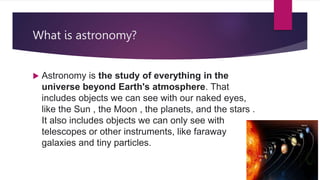
 Astronomy is the study of everything in the
universe beyond Earth's atmosphere. That
includes objects we can see with our naked eyes,
like the Sun , the Moon , the planets, and the stars .
It also includes objects we can only see with
telescopes or other instruments, like faraway
galaxies and tiny particles.
Astrology
 Astrology is the study of the influence that distant
cosmic objects, usually stars and planets, have on
human lives. The position of the sun, stars, moon
and planets have affects on human lives.
Pseudoscience
 Pseudo means “false”
 a collection of beliefs or practices mistakenly
regarded as being based on scientific method.
Difference between Astronomy and
Astrology
 Astronomy is a research based study of planets,
stars, asteroids, galaxies and the properties and
relationship of the celestial bodies. On the other
hand, Astrology is the belief that the positioning of
stars and planets affect the way events occur on
earth.
Our earth (some facts)
 Fifth largest and third from
the sun
 Only planet that can sustain
life
 8,000 miles diameter
 Atmosphere: is the envelope of gases
surrounding the earth. The earth’s atmosphere is
10,000 kilometres long above the ground level.
 Sphere: means round in shape
 “Oblate spheroid” or ellipsoid: Earth’s spin
around sun cause it to squashed at its poles and
swollen at the equator.
 Equator: imaginary line around the middle of earth
 Orbit:
Earth’s equator
 The Equator is an imaginary line around the middle of the Earth. It is
halfway between the North and South Poles, and divides the Earth into
the Northern and Southern Hemispheres.
Earth’s radius
 is the distance from the center of Earth to a
point on or near its surface.
Earth’s rotation
The earth orbits the sun once every year that is equal to 365.25 days.
https://clickv.ie/w/I4Ot
Earth’s atmosphere
https://www.brainpop.com/science/earthsystem/earthsatmosphere/
Earth’s structure
https://www.brainpop.com/science/earthsystem/earthsstructure/
Seasons on earth
The most important factor that determines the season
is the maximum intensity of sun’s rays over a given
area. As Earth revolves around the sun on its tilted axis,
season change. The positioning of subsolar point
indicates the weather. For instance, the subsolar point
moves north and south, indicating summer in the
Northern or Southern Hemisphere.
What causes change in weather on north
and south pole
This illustration shows summer in the Northern
Hemisphere. The Northern Hemisphere is tilted
toward the sun, and the subsolar point is north of
the Equator, where the sun’s rays hit the Earth at a
right angle. The angel of sunlight decreases as you
move away from the subsolar point. The angle of
sunlight reaching the South Pole, for instance, is
almost 0. there it is winter. As the Earth continues to
revolve and the Southern Hemisphere tilts toward
the sun, the Southern Hemisphere will experience
summer.
Earth’s solstice and Equinox
https://www.brainpop.com/science/earthsystem/solsticeandequinox/
What is equinox?
Spring and Autumn equinox
The word equinox is Latin and means equality of night and day. The equinox
points to the specific times usually two times when sun is located exactly
above the equator.
The Northerner and Southern Hemisphere have different dates for equinox.
Northern Southern
Spring equinox 21st March Spring equinox 22nd September
Autumn equinox 22nd September Autumn equinox 21st March
Solstice
 The solstice (combining the Latin words sol for “Sun” and sistere for “To
Stand Still”) is the point where the Sun appears to reach either its highest
or lowest point in the sky for the year and thus ancient astronomers came
to know the day as one where the Sun appeared to stand still.
 In the Northern Hemisphere, the June Solstice heralds the astronomical
beginning of summer and is the day with the most daylight in the year.
The winter solstice in December mark the least sunlight or the shortest
day of the year.
Solstice video
 https://www.nationalgeographic.com/science/article/what-is-summer-winter-
solstice-answer-might-surprise-you
The Moon (Te Marama)
Some facts about Te Marama
 Earth’s natural satellite was formed about 5000 million years ago.
 Little over a quatar the diameter
 The New Moon is when the Sun and Moon are aligned, with the Sun and Earth on
opposite sides of the Moon. The time of new moon varies by time zone.
Moon phases
It takes around 29.5 days to move through the eight Moon phases.
 In western culture, we divide the lunar month into four primary and four
intermediate Moon phases.
 The New Moon is the first primary Moon phase. The next three are the First
Quarter Moon (Half Moon), the Full Moon, and the Third Quarter Moon (Half
Moon).
 In addition, there are four intermediate Moon phases; the Waxing Crescent Moon,
the Waxing Gibbous Moon, the Waning Gibbous Moon, and the Waning Crescent
Moon.
 Full Moon is the most striking Moon phase when
the entire face of the Moon is lit up.
Why can’t see the new moon
1. The alignment of the Sun, the Moon, and Earth leaves the side of the Moon
that faces Earth in darkness. This is called a conjunction or syzygy.
2. The New Moon is up in the daytime sky. It rises and sets around the same time
as the Sun, bringing it too close to the Sun’s glare to be seen with the naked
eye.
References
 https://www.timeanddate.com/astronomy/moon/new-moon.html

Difference between Astronomy and Astrology

  • 1.
  • 2.
    Learning objectives  LO1-Discuss the difference between Astrology and Astronomy  LO2- Define Pseudoscience Success criteria: - Write differences between Astrology and Astronomy
  • 3.
    What is astronomy? Astronomy is the study of everything in the universe beyond Earth's atmosphere. That includes objects we can see with our naked eyes, like the Sun , the Moon , the planets, and the stars . It also includes objects we can only see with telescopes or other instruments, like faraway galaxies and tiny particles.
  • 4.
    Astrology  Astrology isthe study of the influence that distant cosmic objects, usually stars and planets, have on human lives. The position of the sun, stars, moon and planets have affects on human lives.
  • 5.
    Pseudoscience  Pseudo means“false”  a collection of beliefs or practices mistakenly regarded as being based on scientific method.
  • 6.
    Difference between Astronomyand Astrology  Astronomy is a research based study of planets, stars, asteroids, galaxies and the properties and relationship of the celestial bodies. On the other hand, Astrology is the belief that the positioning of stars and planets affect the way events occur on earth.
  • 8.
    Our earth (somefacts)  Fifth largest and third from the sun  Only planet that can sustain life  8,000 miles diameter
  • 9.
     Atmosphere: isthe envelope of gases surrounding the earth. The earth’s atmosphere is 10,000 kilometres long above the ground level.  Sphere: means round in shape  “Oblate spheroid” or ellipsoid: Earth’s spin around sun cause it to squashed at its poles and swollen at the equator.  Equator: imaginary line around the middle of earth  Orbit:
  • 10.
    Earth’s equator  TheEquator is an imaginary line around the middle of the Earth. It is halfway between the North and South Poles, and divides the Earth into the Northern and Southern Hemispheres.
  • 11.
    Earth’s radius  isthe distance from the center of Earth to a point on or near its surface.
  • 12.
    Earth’s rotation The earthorbits the sun once every year that is equal to 365.25 days. https://clickv.ie/w/I4Ot Earth’s atmosphere https://www.brainpop.com/science/earthsystem/earthsatmosphere/ Earth’s structure https://www.brainpop.com/science/earthsystem/earthsstructure/
  • 13.
    Seasons on earth Themost important factor that determines the season is the maximum intensity of sun’s rays over a given area. As Earth revolves around the sun on its tilted axis, season change. The positioning of subsolar point indicates the weather. For instance, the subsolar point moves north and south, indicating summer in the Northern or Southern Hemisphere.
  • 14.
    What causes changein weather on north and south pole This illustration shows summer in the Northern Hemisphere. The Northern Hemisphere is tilted toward the sun, and the subsolar point is north of the Equator, where the sun’s rays hit the Earth at a right angle. The angel of sunlight decreases as you move away from the subsolar point. The angle of sunlight reaching the South Pole, for instance, is almost 0. there it is winter. As the Earth continues to revolve and the Southern Hemisphere tilts toward the sun, the Southern Hemisphere will experience summer.
  • 15.
    Earth’s solstice andEquinox https://www.brainpop.com/science/earthsystem/solsticeandequinox/ What is equinox?
  • 16.
    Spring and Autumnequinox The word equinox is Latin and means equality of night and day. The equinox points to the specific times usually two times when sun is located exactly above the equator. The Northerner and Southern Hemisphere have different dates for equinox. Northern Southern Spring equinox 21st March Spring equinox 22nd September Autumn equinox 22nd September Autumn equinox 21st March
  • 17.
    Solstice  The solstice(combining the Latin words sol for “Sun” and sistere for “To Stand Still”) is the point where the Sun appears to reach either its highest or lowest point in the sky for the year and thus ancient astronomers came to know the day as one where the Sun appeared to stand still.  In the Northern Hemisphere, the June Solstice heralds the astronomical beginning of summer and is the day with the most daylight in the year. The winter solstice in December mark the least sunlight or the shortest day of the year.
  • 19.
  • 20.
    The Moon (TeMarama) Some facts about Te Marama  Earth’s natural satellite was formed about 5000 million years ago.  Little over a quatar the diameter
  • 21.
     The NewMoon is when the Sun and Moon are aligned, with the Sun and Earth on opposite sides of the Moon. The time of new moon varies by time zone.
  • 22.
    Moon phases It takesaround 29.5 days to move through the eight Moon phases.  In western culture, we divide the lunar month into four primary and four intermediate Moon phases.  The New Moon is the first primary Moon phase. The next three are the First Quarter Moon (Half Moon), the Full Moon, and the Third Quarter Moon (Half Moon).  In addition, there are four intermediate Moon phases; the Waxing Crescent Moon, the Waxing Gibbous Moon, the Waning Gibbous Moon, and the Waning Crescent Moon.
  • 23.
     Full Moonis the most striking Moon phase when the entire face of the Moon is lit up.
  • 26.
    Why can’t seethe new moon 1. The alignment of the Sun, the Moon, and Earth leaves the side of the Moon that faces Earth in darkness. This is called a conjunction or syzygy. 2. The New Moon is up in the daytime sky. It rises and sets around the same time as the Sun, bringing it too close to the Sun’s glare to be seen with the naked eye.
  • 27.