ASSISTIVE TECHNOLOGY
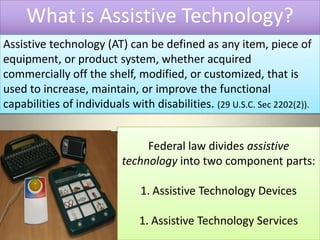
What is Assistive Technology? Assistive technology (AT) can be defined as any item, piece of equipment, or product system, whether acquired commercially off the shelf, modified, or customized, that is used to increase, maintain, or improve the functional capabilities of individuals with disabilities. (29 U.S.C. Sec 2202(2)).Federal law divides assistive technology into two component parts:Assistive Technology Devices Assistive Technology Services
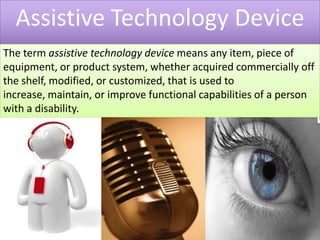
Assistive Technology DeviceThe term assistive technology device means any item, piece of equipment, or product system, whether acquired commercially off the shelf, modified, or customized, that is used to increase, maintain, or improve functional capabilities of a person with a disability.
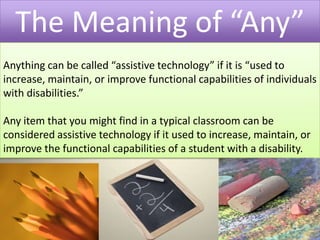
The Meaning of “Any”Anything can be called “assistive technology” if it is “used to increase, maintain, or improve functional capabilities of individuals with disabilities.” Any item that you might find in a typical classroom can be considered assistive technology if it used to increase, maintain, or improve the functional capabilities of a student with a disability.
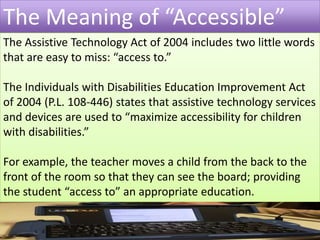
The Meaning of “Accessible”The Assistive Technology Act of 2004 includes two little words that are easy to miss: “access to.”The Individuals with Disabilities Education Improvement Act of 2004 (P.L. 108-446) states that assistive technology services and devices are used to “maximize accessibility for children with disabilities.” For example, the teacher moves a child from the back to the front of the room so that they can see the board; providing the student “access to” an appropriate education.
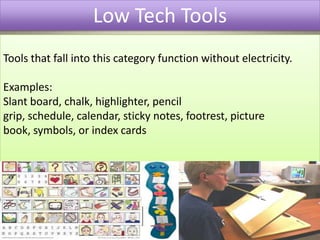
Low Tech ToolsTools that fall into this category function without electricity.Examples:Slant board, chalk, highlighter, pencil grip, schedule, calendar, sticky notes, footrest, picture book, symbols, or index cards
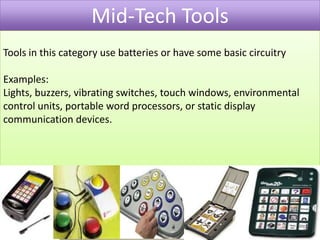
Mid-Tech ToolsTools in this category use batteries or have some basic circuitry Examples:Lights, buzzers, vibrating switches, touch windows, environmental control units, portable word processors, or static display communication devices.
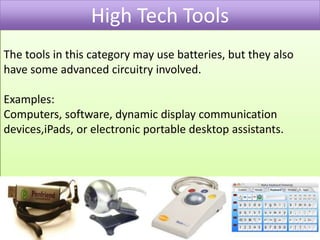
High Tech ToolsThe tools in this category may use batteries, but they also have some advanced circuitry involved. Examples:Computers, software, dynamic display communication devices,iPads, or electronic portable desktop assistants.
Assistive Technology ServicesThe term assistive technology service means any service that directly assists a person with a disability to select, acquire, or use an assistive device. Almost 30 years of research and experience has demonstrated that the education persons with disabilities can be made more effective by supporting the 1) development and 2) use of technology, devices and servicesFederal funds may be used to support the use of technology, to maximize access to general education curriculum.
Services include: Evaluation of a child’s needs, including looking at what they do on a daily basis.
Assistive technology devices (including purchase, lease, etc.)
Selecting, designing, fitting, customizing, adapting, applying, maintaining, repairing, or replacing said device.
Coordinating and using other therapies, services, or devices.
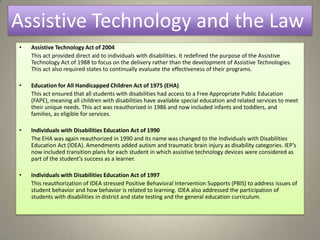
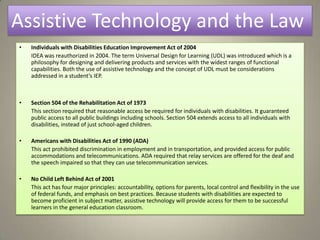
Training or technical assistance for the child, and perhaps, The family of such a child.Training or technical assistance for the child’s teachers or other service providers who are substantially involved in the “major life functions” of the child.Assistive Technology and the LawThe Technology-Related Assistance for Individuals with Disabilities Act  of 1988, “Tech Act of 1988”	This law provided funding for states to develop consumer information and training programs that were designed to meet the needs of individuals with disabilities. This law defined “assistive technology services” and “assistive technology devices.” It provided grants to states to support systems change and advocacy activities related to statewide programs of technology-related assistance for individuals with disabilities. Telecommunications Act of 1996	This act provided provisions for all classrooms and libraries to connections to the information superhighway by the year 2000. This act and its guidelines provided a foundation for ensuring that technology become accessible to all students.Carl D. Perkins Vocational and Technical Education Act of 1998, “Perkins Act”	Provided individuals with academic and technical skills for success in a knowledge and skills economy. Activities supported by this act include access to career and technical education for students with disabilities and the purchase of equipment to ensure access to the latest technology. Funds provided are allocated to both secondary and postsecondary schools. Assistive Technology Act of 1998	The Tech act of 1988 was replaced by this act whose purpose was to support programs and grants to states to help them address the technology needs of individuals with disabilities. This law offered grants to provide assistance to states in maintaining statewide technology-related assistance programs. It also provided for research that incorporated assistive technology use with the Universal Design for Learning.

Assistive Technology Basics

  • 1.
  • 2.
    What is AssistiveTechnology? Assistive technology (AT) can be defined as any item, piece of equipment, or product system, whether acquired commercially off the shelf, modified, or customized, that is used to increase, maintain, or improve the functional capabilities of individuals with disabilities. (29 U.S.C. Sec 2202(2)).Federal law divides assistive technology into two component parts:Assistive Technology Devices Assistive Technology Services
  • 3.
    Assistive Technology DeviceTheterm assistive technology device means any item, piece of equipment, or product system, whether acquired commercially off the shelf, modified, or customized, that is used to increase, maintain, or improve functional capabilities of a person with a disability.
  • 4.
    The Meaning of“Any”Anything can be called “assistive technology” if it is “used to increase, maintain, or improve functional capabilities of individuals with disabilities.” Any item that you might find in a typical classroom can be considered assistive technology if it used to increase, maintain, or improve the functional capabilities of a student with a disability.
  • 5.
    The Meaning of“Accessible”The Assistive Technology Act of 2004 includes two little words that are easy to miss: “access to.”The Individuals with Disabilities Education Improvement Act of 2004 (P.L. 108-446) states that assistive technology services and devices are used to “maximize accessibility for children with disabilities.” For example, the teacher moves a child from the back to the front of the room so that they can see the board; providing the student “access to” an appropriate education.
  • 6.
    Low Tech ToolsToolsthat fall into this category function without electricity.Examples:Slant board, chalk, highlighter, pencil grip, schedule, calendar, sticky notes, footrest, picture book, symbols, or index cards
  • 7.
    Mid-Tech ToolsTools inthis category use batteries or have some basic circuitry Examples:Lights, buzzers, vibrating switches, touch windows, environmental control units, portable word processors, or static display communication devices.
  • 8.
    High Tech ToolsThetools in this category may use batteries, but they also have some advanced circuitry involved. Examples:Computers, software, dynamic display communication devices,iPads, or electronic portable desktop assistants.
  • 9.
    Assistive Technology ServicesTheterm assistive technology service means any service that directly assists a person with a disability to select, acquire, or use an assistive device. Almost 30 years of research and experience has demonstrated that the education persons with disabilities can be made more effective by supporting the 1) development and 2) use of technology, devices and servicesFederal funds may be used to support the use of technology, to maximize access to general education curriculum.
  • 10.
    Services include: Evaluationof a child’s needs, including looking at what they do on a daily basis.
  • 11.
    Assistive technology devices(including purchase, lease, etc.)
  • 12.
    Selecting, designing, fitting,customizing, adapting, applying, maintaining, repairing, or replacing said device.
  • 13.
    Coordinating and usingother therapies, services, or devices.
  • 14.
    Training or technicalassistance for the child, and perhaps, The family of such a child.Training or technical assistance for the child’s teachers or other service providers who are substantially involved in the “major life functions” of the child.Assistive Technology and the LawThe Technology-Related Assistance for Individuals with Disabilities Act of 1988, “Tech Act of 1988” This law provided funding for states to develop consumer information and training programs that were designed to meet the needs of individuals with disabilities. This law defined “assistive technology services” and “assistive technology devices.” It provided grants to states to support systems change and advocacy activities related to statewide programs of technology-related assistance for individuals with disabilities. Telecommunications Act of 1996 This act provided provisions for all classrooms and libraries to connections to the information superhighway by the year 2000. This act and its guidelines provided a foundation for ensuring that technology become accessible to all students.Carl D. Perkins Vocational and Technical Education Act of 1998, “Perkins Act” Provided individuals with academic and technical skills for success in a knowledge and skills economy. Activities supported by this act include access to career and technical education for students with disabilities and the purchase of equipment to ensure access to the latest technology. Funds provided are allocated to both secondary and postsecondary schools. Assistive Technology Act of 1998 The Tech act of 1988 was replaced by this act whose purpose was to support programs and grants to states to help them address the technology needs of individuals with disabilities. This law offered grants to provide assistance to states in maintaining statewide technology-related assistance programs. It also provided for research that incorporated assistive technology use with the Universal Design for Learning.