DATE: 20-02-2014 NO.OF ROLLS : 69 
NO.OF.PRESENT : 69 GENERAL PROFICIENCY 
MEETINGS
Introduction 
A meeting is a gathering of two or more people that has 
been convened for the purpose of achieving a common 
goal through verbal interaction. 
Meetings are tools for accomplishing work. 
The work to be done can include decision making, 
information gathering or problem solving.
Meetings may be distinguished from other gatherings like.. 
• chance encounter 
• a party or the company of friends 
• demonstration 
• a sports game or a concert 
Meetings must be well organised 
A successful meeting begins with good preparation.
DATE: 20-02-2014 NO.OF ROLLS : 69 
NO.OF.PRESENT : 69 
GENERAL PROFICIENCY 
CATEGORIES OF MEETING
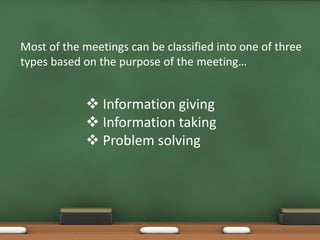
Most of the meetings can be classified into one of three 
types based on the purpose of the meeting… 
 Information giving 
 Information taking 
 Problem solving
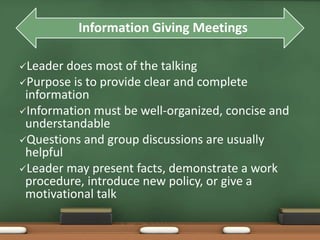
Information Giving Meetings 
Leader does most of the talking 
Purpose is to provide clear and complete 
information 
Information must be well-organized, concise and 
understandable 
Questions and group discussions are usually 
helpful 
Leader may present facts, demonstrate a work 
procedure, introduce new policy, or give a 
motivational talk
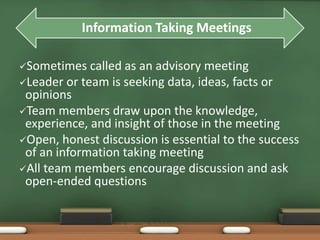
Information Taking Meetings 
Sometimes called as an advisory meeting 
Leader or team is seeking data, ideas, facts or 
opinions 
Team members draw upon the knowledge, 
experience, and insight of those in the meeting 
Open, honest discussion is essential to the success 
of an information taking meeting 
All team members encourage discussion and ask 
open-ended questions
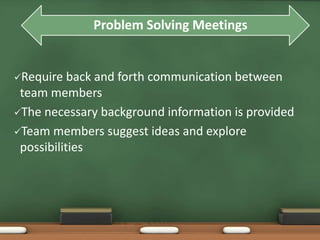
Problem Solving Meetings 
Require back and forth communication between 
team members 
The necessary background information is provided 
Team members suggest ideas and explore 
possibilities
DATE: 20-02-2014 NO.OF ROLLS : 69 
NO.OF.PRESENT : 69 
GENERAL PROFICIENCY 
TYPES OF MEETINGS
There are seven types of meetings in an 
organization… 
 Regular staff meetings 
 Project team or Group meetings 
 Cross-departmental meetings 
 Problem solving meetings 
 Information-sharing or update meetings 
 Combination meetings 
 Ad Hoc meetings
DATE: 20-02-2014 NO.OF ROLLS : 69 
NO.OF.PRESENT : 69 
GENERAL PROFICIENCY 
PROCESS OF MEETING
Selecting Participants 
The decision about who is to attend 
depends on what you want to 
accomplish in the meeting. 
Don't depend on your own 
judgment about who should come. 
If possible, call each person to tell 
them about the meeting, it's 
overall purpose and why their 
attendance is important.
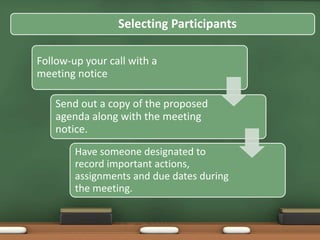
Selecting Participants 
Follow-up your call with a 
meeting notice 
Send out a copy of the proposed 
agenda along with the meeting 
notice. 
Have someone designated to 
record important actions, 
assignments and due dates during 
the meeting.
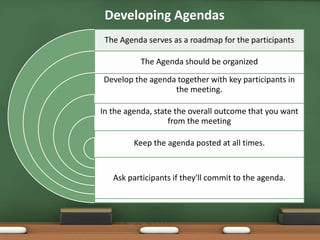
Developing Agendas 
The Agenda serves as a roadmap for the participants 
The Agenda should be organized 
Develop the agenda together with key participants in 
the meeting. 
In the agenda, state the overall outcome that you want 
from the meeting 
Keep the agenda posted at all times. 
Ask participants if they'll commit to the agenda.
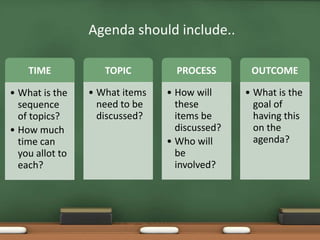
Agenda should include.. 
TIME 
• What is the 
sequence 
of topics? 
• How much 
time can 
you allot to 
each? 
TOPIC 
• What items 
need to be 
discussed? 
PROCESS 
• How will 
these 
items be 
discussed? 
• Who will 
be 
involved? 
OUTCOME 
• What is the 
goal of 
having this 
on the 
agenda?
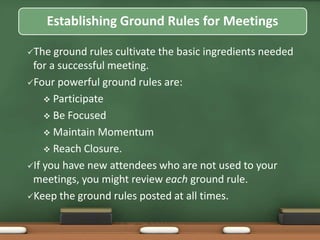
Establishing Ground Rules for Meetings 
The ground rules cultivate the basic ingredients needed 
for a successful meeting. 
Four powerful ground rules are: 
 Participate 
 Be Focused 
 Maintain Momentum 
 Reach Closure. 
If you have new attendees who are not used to your 
meetings, you might review each ground rule. 
Keep the ground rules posted at all times.
Time Management 
Time seems to run out before tasks are completed. 
You might ask attendees to help you keep track of 
the time.(appoint a Time Keeper) 
If the planned time on the agenda is getting out of 
hand, present it to the group and ask for their input 
as a solution.
Evaluation of Meeting 
Evaluating a meeting only at the end of the meeting is 
usually too late to do anything about participants' 
feedback. 
Get feedback during the meeting when you can improve 
the meeting process right away. 
Leave 5-10 minutes at the end of the meeting to 
evaluate the meeting 
Have each member rank the meeting from 1-5 
Have the chief executive rank the meeting last.
DATE: 20-02-2014 NO.OF ROLLS : 69 
NO.OF.PRESENT : 69 GENERAL PROFICIENCY 
EFFECTIVE MEETING
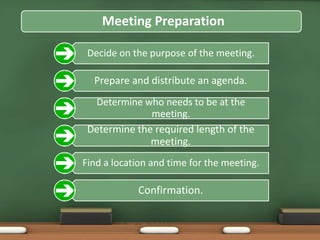
Meeting Preparation 
Decide on the purpose of the meeting. 
Prepare and distribute an agenda. 
Determine who needs to be at the 
meeting. 
Determine the required length of the 
meeting. 
Find a location and time for the meeting. 
Confirmation.
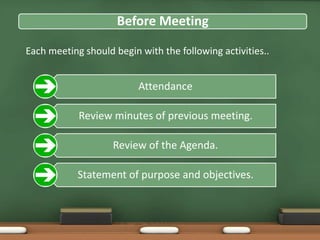
Before Meeting 
Each meeting should begin with the following activities.. 
Attendance 
Review minutes of previous meeting. 
Review of the Agenda. 
Statement of purpose and objectives.
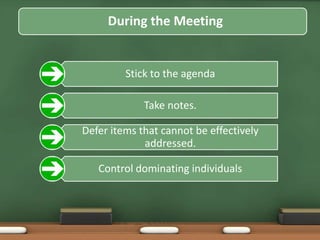
During the Meeting 
Stick to the agenda 
Take notes. 
Defer items that cannot be effectively 
addressed. 
Control dominating individuals
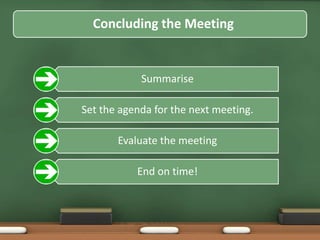
Concluding the Meeting 
Summarise 
Set the agenda for the next meeting. 
Evaluate the meeting 
End on time!
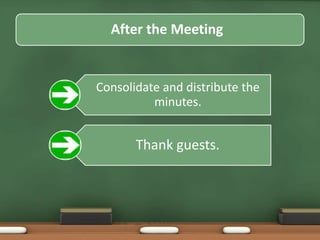
After the Meeting 
Consolidate and distribute the 
minutes. 
Thank guests.
DATE: 20-02-2014 NO.OF ROLLS : 69 
NO.OF.PRESENT : 69 
GENERAL PROFICIENCY 
ROLES & RESPONSIBILITIES
Leader or Chairperson 
Plan and prepare meetings. 
Assign actions and tasks. 
Lead team in discussions. 
The leader opens the meeting and then turns it 
over to the facilitator to lead.
Summarize the last meeting. 
Establish specific outcomes desired for the meeting. 
Appoint a time keeper and recorder. 
Review and clarify the agenda if necessary. 
Recognize attendees who wish to speak 
Remain neutral 
Maintain order 
Facilitator
Establish group agreements 
Protect against domination by a few individuals. 
Encourage participation by all members 
Track progress on the agenda. 
Summarize discussion and future action 
Bring conflicts to the surface. 
Call for breaks. 
Bring the discussion to close.
Recorder 
Capture the basic ideas of speaker, decisions and 
action items in writing 
Responsible for preparing the minutes 
List key discussion points and decisions. 
Uses the recording method best for the situation 
Can stop and clarify the points. 
Circulate the notes after the meeting
Time Keeper 
Track time according to the agenda 
Give regular updates on timing to the group
Group Member 
All other participants in a group are members. 
Group members share responsibility with the 
other roles for the success of the meeting.
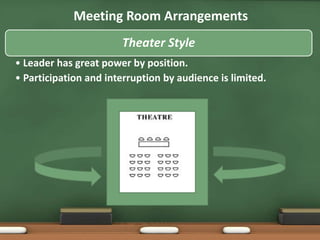
Meeting Room Arrangements 
Theater Style 
• Leader has great power by position. 
• Participation and interruption by audience is limited.
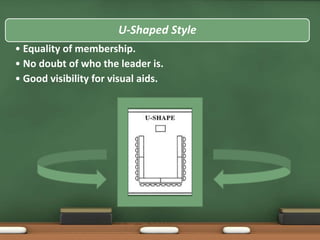
U-Shaped Style 
• Equality of membership. 
• No doubt of who the leader is. 
• Good visibility for visual aids.
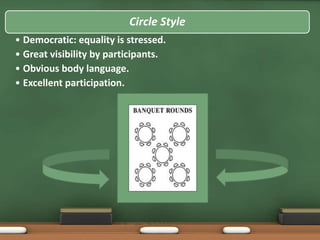
Circle Style 
• Democratic: equality is stressed. 
• Great visibility by participants. 
• Obvious body language. 
• Excellent participation.
DATE: 20-02-2014 NO.OF ROLLS : 69 
MINUTES 
NO.OF.PRESENT : 69 
GENERAL PROFICIENCY
What Are Minutes ? 
An official record of the proceedings of a meeting, 
A reminder of what happened at a meeting 
A permanent record of your team’s discussions and 
progress. 
A basis for discussion of matters arising at the next 
meeting 
Given to members before the start of the next 
meeting
Why Should a Team Take Minutes ? 
Provides a historical record that can be used in 
future meetings for verification of decisions and as 
a reminder of events and actions. 
can provide important information to absentees. 
help to keep everyone on track. 
avoids repetition of an issue which has been 
documented.
• Narrative 
• Agenda Based 
• Summarize 
Types of Minutes
What Are Different Ways to Take 
Minutes? 
Take written minutes and transcribe them after 
the meeting. 
Record key points on a flipchart, chalkboard, or 
whiteboard 
Tape-record the meeting and type up key points 
Type the minutes directly onto a computer during 
the meeting
What should be included in the Minutes ? 
name of the group, place, time, and date of the 
meeting 
names of committee members present 
names of committee members excused or absent 
key items discussed in the order listed on the agenda 
the time the meeting was adjourned 
the date, time, and place of the next meeting 
the recorder’s name and signature
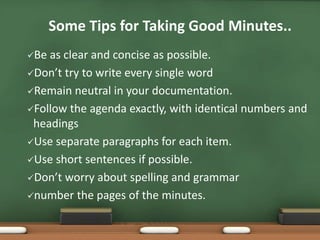
Some Tips for Taking Good Minutes.. 
Be as clear and concise as possible. 
Don’t try to write every single word 
Remain neutral in your documentation. 
Follow the agenda exactly, with identical numbers and 
headings 
Use separate paragraphs for each item. 
Use short sentences if possible. 
Don’t worry about spelling and grammar 
number the pages of the minutes.
DATE: 20-02-2014 NO.OF ROLLS : 69 
NO.OF.PRESENT : 69 
GENERAL PROFICIENCY 
TIPS FOR EFFECTIVE MEETING
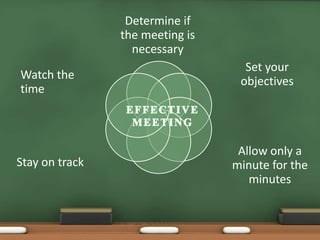
Determine if 
the meeting is 
necessary 
Set your 
objectives 
Allow only a 
minute for the 
minutes 
Watch the 
time 
Stay on track
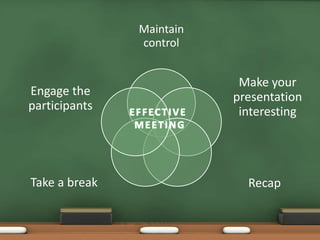
Maintain 
control 
Make your 
presentation 
interesting 
Engage the 
participants 
Take a break Recap
DATE: 20-02-2014 NO.OF ROLLS : 69 
FACTS 
NO.OF.PRESENT : 69 
GENERAL PROFICIENCY
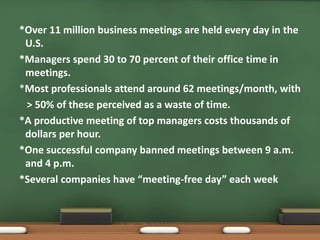
*Over 11 million business meetings are held every day in the 
U.S. 
*Managers spend 30 to 70 percent of their office time in 
meetings. 
*Most professionals attend around 62 meetings/month, with 
> 50% of these perceived as a waste of time. 
*A productive meeting of top managers costs thousands of 
dollars per hour. 
*One successful company banned meetings between 9 a.m. 
and 4 p.m. 
*Several companies have “meeting-free day” each week
THANK y u…

Meetings

  • 1.
    DATE: 20-02-2014 NO.OFROLLS : 69 NO.OF.PRESENT : 69 GENERAL PROFICIENCY MEETINGS
  • 2.
    Introduction A meetingis a gathering of two or more people that has been convened for the purpose of achieving a common goal through verbal interaction. Meetings are tools for accomplishing work. The work to be done can include decision making, information gathering or problem solving.
  • 3.
    Meetings may bedistinguished from other gatherings like.. • chance encounter • a party or the company of friends • demonstration • a sports game or a concert Meetings must be well organised A successful meeting begins with good preparation.
  • 4.
    DATE: 20-02-2014 NO.OFROLLS : 69 NO.OF.PRESENT : 69 GENERAL PROFICIENCY CATEGORIES OF MEETING
  • 5.
    Most of themeetings can be classified into one of three types based on the purpose of the meeting…  Information giving  Information taking  Problem solving
  • 6.
    Information Giving Meetings Leader does most of the talking Purpose is to provide clear and complete information Information must be well-organized, concise and understandable Questions and group discussions are usually helpful Leader may present facts, demonstrate a work procedure, introduce new policy, or give a motivational talk
  • 7.
    Information Taking Meetings Sometimes called as an advisory meeting Leader or team is seeking data, ideas, facts or opinions Team members draw upon the knowledge, experience, and insight of those in the meeting Open, honest discussion is essential to the success of an information taking meeting All team members encourage discussion and ask open-ended questions
  • 8.
    Problem Solving Meetings Require back and forth communication between team members The necessary background information is provided Team members suggest ideas and explore possibilities
  • 9.
    DATE: 20-02-2014 NO.OFROLLS : 69 NO.OF.PRESENT : 69 GENERAL PROFICIENCY TYPES OF MEETINGS
  • 10.
    There are seventypes of meetings in an organization…  Regular staff meetings  Project team or Group meetings  Cross-departmental meetings  Problem solving meetings  Information-sharing or update meetings  Combination meetings  Ad Hoc meetings
  • 11.
    DATE: 20-02-2014 NO.OFROLLS : 69 NO.OF.PRESENT : 69 GENERAL PROFICIENCY PROCESS OF MEETING
  • 12.
    Selecting Participants Thedecision about who is to attend depends on what you want to accomplish in the meeting. Don't depend on your own judgment about who should come. If possible, call each person to tell them about the meeting, it's overall purpose and why their attendance is important.
  • 13.
    Selecting Participants Follow-upyour call with a meeting notice Send out a copy of the proposed agenda along with the meeting notice. Have someone designated to record important actions, assignments and due dates during the meeting.
  • 14.
    Developing Agendas TheAgenda serves as a roadmap for the participants The Agenda should be organized Develop the agenda together with key participants in the meeting. In the agenda, state the overall outcome that you want from the meeting Keep the agenda posted at all times. Ask participants if they'll commit to the agenda.
  • 15.
    Agenda should include.. TIME • What is the sequence of topics? • How much time can you allot to each? TOPIC • What items need to be discussed? PROCESS • How will these items be discussed? • Who will be involved? OUTCOME • What is the goal of having this on the agenda?
  • 16.
    Establishing Ground Rulesfor Meetings The ground rules cultivate the basic ingredients needed for a successful meeting. Four powerful ground rules are:  Participate  Be Focused  Maintain Momentum  Reach Closure. If you have new attendees who are not used to your meetings, you might review each ground rule. Keep the ground rules posted at all times.
  • 17.
    Time Management Timeseems to run out before tasks are completed. You might ask attendees to help you keep track of the time.(appoint a Time Keeper) If the planned time on the agenda is getting out of hand, present it to the group and ask for their input as a solution.
  • 18.
    Evaluation of Meeting Evaluating a meeting only at the end of the meeting is usually too late to do anything about participants' feedback. Get feedback during the meeting when you can improve the meeting process right away. Leave 5-10 minutes at the end of the meeting to evaluate the meeting Have each member rank the meeting from 1-5 Have the chief executive rank the meeting last.
  • 19.
    DATE: 20-02-2014 NO.OFROLLS : 69 NO.OF.PRESENT : 69 GENERAL PROFICIENCY EFFECTIVE MEETING
  • 20.
    Meeting Preparation Decideon the purpose of the meeting. Prepare and distribute an agenda. Determine who needs to be at the meeting. Determine the required length of the meeting. Find a location and time for the meeting. Confirmation.
  • 21.
    Before Meeting Eachmeeting should begin with the following activities.. Attendance Review minutes of previous meeting. Review of the Agenda. Statement of purpose and objectives.
  • 22.
    During the Meeting Stick to the agenda Take notes. Defer items that cannot be effectively addressed. Control dominating individuals
  • 23.
    Concluding the Meeting Summarise Set the agenda for the next meeting. Evaluate the meeting End on time!
  • 24.
    After the Meeting Consolidate and distribute the minutes. Thank guests.
  • 25.
    DATE: 20-02-2014 NO.OFROLLS : 69 NO.OF.PRESENT : 69 GENERAL PROFICIENCY ROLES & RESPONSIBILITIES
  • 26.
    Leader or Chairperson Plan and prepare meetings. Assign actions and tasks. Lead team in discussions. The leader opens the meeting and then turns it over to the facilitator to lead.
  • 27.
    Summarize the lastmeeting. Establish specific outcomes desired for the meeting. Appoint a time keeper and recorder. Review and clarify the agenda if necessary. Recognize attendees who wish to speak Remain neutral Maintain order Facilitator
  • 28.
    Establish group agreements Protect against domination by a few individuals. Encourage participation by all members Track progress on the agenda. Summarize discussion and future action Bring conflicts to the surface. Call for breaks. Bring the discussion to close.
  • 29.
    Recorder Capture thebasic ideas of speaker, decisions and action items in writing Responsible for preparing the minutes List key discussion points and decisions. Uses the recording method best for the situation Can stop and clarify the points. Circulate the notes after the meeting
  • 30.
    Time Keeper Tracktime according to the agenda Give regular updates on timing to the group
  • 31.
    Group Member Allother participants in a group are members. Group members share responsibility with the other roles for the success of the meeting.
  • 32.
    Meeting Room Arrangements Theater Style • Leader has great power by position. • Participation and interruption by audience is limited.
  • 33.
    U-Shaped Style •Equality of membership. • No doubt of who the leader is. • Good visibility for visual aids.
  • 34.
    Circle Style •Democratic: equality is stressed. • Great visibility by participants. • Obvious body language. • Excellent participation.
  • 35.
    DATE: 20-02-2014 NO.OFROLLS : 69 MINUTES NO.OF.PRESENT : 69 GENERAL PROFICIENCY
  • 36.
    What Are Minutes? An official record of the proceedings of a meeting, A reminder of what happened at a meeting A permanent record of your team’s discussions and progress. A basis for discussion of matters arising at the next meeting Given to members before the start of the next meeting
  • 37.
    Why Should aTeam Take Minutes ? Provides a historical record that can be used in future meetings for verification of decisions and as a reminder of events and actions. can provide important information to absentees. help to keep everyone on track. avoids repetition of an issue which has been documented.
  • 38.
    • Narrative •Agenda Based • Summarize Types of Minutes
  • 39.
    What Are DifferentWays to Take Minutes? Take written minutes and transcribe them after the meeting. Record key points on a flipchart, chalkboard, or whiteboard Tape-record the meeting and type up key points Type the minutes directly onto a computer during the meeting
  • 40.
    What should beincluded in the Minutes ? name of the group, place, time, and date of the meeting names of committee members present names of committee members excused or absent key items discussed in the order listed on the agenda the time the meeting was adjourned the date, time, and place of the next meeting the recorder’s name and signature
  • 41.
    Some Tips forTaking Good Minutes.. Be as clear and concise as possible. Don’t try to write every single word Remain neutral in your documentation. Follow the agenda exactly, with identical numbers and headings Use separate paragraphs for each item. Use short sentences if possible. Don’t worry about spelling and grammar number the pages of the minutes.
  • 42.
    DATE: 20-02-2014 NO.OFROLLS : 69 NO.OF.PRESENT : 69 GENERAL PROFICIENCY TIPS FOR EFFECTIVE MEETING
  • 43.
    Determine if themeeting is necessary Set your objectives Allow only a minute for the minutes Watch the time Stay on track
  • 44.
    Maintain control Makeyour presentation interesting Engage the participants Take a break Recap
  • 45.
    DATE: 20-02-2014 NO.OFROLLS : 69 FACTS NO.OF.PRESENT : 69 GENERAL PROFICIENCY
  • 46.
    *Over 11 millionbusiness meetings are held every day in the U.S. *Managers spend 30 to 70 percent of their office time in meetings. *Most professionals attend around 62 meetings/month, with > 50% of these perceived as a waste of time. *A productive meeting of top managers costs thousands of dollars per hour. *One successful company banned meetings between 9 a.m. and 4 p.m. *Several companies have “meeting-free day” each week
  • 47.